Monthly Archives: January 2009

Must see show this Sunday in Vancouver

It’s Friday and time to prepare for the weekend. In that spirit the perfect opportunity has arisen to both notify Vancouverites of a great cultural opportunity and give a shout out to my friend Misha Glouberman who is bringing his famous Trampoline Hall event to Vancouver! What is Trampoline Hall you ask? Look no further then the links above, the text below or the event’s facebook page:

Trampoline Hall is a barroom lecture series usually based in Toronto, but sometimes in other places. On Feb 1, it will be in Vancouver for the first time, as part of the Push Festival.

Trampoline Hall is this: Three people talk, on subjects outside their professional field of expertise. The lectures are sometimes ridiculous, sometimes moving, and always wildly unpredictable. Each talk is followed by a Q&A with the audience which is usually also a lot of fun.

Trampoline Hall was invented by the writer Sheila Heti, and is hosted by Misha Glouberman. In Toronto, it is something of an institution, playing every month for the past seven years or so. It’s also played to great crowds in around a dozen US cities, including Atlanta, Boston, New York, Louisville, Chicago, and San Francisco. Feb 1 will be Trampoline Hall’s first time in Vancouver.

All lecturers for the Vancouver show selected are selected by Veda Hille. Here is the lineup she has chosen:

1) Andrew Feldmar will talk about Cooking from Memory.
2) Kevin Chong will discuss Fraternal Polyandry
3) Faith Moosang will assert “There are Clues Everywhere!!” in a talk about Nancy Drew.

~~~~

“”Unruly… Caustically Funny” – Durham Independent

“They’ve been doing this for several years up in Toronto… now New Yorkers are in its thrall. Clearly, we love it.” – The Village Voice

“Cloud-splitting Genius” – Lola Magazine

“Eccentricity and do-it-yourself inventiveness” – The New Yorker

I’m hoping my plane lands in time so that I can make it!

To the victor go the spoils…

A while back some of you may remember that I wrote a blog post called “The Coalition that Never Was” in which I predicted:

a) the coalition would not bring down the government over the next budget

b) Layton, Dion and Harper will likely be gone within 12 months.

There were a few commentators who disagreed and one of them – Scott Ross –  wanted to place a wager over the issue (a). Namely, he believed that by today – the 29th – the coalition would bring down the government and would take office. I took him up on his offer and during subsequent negotiations (over email) the following terms were agreed to and posted in the post’s comments. Specifically:

Ok, after some offline emailing Scott and I have settled on a bet.

Scott is betting that a coalition will bring down the government on the 27th. I’m betting that it won’t.

The bet will be settled on the 28th – because either there will or will not be a new government.

The loser of this (very friendly) bet agrees to put a button linking to the winner’s blog on a prominent part of their website (likely at the top of the blog).

Today, I’m calling to collect… I hope my button can be posted shortly. I believe we agreed on a two week period for the button’s posting. I also think Scott’s been a phenomenal sport – and so am more than happy to drive traffic his way as well.

As for prediction (b) the odds feel longer but I’m still a believer – I think the first budget/coalition debacle fatally weakened pretty much all of the leaders, I wouldn’t be surprised to see Layton and Harper go down this year. I’m willing to take a friendly wager on this one too…

Lessons from the Globe and Mail's Policy Wiki

I’ve been observing the Globe Policy Wiki with enormous interest. I’m broadly supportive of all of Mathew Ingram’s experiments and efforts to modernize the Globe. That said, my sense is that this project project faces a number of significant challenges. Some from the technology, others around how it is managed. Understanding and cataloging the ups and downs of such this effort is essential. At some point (I suspect in the not too distant future) wikis will make their way into the government’s policy development process – the more we understand the conditions under which they flourish, the more likely such experiments will be undertaken successfully.

Here are some lessons I’ve taken away:

1. The problem of purpose: accuracy vs. effectiveness

Wiki’s are clearly effective at spreading concrete, specific knowledge. Software manuals, best practice lists and Wikipedia works because – more often than not – they seek to share a concrete, objective truth. Indeed “the goal” of Wikipedia is to strive for verifiable accuracy. Consequently, a Wikipedia article on Mohandas Karamchand Gandhi can identify that he was born on October 2nd, 1869. We can argue whether or not this is true, but he was born on a specific day, and people will eventually align around the most accurate answer. Same with a software wiki – a software bug is caused by a specific, verifiable, set of circumstances.  Indeed, because the article is an assemblage of facts its contributors have an easier time pruning or adding to the article.

Indeed, it is where there is debate and subjective interpretation that things become more complicated in Wikipedia. Did George Bush authorize torture? I’ll bet Wikipedia has hosted a heady debate on the subject that, as yet, remains unresolved.

A policy wiki however, lives in this complicated space. This is because the goal of a policy wiki is not accuracy. Policies are are not an assemblage of facts whose accuracy can be debated. A policy is a proposal – an argument – informed by a combination of assumptions, evidence and values. How does one edit an argument? If we share different values, what do I edit? If I have contradictory evidence, what do I change? Can or should one edit a proposal they simply don’t agree with? In Wikipedia or in online software manual the response would be: “Does it make the piece more accurate?” If the answer is yes, the you should.

But with is the parallel guiding criteria for a policy wiki? “Does it make the policy more effective?” Such a question is significantly more open to interpretation. Who defines effective?

It may be that for a policy wiki will only work within communities that share a common goal, or that at least have a common metric for assessing effectiveness. More likely, Wikis in areas such as public policy may require an owner who ultimately acts as an arbiter deciding which edits stand and which edits will get deleted.

2. Combining voting with editing is problematic.

The goal of having people edit and improve a policy proposal runs counter to those of having them vote on a proposal. A wiki is, by definition, dynamic. Voting – or any preference system – implies that what is being voted on is static and unchanging; a final product that different people can assess.  How can a user vote in favour of something if, the next day, if it can be changed into something I may disagree with it? By allowing simultaneously for voting and editing I suspect the wiki discourages both. Voters are unsure if what they are voting for will stay the same, editors were likely wary of changing anything too radically because the voting option suggests proposals shouldn’t change too much – undermining the benefits of the wiki platform.

3. While problematic for editing, the Policy Wiki could be a great way to catalog briefs

One thing that is interesting about the wiki is that anyone can post their ideas. If the primary purpose were to create a catalogue of ideas the policy wiki could be a great success. Indeed, given that people are discouraged from radically altering policy notes this is effectively what the Policy Wiki is (is it still a wiki?). Presently the main obstacle to this success is the layout. The policy briefs currently appear in a linear order based on when they were submitted. This means a reader must scroll through them one by one. There is no categorization or filtering mechanism to help readers find policies they specifically care about. A search feature would enable readers to find briefs with key words. Also, enabling users to “tag” briefs would allow readers to filter the briefs in more useful ways. One could, for example, ask to see briefs tagged “environment,” or “defense” taking you to the content you want to see faster.

Such filtering approaches might distribute readers more accurately based on their interests. In a recent blog post Ingram notes that the Flat Tax briefing note received the most page views. But this should hardly come as a surprise (and probably should not be interpreted as latent interest in a flat tax). The flat tax brief was the first brief on the list. Consequently, casual observers showing up on the site to see what it was all about were probably just clicking on the first brief to get a taste.
Which University will be smart enough to make Masoda Younasy an offer?

Yesterday, Michael Adams pointed me to this great story in the Globe and Mail about the Masoda Younasy – the granddaughter of Afghanistan’s former king, Mohammad Zahir Shah – who, because she created and ran her own construction business, advocated for reform and mused about entering politics has had death threats hurled against her.

In an extraordinary move, Canada has offered her a permit to live here while her life is at risk. A fantastic start.

So what does she want to do? According to the article:

…her aim is to attend a Canadian university and obtain a political-science degree she might some day put to use in her home country.

What an amazing opportunity. Not only for Ms. Younasy, but for Canadians and, more specifically, the university smart enough and agile enough to offer her a speedy enrollment. My own preference is that Queen’s, which is home to the Centre for the Study of Democracy, might make her an offer. Here is a women keen on bringing democracy and opportunity to a country that has seen little of either – her goals couldn’t be more aligned with those of the institution and her perspective and experience would greatly enrich the discussions in all her classes.

These are the types of opportunities that are easily missed, often because the long term opportunities and benefits – to the student, the university and the country – get trumped by bureaucracy and lack of vision. Well, for those who wonder if it is worthwhile, take note that unwittingly done something similar before and everyone was better off because of it.

ChangeCamp: Pulling people and creativity out of the public policy long tail

ChangeCamp is a free participatory web-enabled face-to-face event that brings together citizens, technologists, designers, academics, policy wonks, political players, change-makers and government employees to answer one question: How do we re-imagine government and governance in the age of participation?

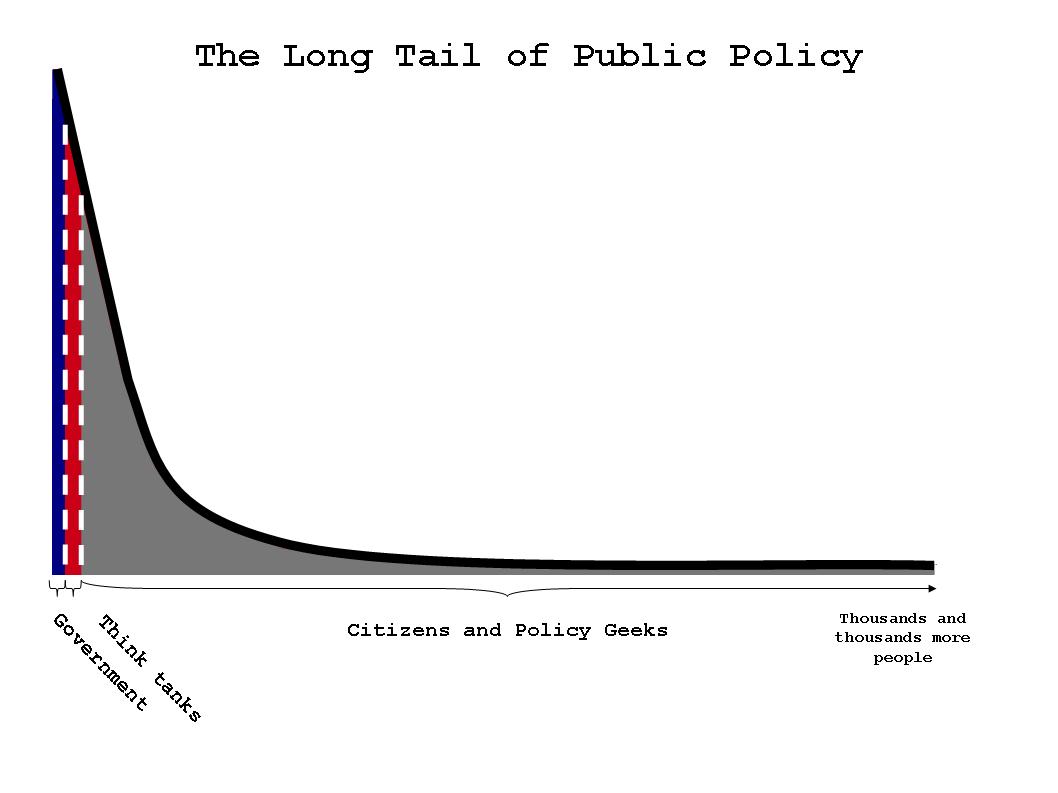
What is ChangeCamp? It is the application of “the long tail” to public policy.

It is a long held and false assumption that ordinary citizens don’t care about public policy. The statement isn’t, in of itself, false. Many, many, many people truly don’t care that much. They want to live their lives focusing on other things – pursuing other hobbies or interests – but there are many of us who do care. Public policy geeks, fans, followers, advocates, etc… we are everywhere, we’ve just been hidden in a long tail that saw the market place and capacity for developing and delivering public policy restricted to a few large institutions. The single most important lesson I learnt from my time with Canada25 is that it doesn’t have to be that way.

Did Canada25 get a new generation of Canadians, aged 20-35 engaged in public policy? I don’t know.

What I do know is, that at the very minimum, we harnessed and enormous, dispersed desire of many Canadians to participate in, and help shape, the public policy debates affecting the country. Most importantly, we did this by doing three things:

  1. we aggregated together the people who cared about public policy, we gave them peers, friends and a sense of community.
  2. we provided a vehicle through which to channel their energy
  3. by combining 1 and 2, and by using simple technology and a low cost approach – we dramatically lowered the barriers (and csots) to entry for credible participating in these national debates

Today, the technology to enable and aggregate people their ideas, to connect them with peers and to create community, is still more powerful. Our capacity to challenge, push, help, cooperate, leverage and compete with the large institutional public policy actors has never been greater. This, for me, is the goal of ChangeCamp. What concrete tools can we build, what information can we demand be opened up, what new relationships can we build to re-imagine how we – the citizens who care – participate in the creation of public policy and the effective delivery of public services. Not to compete or replace the traditional institutional actors, but to ensure more and better ideas are heard and increasingly effective and efficient services are created.

Long tail of public policy

Individually, none of us may have the collective power of a government ministry or even the resources of most think tanks. But collectively, linked together by technology and powered by our energy and spare capital, the long tail of policy geeks and ordinary citizens is bigger, nimbler, more creative and faster than anything else. Do I know that the long tail of policy can be set free? No. But ChangeCamp seems like a fun place to start experimenting, brainstorming and sharing ways we can make this country better.

Vision Fundraiser February 4th

There is a nice gala Vision Vancouver fundraiser coming up on February 4th for those who are interested. Here’s an opportunity to mix it up with the new Mayor and Vision Council members.

As the advertisement states:

Enjoy an evening of specialty tapas highlighting the multitude of Vancouver’s diverse neighborhoods, while mingling with Vancouver’s elected officials, business leaders, union brothers and sisters, social and environmental change agents, and others who are working to make a difference in their communities.

Tickets are $150.00 each with sponsorship opportunities available – for more information call Vision’s Fundraiser Kristi Rivait at 604-568-6913 or email her at kristi@votevision.ca

Why Smart Power matters

America cannot solve the most pressing problems on our own, and the world cannot solve them without America. The best way to advance America’s interest in reducing global threats and seizing global opportunities is to design and implement global solutions. This isn’t a philosophical point. This is our reality.

The president-elect and I believe that foreign policy must be based on a marriage of principles and pragmatism, not rigid ideology. On facts and evidence, not emotion or prejudice. Our security, our vitality, and our ability to lead in today’s world oblige us to recognize the overwhelming fact of our interdependence.

I believe that American leadership has been wanting, but is still wanted. We must use what has been called “smart power,” the full range of tools at our disposal — diplomatic, economic, military, political, legal, and cultural — picking the right tool, or combination of tools, for each situation. With smart power, diplomacy will be the vanguard of foreign policy. This is not a radical idea. The ancient Roman poet Terence, who was born a slave and rose to become one of the great voices of his time, declared that “in every endeavor, the seemly course for wise men is to try persuasion first.” The same truth binds wise women as well.

– Hillary Clinton, January 13th, 2009

During her confirmation hearing before the Senate Foreign Relations Committee Hillary Clinton used the term “Smart Power” no less than 12 times. It is a clever term, one that seeks to navigate between the Hard Power of military might and economic coercion, with the Soft Power of ideology, culture and agenda setting. Does the term signal something new in US foreign policy? Depends on your time frame. Without a doubt it marks the end of the George W. Bush foreign policy era. Clearly the blustery swagger of a shoot first, ask question later has ended. This is a United States that will be more cautious and more engaging. But rather than the start of something new, Smart Power likely signals a return to the Bill Clinton and Bush Sr. era of foreign policy. Indeed, as important as the term Smart Power was, the focus should lie not on the term, but on the revealing paragraph leading up to it:

“The president-elect and I believe that foreign policy must be based on a marriage of principles and pragmatism, not rigid ideology. On facts and evidence, not emotion or prejudice. Our security, our vitality, and our ability to lead in today’s world oblige us to recognize the overwhelming fact of our interdependence.”

Here the guiding principles behind the shift to Smart Power are revealed. Two strike me as paramount. The first reaffirms what I think will be the buzz word of the Obama administration: pragmatism. Despite his soaring speeches and inspiring words Obama is first and foremost interested in achieving the possible – stretch goals are fine – but ideological dreams are not for him. Second, in this speech, the United States’ next Secretary of State signalled to the world that it once again recognizes it cannot go it alone. The acknowledgement of interdependence is the antithesis of “you are with us or against us.” It is an recognition that allies – real allies, not the minnow states bullied into participation – are required to sustain and enhance the stability and prosperity of the international system. Bush Sr. understood this when creating his coalition for the first Gulf War, Clinton sought, insofar as possible, to build similar agreement when advancing his international agenda.

These have two dramatic impacts for Canada – and other countries. The first is that we should expect the Americans will ask us what we think – our advice or thoughts may not change their opinions, but we will likely be asked and when that happens, we’d better have something smart and meaningful to contribute. Second, the opportunity of being consulted comes with it the responsibility to contribute and support, even when the decision or strategy isn’t one that we completely agree with. When you’ve been part of the discussion you can walk away when the rubber hits the road. Third, those who have a well thought out plan for solving a problem will win out over those who have grievances to share. Demonstrate to this administration that you can solve a problem through realizable actions and I suspect they will listen and support you.

For Canadians nowhere is this change in attitude possible more important than on the management of the Canadian Border. I would have a new briefing plan of how we believe the border should be managed ready and waiting for when Clinton or Obama’s first arrives in Ottawa. If the Obama administration acts as it talks, I suspect it will reward and seek out, not those who do as it says, but those who solve the problems they care about. This is a welcome return to the diplomacy of the 1990’s which was also cautious and smart. It was also a good period for Canadian-American relations.

Canadians have spent years hoping the Americans will change. Now that they have, are we ready?

How not to do generational analysis

I read – and laughed – at Maclean’s latest in a series of Gen Y bashing pieces. This time it was Lianne George, with the bat, in the employment office, in her piece “Dude Where’s My Job?”

The piece said a lot more about Lianne George than it did about Gen Yers (or the Net Gen or, if you prefer, anyone under 30) tinged, as it was, with the bitter happiness of someone celebrating another’s (perceived) comeuppance. If only the analysis had been as edgy, or as fun, the piece’s tone.

The saddest element of the article was its reduction of Gen Yers to a coddled, materialistic and self-aggrandizing cohort who are finally about to taste a dose of reality. This despite the fact that – according to George – 44% of Yers still live at home (many, would likely prefer to live independently) and have large student debts (an average of $5,631 per year in according to her). Hardly the stats of an entitled generation.

She laughs that:  “This is a generation, after all, in which seven out of 10 rank themselves “above average” in academic ability.” The intent is to show Gen Yers are delusional self-aggrandizers. However, Gen Yers ARE above average in academic ability when compared to the population as a whole. The number of people attending university and college has been steadily (and aggressively) increasing. Even compared to 18 years ago, a growing % of the labour force has post-secondary education. This is to say nothing of the huge increase in the number of graduate students. For many Gen Yers maybe one parent, and almost none of their grandparents went to college or university. As such Gen Yers are more academically inclined compared to the labour force. Does this give them confidence? Maybe. But I wouldn’t confuse it with a belief they are inherently smarter or better than everyone else.

It is also problematic to talk about generations. I could easily sit here and psychoanalyze how Lianne George is almost certainly a Gen Xer who graduated at a time when there were no jobs and had to claw herself into a career she enjoyed. As such her article is just an expression of the frustration she (and by extension of course, all Gen Xers) feel towards Gen Y who (after making millions in silicon valley) they hope are finally getting their due and will have to behave more like her generation:  forced by a declining economy to abandon their dreams and hopes and become the prototypical slackers of Reality Bites, mocking life as they resign themselves to dead end job after dead end job. What a wonderful thing to wish on a generation.

The problem is – I don’t think most Gen Xers think that way. Moreover, this type of generational thinking blinds us to bigger and more important problems. Gen Xers were never all slackers and Gen Y is not a single cohort. I forsee something much more problematic and unstable emerging than a bunch of Gen Yers feeling let down by the universe. Recently I read that there has been no decline in the number of job recruiters at UBC this year. I fear that we are seeing the wedging of our economy – a separation between an growing wealthy and opportunity rich creative class, a struggling white collar class and a destitute blue collar class. While already true, I fear the main determinant of who’s asking “Dude, where’s my job” won’t be age, but class. Worse, those who end up asking the question risk becoming part of a structural unemployment problem: insufficiently skilled to enter the workforce, and lacking the capital to change their circumstances. This is the analysis we need from Maclean’s, not cheap snipping at a whole generation.

But then, maybe the cheap shots sell more magazines.

7 things about me. Soon to be 7 things about you.

Both Beltzner and Surman have tagged me with the 7 things meme and, to quote Beltzner:

“by The Laws of The Internet, I must participate in the latest meme to sweep Planet Mozilla. “

The Rules for This Particular Meme

  • Link to your original tagger(s) and list these rules in your post. (see above)
  • Share seven facts about yourself in the post. (see below)
  • Tag seven people at the end of your post by leaving their names and the links to their blogs. (see below)
  • Let them know they’ve been tagged.

My Seven:

1. I once spent the night in Rome sleeping outdoors at the Circus Maximus.


2. I have never broken a bone…


3. …or thrown a punch (although not necessarily related there is, I believe, some correlation).


4. I’ve only drunk 3 cups of coffee in my entire life (and yes, I grew up in Vancouver…).

5. I live atop of a supermarket and Home Depot (which sounds scary but is actually quite convenient).


6. A long, long, long time ago, I sung on a childrens record.

7. And once, while walking at at 5400M (17,500 ft), I was passed by a guy smoking a cigarette… (not a proud moment, but in my defense he was a local)

Seven people who are now “it”

  1. Taylor Owen, whose blog has still less levity than mine
  2. Mark Kuznicki, who loves all things webby
  3. Stephen Johnson, who is wicked smart and is on a book tour so may find this fun for his audiences…
  4. Michael Anton Dila, who has so much free time :)
  5. Alexandra Samuel or Rob Cottingham, I’m sure one will read this, the other will blog it.
  6. Sameer Vasta, for being an all round cool guy.
  7. Marc Laporte, because TikiWiki should feel the love too.

My work here is done.

Old modes of production die with the depression…

A few weeks ago I blogged about how I thought land line phones and cable TV would be among the first items to go as people cut budgets. In contrast Cell phones and internet would be among the last (can you imagine trying to find a job without an internet connection?)

Well I forgot to mention that newspapers would be the other obvious target… why spend to get a newspaper when you can get the content online for less or for free?

So I was probably rash in saying that traditional telephone companies (are there any left?) and cable companies would be among the first to feel the pinch. It is going to be newspaper companies. The end is going to come fast and furious. It won’t be pretty.

For my American friends there is already talk about how much trouble the New York Times is in. Indeed, as one industry observer points out, the NYT may not survive past MAY – although by drawing down on its credit and selling assets (like the Boston Red Sox’s) it can survive until 2010.

Here in Canada the situation is bleaker. CanWest, which owns the National Post as well as newspapers in most of the country’s major markets (such as the Vancouver Sun, here in my home town), has reported Q1 losses and its stock continues to free fall. Having lost 92% of its value in the last year it may no longer be able to meet its debt servicing requirements. It turns out that buying more newspapers is not the solution for newspaper companies. A bigger broken business model doesn’t, at some point, transform into a working business model.

The old modes of production are in trouble. Today it’s print, but TV/video better not assume the same pressures won’t be confronting them in the near future.