Monthly Archives: June 2009

Using a media bias tool to calculate our political "drift"

Nicolas T. sent me a cool link to Fairspin, a website where readers rate the bias of news articles.

This is the type of site that works better the more people who use it – the larger the readership the more likely the bias measurement will reflect that of the population’s.  Indeed this is the sites biggest challenge – it could be taken over by readers of a certain political stripe who over rate the news bias  against them, discrediting the sites ranking system.

Looking over the site I got an additional thought. The Vancouver Sun and/or the Globe and Mail sometimes have an editorial from 50 or 100 years ago. This got me thinking that it might be interesting for a site like this is to take random stories that were rated on the site and put them back to users in 2, 5 and 10 years. The reason to do this is to see if readers in 10 years rate the bias differently then they do today. This might give us an additional read to see how what is perceived as “right” and “left” evolve over time.

How Open Data even makes Garbage collection sexier, easier and cheaper

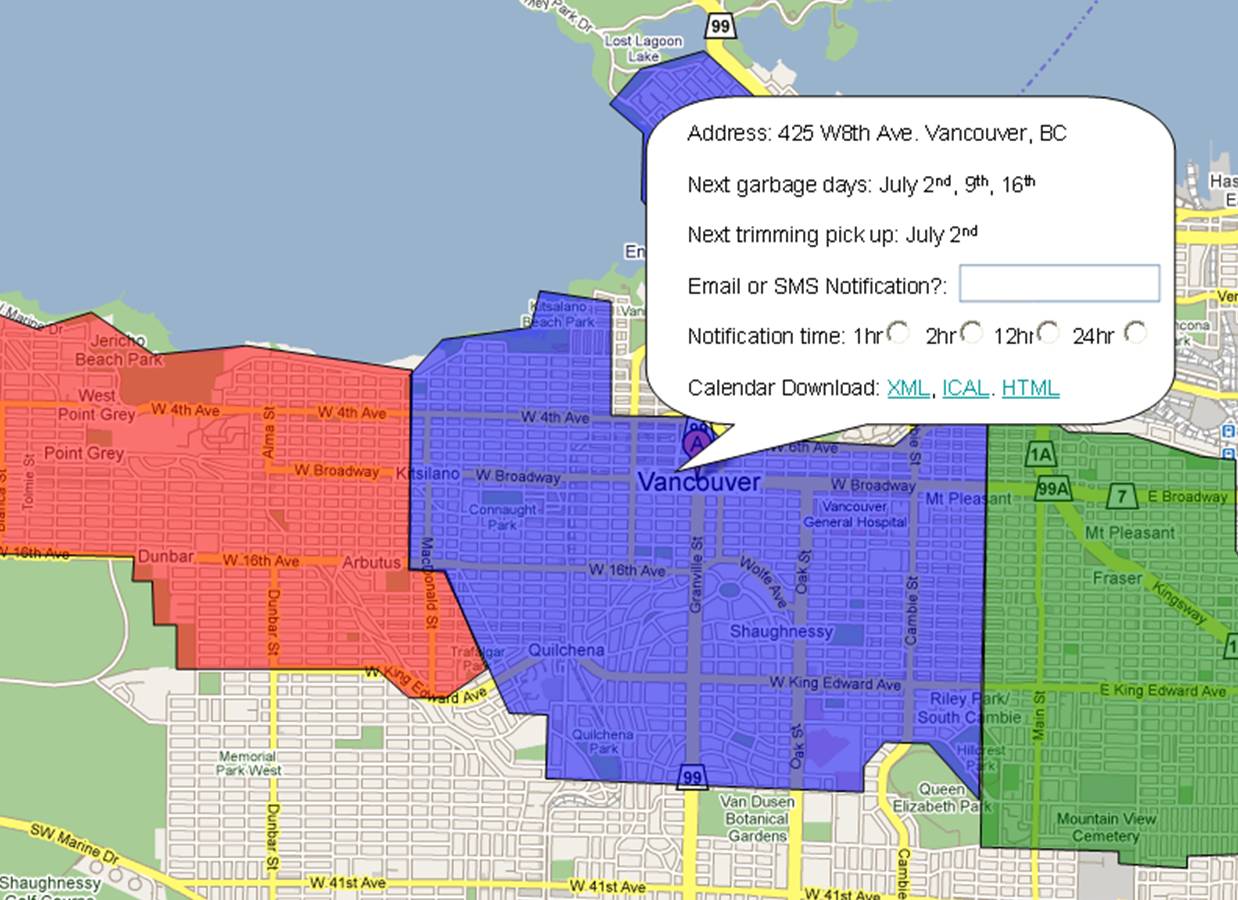
So presently the City of Vancouver only shares its garbage schedule (which it divides into north and south) as a PDF file. This is a pity as it means that no one can build any apps around it. Imagine a website or Iphone app that mashed up google maps with a constantly up to date city garbage pick up schedule. With such a application one could:

  • Simply punch in your address and find out your garbage zone (no more guessing if you live on the border of a zone)
  • Get an email or SMS notification 15 minutes, 1 hour, 12 hours (whenever!) before pick up
  • Download the garbage schedule into your calendar using XML, HTML or ICAL

Garbage-App

Let’s face it, everyone could do with a garbage day reminder. I can imagine that there are 1000’s of Vancouverites who’d sign up for an email notification.

Maybe this seems all very simply, nice but unimportant. But this is more than just creating convenience. What are the implications for such an application?

For citizens:

  • Let’s face it, for many of us, it would be a convenient and nice to get a reminder of when the garbage is going to be picked up
  • It would improve citizen’s appreciation for city services
  • It might also increase the likelihood citizen will recycle as the notification would enable them to better plan and prepare for garbage pick up

For the city & taxpayers

  • Every day 100s of Vancouverites forget to put out there garbage out for pick up. If garbage isn’t picked up, it piles up. This creates several new risks and costs to the city including: increasing likelihood of rodents and health hazards and an increased risk that some residents will dispose of their garbage inappropriately/illegally
  • When garbage is not put out an expensive city asset (the garbage truck, fuel, garbage men) all pass by unused. This means that taxpayers money is not used as efficiently as it could.
  • Moreover,  when garbage isn’t put out there will be twice as much at the house the next week. Multiply that by 100’s of houses and the very quickly the city must deploy extra garbage trucks to deal with this unusually large volume of garbage – costing city taxpayers.

What would be the total value/savings of such an application? Hard to gauge. But add up, time saved by citizens better able to plan around garbage pick up, a small reduction in illegal garbage disposal, a small increase in recycling, slight increase in garbage pick up efficiency and I’m sure the total value would be in the low millions, and the direct savings for the city in the low $100,000 per year. That is not insignificant – especially if all the city had to do was free the data and allow an intrepid hacker to code up the website.

Of course it doesn’t end there. A reliable source tells me the city collects far more data about garbage collection. For example when the driver can’t pick up the garbage can, they make an entry on their device as to why (e.g., it is under a tree). This entry is sent via a wireless connection back to a City database, and includes the highly precise coordinates of the truck at that moment. Then when a resident calls in to find out why the crew did not pick up the garbage can from their residence, the operator can bring up the address on a map and pinpoint the problem.

Such data could also be on the website in an option with something like “Why didn’t my garbage get picked up?” By sharing this data the city could reduce its call volume (and thus costs). With open data, the possibilities, savings and convenience is endless.

When good companies go bad – How Nokia Siemens helped Iran monitor its citizens

Last week my friend Diederik wrote a blog titled “Twittering to End Dictatorship: Ensuring the Future of Web-based Social Movements” in which he expressed his concern that (Western) corporations might facilitate oppressive regimes in wiretapping and spying on their citizens.

Now it appears that his concerns have turned out to be true. As he points on more recently on his blog:

  • The Wall Street Journal reports that Nokia and Siemens have supplied Iran with deep-inspection technologies to develop “one of the world’s most sophisticated mechanisms for controlling and censoring the Internet, allowing it to examine the content of individual online communications on a massive scale”. The  Washington Post also reported this.
  • Siemens has not just sold the “Intelligence Platform” to Iran, but to a total of 60 countries. Siemens calls it “lawful interception”, but in countries with oppressive regimes everything that the government does is lawful.
  • The New York Times reports that China is requiring Internet censor software to be installed on all computers starting from July 1st.

Of course, being Nordic, the Nokia Siemens joint venture which developed and sold the monitoring centre to Iran has a strict code of ethics on their website that addresses issues of human rights, censorship and torture. In theory this should have guided their choice of selling equipment to Iran – obviously it has not.

So Diederik and his friends have started a petition to enable people voice their concern over the failure of Nokia Seimens to adhere to their own code of conduct by selling advanced technology to help the government of Iran to control its citizens. I hope it takes off…

The Rat Pack of Public Service Sector Renewal

As many of you know I spend a lot of time thinking about public service sector renewal – that’s a wonkish term for renewing the public service. I do it because I think the public service is one of the most important institutions in the country since it affects everything we do, pretty much every day.

Over the past few years I’ve met more and more people who are equally passionate about this issue. Some I’ve met in person, others I’ve just chatted with by email. But, over the last 4 years I’ve watched a small group of bloggers – a rat pack of public service sector renewal – emerge. We’re scattered across the country and have come to from different angles but we all care about how our government is, how it should be, and how we can get to from the first place to the latter.

This is no easy task. I’m outside of government so it’s easier for me to speak truth to power. That’s why I’m so impressed with the other rat packers, in pursuit of making government better some have put their jobs on the line from time to time. I’d encourage you to go check our their blogs and give them a read.

The CPSR rat pack:

Me: as my readers know, my own thinking on public service sector renewal tends to focus on public policy development, and how it is going to be impacted by demographic change, technology, social media, networks and emergent systems.

Nick Charney’s blog CPSRenewal is one of the best blogs on public service sector renewal out there. Nick often does a weekly roundup of CPSR articles and blog posts, interviews with public servants and generally shares his thoughts.

Etienne Laliberte is one of the bravest public servants I know. A couple of years ago he wrote “An Inconvenient Renewal” in which shared his thoughts on renewal. Most important, his is probably the only document I’ve seen that treats renewal as a management problem, not a policy problem (something I’ve discussed in the past and intend to talk about again shortly). You can catch him at his blog as well.

A couple of other people I think of as being part of the Rat Pack include Peter Cowan – an OpenEverything alumnus – whose part of a team doing very interesting work with social media tools at Natural Resources Canada.

Thomas Kearney, who doesn’t blog, but is amazing nonetheless, has been a big part of the work behind GCPEDIA.

There’s Laura Wesley’s who’s got a great blog over at Results for Canadians: Measuring Success in Government. Nice to have someone concerned with how we measure success!

And finally there is the outspoken Douglas Bastien at Government of Canada 2.0, ready to tell it as it is and take no prisoners.

I know there are more people than just those I’ve mentioned, but these are the group I know and who’ve always been kind about letting an semi-outsider like me in. If you care about Canadian public service sector renewal (twitter hashtag #cpsr) then I hop you’ll add their RSS feeds to your reader.

Feeding the next economy – Give us a stimulus that stimulates, not placates

Last December – as the debates over the stimulus packages were just beginning, I wrote a piece on why the wrong stimulus today could fail us tomorrow. Well, today has become tomorrow, and we are failing.

A stimulus package should be an investment. It should create new industries and markets, it should find help create efficiencies and improve productivity, in short, in should help the economy grow in a sustainable manner. In the last depression the government accomplished this by funding infrastructure necessary for the 20th century economy, things like roads and highways for cars and transportation, power stations and grids for cities and industry, university buildings for education. Today, we already have much of that infrastructure and – while some of it needs to be renewed – we need to be focusing on what infrastructure is needed for the next economy – the digital economy – that will carry us out of this recession.

So what powers the digital economy? It isn’t coal, steel or cars and power (although these things are necessary), it’s data and connectivity.

Data is the plankton of the new economy. It seems plentiful, tiny and insignificant. But a whole ecosystem of companies, large and small are emerging to feed off of it and support our next economy. People often fail to recognize that the largest company already created by the new economy – Google – is a data company.  Google is effective, rich and powerful not because it sells ads… but because it generates petaflops of data everyday from billions of search queries. This allows it to know more about our society, and sometimes us individually – the merchandise we like, the services we want, the spam we’ll receive, even if the likelihood we’ll get sick in 4 months – than we know about yourself. Give people access to data and they will use it to become more efficient (freeing up more money to reinvest) and to create new services and opportunities (creating new jobs and profits).

Look no further than the City of Washington DC. It created a publicly available database of city collected and created data and asked local individuals and companies to use it. The result? A $50,000 dollar investment in changing processes and offering prize money has so far yielded $2.3M in value. That’s a 46 times return on investment in one year.

Now imagine that at a national level. Imagine Statistics Canada making all its data available freely (since taxpayers have already paid for its creation). As I outlined in a talk to StatsCan last year, not only would this make them a more important ministry, it could foster billions in savings, investments and new jobs all for a tiny sum. Let’s pick a truly excessive number, say $100M (.2% of the stimulus package) and imagine that’s this would be the cost for Statistics Canada to free all its data and provide in formats usable for webpages, cellphones and applications. Even if such a stimulus were only 20% as effective as Washington’s open data project it would still yield $460M in one year of new (not saved) jobs, and improved economic efficiencies and competitiveness. Over a decade, billions in new wealth would be created.

Compare this to our current course of action. To date much of our stimulus has been spent propping up (not creating) industries that are in death spirals such as logging, newspapers, and the auto-sector. The money spent isn’t about creating new or better jobs, it is simply being spent to keep jobs. Indeed, Andrew Coyne calculates that each auto-job saved cost us just under 2 million dollars. It will take years, if not decades, for such an investment to pay off, if it ever does. Worse still, the Canadian economy will be no more efficient or profitable as a result. While we are at it we might as well be giving Canadians money to buy land-line telephones to stimulate the telecommunications sector.

Oh, and it case you are wondering, the Americans already give out much of their government data for free and they are starting to give away more and more. This is a competitive race we are already losing, and only falling further and further behind.

Canada needs a better stimulus, one that is low on carbon and fat on data. Sadly, I fear our current government lacks the vision and creativity to give us what we need to prepare for the 21st century. So far we are off to an ominous start.

Who are you? (A little reader/twitter outreach)

question_markToday my feedburner dashboard informed me that I surpassed 400 subscribers (to my main feed). I’m now regularly getting over 600-700 hits a day and it moves into the 1000s about once every two weeks when I write on open source or the article gets slashdotted or retweeted by someone like Jay Rosen or Tim O’Reilly.

Recently a newspaper editor asked me if I knew who any these subcribers and readers are, why they read my blog and what they like/don’t like. I suddenly realized that while many of you know a bit about me, I know almost nothing about you.

Of course some of you may like it that way! Which is cool, no need to share… but for those who are inclined I thought I’d do a little outreach. If you have a second over the weekend please post a comment below and let me know who you are, why you come to eaves.ca, maybe what you like/don’t like about the site or what you’d like to see more/less of. No guarantees I can act on any of this, but I’d love to hear from you. Of course, often when I’ve solicited input in the past many of you have been more comfortable emailing me – feel free to do that instead, although a comment helps build a sense of community!

Hope to hear from some of you soon.

Open Source Journalism at the Guardian

crowd sourcedA few months ago I wrote a piece called the Death of Journalism which talked about how – even if they find a new revenue model – newspapers are in trouble because they are fundamentally opaque institutions. This built on a piece Taylor Owen wrote called Missing the Link about why newspapers don’t understand (or effectively use) the internet.

Today Nicolas T.  sent me this great link that puts some of the ideas found in both pieces into practice. Apparently, in the wake of the MP expense scandal in the United Kingdom, the Guardian has obtained 700,000 documents of MPs’ expenses to identify individual claims. Most MPs probably imagined they can hide their expenses in the sea of data, for what newspaper could devote the resources to searching through them all?

No newspaper could, if by “newspaper” you mean only its staff and not its community of readers. The Guardian, interestingly, has taken on this larger community definition and has crowd sourced the problem by asking its readers to download and read one or a few documents and report back any relevant information.

What makes this exciting is it is one example of how – by being transparent and leveraging the interest and wisdom of their readership – newspapers and media outlets can do better, more indepth, cheaper and more effective journalism. Think of it. First, what was once an impossible journalist endeavor is now possible. Second, a level of accountability previously unimaginable has been created. And third, a constituency of traditional (and possibly new) Guardian readers has been engaged – likely increasing their loyalty.

Indeed, in effect the Guardian has deputizing its readers to be micro-journalists. This is the best example to date of a traditional (or mainstream) media institution warming (or even embracing) at least a limited concept of “the citizen journalists.” I suspect that as institutions find ways to leverage readers and citizen journalists and that the lines between journalist and reader will increasingly blur. Actually it will have to.

Why is that?

Because for the Guardian model to work, they had to strike an agreement (a bargain – as Clay Shirky calls it) with their community. I don’t think anyone would have been satisfied to do this work and then simply hand it back to the Guardian without the right to access their work, or the work of other micro-journalists. Indeed, following the open source model, the guardian has posted the results for every document read and analyzed. This means that the “raw data” and analysis is available to anyone. Anyone of these micro-journalists can now, in turn, read the assemblage of document reviews and write their own story about the MPs expenses. Indeed, I’m willing to wager the some of the most interesting stories about these 700,000 pages will not be written by staff of The Guardian but by other parties assessing the raw data.

So what does that make the Guardian? Is it a repository, a community coordinator, an editorial service…? And what does it make those who write those stories who aren’t employed by the Guardian? Caring about, or getting caught up in these terms and definitions is interesting, but ultimately, it doesn’t matter. The fact is that journalism is being reinvented and this is one compelling model of why the new model can tackle problems the old one couldn’t even contemplate.

ChangeCamp Vancouver

This weekend ChangeCamp comes to Vancouver. If you are interested definitely sign up early.

I’ll be there of course. But better still Shari Wallace (Director of IT for the City of Vancouver) and I will be running a session together from 3-4 pm to brainstorm what data the City of Vancouver should prioritize on opening up. It’s an opportunity for coders to suggest what might help them build the local apps they’ve always wanted to build.

That, and numerous other sessions will try to help us dive deeper into The Long Tail of Public Policy

So what is ChangeCamp and where will it be?

Saturday June 20th 2009 |  8:30 am – 5:30 pm

555 Seymour Street, Vancouver, BC (BCIT Downtown Campus)

$20 in advance | $25 at the door

Vancouver ChangeCamp is a participatory web-enabled face-to-face event that brings together citizens, technologists, designers, academics, social entrepreneurs, policy wonks, political players, change-makers and government employees to answer these questions:

  • How can we help government become more open and responsive?
  • How do we as citizens organize to get better outcomes ourselves?

The event is a partly structured unconference. One track of the conference will introduce the kinds of projects that harness new ideas and tools for social change. Other tracks at the conference will be participant-driven, with the agenda created collaboratively at the start of the event, allowing participants to share their experiences and expertise.

Hope to see you there!

Footnote on BC-STV

Had a really nice breakfast with Taylor Gunn of Student Vote yesterday. For those who aren’t familiar with their work I strongly encourage you to take a look at their website. For me, they are a great reminder that citizenship is a learnt skill and responsibility – and they work as hard as anyone to foster it.

Looking over the Student Vote website I was struck by their results for the BC election. I wasn’t surprised by the NDP’s strong and the Green’s (relatively strong) showing as young people tend to lean left. Indeed, if anything I was surprised the Green’s didn’t do better given how much I thought the party was driven by youth. No what surprised me was the referendum outcome – specifically how poorly the BC-STV vote did among student “voters” particularly in comparison to last time.

Gunn was telling me that last time, student “voters” passed BC-STV whereas this time the referendum was defeated 55.59% vs. 44.41% with 64 districts opposed and only 17 in favour. This means even among some of the most idealistic “voters” in the province support dropped at least %15 and likely more (I don’t know the specific results for the last election). My sense is that there are again two reasons for this:

1) that reframing the question to a choice between two systems as opposed to a “yes” or “no” for change may have affected voters more dramatically then people thought. Do people want change? Frequently they say yes. But show them what the specifics of what that change will be and they are often less enthusiastic. I’ve always been struck by an exit poll I remember seeing after the 2001 election in which only 35% of voters who voted “yes” in the referendum actually knew what they were voting for.

2) the second is that I think more exposure to BC-STV – both positive and negative – had a culminative negative impact. BC-STV supporters beleived that the more people learnt about BC-STV the more they would like it. I think they exact opposite occured. The more they learnt, the more questions they had and the less the understood or liked the proposed system. I’m open to the possibility that all these student voters were exposed to a negative add campaign that shifted their opinions but it feels a little like a stretch.

Is it time to get rid of the Foreign Service designation?

dfait_logoA Foreign Service officer (FS) is an employees of the Government of Canada who pass the foreign service exam and are hired by the Department of Foreign Affairs and International Trade (DFAIT)and the Canadian International Development Agency (CIDA).

This is important because becoming an FS is no easy task. Every year hundreds of Canadians write the test and few are selected for interviews. Fewer still are hired into the department. This barrier to entry has created a sense of class around the FS designation. To be an FS meant you were the best, the brightest, the most able of public servants – not only a distinct class, but a class above.

But what if this is no longer true? Moreover, what if being a class apart is what’s killing the Foreign Service?

It is worth remembering the environment out of which the FS designation emerged (and for which it is designed for). When Canada’s nascent foreign service began to take shape in the 30’s the diplomatic world looked very different. It was dominated by Europeans and largely populated by quasi royalty – former aristocrats – who had all gone to the right schools, spoke the right languages and knew all the right protocols. Foreign policy was an elite policy area – not just because it was so important – but also because it was dominated by elites (in the class sense of the word). While the role of aristocrats in foreign policy has faded long ago, the legacy of their culture lingered. As a result, the Foreign Service had to ensure that the right people became foreign service officers, no ordinary country bumpkin would do, to have influence in the diplomatic world standards had to be kept.

The FS designation also emerged out of an early and mid 20th century era when public servants did not change ministries. In Ottawa you were a Finance Man, or a Treasury Board Man, or a Natural Resources Man (and yes, for much of that period you were probably a man) and it was uncommon to move from one department to another. In this world, a strong Foreign Service culture made sense since many of the other ministries had a strong sense of culture as well.

But today the world, Canadians and Ottawa, are different. Every ministry engages in foreign policy – be it healthcare issues, the environment, energy, transport, you name it. There is hardly an issue in Canada that does not have an important international dimension. Moreover, public servants now frequently move from ministry to ministry. Indeed, a successful career in the public service requires that you move around. A broad set of experience is deemed to be essential. Finally, the typical public servant has changed dramatically. Today, Canadians are much more internationalized. Many of us are born abroad, still more of us have family abroad, and with (relatively) cheap air travel many Canadians travel abroad. This is a far cry from even 30 years ago. But not only do Canadians travel more, they are better educated. There may have been a time when the average foreign service officer was significantly better educated than the average public servant – but this is simply no longer the case. Many public servants now have Master’s degrees. Indeed, for a while, you couldn’t get hired without one.

This is the world of the public service in the 21st century, and it presents three challenges for the foreign service.

The first, it has become less and less clear what makes a Foreign Service officer unique. An increasing number of public servants outside of DFAIT and CIDA are successfully engaging in international work: negotiating treaties, attending international conferences, and working directly with other governments. If this work can be done by non-FSs the question arises… what is the value add of the Foreign Service Officer? What unique skills and knowledge do they bring? Whenever I’m in Ottawa I hear colleagues, friends, and even strangers ask this question. This is not to say Foreign Service officers are not incredibly talented- but it is asking what, as a class or group, do they offer?

This first problem is compounded by a second that few within DFAIT and CIDA wish to talk about: elitism. FSs have always thought of themselves as not only different but also (if they are honest with themselves) better than other public servants. There was likely a time when this was true. FSs were better educated and more traveled than their peers. Today however, it is no longer the case. Many public servants are relatively well traveled and well educated. The gap simply no longer exists. The result is that, around Ottawa, FSs are perceived as elitist snobs, a perception that is crippling the department. Not only does the rest of Ottawa now question the department’s value add they also, quite understandably, despise being looked down upon. Everyday a thousand small decisions are made to seek ways to work around – rather than with – DFAIT and those decisions are adding up. Nobody wants to play with the foreign service.

Finally, FS designation itself is a direct problem because it us both keeping Ottawa out DFAIT down. Today, public servants move around Ottawa getting experience in different departments – this is how the game is now played. And yet DFAIT and CIDA sit outside the game – FSs don’t want to work in another department and they often resent non-FSs who come and work in theirs. Consequently, few good ideas developed outside the ministry find there way in. Moreover, because FSs have isolated themselves they have neither the network of interdepartmental colleagues nor the experience and knowledge of how Ottawa works that their public service colleagues possess. They are getting outplayed. Still more problematic, the answers to the highly subjective Situational Judgment component of the Foreign Service Test are determined by senior Foreign Service officers. This means that those who succeed in being hired as FSs are those who are most likely to think like the outgoing generation. This creates a conservative trend within the department that reinforces old ideas and the class like elitism.

If DFAIT wants a leading role in the development of government policy it has a number of obstacles it needs to overcome. The most challenging however is reforming the system that shapes the thinking and culture of its employees. One place to start may be acknowledging that the FS designation – while an enormous source of pride – is also a source of significant problems. Opening up the FS designation to other public servants (treating it more like that the ES designation) could be one approach. Alternatively, focusing the FS designation on crisis management in the field and making it a class for people who are going to work in embassies in hostile territory or politically compromising situations may make more sense. These are just suggestions – what is most important is that the yawning culture gap between DFAIT and the rest of Ottawa must be closed – because increasingly the rest of Ottawa is discovering it can live without DFAIT, but DFAIT cannot live without the rest of Ottawa.