Monthly Archives: October 2009

The Stimulus Map: Open Data and enhancing our democracy

The subject of the distribution of stimulus monies has been generating a fair amount of interest. Indeed, the Globe published this piece and the Halifax Chronicle-Herald published this piece analyzing the spending. But something more interesting is also happening…

Yesterday, my friend Ducky Sherwood and her husband Jim published their own analysis, an important development for two reasons.

First, their analysis is just plain interesting… they’ve got an excellent breakdown of who is receiving what (Ontario is a big winner in absolute and per capita terms, Quebec is the big loser). Moreover, they’ve made the discussion fun and engaging by creating this map. It shows you every stimulus project in the country and where you click it will highlight nearby projects. The map also displays and colour-codes every riding in the country by party (blue for Conservatives, magenta for everyone else) and the colour’s strength correlates to the quantity of monies received.

Stimulus Map

Second, and more interesting for me, is how their analysis hints at the enormous possibilities of what citizens can do when Government’s share their data and information about programs with the public in useful formats. (You can get spreadsheets of the data and for those more technically-minded the API can be found here). This is an example of the Long Tail of Public Policy Analysis in action.

This could have a dramatic impact on public discourse. Open data shifts the locus of power in the debate. Previously, simply getting the data was of value since your analysis would likely only compete, at best, with one or two other peoples (usually a news organization, or maybe a professor). But when anyone can access the information the value shifts. Simply doing an analysis is no longer interesting (since anyone can do it). Now the quality, relevance, ideological slant, assumptions, etc… of the analysis are of paramount value. This has serious implications – implications I believe bode well for debate and democracy in this country. Indeed, I hope more people will play with the stimulus data (like these guys have) and that a more rigorous debate about both where it is being spent and how it is being spent will ensue. (Needless to say, I believe that spending money on auto bailouts and building roads does little to promote recovery – the real opportunity would have been in seeding the country with more data to power the businesses of tomorrow).

There are, however, limits to Ducky’s analysis that are no fault of her own. While she can crunch the numbers and create a great map she is… ultimately… limited to the information that government gives her (and all of us). For example the data set she uses is fairly vague about the value of projects: the government labels them “under $100K” or “between $100K and $1M.” These are hardly precise figures.

Nor does the data say anything about the quality of these projects or their impact. Of course, this is what the debate should be about. Where, how effectively, and to what end is our money being spent? Ducky’s analysis allows us to get to these questions more quickly. The point here is that by opening up this stimulus money to popular analysis we can have a debate about effectiveness.

I don’t, for a second, believe that this will be an easy debate – one in which a “right” answer will magically emerge out of the “data.” Quite the opposite, as I pointed out above the debate will now shift to the economic, ideological and other assumptions that inform each opinion.  This could in fact create a less clear picture – but it will also be a picture that is more reflective of the diversity of opinions found in our country and that can scarcely be represented in the two national newspapers. And this is what is most important. Open data allows for a greater debate, one that more citizens can contribute and be a part of rather than just passively observe from their newspapers and TV screens. That is the real opportunity of open data is not that it enables a perfect discussion, but a wider, more democratic and thus, as far as I’m concerned, a better one.

(An additional note, while it is great that the government has created an API to share this data, let us not get too excited; it is very limited in what it tells us. More data, shared openly would be better still. Don’t expect this anytime soon. Yesterday the Government dropped 4,476 pages off at the Parliamentary Budget Office rather than send them a electronic spreadsheet (h/t Tim Wilson). Clearly they don’t want the PBO to be able to crunch the numbers on the stimulus package – which means they probably don’t want you to either.)

Canada's Arctic Strategy – playing to the strengths of others

Last week I the good fortune of participating in an intimate workshop on Canadian foreign policy hosted by CIGI and convened in preparation for an upcoming issue of the International Journal in which the papers will be published.

One of the participants, Elizabeth Riddell-Dixon, gave an excellent paper on The United Nations and the Regime to Manage the Continental Shelf Beyond 200 Nautical Miles. During the discussion of her about her paper and Canada’s activities in the North more generally she reiterated the point she made in her September 2008 Policy Options article entitled Canada’s Arctic continental shelf extension: debunking myths:

Contrary to commonly held myths that Canada is losing the race to stake claims to the Arctic continental shelf beyond 200 nautical miles as other Arctic countries move more quickly and effectively to secure the resources for themselves, there is no “Wild West” scramble occurring, and relations among the participants are remarkably cooperative. There is an international legal regime in place, and its rules are being observed by the Arctic countries. Furthermore, these states already have sovereign rights over the continental shelf beyond 200 miles that do not depend on occupation or proclamation.

I found Riddell-Dixon’s comments fascinating. Her thorough and convincing assessment sits in stark contrast to the headlines one normally reads in the news: “Battle for the Arctic heats up” (CBC), “Arctic military bases signal new Cold War” (The Times), “Canada uses military might in Arctic scramble” (The Guardian) and “Sweden’s arctic army can beat up our arctic army” (who else… The National Post).

Given these articles one is liable to think that a Russian invasion of The North is imminent! And this is perhaps understandable, talking about military exercises and a “wild west” sells newspapers and makes citizens feel patriotic. It is however, completely divorced from how decisions are presently being made. Indeed, Riddell-Dixon pointed that if anything the activities of Russia, Canada, the United States, Norway and Denmark have been marked by cooperation – we share information, resources and even ships – as we collectively map out the ocean floor. Indeed, this – and other areas of cooperation between the 5 circumpolar countries – was outlined in the (dramatically under-reported) Ilulissat Declaration in which the Arctic Five reaffirmed that:

The five coastal states currently cooperate closely in the Arctic Ocean with each other and with other interested parties. This cooperation includes the collection of scientific data concerning the continental shelf, the protection of the marine environment and other scientific research. We will work to strengthen this cooperation, which is based on mutual trust and transparency, inter alia, through timely exchange of data and analyses.

So we have an international legal regime (based on the Law of the Sea) for resolving boundaries in the North. All the relevant actors are adhering to (and even cooperating around) it. And yet, the military rhetoric around the North continues to get trotted out. If the only consequence was to whip up a sense of nationalism and win votes this would be okay. The problem is that, internationally, this behaviour is irresponsible.

Why? Because language about militarizing The North that implicitly suggests disputes will (or worse, should) be resolved through military strength plays to our weaknesses.

If the North really is going to be resolved through (or influenced by) military might then we will find ourselves clashing with the United States (the world’s lone superpower), Russia (a Great Power) and Denmark and Norway (both of whom can more easily focus their military resources in the North). In a game of military chicken we are, in every scenario, the losers. Ratcheting up rhetoric around the military is the exact opposite tact we should be taking. There is an international legal regime in place plays to our strengths: it reaffirms Canada as a norm adherer, commits every one to a rule-based process as well as reinforces the norm that science and data are central to resolving disputes. For a middle (or model) power like Canada, it is hard to ask for a better outcome.

This isn’t to say we should have no military presence in the North – but by emphasizing the military aspect of the North we encourage others to deviate from a process that benefits us and push them towards one that can only hurt our interests. While it may be a simple vote-getter, let’s hope the Prime Minister tones down the rhetoric around the North – my suspicion is that a North that is truly militarized will be a massive drain on resources, an unwelcome distraction and ultimately, a vote loser.

Upcoming talk: Toronto Innovation Showcase

Just a little FYI to let people know I’m going to be in Toronto on Monday, November 2nd for the City of Toronto’s Innovation Showcase.

I’ll be doing a panel Open Government with Maryantonett Flumian (President of the Institute On Governance, I remember meeting her when she was Deputy Minister of Service Canada), Nick Vitalari (Executive Vice President at nGenera), and Peter Corbett (CEO of iStrategyLabs – which runs the Apps for Democracy Competitions for Washington DC).

The Showcase will be running November 2nd and 3rd and our panel will be on Monday the 2nd from 10:15am until noon in the City Council chambers. Registration is free for those who’d like to come and for those interested but not in Toronto, you will be able to watch a live webcast of the event online from their website. You’ll also be able to follow the event on twitter hashtags #TOshowcase and #opendataTO

The goal of the showcase is to provide:

“a venue for you to come and meet with your colleagues to discuss these questions, hear their success stories, share experiences about opportunities and challenges in the public sector using social media, propose suggestions, exchange information on IT and trends, create connections, knowledge, tools and policies that address the increased demand by citizens for better public service, transparency, civic engagement and democratic empowerment.”

Should be fun – hope to catch you there and to have something fun to blog about after it’s over.

Gov 2.0: If I could start with a blank sheet of paper… (part 1)

I was recently invited to be a member of the International Reference Group of the Australian Government’s Web 2.0 Taskforce. Like with the British – who drafted this excellent report – I’m impressed the Australian government is thinking about Web 2.0 comprehensively and strategically, and that it was reaching out internationally to a group of subject matter experts. It is of course an issue I spend a lot of time thinking and writing about.

Recently, the taskforce posted this piece on their blog:

“…imagine for a moment it was your job to create the guidelines that will help public servants engage online. Although you have the examples from other organisations, you are given the rare luxury to start with a blank sheet of paper (at least for this exercise). What would you write? What issues would you include? Where would you start? Who would you talk to?”

While they were looking for suggested guidelines for how employees should interact on the web like those found here (a lot of these are great – I was impressed with DePaul University’s guidelines) I wanted to take a step back. Guidelines are important, but the posts implicitly suggests the focus of a government’s web 2.0 strategy should be focused externally. If I had a blank slate I would write guidelines, but my emphasis would be to get public servants to start using Web 2.0 tools internally. This approach has several advantages:

  1. Start with a safe environment for individuals to learn: As a medium the internet is a notoriously complicated place to communicate. Flame wars, endless and pointless discussions, and even simple misunderstandings are commonplace. I’d like a place where public servants can get comfortable with both the medium and the different Web 2.0 tools. People forget that only a tiny fraction of people have embraced Web 2.0 and most public servants are not part of that early adopter group. Throwing public servants into the deep end of the Web 2.0 pool risks setting them up to drown out of frustration. Creating Web 2.0 tools behind a government firewall gives public servants a lower risk environment to get comfortable and learn to use the technology.
  2. Start with a safe environment for institutions to learn: Developing a new communications culture, one where more public servants are accustomed to engaging with the public directly will take time. Giving public servants an opportunity to practice using social media behind the government firewall enables the organization to assess its strengths and weaknesses and determine what policies should be in place as it further ramps up its public facing engagement.
  3. Make mistakes internally first: For better or for worse, many government agencies are deeply sensitive to communication mistakes. An innocent gaffe that goes viral or is picked up on by the media can quickly temper a minister’s or deputy minister’s appetite to experiment with social media. Every ministry or department will, at some point, experience such a gaffe (most probably already have). Better that these initially happen internally where they can become learning experiences than having them happen publicly where they become communications crises that risk shutting down Government 2.0 experiments.
  4. Internal focus will drive much needed structural change: Building off point number 2, I frequently tell government officials interested in having their organizations “do” social media to stop thinking of this as a communications exercise. Rather than trying to get an analogue government to talk to a digital public – why not make the government digital? Adopting Web 2.0 tools internally is going to change how your organization work for the better. Social media allows people to more effectively exchange information, identify critical resources and avoid the duplication of effort – all of the types of things siloed, hierarchical governments aren’t good at. The fact that adopting these tools will make engaging in the online world much, much easier is only one of many much larger benefits.

All this isn’t to say that Governments shouldn’t engage with the public via social media/web 2.0. They should (they need to!). It is to say that there is huge value, learnings and efficiency gains to be had in adopting web 2.0 internally. If we focus exclusively on the external strategy  we risk only changing how our governments communicate with the public and miss out on the real gains of transforming how our governments work.

Optimism is an instrument of policy

Here is a draft version of a paper I’m working on. It is part of a workshop I’m heading too where each participant was given a quote said by John Holmes, the well known and highly respected Canadian diplomat and foreign policy expert.

Mine was “Optimism is an instrument of policy” which I found to be quite challenging.

Below is my best shake to date, it is always great to get thoughts or feedback as I strive to improve it… If you are feeling shy feel free to email me directly.

“Optimism is an instrument of policy”

As a worldview or philosophy, one would struggle to find a self-respecting international relations theorist who would suggest that optimism is a sound foundation upon which to construct a foreign policy. And this paper will not argue that it is – Homes was far too clever a man to make such a claim, and I am far too weak an intellectual to argue it. Rather, my reading of Holmes’s quote suggests that he was not claiming optimism should be the basis of a foreign policy; rather, he was stating that optimism is an instrument of Foreign Policy. In this much narrower construction, I think he was on to something important, and something our present foreign policy could learn from. Consequently, this paper will attempt to do three things. First, use an example to demonstrate that optimism can indeed be an instrument of policy. Second, try to dissect a few of the conditions under which it might be both necessary and successful. Finally, turn our attention to the present state of Canadian foreign policy and assess what, if any, role optimism may have to play.

For many, optimism — defined as both “a disposition or tendency to look on the more favorable side of events or conditions and to expect the most favorable outcome” as well as “the belief that good ultimately predominates over evil in the world” — has no place in the world of international affairs.  In classic international relations theory, we citizens are supposed to depend on our government having the opposite of an optimistic outlook. In an anarchical society, states live under the constant threat of being undermined, overrun, or exploited. Our government should, if anything, look at the world through pessimistic eyes in order to imagine and prepare for the worst possible scenario.

This simple view of our country and world is, of course, contestable. Canada does not live in a purely anarchical world. Indeed, in both the near abroad and across the Atlantic we have friends and allies who are generally friendly towards us. We collectively agree to constrain our behaviours in some mutually acceptable ways and as a result enjoy a somewhat narrower and more manageable (although not non-existent) set of existential threats to our country. So our relations with both our NATO allies generally and the United States specifically mean that we must not always adopt the most pessimistic outlook when confronting problems. Indeed, our history of cooperation with these allies has cultivated a trust economy where we can have more optimistic expectations of their behaviour towards us, and one another, than traditional realist theory might allow us to predict. But even within these more nuanced structures of inter-state relations there is a limit for optimism. The opportunities to exploit a situation, for members to free-ride, and for balance of powers to shift all mean that as a general rule optimism, as a basis for foreign policy, would not be wise.

This, however, is not what Holmes was stating. Holmes modified his reference to optimism with the term “instrument.” In this regard I would suggest he saw optimism not as the basis for foreign policy but as “a means by which something is done” and “an implement used to facilitate work.” And here I would argue that Holmes is absolutely correct. Optimism has long been an important tool for foreign policy for Canada and others. This is not to say it should be the only tool, nor to argue that it is a universally appropriate tool, only that it is a tool, albeit one that when used well can be powerful.

To highlight how optimism can be an effective tool of foreign policy let us briefly look at how it was wielded by one of history’s greatest realists: Sir Winston Churchill.

In the early days of World War Two, when Great Britain – and Canada – remained more or less isolated, the entrance of the United States into the war was not a foregone conclusion and Germany had a virtual free rein on the continent, any sober assessment – and for certain any realpolitik assessment – of the situation would almost certainly have concluded that all was lost. Beaten and scattered, Great Britain, the Commonwealth, and their few allies (mostly governments in exile) could not easily expect to be able to reverse the early defeats suffered in Europe. Indeed for many, the notion of challenging and defeating Germany would have been described as not merely optimistic in outlook, but possibly foolish if not downright suicidal. (A problem with this question is that one man’s optimistic outlook might be another’s pessimistic view – so I’ve tried to choose a scenario that comes as close as possible to being considered universally bleak.)

Churchill, of course, never lost sight of the raw realpolitik calculus that needed to shift in order to change the tide of the war. For the balance of power to shift Britain would need new allies; without both the Soviet Union and the United States all would be lost. Early on in the war this was his focus. But one key ingredient in pursuit of this goal was the unyielding optimism he radiated in those bleak early days. Whatever the man’s shortcomings, Churchill’s and the outlook of British Government were frequently tough, but the vision was always optimistic. As such they served to inspire not only the British but also their overseas allies in Canada, Australia and elsewhere as well as setting the tone with the Germans and the Americans about what they could expect, and what was expected of them.

As mentioned, many observers probably saw Churchill’s optimism as lunacy. There was certainly a fair degree of bluster and emphasis on a rosy outlook, but that doesn’t diminish its effectiveness. The appearance of reality can be as powerful as reality. Besides, for Churchill it was a necessary tool – one of the few that he had in his arsenal. He also happened to wield it well. However, he also never relied on it exclusively or forgot it was just a tool. His optimism was always in service of something. His belief that the war could be won, that it would be won, that it had to be won kept Britain’s morale and fighting will from collapsing, thus making ultimate victory for the allies possible. As a tool for engaging and cultivating allies, blustering and confusing enemies and simply invigorating citizens, I suspect it was indispensible. At a time when people risked being frozen by fear and all seemed lost, an optimistic vision of both the outcome to the war and for the future of the world was perhaps one of Britain’s greatest assets. This is not to discount the many other pieces of Britain’s foreign policy were essential – its naval power, it relationship with the United States, the resources of its colonies – but would Britain with these resources, but without Churchill’s optimism have helped win the war? I am unsure.

As a student and then a temporary wartime assistant at External Affairs living and working in England from 1938-1943, I expect that Holmes, who witnessed and experienced the potency of this optimism first-hand, probably asked himself the same question.

So what is it about optimism, as a tool, that makes it effective? There are two primary ingredients. First, optimism is a necessary precondition for imagining a better world. Those who believe that only the worst is possible or that the status quo cannot be changed can never imagine a better world, a better outcome or a better future for their citizens or country. This alone is probably the single most important role optimism can play in foreign policy. Unfettered, it can lead to dangerous flights of fancy. Its absence, however, saps the creativity from policy that makes change – particularly pragmatic and trust-building change – possible. Ironically, optimism as an instrument of policy becomes both most important and effective during the bleakest and darkest periods of a problem. It is precisely in such times – when our minds are gripped by fear and focused on survival – that the politics of what is possible is most needed.

Take for example the planning for a post-war era that took place from the midpoint of the Second World War onwards. Think of the optimism required of Churchill, Roosevelt and, to a much lesser degree Stalin to map out this future era. Here, in the ruins of the failed Treaty of Versailles, these men and their advisors – people who had lost friends and loved ones – continued to believe that despite all the lessons of history, all the efforts of men before them, despite the pressures facing their own alliance, that they could bring order and stability to the world. The Bretton Woods institutions – International Bank for Reconstruction and Development (IBRD), the General Agreement on Tariffs and Trade (GATT), and the International Monetary Fund (IMF), along with the United Nations and policies such as the Marshall Plan rested on a belief that a better world was possible – indeed, that it was necessary. Optimism was not a luxury, but a critical tool that was needed to moderate the realist pressure to create a system that would only serve the interests of the allies. Too much blood had been spilt, too much treasure spent, too much lost for that not to be the case. A better future had to be imagined and created because something had to have justified the enormous cost of blood and treasure of the previous two decades.

The second element of optimism’s effectiveness as a tool of foreign policy is that it cannot operate in isolation. Optimism need not, and indeed cannot be divorced from realism. Those who seek to imagine a better world or a better outcome don’t succeed by merely hoping for it.  Optimism can only purchase interest on the part of citizens and allies or provide a vision for what should be done. Without hard assets, diplomatic leverage and the capacity to monitor and follow through on commitments, any such vision is pointless. Again, this paper seeks not to argue that optimism alone is ever sufficient; one need only look at Neville Chamberlain’s policy of appeasement to see what optimism as a tool of foreign policy can look like when wielded in isolation. A vision of peace, nor matter how nobly optimistic, is worthless without the means to monitor and enforce it.

There was a time when Canadians – conservative and liberal – understood this. Wedding optimism with realism was supposed to be the trademark of Pearsonian foreign policy. Pearson proposed a peacekeeping operation to intervene between combatants during the 1956 Suez Crises and to re-imagine a world where war was not inevitable. Optimism was a key instrument: the idea that a small international force could separate and keep the peace between larger and better armed belligerent parties was not without risk. In addition the notion that a middle power could meaningfully intervene in the power plays of the great powers was also not immediately obvious. But in addition to optimism, Pearson’s proposal was combined with a deep sense of realism. Canada was intervening not just because it altruistically wished to prevent war, but because the risks of an escalated war between the Soviets and the Americans had real implications for the security of the country. In addition, although only a Middle Power, Canada had the credibility and capacity to lead such a mission. It could deploy its troops independently and had earned the trust of the key actors involved.

So if optimism is a legitimate tool of foreign policy, does it fit into today’s debate over the direction and future of Canada’s foreign policy? I think the short answer is yes, with an important caveat. I think if John Holmes were alive today he would argue that we need both more, and less, optimism.

First and foremost, there is at present no sense of crisis or urgency in the Canadian foreign policy arena. However much foreign policy enthusiasts may wish it, the public’s attention is not focused as it was during the world wars or even the Cold War. The war on terror has not captured the public’s attention. Indeed, the erosion of human rights and the instigation of the second gulf war has done interminable damage to what is a serious issue. On the other side of the spectrum, climate change increasingly penetrates the public’s (although not the government’s) consciousness as an important issue but it is nowhere near becoming an organizing principle for foreign (or even domestic) policy. If there is a foreign policy issue that is seen to be essential it is access to the American market – although even here the issue is plagued with rowdy opposition and significant ambivalence. (Have Canadians ever cared less about the United States than they do today?)

Without an exogenous organizing principle, and with the benefit of America’s security umbrella, Canada has been afloat. In this almost strangely unique and secure void we have the luxury to debate what, if anything, our foreign policy should look like. It is however, an urgent discussion. Canada has enjoyed an “influence dividend” that came as a result of our significant participation in the Second World War and, subsequently, the Cold War. But this increased significance was never structurally sound – over the long term our military and economy power could not justify. Only continued ingenuity and creativity, a demonstration to key powers that we can be of use and the ability to contribute to the ideas we put forward could the inevitable decline be arrested or at least managed gracefully. But rather than come to consensus on how to manage this problem we have instead vacillated between the extremes of excessive optimism and the complete lack of it.

On the one side we have had Liberals who sometimes misunderstand Pearson as a largely altruistic optimist. They rarely discuss Pearson’s role as key architect, negotiator and signatory of the North Atlantic Treaty Organization. As he noted of the Soviet threat: “Our defence in this conflict must be one of increasing and then maintaining our strength, while always keeping open the channels of negotiation and diplomacy. Arms must go hand in hand with diplomacy.” This was a man who, when necessary, was unafraid to confront those whose goals were antithetical to Canadian values.

Pearson was an optimist – he wanted to help foster a better world – but he also understood that optimism must be balanced with realism. In this regard he respected the role and necessity of power, understood the importance of great-power politics and the limits of treaties. In his own negotiations, he noted that “if the great powers have the will and desire to co-operate, even if the machine isn’t perfect, it won’t matter very much. It will work. Therefore, Canada’s preoccupation […] is based on the hard realities of the existing international situation.” Liberal foreign policy often strays from this understanding. From the Land Mines Treaty to UN reform, Liberals efforts to improve the international system invariably focus on perfecting the machinery irrespective of the interests or participation of the great powers.

But if the Liberals have divorced optimism from realism, Conservatives have divorced realism from optimism. Conservatives have often tried to emphasize the threats to Canada, focusing on the dangers and instability of the world. This messaging is often designed to promote the growth of hard power assets like the military. But extensive research shows that the more scared people become about instability and uncertainty the more unlikely they are to change how they think. The end result could be counterproductive. Painting the world a scary and hostile place that Canadians need to be protected from won’t create support for hard power and a more aggressive role in addressing the world’s problems, rather it could promote isolationism and a desire to retreat from the world altogether.

The Conservative approach is made all the more difficult because their desire to enhance Canadian power appears to be an end unto itself. Are Canadians willing to spend blood and treasure in order to simply earn a seat at the table? Possibly. But I have my doubts that they will be willing to do so in the absence of a genuine threat or opportunity the believe in. They will be even less inclined if our “seat” will be used to do nothing more than sustain the status quo, support American hegemony, or worse, simply substitute American interests for Canadian interests. Our present government has never been more intent on demonstrating Canada’s power but this has done little to arrest our decline, both internationally and vis-à-vis the United States. Today most countries wonder where Canada is on issues it has traditionally championed such as human rights and, to a lesser degree, the environment. It is worth noting that at the recent climate talks in Thailand the group of 77 – the countries of the developing world – simply stood up and out of disgust, walked out in the middle of Canada’s address. Realism without optimism has left us weaker, and less influential, not stronger.

There is no easy way to out of this debate. The whole discussion has a chicken and egg feel to it. Conservatives advocate for means without ends we care for, Liberals want ends we might agree with, but without the means required to make them reality. In the meantime Canada’s influence continues to slip.

The only thing more depressing than the debate is the shrinking number of Canadians who seem to think it matters. While the dedication of those who serve the government is unquestionable there appears to be more and more action taking place outside government. When young people today look for role models in the realm of international affairs they turn to the plucky start-ups of the last two decades like Engineers Without Borders, Free the Children, Greenpeace and others who appear far more adept at marrying optimism with the means of achieving this better, imagined world. If Canada won’t be creative and resourceful then the Canadians who do care will be, without or without their government.

Arresting this decline and trying to find a way transcend the debate between means and ends was one of the key goals of Middle to Model Power, the report I served as lead author of on behalf of the Canada25 community. We sought to marry optimism with hard power as well as tap into the energy of Canadians by focusing on how Canada could generate influence by modeling behaviour. This is not to suggest that the Model Power report provides the answer; but it was a genuine effort to engage some new and outside thinking as well as some younger blood into identifying a new path. Barring some new exogenous threat or organizing principle the difficult problem is that we will need to imagine our role, or stumble along in a free-rider malaise. My point is that we will have to imagine our role, it isn’t going to be given to us.

It is a challenge I suspect John Holmes would have found intriguing. I never had an opportunity to meet the man, but understand from those who worked with, studied under and admired him that he sought to engage young people in policy development, enjoyed creative thinking and believed in searching new and untested paths. Moreover, as president of the Canadian Institute of International Affairs he sought to broaden the community of people engaged in foreign affairs. I believe that all those traits of the man – plus a small dose of optimism about what Canada could be – are precisely what is needed.

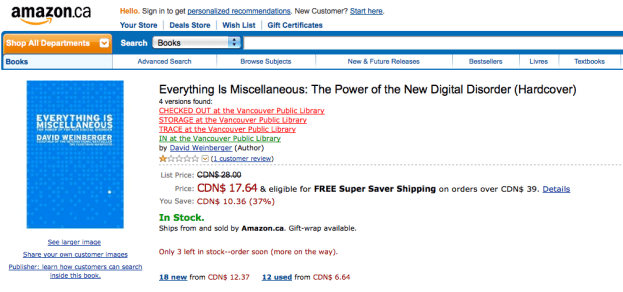
Searching The Vancouver Public Library Catalog using Amazon

A few months ago I posted about a number of civic applications I’d love to see. These are computer, iphone, blackberry applications or websites that leverage data and information shared by the government that would help make life in Vancouver a little nicer.

Recently I was interviewed on CBC’s spark about some of these ideas that have come to fruition because of the hard work and civic mindedness of some local hackers. Mostly, I’ve talked about Vantrash (which sends emails or tweets to remind people of their upcoming garbage day), but during the interviewed I also mentioned that Steve Tannock created a script that allows you to search the Vancouver Public Library (VPL) Catalog from the Amazon website.

Firstly – why would you want you want to use Amazon to search the VPL? Two reasons: First, it is WAY easier to find books on the Amazon site then the library site, so you can leverage Amazon’s search engine to find books (or book recommendations) at the VPL. Second, it’s a great way to keep the book budget in check!

To use the Amazon website to search the VPL catalog you need to follow these instructions:

1. You need to be using the Firefox web browser. You can download and install it for free here. It’s my favourite browser and if you use it, I’m sure it will become yours too.

2. You will need to install the greasemonkey add-on for Firefox. This is really easy to do as well! After you’ve installed Firefox, simply go here and click on install.

3. Finally, you need to download the VPL-Amazon search script from Steve Tannock’s blog here.

4. While you are at Steve’s blog, write something nice – maybe a thank you note!

5. Go to the Amazon website and search for a book. Under the book title will be a small piece of text letting you know if the VPL has the book in its catalog! (See example picture below) Update: I’m hearing from some users that the script works on the Amazon.ca site but not the Amazon.com site.

I hope this is helpful! And happy searching.

Also, for those who are more technically inclined feel free to improve on the script – fix any bugs (I’m not sure there are any) or make it better!

Amazon shot

The Sad State of Vancouver's Entrepreneur of the Year Awards

Last week I noticed Business in BC published its Entrepreneurs of the Year Awards list. The list is filled with deserving and excellent candidates as well as inspiring stories of businesses that are thriving and innovating in a difficult business environment. The recipients are worthy of praise as many embrace values and determination that any city would want to see reflected in its business community.

There is however one thing you won’t find in either the winners, or Runners Ups lists.

Women.

That’s right, of the 8 winners and 16 runner ups, which included a total of 29 people, only a single woman made the list (Queenie Chu, and her business partners Kin Wah and Kin Hun Leung of Kin’s Farm Market, were winners of the Business to Consumer Category).

This, quite frankly, is scandalous. According to the Government of British Columbia research on small business and business in BC:

In 2008, 34.3 per cent of all business owners in British Columbia were women. This was on par with the national average of 34.4 per cent and the fourth-highest rate among the provinces. British Columbia trailed New Brunswick (38.3 per cent), Quebec (36.7 per cent), and Ontario (34.5 per cent) in terms of the share of businesses owned by women.

So 34% of all businesses in the province are owned by women, and yet the number of women cracking the Entrepreneur of the Year finalists’ list is… 1 out 29. So roughly, 3% of the finalists if you are being generous (counting by people), 1.3% if you are being accurate and counting by category.

There are a couple of theories that might explain this.

1) There are no excellent women entrepreneurs.

2) There are excellent women entrepreneurs, but they aren’t on the radar of E&Y and BCB.

3) Business culture defines excellence in terms that were created and modeled by men – and so the selection committee and nominators tend to (without malice or intent) favour men.

4) More men than women care about these types of awards, and so they go more out of their way be noticed and nominated

5) Women have less access to capital and inherit fewer businesses so will have a harder time growing businesses that would meet E&Y’s criteria

6) Answers 2-5, plus a myriad of other reasons…

This post is not an effort to take a swipe at BCB or E&Y – although I would encourage a little introspection on their part to assess why their survey (keeps) producing few, if any, women nominees. I’m not looking for parity but it would be a start if 20% of the field were women. Yes, such a number is still far too low, but it would at least come a little closer to reflecting the actual gender breakdown. I’m quite confident that the reason (1) from above is not why they are not making the list. Indeed, the E&Y committee in Ontario was able to hit this low bar for Ontario’s Entrepreneur of the Year Award. 20% (10/50) of its nominees were women.

It would be nice if these awards instigated a greater degree of introspection in the business community at large, for while no one likes to think sexism exists in Canada, we are, sadly, still not at a place of gender parity. In a recent Accenture survey, approximately two-thirds of Canadian male and female executives (67 percent of men and 64 percent of women) believed gender equality in the workplace has improved in the last 10 years. However, one-third (32 percent) of those executives surveyed believed that men and women have equal opportunities in the workplace, and one-third (34 percent) of the female executives believed that their gender limits their career opportunities. While those demonstrate things have improved from where we were a decade or more ago, they are still sobering numbers.

Spark Interview on VanTrash – The Open Source Garbage Reminder Service

A couple of weeks ago I was interviewed by the CBC’s Nora Young for her show Spark:  a weekly audio blog of smart and unexpected trendwatching about the way technology affects our lives and world.

The interview (which was fun!) dives a little deeper into some of the cool ways citizens – in working to make their lives better – can make cool things happen (and improve their community) when government’s make their data freely available. The interview focuses mostly on VanTrash, the free garbage reminder service created by Luke Closs and Kevin Jones based on a blog post I wrote. It’s been getting a lot of positive feedback and is helping make the lives of Vancouverites just a little less hectic.

You can read more about the episode here and listen to it on CBC radio at 1:05 local time in most parts of Canada and 4:05 on the west coast.

You can download a podcast of the Spark episode here or listen to it on the web here.

If you live in Vancouver – check out VanTrash.ca and sign up! (or sign your parents or neighbour up!) Never forget to take the garbage out again. It works a whole lot better than this approach my friends mom uses for her:

Van trash reminder

My new mac – some thoughts for other PC users

As some of you know, I recently shifted from a PC to a Mac. It’s a big transition for me… I’ve used a PC all my life, so it is easy to say that I’m having a little (but not a ton) of culture shock.

I’ll be honest about the single best selling feature of the mac: Spotlight.

I do very few things on my computer. Mostly I write, I surf, and I email. A LOT of email. So first and foremost, having a computer where I can find my emails and documents easily is critical. When you’ve got over 70,000 emails you want to be able to search, well, neither Microsoft Outlook, any Windows desktop search engine I’ve ever seen, or even Google desktop (which essentially requires you to load a browser each time) is going to cut it.

I NEED to be able to find stuff quickly. Google has bred me with an expectation of instant results (not a slow churning solution). Maybe Windows 7 will get there, but I’ve given up waiting. My 5 year old thinkpad wasn’t going to last long enough for me to see.

Am I happy? Absolutely. One thing our Apple friends do well is design. I love the keyboard, the screen and pretty much everything physical about the machine. Moreover, the convergence of Mac & Windows software has made the transition relatively easy – I’d be frightened to think of how much time on my computer I spend on the browser, but it is a lot… so moving from Firefox to Firefox is pretty sweet.

That said, the transition hasn’t been perfect. There are several features on the Mac that have been frustrating, and even disappointing. For those thinking of making the leap I thought I let you know the rough parts; it shouldn’t dissuade you, just set some expectations that not everything in Macworld is peaches and cream. Of course, if some veteran users have solutions to these issues, I’ll be eternally grateful.

So here’s my list of 4 things I’d change on the Mac – some of these are so petty I’m almost embarrassed…

1. No “send to” email client option. One thing Windows has that I’ve not found on the Mac is the “Send To” folder. Drop any application in the Send To folder and when you right-click on a document you have the option of opening the document with that application. What I loved was being was being able to right-click on a document, send it to my email client and bingo! A new email was created with the document attached. Very productive and easy. Alas, no such luck in the Mac.

2. No “open container” option in spotlight. Yes, I love Spotlight AND… when the drop down menu is showing me a list of found items, why can’t I right-click on it and open the containing folder? Sometimes, I don’t know what document I’m looking for, but I do know it is co-located with a document I do know the title of… Just saying.

3. In Mail, you can’t drag an email to iCal to create an event. Best feature Outlook (and I presume Entourage) has that Mail and iCal don’t is the ability to turn an email into an event. I know that Mail has the funky – click on the date and it will create an event – but it rarely brings in the relevant information. In Outlook I simply dragged an email to the calendar and presto! I had an event in which the email contents were in the notes. That way I could easily copy all the relevant details and, had a ton of context I could quickly reference within my calendar.

4. Okay, so this one seems REALLY petty… but it strikes at something deeper, something important for PC users to know. I’m feeling a little annoyed that, in Mail, when I delete an email in my inbox the cursor always moves to the newer email regardless how the mail is sorted. In Outlook it always moved “down” (Which I had arranged to mean that it went to an older email). Small, I know, but it is driving me crazy when I’m dealing with my email. Of course, this is all part of what I understand to be a larger philosophical problem with Macs (and why I’ve never been an owner before) which is that the company is centered on the idea that it knows how you should use your computer better than you do… so customizing is limited. This is the biggest culture shift for PC users. Owning a Mac is like being in a gated community… its pretty and manicured, but you have to adhere to the community bylaws, or else…! Yes the Windows world has got serious medical issues (viruses), a generic corporate feel (Windows Themes) and a approach to planning that seems modeled after Houston (I say this with some affection) but you also had a lot more freedom to create trouble or solve things your way. At the moment, I’m welcoming my new overlord because it’s like my computer has been taken over by the Swiss! It’s efficient, but if I try to complain… well you get the point.

Pretty much everything else that I’m wrestling with. The way Alt-Tab works on the Mac or the fact that I can’t open press “command+F” to open the “File” menu are things that I know, in time, I’ll adjust to.

19th Century Net Neutrality (and what it means for the 21st Century)

So what do bits of data and coal locomotive have in common?

It turns out a lot.

In researching an article for a book I’ve discovered an interesting parallel between the two in regard to the issue of Net Neutrality. What is Net Neutrality? It is the idea that when you use the Internet, you do so free of restrictions. That any information you download gets treated the same as any other piece of information. This means that your Internet service provider (say Rogers, Shaw or Bell) can’t choose to provide you with certain content faster than other content (or worse, simply block you from accessing certain content altogether).

Normally the issue of Net Neutrality gets cast in precisely those terms – do bits of data flowing through fibre optic and copper cables get treated the same, regardless of whose computer they are coming from and whose computer they are going to. We often like to think these types of challenges are new, and unique, but one thing I love about being a student of history, is that there are almost always interesting earlier examples to any problem.

Take the late 19th and early 20th century. Although the term would have been foreign to them, Net Neutrality was a raging issue, but not in regard to the telegraph cables of the day.  No, it was an issue in regards to railway networks.

In 1903 the United States Congress passed the Elkins Act. The Act forbade railway companies from offering, and railway customers from demanding, preferential rates for certain types of goods. Any “good” that moved over the (railway) network had to be priced and treated the same as any other “good.” In short, the (railway) network had to be neutral and price similar goods equally. What is interesting is that many railway companies welcomed the act because some trusts (corporations) paid the standard rail rate but would then demand that the railroad company give them rebates.

What’s interesting to me is that

a) Net Neutrality was a problem back in the late 19th and early 20th century; and

b) Government regulation was seen as an effective solution to ensuring a transparent and fair market place on these networks

The question we have to ask ourselves is, do we want to ensure that the 21st century (fibre optic) networks will foster economic growth, create jobs and improve productivity in much the same way the 19th and 20th century (railway) networks did for that era? If the answer is yes, we’d be wise to look back and see how those networks were managed effectively and poorly.  The Elkins Act is an interesting starting point, as it represented progressives efforts to ensure transparency and equality of opportunity in the marketplace so that it could function as an effective platform for commerce.