Monthly Archives: February 2010

Open Source Strategy: OpenMRS case study

Last week I had the pleasure of being invited to Indianapolis to give a talk at the Regenstrief Institute – an informatics and healthcare research organization – which also happens to host the founders of OpenMRS.

For those not familiar with OpenMRS (which I assume to be most of you) it is open-source, enterprise electronic medical record system platform specifically designed to respond to those actively building and managing health systems in the developing world. It’s a project I’m endlessly excited about not only because of its potential to improve healthcare in developing and emerging markets, but also because of its longer-term potential to serve as a disruptive innovator in developed markets.

Having spent a few days at Regenstrief hanging out with the OpenMRS team, here are some take aways I have regarding where they are, and where – in my mind – they should consider heading and what are some of the key places they could focus on to get there.

Current State: Exiting Stealth Mode

Paul Biondich and Andrew Arenson point me to this article about Community Source vs. Open Source which has an interesting piece on open source projects that operate in “Stealth Mode”

It is possible to find models similar to community source within the open source environment. For example, some projects opt to launch in a so called ‘stealth mode’, that is, they operate as a truly open source development from inception, but restrict marketing information about the project during the early stages. This has the effect of permitting access to anyone who cares enough to discover the project, whilst at the same time allowing the initiating members to maintain a focus on early strategic objectives, rather than community development.

OpenMRS has grown in leaps and bounds and – I would argue – has managed to stay in stealth mode (even with the help of their friends at Google summer of code). But for OpenMRS to succeed it must exit stealth mode (a transition that has already been steadily gathering steam). By being more public it can attract more resources, access a broader development community and role out more implementations for patients around the world. But to succeed I suspect that a few things need to be in place.

Core Opportunities/Challenges:

1. Develop OpenMRS as a platform to push people towards cooperating (as opposed requiring collaboration) whenever possible.

One of the smartest things Firefox did was create add-ons. The innovation of add-ons accomplished two benefits. First, it allowed those working on the trunk of the Firefox code to continue to do their work without being distracted by as many feature requests from developers who had an idea they wanted to try out. Second, it increased the number of people who could take interest in Firefox, since now you could code up your own add-on cooperatively but independently, of the rest of the project.

With OpenMRS my sense is that then entire UI is a platform that others should be able to develop or build add-on’s for. Indeed, the longer term business model that makes significant sense to me is to treat OpenMRS like WordPress or Drupal. The underlying code is managed by a core open source community but installation, customization, skinning, widgets, etc… is done by a mix of actors from amateurs, to independent hackers and freelancers to larger design/dev organizations. The local business opportunities to support OpenMRS and, in short, create an IT industry in the developing world, are enormous.

2. Structural Change(s)

One consequence of treating OpenMRS as a platform is that the project needs to be very clear about what is “core” versus what is platform. My sense is that members of the Mozilla team does not spend a lot of time hacking on add-ons (unless they have proven so instrumental they are brought into the trunk). Looking at WordPress the standard install theme is about as basic as one could expect. It would seem no one at WordPress is wasting cycles developing nice themes to roll out with the software. There is a separate (thriving) community that can do that.

As a result, my sense is that OpenMRS should ensure that its front-end developers slowly begin to operate as a separate entity. One reason for this is that if they are too close to the trunk developers they may inadvertently prevent prevent the emergence of a community that would specialize in the installing and customizing of OpenMRS. More importantly, those working on the platform and those working on the trunk may have different interests, and so allowing that tension to emerge and learning how to manage it in the open will be healthy for the long term viability of the project as more and more people do front end work and share their concerns with trunk developers.

3. Stay Flexible by Engaging in Community Management/Engagement

One of the challenges that quickly emerges when one turns a software product into an innovation platform is that the interests of those working on the product and those developing on the platform can quickly divide. One often here’s rumblings from the Drupal community about how drupal core developers often appear more interested in writing interesting/beautiful code than in making Drupal easier to use for businesses (core vs. platform!). Likewise, Firefox and Thunderbird also hear similar rumblings from add-on developers who worry about how new platforms (jetpack) might make old platforms (add-ons) obsolete. In a sense, people who build on platforms are inherently conservative. Change, even (or sometimes especially!) change that lowers barriers to entry means more work for them. They have to ensure that whatever they’ve built on top of the platform doesn’t break when the platform changes. Conversely trunk developers can become enamored with change for change’s sake – including features that offer marginal benefits but that disrupt huge ecosystems.

In my mind, managing these types of tension is essential for an open source project – particularly one involving medical records. Trunk developers will need to have A-level facilitation and engagement skills, capable of listening to platform developers and others, not be reactive or defensive, understand interests and work hard to mediate disputes – even disputes they are involved in. These inter-personal skills will be the grease that ensure the OpenMRS machine can keep innovating while understanding and serving the developer community that is building on top of it. The OpenMRS leadership will also have to take a strong lead in this area – setting expectations around how, and how quickly OpenMRS will evolve so that the developer ecosystem can plan accordingly. Clear expectations will do wonders for reducing tensions between disparate stakeholders.

4) Set the Culture in Place now

Given that OpenMRS is still emerging from Stealth mode, now is the time to imprint the culture with the DNA it will need to survive the coming growth. A clear social contract for participation, a code of community conduct and clearer mission statement that can be referenced during decisions will all be essential. I’m of course also interested in the tools we can role out that will help manage the community. Porting over to Trac the next generation of Diederik’s bug-fix predicter, along with his flame monitor, are ways to give community the influence to have a check on poor behaviour and nudge people towards making better choices in resolving disputes.

5) Create and Share Data to Foster Markets

Finally, I think there is enormous opportunity for a IT industry – primarily located in the developing world – to emerge and support OpenMRS. My sense is that OpenMRS should do everything it can to encourage and foster such an industry.

Some ideas for doing this have been inspired by my work around open data. I think it is critical that OpenMRS start asking implementations to ping them once complete – and again whenever an upgrade is complete. This type of market data – anatomized – could help the demonstrate demand for services that already exists, as well as its rate of growth. Developers in underserved counties might realize there are market niches to be filled. In addition, I suspect that all of the OpenMRS implementations that have been completed that we don’t know about represent a huge wealth of information. These are people who managed to install OpenMRS with no support and possibly – on the cheap. Understanding how they did and who was involved could yield important best practices as well as introduce us to prospective community members with a “can do” spirit and serious skills. I won’t dive into too much detail here, but needless to say, I think anonymized but aggregated data provided for free by OpenMRS could spur further innovation and market growth.

Postscript

I’m sure there is lots to debate in the above text – I may have made some faulty assumptions along the way – so this should not be read as final or authoritative, mostly a contribution to what is an ongoing discussion at OpenMRS. Mostly I’m excited about where things are and where they are going, and the tremendous potential of OpenMRS.

The Big Apps come to Vancouver

Disappointed I hadn’t found this out sooner… Turns out the winners of New York’s Big Apps competition have created a Vancouver version of the winning application.

Steven Lao and Victor Sima, creators of the Android phone application Wayfinder, won “Best Overall Application” and prize money of US$5000. The Wayfinder application is an augmented reality application that enables you to use your Android phone’s camera to locate the nearest bus stop, subway station or seabus station.

So what does “augmented reality” mean? Take a look at the image below (this is the Wayfinder application in action).

This is image is what you would see looking at your phone’s screen. The screen is showing whatever building or road (or anything) that the phone’s camera is point at, but then is superimposing a “bubble” that hovers over the nearest actual subway or bus station (In this case it is 0.4 miles as the crow flies, through the building you’r looking at). This means you can simple use your phone to scan around an locate the nearest bus stop with out having to figure out where you are on a map.

Since Vancouver is hosting the Winter Olympics and because Translink made the deft move of sharing its transit data the Wayfinder programmers decided to create a Vancouver version – something they were able to do even though they never visited Vancouver.

You can learn more about Wayfinder in a recent audio interview with Directions Magazine available as a podcast. (H/T to Jonathan M. at the City of Vancouver who pointed this out to me!)

Canada’s Three Tiered Healthcare System

Thanks to Premier Danny Williams’ comments, we are in another short bout of collective denial and misunderstanding of Canada’s healthcare system and the public perception thereof.

1. Denial.

For those not in the know, Premier Williams recently jaunted down to Miami for heart surgery. In his interview with NTV reporter Fred Hutton, he stated, “This is my heart. It’s my health and it’s my choice.” True. It is a choice. If you can afford it.

It’s also a wonderful reflection of the fact that despite all the mythology awe, in Canada, actually have a three-tiered healthcare system. Williams enjoys the benefit of tier three – travel to the US. It’s a choice that many, many wealthy Canadians make. Indeed, it’s a choice other wealthy politicians have made, including former Quebec premier Robert Bourassa and former MP Belinda Stronach. I’m willing to bet that the Mayo Clinic has made a lot of money off wealthy Canadians.

Of course, this effect is largely ignored since most Canadians can’t afford to go to the US. So we pretend it doesn’t happen. Indeed, the 1998 Katz paper, a frequently cited paper that claims Canadians don’t travel to the US for healthcare, strikes me as deeply misleading. As the study states:

An important limitation of this study is that only public out-of-country expenditures are included in the analysis; private sources of funding, including “travel” health insurance plans and out-of-pocket payments, are omitted.

This of course doesn’t prevent them from drawing some very strong conclusions, namely that Canadians don’t go to the US for healthcare. In some ways they are right, average Canadians don’t, but what did you expect if the  study only looks at people who used Ontario public insurance – in short, those who couldn’t afford to travel to the US and pay privately…

Then of course, there is the more familiar second tier. This is private healthcare available here in Canada. Don’t be fooled, there is plenty of private healthcare in Canada. Indeed, at least 30% of healthcare spending in Canada is from private funds. This includes simple things like your glasses and dental costs, as well as the more complex, such as clinics that conduct surgery in Quebec (which the Feds don’t dare close) to those in British Columbia (which most people pretend don’t exist). These service upper middle class Canadians and, ironically, provincial Workers Compensation Boards which are not bound by the Canada Health Act and so can pay to have their patients serviced by private clinics in Canada. Irony!

Finally, there is familiar tier one — the public system that most of us avail ourselves of. (Which still has a huge private component – all those doctor offices are private businesses…) The system generally works, but often has too few doctors (try finding a GP – 4.5 Million of us haven’t!), long wait lines in Emergency Rooms (often hours long) and waiting lists for some procedures (don’t break your hip).

This is the reality of healthcare in Canada. Yes, we have universal healthcare. But it is within a three-tiered system and the wealthy – like Danny Williams – opted out a long, long time ago.

2. (Mis)perceptions of Canadian (Mis)perceptions

Of course, many Canadians know that the wealthy go elsewhere. They even know that their healthcare system is either groaning or breaking (try being on a waiting list) or financially unsustainable (try living in a province where healthcare eats up 45% of the budget and rising). Moreover, they know more money isn’t going to magically solve it (or at least not the amount of money we can afford). Did anyone really believe that $41 billion over 10 years would “save healthcare for a generation?”

(As an aside, I suspect this is why Canadians reject the Liberals’ National Daycare Program – many people agree daycare is good and important but they remain suspicious of a system that is likely to become as top-down, hard to contain and even more difficult to reform/evolve as Healthcare. In short, they don’t wanted it modeled after I system they already think is borked.)

But the story isn’t that Canadians want either the status quo or the American option. Although Canadians recognize our system has huge challenges, most of us agree the American system is far, far worse, particularly for the vast majority of us who can’t afford to fly down there to begin with. Far better to stick with the devil we know, than the bogey man to the south. The fact is… better the system you know and hate, then the one you don’t know and hate even more.

Ultimately, both the Canadian and the American models are likely done. Neither country can afford to manage double digit (or even high single digit) increases in healthcare costs. Somewhere, something has to give. But we’ll have to experience a lot more pain (and denial about how great our system is) before we get there. What I suspect is true is that the wealthy and privileged stopped caring a long time ago. They aren’t invested in the system because – residing in the third tier – they are outside of it.

Open Government – New Book from O'Reilly Media

I’m very excited to share I have a chapter in the new O’Reilly Media book Open Government (US Link & CDN Link). I’ve just been told that the book has just come back from the printers and can now be ordered.
Also exciting is that a sample of the book (pictured left) that includes the first 8 chapters can be downloaded as a PDF for free.

The book includes several people and authors I’m excited to be in the company of, including: Tim O’Reilly, Carl Malamud, Ellen Miller, Micah Sifry, Archon Fung and David Weil. My chapter – number 12 – is titled “After the Collapse,” a reference to the Coasean collapse Shirky talks about in Here Comes Everybody. It explores what is beginning to happen (and what is to come) to government and civil services when transaction and coordination costs for doing work dramatically lower. I’ve packed a lot into it, so it is pretty rich with my thinking, and I’m pleased with the result.

If you care about the future of government as well as the radical and amazing possibilities being opened up by new technologies, processes and thinking, then I hope you’ll pick up a copy. I’m not getting paid for it; instead, a majority of the royalties go to the non-profit Global Integrity.

Also, the O’Reilly people are trying to work out a discount for government employees. We all would like the ideas and thinking in this book to go wide and far and around the globe.

Finally, I’d like to give a big thank you to the editors Laurel Ruma and Daniel Lathrop, along with Sarah Schacht of Knowledge as Power, who made it possible for me to contribute.

Today in the Globe: Facebook's Political Reach

I have the following piece published in the Globe and Mail today. It isn’t going to further endear me to Michael Valpy (who is already not impressed with me)… but felt another perspective on the issue was needed. He, like many traditional columnists, is not a fan of social – or digital – media. Indeed, he has argued it is destroying our country’s social cohesion and democracy. Those familiar with me know I feel differently . By allowing us to self-organize, connect to one another and to our politicians, social media is enabling a different and very powerful type kind of social cohesion and democratic expression.

I respect Valpy a lot and hope we get a chance to sit down and talk social media at some point. Given our collective interest in journalism and statements like this, it feels like it would be fruitful for both of us. Hopefully it will happen.

Facebook’s Political Reach

Yesterday, Michael Valpy posted an interesting piece about a Nanos poll showing Canadians – including younger Canadians – question how much influence political Facebook groups should have on any government.

The problem with the piece lies in the headline: “Facebook forums shouldn’t sway government, young Canadians say.” It suggests that online activism – or social media in general – isn’t credible with the public. This, however, isn’t what the poll showed. Indeed, the poll says little about the credibility of Facebook, particularly compared to other forms of political activity. It does, however, say a lot about social media’s dramatic growth in influence over the past five years.

Critically, the poll didn’t compare forms of political activity. If one had done a similar poll asking whether Canadians believe a demonstration should sway the government, or if direct action – such as when Greenpeace hung a banner from Parliament – should alter government policy, would the numbers have been dramatically different? I suspect not. Governments have electoral mandates – something Canadians broadly agree with. Most political activity, both on and offline, is designed to shape public opinion and ultimately, people’s decisions at the ballot box. That is a threat influences government.

Consequently, it may not be the medium that matters as much as the number of people involved. Do people believe the government should pay attention to a 1,000 person rally? Likely not. Should they pay attention to a 10,000 person Facebook group? Likely not as well. But at a certain point, with large enough numbers, almost any medium matters. Would people think that the government should reconsider a policy in the face of 10-million-person petition? Or a five-million-person Facebook group? Possibly. What about a 500,000-person march? Even this might prompt respondents to reconsider their response.

Ultimately, the Globe article jumps to a negative interpretation of Facebook too quickly. This is understandable in that traditional news organizations are still coming to grips with social – and digital – media. But by allowing us to self-organize, connect to one another and to our politicians, social media is enabling a different and very powerful type kind of social cohesion and democratic expression.

More interesting is how split Canadians appear to be over political groups using Facebook “to share ideas, information and to help mobilize their activities” (30 per cent have a positive view, 30 per cent have a negative view and an enormous 40 per cent are undecided). Here is a technology few Canadians knew existed five years ago, and it is already viewed favourably by a third of Canadians as a way to engage with political groups. As people become more familiar with these online activities I suspect comfort levels will rise, since many people often don’t initially understand or like new technologies. This survey shows us online political organizing is moving into the mainstream – perhaps even more mainstream than a protest or a petition.

So should Facebook influence the government? The prorogation debate shows it already can. But do people believe Facebook should be less influential than other (more traditional) forms of political activity? In this, the survey reveals very little. Indeed as Nik Nanos, the pollster who conducted the survey, adds at the end of the piece (and in contrast to the title): “we still haven’t come to grips with what [Facebook groups] really mean.”

Conservative Senator Talks Harm Reduction

First, for those who have not seen it Maxine Davis, Executive Director of the Dr. Peter Foundation has an important op-ed in the Vancouver Sun titled Attention Ottawa: Insite is a health care service.

More intriguing Safe Games 2010 and the Keeping the Door Open Society (which, for full disclosure, I sit on the board of) are hosting a panel discussion on harm reduction. One of the speakers will be Senator Pierre Claude Nolin, who sits as a Conservative and has been deeply supportive of harm reduction strategies generally and the four pillars strategy specifically here in Vancouver.

For those in Vancouver who are interested in the event – details below. Hope to see you there.

Keeping the Door Society and SafeGames 2010

invite you to attend

Global Insite – A panel discussion and public dialogue on Vancouver’s

innovative response to the international question of What to do About Drugs?

WHEN:

Friday 19th February 2010

7.00 pm – 9.00 pm; doors open 6.30 pm

WHERE:

Japanese Language Hall

487 Alexander Street @ Jackson Street / Vancouver

SPEAKERS

  • DR. ETHAN A. NADELMANN Executive Director, Drug Policy Alliance; New York
  • SENATOR PIERRE CLAUDE NOLIN, Senate of Canada; Ottawa
  • LIZ EVANS Executive Director, Portland Hotel Society; Vancouver
  • DONALD MACPHERSON Co-founder, Canadian Drug Policy Consortium; Vancouver
  • SHARON MESSAGE Past President, Vancouver Area Network of Drug Users; Vancouver
  • TARA LYONS Executive Director, Canadian Students for Sensible Drug Policy; Canada
  • GILLIAN MAXWELL (mc) Project Director, Keeping the Door Open Society, Vancouver

Please join us to hear a panel of experts discuss the Canadian Government’s recent announcement that it will continue its efforts to close down Insite – North America’s only legal supervised injection site.  We invite you to participate in the dialogue that will follow.

How Vancouver's Open Data Community Helped Open Up the French CBC

For those uninterested in the story below and who just want the iCal feed of cultural events in Vancouver, click here.

Also, I had a piece on the Globe site yesterday, was in the air all day, but was told it hit #1 most viewed, which, if true, is nice. You can read it here.

A couple of weeks ago – at a party – I met someone working at the CBC who talked about how they were organizing a calendar of all the cultural events at the Olympics. Turns out the French CBC is placing a strong emphasis on the Cultural Olympiad that is taking place concurrently to the Olympics and they were gathering all the events they could find into a spread sheet.

I commented that CBC views and listeners – French and English – would probably find such a calendar useful and that it would quite interesting if the CBC shared it as an iCal feed so that anyone could download it into their computer’s calendar.

He agreed, but was unsure how to create such a feed. Admittedly, neither was I – but I did know some people who might…

So at Vancouver’s last Open Data Hackathon – kindly hosted by the City Archives and organized by Luke C – I asked around to see if anyone might be interested in converting the spreadsheet into an ical feed. Up stepped Jason M. who did a little trouble shooting, figured out how the spreadsheet needed to be reformatted and then figured out how to convert it.

So now, if you want, you can download a fairly comprehensive list of the cultural events taking place during the Olympics straight into the calendar on your iPhone, computer, google calendar, etc…

It’s got more events than a lot of the other calendars and includes concerts being played at Maison du Quebec, Saskachewan, Alberta, Ontario and Atlantic Canada House.

This is a bit of a shift for the CBC, the kind of shift that I think we need to be supportive of… a little more open, a little more sharing and a lot more useful. Most importantly it is a great example of how the idea of open data spreads – by being useful.

Some More Core-Periphary Maps

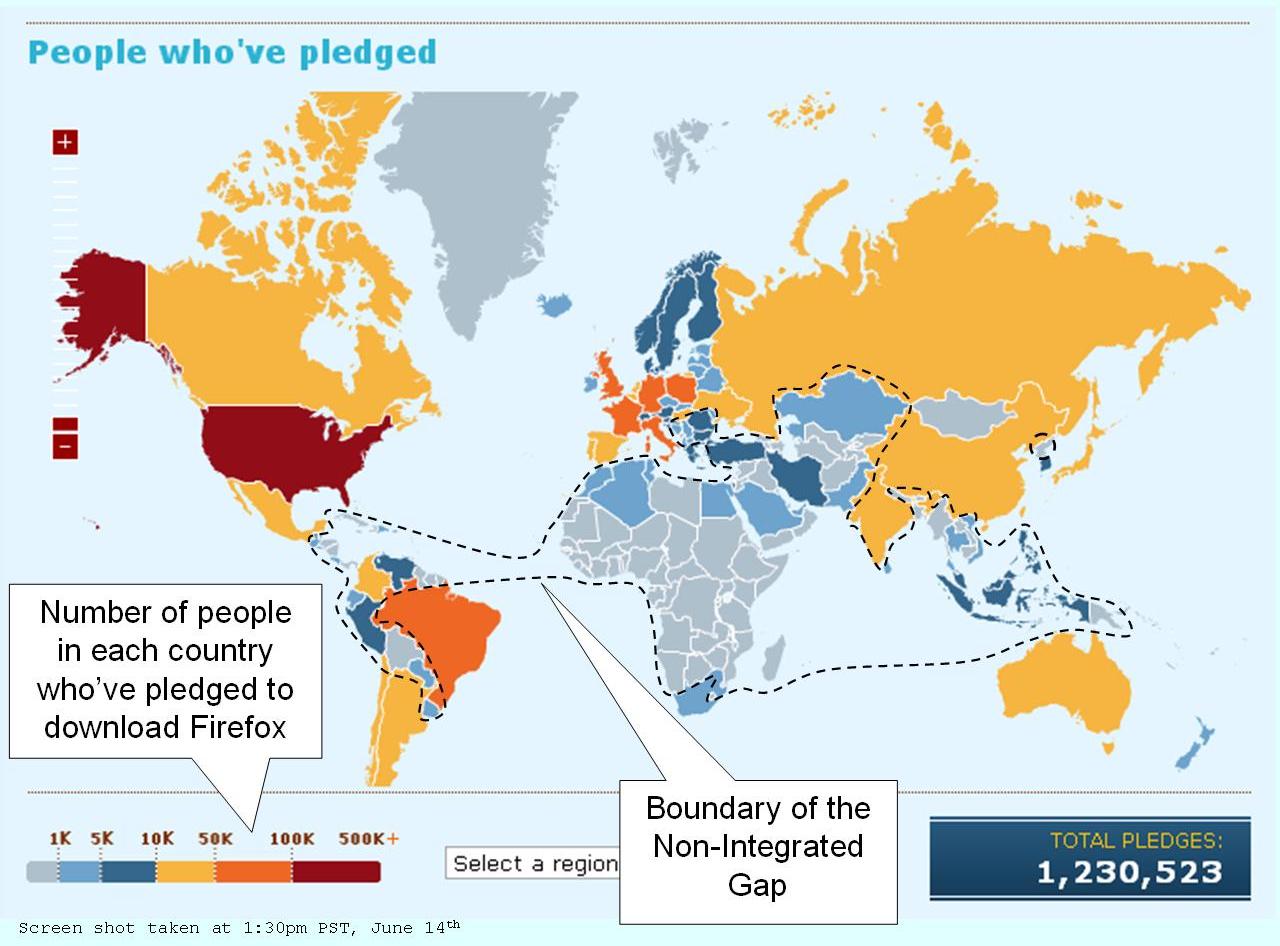
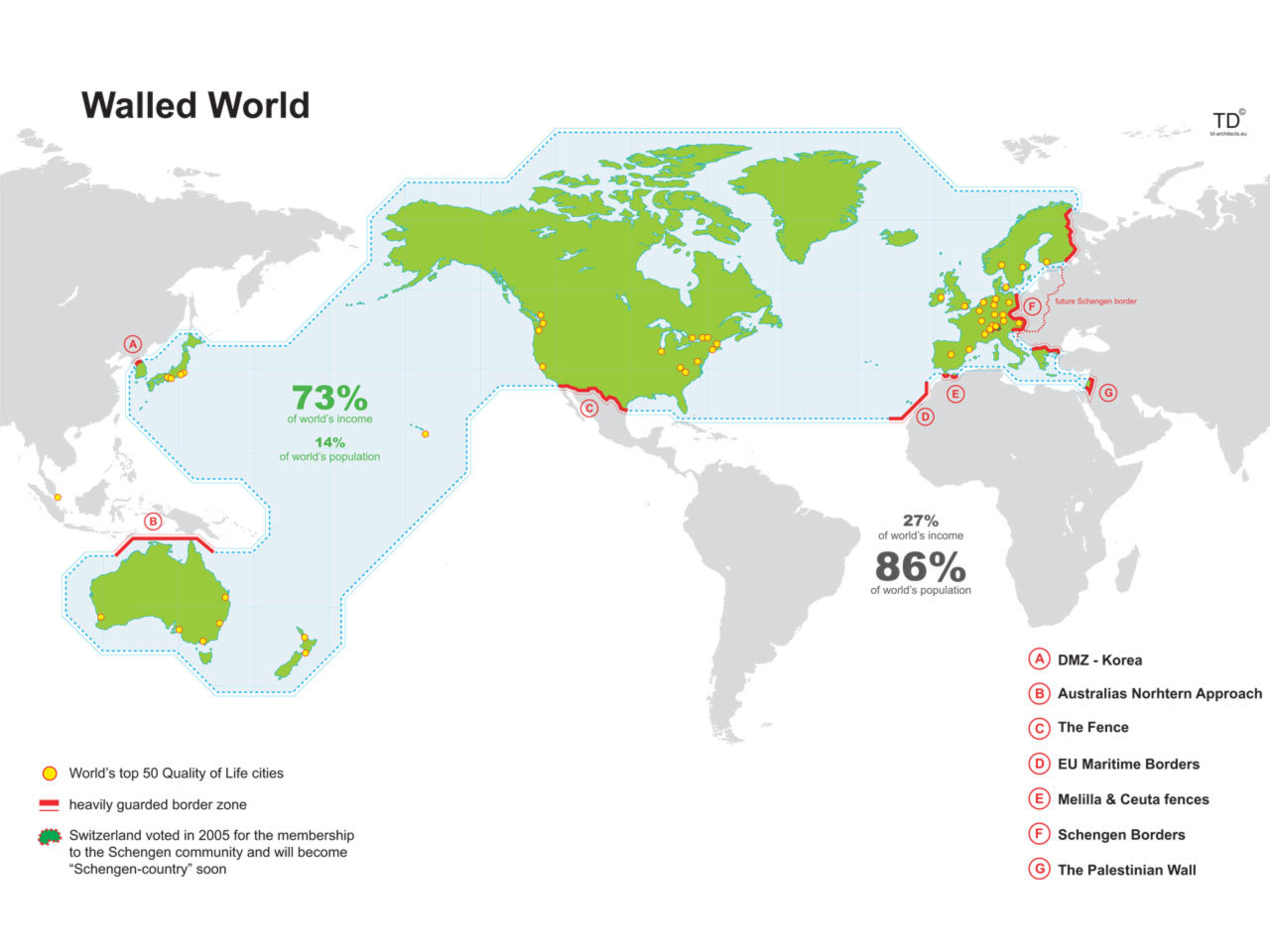
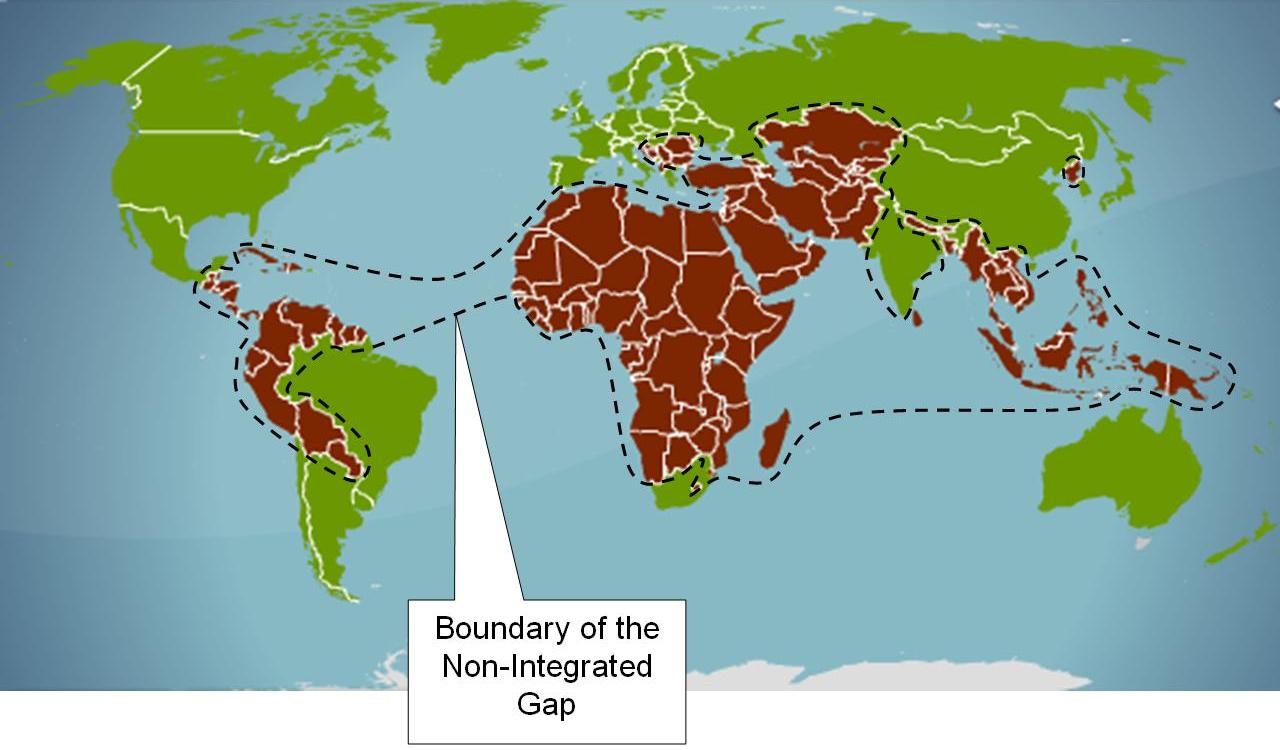
Those who’ve been reading my blog for a long time may remember one of my more popular posts comparing the Firefox 3 Pledge Map (locations of downloads of Firefox 3 back in June 2008) versus Thomas Barnett’s Map (published in The Pentagon’s New Map – his blog here).

PNM%20remixed%202

firefox PNM mash up 2

A little while back a friend shared with me a new map, called The Walled World, that she’d found over at The Raw Feed (a great site, BTW) which offers a similar perspective… but with clearly delineated walls that show who is being kept out of which parts of the world.

the-walled-world-large

All three maps continue reasonate with me. The first offers us a stategic overlay. Which countries are powers/maintainers of the international system – which places are seeking to radical alter it, or cannot seem to become part of the core.

The second shows the virtual implications of that gap. Here, the gap between core and periphery is made starkly clear in technology use.

The final shows the physical manifestation of the gap. A stark reminder of the fences we build and the enormous sums of money and energy poured into keeping certain people out.

As a final note, I do think the third map is slightly misleading. As disturbing as it is, it is actually far, far too flattering to many traditional western powers as it continues to place them at the “centre.” In a world where the United States appears to be in decline this type of map makes China, Brazil, India and Russia (and even South Africa) look like non entities. Nothing could be further from the truth.

Canadian Foreign Policy: The War on Independent Thought

Two stories this week highlight Canada’s rapidly decaying capacity to think, engage and act on foreign policy issues. The first was the Globe’s story Canadian Aid Groups Told to Keep Quiet on Policy Issues, the second is Paul Well’s detailed and devastating account of the implosion of Rights and Democracy, an NGO run by the Federal Government which has seen its entire staff revolt in the face of the political efforts by government to reset its policies.

Both stories hint at a common pattern – that through bullying, funding decisions, appointments and any other means at its disposal – the conservative government is seeking to ensure that any voice in Canada that engages international issues aligns itself with the government’s opinion. In short, this Conservative government is seeking to recentralize Canadian foreign policy. It is an effort that cannot succeed, but in which the attempt will devastate Canada’s influence in the world and negatively impact our capacity to act on the global stage.

Why is this?

Because in the 21st century a country’s foreign policy capacity – especially a small country like Canada – does not spring solely from the size of one’s military and the influence of one’s diplomats. Rather, influence springs from the capacity to tackle and address – increasingly complex – problems. Military might and diplomats can be deeply important but they are increasingly a smaller piece of the puzzle. The real question is, how does a state marshal all the resources and talents at its disposal and focus them on a problem.

In the 19th century the answer was easier. Military might and diplomats were the only tools and so control over these tools – the capacity of a single person (the PM) or group (cabinet) to focus the energy of the state on a problem – was the essence of international influence. But today this is no longer the case. Many of the critical relationships, expertise for addressing problems, volunteering capacity and even funding, lie beyond the control of the state. More importantly, public opinion has become an essential part of any effort. In this world, where the state is only one of many actors, and is one that is frequently looked upon with skepticism, how does one marshal this network or foreign policy ecosystem and attempt to focus it on a problem?

This is the great challenge facing government’s everywhere (especially those of smaller countries where resources outside of government are essential).

The conservative response – outlined above by the Globe and Paul Wells – describes an effort to assert control over these non-state actors and opinion shapers. To bully them into line and force them to not only cooperate with but mimic the government’s priorities.

This strategy will not work.

Over the short term the talent in Canada’s foreign policy network will simply balk. The best will leave for other countries which will seek to engage them on policy, not declare war on independent thought. Today we risk the great “hallowing out” of our foreign policy capacity (and thus international influence) not because the quality of our diplomats or military will decline, but because the quality of our NGO sector will decline.

Moreover, this sector’s international influence depends on independence. Other states and public opinion more generally will not respect Canadian organizations that are seen as merely puppets of the Canadian government. Indeed, expect these types of organizations to see their influence wain to a point where they become insignificant on the international stage. In short, there will be fewer Canadian voices and they will all carry less weight.

Finally however, the ecosystem will adjust. Already many Canadian organizations that work and engage in international issues find it cumbersome to work with Government. People I speak with often eschew CIDA grants since the reporting mechanisms they come with are often more expensive to implement than the value of the grant. Now that Government money is linked with political interference and meddling, an increasing number of organizations will avoid engaging the Canadian government altogether. The result? A NGO sector that is actively hostile – or at best indifferent – to the government and a diminished capacity to coordinate action, research and policy across the Canadian foreign policy ecosystem.  In short, the Canadian government will have no more control over internationally focused resources, but it will have shrunk the country’s collective influence.

In a networked world you can’t control the network, you can only seek to influence it. This government’s actions are a case study in how to lose credibility and sacrifice capacity. If, however, they don’t want a Canada that engages in the world, perhaps, in their mind, it is all worth it.

Carbon Chaos – Celebrating the Launch of an iPhone App

At the beginning of September Gerri Sinclair and I began scheming around me working with a group of her students at the Centre for Digital Media on a project. My initial idea didn’t pan out (more on that in another post) but the students pitched a new idea, one the maintained the original idea of a game that would be fun and that would carry an environmental message.

The result?

Carbon Chaos – an iPhone game designed and built to be fun while educating those who download it about the various advantages and activities of Translink – the transit authority here in the Greater Vancouver area.

And so, with a ton of pride in the students who worked really long hours to create this in a few short weeks here is some beautiful art work they created…

And here is what the game looks like in action…

In short order I hope to share what I learned from the experience and from the students who worked on this (lots of interesting lessons). Needless to say the students deserve infinite praise and I’m eternally grateful to have had the chance to work with them. Amazing, every last one of them. Big thank you’s should also go to their faculty adviser Patrick Pennfather. And finally I know everyone is grateful to TransLink, who sponsored this application and gave it a home. A forward looking organization TransLink, one thinking hard about how technology can transform it – first they opened up their google transit API to the public, then they launched a partnership with Four Square (making each station and a bus a location where you can check in) and of course, they were willing to engage some students on a game they built.

Never, in all my dreams growing up and playing games did I believe that I might one day be a video game producer. Fun, fun, fun. If you have an iPhone, hope you get a chance to download it and see what some emerging developers were able to code up.