Monthly Archives: January 2011

How Yelp Could Help Save Millions in Health Care Costs

Okay, before I dive in, a few things.

1) Sorry for the lack of posts last week. Life’s been hectic. Between Code for America, a number of projects and a few articles I’m trying to get through, the blogging slipped. Sorry.

2) I’m presenting on Open Data and Open Government to the Canadian Parliament Access to Information, Privacy and Ethics Committee today – more on that later this week

3) I’m excited about this post

When it comes to opening up government data many of us focus on Governments: we cajole, we pressure, we try to persuade them to open up their data. It’s approach we will continue to have to take for a great deal of the data our tax dollars pay to collect and that government’s continue to not share. There is however another model.

Consider transit data. This data is sought after, intensely useful, and probably the category of data most experimented with by developers. Why is this? Because it has been standardized. Why has it been standardized. Because local government’s (responding to citizen demand) have been desperate to get their transit data integrated with Google Maps (See image).
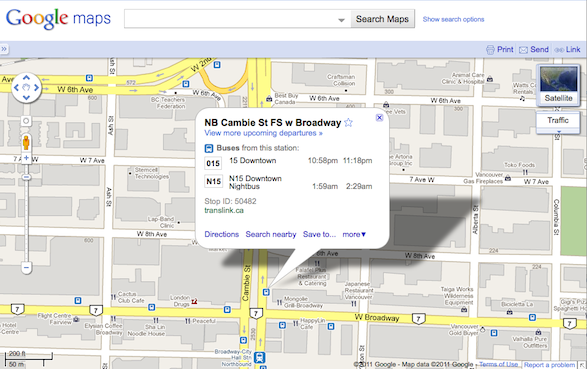
Screen-shot-2011-01-30-at-10.45.00-PM

It turns out, to get your transit data into Google Maps, Google insists that you submit to them the transit data in a single structured format. Something that has come to be known as the General Transit Feed Specification (GTFS). The great thing about the GTFS is that it isn’t just google that can use it. Anyone can play with data converted into the GTFS. Better still, because the data structure us standardized an application someone develops, or analysis they conduct, can be ported to other cities that share their transit data in a GTFS format (like, say, my home town of Vancouver).

In short, what we have here is a powerful model both for creating open data and standardizing this data across thousands of jurisdictions.

So what does this have to do with Yelp! and Health Care Costs?

For those not in the know Yelp! is a mobile phone location based rating service. I’m particularly a fan of its restaurant locator: it will show you what is nearby and how it has been rated by other users. Handy stuff.

But think bigger.

Most cities in North America inspect restaurants for health violations. This is important stuff. Restaurants with more violations are more likely to transmit diseases and food born illnesses, give people food poisoning and god knows what else. Sadly, in most cases the results of these tests are posted in the most useless place imaginable. The local authorities website.

I’m willing to wager almost anything that the only time anyone visits a food inspection website is after they have been food poisoned. Why? Because they want to know if the jerks have already been cited.

No one checks these agencies websites before choosing a restaurant. Consequently, one of the biggest benefits of the inspection data – shifting market demand to more sanitary options – is lost. And of course, there is real evidence that shows restaurants will improve their sanitation, and people will discriminate against restaurants that get poor ratings from inspectors, when the data is conveniently available. Indeed, in the book Full Disclosure: The Perils and Promise of Transparency Fung, Graham and Weil noted that after Los Angeles required restaurants to post food inspection results, that “Researchers found significant effects in the form of revenue increases for restaurants with high grades and revenue decreases for C-graded (poorly rated) restaurants.” More importantly, the study Fung, Graham and Weil reference also suggested that making the rating system public positively impacted healthcare costs. Again, after inspection results in Los Angeles were posted on restaurant doors (not on some never visited website), the county experienced a reduction in emergency room visits, the most expensive point of contact in the system. As the study notes these were:

an 18.6 percent decline in 1998 (the first year of program operation), a 4.8 percent decline in 1999, and a 5.4 per- cent decline in 2000. This pattern was not observed in the rest of the state.

This is a stunning result.

So, now imagine that rather than just giving contributor generated reviews of restaurants Yelp! actually shared real food inspection data! Think of the impact this would have on the restaurant industry. Suddenly, everyone with a mobile phone and Yelp! (it’s free) could make an informed decision not just about the quality of a restaurant’s food, but also based on its sanitation. Think of the millions (100s of millions?) that could be saved in the United States alone.

All that needs to happen is for a simple first step, Yelp! needs approach one major city – say a New York, or a San Francisco – and work with them to develop a sensible way to share food inspection data. This is what happened with Google Maps and the GTSF, it all started with one city. Once Yelp! develops the feed, call it something generic, like the General Restaurant Inspection Data Feed (GRIDF) and tell the world you are looking for other cities to share the data in that format. If they do, you promise to include it in your platform. I’m willing to bet anything that once one major city has it, other cities will start to clamber to get their food inspection data shared in the GRIDF format. What makes it better still is that it wouldn’t just be Yelp! that could use the data. Any restaurant review website or phone app could use the data – be it Urban Spoon or the New York Times.

The opportunity here is huge. It’s also a win for everyone: Consumers, Health Insurers, Hospitals, Yelp!, Restaurant Inspection Agencies, even responsible Restaurant Owners. It would also be a huge win for Government as platform and open data. Hey Yelp. Call me if you are interested.

What Canada’s Realtors could learn from Canada’s Lawyers

Lawyers aren’t generally known to be the most technologically forwarding looking group – but here in Canada they have done one thing really, really well. Making radically efficient the transaction costs around sharing critical information regarding their industry.

CanLII – the non-profit managed by the Federation of Law Societies of Canada has the goal “to make Canadian law accessible for free on the Internet.” In essence CanLII copies all of the materials produced by the courts, organizes it and makes it searchable and re-usable by anyone. For realtors wondering about their future, looking over this service might be a good place to start.

Consider MLS.ca (now rebranded as realtor.ca) the website run by the Canadian Real Estate Association (CREA) that shares information on what homes are for sale where. A few of you may also know that the Competition Bureau and CREA have recently been tangling over access to MLS. While the it is now easier for people to list properties on MLS, the data within MLS is very restricted. Much of the data only realtors can see and re-use of the data appears strictly verboten. These restrictions cause Canadians to suffer from what I like to call the Hulu Syndrome – they can see what a more open system would look like by surfing the various property websites in the United States – but they are stuck using MLS when trying to browse for a home to buy.

Canadian realtors wanting to know what the future looks like for a professional service in a world where data and information is widely available, CanLII offers both a window and a model. Unlike MLS, the great thing about CanLII is that it serves everyone, not just lawyers. It isn’t hard to imagine a world where lawyers insisted that only they can access the cataloging system they pay for (lawyers pay a small annual fee to support CanLII) much like only realtors can access the full database of MLS. In such world if you wanted to read a judgement, or view court documents on a specific case, only a lawyer could access it for you, and then they would interpret it for you, and, to carry the analogy to its logically conclusion, you would rarely or likely never see the original documents.

Thankfully for both the legal system, the market place for legal services and for our democracy, CanLII doesn’t work this way. As mentioned anyone can search, find and download all the information. Indeed, look at CanLII’s Terms of Use:

Subject to the following paragraph and the below conditions pertaining to prohibited use, legal materials published on the CanLII website, such as legislation, regulations and decisions, including editorial enhancements inserted into the documents by CanLII, such as hyperlinks and information in headers and footers, can be copied, printed and distributed by Users free of charge and without any other authorization from CanLII, provided that CanLII is identified as the source of the document.

Compare this to MLS’s terms of use:

This database and all materials on this site are protected by copyright laws and are owned by The Canadian Real Estate Association (CREA) or by the member who has supplied the data. Property listings and other data available on this site are intended for the private, non-commercial use by individuals. Any commercial use of the listings or data in whole or in part, directly or indirectly, is specifically forbidden except with the prior written authority of the owner of the copyright.

(Side note, I’m pretty sure you can’t copyright data – so not sure what the legal rights being exercised here are).

Of course, even though CanLI makes legal documents are freely available, many people still want to use lawyers because they don’t have time or, just as often, realize they need expert advice in this complicated field.

The same would be true of MLS. Many, many buyers will still want to use a realtor, although the buyers and sellers in the market place would be smarter and more informed – but this would probably lead to a better marketplace and happier customers. There are of course, a number of buyers and sellers who will simply freeload off MLS’s data to sell or buy their home on their own (much like some people probably “freeload” off CanLII to represent themselves or do research). But these are probably clients who would prefer to be doing it this way anyway – giving them full access to the database may cause them to a) realize they do need professional help or b) remove customers who don’t really want to use a realtor in the first place and are thus… terrible customers.

This isn’t to say that sharing MLS data won’t be disruptive, I suspect that some people will automate the buying/selling process which a percentage of the market place will prefer to a handheld process – but I suspect that, at some point, this will happen anyway (someone will figure out a model to make it work) at which point CREA and the realtors will have been firmly entrenched in the minds of Canadians as the obstacle to a better, more efficient marketplace, not the leaders who helped foster it.

Lawyers aren’t often known for clarity and simplicity, but clearly when they get it right, they get it right. I hope other professional services will look at what they are up to.

My wish for 2011: Greater comfort with decline and death

Just before Christmas the always awesome Al Emanski asked me if I would write a short answer to a question he was asking a number of people he thought might have interesting answers:

What would you like to become more visible in 2011?

A number of us responded (there are a fair number of cool people on the list and my favourite response so far is by Christian Bason of Mind-Lab in Denmark, who’ve I’ve not met, and whose project I love). You can download all the 500 word responses here.

I wrote the following as my answer. Al was kind enough to include it in his collection and I’m reposting it below as I was rereading it last night, and still feel it’s true a few weeks later. If you want new and better things, it means we also have to learn to let some old ways of doing things go.

Greater comfort with decline and death.

It sounds shocking – and Iʼm being a little over the top. But I mean it.

We are surrounded by institutions, business models and processes that serve us poorly. To me, the definitive example is the Yellow Pages. Here is an unsolicited “service” that is forced upon millions of Canadians, consumes enormous resources to create and distribute, and that is increasingly obsolete with the rise of 411 and the Internet.

Indeed, the stacks of unwanted yellow pages in residential apartment buildings across the country have become alarmingly large. The Yellow Pages are quickly becoming the definitive metaphor of our times: a business that can continue to exist and consume vast resources long after it serves individual or even a collective good. Inertia, not innovation, is the core value.

We can do better. But it means letting things die.

So what Iʼd like is to be more visible in 2011 is death. For Canadians everywhere to look at their lives, their governments, their business or place of work and ask the metaphorical question: Whatʼs the Yellow Pages of my organization?

This is a hard question. And it challenges us in many ways.  Sometimes it may mean we have to stop doing the thing we have become good at, or comfortable with. But we live in such an exciting era where so many new things are possible. But this will only matter if we get comfortable with letting go of the old. As we manage a scarcity of money, resources and time, being able to do this is only going to become more important. It isnʼt easy, but the alternative – a future of continued poorly allocated and inefficiently used resources – is even worse.

The Next International Open Data Hack Day – initial thoughts

Yesterday I got to meet up with Edward Ocampo-Gooding and Mary Beth Baker in Ottawa and we started talking about what the next international open data hackathon: when might be a good time to do it, what might it look like, etc…

One idea is to set a theme that might help inspire people and serve as something to weave the events together in stronger way. Edward proposed the theme of Mom’s and, since, in many, many, many countries, Mother’s day is in May, it seemed like a nice suggestion.

It also has two nice benefits:

  • it gets us away from an exclusive focus on government and might get people in the headspace of creating applications with tangible uses – something almost everyone can relate to
  • many people have mom’s! so getting into the shoes of a mom and imagining what might be interesting, engaging and/or helpful shouldn’t be impossible
  • it might engage new people in the open data movement and in the local events

In addition, another suggestion that was raised is the idea of focusing on a few projects that have already been speced out in advanced – much like Random Hacks of Kindness does with their hackathons. Think this could be fruitful to explore.

Finally, regarding timelines, I’m thinking May. It works thematically (if that theme gets used). More importantly, however, it’s far enough out to plan, near enough to be tangible and sets a nice pace of two global hackathons a year which feels sufficiently ambitious for a group of volunteers, doesn’t crowd out/compete with other hackathons or local events, and seems like a good check in timeline for volunteer driven projects… Also, it might give people a chance to use scrapperwiki in the interim to get data together for projects they want to work on.

Thoughts on all this? Please blog, post a comment below, or if you are feeling shy, drop me a note (david at eaves.ca or @daeaves with hastag #odhd on twitter). I’ve also created a page on the Open Data Day wiki to discuss this if people are more comfortable with that.

What I’m doing at Code for America

For the last two weeks – and for much of January – I’m in San Francisco helping out with Code for America. What’s Code for America? Think Teach for America, but rather than deploying people into classrooms to help provide positive experiences for students and teachers while attempting to shift the culture of school districts, Code for America has fellows work with cities to help develop reusable code to save cities money, make local government as accessible as your favorite website, and help shift the government’s culture around technology.

code-for-america1-150x112The whole affair is powered by a group of 20 amazing fellows and an equally awesome staff that has been working for months to make it all come together. My role – in comparison – is relatively minor, I head up the Code for America Institute – a month long educational program the fellows go through when they first arrive.  I wanted to write about what I’ve been trying to do both because of the openness ideals of Code for America and to share any lessons for others who might attempt a similar effort.

First, to understand what I’m doing, you have to understand the goal. On the surface, to an outsider, the Code for America change process might look something like this:

  1. Get together some crazy talented computer programers (hackers, if you want to make the government folks nervous)
  2. Unleash them on a partner city with a specific need
  3. Take resulting output and share across cities

Which of course, would mistakenly frame the problem as technical. However, Code for America is not about technology. It’s about culture change. The goal is about rethinking and reimagining  government as better, faster, cheaper and adaptive. It’s about helping think of the ways its culture can embrace government as a platform, as open and as highly responsive.

I’m helping (I think) because I’ve enjoyed some success in getting government’s to think differently. I’m not a computer developer and at their core, these successes were never technology problems. The challenge is understanding how the system works, identify the leverage points for making change, develop partners and collaborate to engage those leverage points, and do whatever it takes to ensure it all comes together.

So this is the message and the concept the speakers are trying to impart on the fellows. Or, in other words, my job is to help unleash the already vibrant change agents within the 20 awesome fellows and make them effective in the government context.

So what have we done so far?

We’ve focused on three areas:

1) Understand Government: Some of the fellows are new to government, so we’ve had presentations from local government experts like Jay Nath, Ed Reiskin and Peter Koht as well as the Mayor of Tuscon’s chief of staff (to give a political perspective). And of course, Tim O’Reilly has spoken about how he thinks government must evolve in the 21st century. The goal: understand the system as well as, understand and respect the actors within that system.

2) Initiate & Influence: Whether it is launching you own business (Eric Ries on startups), starting a project (Luke Closs on Vantrash) or understanding what happens when two cultures come together (Caterina Fake on Yahoo buying Flickr) or myself on negotiating, influence and collaboration, our main challenges will not be technical, they will be systems based and social. If we are to build projects and systems that are successful and sustainable we need to ask the right questions and engage with these systems respectfully as we try to shift them.

3) Plan & Focus: Finally, we’ve had experts in planning and organizing. People like Allen Gunn (Gunner) and the folks from Cooper Design, who’ve helped the fellows think about what they want, where they are going, and what they want to achieve. Know thyself, be prepared, have a plan.

The last two weeks will continue to pick up these themes but also give the fellows more time to (a) prepare for the work they will be doing with their partner cities; and (b) give them more opportunities to learn from one another. We’re half way through the institute at this point and I’m hoping the experience has been a rich – if sometimes overwhelming – one. Hopefully I’ll have an update again at the end of the month.

Honourable Mention! The Mozilla Visualization Challenge Update

Really pleased to share that Diederik and I earned an honourable mention for our submission to the Mozilla Open Data Competition.

For those who missed it – and who find opendata, open source and visualization interesting – you can read a description of and see images from our submission to the competition in this blog post I wrote a month ago.

A Response to a Ottawa Gov 2.0 Skeptic

So many, many months ago a Peter R. posted this comment (segments copied below) under a post I’d written titled: Prediction, The Digital Economy Strategy Will Fail if it Isn’t Drafted Collaboratively on GCPEDIA. At first blush Peter’s response felt aggressive. I flipped him an email to say hi and he responded in a very friendly manner. I’ve been meaning to respond for months but, life’s been busy.  However, over the break (and my quest to hit inbox 0) I finally carved out some time –  my fear is that this late response will sound like a counter attack – it isn’t intended as such but rather an effort to respond to a genuine question. I thought it would be valuable to post as many of the points may resonate with supporters and detractors of Gov 2.0 alike. Here’s my responses to the various charges:

The momentum, the energy and the excitement behind collaborative/networked/web 2.0/etc is only matched by the momentum, the energy and the excitement that was behind making money off of leveraged debt instruments in the US.

Agreed, there is a great deal of energy and excitement behind collaborative networks, although I don’t think this is sparked – as ensued, by something analogous to bogus debt instruments. People are excited because of the tangible results created by sharing and/or co-production networks like Wikipedia, Mozilla, Flickr Google search and Google Translate (your results improve based on users data) and Ushahidi inspire people because of the tremendous results they are able to achieve with a smaller footprint of resources. I think the question of what these types of networks and this type of collaboration means to government is an important question – that also means that as people experiment their will be failures – but to equate the entire concept of Gov 2.0 and the above cited organizations, tools and websites with financial instruments that repackaged subprime mortgages is, in my mind, fairly problematic.

David, the onus lies squarely with you to prove that policymakers across government are are incapable of finding good policy solutions WITHOUT letting everyone and his twitting brother chime in their two cents.

Actually the onus doesn’t lie squarely with me. This is a silly statement. In fact, for those of us who believe in collaborative technologies such as GCPEDIA or yammer this sentence is the single most revealing point in the Peter’s entire comment. I invite everyone and anyone to add to my rebuttal, or to Peter’s argument. Even those who argue against me would be proving my point – tools like blogs and GCPEDIA allow ideas and issues to be debated with a greater number of people and a wider set of perspectives. The whole notion that any thought or solution lies solely with one person is the type of thinking that leads to bad government (and pretty much bad anything). I personally believe that the best ideas emerge when they are debated and contested – honed by having flaws exposed and repaired. Moreover this has never been more important than today, when more and more issues cross ministerial divides. Indeed, the very fact that we are having this discussion on my blog, and that Peter deemed it worthy of comment, is a powerful counterpoint this statement.

Equally important, I never said policymakers across government are are incapable of finding good policy solutions. This is serious misinterpretation of what said. I did say that the Digital Economy Strategy would fail (and I’ll happily revise, and soften to say, will likely not be meaningful) unless written on GCPEDIA. I still believe this. I don’t believe you can have people writing policy about how to manage an economy who are outside of and/or don’t understand the tools of that economy. I actually think our public servants can find great policy solutions – if we let them. In fact, most public servants I know spend most of their time trying to track down public servants in other ministries or groups to consult them about the policy they are drafting. In short, they spend all their time trying to network, but using tools of the late 20th century (like email), mid 20th century (telephone), or mid 3rd century BC (the meeting) to do it. I just want to give them more efficient tools – digital tools, like those we use in a digital economy – so they can do what they are already doing.

For the last 8 years I’ve worked in government, I can tell you with absolute certainty (and credibility!) that good policy emerges from sound research and strategic instrument choice. Often (select) public consultations are required, but sometimes none at all. Take 3 simple and highly successful policy applications: seat belts laws, carbon tax, banking regulation. Small groups of policymakers have developed policies (or laws, regs, etc) to brilliant effect….sans web 2.0. So why do we need gcpedia now?

Because the world expects you to do more, faster and with less. I find this logic deeply concerning coming from a public servant. No doubts that government developed policies to brilliant effect before the wide adoption of the computer, or even the telephone. So should we get rid of them too? An increasing number of the world’s major corporations are, or are setting up an internal wiki/collaboration platform, a social networking site, even using microblogging services like Yammer to foster internal collaboration. Indeed, these things help us to do research and develop ideas faster, and I think, better. The question isn’t why do we need GCPEDIA now. The question is why aren’t we investing to make GCPEDIA a better platform? The rest of the world is.

I’ll put this another way: tons of excellent policy solutions are waiting in the shared drives of bureaucrats across all governments.

I agree. Let’s at least put it on a wiki where more people can read them, leverage them and, hopefully, implement them. You sitting on a great idea that three other people in the entire public service have read isn’t a recipe for getting it adopted. Nor is it a good use of Canadian tax dollars. Socializing it is. Hence, social media.

Politics — being what it is — doesn’t generate progressive out solutions for various ideological reasons (applies equally to ndp, lib, con). First, tell us what a “failed” digitial economy strategy (DES) looks like. Second, tell us what components need to be included in the DES for it be successful. Third, show us why gcpedia/wikis offer the only viable means to accumulate the necessary policy ingredients.

For the last part – see my earlier post and above. As for what a failed digital economy strategy looks like – it will be one that is irrelevant. It is one that will go ignored by the majority of people who actually work in the digital economy. Of course, an irrelevant policy will be better than a truly bad one which, which I suspect, is also a real risk based on the proceedings of Canada 3.0. (That conference seemed to be about “how do we save analog business that are about to be destroyed by the digital economy” – a link to one of my favourite posts). And of course I have other metrics that matter to me. That all said, after meeting the public servant in charge of the process at Canada 3.0, I was really, really encouraged – she is very smart and gets it.

She also found the idea of writing the policy on GCPEDIA intriguing. I have my doubts that that is how things are proceeding, but it gives me hope.

Canada's Secret Open Data Strategy?

Be prepared for the most boring sentence to an intriguing blog post.

The other night, I was, as one is wont to do, reading through a random Organization for Economic Coordination and Development report entitled Towards Recovery and Partnership with Citizens: The Call for Innovative and Open Government. The report was, in fact, a summary of its recent Ministerial Meeting of the OECD’s Public Governance Committee.

Naturally, I flipped to the section authored by Canada and, imagine the interest with which I read the following:

The Government of Canada currently makes a significant amount of open data available through various departmental websites. Fall 2010 will see the launch of a new portal to provide one-stop access to federal data sets by providing a “single-window” to government data. In addition to providing a common “front door” to government data, a searchable catalogue of available data, and one-touch data downloading, it will also encourage users to develop applications that re-use and combine government data to make it useful in new and unanticipated ways, creating new value for Canadians. Canada is also exploring the development of open data policies to regularise the publication of open data across government. The Government of Canada is also working on a strategy, with engagement and input from across the public service, developing short and longer-term strategies to fully incorporate Web 2.0 across the government.

In addition, Canada’s proactive disclosure initiatives represent an ongoing contribution to open and transparent government. These initiatives include the posting of travel and hospitality expenses, government contracts, and grants and contribution funding exceeding pre-set thresholds. Subsequent phases will involve the alignment of proactive disclosure activities with those of the Access to Information Act, which gives citizens the right to access information in federal government records.

Lots of interesting things packed into these two paragraphs, something I’m sure readers concerned with open data, open government and proactive, would agree with. So let’s look at the good, the bad and the ugly, of all of this, in that order.

The Good

So naturally the first sentence is debatable. I don’t think Canada makes a significant amount of its data available at all. Indeed, across every government website there is probably no more than 400 data sets available in machine readable format. That’s less that the city of Washington DC. It’s about (less than) 1% of what Britain or the United States disclose. But, okay,let’s put that unfortunate fact aside.

The good and really interesting thing here is that the Government is stating that it was going to launch an open data portal. This means the government is thinking seriously about open data. This means – in all likelihood – policies are being written, people are being consulted (internally), processes are being thought through. This is good news.

It is equally good news that the government is developing a strategy for deploying Web 2.0 technologies across the government. I hope this will be happening quickly as I’m hearing that in many departments this is still not embraced and, quite often, is banned outright. Of course, using social media tools to talk with the public is actually the wrong focus (Since the communications groups will own it all and likely not get it right for quite a while), the real hope is being allowed to use the tools internally.

The Bad

On the open data front, the bad is that the portal has not launched. We are now definitely passed the fall of 2010 and, as for whatever reason, there is no Canadian federal open data portal. This may mean that the policy (despite being announced publicly in the above document) is in peril or that it is simply delayed. Innumerable things can delay a project like this (especially on the open data front). Hopefully whatever the problem is, it can be overcome. More importantly, let us hope the government does something sensible around licensing and uses the PDDL and not some other license.

The Ugly

Possibly the heart stopping moment in this brief comes in the last paragraph where the government talks about posting travel and hospitality expenses. While these are often posted (such as here) they are almost never published in machine readable format and so have to be scrapped in order to be organized, mashed up or compared to other departments. Worse still, these files are scattered across literally hundreds of government websites and so are virtually impossible to track down. This guy has done just that, but of course now he has the data, it is more easily navigable but no more open then before. In addition, it takes him weeks (if not months) to do it, something the government could fix rather simply.

The government should be lauded for trying to make this information public. But if this is their notion of proactive disclosure and open data, then we are in for a bumpy, ugly ride.

Canada ranks last in freedom of information

For those who missed it over the weekend it turns out Canada ranks last in freedom of information study that looked at the world’s western Parliamentary democracies. What makes it all the more astounding is that a decade ago Canada was considered a leader.

Consider two from the Information Commissioner, Suzanne Legault quotes pulled from the piece:

Only about 16 per cent of the 35,000 requests filed last year resulted in the full disclosure of information, compared with 40 per cent a decade ago, she noted.

And delays in the release of records continue to grow, with just 56 per cent of requests completed in the legislated 30-day period last year, compared with almost 70 per cent at the start of the decade.

These are appalling numbers.

The sad thing is… don’t expect things to get better. Why?

Firstly, the current government seems completely uninterested in access to information, transparency and proactive disclosure, despite these being core planks of its election platform and core values of the reform movement that re-launched Canadian conservatism. Indeed, reforming and improving access to information is the only unfulfilled original campaign promise of the Conservatives – and there appears to be no interest in touching it. Quite the opposite – that political staff now intervene to block and restrict Access to Information Requests – contravening the legislation and policy – is now a well known and documented fact.

Second, this issue is of secondary importance to the public. While everyone will say they care about access to information and open government, then number of people (while growing) still remains small. These types of reports and issues are of secondary importance. This isn’t to say they don’t matter. They do – but generally after something bigger and nastier has come to light and the public begins to smell rot. Then studies like this become the type of thing that hurts a government – it gives legitimacy and language to a sentiment people widely feel.

Third, the public seems confused about who they distrust more – the fact is, however bad the current government is on this issue, the Liberal brand is still badly tarnished on this issue of transparent government due to the scandals from almost a decade ago. Sadly, this means that there will be less burden on this government to act since – every time the issue of transparency and open government arise – rather than act, Government leaders simply point out the other parties failings.

So as the world moves on while Canada remains stuck, its government becoming more opaque, distant and less accountable to the people that elect it.

Interestingly , this also has a real cost to Canada’s influence in the world. It means something when the world turns to you as an expert – as we once were on access to information – minister’s are consulted by other world leaders, your public servants are given access to information loops they might otherwise not know about, there is a general respect, a soft power, that comes from being an acknowledged leader. Today, this is gone.

Indeed, it is worth noting that of the countries survey in the above mentioned study, only Canada and Ireland do not have open data portals which allow for proactive disclosure.

It’s a sign of the times.

One Simple Step to Figure out if your Government "gets" Information Technology

Chris Moore has a good post up on his blog at the moment that asks “Will Canadian Cities ever be Strategic?” In it (and it is very much worth reading) he hits on a theme I’ve focused on in many of my talks to government but that I think is also relevant to citizens who care about how technologically sophisticated their government is (which is a metric of how relevant you think you government is going to be in a few years).

If you want to know how serious your government or ministry is about technology there is a first simple step you can take: look at the org chart.

Locate the Chief Information Officer (CIO) or Chief Technology Officer (CTO). Simple question: Is he or she part of the senior executive team?

If yes – there is hope that your government (or the ministry you are looking at) may have some strategic vision for IT.

If no – and this would put you in the bucket with about 80% of local governments, and provincial/federal ministries – then your government almost certainly does not have a strong vision, and it isn’t going to be getting one any time soon.

As Chris also notes and I’ve been banging away at (such as during my keynote to MISA Ontario), in most governments in Canada the CIO/CTO does not sit at the executive table. At the federal level they are frequently Director Generals, (or lower), not Assistant Deputy Minister level roles. At the local level, they often report into someone at the C-level.

This is insanity.

I’m trying to think of a Fortune 500 company – particularly one which operates in the knowledge economy – with this type of reporting structure. The business of government is about managing information… to better regulate, manage resources and/or deliver services. You can’t be talking about how to do that without having the CIO/CTO being part of that conversation.

But that’s what happens almost every single day in many govenrment orgs.

Sadly, it gets worse.

In most organizations the CIO/CTO reports into the Chief Financial Officer (CFO). This really tells you what the organization thinks of technology: It is a cost centre that needs to be contained.

We aren’t going to reinvent government when the person in charge of the infrastructure upon which most of the work is done, the services are delivered and pretty much everything else the org does depends on, isn’t even part of the management team or part of the organizations strategic conversations.

It’s a sad state of affairs and indicative of why our government’s are so slow in engaging in new technology.