Yearly Archives: 2007

The Boomer Factor

I’m not sure what to make of The Boomer Factor. In some ways it’s a fascinating read, a snapshot of how Canadians view themselves at the beginning of the 21st century. But while reading it you can’t help but feel that all the author has done is list stat after stat and link them together with a few sentences. This assessment may be a little unfair, but it reads more like a play by play of the data than as a thought-provoking analysis. Maybe it’s just that there’s very little prose between the streams of stats that inundate the reader.

I should also warn you that I have no capacity to assess whether or not the methodology used to generate these steps is it all sound. If there are true statisticians reading this I’d love your thoughts. That said I did find some of the presentation of the statistics deeply troubling. A notable example is the graph to your right. It shows two bars – one more than twice as large as the other – suggesting an increase of 100 – 120%. And yet, a closer looks at the numbers indicate there’s only been a 12 point difference between the two data points. This visual representation is thus grossly misleading, visually suggesting the argument is much more dramatic than what the data supports.

But these problems aside the book’s author, Reginald Bibby, keys in on several trends that are of interest. Some chapters, like “From Deference to Discernment” have been well documented by others. Others however, such as “From Tomorrow to Today”, a chapter on our quest for more time and the rising expectations we have of one another, along with Chapter 6 “From Knowing too Little to Knowing too Much” on the implications of the Internet and are increasing access to knowledge, are interesting.

But what’s most intriguing about Bibby’s concluding thoughts in these chapters – and the book overall – is that it departs from the book’s title. Bibby seems sanguine about the baby boomers’ capacity to adapt to our changing world, but is exceedingly optimistic about post-boomers – Gen Y and Gen X. Indeed, he terms these emerging generations “Reflective Post-Boomers” and says this about them:

Perhaps to a greater extent than any previous Canadian generation, they (Post-Boomers) have been able to have the time to assess what kind of lives they want to live...

…As they have been assembling their lives, post-boomers have been able to take a good look at how their grandparents, and her parents, lived. They grew up in homes were dads and moms, frankly, were experimenting with how to combine education, careers, raising kids, and marriages. The Post-Boomers saw how things turned out.

Such a vantage point has provided the emerging adult generation a unique opportunity to learn from the pre-boomers and boomer cohorts and extract the best and delete the worst from both. The preliminary evidence suggests that many younger adults are doing just that. They, like the boomers, have moved away from the racist and sexist tendencies of many older Canadians, to an extent as readily exceeding that of boomers. They also have recovered and restored some valuable pre-boomer “files” the boomers had tended either to use infrequently or delete – what people want most, the importance of family life, stability, and religion.on a

They have drawn on the boomers strong emphasis on education, discernment, and information. But they are determined to do a better job of harmonizing such themes with their desire for relationships, time to focus on their children, social compassion, spiritual fulfillment, and the opportunity to simply enjoy life. And so far, at least, they are reporting levels of happiness and for film and that match those of pre-boomers and exceed those of boomers.

Promising developments indeed!

According to his research Bibby also reports that younger Canadians — post-boomers — are more likely to be politically active than their boomer parents. given all the talk about political apathy this conclusion was counterintuitive and interesting. Sadly there wasn’t much discussion before the next statistic was thrust before the reader and the text moved on.

The two places where I think Bibby falls down is in his assessment of how Canadians are associating with one another. He refers repeatedly to the notion of how we’ve shifted from a we to me, while at the same time many of his stats suggest that people are actually deeply interested and engaged in communities. I’m not sure there we’re shifting from a we to me in an absolute sense. What is true is that people are more selective and have more options about who they associate with. Does this mean that we are more “me” focused? Or is it that we can afford to be more “we” focused in ways that make us comfortable?

The other place where Bibby lost me was in his discussion about religion. He suggests that many baby boomers are returning to religion to fill a growing spiritual void in their lives. I confess I don’t know. But this chapter had more analysis and opinion than any other, and so it felt like the story didn’t flow and it was less clear the data supported his assertions. A religious man himself, and an expert on religious trends I couldn’t help but feel that Bibby was inflating this chapter out of personal and professional interest. This could be a gross misunderstanding on my part, but while the rest of the book resonated with my personal experience from what I’ve seen of the country this chapter felt out of place.

Is The Boomer Factor a must read? Not really. But it was nonetheless an enjoyable read. For those interested, it will give you some compelling statistics to reinforce a number of trends you observe, and live with, on a day-to-day basis.

Op-Ed in Yesterday's Toronto Star

Taylor Owen and I published this piece in the Toronto Star on the 10th anniversary of blogging and its impact on news media. (PDF version here)

Blogosphere at age 10 is improving journalism
Jul 30, 2007 04:30 AM
David Eaves & Taylor Owen

Although hard to believe, this month marks the 10th anniversary of blogging, a method for regularly publishing content online.

And what a milestone it is. A recent census of “the blogosphere” counted more than 70 million blogs covering an unimaginable array of topics.

Moreover, every day an astounding 120,000 new blogs are created and 1.5 million new posts are published (about 17 posts per second). Never before have so many contributed so much to our media landscape.

Despite this exponential growth, blogging continues to be misunderstood by both technophiles and technophobes. For the past decade the former have maintained that blogs will replace traditional journalism, ushering in an era of citizen-run media. Conversely, the latter have argued that a wave of amateurs threatens the quality and integrity of journalism – and possibly even democracy.

Both are wrong.

Blogging is not a substitute for journalism. If anything, this past decade shows that blogging and journalism are symbiotic – to the benefit of everyone.

To its many ardent advocates, blogging is displacing traditional journalism. But journalism – unlike blogging – is a practice with a particular set of norms and structures that guide the creation of content. Blogging, despite its unique properties (virtually anyone can reach a potentially enormous audience at little cost), has few, if any norms.

Consider another, more established medium. Books enable various practices, such as fiction, poetry, science and sometimes journalism, to be disseminated. Do books pose a threat to journalism? Of course not. They do the opposite. Journalistic books, like blogs, increase interest in the subjects they tackle and so promote further media consumption.

The same market forces that apply to books and newspapers apply to blogs.

Readers will judge and elect to read based on the same standard: Does it inform, is it well researched and does it add value?

Because blogs are cheaper to maintain they will always be numerous, but this makes them neither unique nor more likely to be read regularly.

Ultimately blogs, like books, don’t replace journalism; they simply provide another medium for its dissemination and consumption.

If technophiles mistakenly claim that blogging competes with – and will ultimately replace – traditional journalism, then technophobes’ fear of being swept away by a tsunami of irrelevant and amateurish blogs is equally misplaced.

Traditionalists’ concern with blogging is rooted in the fact that the average blog is of questionable quality. Ask anyone who has looked, and cringed, at a friend’s blog.

But this conclusion is based on a flawed understanding of how people use the Internet. The Internet’s most powerful property is its capacity to connect users quickly to exactly what they are looking for, including high-quality writing on any subject.

This accounts for the tremendous amount of traffic high-quality blogs receive and explains why these bloggers are print journalists’ true competition. As technology expert Paul Graham argues: “Those in the print media who dismiss online writing because of its low average quality miss the point. No one reads the average blog.”

Once this capability of the Internet is taken into account, the significance of blogging shifts. Imagine that only 5 per cent – or 75,000 – of daily posts are journalistic in content, and that only 1 per cent of these are of high quality. That still leaves 750 high-quality posts published every day.

Even by this conservative assessment, the blogo- sphere still yields a quantity of content that can challenge the world’s best newspapers.

In addition, as a wider range of writers and citizens try blogging, the diversity and quantity of high-quality blogs will continue to increase. Currently, the number of blogs doubles every 300 days. Consequently, the situation is going to get much worse, or depending on your perspective, much better.

As bloggers continue to gain tangible influence in public debates, our understanding of this phenomenon will mature.

And this past decade should serve as a good guide. Contrary to the predictions of both champions and skeptics, blogging has neither displaced nor debased the practice of journalism. If anything, it has made journalism more accurate, democratic and widely read.

Let’s hope blogging’s next decade will be as positive and transformative as the first.

The Trust Economy (or, on why Gen Yers don't trust anyone, except Jon Stewart)

I was listening to Dr. Moira Gunn’s podcast interview of Andrew Keen – author of “The Cult of the Amateur: How Today’s Internet Is Killing Our Culture” – and was struck not only by how Keen’s arguments ate themselves, but how he failed to grasp the internet’s emerging trust economy.

Keen is the new internet contrarian. He argues that the anonymous nature of the internet makes it impossible to trust what anyone says. For example: How do you know this blog really is written by David Eaves? And who is David Eaves? Is he even real? And why should you trust him?

According to Keen, the internet’s “cult of anonymity” creates a low-trust environment rife with lies and spin. But the real problem is how this erosion of trust is spilling over and negatively impacting the credibility of “old media” institutions such as newspapers, news television, movie studies, record labels, and publishing houses. With fewer people trusting – and thus consuming – their products, the traditional “trustworthy” institutions are going out of business and leaving the public with fewer reliable news sources.

Let’s put aside the fact that the decline of deference to authority set in long before the rise of the internet and tackle Keen’s argument head on. Is there a decline of trust?

I’d argue the opposite is true. The more anonymous the internet becomes, and the more it becomes filled with lies and spin, the more its users seek to develop ways to assess credibility and honesty. While there may be lots of people saying lots of silly things anonymously, the truth is, not a lot of people are paying attention, and when they do, they aren’t ascribing it very much value. If anything the internet is spawning a new “trust economy,” one whose currency takes time to cultivate, spreads slowly, is deeply personal, and is easily lost. And who has this discerning taste for media? Generation Y (and X), possibly the most media literate generation(s) to date.

The simple fact is: Gen Yers don’t trust anyone, be it bloggers, newscasters, reporters, movie stars, etc… This is why “The Daily Show with Jon Stewart” is so popular. Contrary to popular opinion, The Daily Show doesn’t target politics or politicians – they’re simply caught in the crossfire – the real target of Stewart et al. is the media. Stewart (and his legions of Gen Y fans) love highlighting how the media – especially Keen’s venerable sources of trustworthy news – lie, spin, cheat and err all the time (and fail to report on the lying, spinning, cheating and errors of those they cover). In short, The Daily Show is about media literacy, and that’s why Gen Yers eat it up.

In contrast, what is being lost is the “blind trust” of a previous era. What Keen laments isn’t a decline in trust, but the loss of a time when people outsourced trust to an established elite who filtered the news and, assessed what was important, and decided what was true. And contrary to Keen’s assertions, those who struggle with this shift are not young people. It is rather the generation unaccustomed to the internet and who lack the media literacy is being made transparent – sometimes for the first time. I recently encountered an excellent example of this while speaking to a baby boomer (a well educated PhD to boot) who was persuaded Conrad Black was innocent because his news source from the trial was Mark Steyn (someone, almost literally, on Black’s payroll). He blindly trusted the Maclean’s brand to deliver him informed and balanced news coverage, a trust that a simple wikipedia search might have revealed as misplaced.

Is there a decline in trust? Perhaps of a type. But it is “blind trust” that is in decline. A new generation of media literates is emerging who, as Dr. Gunn termed it “know that it’s Julia Robert’s face, and someone else’s body, on the Pretty Women posters.” And this skepticism is leading them on their own quest for trust mechanisms. Ironically, it is this very fact that makes Keen’s concerns about old-media unfounded. This search for trust may kill off some established, but untrustworthy “old media” players, but it will richly reward established brands that figure out how to create a more personal relationship with their readers.

Maclean’s: The Black Trial’s other casualty

Maclean’s magazine was just getting interesting again… Andrew Potter (my favourite columnist) was on board, Paul Well’s offered fantastic insights on Ottawa, the new format was edgier and the content more interesting. But Mark Steyn’s coverage of the Black Trial, among some of the worst commentary and news reporting in the country, is a significant step backwards.

I don’t mind biased reporting… everyone has a bias. But it is one thing to have a bias such as “I’m skeptical that non-competes should be criminal under any situation” versus “no matter what evidence is presented, Conrad Black is innocent.” If facts aren’t going to influence you, why go to Chicago? Why be in the court room at all? What insightful analysis could you possibly provide?

If I wanted this type of mindless coverage I’d read one of the numerous conservative blogs.

So won’t somebody in the (Canadian) media stand up and call out the obvious? Mark Steyn is clearly more worried about losing a good reference letter than he is about providing thoughtful analysis or accurate reporting.

What makes this all the sadder are the ridiculous contortions he gets into when reconciling his coverage with other issues.

There was a great example of this yesterday. A reader asked Steyn if he was concerned about the treatment of all convicts or just prisoner Black. So Steyn – now a convert to justice reform – published a list of changes that would improve the US justice system. Listed below is a sample:

Reform 1) “An end to the near universal reliance on plea bargains, a feature unknown to most other countries in the Common Law tradition. This assures that a convicted man is doubly penalized, first for the crime and second for insisting on his right to trial by jury. The principal casualty of this plea-coppers’ parade is justice itself: for when two men commit the same act but the first is jailed for the rest of his life and dies in prison while the second does six months of golf therapy and community theatre on a British Columbia farm and then resumes his business career, the one thing that can be said with certainty is that such an outcome is unjust.”

If one believes that the justice system is only about punishment then I guess Steyn is right. However, the justice system is also about responsibility, rehabilitation and acknowledgment. It offers some latitude to those who accept personal responsibility for their illegal actions. Black might also have enjoyed a more lenient sentence – if he’d acknowledged his guilt.

Reform 2) “An end to the process advantages American prosecutors have accumulated over the years – such as the ability to seize a defendant’s funds and assets and deprive him of the means to hire good lawyers and rebut the charges.”

Ah yes, it was so sad to see Conrad Black – striped of his assets – rely on a public attorney provided by the court. If only he could have afforded Toronto and Chicago’s most elite, prestigious and expensive defense attorneys. If he had, things almost certainly would have gone differently.

Steyn’s clearly not a fan of Black’s defense team. But does he really believe that Black’s case was damaged by his inability to hire one of the most expensive defense teams in North America?

Reform 3) “An end to countless counts. In this case, Conrad Black was charged originally with 14 crimes. That tends, through sheer weight of numbers, to favour a conviction on some counts and acquittal on others as being a kind of “moderate” “considered” “judicious” “compromise” that reasonable persons can all agree on. In other words, piling up the counts hands a huge advantage to the government. In this case, one of the 14 counts was dropped halfway through the trial, and another nine the jury acquitted Conrad on. But the four of the original 14 on which he was convicted are enough. One alone would be sufficient to ruin his life. This is the very definition of prosecutorial excess. Why not bring 20 charges or 30 or 45? After all, the odds of being acquitted of all 45 are much lower than those of being acquitted of 30 or 40.”

Maybe because there were 14 charges worth prosecuting? Either you believe in a jury’s capacity to discern the truth or you don’t. If you don’t trust juries, don’t limit the prosecution, eliminate the jury. Besides, the analysis isn’t even sound. I’ve seen court reporters discuss the opposite effect, about how frivolous charges can taint the credibility of all the counts and so increase the odds of a complete acquittal. But maybe we should cap the number of charges a prosecutor can lay… Of course, by Steyn’s logic this would mean limiting the Picton trial prosecutors to laying charges on 1 or 2 murders since 7 would unfairly weigh the process in favour of the prosecution.

So what’s Steyn’s conclusion?

“Conrad Black would have benefited from the above changes, but so would a lot of nickel’n’dime stumped-tooth losers with tattoos – which is as it should be: Justice is supposed to be blind. But this system is blind drunk on its own power.”

Why? Because according to Steyn’s column and blog, everybody is at fault: the courts, Black’s lawyers, Black’s business partners, the jury, the press, pretty much everyone except Black. In short Black has to be innocent. Consequently some narrative, any narrative, even one that must awkwardly describe a perfect storm of how all the above actors conspiring to bring Black down, must be constructed. Of course, for such a storm to exist the failure of the system must be dramatic, and clearly reform – even radical reform – must be necessary. Hence, the contortions.

It’s a good thing Steyn was in Chicago, providing us with another account of how the system keeps the wealthy, aristocratic white men down. He truly is a modern day Charles Russell.

The end of TV and the end of CanCon?

A few weeks ago I blogged about how the arrival of Joost could eventually require the rethinking of Canadian content rules (CanCon).

For those unfamiliar with CanCon, it is a policy, managed (I believe) by Heritage Canada and enforced by Canada’s broadcasting regulator, the Canadian Radio-television and Telecommunications Commission (CRTC), that establishes a system of quotas to ensure a certain amount of Canadian programming (e.g. music, TV) is broadcast within Canada.

In laymen terms: CanCon ensures that Canadian radio and TV stations broadcast at least some Canadian content. This can be good – making stars out of artists that might not have have received airplay – think The Bare Naked Ladies. And it can be bad, making (usually temporarily) stars out of artists that should never have received airplay – think Snow.

Well I’ve been allowed to serve as a Joost beta tester. After getting my email invitation last week I downloaded a copy.

In essence Joost is like You-Tube, but bigger, faster,  and sleeker. It’s as though Apple’s design team revamped You-Tube from the ground up and, while they were at it, grabbed themselves some partners to provide some more professional content.

But what makes Joost so interesting is how it’s organized. Joost feels like on-demand TV, with content divided into “categories” – such as “documentaries films” – and subdivided into “channels” – such as the “Indieflix channel” and the “Witness channel.” There is already a fair amount of content already available including a number of hour long (or longer) documentaries that are worth watching. (I can’t WAIT until Frontline has a channel up and running. I’d love to be able to watch any Frontline episode, anywhere, anytime, on a full screen.)

So what happens to Canadian content rules when anyone, anywhere can create and distribute content directly to my computer, and eventually, my TV? At this point, the only options left appear to be a) give up, or b) regulate content on the internet. Problematically, regulating internet content and access may be both impossible (even China struggles with this policy objective) and unpopular (I hope you’re as deeply uncomfortable as I am with the government regulating internet content).

The internet has (so far) enabled users to vastly expand the number of media sources available to them, and even create their own media. This has been a nightmare for “traditional media” such as newspapers and television stations, whose younger market demographic has significantly eroded. As a result, these same forces are eroding the government’s capacity to control what Canadians watch.

Which brings us back to option (a). At worst, CanCon is going the way of the Dodo – it will be too difficult to implement and maintain. Indeed a crisis in cultural policy may be looming. On the bright side however, the internet enables ordinary Canadians to create their own media (blogs, podcasts and now even videos) and distribute it over the internet, across the country and around the world. This is a better outcome than CanCon – which essential supports large, established media conglomerates who do Canadian content out of necessity, not passion – could ever have hoped for. Ordinary canadians may now be in the driver seat in creating content. That is a good outcome. Let’s hope any policy that replaces CanCon bears this in mind.

more on segmenting open source communities

I wanted to following up on yesterday’s post about the topology and segmentation of open source communities  with one or two addition comments.

My friend Rahul R. reminded me of the fact that one critical reason we segment is to more effectively allocate time and resources. In a bell shaped vision of the open source community (to get this you really have to read yesterday’s post) it would make sense to allocate the bulk of time on the centre (or average) user. But in a power law distribution, with a massive majority of community participants poorly networked to the project a community may face an important dilemma. Consolidate and focus on current community members, or invest in enabling a group so massive it may seem impossible to have an impact.

But as I reflect on it, this segmentation may create a false choice.

Concentrating on the more connected and active members may not be beneficial. A community needs to cultivate a pipeline of future users. Focusing on current community leaders at the expense of future community leaders will damage the project’s long term viability. More importantly, as discussed yesterday, consolidating and insulating this group may acutally create barriers to entry for new community members by saturating the current key members relationship capacity.

The reverse however, concentrating on a mass of passive users, trying to transform them into more active community members is a daunting task (especially when you are considering a user base of 20-30 million, or even just a beta tester community of 100,000 people). While I think there are a number of exciting things that one can and should do to tackle this segment, it can, and does feel overwhelming. How can you have impact?

The key may be to leverage the super users (or super-nodes – those who are more likely to be connected to people throughout the community) to create a culture that is more inclusive and participatory. Over the long term, successful open source communities will be those capable of not only drawing in new members, but networking them with key operators, decision makers and influencers so that new branches of the community are seeded.

I suspect this does not necessarily occur on to its own. It requires an explicit strategy, supported by training, all of which must be aligned with the community’s values. This will be especially true as newer entrants will have a diverse background (and set of goals and values) then the original community members. Possibly the most effective way to achieve this is to inoculate the super nodes within the community with a degree of openness to diversity, and a capacity for relationship cultivation and management so as to create an open culture that functions well even with a diverse community.

So let’s segment the community- but let’s also use that segmentation to build skills, awareness, etc… in each segment that allows it to contribute to a strategy that transcends each individual segment. For an open source community, I would suggest that, at a minimum, this means offering some training around relationship management, dispute resolution, facilitation and mediation to its super-nodes – e.g. the people most directly shaping the community’s culture.

Open Source Communities – Mapping and Segmentation

I’ve just finished “Linked” by Albert-Laszlo Barabasi (review to come shortly) and the number of applications of his thesis are startling.

A New Map for Open Source Communities

The first that jumps to mind is how it nicely the book’s main point provides a map that explains both the growth and structure of open source communities. Most people likely assume that networks (such as an open source community) are randomly organized – with lots people in the network connected to lots of other people. Most likely, these connections would be haphazard, randomly created (perhaps when two people meet or work together) and fairly evenly distributed.

linked1

If an open-source community was organized randomly and experienced random growth, participants would join the community and over time connect with others and generate new relationships. Some participants would opt to create more relationships (perhaps because they volunteer more time), others would create fewer relationships (perhaps because they volunteer less time and/or stick to working with the same group of people). Over time, the law of averages should balance out active and non-active users.

New entrants would be less active in part because they possess fewer relationships in the community (let’s say 1 or 2 connections). However, these new entrants would eventually became more active as they made new relationships and became more connected. As a result they would join the large pool of average community members who would possess an average number of connections (say 10 other people) and who might be relatively active. Finally, at the other extreme we would find veterans and/or super active members. A small band of relatively well connected members who know a great deal of people (say 60 or even 80 people).

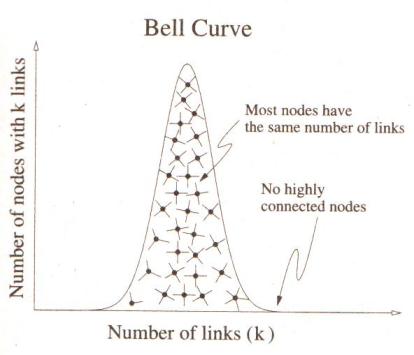
Map out the above described community and you get a bell curve (taken from the book Linked). A few users (nodes) with weak links and a few better connected than the average. The bulk of the community lies in the middle with most people possessing more or less the same number of links and contributing more or less the same amount as everyone else. Makes sense, right?

Or maybe not. People involved in open-source communities probably will remark that their community participation levels does not look like this. This, according to Barabasi, should not surprise us. Many networks aren’t structured this way. The rules that govern the growth and structure of many network – rules that create what Barabasi terms “scale-free networks” – create something that looks, and acts, very differently.

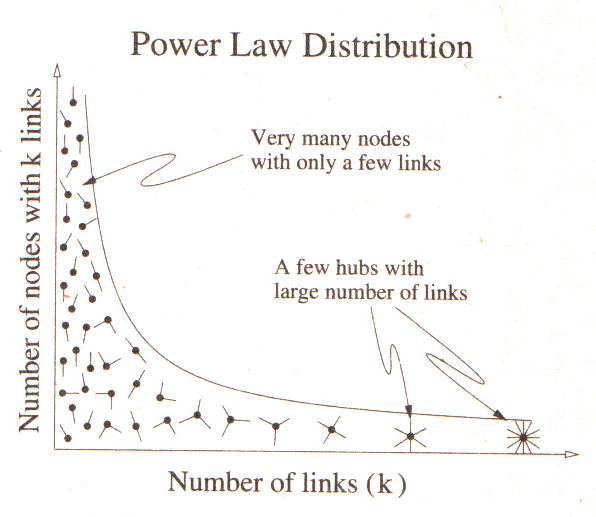
In the above graph we can talk about about the average user (or node) with confidence. And this makes sense… most of us assume that there is such thing as an average user (in the case of opensource movements, it’s probably a “he,” with a comp-sci background, and an avid Simpson’s fan). But in reality, most networks don’t have an average node (or user). Instead they are shaped by what is called a “power law distribution.” This means that there is no “average” peak, but a gradually diminishing curve with many, many, many small nodes coexisting with a few extremely large nodes.

linked2

In an open source community this would mean that there are a few (indeed very few, in relation to the community’s size) power users and a large number of less active or more passive users.

Applying this description to the Firefox community we should find the bulk of users at the extreme left. People who – for example – are like me. They use Firefox and have maybe even registered a bug or two on Firefox’s Bugzilla webpage. I don’t know many people in the community and I’m not all the active. To my right are more active members, people who probably do more – maybe beta test or even code – and who are better connected in the community. At the very extreme and the super-users (or super nodes). These are people who contribute daily or are like Mike Shaver (bio, blog) and Mike Beltzner (bio, blog): paid employees of the Mozilla corporation with deep connections into the community.

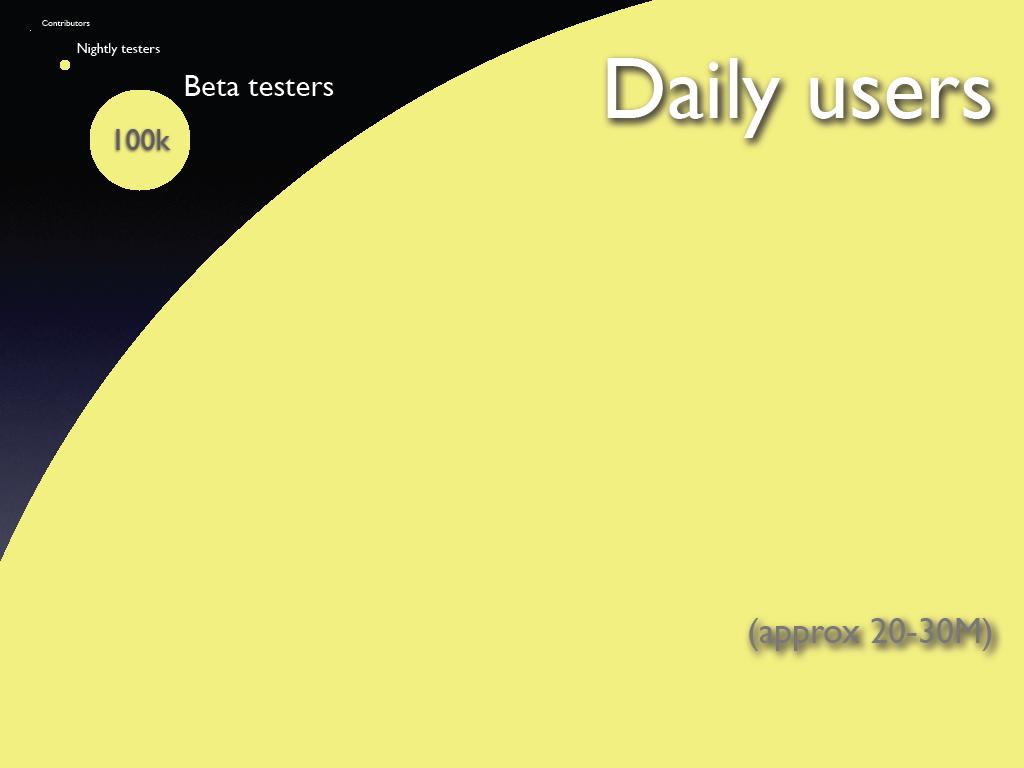
Indeed, Beltzner’s presentation on the FireFox community (blog post here, presentation here and relevant slides posted below) lists a hierarchy of participation level that appears to mirror a power law distribution.

mbslide3

I think we can presume that those at the beginning of the slide set (e.g Beltzner, the 40 member Mozilla Dev Team and the 100 Daily Contributors) are significantly more active and connected within the community than the Nightly Testers, Beta Testers and Daily Users. So the FireFox community (or network) may be more accurately described by a Power Law Distribution.

Implications for Community Management

So what does this mean for open source communities? If Barabasi’s theory of networks can be applied to open source communities – there are at least 3 issues/ideas worth noting:

1. Scaling could be a problem

If open source communities do indeed look like “scale-free networks” then it maybe be harder then previously assumed to cultivate (and capitalize on) a large community. Denser “nodes” (e.g. highly networked and engaged participants) may not emerge. Indeed the existence of a few “hyper-nodes” (super-users) may actually prevent new super-users (i.e. new leaders, heavy participants) from arising since new relationships will tend to gravitate towards existing hubs.

Paradoxically, the problem may be made worse by the fact that most humans can only maintain a limited number of relationships at any given time. According to Barabasi, new users (or nodes) entering the community (or network) will generally attempt to forge relationships with hub-like individuals (this is, of course, where the information and decision-making resides). However, if these hubs are already saturated with relationships, then these new users will have hard time forging the critical relationships that will solidify their connection with the community.

Indeed, I’ve heard of this problem manifesting itself in open source communities. Those central to the project (the hyper nodes) constantly rely on the same trusted people over and over again. As a result the relationships between these individuals get denser while the opportunities for forging new relationships (by proving yourself capable at a task) with critical hubs diminishes.

2. Segmentation model

Under a Bell Shaped curve model of networks it made little sense to devote resource and energy to supporting and helping those who participate least because they made up a small proportion on the community. Time and energy would be devoted to enabling the average participant since they represented the bulk of the community’s participants.

A Power Law distribution radically alters the makeup of the community. Relatively speaking, there are an incredibly vast number of users/participants who are only passively and/or loosely connected to the community compared to the tiny cohort of active members. Indeed, as Beltzner’s slides point out 100,000 Beta testers and 20-30M users vs. 100 Daily Contributors and 1000 Regular Contributors.

The million dollar question is how do we move people up the food chain? How do we convert users and Beta testers and contributors and daily contributors? Or, as Barabasi might put it: how do increase nodes density generally and the number of super-nodes specifically?Obviously Mozilla and others already do this, but segmenting the community – perhaps into the groups laid out by Beltzner – and providing them with tools to not only perform well at that level, but that enable them to migrate up the network hierarchy is essential. One way to accomplish this task would be to have more people contributing to a given task, however, another possibility (one I argue in an earlier blog post) is to simply open source more aspects of the project, including items such as marketing, strategy, etc…

3. Grease the networks nodes

Finally, another way to over come the potential scaling problem of open source is to improve the capacity of hubs to handle relationships thereby enabling them to a) handle more and/or b) foster new relationships more effectively. This is part of what I was highlighting on my post about relationship management as the core competency of open source projects.

Conclusion

This post attempts to provide a more nuanced topology of open source communities by describing them as scale-free networks. The goal is not to ascertain that there is some limit to the potential of open source communities but instead to flag and describe possible structural limitations so as to being a discussion on how they can be addressed and overcome. My hope is that others will find this post interesting and use its premise to brainstorm ideas for how we can improve these incredible communities.

As a final note, given the late hour, I’m confident there may be a typo or two in the text, possible even a flawed argument. Please don’t hesitate to point either out. I’d be deeply appreciative. If this was an interesting read you may find – in addition to the aforementioned post on community management – this post on collaboration vs cooperation in open source communities to be interesting.

If a tree falls in the forest…

If a debate happens in city council, and nobody is around to report on it, does it have an impact?

Last Thursday I noticed that the Toronto edition of the National Post had front page coverage of Toronto’s city council meeting.

Front Page – with a giant picture to boot!

I’m trying to remember the last time a council issue was the lead cover story in the Vancouver Sun… How about the last time there was a photo of a council meeting?

Sadly – from what I can tell – neither The Sun, nor The Province, nor anyone else, have a single reporter exclusively dedicated to Vancouver city hall and municipal politics (if I’m wrong about this please send me a note – who is it?). This is akin to the Globe or National Post failing to assign someone to cover Parliament Hill. Vaughn Palmer does an excellent job covering the BC legislature for The Sun – so why not have someone do the same for municipal politics?

The lack of coverage fosters a city whose political and policy ideas are often unheard and poorly debated, whose municipal scandals go unquestioned and unpublicized and whose council members and mayor go unscrutinized.

Maybe The Sun may feel it simply isn’t profitable to have such a column. I understand (although doubt it). But this function is so important, some solution must be found. Maybe the Vancouver Foundation or some other agency could endow a reporter to cover the City Hall beat.

Or maybe… the Sun should consider outsourcing the role.

Sounds crazy? Admittedly it’s hardly ideal. But a news website in Pasadena, California, recently hired an Indian journalist to cover local politics. The journalist can watch local council meetings over the internet (the same could be done in Vancouver), many documents are available through the city’s website (as they are in Vancouver), and as the editor of the news web site noted “Whether you’re at a desk in Pasadena or a desk in Mumbai, you’re still just a phone call or e-mail away from the interview.” It’s not my favoured solution, but it is better than nothing.

Vancouverites often claim they’re not jealous of Toronto, but maybe we should be. With the Globe, the National Post and the Toronto Star writing regularly about the city’s politics I know I’m feeling envious.

Addition 11:20am PST – David Beers, editor of The Tyee, has emailed me to say: “Was surprised to see you single us out as one who is stingy on coverage of Vancouver city hall. In fact we do have one reporter who has been dogging the issue of homeless housing, covering city council sessions and often the byline on a cover story. Check out Monte Paulsen’s work.”

It is true, the Tyee has more in depth coverage of city hall than anybody else in town… all to glad to be called out on the oversight and hope readers will check out Paulsen’s work. Also, to be fair, the Georgia Straigt does a review of city councilors and talks about municipal politics, but it doesn’t have consistent reporting on the subject.

Job Opportunity with Canada's World

Another Job Opportunity for those interested in Canadian Foreign Policy and International Issues.

Job Opportunity – Ethnocultural Outreach Coordinator

Term: 12 months, 28 hours per week
Rate: $27 per hour
Location: Vancouver
Ideal Start date: September 4, 2007
Application deadline: August 13, 2007

Canada’s World, a project of the SFU Centre for Dialogue, seeks a full-time Ethnocultural Outreach Coordinator to join our national team. Canada’s World is a national citizens’ dialogue aimed at creating a new vision for Canadian international policy. Our secretariat offices are based in Vancouver and we work in collaboration with a series of academic and non-profit organizations across the country.

The Ethnocultural Outreach Coordinator plays a pivotal role in this collaborative initiative. S/he will report to the Director of Canada’s World and work closely with staff, interns, volunteers and advisory committee members in engaging ethnocultural and diaspora communities in a series of dialogues about Canada’s place in the world.

The ideal candidate will be an excellent communicator, well organized, and detail oriented with a passion for, and knowledge of, international policy issues. S/he will be bilingual (French and English), enjoy working in a dynamic work environment and have strong networks within ethnocultural and diaspora communities. S/he will be experienced at facilitating community meetings, compiling tailored resource materials, organizing events and speaking to the media. S/he will possess a post-secondary degree in Arts, Social Sciences or a related field, and enjoy working with people.

Canada’s World is an equal opportunity employer. All interested applicants should submit their cover letter, resume and a 200 word response to the following question: What are the greatest challenges and opportunities facing Canada internationally in the next twenty years?

Applications should be mailed to:
Shauna Sylvestershaunas(at)canadasworld.ca,
Canada’s World Fellow,
SFU Centre for Dialogue,
3303 – 515 West Hastings Street,
Vancouver, B.C. V6B 5K3


It's friday. We should all have a laugh…

Yesterday’s posting on the flaws in the Citizen Assembly process generated a lively debate – one I hope will continue today and tomorrow.

In the meantime, for some comic relief, I’m keen to share my newest geek chic find. It’s called “Piled Higher and Deeper” and it is a comic strip by a grad student at Stanford. For anyone who has been a grad student, the child of professors or worse, both, this comic is painfully, indeed sometimes cruelly, hilarious.

I chose this sample, not because it is the funniest, but because it jives with the main point of this post:

Just in case you were wondering, if you found this funny, you are a geek.

For those brave enough to take the plunge, I recommend starting at the beginning and reading them sequentially.