Monthly Archives: June 2011

How the War on Drugs Destabilized the Global Economy

This is truly, truly fantastic. If you haven’t already read this stunning story from the Guardian: How a big US bank laundered billions from Mexico’s murderous drug gangs. This is, in essence a chronicle how the dark and sordid side of banking and about how one US bank – Wachovia – essentially allowed Mexican drug cartels to launder a whopping $378B.

But this interestingly, is just the tip of the iceberg. It turns out that Mexican money may have been the only thing holding the US financial system together. Check out the following and the last paragraph especially (I’ve bolded it, it is so stunning):

More shocking, and more important, the bank was sanctioned for failing to apply the proper anti-laundering strictures to the transfer of $378.4bn – a sum equivalent to one-third of Mexico’s gross national product – into dollar accounts from so-called casas de cambio (CDCs) in Mexico, currency exchange houses with which the bank did business.

“Wachovia’s blatant disregard for our banking laws gave international cocaine cartels a virtual carte blanche to finance their operations,” said Jeffrey Sloman, the federal prosecutor. Yet the total fine was less than 2% of the bank’s $12.3bn profit for 2009. On 24 March 2010, Wells Fargo stock traded at $30.86 – up 1% on the week of the court settlement.

The conclusion to the case was only the tip of an iceberg, demonstrating the role of the “legal” banking sector in swilling hundreds of billions of dollars – the blood money from the murderous drug trade in Mexico and other places in the world – around their global operations, now bailed out by the taxpayer.

At the height of the 2008 banking crisis, Antonio Maria Costa, then head of the United Nations office on drugs and crime, said he had evidence to suggest the proceeds from drugs and crime were “the only liquid investment capital” available to banks on the brink of collapse. “Inter-bank loans were funded by money that originated from the drugs trade,” he said. “There were signs that some banks were rescued that way.”

But the more interesting part of the story, that picks up on the above quote by Antonio Maria Costa, lies deeper in the story:

“In April and May 2007, Wachovia – as a result of increasing interest and pressure from the US attorney’s office – began to close its relationship with some of the casas de cambio.”

and, a paragraph later…

“In July 2007, all of Wachovia’s remaining 10 Mexican casa de cambio clients operating through London suddenly stopped doing so.”

In other words from April through July, with increasing intensity, Wachovia got out of the drug money laundering business. Of course, this just also happens to be at the exact same time that the liquidity crisis starts hitting US banks prompting “The Bank Run We Knew So Little About.”

This is not to say that the financial crises was caused by drug money – it wasn’t. All those crazy mortgages and masses of consumer debt created a house of cards that was teetering away. But it could be that the sudden end to access of vast billions of Latin America drug money did tip the system over the edge.

I say this because here in Canada we have a government that not only does not believe in harm reduction as an effective way to deal with the drug problem, but it intends to pursue a prison focused US style approach to crime that even the most ardent US conservatives are calling a failure. And why does this matter? I mention the above stories because it is worth noting the size, scope and complexity of problem with face. This is a structural, systemic problem, not something that is going to be solved by throwing an additional 1,000 or even 100,000 people in jail. $378B. Through one bank. One third of Mexico’s GDP. And that’s all just pure profit. That’s probably 80 times more than we spend on fighting the war on drugs every year. Through one bank.

And, as the US authorities appear to have demonstrated it may be that the only thing more expensive than losing the war on drugs is winning a major battle – as apparently that can throw the entire global financial system into disarray. So if we think that upping the amount we spend on this war by $1B or even $10B is going to make a lick of difference, we’ve got another thing coming. But I suppose in the mean time, it will secure a few votes.
Lost Open Data Opportunities

Even sometimes my home town of Vancouver gets it wrong.

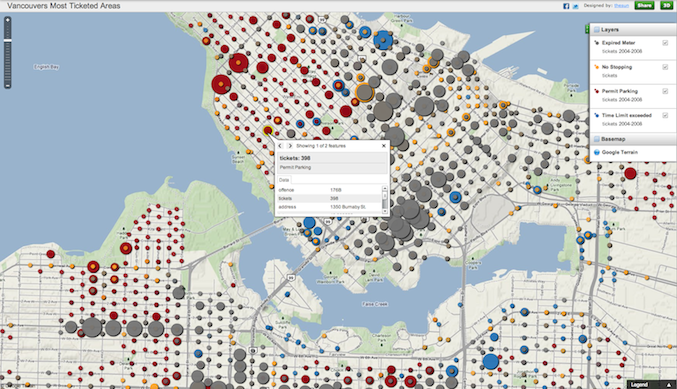
Reading Chad Skelton’s blog (which I frequently regularly and recommend to my fellow Vancouverites) I was reminded of the great work he did creating an interactive visualization of the city’s parking tickets as part of a series around parking in Vancouver. Indeed, it is worth noting that the entire series was powered by data supplied by the city. Sadly, it just wasn’t (and still isn’t) open data. Quite the opposite, it was data that was wrestled, with enormous difficulty, via an FOI (ATIP) request.

parking-tickets

In the same blog post Chad recounts how he struggled to get the parking data from the city:

Indeed, the last major FOI request I made to the city was for its parking-ticket data. I had to fight the city tooth and nail to get them to cough up the information in the format I wanted it in (for months their FOI coordinator claimed, falsely, that she couldn’t provide the records in spreadsheet format). Then, when the parking ticket series finally ran, I got an email from the head of parking enforcement. He was wondering how he could get reprints of the series — he thought it was so good he wanted to hand it out to new parking enforcement officers during their training.

What is really frustrating about this paragraph is the last sentence. Obviously the people who find the most value in this analysis and tool are the city staff who manage parking infractions. So here is someone who, for free(!), provides an analysis and some stories that they now use to train new officers and he had to fight to get the data. The city would have been poorer without Chad’s story and analysis. And yet it fought him. Worse, an important player in the civic space (and an open data ally) feels frustrated by the city.

There are of course, other uses I could imagine for this data. I could imagine the data embedded into an application (ideally one like Washington DC’s Park IT DC – which let’s you find parking meters on a map, identify if they are available or not, and see local car crime rates for the area) so that you can access the risk of getting a ticket if you choose not to pay. This feels like the worse case scenario for the city, and frankly, it doesn’t feel that bad and would probably not affect people’s behaviour that much. But there may be other important uses of this data – it may correlate in some interestingly and unpredictably against other events – connections that if made and shared, might actually allow the city to leverage its enforcement officers more efficiently and effectively.

Of course, we won’t know what those could be, since the data isn’t shared, but it is the kind of thing Vancouver should be doing, given the existence of its open data portal. But all government’s should take note. There is a cost to not sharing data. Lost opportunities, lost insights and value, lost allies and networks of people interested in contributing to your success. It’s all our loss.

Birthday, technology adoption and my happiness

Yesterday I was reminded by the fact that I have great friends – friends who are far better to me than I deserve. You see, yesterday was my birthday and I was overwhelmed with the number of well wishers who sent me a little note.  I’m so, so lucky – something I should never forget.

It was also an illustrative guide to technology adoption and technology is and isn’t impacting my life.

I was struck by the way people got in touch with me. I’m a heavy twitter user and so I don’t spend a lot of time on facebook but yesterday was a huge reminder of how much in the minority I am. While I received maybe 10 mentions or DMs wishing me a happy birthday via twitter (all deeply appreciated) I received somewhere around 100 wall postings and/or facebook messages. Good old email came in at around 15-20 messages. Facebook is simply just big. Huge even. I know that on an intellectual level, but it is great to have these visceral reminders every once in a while. They hit home much harder.

Of course, the results are not a perfect metric of adoption. One thing facebook has going for it that email and twitter don’t is it reminds you of your friends birthdays on its landing page. This is just plain smart of facebook’s part. But it is also interesting in that, knowing this face had no impact on how happy or grateful I was to get messages from people. The fact that technology reminded people – and so they weren’t simply remembering on their own – didn’t matter a lick in how happy I was to hear from them. Indeed, it was wonderful to hear from people – such as old high school friends – I haven’t seen or heard of in ages.

All of this is to say, I continue to read how social media sites and social networks specifically are creating more superficial connections and reducing the quality or intensity of who is a “friend.” My birthday was a great reminder of how ridiculous this talk is. My close friends still reached out, and I got to spend a great day on the weekend with a number of them. Facebook has not displaced them. What it has done however is kept me connected with people who can’t always be close to me, either because of the constraints of geography, or because the evolution of time. Ultimately, these technologies don’t create binary choices between having close intimate friends or lots of weak ties, they are complimentary. My close friends who move away can stay connected to me, and those with whom I form “loose” ties, migrate into my strong ties.

In both cases – for those I get to see frequently and those I don’t – I’m grateful to have them in my life, and that Facebook, twitter and email makes this easier has frankly, made my life richer.