Monthly Archives: August 2011

Shared IT Services across the Canadian Government – three opportunities

Earlier this week the Canadian Federal Government announced it will be creating Shared Services Canada which will absorb the resources and functions associated with the delivery of email, data centres and network services from 44 departments.

These types of shared services projects are always fraught with danger. While they sometimes are successful, they are often disasters. Highly disruptive with little to show for results (and eventually get unwound). However, I suspect there is a significant amount of savings that can be made and I remain optimistic. With luck the analogy here is the work outgoing US CIO Vivek Kundra accomplished as he has sought to close down and consolidate 800 data centres across the US which is yielding some serious savings.

So here’s what I’m hoping Shared Services Canada will mean:

1) A bigger opportunity for Open Source

What I’m still more hopeful about – although not overly optimistic – is the role that open source solutions could play in the solutions Shared Services Canada will implement. Over on the Drupal site, one contributor claims government officials have been told to hold off buying web content management systems as the government prepares to buy a single solution for across all departments.

If the government is serious about lowering its costs it absolutely must rethink its procurement models so that open source solutions can at least be made a viable option. If not this whole exercise will mean the government may save money, but it will be the we move from 5 expensive solutions to one expensive solution variety.

On the upside some of that work has clearly taken place. Already there are several federal government websites running on Drupal such as this Ministry of Public Works website, the NRCAN and DND intranet. Moreover, there are real efforts in the open source community to accommodate government. In the United States OpenPublic has fostered a version of Drupal designed for government’s needs.

Open source solutions have the added bonus of allowing you the option of using more local talent, which, if stimulus is part of the goal, would be wise. Also, any open source solutions fostered by the federal government could be picked up by the provinces, creating further savings to tax payers. As a bonus, you can also fire incompetent implementors, something that needs to happen a little more often in government IT.

2) More accountability

Ministers Ambrose and Clement are laser focused on finding savings – pretty much every ministry needs to find 5 or 10% savings across the board. I also know both speak passionately about managing tax payers dollars: “Canadians work hard for their money and expect our Government to manage taxpayers dollars responsibly, Shared Services Canada will have a mandate to streamline IT, save money, and end waste and duplication.”

Great. I agree. So one of Shared Service Canada’s first act should be to follow in the footsteps of another Vivek Kundra initiative and recreate his incredibly successful IT Dashboard. Indeed it was by using the dashboard Vivek was able to “cut the time in half to deliver meaningful [IT system] functionality and critical services, and reduced total budgeted [Federal government IT] costs by over $3 billion.” Now that some serious savings. It’s a great example of how transparency can drive effective organizational change.

And here’s the kicker. The White House open sourced the IT Dashboard (the code can be downloaded here). So while it will require some work adapting it, the software is there and a lot of the heavy work has been done. Again, if we are serious about this, the path forward is straightforward.

3) More open data

Speaking of transparency… one place shared services could really come in handy is creating some data warehouses for hosting critical government data sets (ideally in the cloud). I suspect there are a number of important datasets that are used by public servants across ministries, and so getting them on a robust platform that is accessible would make a lot of sense. This of course, would also be an ideal opportunity to engage in a massive open data project. It might be easier to create policy for making the data managed by Shared Service Canada “open.” Indeed, this blog post covers some of the reasons why now is the time to think about that issue.

So congratulations on the big move everyone and I hope these suggestions are helpful. Certainly we’ll be watching with interest – we can’t have a 21st century government unless we have 21st century infrastructure, and you’re now the group responsible for it.
Open Source Data Journalism – Happening now at Buzz Data

(there is a section on this topic focused on governments below)

A hint of how social data could change journalism

Anyone who’s heard me speak in the last 6 months knows I’m excited about BuzzData. This week, while still in limited access beta, the site is showing hints its potential – and it still has only a few hundred users.

First, what is BuzzData? It’s a website that allows data to be easily uploaded and shared among any number of users. (For hackers – it’s essentially github for data, but more social). It makes it easy for people to copy data sets, tinker with them, share the results back with the original master, mash them up with other data sets, all while engaging with those who care about that data set.

So, what happened? Why is any of this interesting? And what does it have to do with journalism?

Exactly a month ago Svetlana Kovalyova of Reuters had her article – Food prices to remain high, UN warns – re-published in the Globe and Mail.  The piece essentially outlined that food commodities were getting cheaper because of local conditions in a number of regions.

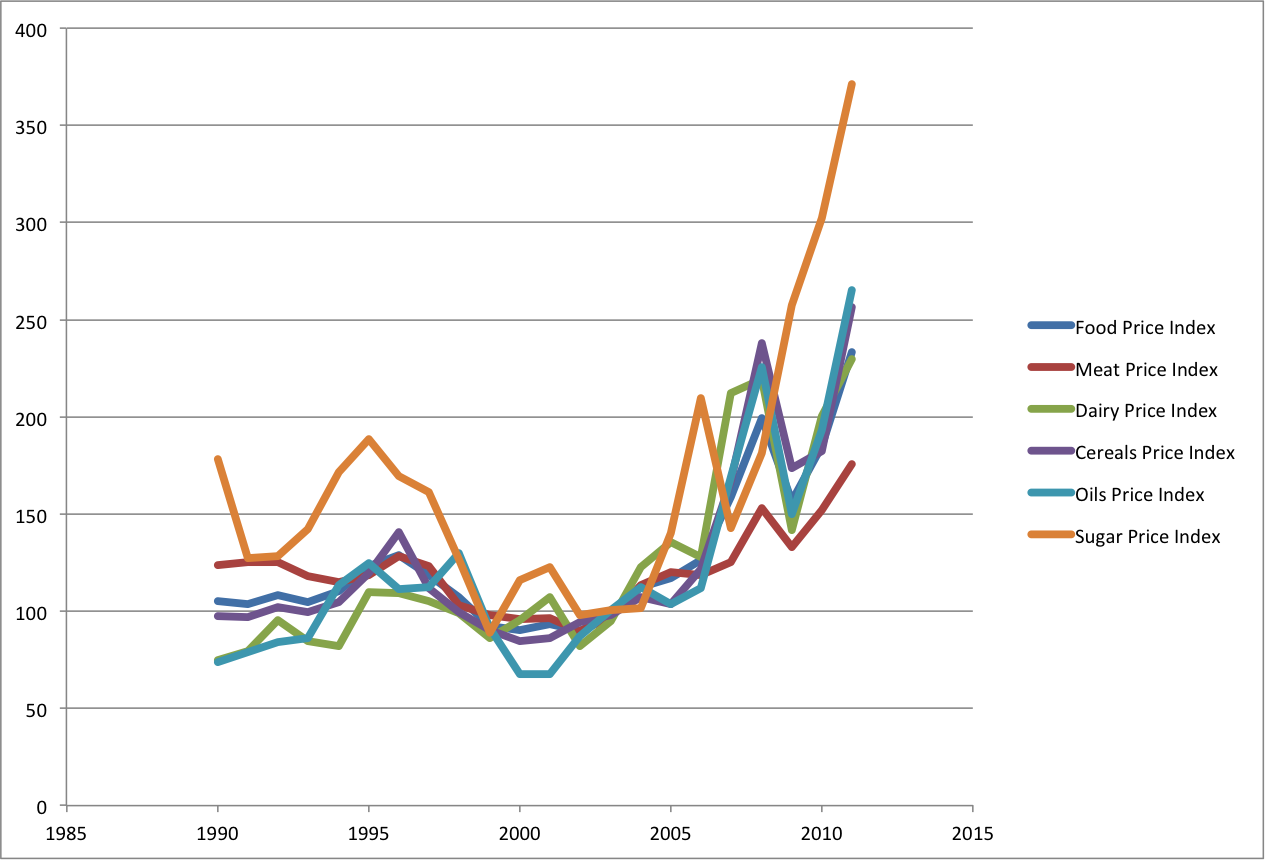
Someone at the Globe and Mail decided to go a step further and upload the data – the annual food price indices from 1990-present – onto the BuzzData site, presumably so they could play around with it. This is nothing complicated, it’s a pretty basic chart. Nonetheless a dozen or so users started “following” the dataset and about 11 days ago, one of them, David Joerg, asked:

The article focused on short-term price movements, but what really blew me away is: 1) how the price of all these agricultural commodities has doubled since 2003 and 2) how sugar has more than TRIPLED since 2003. I have to ask, can anyone explain WHY these prices have gone up so much faster than other prices? Is it all about the price of oil?

He then did a simple visualization of the data.

FoodPrices

In response someone from the Globe and Mail entitled Mason answered:

Hi David… did you create your viz based on the data I posted? I can’t answer your question but clearly your visualization brought it to the forefront. Thanks!

But of course, in a process that mirrors what often happens in the open source community, another “follower” of the data shows up and refines the work of the original commentator. In this case, an Alexander Smith notes:

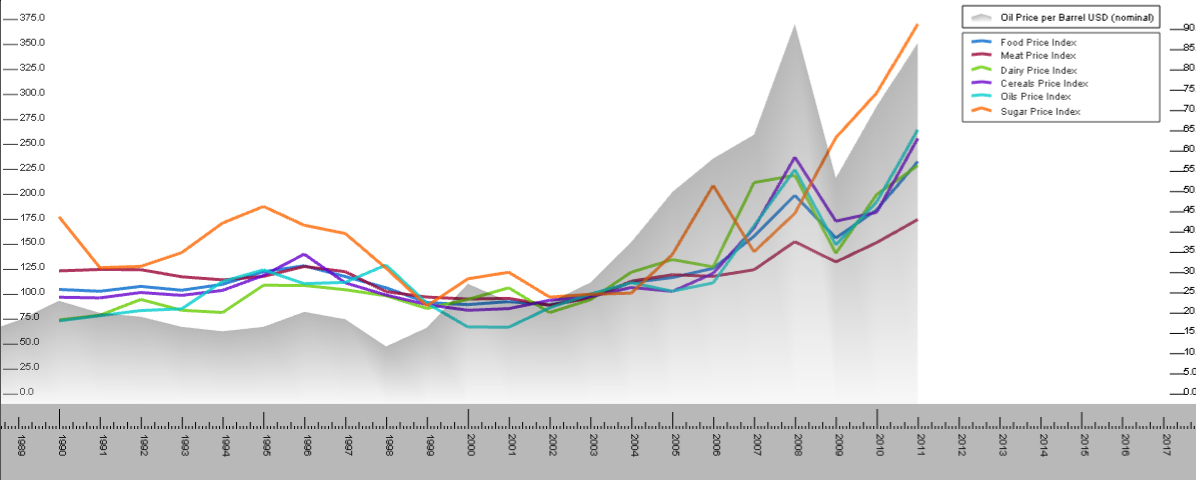
I added some oil price data to this visualization. As you can see the lines for everything except sugar seem to move more or less with the oil. It would be interesting to do a little regression on this and see how close the actual correlation is.

The first thing to note is that Smith has added data, “mashing in” Oil Price per barrel. So now the data set has been made richer. In addition his graph quite nice as it makes the correlation more visible than the graph by Joerg which only referenced the Oil Price Index. It also becomes apparent, looking at this chart, how much of an outlier sugar really is.

oilandfood

Perhaps some regression is required, but Smith’s graph is pretty compelling. What’s more interesting is not once is the price of oil mentioned in the article as a driver of food commodity prices. So maybe it’s not relevant. But maybe it deserves more investigation – and a significantly better piece, one that would provide better information to the public – could be written in the future. In either case, this discussion, conducted by non-experts simply looking at the data, helped surface some interesting leads.

And therein lies the power of social data.

With even only a handful of users a deeper, better analysis of the story has taken place. Why? Because people are able to access the data and look at it directly. If you’re a follower of Julian Assange of wikileaks, you might call this scientific journalism, maybe it is, maybe it isn’t, but it certainly is a much more transparent way for doing analysis and a potential audience builder – imagine if 100s or 1000s of readers were engaged in the data underlying a story. What would that do to the story? What would that do to journalism? With BuzzData it also becomes less difficult to imagine a data journalists who spends a significant amount of their time in BuzzData working with a community of engaged pro-ams trying to find hidden meaning in data they amass.

Obviously, this back and forth isn’t game changing. No smoking gun has been found. But I think it hints at a larger potential, one that it would be very interesting to see unlocked.

More than Journalism – I’m looking at you government

Of course, it isn’t just media companies that should be paying attention. For years I argued that governments – and especially politicians – interested in open data have an unhealthy appetite for applications. They like the idea of sexy apps on smart phones enabling citizens to do cool things. To be clear, I think apps are cool too. I hope in cities and jurisdictions with open data we see more of them.

But open data isn’t just about apps. It’s about the analysis.

Imagine a city’s budget up on Buzzdata. Imagine, the flow rates of the water or sewage system. Or the inventory of trees. Think of how a community of interested and engaged “followers” could supplement that data, analyze it, visualize it. Maybe they would be able to explain it to others better, to find savings or potential problems, develop new forms of risk assessment.

It would certainly make for an interesting discussion. If 100 or even just 5 new analyses were to emerge, maybe none of them would be helpful, or would provide any insights. But I have my doubts. I suspect it would enrich the public debate.

It could be that the analysis would become as sexy as the apps. And that’s an outcome that would warm this policy wonk’s soul.