Yearly Archives: 2011

City of Vancouver Wins Top Innovator Award from BC Business

To be clear, this is not top innovator among governments, this is top innovator among all organizations – for-profit, non-profit and government – in the province.

You can see the award write up here.

As the article states, Vancouver Open-Data initiative “floored the [judging] panel.” Indeed, one panellist stated: “I have never seen a municipality open to new ideas in my life. When was the last time any level of government said, Here are our books; fill your boots?”

Back in October BC Business asked me to write a think piece explaining open data, I ended up penning this piece entitled “The Difference Data Makes”. It fantastic to see the business community recognizing the potential of open data and how it could transform both the way government works, and the opportunities it poses for the private and non-profit organizations as well as citizens.

It’s a great data for the City of Vancouver and for Open Data.

Calgary Launches Business Plan and Budget App

So this is interesting. The City of Calgary has launched a Business Plan & Budget app for free from iTunes.

It’s a smart move as it creates an easy, “one button” option for citizens to participate in and learn about the city’s financial planning process. You can read (a tiny bit) more at the City of Calgary’s blog.

Looking more closely at the app, it doesn’t offer a huge amount but don’t dismiss it too quickly. Consolidating all the information into a single place and making it available to people on the go is a great starting point. Secondly, it is worth remembering that this is just a starting point – there is obviously lots to be learned about how to engage citizens online – especially using mobile technology. If this is done right, Calgary will be learning these lessons first, which means their 2nd and 3rd generation versions of the app and the process will be more sophisticated while others are left catching up (think of Apple and the iPad).

So while the app is fairly light on features today… I can imagine a future where it becomes significantly more engaging and comprehensive, using open data on the data and city services to show maps of where and how money is spent, as well as post reminders for in person meet ups, tours of facilities, and dial in townhall meetings. The best way to get to these more advanced features is to experiment with getting the lighter features right today. The challenge for Calgary on this front is that it seems to have no plans for sharing much data with the public (that I’ve heard of), it’s open data portal has few offerings and its design is sorely lacking. Ultimately, if you want to consult citizens on planning and the budget it might be nice to go beyond surveys and share more raw data and information with them, it’s a piece of the puzzle I think will be essential. This is something no city seems to be tackling with any gusto and, along with crime data, is emerging as a serious litmus test of a city’s intention to be transparent.

The possibilities that Calgary’s consultation app presents are exciting – and again it is early days – so it will be interesting if developers in Calgary and elsewhere can begin to figuring out how to easily extend and enhance this type of approach. Moreover, it’s nice to see a city venturing out and experimenting with this technology, I hope other cities will not just watch, but start experiments of their own, it’s the best way to learn.


Become an IDEO.org Resident

This looks quite interesting.

IDEO, an organization known for bringing spurring innovation, creative thinking and user-friendly design, is looking to focus on the social sector. As part of this effort they are going to be hiring a number of residents to use IDEO’s approach and methodology to focus on pressing social problems around the world. IDEO’s an organization I’ve a lot of time and respect for, certainly somewhere I think it would have been amazing to spend a summer in college or a few years afterwards.

Here’s two snippets from their website:

We’re launching IDEO.org to spread human-centered design through the social sector and improve the lives of people in low-income communities across the globe. IDEO.org is starting this September and looking for its first class of residents to be part of the team. Build empathy, generate ideas, prototype concepts, deliver solutions. Join us!

and

Through the course of 11 months, residents will work on poverty related challenges covering an array of topics – such as, agriculture, gender equity, financial services, health, and water and sanitation. Example projects include working with a microfinance institution in Kenya to create new ways for low-income customers to save, supporting a small Indian start-up to design a low-cost electricity system, or partnering with a domestic healthcare non-profit to bring birth control options to low-income women in the U.S.

Residents will be based in San Francisco, but will spend significant time traveling and in the field. Candidates should have an openness to other cultures and lifestyles and will be expected to be self-reliant and thrive in a start-up environment.

You can read more here. Definitely an opportunity worth checking out.

Access to Information is Fatally Broken… You Just Don’t Know it Yet

I’ve been doing a lot of thinking about access to information, and am working on a longer analysis, but in the short term I wanted to share two graphs – graphs that outline why Access to Information (Freedom of Information in the United States) is unsustainable and will, eventually, need to be radically rethought.

First, this analysis is made possible by the enormous generosity of the Canadian Federal Information Commissioners Office which several weeks ago sent me a tremendous amount of useful data regarding access to information requests over the past 15 years at the Treasury Board Secretariat (TBS).

The first figure I created shows both the absolute number of Access to Information Requests (ATIP) since 1996 as well as the running year on year percentage increase. The dotted line represents the average percentage increase over this time. As you can see the number of ATIP requests has almost tripled in this time period. This is very significant growth – the kind you’d want to see in a well run company. Alas, for those processing ATIP requests, I suspect it represents a significant headache.

That’s because, of course, such growth is likely unmanageable. It might be manageable if say, the costs of handling each requests was dropping rapidly. If such efficiencies were being wrestled out of the system of routing and sorting requests then we could simply ignore the chart above. Sadly, as the next chart I created demonstrates this is not the case.

ATIPcosts

In fact the costs of managing these transactions has not tripled. It has more than quadrupled. This means that not only are the number of transactions increasing at about 8% a year, the cost of fulfilling each of those transactions is itself rising at a rate above inflation.

Now remember, I’m not event talking about the effectiveness of ATIP. I’m not talking about how quickly requests are turned around (as the Information Commissioner has discussed, it is broadly getting worse) nor am I discussing less information is being restricted (it’s not, things are getting worse). These are important – and difficult to assess – metrics.

I am, instead, merely looking at the economics of ATIP and the situation looks grim. Basically two interrelated problems threaten the current system.

1) As the number of ATIP requests increase, the manpower required to answer them also appears to be increasing. At some point the hours required to fulfill all requests sent to a ministry will equal the total hours of manpower at that ministry’s  disposal. Yes that day may be far off, but they day where it hits some meaningful percentage – say 1%, 3% or 5% of total hours worked at Treasury Board, may not be that far off. That’s a significant drag on efficiency. I recall talking to a foreign service officer who mentioned that during the Afghan prisoner scandal an entire department of foreign service officers – some 60 people in all – were working full time on assessing access to information requests. That’s an enormous amount of time, energy and money.

2) Even more problematic than the number of work hours is the cost. According to the data I received, Access to Information requests costs The Treasury Board $47,196,030 last year. Yes, that’s 47 with a “million” behind it. And remember, this is just one ministry. Multiply that by 25 (let’s pretend that’s the number of ministries, there are actually many more, but I’m trying to be really conservative with my assumptions) and it means last year the government may have spent over $1.175 Billion fulfilling ATIP requests. That is a staggering number. And its growing.

Transparency, apparently, is very, very expensive. At some point, it risks becoming too expensive.

Indeed, ATIP reminds me of healthcare. It’s completely unsustainable, and absolutely necessary.

To be clear, I’m not saying we should get rid of ATIP. That, I believe, to be folly. It is and remains a powerful tool for holding government accountable. Nor do I believe that requesters should pay for ATIP requests as a way to offset costs (like BC Ferries does) – this creates a barrier that punishes the most marginalized and threatened, while enabling only the wealthy or well financed to hold government accountable.

I do think it suggests that governments need to radical rethink how manage ATIP. More importantly I think it suggests that government needs to rethink how it manages information. Open data, digital documents are all part of a strategy that, I hope, can lighten the load. I’ve also felt that if/as government’s move their work onto online platforms like GCPEDIA, we should simply make non-classified pages open to the public on something like a 5 year timeline. This could also help reduce requests.

I’ve more ideas, but at its core we need a system rethink. ATIP is broken. You may not know it yet, but it is. The question is, what are we going to do before it peels off the cliff? Can we invent something new and better in time?

The Canadian Election – Conservatives put Harper's Reputation on the line

Sadly, not a lot of issues of come up so far in the Canadian election. Rather than talk ideas or about the challenges confronting the country we’ve been mired in a debate about one thing: coalition governments.

On the surface, as John Ibbitson points out, this has been a win for Stephen Harper. But I’m not so sure it will remain that way.

I’ve always felt that Harper’s greatest strength has been his perceived integrity. Canadians don’t particularly like Stephen Harper – nobody wants to have him over or to sit down for a beer with him. And many believe he is overly thuggish and ruthless. But most have come to trust him. But now, with Giles Duceppe running around waiving a signed letter between him, Harper and Layton, and Layton talking about how a Conservative-NDP-Block coalition was “on the table” the hypocrisy of the coalition argument, could be slowly eroding Harper’s brand. Combine it with the unwillingness of the Conservative government to disclose the real price of new fighter jets and the crime bill/new prisons and the mix could become toxic.

The flip side of the problem is that no one really cares for Ignatieff either. So getting that message to stick won’t be easy – but it’s probably the best chance the Liberals have had in a number of years with Mr. Harper. Indeed, on my flight to Toronto yesterday I asked 2 women sitting next to me what they thought of the election and they both said – “anyone but Harper” even though they thought “they were all pigs, but let’s give a new pig a chance.” Hardly flattering words for anyone, (and definitely not a representative sample) but harsh indictment of our politicians and potentially an ill omen for the governing party.

Finally, the one exception I’ve seen to the non-issue based campaign was out west where Jack Layton hammered on the HST issue. I thought this was an interesting strategy. From what I can tell living in BC most residents associate the HST decision with the provincial, not federal government. Moreover the anger of the tax has clearly waned. As Vaughn Palmer’s recent article “Recall campaigns test notion that any publicity is good publicity” outlines the issue has lost traction among the public. If the NDP can reignite and exploit it I’ll be impressed. But the strategy is not without risk, given people appear to have moved Layton risks seeming behind the times, and trying to exploit an issue for crass political gain, rather than addressing something that really worries BCers. Will be interesting to see if it the HST issue sizzles, fizzles or implodes.

Election Mashup!

Since we are, apparently, heading into an election up here in Canada, I thought it would be great time to share this fantastic website my friend Diederik Van Liere recently pointed out to me.

The site, created by Montreal developer Cedric Sam, is a mashup of 2008 federal election and polling data, federal open data from the Geogratis website and Google Earth. It allows users to see how support for candidates was distributed within ridings. Something any political junkie could enjoy.

You can read more about the project on Cedric’s blog. Here’s his description:

I used cartographic data from the Geogratis.gc.ca website. I imported the Shapefiles to a PostgreSQL database with Postgis. Then, I processed results by polling divisions from the 2008 election, data available on the Elections Canada website. It was put in a separate table on the same database. A custom program in Python using the very handy libkml (a code library developed and supported by Google) took the data and outputted pretty KML code. It was packed as a KMZ and uploaded to my webspace. [E-mail me, if you want to exchange ideas on the code].

I of course love the fact that Cedric, like many great hackers I meet, is always keen to work with others to make the code better or explore how it might be enhanced.

As I now live in Vancouver Centre I obviously couldn’t resist pulling it up. Here’s a screen shot… but I encourage you to check out the site yourself!

Screen-shot-2011-03-23-at-11.59.48-PM

New Canadian Award on Transparency: Grace-Pépin Access to Information Award

Last week I received an email from the Information Commissioner of Canada who, in collaboration with her provincial and territorial counterparts, has announced the creation of the Grace-Pépin Access to Information Award. If you know someone you think might be deserving of nomination there are more details here, including access to the nomination document.

Below is a blurb the office sent me promoting what I believe is a noteworthy award.

Do you take any opportunity to promote access to information? Do you spend your free time developing tools that facilitate access to information? Do you regularly ask for information under the Access to Information Act? Do your activities require public institutions to comply with policies that optimize transparency? Or, do you know someone who fits the above description?

If you answered yes to one of these questions, if you are involved in any other activities that promote access to information and increase government transparency and accountability, or if you know someone who does, Canada’s federal, provincial and territorial Access to Information and Privacy Commissioners want to recognize these efforts and invite you to submit a nomination to the first-ever Grace-Pépin Access to Information Award!

The Grace-Pépin Award was introduced on September 29 by the federal, provincial and territorial Access to Information and Privacy Commissioners. Presented in memory of John Grace, former Information Commissioner of Canada, and Marcel Pépin, president and founder of the Commission d’accès à l’information du Québec, the award recognizes those who promote access to information principles in Canada.

For more information on the Grace-Pépin Access to Information Award, visit the section about the award on the official Right to Know Web site.

Game Theory: Coalition, Libya, Gaddafi and the exit strategy

Great question Andrew – one that deserves answering.

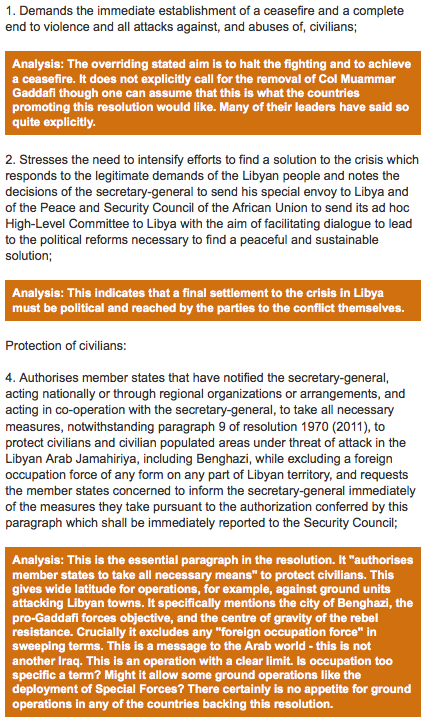
Here’s my quick assessment. My guess is that the intention of the military action is to give Gaddafi alternatives to fighting. The goal of the no-fly zone and other military activities is designed to bring about a stalemate in the Libyan conflict. It’s goal is to provide the rebels with a clear safe haven which they can defend and sustain themselves. This fact, over time, would foster circumstances by which a negotiated agreement (or internationally mediated agreement) between the Libyan government and the rebels would be seen as necessary by both parties. This could, of course, come about with (or without) Gaddafi’s endorsement – but it would leave him some leverage if he chose to go down this path. Indeed, this political negotiated outcome is an explicit goal of the UN resolution. Moreover, the removal of Gaddafi is not called for. There is a wonderful analysis of the resolution on the BBC website, I’ve extracted the relevant parts below:

Screen-shot-2011-03-20-at-4.48.03-PM

The stalemate outcome analysis also feels plausible given it is hard to imagine the Libyan rebels have either the equipment, training, resources and resolve to topple the Libyan government, with or without air support. Occupying vast swaths of the country may simply be sufficient for the rebels to achieve their goals – to force Gaddafi to accept he can no longer rule the country alone.

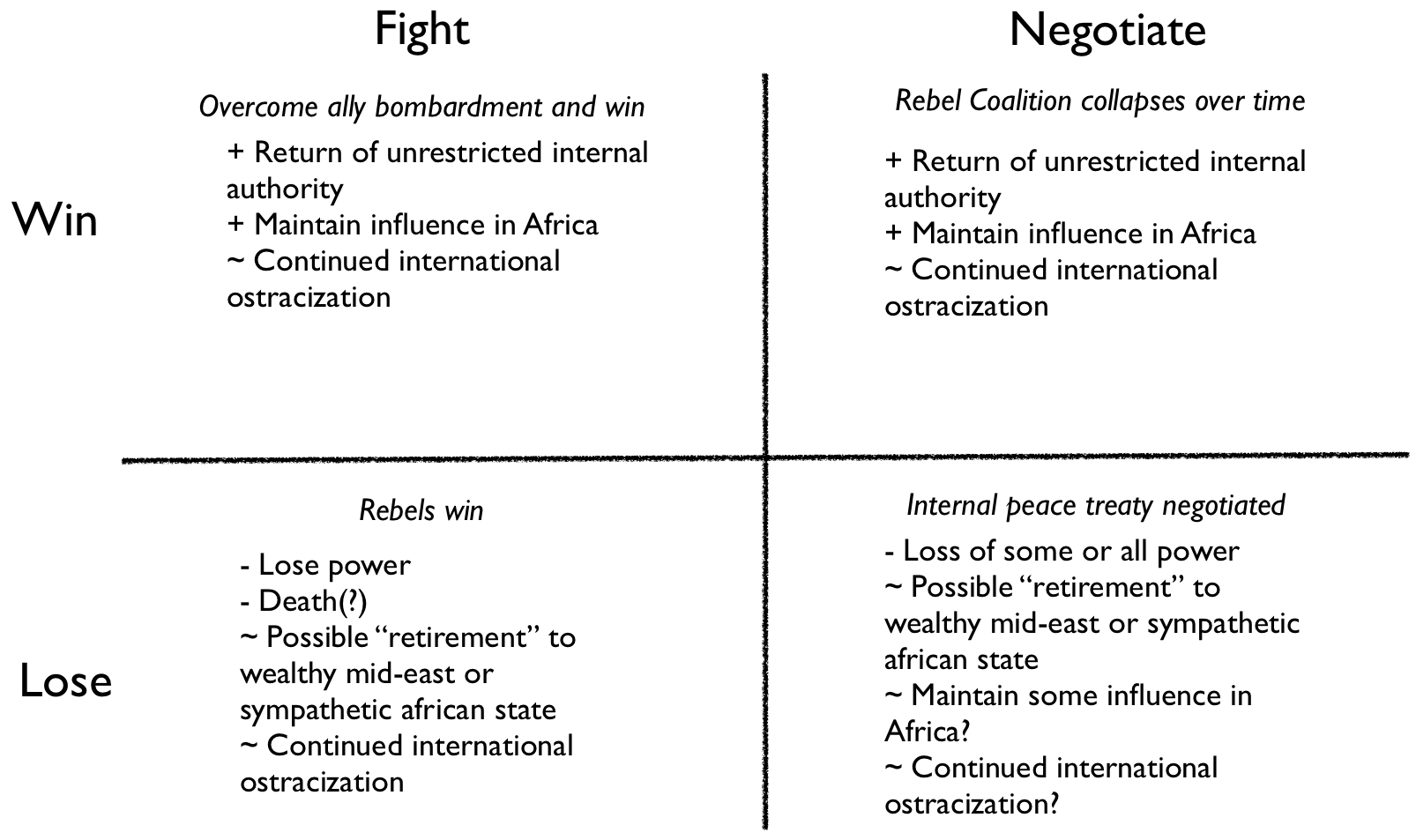
So in short, Gaddafi has as simple choice. He can fight and try to win outright (or gain enough leverage so as to create a negotiated outcome that would achieve the same outcome as winning). This has the benefit of huge upside if he wins (with disastrous outcomes from the west – expect some retaliatory terrorism) but it also has more dramatic downsides. If he loses, a complete loss of power, death and/or imprisonment all seem very likely. So this is a high stakes path.

Alternatively, he can choose to negotiate. This route has more ambiguity, something that presents a risk in of itself (a reason why the back channels will matter so much – see below). Here the upsides and downsides are slightly less extreme, although there is a possibility of an outright “win” for Gaddafi is not off the table completely.

Given these choices it wouldn’t be inconceivable for Gaddafi to choose to fight at first to test the resolve of the Allies and the rebels (something we are seeing now) and, should that not work (which it probably won’t, but could) he can always change gears and retreat into a stalemate negotiation and put forward offers that attempt to fracture the rebel coalition. If he can do that, he could still win back enough support to retake the country, find some way to influence the next government, or at worst, be forced to retire.

I’ve tried to sum all this up on a choice matrix below. The sum of it is, the top lefthand outcome seemed a certain outcome a few days ago. Now the allies are forcing the right column back into the picture. Have downsides down the left become significant enough? And the upsides or exit strategies for Gaddafi on the right certain enough to chance the calculus? That’s really the question – but I do think it remains a possibility.

david-eaves-gaddafi-analysis

There are, of course, at least two other parts of the puzzle that need to be in place to ensure that Gaddafi isn’t forced into fighting.

1. Someone would need to back channel to him the allies intentions: that the UN resolution is designed only to force a stalemate, not oust the current government. It might be logical for Gaddafi to then try to continue fighting and see if he can win despite the airstrikes (as this would maximize his leverage) and, he can always choose to back down later.

2. The western allies and the rebels would need to not interpret the retreat or adoption of a defensive posture by Gaddafi forces as signs of imminent collapse and try to press the advantage.

Obviously I do not know if condition number 1 is in place. In regards to condition number 2, this is also unclear, although I suspect the risks are relatively low. The UN resolution would appear to suggest this isn’t as possible but maybe the biggest unknown is France, which appears unusually keen for battle. The worst case scenario here is that Sarkozy sees the conflict as a way to establish is “presidentialness” in the lead up to an election and so seeks to exploit it, dragging the rebels, and the rest of the allies down a path that needn’t be trodden. But even here, the likelihood feels relatively low.

Of course, there are always thousands of other variables and I’m sure there are more than a few holes to poke in this analysis (I’m all ears for those who want to take a stab – would be great to hear more), but hope this is a helpful attempt to answer that important question. If the only choice you give someone is to fight, expect a fight. And it isn’t clear that we have the resources or stomach to fight back to the bitter end, so I hope someone in Paris or Washington DC has thought this through from this perspective.

Canada launches data.gc.ca – what works and what is broken

Those on twitter will already know that this morning I had the privilege of conducting a press conference with Minister Day about the launch of data.gc.ca – the Federal Government’s Open Data portal. For those wanting to learn more about open data and why it matters, I suggest this and this blog post, and this article – they outline some of the reasons why open data matters.

In this post I want to review what works, and doesn’t work, about data.gc.ca.

What works

Probably the most important thing about data.gc.ca is that it exists. It means that public servants across the Government of Canada who have data they would like to share can now point to a website that is part of government policy. It is an enormous signal of permission from a central agency that will give a number of people who want to share data permission, a process and a vehicle, by which to do this. That, in of itself, is significant.

Indeed, I was informed that already a number of ministries and individuals are starting to approach those operating the portal asking to share their data. This is exactly the type of outcome we as citizens should want.

Moreover, I’ve been told that the government wants to double the number of data sets, and the number of ministries, involved in the site. So the other part that “works” on this site is the commitment to make it bigger. This is also important, as there have been some open data portals that have launched with great fanfare, only to have the site languish as neither new data sets are added and the data sets on the site are not updated and so fall out of date.

What’s a work in progress

The number of “high value” datasets is, relatively speaking, fairly limited. I’m always cautious about this as, I feel, what constitutes high value varies from user to user. That said, there are clearly data sets that will have greater impact on Canadians: budget data, line item spend data by department (as the UK does), food inspection data, product recall data, pretty much everything on the statscan website, Service Canada locations, postal code data and, mailbox location data, business license data, Canada Revenue data on charities and publicly traded companies are all a few that quickly come to mind, clearly I can imagine many, many more…

I think the transparency, tech, innovation, mobile and online services communities will be watching data.gc.ca closely to see what data sets get added. What is great is that the government is asking people what data sets they’d like to see added. I strongly encourage people to let the government know what they’d like to see, especially when it involves data the government is already sharing, but in unhelpful formats.

What doesn’t work

In a word: the license.

The license on data.gc.ca is deeply, deeply flawed. Some might go so far as to say that the license does not make it data open at all – a critique that I think is fair. I would say this: presently the open data license on data.gc.ca effectively kills any possible business innovation, and severally limits the use in non-profit realms.

The first, and most problematic is this line:

“You shall not use the data made available through the GC Open Data Portal in any way which, in the opinion of Canada, may bring disrepute to or prejudice the reputation of Canada.”

What does this mean? Does it mean that any journalist who writes a story, using data from the portal, that is critical of the government, is in violation of the terms of use? It would appear to be the case. From an accountability and transparency perspective, this is a fatal problem.

But it is also problematic from a business perspective. If one wanted to use a data set to help guide citizens around where they might be well, and poorly, served by their government, would you be in violation? The problem here is that the clause is both sufficiently stifling and sufficiently negative that many businesses will see the risk of using this data simply too great.

UPDATE: Thursday March 17th, 3:30pm, the minister called me to inform me that they would be striking this clause from the contract. This is excellent news and Treasury Board deserves credit for moving quickly. It’s also great recognition that this is a pilot (e.g. beta) project and so hopefully, the other problems mentioned here and in the comments below will also be addressed.

It is worth noting that no other open data portal in the world has this clause.

The second challenging line is:

“you shall not disassemble, decompile except for the specific purpose of recompiling for software compatibility, or in any way attempt to reverse engineer the data made available through the GC Open Data Portal or any part thereof, and you shall not merge or link the data made available through the GC Open Data Portal with any product or database for the purpose of identifying an individual, family or household or in such a fashion that gives the appearance that you may have received or had access to, information held by Canada about any identifiable individual, family or household or about an  organization or business.”

While I understand the intent of this line, it is deeply problematic for several reasons. First, many business models rely on identifying individuals, indeed, frequently individuals ask businesses to do this. Google, for example, knows who I am and offers custom services to me based on the data they have about me. It would appear that terms of use would prevent Google from using Government of Canada data to improve its service even if I have given them permission. Moreover, the future of the digital economy is around providing customized services. While this data has been digitized, it effectively cannot be used as part of the digital economy.

More disconcerting is that these terms apply not only to individuals, but also to organizations and businesses. This means that you cannot use the data to “identify” a business. Well, over at Emitter.ca we use data from Environment Canada to show citizens facilities that pollute near them. Since we identify both the facilities and the companies that use them (not to mention the politicians whose ridings these facilities sit in), are we not in violation of the terms of use? In a similar vein, I’ve talked about how government data could have prevented $3B of tax fraud. Sadly, data from this portal would not have changed that since, in order to have found the fraud, you’d have to have identified the charitable organizations involved. Consequently, this requirement manifestly destroys any accountability the data might create.

It is again worth noting that no other open data portal in the world has this clause.

And finally:

4.1 You shall include and maintain on all reproductions of the data made available through the GC Open Data Portal, produced pursuant to section 3 above, the following notice:

Reproduced and distributed with the permission of the Government of Canada.

4.2 Where any of the data made available through the GC Open Data Portal is contained within a Value-Added Product, you shall include in a prominent location on such Value-Added Product the following notice:

This product has been produced by or for (your name – or corporate name, if applicable) and includes data provided by the Government of Canada.

The incorporation of data sourced from the Government of Canada within this product shall not be construed as constituting an endorsement by the Government of Canada of our product.

or any other notice approved in writing by Canada.

The problem here is that this creates what we call the “Nascar effect.” As you use more and more government data, these “prominent” displays of attribution begin to pile up. If I’m using data from 3 different governments, each that requires attribution, pretty soon all your going to see are the attribution statements, and not the map or other information that you are looking for! I outlined this problem in more detail here. The UK Government has handled this issue much, much more gracefully.

Indeed, speaking of the UK Open Government License, I really wish our government had just copied it wholesale. We have a similar government system and legal systems so I see no reason why it would not easily translate to Canada. It is radically better than what is offered on data.gc.ca and, by adopting it, we might begin to move towards a single government license within Commonwealth countries, which would be a real win. Of course, I’d love it if we adopted the PDDL, but the UK Open Government License would be okay to.

In Summary

The launch of data.gc.ca is an important first step. It gives those of us interested in open data and open government a vehicle by which to get more data open and improve the accountability, transparency as well as business and social innovation. That said, there is much work to be done still: getting more data up and, more importantly, addressing the significant concerns around the license. I have spoken to Treasury Board President Stockwell Day about these concerns and he is very interested and engaged by them. My hope is that with more Canadians expressing their concerns, and with better understanding by ministerial and political staff, we can land on the right license and help find ways to improve the website and program. That’s why we to beta launches in the tech world, hopefully it is something the government will be able to do here too.


Apologies for any typos, trying to get this out quickly, please let me know if you find any.