Yearly Archives: 2011

Access to Information in Alberta: The Grim Picture on the Ground

I’ve been following with great interest the efforts of Intellog Blog’s effort’s to get the Government of Alberta to gain access to the location of all oil and gas wells in the Western Sedimentary Basin. Their goal is pretty simple, they want to spur research and increase awareness around the economic opportunities, health consequences and environmental implications of the drilling by making the data available. Such a conversation is, of course, made a whole lot easier if one has actual accurate information to reference.

Of course the government (paid via Alberta tax dollars) collects this information. It has simply decided that it can use the information, but no one else can.

Indeed, the Intellog Blog has struggled for 3 years to get this information. This despite the fact that the Alberta Freedom of Information and Protection of Privacy Act (FOIPPA) is abundantly clear about this: FOIPPA requires public bodies to make information available to the public that is clearly in the public interest including the environment or public health or safety.

Today the issue is before the Alberta Access to Information Commissioner, who I hope makes the right decision. Alberta (and many governments) has a dubious history of not sharing information, or even misleading the public about critical issues around health impacts.

It’d be nice to see the commissioner send a message and start to shift the culture.

MP Jim Abbott: The Face of the Sad State of Open Data in Canada

“I guess my attack to this has always been from the perspective of are we working in a bubble. In other words, when this was… under this initiative by the President, how quick was the takeup by the population at large? Not by the people that we affectionately call geeks, or people who don’t have a life, or don’t come up out of the dark, or whatever. The average person walking through Times Square I guess is what I’m trying to say. How quick was their take up, and in fact has there been a takeup?”

Jim Abbott, ETHI Meeting No. 47, Open Government Study, March 2, 2011

Yes, the above quote comes from Jim Abbott, Member of Parliament (Conservative) for Kootenay—Columbia during the testimony of Beth Noveck, President Obama’s former Deputy Chief Technology Officer for Open Government (her statement can be found here). You can see the remarks in the online video here, at around the 1:17:50 mark.

First, I want to be clear. This is disappointing, not on a political level, but on an individual level. During my testimony for the ETHI committee (which I intend to blog about) I found members of all parties – NDP, Liberal, Bloc Quebecois and Conservative – deeply interested in the subject matter, asking thoughtful questions and expressing legitimate concerns. Indeed, I was struck by Pierre Poilievre, the Conservative MP for Napean-Carleton, who asked a number of engaging questions, particularly around licenses. That’s a level of sophistication around the issue that many people don’t care to ask about. Moreover, many of the committee members grasped the economic and social opportunity around open data.

Jim Abbott, in contrast, may believe that describing technologists and geeks as people who “don’t have a life” or “don’t come up out of the dark” is affectionate, but I’m not so sure these stereotypes are so endearing, especially given how they aren’t true. Moreover, his comments are particularly unfortunate as it’s the people he (affectionately) demeans who created RIM, OpenText, Cognos, and thousands of other successful technology companies that pump billions into the Canadian economy, employ hundreds of thousands, and do actually impact the “person on the street.” But a few simple demeaning words can make one forget these contributions or worse, make them sound insignificant.

Of course, it will be the work of these people that creates the open data applications that, in the US at least, already impact the average person walking through Times Square (consider this lifesaving app that was created by a hacker using opendata). Indeed, there are a growing number of businesses consuming and using open data, some even valued in the billions of dollars and used by millions of americans every day.

The sad part is they will only be available to the people in Times Square, or Trafalgar Square or on the Champs-Élysées since the Americans, British and French all have national open data portals (among numerous other countries). There will be no uptake for people on Wellington St., Queen St., Robson St. or wherever, since without a national open data portal in Canada, there can be no uptake. (It’s not easy to be behind the French government on an issue related to the digital economy, but we’ve somehow managed).

But forget the economic opportunity. There is also the question of government transparency and accountability. What makes the above statement so disappointing is that it exposes how an MP who for so long railed for greater transparency in government, has suddenly decided that transparency is no longer important unless “there is sufficient uptake.”

One wonders what Jim Abbott of 2000 would say of Jim Abbott of 2011? Because back in a pre-2001 era Jim Abbott had fantastic quotes like this:

I suggest in the strongest way possible to the minister that even if we can get him to clear up the history of the Canada Information Office, which I do not have a lot of hope for but I am asking for, from this point forward there must be proper transparency of the Canada Information Office. The country needs openness and transparency because democracy cannot be true democracy without openness and transparency.

Jim Abbott, June 8th, 2000 / 11:10 a.m.

and this

Second, the difficulty the government has created with the Canada Information Office is that many of the contracts and much of the ongoing activity have been conducted in a way that does not befit what we are in Canada, which is a democracy. In a democracy the people depend on the people in the Chamber to hold the government accountable for the affairs of the government and to be as transparent as possible.

Jim Abbott, June 8th, 2000 / 11:10 a.m.

and this

It will never have the transparency that it must have in a democracy. It is just absolutely unacceptable.

Jim Abbott, June 16th, 1995 / 3:25 p.m.

I could go on…

(If you are wondering how I was able to dig up these quotes, please check out OpenParliament.ca – it really is extraordinary tool and again, shows the power of open (parliamentary) data).

But more importantly, and on point, it seems to me that Jim Abbott from the year 2000 would see open data as a important way to ensure greater transparency. Wouldn’t it have been nice if the Canada Information Office had had its budget and expenditures available as open data? Wouldn’t that have brought about some of the accountability the 2000 Jim Abbott would have sought? Sadly, and strangely, Jim Abbott of 2011 no longer seems to feel that way.

Yes, if only he could meet Jim Abbott of 2000, I think they’d have a great debate.

Of course, Jim Abbott of 2000 can’t meet Jim Abbott of 2011, and so it is up to us to (re)educate him. And on that front, I have, so far, clearly failed the tech community, the open data community and the government accountability community. Hopefully with time and more effort, that will change. Maybe next time I’m in Ottawa, Jim Abbott and I can grab coffee and I can try again.

Launching an Open Data Business: Recollect.net (Vantrash 2.0)

Have you ever forgotten to take the garbage or recycling out? Wouldn’t it be nice if someone sent you a reminder the night before, or the morning of? Maybe an email, or an SMS, or even a phone call?

Now you can set it up so somebody does. Us.

Introducing Recollect: the garbage and recycling collection reminder service.

For People

We’ve got the garbage schedules for a number of Canadian cities big and small (with American ones coming soon) – test our site out to see if we support yours.

You can set up a reminder for the night before – or the day of – your garbage pickup, and we’ll email, text or call you letting you know your garbage day is imminent and what will be picked up (say, recycling, yard waste or garbage). Our email and Twitter reminders are free, and text message and phone calls cost $1.50 a month.

If you think you, your sibling, friends, or your parents might like a service like this, please come check out our website.

It’s simple and we hope you’ll give it a whirl.

For Cities

We don’t think that Recollect is going to change the world, but we do think we can help better manage citizens’ expectations around customer service. For cities (and companies) interested in connecting with their citizens and customers, we have have a number of partnering options we have already started to explore with some cities.

More importantly, if you’d like to see Recollect come to your city, have your garbage schedule and zones available for download – like Edmonton and Vancouver.

On either of these fronts, if you are a politician, city employee or a business owner who needs a reminder service of some kind, please contact us.

Background – an open data municipal business

In June of 2009, as Vancouver was preparing to launch its open data portal I wrote a blog post called How Open Data even makes Garbage collection sexier, easier and cheaper in which I talked about how, using city data, a developer could create a garbage pickup reminder service for Vancouverites. Tim Bray called it his Hello World moment for Open Data. More importantly, Luke Closs and Kevin Jones, two Vancouver programers (and now good friends) took the idea and made it real. The program was called Vantrash, and in two quiet, low-maintenance years – with no advertising or marketing – it garnered over 3000 users.

Last week we retired Vantrash. Today, we launched Recollect.

Yes, Recollect is more beautiful than its predecessor, but more importantly it is going to start serving your community. At a high level, we want to see if we can scale an open data business to a continental level. Can we use open data to serve a range of cities across North America?

At a practical level, the goal of Recollect is more basic: To help make citizens’ lives just a little bit easier by providing them customized reminders for services they use, to the device of their choice, at the time of their choice.

Let’s face it: We are all too busy being parents, holding down jobs or enjoying the limited free time we have to remember things like garbage day or little league schedules. Our job is to make your life easier by finding ways to free our minds of wasting time remembering these small details. If you aren’t trying to remember to take out the garbage, hopefully it means you can spend a little more time thinking about your family, your work or whatever your passion may be.

In short, we believe that city services should be built around your life – and we are trying to take a small step to bring that a little closer to reality.

Again, we don’t expect Recollect to change the world. But we do hope that it will serve as a building block for rethinking the government-user experience that will lay the foundations so that others will be able to change the world.

The Curious Case of Media Opposing Government Transparency

My gosh there is a lot going on. Republicans – REPUBLICANS(!) who were in charge of America’s prison system are warning Canada not to follow the Conservatives plan on prisons, the Prime Minister has renamed the government, after himself and my friends at Samara had in Toronto the Guardian’s Emily Bell to talk wikileaks and data journalism (wish I could have been there).

It’s all very interesting… and there is a media story here in British Columbia that’s been brewing where a number of journalists have become upset about a government that has become “too” transparent.

It’s an important case as it highlights some of the tensions that will be emerging in different places as governments rethink how they share information.

The case involves BC Ferries, a crown corporation that runs ferries along critical routes around the province. For many years the company was not subject to the province’s Freedom of Information legislation. However, a few months ago the government stated the crown corporation would need to comply with the act. This has not pleased the corporation’s president.

To comply with the act BC Ferries has created an FOI tracker website on which it posts the text of FOI requests received. Once the records are processed they are posted online and some relevant listservs. As a result they can be read by an audience (that cares).

Broadly, journalists, are up in arms for two reasons. One bad, the other even worse.

The terrible reasons was raised by Chad Skelton (who’s a great reporter for whom I have a lot of respect and whose column should be read regularly).

Skelton argues that BC Ferries deserves part of the blame for stories with errors as the process lead news agencies to rush (carelessly) in order to beat each other in releasing the story. This is a disappointing position. It’s the news media’s job to get the facts right. (It’s also worth noting here that Skelton’s own media organizations did not make the mistakes in question). Claiming that BC Ferries is even partly responsible seems beyond problematic since they are in no way involved in the fact and error checking processes. We trust the media (and assess it) to get facts right in fast moving situations… why should this be different?

More interesting is the critique that this model of transparency undermines the ability of journalists to get a scoup and thus undermines the business model of traditional media.

What makes this so interesting is that is neither true nor, more importantly, relevant.

First, it’s not the job of government to support the business model of the media. The goal of government should be to be as transparent as possible about its operations. This can, and should, include its FOI requests. Indeed, one thing I like about this process is that an FOI request that is made but isn’t addressed starts to linger on the site – and that the organization can be held to account, publicly, for the delay. More importantly, however, I’m confident that the media will find new ways to exploit the process and that, while painful, new business models will emerge.

Second, the media is not the only user of FOI. It strikes me as problematic to expect that the FOI system should somehow be tailored to meet needs alone. Individuals, non-profits, businesses, opposition politicians and others all use the FOI process. Indeed, the policy strengthens many of these use cases since, as mentioned above,  delays in processing will be visible and open the organization up to greater pressure and scrutiny. Why are all the use cases of these other institutions somehow secondary to those of journalists and the media? Indeed, the most important use case – that of the citizen – is better served. Isn’t that the most important outcome?

Third, this form of transparency could make for better media. One of my favourite quotes (which I got via Tim O’Reilly) comes from Clayton Christensen in a 2005 Harvard Business Review article:

“When attractive profits disappear at one stage in the value chain because a product becomes modular and commoditized, the opportunity to earn attractive profits with proprietary products will usually emerge at an adjacent stage.”

So BC Ferries has effectively commoditized FOI requests. That simply means that value will shift elsewhere. One place it could shift to is analysis. And wouldn’t that be a good thing to have the media compete on? Rather than simply who got the fact fastest (a somewhat silly model in the age of the internet) readers instead started to reward the organization with the best insights? Indeed, it makes me think that on superficial issues, like say, the salary of an employee, it may be hard for one individual or organization to scoop another. But most often the value of these stories is also pretty low. On a more significant story, one that requires research and digging and a knowledge of the issue, it’s unclear that transparency around FOI requests will allow others to compete. More interestingly, some media organizations, now that they have access to all FOI requests, might start analyzing them for deeper more significant patterns or trends that might reveal more significant problems that the current scattered approach to FOI might never reveal.

What’s also been interesting is the reaction stories by journalists complaining about this issue have been received. It fits nicely in with the piece I wrote a while ago (and now published as part of a journalism textbook) about Journalism in an Open Era. The fact is, the public trust of opaque institutions is in decline – and the media is itself a pretty opaque institution. Consider these three separate comments people wrote after the stories I’ve linked to above:

“I wonder over the years how many nuggets of information reporters got through FOI but the public never heard about because they didn’t deem it “newsworthy”. Or worse, that it was newsworthy but didn’t follow their storyline.” (found here)

“And the media whining about losing scoops — well, tough beans. If they post it all online and give it to everyone, they are serving the public –the media isn’t the public, and never has been.” (found here)

“The media’s track record, in general, for owning up to its blunders continues to be abysmal. Front page screw-ups are fixed several days (or weeks) later with a little “setting it straight” box buried at the bottom of P. 2 — and you think that’s good enough. If the media were more open and honest about fixing its mistakes, I might cut you a little slack over the BC Ferries’ policy of making your life difficult. But whining about it is going to be counterproductive, as you can see from most of the comments so far.” (found here)

While some comments were supportive of the articles, the majority have not been. Suggesting that at the minimum that the public does not share the media’s view that this new policy is a “controversial.”

This is not, of course, to say that BC Ferries implemented its policy because it sought to do the right thing. I’m sure it’s president would love for their to be fewer requests and impede the efforts of journalists. I just happen to think he will fail. Dismally. More concerning is the fact that FOI requests are not archived on the site and are removed after a few months. This is what should get the media, the public and yes, the Information and Privacy Commissioner, up in arms.

Today in the Toronto Star: End the silence on aid

Sorry for the cross post – I have this piece today on the opinion page of the Toronto Star. They’ve actually done a nice graphic for it so do encourage you to check it out.

End the silence on aid

For the past two weeks, Canadians have slowly watched the minister of international development, Bev Oda, implode. Caught in a slowly escalating scandal, it’s become clear that the minister misled Parliament — and the public — about how the government chooses whom it funds to do international development work.

The scandal around Oda, however, is a metaphor for a much larger problem in Canada’s foreign aid. The world is dividing itself into donors who hold forth an open model of evidence, accountability and, above all, transparency, and those who cling to a model of patronage, ideology and opacity.

So the question is: Where will Canada land on this debate? So far, the answer is not promising.

Internationally, the Kairos decision suggests Canada is on the wrong side of the divide. Indeed, the gap between CIDA and the world’s leading institutions is growing. Consider a recent report by the U.K.-based international advocacy group Publish What You Fund. Of the 30 institutions assessed in its 2010 report on aid transparency, the Canadian International Development Agency ranked 23rd. Among countries, Canada ranked 15th out of 22 (the Netherlands, U.K. and Ireland held the top three spots).

We are, by any metric, near the bottom of the pack. For a country and a government that prides itself on accountability and transparency, it’s a damning assessment.

What’s all the more frustrating is that transparency isn’t just about accountability. It’s about effectiveness and saving taxpayers’ money — something our major allies have already figured out.

So while Canada’s international development minister fights allegations of making the decision-making process more opaque, a coalition of leading countries is moving forward — without Canada — to do the opposite.

Take, for example, the newly founded International Aid Transparency Initiative (IATI). A coalition of donor governments, developing countries and NGOs, the IATI has a single goal: to improve aid effectiveness by making information about aid spending easier to access, use and understand.

It’s a deeply pragmatic exercise, one far removed from the partisan politics around aid seen in Canada. In one of its first reports, it outlines how setting up systems to make aid data available would involve a one-time cost of between $50,000 and $500,000, but would save taxpayers in countries like Canada several times that amount every year.

Part of these savings would come just from reducing bureaucracy. Making data publicly available would eliminate the need for civil servants to respond to duplicate information requests from international organizations, other governments and Canadian organizations. Instead, the relevant information could just be downloaded. It’s the kind of efficiency we expect from our government.

It’s also the kind of transparency Canadians are starting to see elsewhere. The World Bank — at one time loathed for its opacity — has made transparency a core value of its operations. It recently launched an open data portal where it shares enormous quantities of information on the global economy and aid projects. It has also promised much more and is slowly rolling out a “mapping for results” website where every project the bank funds and how much money it receives can be viewed on a downloadable map.

Canada sits on the sidelines while others move forward implementing proposals that could — ironically — fund several Kairoses every year.

The costs aren’t borne just by taxpayers, but also by Canadian NGOs. They have to provide the same information, but in different forms, to every government and organization that funds them. This means aid workers spend precious time and money filling out CIDA’s unique forms. Repeat this cost over the hundreds of projects that CIDA funds and the collective waste is enormous.

Perhaps more importantly, making our aid more transparent and accessible would close another gap — our inability to measure our effectiveness. One of the reasons countries like the U.K., Denmark and Sweden have signed up to the International Aid Transparency Initiative is so they can more easily compare the projects they fund with one another. These are countries that are serious about getting bang for their buck — they want to compare the evidence, see which projects work, and which ones fail.

It’s a lesson leading Canadian organizations are taking to heart. Engineers Without Borders, for example, regularly publishes a “failure report” in which it outlines which of its projects didn’t work and why. This honest, open and evidence-based approach to development is exactly what we need to demand of our government. Anything less constitutes a waste of our tax dollars.

And yet, the current debate in Parliament suggests we may be mapping a different route — one of opaque, ideologically driven development that is blind to both effectiveness and accountability. This serves neither Canadians nor donor recipients well.

Regardless of whether Oda resigns, Canadians should not lose sight of the larger issue and opportunity. We are in the midst of a global movement for international development aid transparency.

The benefits are clear, our allies are present, and even five of our focus recipient countries have signed up. And yet, Canada is nowhere to be found.

Lessons from fashion's free culture: Johanna Blakley on TED.com

This TEDx talk by Johanna Blakley is pure gold (thank you Jonathan Brun for passing it along). It’s a wonderful dissection – all while using the fashion industry as a case study – of how patents and licenses are not only unnecessary for innovation but can actually impede it.

What I found particularly fascinating is Johanna’s claim that long ago the US courts decided that clothing was “too utilitarian” to have copyright and patents applied to it. Of course, we could say that of a number of industries today – the software industry coming to mind right off the bat (can anyone imagine a world without software?).

The presentation seems to confirm another thought I’ve held – weaker copyright and patents protections do not reduce or eliminate peoples incentive to innovate. Quite the opposite. It both liberates innovation and increases its rate as others are able to copy and reuse one another. In addition, it makes brands stronger, not weaker. In a world where anybody can copy anybody, innovation and the capacity to execute matters. Indeed, it is the only thing that matters.

It would be nice if, here in Canada, the Ministers of Heritage (James Moore) and Industry (Tony Clement) would watch and learn from this video – and the feedback they received from ordinary Canadians. If we want industries as vibrant and profitable as the fashion industry, it may require us to think a little differently about copyright reform.

Articles I'm Digesting: Feb 28th, 2011

Been a while since I’ve done one of these. A surprising amount of reading getting done in my life despite a hectic schedule. In addition to the articles below, I recently finished Shirky’s Cognitive Surplus (solid read) and am almost done Kevin Kelly’s What Technology Wants, which, is blowing my mind. More on both soon, I hope.

Why Blogs (Still) Aren’t Dead…No Matter What You’ve Heard by Kimberly Turner

I got to this via Mathew Ingram of GigaOM. A few months ago there was some talk about the decline of blogs. You could almost hear the newspaper people rubbing their hands with glee. Turns out it was all bogus. This article outlines some great stats on the issue and lays out where things are at, and why the rumor got started. The sooner than everyone, from the newspaper writer, to the professional blogger, to the amateur blogger to the everyday twitterer accepts/realizes they are on the same continuum and actually support one another, the happier I suspect we’re all going to be.

The Inside Story of How Facebook Responded to Tunisian Hacks by Alexis Madrigal

Totally fascinating and fairly self-explanatory:

By January 5, it was clear that an entire country’s worth of passwords were in the process of being stolen right in the midst of the greatest political upheaval in two decades. Sullivan and his team decided they needed a country-level solution — and fast…

…At Facebook, Sullivan’s team decided to take an apolitical approach to the problem. This was simply a hack that required a technical response. “At its core, from our standpoint, it’s a security issue around passwords and making sure that we protect the integrity of passwords and accounts,” he said. “It was very much a black and white security issue and less of a political issue.”

That’s pretty much the stand I’d like a software service to take.

Work on Stuff that Matters: First Principles by Tim O’Reilly

Basically, some good touch stones for work, and life, from someone I’ve got a ton of respect for.

Love and Hate on Twitter by Jeff Clark

Awesome visualizations of the use of the words love and hate on twitter. It is amazing that Justin Bieber always turns up high. More interesting are how brands and politicians get ranked.

The Neoformix blog is just fantastic. For hockey fans, be sure to check out this post.

Lazy Journalist Revealer. This. Is. Awesome.

Everybody keeps thinking that transparency and improved access to content is something that is only going to affect government, or, maybe some corporations.

I’ve tried to argue differently in places like this blog post and in Taylor and I’s chapter in The New Journalist.

Here’s a wonderful example of how new tools could start to lay more bare the poor performance of many newspapers in actually reporting news and not simple regurgiatating press releases.

Check out the site – called Churnalism.com – that allows you to compare any UK news story against a database of UK press releases. Brilliant!

Wish we had one of these here in North America.

Found this via the Future Journalism Project, which also links to a story on the Guardian website.

Saving Healthcare Billions: Let's fork the VA's Electronic Health Records System

Alternative title for this post: How our Government’s fear of Open Source Software is costing us Billions.

So, I’ve been meaning to blog this for several months now.

Back in November I remember coming across this great, but very short, interview in the Globe and Mail with Ken Kizer. Who, you might ask, is Ken Kizer? He’s a former Naval officer and emergency medicine physician who became the US Veteran’s Affair’s undersecretary for health in 1994.

While the list of changes he made is startling and impressive, what particularly caught my attention is that he accomplished what the Government of Ontario failed to do with $1Billion in spending: implementing an electronic medical record system that works. And, let’s be clear, it not only works, it is saving lives and controlling costs.

And while the VA has spent millions in time and energy developing that code, what is amazing is that it’s all been open sourced, so the cost of leveraging it is relatively low. Indeed, today, Ken Kizer heads up a company that implements the VA’s now open source solution – called VistA – in hospitals in the US. Consdier this extract from his interview:

You have headed a company that promoted “open-source” software for EHR, instead of a pricier proprietary system. Why do you think open source is better?

I believe the solution to health-care information technology lies in the open-source world that basically gives away the code. That is then adapted to local circumstances. With the proprietary model, you are always going back to the vendor for changes, and they decide whether to do them and how much they will cost. In Europe, open source EHR software is zooming. It’s the most widely deployed EHR system in the world, but not here.

Sometimes I wonder, do any Canadian government’s ever look at simply forking VistA and creating a Canadian version?

I wonder all the more after reading a Fortune Magazine article on the changes achieved in the VA during this period. The story is impressive, and VistA played a key role. Indeed, during Kizer’s tenure:

  • The VA saw the number of patents it treat almost doubke from 2.9 million 1996 to 5.4 million patients in 2006.
  • Customer satisfaction ratings within the VA system exceeded those of  private health care providers during many of those years.
  • All this has been achieved as the cost per patient has held steady at roughly $5,000. In contrast the rest of the US medical system saw costs rise 60 percent to $6,300.
  • And perhaps most importantly, in a time of crises the new system proved critical: while Hurricane Katrina destroyed untold numbers of cilivians (paper) healthcare records, VistA’s ensured that health records of veterans in the impacted areas could be called upon in a heartbeat.

This is a story that any Canadian province would be proud to tell its citizens. It would be fascinating to see some of the smaller provinces begin to jointly fund some e-health open source software initiatives, particularly one to create an electronic healthcare record system. Rather than relying on a single vendor with its coterie of expensive consultants, a variety of vendors, all serving the same platform could emerge, helping keep costs down.

It’s the kind of solution that seems custom built for Canada’s healthcare system. Funny how it took a US government agency to show us how to make it a reality.

Sharing Critical Information with the public: Lessons for Governments

Increasingly governments are looking for new and more impactful ways to communicate with citizens. There is a slow but growing awareness that traditional sources of outreach, such as TV stories and newspaper advertisements are either not reaching a significant portion of the population and/or have little impact on raising awareness of a given issue.

The exciting thing about this is that there is some real innovation taking place in governments as they grapple with this challenge. This blog post will look at one example from Canada and talk about why the innovation pioneered to date – while a worthy effort – falls far short of its potential. Specifically, I’m going to talk about how when governments share data, even when they use new technologies, they remain stuck in a government-centric approach that limits effectiveness. The real impact of new technology won’t come until governments begin to think more radically in terms of citizen-centric approaches.

The dilemma around reaching citizens is probably felt most acutely in areas where there is a greater sense of urgency around the information – like, say, in issues relating to health and safety. Consequently, in Canada, it is perhaps not surprising to see that some of the more innovative outreach work has thus been pioneered by the national agency responsible for many of these issues, Health Canada.

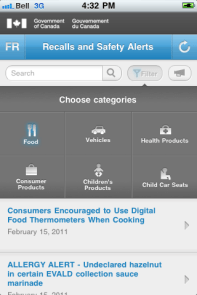
HC-Widgethc-appThe most cutting edge stuff I’ve seen is an effort by Health Canada to share advisories from Health Canada, Transport Canada and the Canadian Food Inspection Agency via three vehicles: an RSS feed, a mobile app available for Blackberry, iPhone (pictured far right) and Android, and finally as a widget (pictured near right) that anyone can install into their blog.

I think all of these are interesting ideas and have much to commend them. It is great to see information of a similar type, from three different agencies, being shared through a single vehicle – this is definitely a step forward from a user’s perspective. It’s also nice to see the government experiment with different vehicles for delivery (mobile and other parties’ websites).

But from a citizen-centric perspective, all these innovations share a common problem: They don’t fundamentally change the citizen’s experience with this information. In other words, they are simply efforts to find new ways to “broadcast” the information. As a result, I predict that these intiatives will have a minimal impact as currently structured. There are two reasons why:

The problem isn’t about access: These tools are predicated on the idea that the problem to conveying this information is about access to the information. It isn’t. The truth is, people don’t care. We can debate about whether they should care but the fact of the matter is, they don’t. Most people won’t pay attention to a product recall until someone dies. In this regard these tools are simply the modern day version of newspaper ads, which, historically, very few people actually paid attention to. We just couldn’t measure it, so we pretended like people read them.

The content misses the mark: Scrape a little deeper on these tools and you’ll notice something. They are all, in essence, press releases. All of these tools, the RSS feed, blog widget and mobile apps, are simply designed to deliver a marginally repackaged press release. Given that people tuned out of newspaper ads, pushing these ads onto them in another device will likely have a limited impact.

As a result, I suspect that those likely to pay attention to these innovations were probably those who were already paying attention. This is okay and even laudable. There is a small segment of people for whom these applications reduce the transactions costs of access. However, with regard to expanding the numbers of Canadians impacted my this information or changing behaviour in a broader sense, these tools have limited impact. To be blunt, no one is checking a mobile application before they buy a product, nor are they reading these types of widgets in a blog, nor is anyone subscribing to an RSS feed of recalls and safety warnings. Those who are, are either being paid to do so (it is a requirement of their job) or are fairly obsessive.

In short, this is a government-centric solution – it seeks to share information the government has, in a context that makes sense to government – it is not citizen-centric, sharing the information in a form that matters to citizens or relevant parties, in a context that makes sense to them.

Again, I want to state while I draw this conclusion I still applaud the people at Health Canada. At least they are trying to do something innovative and creative with their data and information.

So what would a citizen-centric approach look like? Interestingly, it would involve trying to reach out to citizens directly.

People are wrestling with a tsunami of information. We can’t simply broadcast them with information, nor can we expect them to consult a resource every time they are going to make a purchase.

What would make this data far more useful would be to structure it so that others could incorporate it into software and applications that could shape people’s behaviors and/or deliver the information in the right context.

Take this warning, for example: “CERTAIN FOOD HOUSE BRAND TAHINI OF SESAME MAY CONTAIN SALMONELLA BACTERIA” posted on Monday by the Canadian Food Inspection Agency. There is a ton of useful information in this press release including things like:

The geography impacted: Quebec

The product name, size and better still the UPC and LOT codes.

Product Size UPC Lot codes
Tahini of Sesame 400gr 6 210431 486128 Pro : 02/11/2010 and Exp : 01/11/2012
Tahini of Sesame 1000gr 6 210431 486302 Pro: 02/11/2010 and Exp: 01/11/2012
Premium Halawa 400gr 6 210431 466120 Pro: 02/11/2010 and Exp: 01/11/2012
Premium Halawa 1000gr 6 210431 466304 Pro: 02/11/2010 and Exp: 01/11/2012

However, all this information is buried in the text so is hard to parse and reuse.

If the data was structured and easily machine-readable (maybe available as an API, but even as a structured spreadsheet) here’s what I could imagine happening:

  1. Retailers could connect the bar code scanners they use on their shop floors to this data stream. If any cashier swipes this product at a check out counter they would be immediately notified and would prevent the product from being purchased. This we could do today and would be, in my mind, of high value – reducing the time and costs it takes to notify retailers as well as potentially saving lives.
  2. Mobile applications like RedLaser, which people use to scan bar codes and compare product prices could use this data to notify the user that the product they are looking at has been recalled. Apps like RedLaser still have a small user base, but they are growing. Probably not a game changer, but at least context sensitive.
  3. I could install a widget in my browser that, every time I’m on a website that displays that UPC and/or Lot code would notify me that I should not buy that product and that it’s been recalled. Here the potential is significant, especially as people buy more and more goods over the web.
  4. As we move towards having “smart” refrigerators that scan the RFID chips on products to determine what is in the fridge, they could simply notify me via a text message that I need to throw out my jar of Tahini of Sesame. This is a next generation use, but the government would be pushing private sector innovation in the space by providing the necessary and useful data. Every retailer is going to want to sell a “smart” fridge that doubles as a “safe” fridge, telling you when you’ve got a recalled item in it.

These are all far more citizen-centric, since they don’t require citizens to think, act or pay attention. In short, they aren’t broadcast-oriented, they feel customized, filtering information and delivering it where citizens need it, when they need it, sometimes without them even needing to know. (This is the same argument I made in my How Yelp Could Help Save Millions in Healthcare Costs). The most exciting thing about this is that Health Canada already has all the data to do this, it’s just a question of restructuring it so it is of greater use to various consumers of the data – from retailers, to app developers, to appliance manufactuers. This should not cost that much. (Health Canada, I know a guy…)

Another advantage of this approach is that it also gets the Government out of the business of trying to find ways to determine the best and most helpful way to share information. This appears to be a problem the UK government is also interested in solving. Richard A. sent me this excellent link in which a UK government agency appeals to the country’s developers to help imagine how it can better share information not unlike that being broadcast by Health Canada.

However, at the end of the day even this British example falls into the same problem – believing that the information is most helpfully shared through an app. The real benefit of this type of information (and open data in general) won’t be when you can create a single application with it, but when you can embed the information into systems and processes so that it can notify the right person at the right time.

That’s the challenge: abandoning a broadcast mentality and making things available for multiple contexts and easily embeddable. It’s a big culture shift, but for any government interested in truly exploring citizen-centric approach, it’s the key to success.