Yearly Archives: 2011

The State of Open Data in Canada: The Year of the License

Open Data now an established fact in a growing list of Canadian cities. Vancouver, Toronto, Edmonton, Ottawa have established portals, Montreal, Calgary, Hamilton and some other cities are looking into launching their own and a few provinces are rumored to be exploring open data portals as well.

This is great news and a significant accomplishment. While at the national level Canadian is falling further behind leaders such as England, the United States, Australia and New Zealand, at the local and potentially provincial/state level, Canada could position itself as an international leader.

There is however, one main obstacle: our licenses.

The current challenge:

So far most Open Data portals adopt what has been termed the Vancouver License (it was created by Vancouver for its open data portal and has subsequently been adopted, with occasional minor changes, by virtually every other jurisdiction).

The Vancouver license, however, suffers from a number of significant defects. As someone who was involved in its creation these “bugs” were a necessary tradeoff. If we were looking for a perfect license that satisfied all stakeholders, I suspect we’d still be arguing about it and there’d be no open data or data portal with the Vancouver license. Today, thanks in part to the existence of these portals our politicians, policy makers and government lawyers understanding of this issue has expanded. This fact, in combination with a growing number of complaints about the licenses from non-profits and businesses interested in using open data, has fostered growing interest in adjusting it.

This is encouraging. And we must capitalize on the moment. I wish to be clear: until Canadian governments get the licensing issue right, Open Data cannot advance in this country. Open Data released by governments will not enjoy significant reuse undermining one of the main reasons for doing Open Data.

There are a few things everyone agrees a new license needs to cover. It must establish there is no warranty to the data and that the government cannot be held liable for any reuse. So let’s focus on the parts that governments most often get wrong.

Here, there are 3 things a new license needs to get right.

1. No Attribution

NASCAR-2-300x199

Nascar Jeff Gordon #24 by Dan Raustadt licensed CC-NC-ND

We need a license that does not require attribution. First, attribution gets messy fast – all those cities logos crammed in on a map, on a mobile phone? It’s fine when you are using data from one or two cities, but what happens when you start using data from 10 different governments, or 50? Pretty soon you’ll have NASCAR apps, that will look ugly and be unusable.

More importantly, the goal of open data isn’t to create free advertising for governments, its to support innovation and reuse. These are different goals and I think we agree on which one is more important.

Finally, what government is actually going to police this part of the license? Don’t demand what you aren’t going to enforce – and no government should waste precious resources by paying someone to scour the internet to find websites and apps that don’t attribute.

2. No Share alike

One area the Vancouver license falls down is on the share is in this clause:

If you distribute or provide access to these datasets to any other person, whether in original or modified form, you agree to include a copy of, or this Uniform Resource Locator (URL) for, these Terms of Use and to ensure they agree to and are bound by them but without introducing any further restrictions of any kind.

The last phrase is particularly problematic as it makes the Vancouver license “viral.” Any new data created through a mash up that involves data with the Vancouver license must also use the Vancouver license. This will pretty much eliminate any private sector use of the data since any new data set a company creates they will want to be able to license in manner that is appropriate to their business model. It also has a chilling effect on those who would like to use the data but would need to keep the resulting work private, or restricted to a limited group of people. Richard Weait has an unfortunately named blog post that provides an excellent example of this problem.

Any new license should not be viral so as to encourage a variety or reuses of any data.

3. Standardized

The whole point of Open Data is to encourage the reuse of a public asset. So anything a government does that impedes this reuse will hamper innovation and undermine the very purpose of the initiative. Indeed, the open data movement has, in large part, come to life because one traditional impediment to using data has disappeared: data can now usually be downloaded and available in open formats that anyone can use. The barriers to use have declined so more and more people are interested.

But the other barrier to re-use is legal. If licenses are not easily understood then individuals and businesses will not reuse data, even when it is easily downloadable from a government’s website. Building a businesses or a new non-profit activity on a public asset to which your rights are unclear is simply not viable for many organizations. This is why you want every government should want its license to be easily understood – lowering the barriers to access means making data downloadable and reducing the legal barriers.

Most importantly, it is also why it is ideal if there is a single license in the whole country, as this would significantly reduce transaction and legal costs for all players. This is why I’ve been championing Canada’s leading cities to adopt a single common license.

So, there are two ways of doing this.

The easiest is for Canadian governments to align themselves with several of the international standardized open data licenses that already exist. There are a variety out there. My preference is the Open Commons’ Public Domain Dedication and License (PDDL), although they also publish the Open Database License (ODC-ODbL) and the Attribution License (ODC-By). There is also Creative Commons CC-0 license which Creative Commons suggests to use for open data (I actually recommend against all of these except the PDDL for governments, but more on that later).

These licenses has several advantages.

First, standardized licenses are generally well understood. This means people don’t have to educate themselves on the specifics of dozens of different licenses.

Second, they are stable. Because these licenses are managed by independent authorities and many people use them, they evolve cautiously, and balance the interest of consumers and sharers of data or information.

Third, these licenses balance interests responsible. The creators of these licenses are thought through all the issues that pertain to open data and so give both consumers of data and distributors of data comfort in knowing that they have a licenses that will work.

A second option is for governments in Canada to align around a self-generated common license. Indeed, this is one area where the Federal Government could show (some presently lacking) leadership.(although GeoGratis does have a very good license). This, for example appears to be happening in the UK, where the national government has created an Open Government Licence.

My hope is that, before the year is out, jurisdictions in Canada began to move towards a common licenses, or begin adopting some standard licenses.

Specifically, it would be great to see various Canadian jurisdictions either:

a) Adopt the PDDL (like the City of Surrey, BC). There are some reference to European Data Rights in the PDDL but these have no meaning in Canada and should not be an obstacle – and may even reassure foreign consumers of Canadian data. The PDDL is the most open and forward looking license.

b) Adopt the UK government’s Open Government Licence. This license is the best created by any government to date (with the exemption of simple making the data public domain, which, of course, is far more ideal.

c) Use a modified version of the Geogratis license that adjusts the “3.0 PROTECTION AND ACKNOWLEDGEMENT OF SOURCE” clause to prevent the NASCAR effect from taking place.

What I hope does not happen is that:

a) More and more jurisdictions continue to use the Vancouver License. There are better options and it is an opportunity to launch an open data policy and leapfrog the current leaders in the space.

b) Jurisdictions adopt a Creative Commons license. Creative Commons was created to help license copyrighted material. Since data cannot be copyrighted, the use of creative commons risks confusing the public about the inherent rights they have to data. This is, in part, a philosophical argument, but it matters, especially for governments. We – and our governments especially – cannot allow people to begin to believe that data can be copyrighted.

c) There is no change to the current licenses being used, or a new license, like Open Database License (ODC-ODbL) which goes against the attributes described above, is adopted.

Let’s hope we make progress on this front in 2011.
Open Knowledge Foundation Open Data Advocate

My colleagues over at the Open Knowledge Foundation have been thinking about recruiting an Open Data Advocate, someone who can coordinate a number of the activities they are up to in the open data space. I offered to think about what the role should entail and how that person could be effective. Consequently, in the interests of transparency, fleshing out my thinking and seeing if there might be feed back (feel free to comment openly, or email me personally if you wish to keep it private) I’m laying out my thinking below.

Context

These are exciting times for open government data advocates. Over the past few years a number of countries, cities and international organizations have launched open data portals and implemented open data policies. Many, many more are contemplating joining the fray. What makes this exciting is that some established players (e.g. United States, UK, World Bank) are continue to push forward and will, I suspect, be refining and augmenting their services in the coming months. At the same time there are still a number of laggards (e.g. Canada federally, Southern Europe, Asia) in which mobilizing local communities, engaging with public servants and providing policy support is still the order of the day.

This makes the role of an Open Data Advocate complex. Obviously, helping pull the laggards along is an important task. Alternatively (or in addition) they may need to also be thinking longer term. Where is open data going, what will second and third generation open data portals need to look like (and what policy infrastructure will be needed to support them).

These are two different goals and so either choosing, or balancing, between them will not be easy.

Key Challenges

Some of the key challenges spring quite obviously from that context. But there are also other challenges, I believe to be looming as well. So what do I suspect are the key challenges around open data over the next 1-5 years?

  1. Getting the laggards up and running
  2. Getting governments to use standardized licenses that are truly open (be it the PDDL, CC-0 or one of the other available licenses out there
  3. Cultivating/fostering an eco-system of external data users
  4. Cultivating/fostering an eco-system of internal government user (and vendors) for open data (this is what will really make open data sustainable)
  5. Pushing jurisdictions and vendors towards adopting standard structures for similar types of data (e.g. wouldn’t it be nice if restaurant inspection data from different jurisdictions were structured similarly?)
  6. Raising awareness about abuses of, and the politicization of, data. (e.g. this story about crime data out of New York which has not received nearly enough press)

The Tasks/Leverage Points

There are some basic things that the role will require including:

  1. Overseeing the Working Group on Open Government Data
  2. Managing opengovernmentdata.org
  3. Helping organize the Open Government Data Camp 2011, 2012 and beyond

But what the role will really have to do is figure out the key leverage points that can begin to shift the key challenges listed above in the right direction. The above mentioned tasks may be helpful in doing that… but they may not be. Success is going to be determined but figuring how to shift systems (government, vendor, non-profit, etc…) to advance the cause of open data. This will be no small task.

My sense is that some of these leverage points might include:

  1. Organizing open data hackathons – ideally ones that begin to involve key vendors (both to encourage API development, but also to get them using open data)
  2. Leveraging assets like Civic Commons to get open data policies up on online so that jurisdictions entertaining the issue can copy them
  3. Building open data communities in key countries around the world – particularly in key countries in such as Brasil and India where a combination of solid democratic institutions and a sizable developer community could help trigger changes that will have ramifications beyond their borders (I suspect there are also some key smaller countries – need to think more on that)
  4. I’m sure this list could be enhanced…

Metrics/Deliverables

Obviously resolving the above defined challenges in 1-5 years is probably not realistic. Indeed, resolving many of those issues is probably impossible – it will be a case of ensuring each time we peel back one layer of the onion we are well positioned to tackle the next layer.

Given this, some key metrics by which the Open Knowledge Foundation should evaluate the person in this role might be:

At a high level, possible some metrics might include:

  • Number of open data portals world wide? (number using CKAN?)
  • Number of groups, individuals, cities participating in Opendata hackathons
  • Number of applications/uses of open data
  • Awareness of CKAN and its mission in the public, developer space, government officials, media?
  • Number of government vendors offering open data as part of their solution

More additional deliverables, could include:

  • Running two Global OpenData Hackathons a year?
  • Developing an OKFN consulting arm specializing in open data services/implementation
  • Create an open data implementation policy “in a box” support materials for implementing an open data strategy in government
  • Develop a global network of OKFN chapters to push their local and national governments, share best practices
  • Run opendata bootcamps for public servants and/or activists
  • Create a local open data hackathon in a box kit (to enable local events)
  • Create a local “how to be an open data activist” site
  • Conduct some research on the benefits of open data  to advance the policy debate
  • Create a stronger feedback loop on CKAN’s benefits and weaknesses
  • Create a vehicle to connect VC’s and/or money with open data drive companies and app developers (or at least assess what barriers remain to use open data in business processes).

Okay, I’ll stop there, but if you have thoughts please send them or comment below. Hope this stimulates some thinking among fellow open data geeks.

The problem with the UBB debate

I reley dont wan to say this, but I have to now.

This debate isso esey!

– Axman13

Really, it is.

The back and forth for and against UBB has – for me – sadly so missed the mark on the real issue it is beyond frustrating. It’s been nice to see a voice or two like Michael Geist begin to note the real issue – lack of competition – but by and large, we continue to have the wrong debate and, more importantly, blame the wrong people.

This really struck home with me while reading David Beers’s piece in the Globe. The first half is fantastic, demanding greater transparency into the cost of delivering bandwidth and of developing a network; this is indeed needed. Sadly, the second half completely lost me, as it makes no argument, notably doesn’t call for foreign investment (though he wants the telcos’ oligarchy broken up – so it’s unclear where he thinks that competition is going to come from) and worse, the CRTC is blamed for the crisis.

It all prompted me – reluctantly – to outline what I think are the three problems with the debate we’ve been having, from least to most important.

1. It’s not about UBB; it’s about cost.

Are people mad about UBB? Maybe. However, I’m willing to wager that most people who have signed the petition about UBB don’t know what UBB is, or what it means. What they do know is that their Internet Service Provider has been charging a lot for internet access. Too much. And they are tired of it.

A more basic question is: do people hate the telcos? And the answer is yes. I know I dislike them all. Intensely. (You should see my cell phone bill; my American friends laugh at me as it is 4x theirs). The recent decision has simply allowed for that frustration to boil over. It has become yet another example of how a telecommunication oligarchy is allowed to charge whatever it wants for service that is substandard to what is often found elsewhere in the world. Of course Canadians are angry. But I suspect they were angry before UBB.

So, if getting gouged is the issue the problem of making the debate about UBB is we risk taking our eye off the real issue – the cost of getting online. Even if the CRTC reverses its decision, we will still be stuck with some of the highest rates in for internet access in the world. This is the real issue and should be the focus of the debate.

2. If the real issue is about price, the real solution is competition.

Here Geist’s piece, along with the Globe editorial, is worth reading. Geist states clearly that the root of the problem is a lack of competition. It may be that UBB – especially in a world of WiMax or other highspeed wireless solutions – could become the most effective way to charge for access and encourage investment. Why would we want to forestall such a business model from emerging?

I’m hoping, and am seeing hints, that that this part of the debate is beginning to come to the fore, but so long as the focus is on banning UBB, and not increasing competition, we’ll be stuck having the wrong conversation.

3. The real enemy is not the CRTC; it’s the Minister of Industry Canada.

This, of course, is both the most problematic part of this debate and the most ironic. The opponents to UBB have made the wrong people the enemy. While people may not agree with the CRTC’s decision, the real problem is not of their making. They can only act within the regulatory regime they have been given.

The truth of the matter is, after 40 years of the internet, Canada has no digital economy strategy. Given it is 2011 this is a stunning fact. Of course, we’ve been promised one but we’ve heard next to nothing about it since the consultation has been closed. Indeed – and I hope that I’ll be corrected here – we haven’t even heard when it will land.

The point, to make it clear, is that this is not a crisis or regulatory oversight. This is a crisis of policy mismanagement. So the real people to blame are the politicians – and in particular the Industry Minister who is in charge of this file. But since those in opposition to UBB have made it their goal to scream at the CRTC, the government has been all too happy to play along and scream at them as well. Indeed, the biggest irony of this all is that it has allowed the government to take a populist approach and look responsive to a crises that they are ultimately responsible for.

P.S. Left-wing bonus reason

So if you are a left leaning anti-UBB advocate – particularly one who publishes opinion pieces – the most ironic part about this debate is that you are the PMO’s favourite person. Not only have you deflected blame over this crisis away from the government and onto the CRTC you’ve created the perfect conditions for the government to demand an overhaul (or simply just the resignation) of key people on the CRTC board.

The only reson this is ironic is beacuase Konrad W. von Finckenstein (head of the CRTC) may be the main reason why Sun Media’s Category 1 application for its “Fox News North” channel was denied. There is probably nothing the PMO would like more than to brush Kinchenstein aside and be to reshape the CRTC so as to make this plan a reality.

Wouldn’t it be ironic if a left-leaning coalition enabled the Harper PMO and Sun Media to create their Fox News North?

And who said Canadian politics was boring?

P.P.S. If you haven’t figured out the spelling mistake easter eggs, I’ll make it more obvious: click here. It’s an example of why internet bandwidth consumption is climbing at double digits.

Why the CRTC was right on Usage-Based Billing

Up here in Canada (and I say that in the identity sense, since at the moment I’m in Santa Clara at the Strata Conference) a lot of fuss has been made about the CRTC’s decision regarding the approval of usage-based billing. So much fuss, in fact, that appears the government is going to over turn it.

One thing that has bothered me about these complaints is that they have generally come from people who also seem to oppose internet service providers throttling internet access. It’s unclear to me that you can have it both ways – you can’t (responsibly) be against both internet throttling and usage-based billing. As much as I wish it were the case there is not unlimited internet access in Canada. At some point this genuinely is a scarce resource and if you give people unlimited access at a fixed price at some point the system is going to collapse…

Indeed, what really concerns me is the incentive structure forbidding usage-based billing creates. There is a finite market for broadband access in Canada so the capital for increasing capacity can’t come exclusively from signing up new users. If you make it so that fixed bills are the only way to bill customers then what incentives do internet providers have to improve capacity? At best they will be incented only to provide a minimally viable service. I mean, why build out when you won’t be able to get a return on investment for the extra capacity?

I’d prefer to have an internet provider market where the players are building out their network in order to meet the needs of the most demanding users who are willing to pay for the extra bandwidth. Why? Because it will ensure that capacity keeps increasing as the large players continue to fight to meet the needs of that market. This means there is a financial incentive to increase bandwidth – which is ultimately what you want the incentives to be.

Besides, if – like me – you happen to believe that roads should be tolled then it’s unclear why you shouldn’t also feel like  consumers of large quantities of bandwidth should pay more than someone who barely consumes any at all. Why should low bandwidth users subsidize high-bandwidth users (or worse, that innovative services be made useless because the other solution is throttling).

I want to be clear. All of this isn’t to say that we shouldn’t regulate the ISP business or that we should treat the internet service providers as trustworthy. We are still in an oligarchy, something their behaviour reminds me of every day. I agree that the ISPs demands are in part an effort to make less attractive services like Netflix that threaten many of the ISPs other business – cable TV. So, if we are going to engage in usage-based billing then I’d expect a few things, including:

  • a generous baseline of fixed-fee internet usage a month. (In an ideal world I’d actually say a basic amount should be free – as I believe access to the internet, like access to books in a library, is increasingly becoming a necessary basic service of our society)
  • let’s have REAL usage-based billing. This means, let’s do usage-based billing that will make us more efficient. Charge me more at peak times, less during off peak times the way electricity companies do. That way I’ll bittorrent my files at night when it costs next to nothing, and be smarter about consumption during peak hours.
  • real transparency into how much the ISPs are investing into increasing their capacity.
  • bandwidth from certain IP addresses – like Parliament, Provincial Legislatures and City Halls should be unlimited. No one should be eating into their fix-priced limit or charged extra while engaging in their most basic democratic rights (so unlimited CSPAN video watching)
  • your network now must be neutral. One reason I like usage-based billing is that it destroys a major argument used to justify traffic shaping – that the network can’t handle the demand. Well, not you get rewarded for high demand – so satisfy it! If consumer advocates can’t oppose both usage-based billing and throttling, then telcos and cable companies can’t have both either.

I can imagine that this post will make some of my colleagues upset. Please fire away, tell me how I’ve got it all wrong. But please make sure that you’ve got an answer that addresses some of the concerns raised here. If you’ve been against throttling (and you know who you are), explain to me how it is that we can both (sustainably) have zero throttling and unlimited fixed fee internet access? In a world where online video is taking off, I’m just not sure I see it. Unless, of course, we think Google is going to provide the answer.

Finally, if you haven’t read it, Richard French has a very thoughtful piece in the Globe and Mail entitled Second-Guessing the CRTC Comes at a Price check it out. It certainly helped reaffirm some of my own thinking.

Egypt: Connected to revolution

This piece is cross-posted from the Opinion Page of the Toronto Star which was kind enough to publish it this morning.

Over the weekend something profound happened. The Egyptian government, confronted with growing public unrest, attempted to disconnect itself. It shut down its cellular and telephone networks and unplugged from the Internet.

It was a startling recognition of this single most powerful force driving change in our world: connectivity. Our world is increasingly divided between the connected and the disconnected, between open and closed. This could be the dominant struggle of the 21st century and it forces us to face important questions about our principles and the world we want to live in.

Why does connectivity matter? Because it allows for free association and self-expression, both of which can allow powerful narratives to emerge in a society beyond the control of any elite.

In Egypt, the protests do not appear driven by some organized cabal. The Muslim Brotherhood — so long held up as the dangerous alternative to the regime — was caught flat-footed by the protests. The National Coalition for Change, headed by Nobel laureate Mohamed ElBaradei, seems to have emerged as the protesters’ leader, not their instigator.

Instead, Egypt may simply have reached a tipping point. Its citizens, having witnessed the events in Tunisia, came to realize they were no longer atomized and uncoordinated in the face of a police state. They could self-organize, connect with one another, share stories and videos, organize meetings and protests. In short, they could tell their own narratives to one another, outside the government’s control.

These stories can be powerful.

In Egypt, a video of an unknown protester being shot and carried away has generated a significant viewership. In Iran, the video of Neda Agha-Soltan dying from a gunshot wound transformed her into a symbol. In Tunisia, videos of protestors being shot also helped mobilize the public.

Indeed, as the family of Mohamed Bouazizi — the man who by setting himself on fire out of frustration with local authorities, triggering the Tunisian protests — noted to an Al Jazeera reporter, people are protesting with “a rock in one hand, a cellphone in the other.”

This is what makes movements like this so hard to fight. There is no opposition group to blame, no subversive leadership to decapitate, no central broadcast authority to shut down. The only way to stop the protests is to eliminate the participants’ capacity to self-organize. During the Green Revolution in Iran, that meant shutting down some key websites; in Egypt, it appears to mean shutting down all communication.

Of course, this state of affairs cannot continue indefinitely. Too much of the Egyptian economy depends on people being able to connect. The network that makes possible a modern economy also makes possible a popular uprising.

At some point Egypt will have to decide: disconnect forever like North Korea, or reconnect and confront the reality of the connected world.

For those of us who believe in freedom, individuality, self-expression and democracy, connectivity is among our most powerful tools because it makes possible alternative narratives.

From East Germany to the Philippines, Iran to Tunisia, connectivity has played a key role in helping people organize against governments that would deny them their rights. It’s a tool democracies have often used, from broadcasts like Radio Free Europe during the Cold War to the U.S. government’s request that Twitter not conduct a planned upgrade to its website that would have disrupted its service during the recent Iranian Green Revolution.

But if we believe in openness, we must accept its full consequences. Our own governments have a desire to disconnect us from one another when they deem the information to be too dangerous.

Today most U.S. government departments, and some Canadian ministries, still deny their employees access to WikiLeak documents, disconnecting them from information that is widely available to the general public.

More darkly, the government pressured companies such as Amazon and Paypal to not offer their services to WikiLeaks — much like the Iranian government tried to disrupt Twitter’s service and the Tunisian government attempted to hijack Facebook’s. Nor is connectivity a panacea. In Iran, the regime uses photos and videos from social networks and websites to track down protestors. Connectivity does not guarantee freedom; it is simply a necessary ingredient.

The events in Egypt are a testament to the opportunity of the times we live in. Connectivity is changing our world, making us more powerful individually and collectively. But ultimately, if we wish to champion freedom and openness abroad — to serve as the best possible example for countries like Egypt — we must be prepared to do so at home.

David Eaves is a Vancouver-based public policy entrepreneur and adviser on open government and open data. He blogs at eaves.ca

How Yelp Could Help Save Millions in Health Care Costs

Okay, before I dive in, a few things.

1) Sorry for the lack of posts last week. Life’s been hectic. Between Code for America, a number of projects and a few articles I’m trying to get through, the blogging slipped. Sorry.

2) I’m presenting on Open Data and Open Government to the Canadian Parliament Access to Information, Privacy and Ethics Committee today – more on that later this week

3) I’m excited about this post

When it comes to opening up government data many of us focus on Governments: we cajole, we pressure, we try to persuade them to open up their data. It’s approach we will continue to have to take for a great deal of the data our tax dollars pay to collect and that government’s continue to not share. There is however another model.

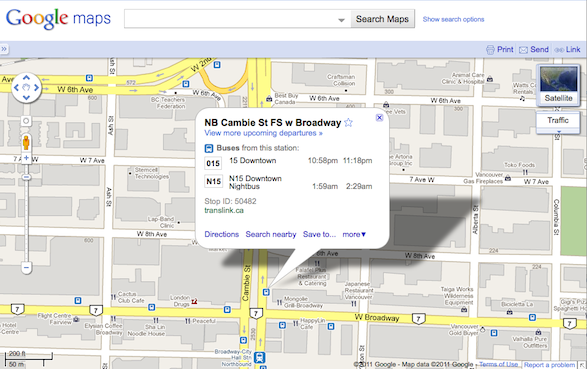
Consider transit data. This data is sought after, intensely useful, and probably the category of data most experimented with by developers. Why is this? Because it has been standardized. Why has it been standardized. Because local government’s (responding to citizen demand) have been desperate to get their transit data integrated with Google Maps (See image).
Screen-shot-2011-01-30-at-10.45.00-PM

It turns out, to get your transit data into Google Maps, Google insists that you submit to them the transit data in a single structured format. Something that has come to be known as the General Transit Feed Specification (GTFS). The great thing about the GTFS is that it isn’t just google that can use it. Anyone can play with data converted into the GTFS. Better still, because the data structure us standardized an application someone develops, or analysis they conduct, can be ported to other cities that share their transit data in a GTFS format (like, say, my home town of Vancouver).

In short, what we have here is a powerful model both for creating open data and standardizing this data across thousands of jurisdictions.

So what does this have to do with Yelp! and Health Care Costs?

For those not in the know Yelp! is a mobile phone location based rating service. I’m particularly a fan of its restaurant locator: it will show you what is nearby and how it has been rated by other users. Handy stuff.

But think bigger.

Most cities in North America inspect restaurants for health violations. This is important stuff. Restaurants with more violations are more likely to transmit diseases and food born illnesses, give people food poisoning and god knows what else. Sadly, in most cases the results of these tests are posted in the most useless place imaginable. The local authorities website.

I’m willing to wager almost anything that the only time anyone visits a food inspection website is after they have been food poisoned. Why? Because they want to know if the jerks have already been cited.

No one checks these agencies websites before choosing a restaurant. Consequently, one of the biggest benefits of the inspection data – shifting market demand to more sanitary options – is lost. And of course, there is real evidence that shows restaurants will improve their sanitation, and people will discriminate against restaurants that get poor ratings from inspectors, when the data is conveniently available. Indeed, in the book Full Disclosure: The Perils and Promise of Transparency Fung, Graham and Weil noted that after Los Angeles required restaurants to post food inspection results, that “Researchers found significant effects in the form of revenue increases for restaurants with high grades and revenue decreases for C-graded (poorly rated) restaurants.” More importantly, the study Fung, Graham and Weil reference also suggested that making the rating system public positively impacted healthcare costs. Again, after inspection results in Los Angeles were posted on restaurant doors (not on some never visited website), the county experienced a reduction in emergency room visits, the most expensive point of contact in the system. As the study notes these were:

an 18.6 percent decline in 1998 (the first year of program operation), a 4.8 percent decline in 1999, and a 5.4 per- cent decline in 2000. This pattern was not observed in the rest of the state.

This is a stunning result.

So, now imagine that rather than just giving contributor generated reviews of restaurants Yelp! actually shared real food inspection data! Think of the impact this would have on the restaurant industry. Suddenly, everyone with a mobile phone and Yelp! (it’s free) could make an informed decision not just about the quality of a restaurant’s food, but also based on its sanitation. Think of the millions (100s of millions?) that could be saved in the United States alone.

All that needs to happen is for a simple first step, Yelp! needs approach one major city – say a New York, or a San Francisco – and work with them to develop a sensible way to share food inspection data. This is what happened with Google Maps and the GTSF, it all started with one city. Once Yelp! develops the feed, call it something generic, like the General Restaurant Inspection Data Feed (GRIDF) and tell the world you are looking for other cities to share the data in that format. If they do, you promise to include it in your platform. I’m willing to bet anything that once one major city has it, other cities will start to clamber to get their food inspection data shared in the GRIDF format. What makes it better still is that it wouldn’t just be Yelp! that could use the data. Any restaurant review website or phone app could use the data – be it Urban Spoon or the New York Times.

The opportunity here is huge. It’s also a win for everyone: Consumers, Health Insurers, Hospitals, Yelp!, Restaurant Inspection Agencies, even responsible Restaurant Owners. It would also be a huge win for Government as platform and open data. Hey Yelp. Call me if you are interested.

What Canada’s Realtors could learn from Canada’s Lawyers

Lawyers aren’t generally known to be the most technologically forwarding looking group – but here in Canada they have done one thing really, really well. Making radically efficient the transaction costs around sharing critical information regarding their industry.

CanLII – the non-profit managed by the Federation of Law Societies of Canada has the goal “to make Canadian law accessible for free on the Internet.” In essence CanLII copies all of the materials produced by the courts, organizes it and makes it searchable and re-usable by anyone. For realtors wondering about their future, looking over this service might be a good place to start.

Consider MLS.ca (now rebranded as realtor.ca) the website run by the Canadian Real Estate Association (CREA) that shares information on what homes are for sale where. A few of you may also know that the Competition Bureau and CREA have recently been tangling over access to MLS. While the it is now easier for people to list properties on MLS, the data within MLS is very restricted. Much of the data only realtors can see and re-use of the data appears strictly verboten. These restrictions cause Canadians to suffer from what I like to call the Hulu Syndrome – they can see what a more open system would look like by surfing the various property websites in the United States – but they are stuck using MLS when trying to browse for a home to buy.

Canadian realtors wanting to know what the future looks like for a professional service in a world where data and information is widely available, CanLII offers both a window and a model. Unlike MLS, the great thing about CanLII is that it serves everyone, not just lawyers. It isn’t hard to imagine a world where lawyers insisted that only they can access the cataloging system they pay for (lawyers pay a small annual fee to support CanLII) much like only realtors can access the full database of MLS. In such world if you wanted to read a judgement, or view court documents on a specific case, only a lawyer could access it for you, and then they would interpret it for you, and, to carry the analogy to its logically conclusion, you would rarely or likely never see the original documents.

Thankfully for both the legal system, the market place for legal services and for our democracy, CanLII doesn’t work this way. As mentioned anyone can search, find and download all the information. Indeed, look at CanLII’s Terms of Use:

Subject to the following paragraph and the below conditions pertaining to prohibited use, legal materials published on the CanLII website, such as legislation, regulations and decisions, including editorial enhancements inserted into the documents by CanLII, such as hyperlinks and information in headers and footers, can be copied, printed and distributed by Users free of charge and without any other authorization from CanLII, provided that CanLII is identified as the source of the document.

Compare this to MLS’s terms of use:

This database and all materials on this site are protected by copyright laws and are owned by The Canadian Real Estate Association (CREA) or by the member who has supplied the data. Property listings and other data available on this site are intended for the private, non-commercial use by individuals. Any commercial use of the listings or data in whole or in part, directly or indirectly, is specifically forbidden except with the prior written authority of the owner of the copyright.

(Side note, I’m pretty sure you can’t copyright data – so not sure what the legal rights being exercised here are).

Of course, even though CanLI makes legal documents are freely available, many people still want to use lawyers because they don’t have time or, just as often, realize they need expert advice in this complicated field.

The same would be true of MLS. Many, many buyers will still want to use a realtor, although the buyers and sellers in the market place would be smarter and more informed – but this would probably lead to a better marketplace and happier customers. There are of course, a number of buyers and sellers who will simply freeload off MLS’s data to sell or buy their home on their own (much like some people probably “freeload” off CanLII to represent themselves or do research). But these are probably clients who would prefer to be doing it this way anyway – giving them full access to the database may cause them to a) realize they do need professional help or b) remove customers who don’t really want to use a realtor in the first place and are thus… terrible customers.

This isn’t to say that sharing MLS data won’t be disruptive, I suspect that some people will automate the buying/selling process which a percentage of the market place will prefer to a handheld process – but I suspect that, at some point, this will happen anyway (someone will figure out a model to make it work) at which point CREA and the realtors will have been firmly entrenched in the minds of Canadians as the obstacle to a better, more efficient marketplace, not the leaders who helped foster it.

Lawyers aren’t often known for clarity and simplicity, but clearly when they get it right, they get it right. I hope other professional services will look at what they are up to.

My wish for 2011: Greater comfort with decline and death

Just before Christmas the always awesome Al Emanski asked me if I would write a short answer to a question he was asking a number of people he thought might have interesting answers:

What would you like to become more visible in 2011?

A number of us responded (there are a fair number of cool people on the list and my favourite response so far is by Christian Bason of Mind-Lab in Denmark, who’ve I’ve not met, and whose project I love). You can download all the 500 word responses here.

I wrote the following as my answer. Al was kind enough to include it in his collection and I’m reposting it below as I was rereading it last night, and still feel it’s true a few weeks later. If you want new and better things, it means we also have to learn to let some old ways of doing things go.

Greater comfort with decline and death.

It sounds shocking – and Iʼm being a little over the top. But I mean it.

We are surrounded by institutions, business models and processes that serve us poorly. To me, the definitive example is the Yellow Pages. Here is an unsolicited “service” that is forced upon millions of Canadians, consumes enormous resources to create and distribute, and that is increasingly obsolete with the rise of 411 and the Internet.

Indeed, the stacks of unwanted yellow pages in residential apartment buildings across the country have become alarmingly large. The Yellow Pages are quickly becoming the definitive metaphor of our times: a business that can continue to exist and consume vast resources long after it serves individual or even a collective good. Inertia, not innovation, is the core value.

We can do better. But it means letting things die.

So what Iʼd like is to be more visible in 2011 is death. For Canadians everywhere to look at their lives, their governments, their business or place of work and ask the metaphorical question: Whatʼs the Yellow Pages of my organization?

This is a hard question. And it challenges us in many ways.  Sometimes it may mean we have to stop doing the thing we have become good at, or comfortable with. But we live in such an exciting era where so many new things are possible. But this will only matter if we get comfortable with letting go of the old. As we manage a scarcity of money, resources and time, being able to do this is only going to become more important. It isnʼt easy, but the alternative – a future of continued poorly allocated and inefficiently used resources – is even worse.

The Next International Open Data Hack Day – initial thoughts

Yesterday I got to meet up with Edward Ocampo-Gooding and Mary Beth Baker in Ottawa and we started talking about what the next international open data hackathon: when might be a good time to do it, what might it look like, etc…

One idea is to set a theme that might help inspire people and serve as something to weave the events together in stronger way. Edward proposed the theme of Mom’s and, since, in many, many, many countries, Mother’s day is in May, it seemed like a nice suggestion.

It also has two nice benefits:

  • it gets us away from an exclusive focus on government and might get people in the headspace of creating applications with tangible uses – something almost everyone can relate to
  • many people have mom’s! so getting into the shoes of a mom and imagining what might be interesting, engaging and/or helpful shouldn’t be impossible
  • it might engage new people in the open data movement and in the local events

In addition, another suggestion that was raised is the idea of focusing on a few projects that have already been speced out in advanced – much like Random Hacks of Kindness does with their hackathons. Think this could be fruitful to explore.

Finally, regarding timelines, I’m thinking May. It works thematically (if that theme gets used). More importantly, however, it’s far enough out to plan, near enough to be tangible and sets a nice pace of two global hackathons a year which feels sufficiently ambitious for a group of volunteers, doesn’t crowd out/compete with other hackathons or local events, and seems like a good check in timeline for volunteer driven projects… Also, it might give people a chance to use scrapperwiki in the interim to get data together for projects they want to work on.

Thoughts on all this? Please blog, post a comment below, or if you are feeling shy, drop me a note (david at eaves.ca or @daeaves with hastag #odhd on twitter). I’ve also created a page on the Open Data Day wiki to discuss this if people are more comfortable with that.

What I’m doing at Code for America

For the last two weeks – and for much of January – I’m in San Francisco helping out with Code for America. What’s Code for America? Think Teach for America, but rather than deploying people into classrooms to help provide positive experiences for students and teachers while attempting to shift the culture of school districts, Code for America has fellows work with cities to help develop reusable code to save cities money, make local government as accessible as your favorite website, and help shift the government’s culture around technology.

code-for-america1-150x112The whole affair is powered by a group of 20 amazing fellows and an equally awesome staff that has been working for months to make it all come together. My role – in comparison – is relatively minor, I head up the Code for America Institute – a month long educational program the fellows go through when they first arrive.  I wanted to write about what I’ve been trying to do both because of the openness ideals of Code for America and to share any lessons for others who might attempt a similar effort.

First, to understand what I’m doing, you have to understand the goal. On the surface, to an outsider, the Code for America change process might look something like this:

  1. Get together some crazy talented computer programers (hackers, if you want to make the government folks nervous)
  2. Unleash them on a partner city with a specific need
  3. Take resulting output and share across cities

Which of course, would mistakenly frame the problem as technical. However, Code for America is not about technology. It’s about culture change. The goal is about rethinking and reimagining  government as better, faster, cheaper and adaptive. It’s about helping think of the ways its culture can embrace government as a platform, as open and as highly responsive.

I’m helping (I think) because I’ve enjoyed some success in getting government’s to think differently. I’m not a computer developer and at their core, these successes were never technology problems. The challenge is understanding how the system works, identify the leverage points for making change, develop partners and collaborate to engage those leverage points, and do whatever it takes to ensure it all comes together.

So this is the message and the concept the speakers are trying to impart on the fellows. Or, in other words, my job is to help unleash the already vibrant change agents within the 20 awesome fellows and make them effective in the government context.

So what have we done so far?

We’ve focused on three areas:

1) Understand Government: Some of the fellows are new to government, so we’ve had presentations from local government experts like Jay Nath, Ed Reiskin and Peter Koht as well as the Mayor of Tuscon’s chief of staff (to give a political perspective). And of course, Tim O’Reilly has spoken about how he thinks government must evolve in the 21st century. The goal: understand the system as well as, understand and respect the actors within that system.

2) Initiate & Influence: Whether it is launching you own business (Eric Ries on startups), starting a project (Luke Closs on Vantrash) or understanding what happens when two cultures come together (Caterina Fake on Yahoo buying Flickr) or myself on negotiating, influence and collaboration, our main challenges will not be technical, they will be systems based and social. If we are to build projects and systems that are successful and sustainable we need to ask the right questions and engage with these systems respectfully as we try to shift them.

3) Plan & Focus: Finally, we’ve had experts in planning and organizing. People like Allen Gunn (Gunner) and the folks from Cooper Design, who’ve helped the fellows think about what they want, where they are going, and what they want to achieve. Know thyself, be prepared, have a plan.

The last two weeks will continue to pick up these themes but also give the fellows more time to (a) prepare for the work they will be doing with their partner cities; and (b) give them more opportunities to learn from one another. We’re half way through the institute at this point and I’m hoping the experience has been a rich – if sometimes overwhelming – one. Hopefully I’ll have an update again at the end of the month.