Monthly Archives: November 2011

Gov 2.0: Network Analysis for Income Inequality?

I’ve been thinking a lot about these two types of graphs at the moment.  This first is a single chart that shows income growth for various segments of the US population broken down by wealth.

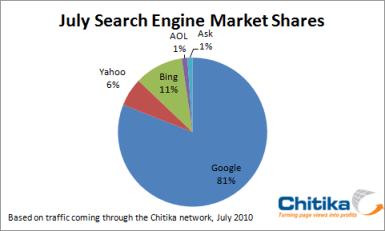
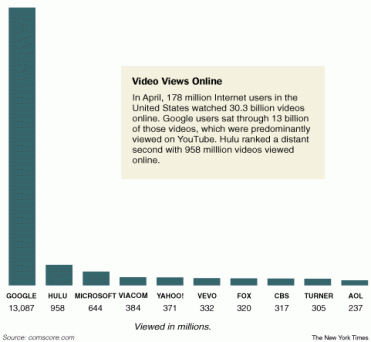
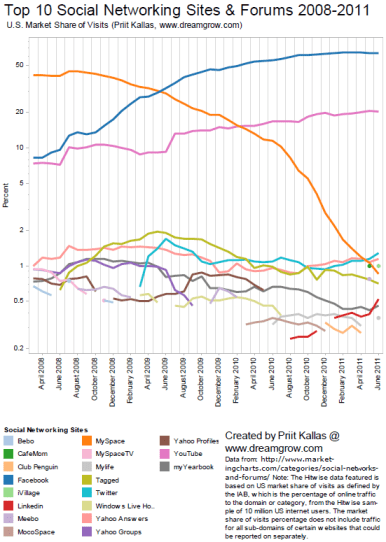
This second is a group of graphs that talk about pageviews and visits to various websites on the internet.
bits-tue71-custom2Top-10-Social-Networking-Sites-by-Market-Share-of-Visits-June-2011July-Search-Engine-Market-Share

What is fascinating about the internet stats is that they are broadly talking about distribution among the top websites – forget about everyone else where the pageviews become infinitesimally small. So even among top websites have a power law distribution, which must be even stronger once one starts talking about all websites.

And this is what I’m frequently told. That the distribution of pageviews, visits and links on the internet looks a lot like the first graph, although possibly even more radically skewed.

In other words while the after-tax income chart isn’t a clean curve, the trends of the two are likely very similar – except that the top 1% of websites do even better than the top 1% of after tax income earners. So both charts look like power law distributions.

Does this matter? I’m not sure, but I’m playing with some thoughts. While I’m confident that the income chart as power law distribution has replicated itself several times in history (such as during the lead up to the great depression, what is less clear to me is if the exponential growth has ever happened so fast? (would be fascinating to know if others have written on this). The rich have often gotten richer – but have they gotten richer this quickly before?

And is this what happens in a faster, more networked economy? Maybe the traits of the online network and its power law distribution are beginning to impact the socioeconomic network of our society at large?

Could this also mean that we need some new ways to ensure social and economic mobility in our economy and society. Network effects are obviously powerful online, but have also, historically, been important offline. In society, your location on that curve creates advantages, it likely gives you access to peers and capital which position you to maintain your status in the network. Perhaps the internet, rather than making the network that is our society more fluid, is actually doing the opposite. It is increasingly the power law distribution, meaning the network effects are getting stronger, further reinforcing advantages and disadvantages. This might have important implications for social and economic mobility.

Either way, applying some network analysis to income inequality and social mobility as well as the social programs we put in place to ensure equality of opportunity, might be a good frame on these problems. I’d love to read anything anyone has written on this – very much open to suggestions.
Using Open Data to drive good policy outcomes – Vancouver’s Rental Database

One of the best signs for open data is when governments are starting to grasp its potential to achieve policy objectives. Rather than just being about compliance, it is seen as a tool that can support the growth and management of a jurisdiction.

This why I was excited to see Vision Vancouver (in which I’m involved in generally, but was not involved in the development of this policy proposal) announced the other day that, if elected, it intends to create a comprehensive online registry that will track work orders and property violations in Vancouver apartments, highlighting negligent landlords and giving a new tool to empower renters.

As the press release goes on to state, the database is “Modeled after a successful on-line watchlist created by New York City’s Public Advocate, the database will allow Vancouver residents to search out landlords and identify any building or safety violations issued by the City of Vancouver to specific rental buildings.”

Much like the pieces I’ve written around restaurant inspection and product recall data, this is a great example of a data set, that when shared the right way, can empower citizens to make better choices and foster better behaviour from landlords.

My main hope is that in the implementation of this proposal, the city does the right thing and doesn’t create a searchable database on its own website, but actually creates an API that software developers and others can tap into. If they do this, someone may develop a mobile app for renters that would show you the repair record of the building you are standing in front of, or in. This could be very helpful for renters, one could even imagine an app where you SMS the postal code of a rental building and it sends you back some basic information. Also exciting to me is the possibility that a university student might look for trends in the data over time, maybe there is an analysis that my yield and insight that could help landlords mitigate against problems, and reduce the number of repairs they have to make (and so help reduce their costs).

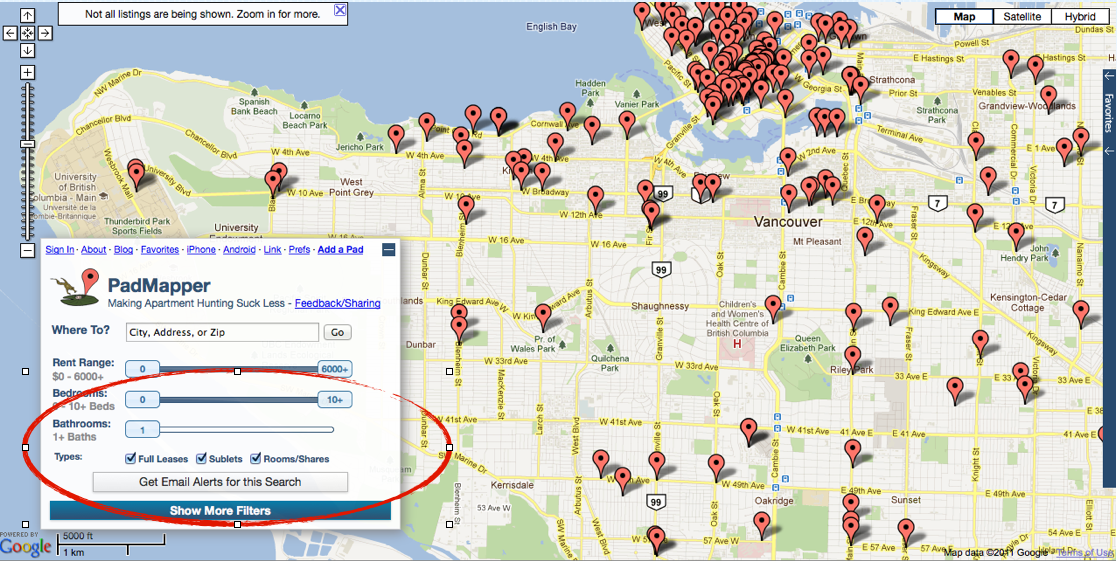
But if Vancouver and New York actually structured the data in the same way, it might create an incentive for other cities to do the same. That might entice some of the better known services to use the data to augment their offerings as well. Imagine if PadMapper, in addition to allowing a prospective renter to search for apartments based on rent costs and number of rooms, could also search based on number of infractions?

pad-mapper-rental

That might have a salutary effect on some (but sadly not all) landlords. All an all an exciting step forward from my friends at Vision who brought open data to Canada.