Teaching Digital at the Kennedy School of Government: Part 5: Foundational Topics

One challenge I’ve observed about how digital technologies are taught at most schools of policy or government is it takes a relatively ad hoc approach. It is a mix of courses that emerge due to either student demand or faculty interest. To be fair, this is often better than nothing, but it offers little in terms of methodology or structure for thinking about digital. Students are left to themselves to draw connections between subjects, or the underlying principles and challenges that span across them.

My goal is to educate students around the social, economic and policy changes brought about by the way digital technologies expand or threaten how we can solve problems, relate to one another, and reimagine institutions and the world.

Achieving this requires a structured approach, to bring clarity to the core issues and ensure students leave with a solid foundation of knowledge.

The intent is to enable students to understand how digital challenges rules, norms and structures — for good and ill. It is also about getting them to manage learning organizations that can absorb and leverage the fast feedback digital systems create.

Prerequisites

As a brief aside, in my classroom I assume students come to me with some basic knowledge. At the Harvard Kennedy School, students in the MPP program have a set of “core” classes required in the first year. This include some economics, stats, and most importantly, ethics. So I assume many of my students come into my class with some background in these subjects.

Foundational Topics

My bias in all this is around how digital will impact the provision of public services (I’m happy to own this bias and recognize it, meaning I make choices others might not) but I have attempted to design a structure for my students I believe works across a broad range of policy and governance challenges.

Here at HKS I’ve tried to lay out six foundational topics of which a basic understanding is essential. It is not that other skills or domains of knowledge don’t matter, (such as economics or leadership — these should be taught as well, but are likely already covered in a leading schools) but it is that these are most likely not to be taught, particularly in the context of digital.

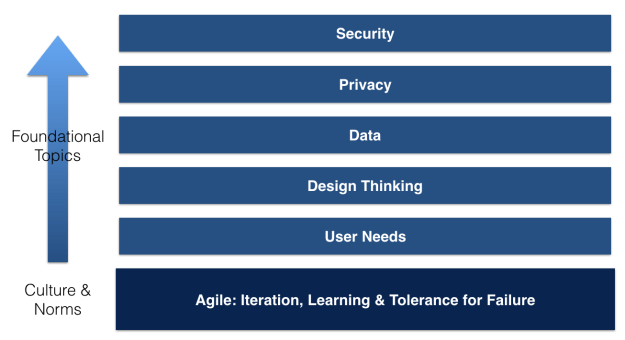
The first starts with some culture shock. Getting students to understand how technology is challenging the speed and way public goods could be built and delivered.

A part of this is teaching agile, not just as a project management skill but also as form of organizational culture. It is about having students understand how digital technologies alter how quickly organizations can learn.

To be clear, the point is not to worship at the alter of agile, but to think critically about where agile can work to increase speed and learning in policy development and the delivery of public services, as well as where it makes less sense as an approach. Should 100% of government work adopt an agile approach? Definitely not. But more than 0% should. And this is particularly true when it comes adopting digital approaches to organizing work within government and delivering services. Enabling students to see a universe beyond multi year inflexible plans and to provide them with language and frameworks for an adaptive and agile approach is an essential foundation for both thinking about digital in government and frankly, for a great deal of other work that has little to do with digital.

Once this foundation is laid, students then look at the topics of User Needs, Design Thinking*, Data, Privacy and Security**. These five topics are a useful way to talk about the politics, tradeoffs and challenges in digital sphere.
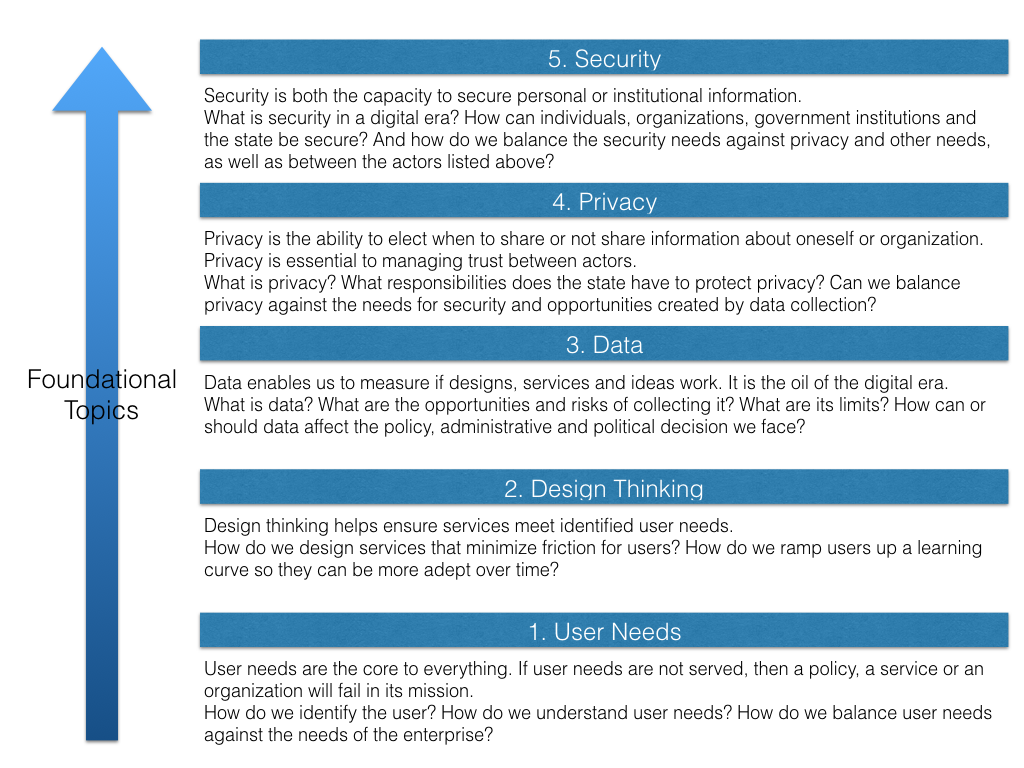
A basic analytical framework in each of the above areas provides students with a foundation for asking critical and important questions when confronting a new policy question or mobilizing assets to deliver services digitally. Each of these foundational topics are packed with both practical operational questions as well as significant political and ethical questions:

  • Who are our users? (this is a deeply political and practical question that should be answered at multiple levels).
  • Are we capable of designing for our end users and the administrators who must serve them and the broader public interest?
  • What data do we collect? Are we using it to learn? Is collecting it necessary? How might this data be mis-used?
  • Does this service, process, or product protect users’ privacy? Should it? What is the benefit? What is the cost?
  • What threats should we protect governments systems from? Economic systems? Broader democratic and social systems? Who is responsible for this protection?

These issues are also listed in priority. While all are critical, each one must be understood and informs one’s understanding of the next one. And while all are essential, they may be weighted based on the learning and career objective of a student. A student interested in service delivery will need to know more about user needs, design and data than, say, an information cybersecurity expert who will have a stronger focus on security and data.
I use this framework in two ways. First, in my DPI-662 Digital Government course, I seek to transform students into foxes, by giving them some basic introduction to each of these concepts. My assumption is that, when confronted with a online service to regulate, a vendor trying to sell the government software or trying to deploy an government service online, asking a question on any of the above 6 topics will probably serve them well. Thus, learning to think critically about each of them will provide a crucial foundation for learning about any new technology or concept.

The second way I use this framework at the Harvard Kennedy School is as an organizing structure for other classes. The intent is to give students the opportunity to become “hedgehogs” and receive further instruction on each of these foundational topics. As a result we offer multiple deeper courses on each of these topics so that depending on the career a student will have — either as a politico, administrator or regulator — they can do a deeper dive in a manner that will serve their interests. More on how we do this in a subsequent post.

* Note: Some readers may wonder why User Needs and Design Thinking are listed separately. It is true that these would traditionally be merged. I’ve separated them for two reasons. First, there are a set of questions about who the users are that are deeply political that should be answered separately from the issue of how we would design for services, policies and regulations to serve them. The second is, I’ve found governments are frequently not great at a) identifying and understanding users and b) engaging in design thinking, so separating them out is another way to emphasize the need to invest in these these capacities.

** Note: Security and Privacy are also deeply related topics. I’ve purposely listed them separately. Security and privacy interests can clash, particularly when discussing the interests of an organization versus those of an individual. My experience, in the government context, is that when privacy and security are lumped together, privacy has a funny way of taking a back seat in the discussion. This risk is particularly real in schools of policy and government, where organizational interests — usually those of the government — are front and center. Separating them out hopefully ensures they remain on a equal footing.

This is the fifth in a series of pieces about how I’m wrestling with how to teach about digital technologies at policy schools. If you’re interested you can read:

here at Digital@HKS or on my blog.
Teaching Digital at the Kennedy School of Government: Part 4: The Trap — Teaching Tech and Concepts

Before talking about the framework for thinking about digital at the Harvard Kennedy School, I want to discuss what we aren’t doing. I do this because I frequently get asked by students and others to respond to needs that I think are poorly articulated. I believe we should listen to users (students) but that doesn’t always mean they know how to articulate what they want perfectly.

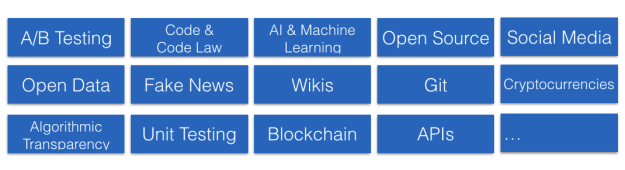
Sample of Technologies and Concepts

One risk is that a policy school ends up focusing on either what is easy or sexy (or both). This is compounded by the fact that professional degree students (as well as exec-ed students) who feel real pressure to skill up for the job market may gravitate to courses that focus on tactics or tools. This includes subjects like how to use a technology of the day, such as Twitter, Slack, or Bitcoins, or perhaps a specific skill, such as learning to code in rails or python.

Courses on these topics appeal for many reasons. They are practical: one learns how to “use” a technology or leaves with a greater awareness of it. They are bounded: by focusing on a specific technology or application, they are narrow in scope. This creates nice boundaries for the student, and it also makes teaching them easier (but not necessarily effective). The more tactical the course, the cheaper they are likely to run: finding people willing to teach a course on how to program or how to use social media in a campaign is probably easy and cost-effective. But even when the course is around a broader concept rather than a narrow tool, there are still drawbacks. There are so many important issues that are shared across technology, like issues of privacy or security, that students risk re-learning core concepts over and over again as they go from course to course about each new concept or technology.

This is not to say policy schools should teach no courses that meet the above criteria. It is just the wrong place to start. Why?

First, technologies evolve and change over time — sometimes quickly — so learning how to use a specific technology may simply set a student up to become rapidly deskilled. Second, learning how to use tools, while at a policy school, has a huge opportunity cost. Third, policy schools (and universities in general) are ill equipped to teach these skills cheaply and quickly. Here at the Harvard Kennedy School students have access to Lynda.com which teaches many of these technologies quickly and cheaply. But finally and most importantly, this work is generally tactical. For a policy school a set of technologies cannot make up an organizing principle around which a curriculum can be structured. This isn’t to say that a specific technology isn’t sometimes important, but it is not the point of departure. I’m not interested in teaching specific technologies. I’m interested in how all digital technologies may impact systems, organizations and the delivery of public goods. Insofar as is possible, I’m much more interested in policy schools providing students tools to assess all digital technologies than a specific one.

I mean, each of these are really interesting and you could (and maybe even should) legitimately do a course on each one.

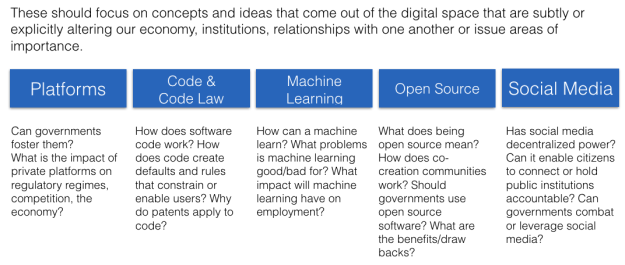
Any serious policy school should focus on how these digital technologies are changing governance, the provision of public services, social norms and/or the economy. This requires that students have some shared sense of critical questions they should be asking about any digital technology and how it may or may not benefit government or society.

As for “tool learning” this should — where possible — be a byproduct of assignments, but it should not be the lesson in of itself. As a result I encourage my colleagues here at HKS to build assignments that involve tools: for example I make all students submit all assignments via blogs, so that they learn how blogging tools work, but learning how to blog is never the assignment in of itself.

Sidebar: The second point from above is why I advise students not to take the popular CS50 course. If students want to learn to code, they shouldn’t do it while at school of policy. It is possibly the singularly most expensive way I could imagine to learn to code. Encourage students to do it via Code Academy or some other resource the summer before students arrive. They’ll learn more than they would in CS50, it will cost a fraction of the amount, they’ll be able to apply what they learned in classes immediately and, it will free up time to take courses they they’ll never be able to take outside of the policy school environment.

Next up, let’s talk about what foundational knowledge students should learn at a policy school that will make it both easier to learn the tools and concepts outlined above as well as position students to be more critical and thoughtful while engaged in that learning.

This is the fourth in a series of pieces about how I’m wrestling with how to teach about digital technologies at policy schools. If you’re interested you can read:

Teaching Digital at the Kennedy School of Government: Part 3 – Our Users and What They Need

Focusing on the User: Who Policy Schools Teach

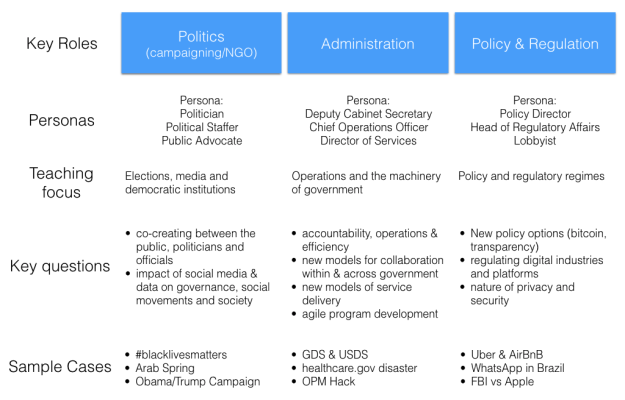
While students from Schools of Policy and Government go on to do a variety of work, whether in the private, nonprofit or for profit sector, most will take a role in one of three functional areas: Politics, Administration/Operations and Public Policy.

Like with much in life, there isn’t always a clear dividing line between types. In addition, over the course of their career many students will occupy jobs in all three and some roles will blend responsibilities. However, as a heuristic to help organize a policy school’s thinking around what it should teach, these are helpful definitions.

This felt further validated while reading Craig Lambert’s interesting case study on the founding of the Harvard Kennedy School (sent via co-conspirator Nicco Mele). In it, Edith Stokey, one of the school’s founding mothers, had a similar view when describing how the school’s curriculum emerged.

“Another new invention was the KSG curriculum which, from the start, emphasized policy analysis and systems analysis to improve decision-making. “That grows out of the [Robert] McNamara and the ‘whiz kids,’ ” says Edith Stokey, referring to the coterie the helped McNamara transform Ford Motor Company when he headed it in the 1950s. “But then came the discovery that good policy isn’t any use if it isn’t implemented at the street level, so we began to worry about implementation and management. Thirdly, with Neudstadt the moving force, there was growing emphasis on politics, including persuasion, legitimacy, and how get the power to get things done.”

Stokey’s three curriculum areas, roughly mapped to the roles I outlined.

A Framework for Organizing our Users

Having established these roles as the “product” that schools of policy and government produce, I’ve fleshed out personas for each. Below are illustrative examples of what a school of policy and government should focus on, from a digital perspective, to equip students with the judgment, knowledge and experience to be successful in each role:

First, I expect people may disagree as to what is most important for each role to learn. I’m okay with that. The point is that fleshing out the framework will prove useful to anyone seeking to engage in education in this space. The goal is to focus on user needs (the students) to help schools determine where to target resources and/or how to structure courses by type (and would love feedback). This is my best effort and is one way by which to structure courses (I have a second framework I do as well that I’ll be sharing in the next post or two).

In addition to understanding what type of product you are trying to create, my hope is that this chart will prevent people from creating courses that lump all the roles into a single course. There are ways that can work, but it is hard, and if you don’t structure it correctly there are real risks you’ll end up making everyone unhappy.

Second, this framework helps me because it identifies key common traits about the key roles students will have in a student body that is both:

a) insanely diverse: I mean this both in the students’ backgrounds (students range in age from 23–50+, come from over 80 countries and span the range of race, gender, sexual orientation, religion, and socio-economic class); and

b) in terms of career focus and interest: The types of jobs people had when they arrive and when they graduate is also exceedingly diverse.

You may not suffer from problem (a) or (b) which is lucky. But most governments’ educational programs and many policy schools do, so the framework provides some structure despite this heterogeneity.

Third, our students come to us with varying degrees of knowledge and skills when it comes to digital issues and technologies. Some are software engineers and data scientists, others have never had a gmail account. Maybe in 20 years’ time the baseline level of knowledge will normalize, but I doubt it, and well, that’s so deep into my career arc it isn’t worth thinking about. Yes, I want to prepare people for careers in public service who will go on to be CIOs… AND I need to prepare that overwhelming majority who won’t and for whom digital will be just a part of their job, not all of their job. This chart gives me some lane ways to organize them and a way to begin thinking about what knowledge, in which domains, I need them to know in order to feel like the school is preparing them appropriately for each of the roles outlined.

And of course even if you don’t suffer from the challenges above, I think it still serves as a useful starting point if your students are yelling “we want more technology courses” (which they were here). This may provide a little of a map to discern what kind of digital courses, the types of case studies and possible topics for events or guest speakers, that will be useful to them.

The Goal: Digital Leaders and Partners

I’m not going to go into details about what skills, knowledge and capabilities I think students need to have (yet). But I do have two other categories of students, those who will be technology leaders and those who need to be effective partners.

I don’t expect (nor do I have the skills) to have all 110 students in my main course on technology and government — DPI-662: Digital Government — to magically emerge as Todd Park clones (although that would be amazing).

Rather, I have two goals.

The first relates to those who come to me with a strong digital background. Here the goal is to equip them with language, frameworks and tools that set them on a path where, with hard work, experience and luck, some could emerge as Todd Parks one day in the future. I take great care to attract students with digital backgrounds. It isn’t easy. But it also isn’t impossible. Policy schools need to attract students with strong digital background. It is, to put it bluntly, much easier to turn a software engineer into a policy wonk than a policy wonk into an software engineer. As a result, any school interested in focusing on digital issues will need to actively pursue and accept students with technical backgrounds. Contrary to popular belief that software engineers are impossible to hire and recruit, USDS, 18F, Code for America and numerous other programs demonstrate that many software engineers, designers, product managers, and data scientists are deeply interested in foregoing salaries to serve the public good. Cultivating this small group into the next generation of IT leaders who can help support and ultimately lead the digital transformation of governments and other important institutions at the enterprise level is a major goal of mine, and Digital@HKS.

The second group is the larger group and those who come to the school without a strong digital background. The goal here is not to magically turn them into digital experts (although some can leave HKS as effective product managers and data scientists). Rather the goal is to enable them to:

a) at a minimum: equip them with sufficient knowledge to have solid BS detecting skills to ascertain when direct reports, vendors or even executives try to push initiatives that will fail or not work from a digital perspective. (This is akin to what we try to do in statistics with many students — some arrive skilled and leave as deep experts, but most arrive with less skills. We don’t turn them into statisticians, but we enable them to spot good from bad practices.)

b) ideally: have sufficient skills to help the departments in which they work or oversee be able to adapt its work to a digital world; and

c) preferably: know how to be effective partners to CIOs, vendors and digital types so they can help support digital transformation at the agency or enterprise level when appropriate and push back when ideas are poorly conceived or technology-centric with no clear purpose.

Having now worked with several hundred students here, what is nice is that I can clearly lump them in to both buckets. I have those with clearer digital skills looking for CIO or say product management jobs and I have those that are returning to a policy area (such as housing or eduction) as an analyst or manager who have a clearer idea of what questions they should be asking before anyone starts trying to engage in technology initiatives.

This is the second in a series of pieces about how I’m wrestling with how to teach about digital technologies at policy schools. If you’re interested follow me here on eaves.ca or at the Digital@HKS blog. You can also read part one here and part two here.

Teaching Digital at the Kennedy School of Government: Part 2 – Defining Digital

Why Digital?

For the purposes of our thinking we will use “digital” an umbrella term to describe the set of challenges, opportunities and issues that arise from a combination of information and telecommunications technologies.

Why digital? For one, “technology” is too broad a term. At HKS — and I suspect schools of policy and government in general — technology refers to not only information technology but all technologies and what I think many in the public would think of as areas of science like nuclear energy, biotech and climate change. This is clearly outside the purview of digital (and/or what I’m personally focused on). Words matter. If you run around using technology synonymously with information technology, some very smart and generally supportive people doing important and good work will rightfully be offended. Let’s not fight academic battles with allies — we have more important ones to engage in (privacy, user centric approaches, security, surveillance, regulation, etc..).

On the opposite end, “information technology” feels too narrow. Yes digital is about things like software, the internet, big data, and innovations like smartphones and artificial intelligence. But it must also be more than that. I’ve always loved how Clay Shirky wrestled with this in Here Comes Everybody:

“The tools that a society uses to create and maintain itself are as central to human life as a hive is to bee life. Though the hive is not part of any individual bee, it is part of the colony, both shaped by and shaping the lives of its inhabitants.”

Here at Digital@HKS we are as much, if not more, interested in the social, economic and policy changes brought about by the way digital technologies expand or threaten how we can solve problems, relate to one another, and reimagine institutions and the world. Information technology risks focusing us on the technology. The intent of using “digital” (while admittedly imperfect) is to try to be broader, to allow us to acknowledge the foundational role information technology plays, but focus on how we as individuals and society think about digital, interact with, use and are shaped by it.

This is the second in a series of pieces about how I’m wrestling with how to teach about digital technologies at policy schools. If you’re interested follow me here on eaves.ca. You can also read part one.

Teaching Digital at the Kennedy School of Government: A Road Map (part 1)

Part 1: Why Digital Matters

Digital technologies matter because our society, our economy, and our organizations have — for better and worse — become digitized. If policy makers and public servants can’t understand what this means, how it alters the production of public goods, or its impact on management, regulation, the economy, and policy, we are in trouble.

  • The Indian government is tying biometrics of its 1.3 billion citizens to a (nominally voluntary) digital identification system that will be required to access key government services and bank accounts. What does this mean for privacy, security and how the state delivers services?
  • In France and America, foreign actors hack into the main political parties’ email systems and leak contents in an effort to sway elections — or at least, to destroy the information sphere and make coherent public discourse impossible. Can democracies survive persistent digital disinformation campaigns?
  • In America, the failure of the healthcare.gov launch almost cost a sitting president one of his signature policies. Do governments possess the capability to deliver digital services?
  • Simple artificial intelligence systems could displace call centers, threatening to remove one of the lower rungs of the economic development ladder for some of the world’s poorest countries. Will digital technologies impede economic development for the world’s poor?

Digital: it is just beginning

In August 2011, Marc Andreessen — inventor of the first widely-adopted web browser and founder of Andreessen Horowitz — wrote a Wall Street Journal piece, “Software is Eating the World.” For many, the piece smelled of hubris, as markets (and the public) could still remember the dot.com bubble of a decade earlier.

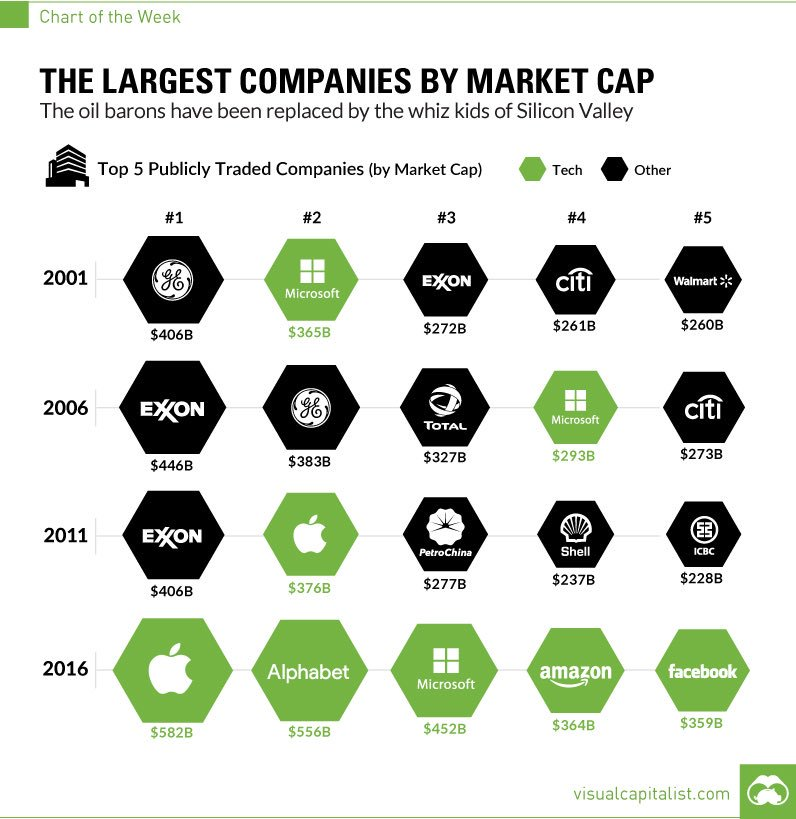
Andreessen’s assertion has proven prescient. Today, the five largest companies in the world (by market capitalization) are technology companies. And those that are not, like GE, are busy trying to redefine themselves as such.

But this ascension of digital in the world of business is only a part of the story. Andreessen’s confidence rested in part on the observation that across the business and public sector — and even one’s personal space — there existed millions, if not billions, of processes which today are either analog, undocumented, or automated but unconnected to the internet. He saw billions of tasks and activities — from the mundane (renewing your parking permit) to the critical (detecting tax fraud) — that software can or could do. And as more systems, more “things” and more services digitize, the possibilities and challenges will grow exponentially. This is why software still has much “eating” to do.

Andreessen’s piece has numerous implications. There are three I believe will matter above all others for schools of policy and government like the Harvard Kennedy School.

Digital — Why it Matters to Schools of Policy and Government

The first involves a fairly straight forward implication of Andreessen’s analysis. An alternative reading of Andreessen’s op-ed title is “How digital is eating the physical.” It is the digital sphere — and the rules, norms and structures that come to define it—that will, in many cases, control the physical sphere. This is why digital’s impact on the economy, democracy, and society should not be underestimated. It is also why understanding, shaping and engaging in those rules, norms and structures is essential to a policy school. Those interested in the public sphere will need frameworks and tools to address questions of ethics in digital technologies, to say nothing of its impact on equity, the public good, safety, privacy and innumerable other issues.

The second involves a renewal of institutions. Digital is transforming how we work and how institutions are structured and managed (imagine running a company in the present day without email — or for the hip among you, Slack). Government is no exception. What government can and should look like in a digital age is a real and pressing question. This is why digital transformation is such a buzz word. Organizations (governments, NGOs and companies) are all grappling with how to stay competitive or relevant, and it is forcing them to rethink how they are structured, how they process information and what skills their employees have. This is true in the private sector; again, GE serves as an example as it tries to shift from manufacturing to information services. The advantage of the private sector is that when organizations fail to make the transformation, they unwind, and their capital and assets are redeployed. The public sector has no such advantage. And you don’t want to live in a country where the government becomes obsolete or incapable. This makes digital transformation for schools of policy and government both urgent and critical.

Which brings me to the third way digital matters to schools of policy and government. People often talk about how technology — our digital world — accelerates the pace of change for both good and ill. There is indeed much that is speeding up. I believe the core opportunity and requirement of the digital age will be to accelerate how organizations learn. Digital provides the infrastructure — systems to measure, collect and analyze data, more easily than ever before. The question is how public institutions will adapt to and responsibly use these capabilities. Can governments become learning organizations that move at the speed of digital? And I mean this not just in the provision of services but in the development of public policy, regulatory regimes and innumerable other areas? At its heart, digital is unleashing a cultural and organizational change challenge. One that pits planners (bureaucratic systems comfortable with detailed but rigid plans and policies laid out in advance) and learners (agile oriented systems that seek to enable governments to learn and adapt), sometimes in real time. Balancing the world views of learners and planners, while continuing to constrain both with a strong system of values and ethics essential for public institutions, is a central challenge.

Digital matters in policy schools because unlike many of my technologist friends, I don’t think government is irrelevant. Nor do I believe it has permanently been left behind. Governments are slow moving, but immensely powerful beasts. They are also beasts that respond very aggressively to threats. I do not worry about governments failing to adapt to the digital age — they will eventually do that. I fear how governments will adapt. Will a world of agile, learning governments power democratic rights that enable us to create better societies? Or will they surveil us and eliminate dissent to create societies that serve their interest?

That future is up for grabs. It is why digital matters to schools of policy and government. It is why it matters to me. It is why I’m here at the Kennedy School.


This is the first in a series of pieces about how I’m wrestling with how to teach about digital technologies at policy schools. If you’re interested in part two, follow me here at eaves.ca or on the Digital@HKS blog on Medium.

The End of the American World: Without Vision there can be no Leadership

America is leaving the Paris Agreement on Climate Change. This is, by scientific consensus, a terrible outcome for the planet. But it is also a disaster for American foreign policy and its role as a global leader.

With this decision I’m left scratching my head. What does America stand for? What does it want the world to look like? I can no longer tell you.

Here, quick test: Name an issue the US Government is taking a leadership position on in the world.

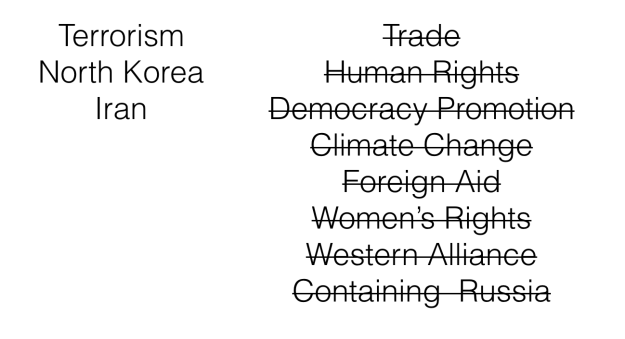
I can think of three. All of which are reactionary, none of which represent of a vision of where we should go. What is easier to tell you is what the US Government — and by this I don’t just mean the president, but also a large number of congresspeople and possible senators—no longer believe is important.

American Priorities.png

US Foreign Policy Priorities

Some of these items — women’s rights and climate change for example — have been contentious domestically for some time. But others formed the bedrock of the American vision for the world. Yes, there are lots of examples of American hypocrisy in its foreign policy (this is true of all countries) but trade, the western alliance (grounded in NATO), human rights and democracy served as general foundations for bringing together key stakeholders around the world in a shared vision of what the world should look like.

That is now all in tatters.

What does America believe in? What is the shared vision around which it will rally allies and unaligned countries? Beats me. Fighting terrorism is important, but it isn’t an organizing principle upon which to build a vision of the future.

China is willing to marshal economic and political capital to fight climate change which it is also leveraging to engage India and others. Its One Belt, One Road infrastructure plan is a vision for re-organizing global trade. Its Asian Infrastructure Investment Bank offers an alternative to the World Bank(which it is unclear the current administration even cares about) as a way to fund development and growth.

There is a lot about China’s vision for the world that is unclear and frankly, I’m not comfortable with. It is not hard to imagine a mercantilists’ world where human rights are non-existent. But it at least conveys a vision of shared prosperity, and it has a vision that tries to tackle global shared problems like climate change that require leadership.

And this rot in US leadership is not about Trump. What is clear is that Congresspeople and Senators appear happy to trade American leadership and vision for domestic wins such as repealing the Affordable Care Act and rolling back taxes. When Chancellor Merkel of Germany says the United States can no longer be relied upon, she wasn’t just talking about the president.

It’s the end of the American century, not because America lacks the capacity to lead, but because, at best, it has no identifiable vision for where it wants to take the world. At worst, I’m left inferring its vision is a planet my kids won’t be able to live on and a trade system unconnected to rules but linked to market size and where America must also “win.”

This isn’t to say the alternatives are much better, but those looking for vision and leadership need to hope America wakes from its sleep walk, get very creative in finding partners, or start picking between relatively unpalatable options.

But hoping others change has not been a sound basis for foreign policy in the past, and so I doubt the world will wait long.

Government, Digital Services & IT Procurement Reform

Next semester I’ll be teaching a course on why healthcare.gov initially turned into a disaster. Why? Because sadly, the failure of healthcare.gov was not special. Conservative estimates suggest over half of all IT projects are not completed on time or on budget. Others suggest the numbers are higher still. What did make healthcare.gov special was that its failure was so spectacularly public. As a result, unlike so many IT failures that stay hidden from public view, healthcare.gov is, somewhat paradoxically, safe to talk about. This makes it a wonderful case study to explore why so many large IT projects end in disaster.

Thinking about the course has me diving deeper into government IT procurement. Many of my colleagues in the civic tech space are convinced that procurement reform is critical to improving government IT services and fostering a better eco-system of IT vendors. I agree there is a great deal of good work that could be done to make procurement simpler and more effective. However, procurement is not a silver bullet. Indeed, I suspect that procurement reform, on its own, will have a limited impact, because it is not the central problem.

What procurement thinks it is trying to solve

There are two broad goals of government IT procurement policies that I think often get conflated.

One set of rules try to constrain and/or force people to make good technicaldecisions. Is the solution accessible? Is it secure? Does it protect privacy? etc…

The second goal is to constrain and/or force people to make good processdecisions. This is about ensuring fairness, accountability and broadly to prevent corruption. Did you get three bids? Have you laid out the specifications? Are you related to any of the vendors? Have the vendors donated money to any politicians? etc…

Both sets of rules have unintended consequences that make procurement slow and more difficult (although for many governments this can be a feature, not a bug, and making spending more difficult can be a net positive at a system level even if frustrating at the unit level).

The underlying assumption

Unpack these two goals — and particularly the first one — and you discover two underlying assumptions:

  1. IT implementations are treated like technical not adaptive challenges

The first assumption is that IT should be commoditized. While some IT purchases may be similar to buying a pencil, most are not. And if you are talking about an IT purchase that is custom build or the cost is north of $1 million, this is almost definitely not the case. Large IT implementations are complex with significant unknowns. It is impossible (despite organizations efforts) to spec out how all the problems will be solved in advance. Moreover this work takes place in dynamic environments where assumptions about the tech it will operate on, how users will interface with it and even what it product will need to do are dynamic. We treat IT projects like they are technical challenges — that we know exactly what must be done and that it can be all mapped out in advance — but they are almost always adaptive problems, where we don’t even know what all the problems are at the beginning of the process.

2. Effective process can force good decision making (or at least constrain bad ones)

Think of all the questions an enterprise — government or for profit — needs to assess: Will a solution work? Does it have a good user experience for our users? Can that UX evolve? Can the vendor adapt to unknown problems? Can they integrate with our current environment? To our future environment? Plus hundreds of other issues, all of which require nuance and knowledge.

But any set of procurement rules is about standardization process — so that the process can be evaluated, not the outcome. And this makes it harder to bring to bear these nuanced decision and knowledge because nuance, by definition, is hard to standardize. I fear that implicit in procurement reform is the belief that a good set of policies can design a process that, irregardless of who runs it, will prevent disaster and possibly even ensure an optimal outcome. If we assume procurement problems are technical problems for which the appropriate solution must merely be identified, then with the right “code” the machinery of procurement — regardless of who is manning it — should be able to select the optimal solution.

Both assumptions are, of course, patently ridiculous.

This is why I’m not confident that tinkering with the rules of procurement in the IT sector will generate much change. I certainly don’t think it will foster a new eco-system of service providers who will provide solutions that don’t fail 50% of the time. All the tinkering in the world won’t change the underlying issues — which is more than anything else: more than rules, oversight or the size of the ecosystem, is capacity of the people of running the procurement to evaluate technology and vendors capacity that matters.

I’ve seen terrible, terrible IT choices made by organizations and inspired decisions (like California’s Child Welfare Services RFP on which I’m writing a case study) be produced by virtually identical procurement rules and policies. The current rule set can allow a determined actor in government to make good choices. Could we do a lot better? Absolutely. But it is not the defining barrier.

This is, again, why I think USDS and similar digital service groups that try to attract talent that has worked on mass market consumer technology matter. Recruiting top technology talent into government is the single best strategy for ensuring better procurement. Deeply experienced people stuck with an okay rule set will be better than less experienced people stuck with an okay rule set.

And vendors generally agree. As a vendor, what you want more than anything is a capable, intelligent and knowledgeable buyer, not a set of rules that must be adhered to no matter the context.

And, to be clear, this is how the private sector does it. Ask Peter Thiel, Mark Zuckerberg, Elon Musk or Paul Graham (especially Paul Graham). None of them would outsource the technology choices for their start up or $1B dollar unicorn to a group of procurement officers equipped with even the most perfect set of procurement rules. Quite the contrary. They spend millions in stock options and money hiring amazing talent to make highly informed decisions to meet needs in a fluid and evolving environment.

So we should do Procurement Reform?

We should. We definitely should. But let’s recognize the limits. We should have rules that prevent corruption, nepotism or competitive practices. But unshackling people of rules may equip them to make more bad decisions as it does good ones. Let’s make rules that help people buy software and don’t make the process a burden, but our defense against poor outcomes shouldn’t be more rules, it should be an investment in pulling the brightest and best minds into government.

This is a problem I think digital service groups are trying to solve — creating a pipeline of talent that has worked with the latest tech and delivered solutions that have served hundreds of millions of users, flowing through government. So let’s just ensure that we invest in both. Procurement reform without the right people won’t get us there.

The Future of USDS: Trump, civic tech and the lesson of GDS

Across Washington, the country, and the world, the assumptions people have about various programs, policies and roles have been radically altered in the last 12 hours with the victory of President-Elect Trump. Many of my students and colleagues have asked me — what does this mean for the future of United States Digital Service and 18F? What should it mean?

This is not the most important question facing the administration. But for those of us in this space the question matters. Intensely. And we need a response. USDS and 18F improve how Americans interact with their government while saving significant amounts of money. Democrats and Republicans may disagree over the size of government, but there is often less disagreement over whether a service should be effectively and efficiently delivered. Few in either party believe a veteran should confront a maze of forms or confusing webpages to receive a service. And, the fact is, massive IT failures do not have a party preference. They have and will continue to burn any government without a clear approach of how to address them.

So what will happen now?

The first risk is that the progress made to date will get blown up. That anything attributed to the previous administration will be deemed bad and have to go. I’ve spent much of the morning reaching out to Republican colleagues, and encouraging those I know in the community to do the same. What I’ve heard back is that the most plausible scenario is nothing happens. Tech policy sits pretty low on the priority list. There will be status quo for likely a year while the administration figures out what is next.

That said, if you are a Republican who cares about technology and government, please reach out. I can connect you with Jen Pahlka who would be happy to share her understanding of the current challenges and how the administration can use USDS to ensure this important work continues. There are real challenges here that could save billions and ensure Americans everywhere are better served.

The second risk is implosion. Uncertainty about what will happen to USDS and 18F could lead to a loss of the extraordinary talent that make the organizations so important.

Each employee must decide for themselves what they will do next. Those I’ve had the privilege to engage with at USDS, 18F or who served as Presidential Innovation Fellows have often displayed a sense of duty and service. The divisive nature of the campaign has created real wounds for some people. I don’t want to pretend that that is not the case. And, the need to push governments to focus on users, like Dominic, is no less diminished. Across Washington, there are public servants who did not vote Republican who are returning to their jobs to serve the best they can. The current administration has been effective in issuing a call to arms to civic technologists to help government. Now, having created a critical mass of civic technologists in DC, can it hold to continue to have the influence and grow the capabilities a 21st century government needs? Maintaining this critical mass is a test that any effort to institutionalize change must clear.

If you work for USDS or 18F, there are maps. The Government Digital Service was created by a partnership between a Conservative Minister (Francis Maude) and a group of liberal technologists (Mike Bracken et al). I doubt either party was naturally comfortable with the other at first, but an alliance was made and both its strengths and its flaws could serve as one template for a way to move forward.

My own sense is the work of USDS and 18F must be bigger than any one administration or party. For some this is a painful conversation, for others it is an easy conclusion. I understand both perspectives.

But in either case, there must be a dialogue around this work. So please, both sides. Find a way to talk. There is certainly a need for that in the country.

If there is anything we can do at Harvard Kennedy School to convene actors on either side of the aisle to help find a path forward for this work, please let me know. This work is important, and I hope it will not be lost.

Addendum: Just saw Naoh Kunin’s piece on why he is staying. Again, everyone has to make their choice, but believe in the conversation.

Improvising a Digital Curriculum at the Harvard Kennedy School of Government

Since arriving as a Lecturer at the Kennedy School of Government at Harvard, I’ve been thinking a lot about how to integrate digital into the curriculum. I have a course on Digital Government and will be teaching modules next term on what we’ve learned from Digital Services (like USDS and GDS) as well as one dissecting why Healthcare.gov failed and what we learned.

However, many students ask me what else they should be taking. And while I have broader thoughts on what policy schools and schools of government should be doing (more on that in another piece), carving out a digitally oriented curriculum based on assets the school already has is both a good exercise and can provide some instant advice to interested students. And the good news is, there more that touches digital at the Kennedy School than people realize — it just isn’t always framed that way.

So, for students looking at this space there are two ways I would look for courses.

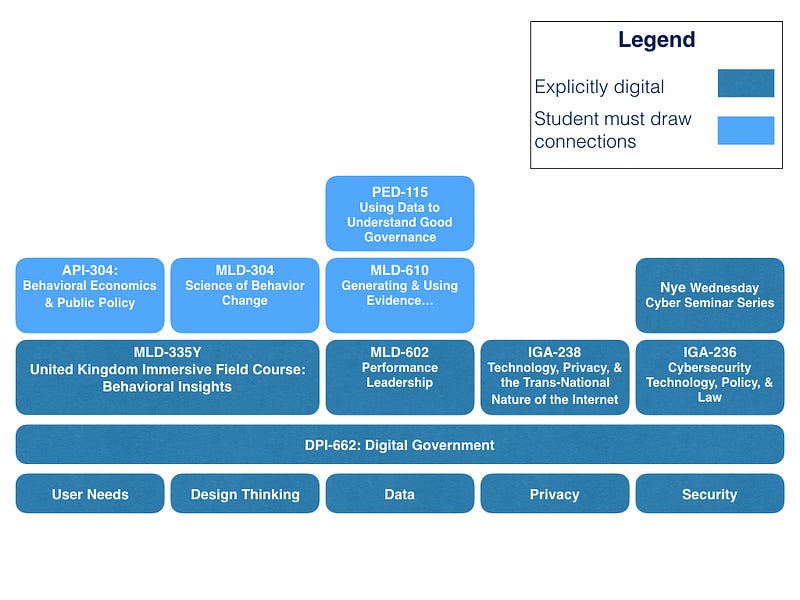
The first is to identify courses that zero in on some areas of knowledge that are core to understanding digital. I’ve identified 5 that I think every school should focus on (and would love feedback on these): User Needs, Design Thinking, Data, Privacy and Security (and yes, privacy and security are separated for good reason!). I have more thoughts on why I’ve chosen these 5, but will save that for another piece so we can stay focused.

Having a grounding in each of these topics is critical. They touch pretty much every other topic, concept and idea in the digital space. I cover each of these in my DPI-662 to provide students with such a grounding, but ideally there are (or should be) more courses that would allow students to delve even deeper into them.

With that in mind, the chart below outlines some courses I know, or suspect, would accomplish this goal. The dark blue courses are explicitly about digital/technology in government, while the light blue ones cover relevant subject matter, but may require the student to make linkages to the digital (perhaps by choosing their assignments or the cases they focus on strategically).

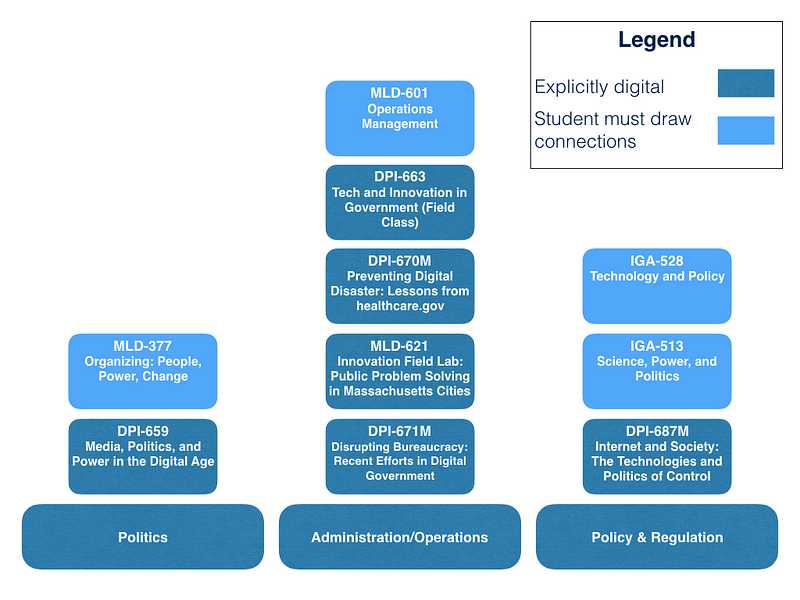
The second way to identify courses is by the type of job or role you hope to pursue after graduation. Here, broadly see three types of career paths:

  • Politics: For students who intend to be politicians, or a staffer
  • Administration/Operations: For students who intend to run large organizations or oversee the delivery of services
  • Policy and Regulation: For students who want to write and/or advocate policy

Again, a basic grounding in the five disciplines outlined previously is an essential prerequisite. This is because this second batch of courses draws on all 5 in varying degrees. The courses may emphasize some — like say security or data — more than others, but having a grounding all five will both make these courses more enjoyable and enable students to learn more from them.

A few additional thoughts:

  • I’m still relatively new and so not intimately familiar with all the courses at HKS, so would love feedback if anyone thinks these are wrong or am missing some
  • I’ve limited myself to courses at HKS. I’m confident there are courses elsewhere on campus that could be helpful. Will start to look at those next
  • Would love feedback and thoughts on anything in the piece. It forms part of a much broader piece I’m working on
  • Part of the exercise here is to identify gaps where further courses could be helpful — so would also love thoughts on that
  • There are lots of non-courses (e.g. reading groups, projects at the Ash, Belfer or Shorenstein Centers that touch on this material — I’ve not included those here
  • Finally, would like to thank Glynis Startz — second year student here at HKS — for helping me sort through the catalogue

The Empire Strikes Back: How the death of GDS puts all government innovators at risk

The UK Government Digital Service(GDS) is dead. I’m sure it will continue to exist in some form, but from what I’ve read it appears to have been gutted of its culture, power and mandate. As a innovator and force for pulling the UK government into the 21st century, it’s over.

The UK government comms people, and the new head of GDS himself will say otherwise, but read between the lines of the stories as well as what former GDS people are saying, and it’s clear: GDS is dead.

These narratives are also aligned as to why. GDS was killed by what the Brits call “Whitehall.” This is short form for the inner and elite circles of the UK public service somewhat cruelly depicted in “Yes, Minister.” Their motive? GDS represented a centralization of IT control, and the departments — for whom GDS frequently found savings of tens of millions of pounds and provided effective online services on behalf of— didn’t like seeing their autonomy and budget sucked away by a group of IT geeks.

Losing GDS is a tragedy for the UK. But the downside isn’t limited to just the UK. It represents a blow to efforts to rethink and digitize governments around the world.

Why?

Because the debates over how governments work are not domestic (they haven’t been for a long time). GDS inspired innovators and politicians everywhere who were hungry for models of how governments could function in a digital age. Copycats sprang up around the world, such as the Digital Transformation Office in Australia and the United States Digital Service in the US at the national level, as well as others at the regional and local level. (For example, the Province of Ontario, which has a fantastic digital team, is currently hiring a Chief Digital Officer to lead a similar type of org.)

While working independently, these organizations share a common sense of mission and so trade best practices and lessons. More importantly, a few years ago they benefited from a massive asymmetry in information. They understood just how disruptive the innovation they were seeking to implement could be. And not from a technology perspective, but to the organizational structure and distribution of power within the public service.

As it became clearer to the rest of the public service in the UK just how far-reaching GDS’s vision was, and how much thinking digitally challenges the way senior public servants in places like Whitehall think… that asymmetry in knowledge and capacity didn’t diminish, but the asymmetry in awarenessand implications did. And so the center fought back. And it has far more power than any GDS might.

But it isn’t just in the UK. I suspect the existence of GDS and its global network has activated a global counter-movement among senior mandarins. Public servants are connected across international borders by shared alma maters, common international organizations and professional groups, cross-border projects, etc.… don’t think for a second that that global network hasn’t been activated (particularly among Treasury Board officials) to what some see as a new threat.

To be clear, this isn’t a GDS good, Whitehall bad piece. For anything to fail there is probably some shared responsibility. And assigning blame doesn’t really matter. What I care about it preserving what I and many others believe are important efforts to modernize governments so that the effectiveness of government, and trust in its institutions, are maintained.

So what does matter is, if you work for a digital service outside the UK, it is time to go double down on political cover and/or to reach out to the senior public servants around you and build some alliances. Because your Whitehall equivalent definitely has relationships with the UK Whitehall, and they are asking them what they think and know about GDS, and their story probably isn’t a good one.

The empire of traditional siloed bureaucracy is fighting back. You probably won’t beat it. So how are you going to engage it?