Open Data Day in 110 cities Worldwide! Here’s 6 things to do

It is, as always, with a fair amount of wonder that I watch the open data day wiki grow each year. This year there are 100 self organized events taking place worldwide (at last count). It is an impressive number. This includes events in places like Buenos Aires (which is doing open data street art), Ilorin Nigeria, Kampala Uganda, Barcelona Spain and Aomori Japan to name just a few.

Many of these events have speakers lined up, projects to hack on, seminars and workshops organized. Others are straightforward hackathons and/or unconferences.

If you are heading to an Open Data Day event be sure to take a look at the local events page on the wiki or local website to see what is planned. But if you are looking to get inspired… here are 6+ ideas for what to do on open data day.

1. Use Where Does My Money Go to create a simple visualization of a government budget.

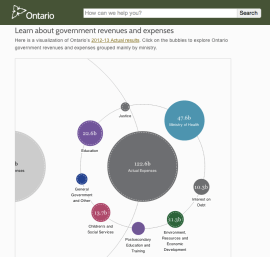
WDMMG Ontario

I love where does my money go. It is just so simple and makes budgets much easier to understand. I persuaded the Ontario Government to use it when it released its budget a few months ago.

The nice part is… it is open source. Check out the code here. No reason why a small team couldn’t fork it and enter in new numbers to visualize the local, regional, state or national budget near where you live!

2. Don’t fixate on an app – fixate on your community

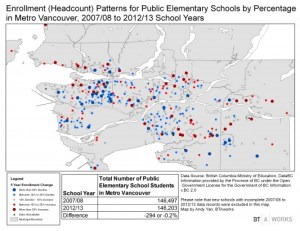
Metro_YVR_Schools2008_20131-533x411Here in Vancouver I’m inviting Andy Yan of the local non-proft BTAWorks to give some opening remarks at our open data day. Why? Because Andy is a legendary user of local open data. And he doesn’t build apps – instead he uses data to better explain Vancouver to Vancouverites.

Andy uses simple mapping software, and even sometimes just plain old excel to take data and analyze it. He’s written about property values in Vancouver (on several occasions), enrolment patters in the city’s public schools, the distribution of coffee houses and books stores in the city and, perhaps most notably, an analysis of the number of empty condos in a city with expensive real estate.

My point with Andy’s work is that you don’t need to create an app to use open data. Indeed, it may not even be a good idea. Rather there is lots to be done just analyzing data or figuring out different ways it may have meaning for the people who live in your city. If you can enable more people to understand an phenomenon or problem that is, in of itself, quite valuable.

3. Find Your People

While Open Data Day has become a “thing” it isn’t an organization or a group. It is just an excuse with some simple rules for a world wide community to mobilize itself at a very local level.

That said there ARE lots of amazing groups out there. And Open Data Day is the perfect day to meet some of them and get involved in the amazing work they are doing. Indeed, groups that use open data have a variety of flavours – so there is often something for everyone. Some of these groups include Hacks and Hackers (journalists and software developers), Open Knowledge Foundation (open data activists), Code for All (civic hackers), Mozilla (open web), the Sunlight Foundation (government transparency), to name but a few. There are also lots of more local and national based groups, as well as industry specific groups such as the Extractive Industries Transparency Initiative and the International Aid Transparency Initiative. Often someone at your local event will already be a member of one of these groups – it is a great time to learn more and maybe even join!

4. How to be useful even if you don’t code or can’t use excel

Last year I wrote about three ways anyone can participate in projects on open data day. There is nothing that stops you from creating a keynote/powerpoint that mocks up an idea you have for an analysis or app, or from helping a group document its work so that others can replicate it, or from just going out and finding some useful data that you think might be in the public interest and working with others to get it scraped and made usable.

Indeed what I love about all these examples is that they are paths to learning more. The straight fact is, I can’t code and I have only limited proficiency with something like excel. But I’ve always found ways to make myself useful and in doing so… I have learned so much.

Open Data Day is less about doing than it is about learning, networking and organizing. Ultimately there is nothing stopping you from self organizing a workshop about anything you care about, an issue, a data set, a tool, and asking someone to teach you about and others to learn with you!

5. Go New School – Mobilize a Community to Request a Data Set

Many governments that have open data portals have a “request a data set” option on the page. What an opportunity. If there is a data set that would help bring transparency and accountability to your community… say around environmental pollution, local budget data, contracts and procurement data or arrest rates in a community then why not mobilize local non-profits, stakeholders and even citizens to mount a campaign to “make it open.”

A public campaign that notes the number of people who have “requested” a data set could apply pressure on a government to fulfill its promise to make more data sets open. More importantly, if might giver the community important data by which to challenge public policy or advocate for change.

6. Go Old School – Submit an Access to Information Request

Before there was open data there was… access to information requests. This slow, often cumbersome way of getting government information is critically important. This is because – in places where Access to Information laws exist – they are the only legally backed way to secure government information (and data).

Just learning how to do an access to information can be novel since so few ordinary citizens ever do one. But it many jurisdictions it is your right to be able to do so.

For activists and software developers who are particularly interested in this area of governance/law I encourage you to check out the Alaveteli project started by the amazing team at MySociety. It attempts to bring to add some #opengov tech to the Access to Information world.

I hope this are helpful ideas. More importantly, I hope wherever you are that you have an amazing time on open data day.


So… before there was access to information, there was

What’s in my yogurt

Would you like to know more?


Open Data Day in Vancouver – Registration is live

I’m happy to share that this February 22nd there will be an Open Data Day event in Vancouver. The details are as follows:

The event will take place at Domain7 – who have kindly volunteered their space – on Saturday, February 22, from 10:00 AM to 4:30 PM. We have limited space and want to coordinate lunch so if you want to attend please register here.

We have an exciting day planned – a few opening talks and networking and then a day of hacking, learning and sharing. More details to follow shortly! Very much hope to see you there!

The dangerous mystique of the “open data” business

I’m frequently asked by people about how they can start an “open data business.” Let me first say that I love that the question gets asked. I love that people are interested in Open Data. I love that people want to learn more, they want to play, they want to think of ways of creating a company. These are, in part, signs of how far the open data discussion has come – people see it as a resource that they would like to leverage.

It is, also, the wrong question.

This is not to say there are not businesses that use open data. Indeed, a vast number of companies use open data (anyone company using census data for even a tiny part of their business qualifies). Nor am I denying there aren’t businesses built primarily with open data – the Open Data 500 list demonstrates there are. Plus I get introduced almost daily to businesses that are: both Ajah and OpenCorporates come to mind (I have donated advice, but have no financial connection, with either).

The Trap

But from a founder (or, I suppose, investor) perspective there are dangers to thinking about “open data” as a unique business space.

The danger is in failing to understand there is virtually nothing that distinguishes an open data business from any other business. Any business needs to solve a real (or sadly, at times imagined) problem, it needs to find clients (e.g. people willing to pay for that solution), and it needs to execute on a number of other things at least competently (HR, marketing, management, cashflow, etc…).

The danger with putting the words “open data” before the word “business” is that it risks making people think Open Data businesses are somehow unique. They are not. If there is a gapping chasm between the question of “what can I do with software” and “how can I create a viable software company” there is an equally large gap between “what can I do with open data” and “how can I create a viable company using open data.” And the questions you need to ask yourself to figure out that latter question (many of which are nicely laid out in this book) are independent of whether it is a software, hardware, crafts or open data business.

Indeed open source software space gives us a nice analogy. I suspect few people decide to create an open source software company – they decide to create a company and the software license is a reflection of their strategic options. I think it is the same with open data. You don’t start a company saying “let’s use open data.” You start a company to solve a problem, of which using or publishing open data may be the only, or the most strategic, way of doing this.

The Opportunity 

Some readers may be surprised to see me write this. I am, and continue to be an advocate of open data. But open data is not some magic pixie dust that causes normal business logic to disappear. And it is not that I think people are saying that per se, it is just that I want them to understand that the 99% of the problems that needs to be solved in an “open data business” lie in the third word of that string, and that while the first two do confer some unique advantages and disadvantages, these are relatively trivial.

The real opportunity of open data lies not in the way it creates a new unique type of business, but that it offers a new set of cheap building blocks by which to try to solve problems. In other words it increases the diversity and, lowers the cost of, inputs.

Here again the world of software is instructive. The Economist’s recent survey on Tech Start Ups talks of a Cambrian Explosion because of the availability of “Cheap and ubiquitous building blocks for digital products…” many of which are (and many of which are not) open source. The cheap availability of these building blocks is allowing for a range of experimentation that was previously not possible, or at least, prohibitively expensive.

Open data – whether as an input for software products and services, for analysis (journalistic or corporate) or for scientific research – is cheap (in theory free) and increasingly plentiful. It has the possibility of thus being the equivalent of the cheap code that is powering a great deal of experimentation in the world of software. As an open data advocate the possibility of this increased experimentation has me excited.

Conclusion

So if you are thinking about starting an open data business – that is great! I’m excited to hear that and I am keen to help and be supportive. But focus on that third word – business. That’s the one that really matters.

From a data perspective you should be asking yourself – what real tangible pain does doing something with this data set help me solve that was previously only possible with a more expensive input (e.g. proprietary data) or not possible at all. The second is to think of the impact of using open data on your strategy. Where does it leave you more vulnerable (too copy cats or the whims of the data publisher) and where does it leave you stronger (if the data is commoditized then the axis of competition will lie in other parts of the business).

I hope this is a helpful nuance to the issue of open data businesses, and some helpful input for those looking at open data and thinking about to find business opportunities in it.

Open Data Advice for Librarian Coders

For the purposes of this post we will ignore how remarkably badass sounding the word librarian becomes when “coder” is added to the end of it.

I recently had a librarian who had just picked up some coding skills email me and ask how they could get into Open Data (if, by the way, you were interested in someone with those skills, I’d be happy to connect you to them). Here is an edited version of my response:

I actually think that librarians are exactly what the open data space needs. It is interesting to think about the consulting services and organizational problems that exist in a world of almost infinite data – and particularly in a world with large amounts of open data.

Open Data portals are are getting more and more data sets – but I’m not sure anyone has meaningfully figured out how you organize that data in meaningful way? Or at least make them searchable in a way that is meaningful to a cross section of people as opposed to a narrow highly specialized specific type of user (e.g. an academic or domain expert)? Nor has anyone – as far as I can tell – cracked the problem (or developed the human hacks necessary) around acquiring and organizing meta data (e.g. actually getting it, and then making it understandable to a range of audiences without losing its nuance).

Certainly when I facilitated consultations on open data in a range of cities across Canada the issue of searchability and finding data came up over and over again. It was a very strong theme.

These are serious problems. And they are probably going to get much much worse as more data becomes available.

Open Contracting Workshop in Montreal on Friday

This was sent to me by Michael Roberts who has been doing great work in the Open Data and Open Standards space in Canada. Please check this out:

What: Open Contracting Data Standard: Stakeholder Workshop

When: 31st January 2014 – 9am – 3pm

Where: Hilton Montreal Bonaventure 

Hashtag (always required): #opencontractingdata

Register at: http://bit.ly/ocds-stakeholders

About the Open Contracting Data Standards project:

Over the course of 2014 the Open Contracting Partnership (OCP), the World Wide Web Foundation and wide range of stakeholders will be working to develop the first version of a global open data standard for publishing information on public contracts. The Open Contracting Partnership (OCP) believes that increased disclosure and participation in public contracting will make contracting more competitive and fair, will improve contract performance, and will better secure development outcomes. The development of an open contracting data standard is a vital step in joining up data across sectors and silos, allowing it to become truly socially useful. It will result in increased transparency around contracting processes and will empower citizens to be able to hold governments to account.

Stakeholder workshop:

We invite you to join us on 31st January 2014 for a stakeholder workshop to:

  • Explore the goals and potential for an Open Contracting Data Standard;
  • Identify opportunities for involvement in the development of the standard;
  • Shape core activities on the 2014 standard development road map;

Outline agenda (tbc):

  • 8.30am – 9.00 am: Welcome and coffee
  • 9.00am – 10.30am: The Open Contracting Road Map 
  • Including the history of the Open Contracting initiative; an introduction to the data standard project; and an exploration of data standard development so far.
  • 10.30am – 10.45am: Coffee break
  • 10.45am – 11.45am:  Shaping the vision & identifying stakeholders
  • Participative small group discussions focussed on outlining short and long-term visions for an open contracting data standard, and identifying the roles for key stakeholders to play in the development of the standard.
  • 11.45am – 12:30pm: Ways of working and key issues: an open development approach
  • Introducing the collaborative tools available for engaging with the development of the data standard, and identifying the key issues to be addressed in the coming months (the basis for task-groups in the afternoon).
  • 12.30pm – 1.30pm: Lunch
  • 1.30pm – 3.00pmTask groups
  • Small group work on specific issues, including the future governance of a standard, shared identifiers (e.g. organisational identifiers), data formats, demand side workshops, supply side research and related standards.

Who is the meeting for?

This meeting is designed to provide an opportunity for anyone interested in the Open Contracting Data Standard work to learn more about it. There will be discussions tailored to both providers of contracting data, and users of data, as well as discussions focussed at connecting the Open Contracting Data Standard with related open data projects, including IATI, Open Spending and open data on companies.

Open Data Day Google+ Hang Out

With just about a month to go until Open Data Day things are going well. There are quite a few cities that have been added to the open data day wiki.

This year we thought we would try something new. On January 21st we are going to host a  Get Ready For Open Data Day 2014! Google hangout.

The goal of the hangout is to help people thinking about organizing an event in their city get a sense of what others doing, ask questions about what has worked in the past, and just learn more about what is possible on the day. 

We’ll be hosting a 30-60 minute event on Tuesday, January 21 (at 11:00 am EST/ 8:00 PST/ 16:00 GMT /17:00 CEST) with myself, Heather Leson and Beatrice Martini focused on:

  1. What is Open Day Day – History
  2. Planning tips
  3. Open Q&A

There is likely a limit to how many people we can host on the hangout so please let us know if you’d like to participate.

And if you are interested in connecting with others – especially those who have run open data day events before – please consider joining the mailing list!

Santa Claus, Big Data and Asymmetric Learning

Any sufficiently advanced technology is indistinguishable from magic.

– Arthur C. Clarke’s Third Law of Prediction

This Christmas I had a wonderfully simple experience of why asymmetric rates of learning matter so much, and a simple way to explain it to friends and colleagues.

I have a young son. This is his first Christmas where he’s really aware of the whole Christmas thing: that there is a Santa Claus, there is a tree, people are being extra nice to one another. He’s loving it.

Naturally, part of the ritual is a trip to visit Santa Claus and so the other day, he embarked on his first visit with the big guy. Here’s a short version of the transcript:

Santa: “Hello Alec, would you like to talk to Santa?”

Alec: (with somewhat shy smile…) “Yes.” 

Santa: “So Alec, do you like choo-choo trains?”

Alec: (smile, eyes wide) “Yes.”

Santa: “Do you like Thomas the choo-choo train?”

Alec: (practically giggling, eyes super wide) “Yes!”

Reflecting on this conversation, all I can think is… no wonder kids believe in Santa Claus. I mean, here’s Alec’s first interaction with Santa ever and the guy, with no prompting, knows his name, knows one of his favourite things in the world, and even a specific type of toy related to that thing. Combine this with an appealing user interface (costumes, Christmas theme, and visitors treated like they’re very special) and of course it appears to actually be like magic. Alec must have thought Santa knew him personally.

It is easy to pretend this is something that only happens to two year-olds, but pretty much everyone I’ve met has, at one point, felt like LinkedIn or Facebook has been uncanny (for better or worse) in predicting a preference or connection.

The reality is there is just a massive asymmetry in learning. Most kids will have a single “Santa” interaction (or learning opportunity) a season – at most they’ll have two or three. Whereas a Santa in a shopping mall is going to meet thousands of kids (and thus have thousands of learning opportunities). Between these interactions and some basic research, any Santa worth his salt is going to pick up pretty quickly on what boys and girls tend to like and develop some quickly testable hypotheses about what any kid wants. Compared to the kids he meets, Santa is swimming in a world of big data: Lots of interactions and learning opportunities that allow him to appear magically aware.

The point here is that, as users, it is important for us to remember these things are not magic, but are driven by some pretty understandable tools. In addition, while we can’t always diminish the asymmetry in the rate of learning between users and the services they use, just understanding the dynamic can help demystify a service in a way that can be empowering to the user. I’m not going to ruin the magic of Santa’s tricks with my son, at least not for a few years – but I’m quite happy (and feel we are collectively responsible) to do so when it comes to online services.

Finally, it does show the power that increasing the rate of transactions can have on how quickly a system can learn. I’m spending more and more time trying to think about how systems – be they governments, non-profits or companies – can capture interactions and learning moments to help them become more effective, without pretending that it is magical – or infantilizing their users.

Open Data for Development Challenge on Jan 27-28

This just came across my email via Michael Roberts who has been doing great work in this space.

Mail Attachment

Open Data for Development Challenge
January 27–28, 2014 — Montreal, Canada

Do you want to share your creative ideas and cutting-edge expertise, and make a difference in the world?
Do you want to help Canadians and the world understand how development aid is spent and what its impact is?
Do you want to be challenged and have fun at the same time?

If so, take the Open Data for Development Challenge!

This unique 36-hour ”codathon” organized by Foreign Affairs, Trade and Development Canada will bring together Canadian and international technical experts and policy makers to generate new tools and ideas in the fields of open data and aid transparency and contribute to innovative solutions to the world’s pressing development challenges.

The event will feature keynote speakers Aleem Walji, Director of the World Bank’s Innovation Labs, and Mark Surman, Executive Director of the Mozilla Foundation. It will have two related dimensions:

  • Technical challenges that involve building applications to make existing open aid and development-related data more useful. Proposed topics include building a data viewer compatible with multilingual data, creating a publishing tool suitable for use by mid-sized Canadian non-profit organizations, developing and testing applications for open contracting, and taking a deep dive into the procurement data of the World Bank Group. There is room for challenges proposed by the community. Proposals should be submitted through the event website no later than January 8th. Challenges will be published prior to the event, along with key datasets and other related information, to enable participants to prepare for the event.
  • Policy discussions on how open data and open government can enable development results. This would include the use of big data in development programming, the innovative ways in which data can be mapped and visualized for development, and the impact of open data on developing countries.

The international aid transparency community will be encouraged to take promising tools and ideas from the event forward for further research and development.

An overview of the draft program is attached. The event will be in English and French, with interpretation provided in the plenary sessions and panel discussions.

We invite you to register, at no cost, at this website as soon as possible and no later than January 10. A message confirming your registration and providing additional information about the venue and accommodation will be sent to confirmed participants. Please wait for this confirmation before making any travel arrangements. Participants are asked to make their own accommodation arrangements. A limited number of guest rooms will be available to event participants at a preferential rate.

To find out more about the Open Data for Development Challenge, please go to DFATD’s website.

Open Data Day 2014 is Coming Feb 22 – Time to Join the Fun!

So, with much help from various community members (who reminded me that we need to get this rolling – looking at you Heather Leson), I pleased to say we are starting to gear up for Open Data Day 2014 on February 22nd, 2014.

From its humble beginnings of a conversation between a few friends who were interested in promoting and playing with open data, last year Open Data Day had locally organized events take place in over 100 cities around the world. Check out this video of open data day in Kathmandu last year.

Why makes Open Data Day work? Mostly you. It is a global excuse for people in communities like yours to come together and organize an event that meets their needs. Whether that is a hackathon, a showcase and fair, lectures, workshops for local NGOs and businesses, training on data, or meetings with local politicians – people are free to organize around whatever they think their community needs. You can read more about how Open Data Day works on our website.

Want to join in on the fun? I thought you’d never ask. Listed below are some different ways you can help make Open Data Day 2014 a success in your community!

A) How can I let EVERYONE know about open data day

I love the enthusiasm. Here’s a tweet you can send:

#OpenData Day is community powered in a timezone near you.  http://opendataday.org/ #ODD2014

Yes, our hashtag is #ODD2014. Cause we are odd. And cause we love open data.

B) I’d like to participate!

Great! If you are interested in participating in check out the Open Data Day wiki. We’ve just unlocked the pages so cities haven’t been added yet but feel free to add your city to the list, and put down your name as interested in participating. You can even check to see who organized the event last year to see if they are interested in doing it again.

C) Forget about participating, I want to coordinate an Open Data Day event in my city.

Whoa! Very exciting! Here’s a short checklist of what to do:

  • If you didn’t organize one last year, check to see if anyone in your city did. It would be good to connect with them first.
  • Read the Open Data Day website. Basically, pick up on our vibe: we want Open Data Day to work for everyone, from novices who know little about data to experts like Kaggle participants and uber geeks like Bruce Schneier. These events have always been welcoming and encouraging – it is part of the design challenge.
  • Okay, now add your city to the list, let people know where it will be taking place (or that you are working on securing space), let them know a rough agenda, what to expect, and how they can contribute.
  • Add yourself to the 2014 Open Data Day map. (Hint: Wikipedia lists Lat/Long in the information side bar for each cities wiki page: “Coordinates: 43°42′N 79°24′W”)
  • Join the Open Data Day mailing list. Organizers tend to share best practices and tips here. It’s not serious, really just a help and support group.
  • Check out resources like this and this about how to organize a successful event.
  • Start spreading the news!

D) I want to help more! How can Open Data Day work more smoothly everywhere?

Okay, for the truly hardcore you right, we need help. Open Data day has grown. This means we’ve outgrown a whole bunch of our infrastructure… like our webpage! Everyone involved in this is a volunteer so… we have some extra heavy lifting we need help with. This includes:

a. Website template update: The current Open Data Day template was generously donated by Mark Dunkley (thank you!!!). We’d love to have it scale a little better and refresh the content. You can see the code on github here. Email me if you are interested. Skills required: css, design

b. Translation: Can you help translate the ODD site into your language? You can submit the requests on github or send a document to heather.leson at okfn dot org with the content. She’ll do the github stuff if that’s beyond you.

c. Map: Leaflet and layers helpers wanted! We’d like a map geek to help correct geolocation and keep the 2014 map fresh with accurate geo for all the locations. Github repo is here and the event list is here.

What’s next?

I’m really looking forward to this year… I’ve lots more thoughts I’ll be sharing shortly.

Plus, I can’t wait to hear from you!

The End of Canada Post and the Coming War for Your Mailbox

As pretty much everyone in Canada learned yesterday (and no one outside the country cares to know), Canada Post, the country’s national postal service will phase out home mail delivery by 2019.  The reason? It’s obvious. The internet has hammered mail volumes. There was 20% less mail delivered in 2012 than 2006. And 6 of that 20% decline occurred in 2012 alone, suggesting the pace is accelerating.

First, I’m really quite happy about (the long term implications of) the demise of home delivery. For me, Canada Post has become a state sanctioned spamming infrastructure. When the little red dot on my mailbox rubs off (as it recently did) the volume of actual wanted mail versus unsolicited mail I receive runs at at least 20% versus 80%. Indeed, the average Canadian household got 1,178 flyers in 2010. About 22 a week. And that doesn’t even count unaddressed mail.

I shudder to think of the colossal waste of paper and energy created by the production, shipping, delivery and recycling the essentially endless circulation of this vast pulp forrest. All the more so given less than 3% probably ever gets looked at, much less read.

The problem is, in the short term at least, things may get worse. Or at least messier. One way of thinking about this change is that your front door just got massively deregulated. I suspect a whole new level of unwanted and unsolicited mail spam is about to hit the more densely populated swaths of the country. So much so, I expect we are going to see – in fact demand – new legislation to regulate physical spam.

Let me explain.

Up until now the cheapest way to send you spam – unsolicited mail or even just targeted advertising – was via the post person. Indeed Canada Post has long depended on this – generally unwanted – mail. You may remember in May, in one of the saddest public campaigns ever launched, Canada Post tried persuading Canadians that Junk mail was good for them.

One of the big advantages of junk mail is, however fleeting, it ended up in your home. Shift delivery to a mailbox out of the house however and you get this:

mailbox mess

Toronto Star File Photo

So there are two implications of the change. The first, as the photo above testifies, is that some – maybe even many advertisers, will feel like their mailers are less effective. They will of course actually know this, since the ROI on mailers is a pretty exact, and measured, science.

The second is that the largest player in the delivery of pulp to peoples homes business will have retreated away from… the home. Leaving a big demand to be filled by new entrants.

Thus, it is quite conceivable that Canada Post may see its junk mail volumes decline faster still. However, I suspect that while mail will decline, unaddressed mail – what you and I think of as flyers – could increase. These flyers, delivered by private players, have the enormous benefit of going right to your front door, just like good old junk mail did. Oh, and deliverers of these flyers don’t have pesky policies that stop them from delivering items to houses with signs that say “no junk mail.”

What does that mean? Well hopefully, in the long term, junk mail proves less and less effective a means of selling things. But I suspect that there will always be an advantage to shoveling 30 flyers a week onto your front stoop. So I can imagine another long term trend. In 2010 the government passed anti-spam legislation that focused on, the digital form of spam. So while I’m quite confident this law will have close to zero impact on digital spammers, for a growing number of Canadians I suspect there is little difference between online and offline spam in their mind. So much so that, it would not surprise me if an uptick in unsolicited flyers and mailers to people’s door – where they no longer get actual mail – make real anti-spam legislation a political winner. Indeed, a clever opposition party, wanting to show the more ill-conceived elements of the government’s plan, burnish its environmental credentials and own the idea early, might even propose it.

Will we get there? I don’t know. But if we just unleashed a wave of new spam and flyers on Canadians, I hope some new tool emerges that allows Canadians to say no to unsolicited junk.