This is, quite possibly, my best moment of 2007. I’ve been promising some friends that I’d blog about it for quite some time – so here we go.
PART 1:
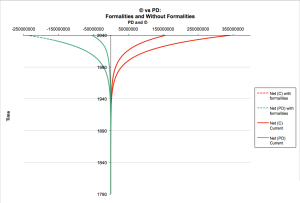 Back in January, Lawrence Lessig – a man whose speeches and books: changed the way I see the world; got me excited about and engaged in open source; inspired me to start fighting for the internet; helped instigate my blog; pulls me (at times) towards law school; and regularly makes me want to move to San Francisco a be part of what is one of the most exciting community in the world – wrote this post.
The post essentially discusses two things. The first half reviews and assesses the U.S. District Court for the Northern District of California (or the Ninth Circuit for those who know their courts) decision on a copyright case called Kahle vs. Gonzales (broadly themed around the issue of Free Culture that Lessig has championed). The court ruled against Lessig and his team so he dissects their response. In the post’s second part Lessig diagnoses that his argument might have been better expressed visually. He then outlines a model, and a graph, he developed to do just this. Most importantly, he posts the basic spreadsheet on his blog and states:
Again, this is a beta model. I’d be very grateful for any errors identified, or for a better specification of the same. After a review by a couple friends, I will post any corrections to this. At that time, I’ll also include any corrections noted in the comments.
I would do virtually anything to help Lessig and the important work he, and others like him, are doing. Sadly, lacking a legal background I’m not sure how much help I would be in drafting an improved Supreme Court petition (I would probably just waste his time and actually do the cause more damage than good). Designing a better graph however, that is something I can do.
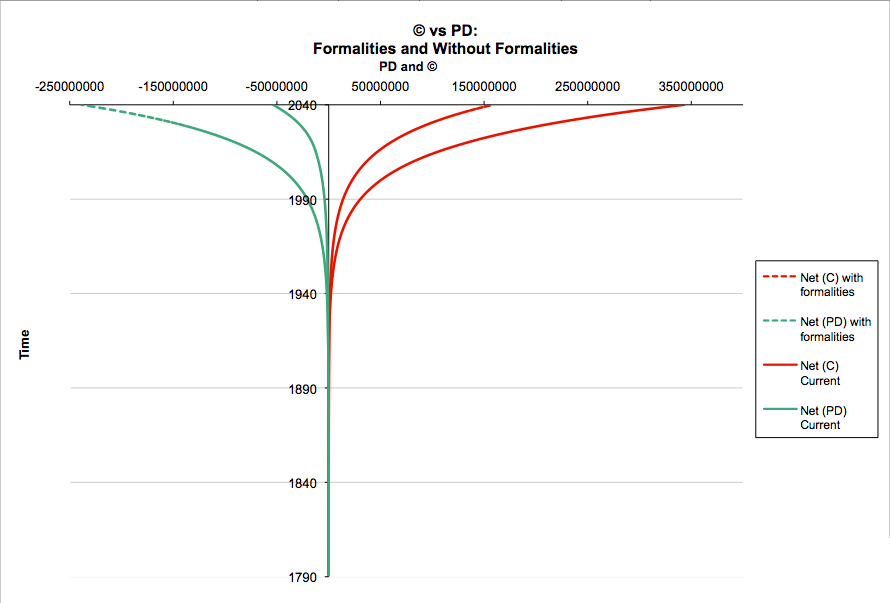
Consequently, I posted a comment on Lessig’s blog where I re-graphed his results but displayed them in a visual manner that I thought made it easier to convey his argument. You can see my comment, along with the reasoning and the new model, here. I of course also shared the model so that others could improve on it.
The best part was Lessig wrote me an email me and thanked me for the help. Words can’t convey how much I’ve wanted to help with this movement/cause. So getting a thank you email meant the world to me. In this space (and virtually every space) I’m a nobody – some guy on the other end of a wire – but I love living in a world where even I can spend a few hours (a lot of hours actually) working on something and do well enough that I can help an expert and leader of a movement I feel so much passion for. I still feel ill-equipped to help out, but that thank you email made me feel like that my small contribution was genuinely helpful. For both those who know me, and those who don’t, it may sound pathetic, but I really couldn’t stop smiling for days.
And then it got better.
Part 2:
One of the nicest people in the world – Virginia Law School professor Chris Sprigman emailed me out of the blue with a note that said:
Hello David. Larry sent me the message you sent to him, and I’ve been puzzling through your graph. I’m drafting a petition for rehearing in Kahle, and I’d like to speak with you and understand your methodology, in the hope that we might use your graph in the brief. Do you have any time to speak later today?
We chatted and I went through a couple of iterations of my graph. And then at some point he asked: Would you be willing to do all the graphs for our Supreme Court petition?
Obviously, I agreed.
So you can see the petition here. Sadly, my original graph that got me involved didn’t make the cut. I don’t make any claims that my work was at all intellectual – I was making graphs. But I’m not sure I’ve ever been happier then the hours I spent tweaking things here and there to see if there was something – anything – I could do to help make this small part of a Supreme Court petition better.
So there it is, number one – for the simple reason that blogs and the internet can allow anyone, anywhere, to contribute to something they believe in. I’ve never met Chris or Larry and they didn’t know me from anyone, but the internet’s meritocratic culture meant that if they thought I could contribute – it didn’t matter – they’d bring me on. And for that I’m eternally gratefully, and will also be eternally willing to work my butt off for them and for the cause of free culture.


 eaves.ca