Canada2020 speaker series launched

Canada2020 has just announced that it is launching a regular speaker series, with an event to be held on the last Thursday of every month. This is great news for Ottawa. Anyone trying to bring interesting speakers and raise the city’s spice quotient will enjoy my support.

Their first speaker will be Andrea Mandel-Campbell, the author of “Why Mexicans don’t drink Molson“. Jay Myers, President, Canadian Manufacturers and Exporters will be the respondent.

Entrance is free of charge, thanks to kind support of Scotiabank, Power Corporation and AstraZeneca.

http://canada2020.eventbrite.com/?invite=MzY0MjkvZGF2aWRfYV9lYXZlc0B5YWhvby5jb20vMQ%3D%3D%0A

For those who like interested in attending you can respond here

Event details:

Date
September 27, 2007 at 6:30 pm ET

Location
Sheraton Hotel Ottawa
150 Albert Street
Ottawa, Ontario K1P 5G2
Canada

electoral reform: maybe people just don't care

Yesterday, the Toronto Star had this fun story about the upcoming referendum on electoral reform. My favourite part was the beginning:

To find out what people think about the Ontario referendum being held a month from today, the Toronto Star stopped some 50 people at Yonge and Bloor Sts.

Just one person knew about it.

Only three others were interested enough to listen to what was being proposed.

Clearly this issue represents a burning platform for the electorate… Or not.

And let’s be fair – it is not like Canadians can’t get passionate about issues: The Charlotte Town Accord, Meech Lake, Free Trade, all caught voters attentions. If electoral reform hasn’t, maybe that means something…

Of course, proponents of Electoral Reform will claim this is because of a lack of press coverage and/or awareness on the part of the public. But then, this is the same bitter claim of any group whose issue isn’t dominating the news agenda.

Problematically, they’ll keep making that claim until their issue makes the news agenda and pierces the public’s consciousness. The basic precept being – everybody would care about this as much as I do – if only they were as well informed as I am.

Perhaps, or perhaps there is a simpler explanation. Maybe electoral reform is not a pressing issue to most people. Certainly a system the strengthens the power of the parties and the backroom boys isn’t easily going to inspire people I know…

Note to Balsillie: Lack of funding didn't kill the CIIA, its culture did

Interesting news on the Canadian international policy front. Some of you may have read this story outlining how Balsillie has given $1million dollars, and will lead the fundraising effort for another million, to establish the Canadian International Council.

This is a good news/bad news story with some important lessons for anyone running a national organization.

First, the good news.

Any funding into the study of Canadian Foreign Policy is good news. Thanks to Andrew Cohen, the notion that Canada’s influence in the world is in virtual free fall is now accepted orthodoxy. As Jeffrey Simpson aptly put it: “never before has the world meant more to Canada; never has Canada meant less to the world.” A wider set of voices, activitely engaging in public debates about Canada and the world, should be a welcome development.

Moreover, this move will rescue the fast declining Canadian Institute for International Affairs (CIIA). At one time the CIIA was the crucible in which the international affairs were debated and discussed in Canada. Membership was essential for anyone active in the development of foreign policy.

Times, however, have changed. Today there are a wealth of groups that engage international issues: Engineers without Borders, Journalists for Human Rights, the Canadian Red Cross, Oxfam Canada, Greenpeace, Canadian Council of Chief Executives, etc… offer both a more focused discussion and, perhaps more importantly, tangible impact, in a way the CIIA couldn’t, and the CIC can’t. Common wisdom says the glory days of the CIIA ended for a reason… as the above mentioned list attests, the marketplace simply became more competitive and specialized. That said, it may be that there is both an interest in, and a critical role for, a non-partisan organization that brings Canadians together to talk about foreign policy in the broadest sense. I certainly hope so.

And now, the bad news

Rebranding and plowing money back into the CIIA saves it from having to ask itself the tough question: why is it dying? And have no doubt, the CIIA is dying. This is true in the figurative sense, something John MacNaughton, its chair conceded in the Globe when he noted that the establishment of the CIC “moves CIIA from the deathbed to the launching pad.” It is also true in the literal sense. The average age of the CIIA’s 1300 members is in the 60s and possibly 70s (remember, this is the average age). I went to several events in Ottawa where the under 50 crowd represented maybe 5-7% of the audience.

The challenge for the CIIA, and now the CIC, is twofold, but with a single goal: become relevant by attracting new, younger, members.

Part of this problem is structural. In many chapters (the Kitchener-Waterloo branch being a notable exception) the CIIA has become a place where retired diplomats gather. It’s boards are dominated by retired diplomats (although there is often a token young person, usually from the local university). This means the issues, discussions, and networks are geared towards an older audience. When the CIIA was a place where aspiring diplomats and foreign policy geeks gathered, the network effect caused more young members to join, so they could meet peers who were rising stars. Today, the CIIA is a place where retired diplomats and foreign policy geeks meet, this means the network effects work against younger people, who while possibly keen to learn from wiser souls, recognize they are less likely to meet contemporaries and peers. In short, the CIIA lacks critical mass in the right demographics.

The part of the problem is cultural. CIIA meetings tend to be stuffy, formal events, reflecting the diplomatic tradition from its founding period (1930’s-50’s). While there is not dress code, members tend to wear suits and events focus on speeches with some Q&A. It’s all very traditional, formal and hierarchical. International affairs already suffers from a reputation as a snobby subject, this formality almost certainly discourages novices and younger members from participating, and returning.

In short, the CIIA financial issues were never the problem, just the symptom. The problem is cultural.

Money: an opportunity rife with risk

Without a real change in course, things at the CIC will look very much like they do at the CIIA today. Moreover, if past performance is anything to go by, the selection of 20 fellows will have little impact, and could make things worse. My suspicion (and fear) is that the CIC’s fellowships will become the retirement home for Canada’s foreign policy old guard, men like the eminent and highly qualified Allan Gotlieb. Worse still, the alleged “innovative” choices will people like Jennifer Welsh, Michael Byers or Rob Huebert (just to cover the political spectrum). In reality these people should be “safe” choices. As they, and the old guard, already have a pulpit from which to speak, and have done so effectively. If the CIC wants to be about new ideas and compelling debates, it should bring in some younger and more diverse blood. Perhaps set a target of making a third to half its fellows true “risky” choices – rising voices, or those outside the old safe, stodgy world of the foreign policy cocktail circuit. Ideally, they’d target people with credibility, and an emerging track record of engaging in public debates.

So in closing… here are some people I’d like to see nominated for the CIC fellowships (in no particular order):

And for some older voices probably not on the radar of the CIC I might include:

  • Daryl Copeland – Public servant, outside thinker
  • Max Wyman – the arts in Canadian foreign policy
  • Chief Billy Diamond – business and first nations perspective

So there it is, the unvarnished analysis of the challenges facing the CIC. I’m cheering for them, I just hope they are willing to break the old-boys network mold. If not, we’ll be back where we were in no time.

CIBC's Website Hacked?

So I just got a call from CIBC informing me that my brand new 24 hour old ATM Card may have been compromised. The man on the phone tried to claim I had fallen victim to a phishing scam and that my card number had been targeted.

Most phishing scams involve an phony email that directs the victim to a replica website (e.g. an email from what appears to be RBC directs you to a website that looks exactly like the RBC website). The unsuspecting party, not realizing they are at a fake website then attempts to log – and thus gives away their login and password.

In this case however, I went directly to CIBC’s website (www.cibc.com) and followed their protocols. Moreover, I actually did log into my account (I could see my account info and last few transactions).

I want to be clear – while I seasoned computer user, I am not a computer or security expert (and would invite the  opinions of those who are) however, it seems to me that if someone got my information, it was because they were able to manipulate CIBC’s website. Wouldn’t that mean they’d have hacked the website itself?

Fortunately for CIBC, it is become a pro at dealing with security problems. Practice makes perfect…

And while we are on the subject of CIBC… I’ve encountered yet another way they punish customers. The reason I got a new ATM card was because I was opening a small business account. The most basic pricing plan was called a “Pay as you go” account which had a $5 monthly fee + $0.80 per transaction + $0.16 for depositing checks and $1.60 for depositing cash. This account did not, however, include an ATM card. Getting an ATM card cost an additional $5 a month. It costs the bank less for me to use an ATM then an actual teller. And yet, to use a service that saves them money – the consumer pays an additional charge? What happened to “passing along the savings?”  Not in Canada’s banking oligarchy marketplace. The worst part is that this approach creates the worst possible incentive structure. Small business owners are more likely to use tellers – driving up CIBC’s costs – and its bad for small businesses – they are denied a flexible and convenient 24 hour service.

When I lived in Boston, Fleet Bank (now Bank of America) who is the furthest thing from a customer oriented bank you can find did the opposite. Lower monthly bank fees if you only used an ATM, higher fees if you wanted to use a personal teller. I hated Bank of America, but at least that service structure makes sense to me.

review of small pieces loosely joined

I’m not sure where to begin with Small Pieces Loosely Joined.

Maybe with my regrets. My biggest regret is that it took me so long pick it up and read it. And I had no excuse, Beltzner had been trying to get me to read it for months. I now understand why.

Small Pieces Loosely Joined

Lawrence Lessig’s Free Culture took me into new territory by introducing me to the dangers and important issues confronting our emerging online world. In contrast, Small Pieces Loosely Joined did the opposite, it was a homecoming, a book that explained to me things I intuitively knew or felt, but in a manner that expanded my understanding and appreciation. It’s as though the author, David Weinberger, took me on a tour of my own home, a place I knew intimately, and explained to me its history, the reason and method of its construction, its impact on my life and its significance to my community. Suddenly, the meaning of a thing I use and live in everyday was expanded in ways that were consistent with what I already knew, but didn’t. Wienberger accomplishes all this, but in talking about the internet.

Weinberger achieves this by outlining how our sense of time, space, knowledge and matter is shaped by the online experience. Initially, the book could be mistaken as a more sophisticated Wikinomics, but as each concept builds on the other, the book becomes an increasingly philosophical and thoughtful treatise. Indeed, unlike Wikinomics, which anyone can scream through like a normal business book, Small Pieces took longer to read than anticipated because I wanted (and needed) to slow down and play with its ideas.

Indeed, you can see how so many ideas connect with this book. From The Naked Corporation (Weinberger’s discusses how our desire for authenticity drives form on the internet), to The Wisdom of Crowds to The Long Tail, this book is essential reading to those interesting in understanding of our emerging new world, one overlaid with an internet. Even I was caught in the vortex. For example, I recently wrote a post on the emerging trust economy (all while pitching in my two cents on Keen). I knew the ideas weren’t completely novel, but there was Weinberger, filling in the holes of my thoughts, outlining why we keep going back to the internet even though it is filled with so much disinformation (unlike FOX, CNN, or CBS or any corporate brochures that preceded the internet). Weinberger recognizes that:

…we don’t process information the way philosophers or computer programmers expect us to. We don’t use a systematic set of steps for evaluating what should be believed. Instead, we do on the web we do in the real world: we listen to the context, allow ourselves to be guided by details that we think embody the whole, and decide how much of what this person says were going to believe.

It’s not perfect. But then, neither are we.

But even without all that perfection, we still managed to create this amazing thing called the internet. This is singularly significant accomplishment and one Weinberger believes we must celebrate. And he’s right. At almost no time in history have we built something that is, and can become still more, broad and representative. And it is important that we remember the values that made it possible. A culture of freedom.

…consider how we would’ve gone about building the Web had we deliberately set out to do so. Generating the billions of pages on the web, all interlinked, would have required a mobilization on the order of world war. Because complexity requires management, we would have planned it, budgeted it, managed it,… and we would have failed miserably… We’d have editors pouring through those pages, authenticating them, vetting them for scandalous and pornographic material, classifying them, and obtaining signoff and permissions to avoid the inevitable lawsuits. Yet we — all of us — have built the global web without a single person with a business card that says “manager, WWW.”

Our biggest joint undertaking as a species is working out splendidly, but not only because we forgot to apply the theory that has guided us ever since determines were built. Whether we’ve thought about it explicitly or not, we all tacitly recognize — it’s part of the Web’s common sense — that what’s on the Web was put there without permission. We know that we can go where we want on the web without permission. The sense of freedom on the web is palpable. The web is profoundly permission free and management free, and we all know it.

More recently, Weinberger has emerged as a champion of the internet, probably most famously for taking on Andrew Keen in a now famous debate whose transcript can be read on the WSJ. His book explains the knowledge and understanding that allows Weinberger to be optimistic in the face of people like Keen. Indeed this book serves as a map to what has become Weinberger’s larger thesis – that the internet is not just a human project, but a humanizing project.

The Web is a social place. It is built page by page by people alone in groups of that other people can read those pages. It is an expression of points of view is diversion as human beings. In almost every case, what’s written is either explicitly or implicitly a view of how the world looks; the Web is a multimillion-part refraction of the world. Most of all, at the center of the web is human passion. We build each page because we care about something, whether we are telling other shoppers that a Maytag wasn’t as reliable as the ads promise, giving tips on how to build a faster racer for a soap box derby, arguing that the 1969 moon landing was a hoax, or even ripping off strangers.

What we see when we look into the internet is ourselves.

Increasingly, understanding humanity will require understanding the internet, and Weinberger’s book is a good departure point for that education.

In Memoriam of Jim Wright

The start of fall has been a particularly tough this year. Yesterday I was informed that James Wright had passed away in a terrible accident.

Many of you – especially outside Montreal – will never have heard of Jim. This fact is not a reflection on Jim’s impact on those around him, but is rather a reflection of his understated nature. Simply put, Jim was an extraordinary person. A man who relentlessly gave his time, his energy and himself to others and yet, despite his innumerable achievements, always kept a surprisingly low profile.

Indeed, this low-key diminutive style regularly caught me off guard. Everywhere I turned in Montreal I would inevitably discover that regardless the cause or group, Jim somehow seemed to be involved. The breadth of his volunteer activities are too numerous to name. Heather Munroe-Blum – the Principal of McGill – listed a few in her press release:

Jim was a graduate of McGill (BA ’65) and Université Laval law school. In 1969, he joined the law firm of Martineau Walker (now Fasken Martineau) where he worked for 30 years. From 1977 to 1979 he was the deputy director of the Compliance Branch of The Foreign Investment Review Agency. In 1999, he was appointed executive director of EPOC Montreal, an organization that provides job training for disadvantaged young adults. In 2003, he was appointed director of the Sauvé Scholars Foundation, which provides one-year study fellowships at McGill to young leaders from around the world. From 1991-99, Jim served the City of Westmount as a councillor. He also served as president of the Wexford Foundation and the University Club of Montreal.

jim wrightAnd yet even this list fails to capture of all Jim’s activities – such as his role as a Board Member (and I believe, one time president?) of Volunteer Canada and a Governor on the Board of McGill University.

But the list of volunteer activities – while revealing – fails to capture what made Jim so impressive. What defined Jim’s was his optimism and compassion, traits made evident by the manner in which he and his family opened up their home and their lives to those they helped. Many Canadians opt to dedicate their lives to public service but I’ve yet to meet one who did it with Jim’s warmth, openness, and giving nature.

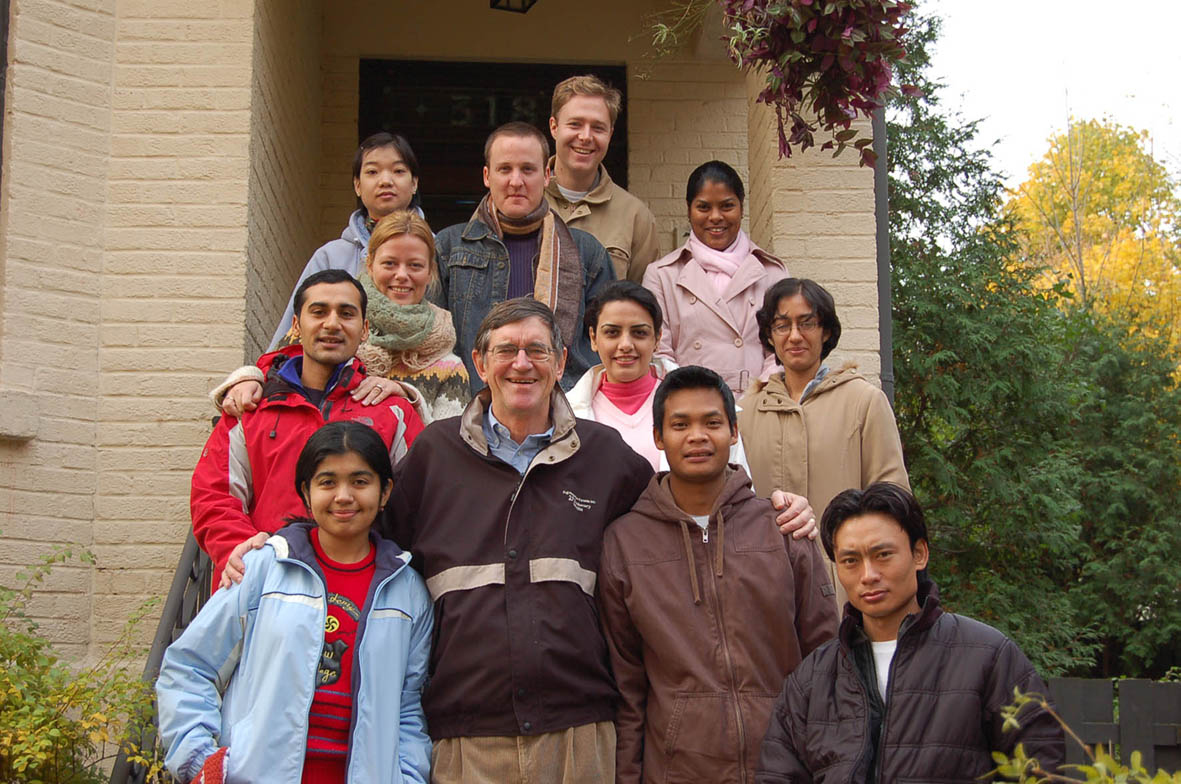
This was how I got to know and love Jim. Those of us fortunate enough to become Sauvé scholars were generally outsiders to the Montreal community. This was true for me, a Canadian, but even more so for my fellow scholars who hailed from far away places such as China, Nepal, Bhutan, South Africa, Iran and Pakistan. Jim’s connections within McGill and throughout the Montreal community enabled the program to run smoothly and maximized the opportunities available to us scholars.

More importantly however, Jim made Montreal our home, not simply by his work as the program’s Executive Director but by literally opening up his own home and life to us. All the scholars (and their friends) regularly visited the Wright’s house for parties, dinners and other get togethers. Indeed, more than one Sauvé Scholar took up temporary residence in the Wright house to bridge between their time as a Scholar and their subsequent job.

For myself, my time at Sauvé house saw Jim and I’s relationship evolve from that of charge, to adviser, to mentor and then friend. I return annually to the house, both to connect with the new scholars and seek advice from Jim on my next steps. And I am not unique in this. There are now over 60 Sauvé Scholars spanning the globe. For some Jim continued to be a good friend, for others, especially those who remained in Montreal, he also continued to serve as a source of community and advice. One such scholar, Meriem Maza, was visiting the Wright’s at their cottage and was also tragically killed in the accident.

Saturday was a dark day for me personally, I remain full of disbelief, frustration and sadness, trying to feel glad that I at least knew Jim, and that I have him as a model to aspire to.

Saturday was also a dark day for the Sauvé Community and for Montreal more broadly. We lost a founding spoke in our network – the man whose compassion and work helped bind us together as a community. Equally tragic, we lost one of our peers, a bright and established talent who was our fellow scholar. In the emails that have floated through the Sauvé community so many have referred to Jim as their father in Montreal, others, who studied with Meriem, refer to her as a sister. These are voids no one will be able fill.

2005 Fellow and Jim

Jim with the 2004-05 Sauve Scholars

The Fascinating Phenomenon that is Andrew Keen

So Andrew Keen oozed his way on to the Colbert Report the other night and I just caught the video off the website.

For those unfamiliar with Keen he is the author of “The Cult of the Amateur: How Today’s Internet Is Killing Our Culture” a book in which he describes how the internet is making arts and media unprofitable. As innumerable blogs, and most notable, David Weinberger have documented, there are so many holes in Keen’s thesis it is hard to know where to start.

On the Colbert Report Keen cycled through some of his regulars. He correctly pointed out that certain types of media and arts are unprofitable because of the internet… and ignored how the internet has simultaneously given rise to a multitude of new ways for artist to earn a living. New business models are emerging. On the hilarious side, Keen briefly tried to argue that it was blogs and the internet – not American’s old media institutions such as CNN and FOX – that allowed the American public to be hoodwinked into believing there were weapons of mass destruction in Iraq. My god, blogs were the only place in the US where an honest discussion about Iraqi WMDs took place! I could go on… but why repeat what so many others have said.

What it interesting to me is that a phenomenon like Keen even exists. Why is it that we repeatedly listen to people who take a simple ideas and overextend it in illogical ways. Does anyone else remember the fear mongering 1994 book – The End of Work – about how “worldwide unemployment will increase as new computer-based and communications technologies eliminate tens of millions of jobs in the manufacturing, agricultural and service sectors”? Keen’s book is similar in that it nicely capture our society’s paranoias and fears about change (this time wrought by “web 2.0”).

Interestingly I think Keen is a necessary and positive phenomenon. Indeed, Keen exists, is championed and raised up on a pedestal not because he is right, but because is so glamorously wrong. Societies need Keen so that his arguments can be publicly destroyed in a manner that satisfies even the strongest doubters. In this case, Keen’s book helps advance the larger narrative of how centralized authorities that offer the illusion of certainty are collapsing in the face of probabilistic networks that offer a reality of uncertainty. This narrative is hardly new – books that preceded “The Cult of the Amateur” like “The Long Tail” and “Free Culture” more than aptly dealt with Keen’s arguments, they just didn’t do it publicly enough. The publics’ appetite to understand and hear this debate is merely climaxing and has not yet been sated.

The San Francisco Chronicle is right to say “every good movement needs a contrarian. Web 2.0 has Andrew Keen.” Sometimes being contrarian is about offering a valuable insight and keeping the debate honest. And then, sometime its about encapsulating the worst fears, insecurities, and power dynamics of a dying era so that a society can exorcise it. I guess it’s a role someone has to play, and Keen will be well rewarded for it… as his book is reviewed and sold, online.

(NB: If you are looking for a good book on the internet, skip The Cult of the Amateur and consider David Weinberger’s Small Pieces Loosely Joined or Everything Is Miscellaneous: The Power of the New Digital Disorder they are both excellent).

Op-ed on Iraq and Canada in today's Toronto Star

Taylor and I have another op-ed in today’s Toronto Star. It isn’t often that we get to see a foreign policy dilemma development in front of us. When we do, we have a rare opportunity, and responsibility, to debate and plan our response. I accept that people may not agree with the prescription… but I would encourage them to at least voice their own proposal.

Iraq suddenly appears on Canada’s radar screen
Aug 29, 2007 04:30 AM
David Eaves and Taylor Owen

For the past five years, Canadian leaders have had little to say about the Iraq war. Content not to be in but careful not to be too critical, most have adopted a laissez-faire position on the conflict. This position is unsustainable.

In just over a year’s time, Americans will elect a new president. Regardless of whether the victor is a Democrat or a Republican, the last ardent defender of the Iraq war will have left the international stage and the world will look at Iraq through a new lens. The Iraq war, “Bush’s War,” will be over. Iraq the humanitarian crisis will be in the ascendant.

In anticipation of this emerging shift, the Security Council last week voted unanimously to increase the UN’s role in Iraq. The international body will endeavour to do what it – and notably not what the U.S. military – does best: engage in essential diplomatic, negotiation and humanitarian activities.

And this is only the beginning. While the departure of U.S. and British troops will undoubtedly remove one aggravating factor, sectarian strife, a humanitarian crisis and a failing state will remain.

Within a year, Iraq will have shifted from a precipitous and ill-executed American invasion and occupation, into an internationalized humanitarian crisis.

And a crisis it is.

According to a recent UN report, there are 1.8 million internally displaced persons and 2 million refugees in neighbouring countries, with an additional 40,000 to 50,000 leaving per month; 54 per cent of the population lives below the extreme poverty line of $1 a day; 43 per cent of children under the age of 5 suffer from malnutrition; inflation is 70 per cent, and in 2006 there were 34,452 recorded civilian deaths and 36,685 recorded civilian injuries.

Compare these numbers to Kosovo and East Timor, and add the regional consequences of a prolonged Iraqi civil war, and surely there is a case for active international engagement.

As the recent Security Council resolution indicates, a global strategy is starting to take shape. There will be calls for still greater UN intervention, possibly even a peacekeeping force. Over the next 12 to18 months, an international plan for dealing with Iraq will likely emerge.

Will Canada help shape it?

We could opt not to. That would be politically expedient, although it would confirm our declining status on the international stage.

Or we could see this as a diplomatic opportunity where we are uniquely positioned to lead. Canada is an ally of the United States and Britain but had the integrity and self-confidence to not participate in the flawed invasion. Canada is not burdened with a colonial or imperialist past in the region. Unlike Germany and France, Canada has had limited financial interests in Iraq. And, in contrast to Russia and China, Canada possesses a relatively well-respected record on human rights.

By helping to develop a solution that could bring stability to Iraq, the region and the international community, Canada could shine. Indeed, the parallels to the event that launched Canada’s much vaunted but greatly diminished status as an international peace broker are noteworthy.

During the 1956 Suez crisis, the world’s powers were equally hamstrung. What made us so useful then is what could make us so useful today.

This potential is, of course, complicated by our role in Afghanistan. It could reasonably be argued that Afghanistan is our primary international commitment and that we simply do not have the resources to contribute to two major peace-building efforts. But military constraints need not curtail our diplomatic role in a new UN-led effort in Iraq.

Any future mission in Iraq will require a legitimacy that the U.S. invasion lacked. Our position within the UN, coupled with our unique standing in the international community, could make sure this is achieved.

As a country, we need to remember that, regardless of the causes, Iraq today is a humanitarian crisis and a geopolitical time bomb, a country whose collapse or breakup could destabilize the immediate region, and potentially much more.

Here’s hoping Canadian humanitarianism helps shape the way forward.

Taylor Owen is a doctoral student and Trudeau Scholar at the University of Oxford. David Eaves is a frequent speaker, consultant and writer on public policy and negotiation.

Old Media – was the golden era ever that golden?

“There is a country in the world where only 15% of the population has completed high school and just 5% have university degrees. Television sets are something of a rarity, cable is nonexistent; programs are available for only a limited number of hours a day – in black-and-white. The total circulation of weekly newspapers comes in at about 20% of the population. There is only one national magazine. No one has access to the Internet. No one owns a cell phone. The best bets for information seem to be radio, libraries, and access to a few knowledgeable people.

The country? Canada. The year? 1960.”

The Boomer Factor by Reginald Bibby

Friends and proponents of “old media” keep referring to the “good old days” when people read allegedly high quality newspapers. More importantly they lament the decline of the number of people who read newspapers and who are news literate.

At the root of this fear is an assmuption that in an earlier era we had a better informed, more active and more engaged citizenry. As a result our democracy, social cohesion and rates of social engagement were stronger. What I love about the above statistics is how they vividly show that this idealized view of the past is a complete myth. Even at the height of this era, the 1960’s, newspaper subscription rates were at a mere 20% of the population.

It is worth noting that today 81% of households and 67.8% of Canadian have high speed access to the Internet. While not all of them are reading the New York Times of the Globe and Mail, I am willing to bet a good number of them are consuming a written, online media of some form. All this begs the question was the golden age of old media really all that golden?

Social networking vs. Government Silos'

As some of you may remember, back in May I published an op-ed on Facebook and government bureaucracy in the Globe and Mail. The response to the article has been significant, including emails from public servants across the country and several speaking engagements. As a result, I’m in the process of turning the op-ed into a full blown policy article. With luck somewhere like Policy Options will be interested in it.

So… if anyone has any stories – personal or in the media- they think might be relevant please do send them along. For example Debbie C. recently sent me this story, about the establishment of A-Space, a social networking site for US intelligence analysts, that is proving to be a very interesting case study.