Tag Archives: book review

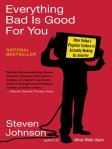
Review of Steven Johnson’s "Everything Bad is Good For You"

Everything bad is good for youSteven Johnson’s contrarian book “Everything Bad is Good For You” argues that, for the past three decades, a combination of economic, technological and neurological forces have increased the complexity of popular culture. The result? Popular culture is causing us to exercise our minds in new and increasingly strenuous ways. In short, popular culture isn’t making us dumber, it is making us smarter.

To understand Johnson thesis it is essential to distinguish between the content and structure of pop culture. This is because Johnson is not applauding or even condoning the content of pop culture, what he is celebrating is how the increasing complexity of TV shows, video games and internet content is forcing us to work harder to explore, understand, engage and even guide, the content. Better yet, our brains want it this way. The result is a virtuous loop created within the pop culture industry. People who want and demand more engaging and complicated pop culture foster a media industry keen to serve it up. Don’t believe it? Try following Johnson’s advice and watch a TV show from 20 years ago. Invariably, you’ll quickly notice is how linear, simple and boring it is.

What makes this book compelling – particularly when juxtaposed against those who rant about the decline of culture – is its style. Everything Bad is Good For You is not a social commentary piece, anecdotally comparing a rose tinted past to the present (or vice versa). It is a book grounded in evidence and research relying, in particularly, on improving IQ tests as its principal data source. The result is a book filled with little gems. For example, contrary to all stereotypes, white collared professionals who play video games are actually more social, more confident and more adept at solving problems than their colleagues. Revenge of the nerds anyone?

The highlight though, was how the book provided an indirect explanation of a broader societal shift I’ve noticed, commented on, but have had difficulty articulating. Before it properly penetrated the popular consciousness the term ‘network’ kept cropping up in within Canada25. By the time we wrote From Middle to Model Power report the word was such a touchstone for the organization we decided to explicitly make it the central theme of the report. This turned out to be a wise decision.

Whenever I presented on or spoke about the report, the network theme resonated strongly, particularly but not exclusively, with younger members in the audience. Suddenly, everywhere I turned people were thinking in terms of networked systems. Up until this book I’d assumed that this was the result of the internet – that somehow its architecture was influencing how people thought and understood the world. It appears that that answer was only partly correct. Everything Bad is Good For You persuasively argues that the influences behind this emerging perspective are more pervasive than just the internet – they have permeated every medium of our pop culture including games, TV, movies, etc… Consequently, pop culture has been shaping the minds of an entire generation, turning them into system thinkers for whom the network is the structure they most naturally and intuitively identify with. Now there’s an idea I can’t wait to sink my teeth into further…

[tags] book review, Everything bad is good for you, steven johnson, popular culture[/tags]

Review of Paul Graham's Hackers & Painters

You can also read this review here.

In the “Note to Readers” section at the start of Hackers and Painters: Big Ideas from the Computer Age Paul Graham points out that the book’s chapters stand alone and can be read in any order or skipped altogether. While true, it also is misleading. While each chapter may stand on its own the book does possess a single theme. Hackers and Painters is about creativity. It’s about our individual capacity to be creative, a society’s capacity to let us be creative, and the degree to which we allow our tools to limit our creativity. Graham is concerned about these questions in relation to software programmers (whom he believes should think like painters – hence the title) but the ideas are pertinent to any profession that requires creativity.
For those unfamiliar with the author, Paul Graham is the geek’s geek. In 1995 he and Robert Morris developed the first web-based application, ViaWeb, which was acquired by Yahoo in 1998. For those less technically inclined, web-based applications are the programs we use over the internet and that don’t reside on your computer (while common place today this was ground breaking stuff back in 1995…). To put it bluntly Graham understands technology and its implications. Sadly, I suspect few people outside of the technology world will read his book. For Graham, particularly in the first half of this book, can write about technology the way few can: in English. Moreover, he’s enjoyable to read because he’s blunt, funny and, by necessity, contrarian. Why contrarian? Because Graham is all about beating the average. And to avoid being average you have to be creative, and to be creative you’ve got to… break rules.

That’s right, the enemy of creativity are rules. Indeed, Paul defines a hacker as a rule-breaker: “(To hack) can be either a compliment or an insult. It’s called a hack when you do something in an ugly way. But when you do something so clever that you somehow beat the system, that’s also called a hack… Believe it or not the two senses of ‘hack’ are connected. Ugly and imaginative solutions have something in common: they both break rules. And there is a gradual continuum between rule breaking that’s merely ugly (using duct tape to attach something to your bike) and rule breaking that is brilliantly imaginative (discarding Euclidean geometry).” If this quote gets your juices flowing then this book is for you. I was intuitively comfortable with this idea because I see it in my own world. A good negotiator operates in a similar way. He or she sees the written and unwritten rules behind an impasse and finds a clever ways to ‘hack’ them – to generate a clever solution the parties can agree to.

If Hackers and Painters is about maximizing creativity, and if the enemy of creativity are rules then, as James Burke would say “there is only one place to go.” Get rid of the rules (or at least learn how to ignore them). Consequently, the subtext running through this book is a libertarian plea for individuals to choose how and if they will limit their creativity. But there is a tension in all this. As Paul notes in Chapter 7 (Mind the Gap) a society with too many rules stifles creativity. But a society without rules can extinguish it altogether. So where is the balance? It is an issue I wish Graham would explore further. Also, readers faint of heart should be warned, Graham likes to make bold (and at times unsubstantiated) claims. My favorite is : “… most physicists could, if necessary, make it through a PhD program in French literature, but few professors of French literature could make it through a PhD program in physics.” While I suspect a lot of people might agree with this statement, those that disagree with it would vehemently disagree with it. It certainly is a little outlandish. Finally, the last few chapters dive fairly heavily into discussions regarding programing language… a debate that has broader, interesting implications, but which might cause many readers to stray. But these are small quibbles with what is otherwise an interesting and provoking read.

Because this book is so different then what my friends would normally read, I’ve decided to throw in two fun quotes and passages, in an effort to tempt you into checking it out:

“One often hears a policy criticized on the grounds that it would increase the income gap between rich and poor. As if it were an axiom that this would be bad… I’d like to propose an alternative idea: that in a modern society, increasing variation in income is a sign of health. Technology seems to increase the variation in productivity at faster than linear rates. If we don’t see corresponding variation in income, there are three possible explanations: (a) that technical innovation has stopped, (b) that the people who would create the most wealth aren’t doing it, or (c) they aren’t getting paid for it.”

“The best writing is rewriting,” wrote E. B. White. Every good writer knows this, and it’s true for software too. The most important part of design is redesign. To write good software you must simultaneously keep two opposing ideas in your head. You need the young hacker’s naïve faith in his abilities, and at the same time the veteran’s scepticism. You have to be able to think how hard can it be? With one half of your brain while thinking it will never work with the other. The trick is to realize that there’s no real contradiction here. You want to be optimistic and sceptical about two different things. You have to be optimistic about the possibility of solving the problem, but sceptical about the value of whatever solution you’ve got so far.”

[tags] Paul Graham, Hackers & Painters, book review, creativity[/tags]

Review of Graham Fraser’s “Sorry, I don’t speak French”

Dear friends, sorry for the long delay between posts. Between the convention last week and the 5 days of seminars in 3 cities I did this week I was a cooked noodle by the weekend. I’m back on the horse though, and even polished off “Sorry, I don’t Speak French” on the flight to Vegas. I’ve written up a little review for those who were thinking about picking it up…

I stumbled upon this book by luck. Sam M. recommended I check it out after posting my CBC piece on the Dominion Institute blog. Serendipitously, a month later the Millennium Scholarship foundation gave me a copy as a thank you gift for a talk I gave at a “Think Again” conference.

It’s a brave soul who wades into Canada’s language politics but Graham Fraser has clearly impressed given that soon after the publication of this book he took on the role of Commissioner of Official Languages. In reading this book I take comfort in knowing we have a Commissioner well educated on the subject. Graham’s book provides us with a basic review of Canada’s language policy – essentially beginning 50 years ago with the launch of a Royal Commission on Bilingualism and weaving its way to the present day, analyzing the impact and effect of the commission’s results along the way.

For me the book had deep personal resonance. If you are a French Immersion Alumnus (Frims, as we called ourselves at Churchill) or have lived in either Ottawa or Montreal, I suspect it will for you as well. Upon reading the book the larger political and policy forces that drove both my education and experiences living in these places came into focus. Graham’s honest recounting of the tensions and problems inherent in Canada’s bilingualism policies often confirm what we likely suspected and/or already knew – his book compelling not because of its novelty, but because it gives those thoughts context and structure.

The book also made me realize I share a common experience with some 347,000 other Canadians. Canadians who were also educated in French Immersion but are often too embarrassed to speak it because they feel their French is inadequate (something I’ve begun to overcome) and/or who went on to learn a third language. Indeed, the only part of his discussion of immersion experience that didn’t ring true to me was his description of French Immersion as an Anglo education and culture, translated into French. I remember reading L’Etranger by Camus and other “French” books (not French translations of English books as he asserts). I also distinctly remember the strong Quebecois nationalists’ slant of my Grade 10 history text – a perspective that was almost disorienting when read from a classroom in Vancouver.

The books strongest and weakest moment is reserved for its analysis of present day language policy. Graham’s thesis appears to be that bilingualism has been, more or less, a success. Its detractors, and Canadians more generally, have simply misunderstood its intended goal. Bilingualism, according to Graham, was never about getting every Canadian to learn the other official language but to enable the public service, and the government services they provide, to function in both official languages. In this regard the chapter on the impact of bilingualism on the public service is excellent while the chapter on bilingualism in politics – which essential discusses how bilingualism is a prerequisite for political leadership – is somewhat wanting. Indeed, throughout the book you are left wanting for more. It almost felt like Graham constantly leads you up to the finish line, but then chooses to end the chapter, failing to provide you with the analytical conclusion you thought he was going to provide. My real fear is that he is much more pessimistic then he lets on and didn’t have the heart to plunge the dagger too deeply into policies and a subject matter he clearly feels passionate about.

If you are a Frimm, a public servant, or someone concerned with either language politics or national unity – this is definitely a book for you. It’s an easy, enjoyable to read and, if you’re like me, humbling. Given how much of our collective energy language seems to have occupied over the past two decades I remain struck by how little I knew (and still know) about Canadian language policy. It’s a great primer, and if you’ve got the time, worth reading.

[tags]book review, bilingualism, public policy, canadian politics, graham fraser[/tags]