I’ve been thinking a lot about these two types of graphs at the moment. This first is a single chart that shows income growth for various segments of the US population broken down by wealth.

This second is a group of graphs that talk about pageviews and visits to various websites on the internet.
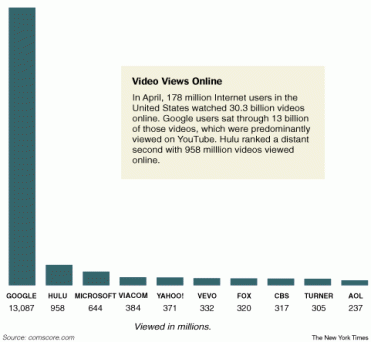
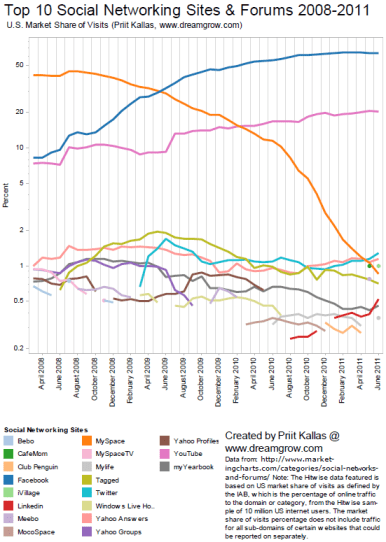
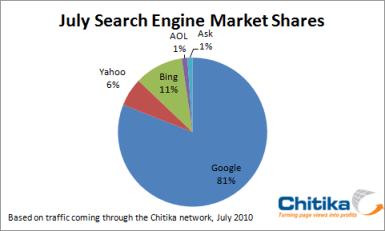
What is fascinating about the internet stats is that they are broadly talking about distribution among the top websites – forget about everyone else where the pageviews become infinitesimally small. So even among top websites have a power law distribution, which must be even stronger once one starts talking about all websites.
And this is what I’m frequently told. That the distribution of pageviews, visits and links on the internet looks a lot like the first graph, although possibly even more radically skewed.
In other words while the after-tax income chart isn’t a clean curve, the trends of the two are likely very similar – except that the top 1% of websites do even better than the top 1% of after tax income earners. So both charts look like power law distributions.
Does this matter? I’m not sure, but I’m playing with some thoughts. While I’m confident that the income chart as power law distribution has replicated itself several times in history (such as during the lead up to the great depression, what is less clear to me is if the exponential growth has ever happened so fast? (would be fascinating to know if others have written on this). The rich have often gotten richer – but have they gotten richer this quickly before?
And is this what happens in a faster, more networked economy? Maybe the traits of the online network and its power law distribution are beginning to impact the socioeconomic network of our society at large?
Could this also mean that we need some new ways to ensure social and economic mobility in our economy and society. Network effects are obviously powerful online, but have also, historically, been important offline. In society, your location on that curve creates advantages, it likely gives you access to peers and capital which position you to maintain your status in the network. Perhaps the internet, rather than making the network that is our society more fluid, is actually doing the opposite. It is increasingly the power law distribution, meaning the network effects are getting stronger, further reinforcing advantages and disadvantages. This might have important implications for social and economic mobility.
Either way, applying some network analysis to income inequality and social mobility as well as the social programs we put in place to ensure equality of opportunity, might be a good frame on these problems. I’d love to read anything anyone has written on this – very much open to suggestions.
 The Conservatives is by far one of the most networked parties for Canada’s political environment. Why is this? Because of their roots as the Reform party. Because they started from nothing – and were even feared by larger corporate funders who saw them as too radical – they developed and have come to rely on fund raising through individuals. This has two consequences. First, to fund raise successfully in this manner they must be keenly aware of what their network of individual donors think, so they are constantly in tune with their supporters listening to them and engaging them. Second, by relying on a network of grassroots contributors they have never relied on large corporate donors. Thus, when Chretien passed campaign finance reform and essentially eliminated institutional donations (from unions and corporations) he created an election fund raising ecosystem in which the conservative model was well positioned to thrive.
 But probably the party facing the biggest challenge – long term – is the NDP, the one party that can ignore networks and continue to survive. This is largely because the unions – which can no longer donate as much money as they once could – can still deliver boots on the ground to help out. In short the NDP is one party that need not cultivate a network in order to survive. This dependency means it will likely not put in place the infrastructure to enable organic growth. Consequently, growth will require an exogenous event, namely a Liberal collapse – something that while theoretically possible – is hard to imagine. As such, the NDP will continue to sit influence the debate indirectly, a role that satisfies some of its members while infuriating others.
 eaves.ca