On Vaccines, Incentives, Open Data and Public Policy

I know. Some mom coming out in favor of vaccines shouldn’t be breaking news. There’s nothing edgy about siding with most parents, nearly all the world’s governments and the vast majority of medical researchers and practitioners. But more of us need to do it.

And so begins JJ Keith – reknown blogger of all things parenting (I’m told) – titled I’m Coming Out… as Pro-Vaccine in the Huffington Post. Two days after getting published the piece has received a staggering 35,000+ facebook “likes” (a number, I suspect, that dwarfs the total likes of every “formal” public policy piece written in the last 48 hours combined – of course her’s IS a piece about public policy). And, it is a wonderfully written piece – filled with a dark sense of humour and concern that the topic deserves.

Keith’s main point is that more parents need to come out in favour of vaccines. That the central problem with the anti-vaccine movements is that they are loud and the rest of… well… are not. And I agree. It would be great if more of us stood up and talked about the importance of vaccines and engaged in this so called debate. Indeed, it may be the best of a number of not so great public policy options.

I’d love to think that there are simple policy measures that could fix what is, quite frankly, a matter of life and death. Requiring parents to produce proof of vaccination when entering their kids in public school feels like an obvious option. Greater transparency into vaccination rates in schools could also potentially spur parents to select schools that are “safer” from a health perspective. But not all those incentives in either case always push in the right direction.

So first, why does this matter?

When parents fail to vaccinate their children they don’t just put their own kids at risk of contracting measles, polio and other terrible diseases. Sadly, they put at risk newborns (who cannot be vaccinated) and – more critically – a chunk of the population who legitimately cannot be vaccinated or interestingly, who do get vaccinated but for whom the vaccination does not work.

This is why epidemiologists refer to “herd immunity” (it’s always nice when discussing public policy to refer to humanity as a “herd”). Since vaccines don’t work on everyone, enough people need to be vaccinated to prevent the disease from spreading reliably. The percentages required is usually north of 80% or 90% although I’m sure it varies a little based on the communicability of the disease.

Thus, what we actually have here is a free rider problem. If everyone vaccinates, then a few people opting out are probably safe if “the herd” remains sufficiently immune to the diseases. But drop below 80% and suddenly a tipping point is reached and things can get scary. Very scary. Frighteningly, there are whole (small) schools districts in California that fall below 50% immunized. And there are normal sized school districts that sit in the 60% and 70% range.

Indeed, thanks to the California Department of Public Health (CDPH), I was able to download the vaccination rates for every preschool in the state and poke through the raw assessment data myself (Sidenote: Dear CDPH administrators, please format your excel spreadsheets without merging title columns that make it impossible for users to sort the data, super frustrating). Shockingly two preschools, Kolbe Academy in Napa and the Waldorf School of Santa Barbara, had a zero kids – that is not one child – with all the required vaccines. Moreover, at Kolbe every single kid had a personal (not medical) exemption while at the Waldorf all but two had personal exemptions (meaning there parents didn’t want their kids to have vaccines) and the other two had simple not gotten around to it. Indeed at least 230 preschools in the state had kids with “personal exemptions” from vaccines that caused total immunization rates to fall below 80%.

These preschools are, in essence time bombs.

And some have already gone off! Just Googling “Whoop Cough Waldorf” (a chain of preschools that seems to dominate my poor immunization list) revealed a story about The East Bay Waldorf School – where only 44% of students are immunized – that had to be shut down by the local health authority because of an outbreak of Whooping Cough which is… easily prevent by a vaccine.

So a simple solution would be to require all kids who go to public schools to be vaccinated. This however, is already the rule in places like Santa Clara, and it while in part effective, it also drives  all the non-immunized kids into the same private schools, further diminishing the herd immunization effect and creating an ideal breeding ground for a dangerous disease.

Disturbingly, this is only desirable insofar as having a few outbreaks in schools like this cause parents to rethink their approach. But this is a terrible, terrible price to pay. It recently happened in Texas where a church that preached a deep skepticism of medicine and vaccines suffered a measles outbreak. Luckily no one died, but the church very quickly set up vaccination stations on its site. It is amazing how quickly one returns to fold of science and medicine once kids start contracting fatal diseases.

I also wouldn’t be surprised me if someone, using the data from the California Dept of Public Heath website created an web application that did a risk assessment of every school based on a number of factors of which vaccination rates would loom large. On the one hand it might cause parents to demand that other kids who attend the school also be vaccinated. On the flip side it might just accelerate the divisions between the anti-immunization camp and everyone else, creating even more dense clusters of schools where non of the kids are immunized.

In the end, short of a series of minor epidemics where enough kids die to scare non-conforming parents into getting their kids immunized, I fear that JJ Keith is doing the best possible thing: trying to build a coalition that will confront those spreading misinformation about vaccinations. Indeed, maybe a good first step would be organizing a boycott of Jenny McCarthy – a celebrity and “The View” co-hostess who has been one of the worst offenders in spreading misinformation about vaccines. Maybe we could call schools where more than 20% of the kids are not immunized because of their parents personal preference “McCarthy Schools.” And every time there is a measles breakout we can label it a “McCarthy Outbreaks” or worse, a “McCarthy death.” It’s strong language, but society maybe need to get tough to rebuild the social pressure needed to stomp out this problem… the other tools at our disposal are not, I fear, that strong.

Why Journalists Should Support Putting Access to Information Requests Online Immediately

Here’s a headline you don’t often expect to see: “Open-Government Laws Fuel Hedge-Fund Profits.”

It’s a fascinating article that opens with a story about SAC Capital Advisors LP – a hedge fund. Last December SAC Capital used Freedom of Information Laws (FOIA) to request preliminary results on a Vertex Pharmaceuticals drug being tested by the US Food and Drug Administration. The request revealed there were no “adverse event reports,” increasing the odds the drug might be approved. SAC Capital used this information – according to the Wall Street Journal – to snatch up 15,000 shares and 25,000 options of Vertex. In December – when the request was made – the stock traded around $40. Eight months later it peaked at $89 and still trades today at around $75. Thus, clever usage of government access to information request potentially netted the company a cool ROI of 100% in 9 months and a profit of roughly 1.2 million dollars (assuming they sold around $80).

This is an interesting story. And I fear it says a lot about the future of access to information laws.

This is because it contrasts sharply with the vision of access to information the media likes to portray: Namely, that access requests are a tool used mainly by hardened journalists trying to uncover dirt about a government. This is absolutely the case… and an important use case. But it is not the only usage of access laws. Nor was it the only intended use of the law. Indeed, it is not even the main usage of the law.

In my work on open data I frequently get pulled into conversations about access to information laws and their future. I find these conversations are aggressively dominated by media representatives (e.g. reporters) who dislike alternative views. Indeed, the one-sided nature of the conversation – with some journalists simply assuming they are the main and privileged interpreters of the public interest around access laws – is deeply unhealthy. Access to information laws are an important piece of legislation. Improving and sustaining them requires a coalition of actors (particularly including citizens), not just journalists. Telling others that their interests are secondary is not a great way to build an effective coalition. Worse, I fear the dominance of a single group means the conversation is often shaped by a narrow view of the legislation and with a specific set of (media company) interests in mind.

For example, many governments – including government agencies in my own province of British Columbia – have posted responses to many access to information requests publicly. This enrages (and I use that word specifically) many journalists who see it as a threat. How can they get a scoop if anyone can see government responses to their requests at the same time? This has led journalists to demand – sometimes successfully – that the requestor have exclusive access to government responses for a period of time. Oy vey. This is dangerous.

For certain types of stories I can see how complete transparency of request responses could destroy a scoop. But most stories – particularly investigative stories – require sources and context and understanding. Such advantages, I suspect, are hard to replicate and are the real source of competitive advantage (and if they aren’t… shouldn’t they be?).

It also suggests that a savvy public – and the media community – won’t be able to figure out who always seems to be making the right requests and reward them accordingly. But let’s put issues of a reputation economy and the complexity of reporting on a story aside.

First, it is worth noting that it is actually in the public interest to have more reporters cover a story and share a piece of news – especially about the government. Second, access to information laws were not created to give specific journalists scoops – they were designed to maximize the public’s capacity to access government information. Protecting a media company’s business model is not the role of access laws. It isn’t even in the spirit of the law.

Third, and worst, this entire debate fails to discuss the risks of such an approach. Which brings me back to the Wall Street Journal article.

I have, for years, warned that if public publication of access to information requests results are delayed so that one party (say, a journalist) has exclusive access for a period of time, then the system will also be used by others in pursuit of interests that might not be in the public good. Specifically, it creates a strong incentive for companies and investors to start mining government to get “exclusive” rights to government information they can put to use in advancing their agenda – making money.

As the SAC Capital Case outlined above underscores, information is power. And if you have exclusive access to that information, you have an advantage over others. That advantage may be a scoop on a government spending scandal, but it can also be a stock tip about a company whose drug is going to clear a regulatory hurdle, or an indication that a juicy government contract is about to be signed, or that a weapons technology is likely to be shelved by the defence department. In other words – and what I have pointed out to my journalist friends – exclusivity in access to information risks transforming the whole system into a giant insider information generation machine. Great for journalists? Maybe. (I’ve my doubts – see above.) But great for companies? The Wall Street Journal article shows us it already is. Exclusivity would make it worse.

Indeed, in the United States, the private sector is already an enormous generator of access requests. Indeed one company, that serves as a clearing house for requests, accounts for 10% of requests on its own:

The precise number of requests from investors is impossible to tally because many come from third-party organizations that send requests on behalf of undisclosed clients—a thriving industry unto itself. One of them, FOI Services Inc., accounted for about 10% of the 50,000 information requests sent to the FDA during the period examined by the Journal. Marlene Bobka, a senior vice president at Washington-based FOI Services, says a “huge, huge reason people use our firm is to blind their requests.”

Imagine what would happen if those making requests had formal exclusive rights? The secondary market in government information could become huge. And again, not in a way that advances the public interest.

In fact, given the above-quoted paragraph, I’m puzzled by the fact that journalists don’t demand that every access to information request be made public immediately. All told, the resources of the private sector (to say nothing of the tens of thousands of requests made by citizens or NGOs) dwarf those of media companies. Private companies may start (or already are) making significantly more requests than journalists ever could. Free-riding on their work could probably be a full time job and a successful career for at least a dozen data journalists. In addition, by not duplicating this work, it frees up media companies’ capacity to focus on the most important problems that are in the public good.

All of this is to say… I fear for a world where many of the journalists I know – by demanding changes that are in their narrow self-interest – could help create a system that, as far as I can tell, could be deeply adverse to the public interest.

I’m sure I’m about to get yelled at (again). But when it comes to access to information requests, we are probably going to be better off in a world where they are truly digitized. That means requests can be made online (something that is somewhat arriving in Canada) and – equally importantly – where results are also published online for all to see. At the very minimum, it is a conversation that is worth having.

New Zealand: The World’s Lab for Progressive Tech Legislation?

Cross posted with TechPresident.

One of the nice advantage of having a large world with lots of diverse states is the range of experiments it offers us. Countries (or regions within them) can try out ideas, and if they work, others can copy them!

For example, in the world of drug policy, Portugal effectively decriminalized virtually all drugs. The result has been dramatic. And much of it positive. Some of the changes include a decline in both HIV diagnoses amongst drug users by 17% and drug use among adolescents (13-15 yrs). For those interested you can read more about this in a fantastic report by the Cato Institute written by Glenn Greenwald back in 2009 before he started exposing the unconstitutional and dangerous activities of the NSA. Now some 15 years later there have been increasing demands to decriminalize and even legalize drugs, especially in Latin America. But even the United States is changing, with both the states of Washington and Colorado opting to legalize marijuana. The lessons of Portugal have helped make the case, not by penetrating the public’s imagination per se, but by showing policy elites that decriminalization not only works but it saves lives and saves money. Little Portugal may one day be remembered for changing the world.

I wonder if we might see a similar paper written about New Zealand ten years from now about technology policy. It may be that a number of Kiwis will counter the arguments in this post by exposing all the reasons why I’m wrong (which I’d welcome!) but at a glance, New Zealand would probably be the place I’d send a public servant or politician wanting to know more about how to do technology policy right.

So why is that?

First, for those who missed it, this summer New Zealand banned software patents. This is a stunning and entirely sensible accomplishment. Software patents, and the legal morass and drag on innovation they create, are an enormous problem. The idea that Amazon can patent “1-click” (e.g. the idea that you pre-store someone’s credit card information so they can buy an item with a single click) is, well, a joke. This is a grand innovation that should be protected for years?

And yet, I can’t think of single other OECD member country that is likely to pass similar legislation. This means that it will be up to New Zealand to show that the software world will survive just fine without patents and the economy will not suddenly explode into flames. I also struggle to think of an OECD country where one of the most significant industry groups – the Institute of IT Professionals appeared – would not only both support such a measure but help push its passage:

The nearly unanimous passage of the Bill was also greeted by Institute of IT Professionals (IITP) chief executive Paul Matthews, who congratulated [Commerce Minister] Foss for listening to the IT industry and ensuring that software patents were excluded.

Did I mention that the bill passed almost unanimously?

Second, New Zealanders are further up the learning curve around the dangerous willingness their government – and foreign governments – have for illegally surveilling them online.

The arrest of Kim Dotcom over MegaUpload has sparked some investigations into how closely the country’s police and intelligence services follow the law. (For an excellent timeline of the Kim Dotcom saga, check out this link). This is because Kim Dotcom was illegally spied on by New Zealand’s intelligence services and police force, at the behest of the United States, which is now seeking to extradite him. The arrest and subsequent fall out has piqued public interest and lead to investigations including the Kitteridge report (PDF) which revealed that “as many as 88 individuals have been unlawfully spied on” by the country’s Government Communications Security Bureau.

I wonder if the Snowden documents and subsequent furor probably surprised New Zealanders less than many of their counterparts in other countries since it was less a bombshell than another data point on a trend line.

I don’t want to overplay the impact of the Kim Dotcom scandal. It has not, as far as I can tell, lead to a complete overhaul of the rules that govern intelligence gathering and online security. That said, I suspect, it has created a political climate that amy be more (healthily) distrustful of government intelligence services and the intelligence services of the United States. As a result, it is likely that politicians have been more sensitive to this matter for a year or two longer than elsewhere and that public servants are more accustomed at policies through the lens of its impact on rights and privacy of citizens than in many other countries.

Finally, (and this is somewhat related to the first point) New Zealand has, from what I can tell, a remarkably strong open source community. I’m not sure why this is the case, but suspect that people like Nat Torkington – and open source and open data advocate in New Zealand – and others like him play a role in it. More interestingly, this community has had influence across the political spectrum. The centre left labour party deserves much of the credit for the patent reform while the centre-right New Zealand National Party has embraced both open data. The country was among the first to embrace open source as a viable option when procuring software and in 2003 the government developed an official open source policy to help clear the path for greater use of open source software. This contrasts sharply with my experience in Canada where, as late as 2008, open source was still seen by many government officials as a dangerous (some might say cancerous?) option that needed to be banned and/or killed.

All this is to say that in both the public (e.g. civil society and the private sector) and within government there is greater expertise around thinking about open source solutions and so an ability to ask different questions about intellectual property and definitions of the public good. While I recognize that this exists in many countries now, it has existed longer in New Zealand than in most, which suggests that it enjoys greater acceptance in senior ranks and there is greater experience in thinking about and engaging these perspectives.

I share all this for two reasons:

First, I would keep my eye on New Zealand. This is clearly a place where something is happening in a way that may not be possible in other OECD countries. The small size of its economy (and so relative lack of importance to the major proprietary software vendors) combined with a sufficient policy agreement both among the public and elites enables the country to overcome both internal and external lobbying and pressure that would likely sink similar initiatives elsewhere. And while New Zealand’s influence may be limited, don’t underestimate the power of example. Portugal also has limited influence, but its example has helped show the world that the US -ed narrative on the “war on drugs” can be countered. In many ways this is often how it has to happen. Innovation, particularly in policy, often comes from the margins.

Second, if a policy maker, public servant or politician comes to me and asks me who to talk to around digital policy, I increasingly find myself looking at New Zealand as the place that is the most compelling. I have similar advice for PhD students. Indeed, if what I’m arguing is true, we need research to describe, better than I have, the conditions that lead to this outcome as well as the impact these policies are having on the economy, government and society. Sadly, I have no names to give to those I suggest this idea to, but I figure they’ll find someone in the government to talk to, since, as a bonus to all this, I’ve always found New Zealanders to be exceedingly friendly.

So keep an eye on New Zealand, it could be the place where some of the most progressive technology policies first get experimented with. It would be a shame if no one noticed.

(Again If some New Zealanders want to tell me I’m wrong, please do. Obviously, you know your country better than I do).
Thesis Question Idea: Probing Power & Promotions in the Public Service

Here’s an idea for a PhD candidate out there with some interest in government or HR and some quant skills.

Imagine you could access the a sensible slice of the HR history of a 300,000+ person organization, so you could see when people were promoted and where they moved in the organization?.

I’m not sure if would work, but the Government Electronic Directory Service (GEDS), essentially a “white pages” of Canada’s national government, could prove to be such a dataset. The service is actually designed to let people find one another within government. However, this also means it could potentially allow an someone to track the progress of public servants careers since you can see the different titles an employee enjoys each time they change jobs (and thus get a new title and phone number in GEDS). While not a perfect match, job titles generally map up to pay scales and promotions, likely making it not a prefect, but likely still a good, metric for career trajectory.

The screen shot below is for a random name I tried. I’ve attempted to preserve the privacy of the employee, which, in truth isn’t really necessary, since anyone can access GEDS and so the data isn’t actually private to begin with.

GEDS 2

There are a number of interesting questions I could imagine an engaged researcher could ask with such data. For example, where are the glass ceilings: are there particular senior roles that seem harder for women to get promoted into? Who are the super mentors: is there a manager whose former charges always seem to go on to lofty careers? Are there power cliques: are there super public servants around whom others cluster and whose promotions or career moves are linked? Are there career paths that are more optimal, or suboptimal? Or worse is ones path predetermined early on by where and in what role one enters the public service? And (frighteningly), could you create a predictive algorithm that allowed one to accurately forecast who might be promoted.

These types of questions could be enormously illuminating and shed an important light on how the public service works. Indeed, this data set would not only be important to issues of equity and fairness within the public service, but also around training and education. In many ways, I wish the public service itself would look at this data to learn about itself.

Of course, given that there is not effectively a pan-government HR group (that I’m aware of) it is unlikely that anyone is thinking about the GEDS data in a pan-government and longitudinal way (more likely there are HR groups organized by ministry that just focus on their ministry’s employees). All this, in my mind, would make this research in an academic institution all the more important.

I’m sure there are probably fears that would drive opposition to this. Privacy is an obvious one (this is why I’m saying an academic, or the government itself, should do this). Another might be lawsuits. Suppose such a study did discover institutional sexism? Or that some other group of people were disproportionally passed over for roles in a way that suggested unfair treatment. If this hypothetical study were able to quantify this discrimination in a new way, could it then be used to support lawsuits? I’ve no idea. Nor do I think I care. I’d rather have a government that was leveraging its valuable talent in the most equitable and effective way then one that stayed blind to understanding itself in order to avoid a possible lawsuit.

The big if of course, is whether snapshots of the GEDS database have been saved over the years, either on purpose or inadvertently (backups?). It is also possible that some geek somewhere has been scrapping GEDS on a nightly, weekly or monthly basis. The second big if is, would anyone be willing to hand the data over? I’d like to think that the answer would be yes, particularly for an academic whose proposal had been successfully vetted by an Institutional Review Board.

If anyone ever decides to pursue this, I’d be happy to talk to you more about ideas I have. Also, I suspect there may be other levels of government that similar applications. Maybe this would work easier on a smaller scale.

Announcing the 311 Data Challenge, soon to be launched on Kaggle

The Kaggle – SeeClickFix – Eaves.ca 311 Data Challenge. Coming Soon.

I’m pleased to share that, in conjunction with SeeClickFix and Kaggle I’ll be sponsoring a predictive data competition using 311 data from four different cities. My hope is that – if we can demonstrate that there are some predictive and socially valuable insights to be gained from this data – we might be able to persuade cities to try to work together to share data insights and help everyone become more efficient, address social inequities and address other city problems 311 data might enable us to explore.

Here’s the backstory and some details in anticipation of the formal launch:

The Story

Several months back Anthony Goldbloom, the founder and CEO of Kaggle – a predictive data competition firm – approached me asking if I could think of something interesting that could be done in the municipal space around open data. Anthony generously offered to waive all of Kaggle’s normal fees if I could come up with a compelling contest.

After playing around with some ideas I reached out to Ben Berkowitz, co-founder of SeeClickFix (one of the world’s largest implementers of the Open311 standard) and asked him if we could persuade some of the cities they work for to share their data for a competition.

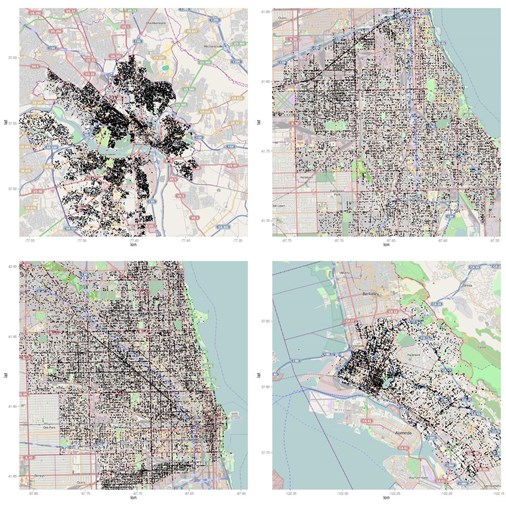
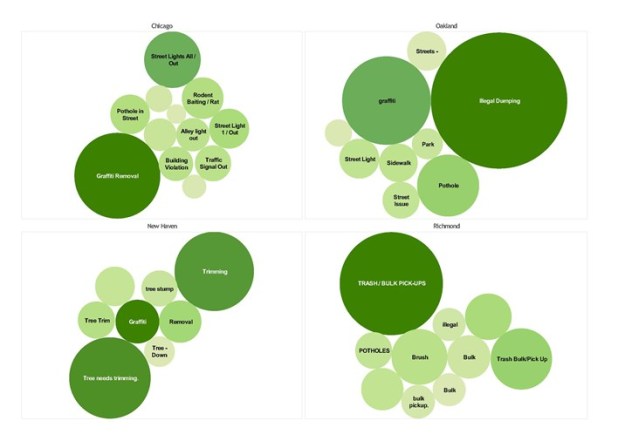
Thanks to the hard work of Will Cukierski at Kaggle as well as the team at SeeClickFix we were ultimately able to generate a consistent data set with 300,000 lines of data involving 311 issues spanning 4 cities across the United States.

In addition, while we hoped many of who might choose to participate in a municipal open data challenge would do so out curiosity or desire to better understand how cities work, both myself and SeeClickFix agreed to collectively put up $5000 in prize money to help raise awareness about the competition and hopefully stoke some media (as well as broader participant) interest.

The Goal

The goal of the competition will be to predict the number of votes, comments and views an issue is likely to generate. To be clear, this is not a prediction that is going to radically alter how cities work, but it could be a genuinely useful to communications departments, helping them predict problems that are particularly thorny or worthy proactively communicating to residents about. In addition – and this remains unclear – my own hope is that it could help us understand discrepancies in how different socio-economic or other groups use online 311 and so enable city officials to more effectively respond to complaints from marginalized communities.

In addition there will be a smaller competition around visualization the data.

The Bigger Goal

There is, however, for me, a potentially bigger goal. To date, as far as I know, predictive algorithms of 311 data have only ever been attempted within a city, not across cities. At a minimum it has not been attempted in a way in which the results are public and become a public asset.

So while the specific problem  this contest addresses is relatively humble, I’d see it as a creating a larger opportunity for academics, researchers, data scientists, and curious participants to figure out if can we develop predictive algorithms that work for multiple cities. Because if we can, then these algorithms could be a shared common asset. Each algorithm would become a tool for not just one housing non-profit, or city program but a tool for all sufficiently similar non-profits or city programs. This could be exceptionally promising – as well as potentially reveal new behavioral or incentive risks that would need to be thought about.

Of course, discovering that every city is unique and that work is not easily transferable, or that predictive models cluster by city size, or by weather, or by some other variable is also valuable, as this would help us understand what types of investments can be made in civic analytics and what the limits of a potential commons might be.

So be sure to keep an eye on the Kaggle page (I’ll link to it) as this contest will be launching soon.

Hello World & Berkman Affiliation

I’m back!

After a restful 1-2 month break from blogging, I’m re-emerging. Both energy and ideas wise. Can’t wait to share some of my new thoughts, as well as revisit some old ones.

I’ve also some fun news. This academic year I’ll be an affiliate at the Berkman Centre for Internet and Society. Indeed, I’m in Boston at the moment taking part in their open house and the launch of their year. I’ll continue to reside in Vancouver but hope to be in and out of Boston throughout the year, so if you are passing through, let me know. I’m also already enjoying the many fruitful conversations with the Berkman community and am drawing energy and ideas from them. Really looking forward to a year where I can start thinking of new ways in which I’d like to grow my intellectual capital.

A big part of the year for me is going to be about that, shedding topics that I feel I’ve talked enough about and beginning to explore new ones. Part of that will, hopefully, be reflected in my writing.

Also, Karen Fung helpfully pointed out that the link for the “my life” venn diagram on my about me page had broken, so I’ve taken it as a sign to update it. Many friends and colleagues have found it to be helpful when trying to understand or (worse!) describe some of what I do. It’s hardly a complete representation of my professional life, but it is a fun effort to try to visualize a good chunk of it. (BTW, if you decide to create your own, please send me a link, would love to see it)

My Life


Finally, I’d like to say thank to those that wrote me emails asking if everything was okay as I took a blogging hiatus. All is good! After almost 7 years of straight blogging, plus writing with TechPresident… I’m Just trying to recenter myself, manage my life (both as I grow, and as I manage new responsibilities, like my 21 month old son!) and think about what I’m doing and where I want to go.

Can’t wait to get back to writing. I hope some of what I say continues to be of interest, or of value to you too.

Beyond Property Rights: Thinking About Moral Definitions of Openness

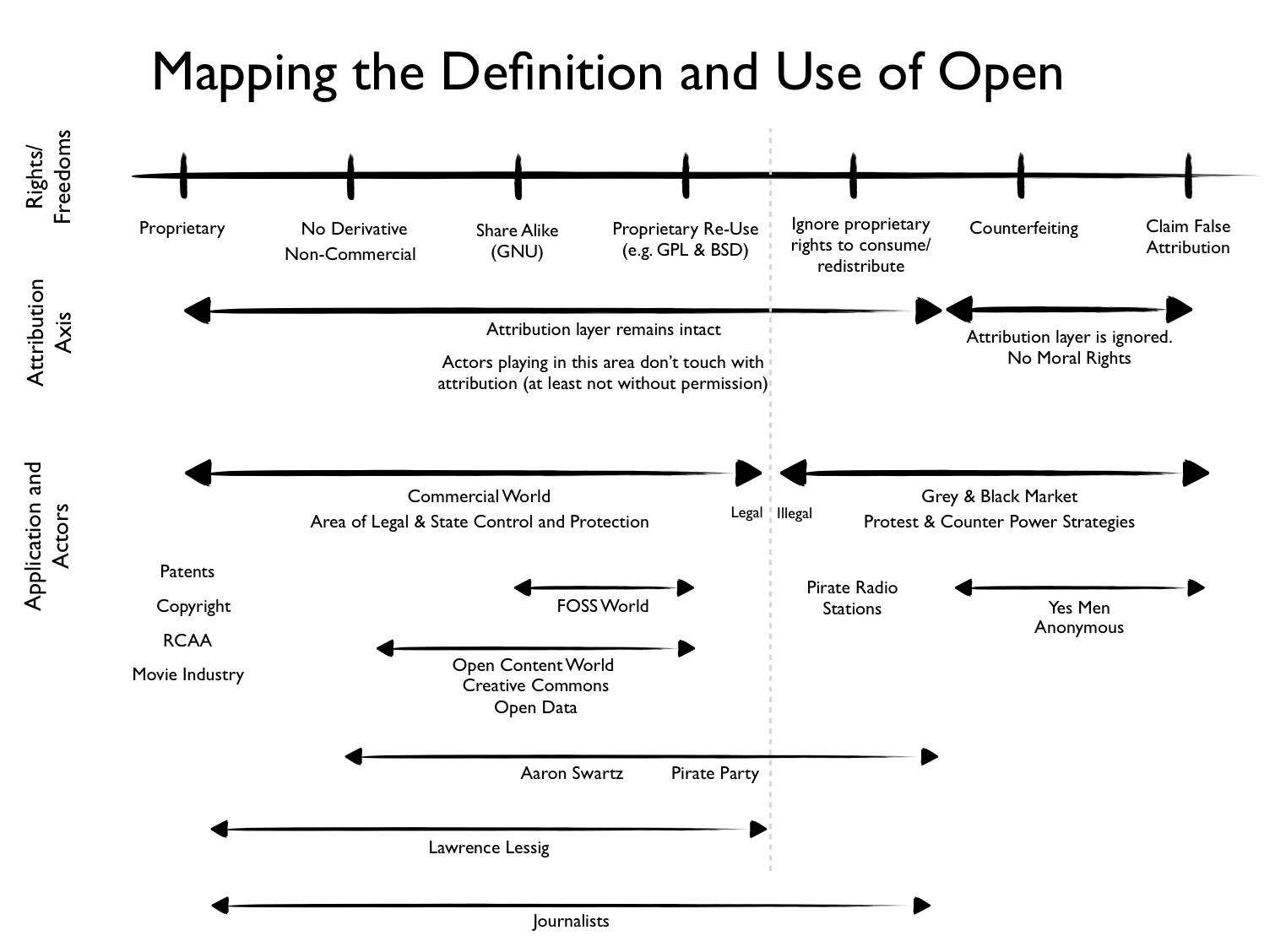
“The more you move to the right the more radical you are. Because everywhere on the left you actually have to educate people about the law, which is currently unfair to the user, before you even introduce them to the alternatives. You aren’t even challenging the injustice in the law! On the right you are operating at a level that is liberated from identity and accountability. You are hacking identity.” – Sunil Abraham

I have a new piece up on TechPresident titled: Beyond Property Rights: Thinking About Moral Definitions of Openness.

This piece, as the really fun map I recreated is based on a conversation with Sunil Abraham (@sunil_abraham), the Executive Director of the Centre for Internet and Society in Bangalore.

If you find this map interesting… check the piece out here.

map of open


Some good articles on surveillance

There are a number of very good articles floating around as the NSA debacle begins to sink in. Two in particular come to mind, the first is a great long read, the second and third are just about the range of implications that will emerge over time of living in a surveillance state that continues to have many functioning democratic institutions:

The Ecuadorian Library

Lawyers eye NSA data as treasure trove for evidence in murder, divorce cases

It’s time Google came to grips with how it enables the surveillance state

Again, as outraged as Americans may be, we non-american have already had to come to grips with the fact that a drone strike can be called against us any time, any where, with no judicial oversight. And now we are coming to grips with the fact that the US government is monitoring everything we do online and building the capacity to store it, indefinitely.

I don’t think America has really grasped how far it has fallen from the “shining city upon a hill whose beacon light guides freedom-loving people everywhere.” This isn’t to say any one thinks that other players are better, but America sold the world not on a relative debate (hey, we’re better than the Russians) but on the promise of an ideal.

More on all of this on Tuesday but wanted to share the reads.

Vacation

Some of you may have noticed I haven’t posted in a bit.

I’ve not stopped blogging! I’m just taking a break to recharge the batteries and do some thinking. The travel this year has been intense so I think I may have over done it a bit. Trying to catch up on some reading. I’ll be back soon.

Dave