LinkedIn is as confused about what I do as everyone else

Often when I meet people, they ask me what I do.

The challenge is, there is no easy answer to that question. I advise companies and non-profits on strategy, I do advocacy work and serve as an expert on open-innovation, open government and open data, I also work a negotiation consultant and mediator, I do some work with open source communities around community management, and then there are about another dozen projects and boards that I sit on.

In reality, my work actually does tie together quite nicely, just not in a “this is my job title” kind of way. I also feel bad about the confusion. It doesn’t feel polite to take 5-10 minutes to explain one’s career and frankly, from a business development perspective, it isn’t very savvy. It’s part of the reason why I created the venn diagram at the bottom of this page. So people could see how my the different parts of my work relate to one another (or at least how I think they relate to one another – and yes, I should update it).

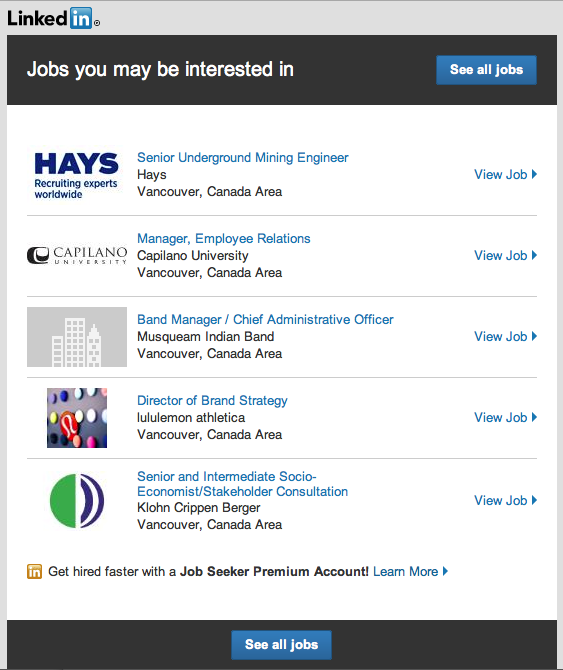
So it was somewhat fun to get this email from LinkedIn about jobs I may be interested in. I appear to have them vexed, or at least confused. I mean check out these jobs! What a mix! If only I WERE qualified for all of them.

The coolest one, by far, is the Chief Administration Officer for the Musqueam Nation. But I’m definitely scrambling LinkedIn’s algorithms. Will be interesting to see if/how they evolve to produce results that likely make more sense.

I’ve never thought of myself as a underground mining engineer…

Linkedin Jobs

The Value of Open Data – Don’t Measure Growth, Measure Destruction

Alexander Howard – who, in my mind, is the best guy covering the Gov 2.0 space – pinged me the other night to ask “What’s the best evidence of open data leading to economic outcomes that you’ve seen?”

I’d like to hack the question because – I suspect – for many people, they will be looking to measure “economic outcomes” in ways that I don’t think will be so narrow as to be helpful. For example, if you are wondering what the big companies are going to be that come out of the open data movement and/or what are the big savings that are going to be found by government via sifting through the data, I think you are probably looking for the wrong indicators.

Why? Part of it is because the number of “big” examples is going to be small.

It’s not that I don’t think there won’t be any. For example several years ago I blogged about how FOIed (or, in Canada ATIPed) data that should have been open helped find $3.2B in evaded tax revenues channeled through illegal charities. It’s just that this is probably not where the wins will initially take place.

This is in part because most data for which there was likely to be an obvious and large economic impact (eg spawning a big company or saving a government millions) will have already been analyzed or sold by governments before the open data movement came along. On the analysis side of the question- if you are very confident a data set could yield tens or hundreds of millions in savings… well… you were probably willing to pay SAS or some other analytics firm 30-100K to analyze it. And you were probably willing to pay SAP a couple of million (a year?) to set up the infrastructure to just gather the data.

Meanwhile, on the “private sector company” side of the equation – if that data had value, there were probably eager buyers. In Canada for example, interest in census data – to help with planning where to locate stores or how to engage in marketing and advertising effectively – was sold because the private sector made it clear they were willing to pay to gain access to it. (Sadly, this was bad news for academics, non-profits and everybody else, for whom it should have been free, as it was in the US).

So my point is, that a great deal of the (again) obvious low hanging fruit has probably been picked long before the open data movement showed up, because governments – or companies – were willing to invest some modest amounts to create the benefits that picking those fruit would yield.

This is not to say I don’t think there are diamonds in the rough out there – data sets that will reveal significant savings – but I doubt they will be obvious or easy finds. Nor do I think that billion dollar companies are going to spring up around open datasets over night since –  by definition – open data has low barriers to entry to any company that adds value to them. One should remember it took Red Hat two decades to become a billion dollar company. Impressive, but it is still a tiny compared to many of its rivals.

And that is my main point.

The real impact of open data will likely not be in the economic wealth it generates, but rather in its destructive power. I think the real impact of open data is going to be in the value it destroys and so in the capital it frees up to do other things. Much like Red Hat is fraction of the size of Microsoft, Open Data is going to enable new players to disrupt established data players.

What do I mean by this?

Take SeeClickFix. Here is a company that, leveraging the Open311 standard, is able to provide many cities with a 311 solution that works pretty much out of the box. 20 years ago, this was a $10 million+ problem for a major city to solve, and wasn’t even something a small city could consider adopting – it was just prohibitively expensive. Today, SeeClickFix takes what was a 7 or 8 digit problem, and makes it a 5 or 6 digit problem. Indeed, I suspect SeeClickFix almost works better in a small to mid-sized government that doesn’t have complex work order software and so can just use SeeClickFix as a general solution. For this part of the market, it has crushed the cost out of implementing a solution.

Another example. And one I’m most excited. Look at CKAN and Socrata. Most people believe these are open data portal solutions. That is a mistake. These are data management companies that happen to have simply made “sharing (or “open”) a core design feature. You know who does data management? SAP. What Socrata and CKAN offer is a way to store, access, share and engage with data previously gathered and held by companies like SAP at a fraction of the cost. A SAP implementation is a 7 or 8 (or god forbid, 9) digit problem. And many city IT managers complain that doing anything with data stored in SAP takes time and it takes money. CKAN and Socrata may have only a fraction of the features, but they are dead simple to use, and make it dead simple to extract and share data. More importantly they make these costly 7 and 8 digital problems potentially become cheap 5 or 6 digit problems.

On the analysis side, again, I do hope there will be big wins – but what I really think open data is going to do is lower the costs of creating lots of small wins – crazy numbers of tiny efficiencies. If SAP and SAS were about solving the 5 problems that could create 10s of millions in operational savings for governments and companies then Socrata, CKAN and the open data movement is about finding the 1000 problems for which you can save between $20,000 and $1M in savings. For example, when you look at the work that Michael Flowers is doing in NYC, his analytics team is going to transform New York City’s budget. They aren’t finding $30 million dollars in operational savings, but they are generating a steady stream of very solid 6 to low 7 digit savings, project after project. (this is to say nothing of the lives they help save with their work on ambulances and fire safety inspections). Cumulatively  over time, these savings are going to add up to a lot. But there probably isn’t going to be a big bang. Rather, we are getting into the long tail of savings. Lots and lots of small stuff… that is going to add up to a very big number, while no one is looking.

So when I look at open data, yes, I think there is economic value. Lots and lots of economic value. Hell, tons of it.

But it isn’t necessarily going to happen in a big bang, and it may take place in the creative destruction it fosters and so the capital it frees up to spend on other things. That may make it potentially harder to measure (I’m hoping some economist much smarter than me is going tell me I’m wrong about that) but that’s what I think the change will look like.

Don’t look for the big bang, and don’t measure the growth in spending or new jobs. Rather let’s try to measure the destruction and cumulative impact of a thousand tiny wins. Cause that is where I think we’ll see it most.

Postscript: Apologies again for any typos – it’s late and I’m just desperate to get this out while it is burning in my brain. And thank you Alex for forcing me to put into words something I’ve been thinking about saying for months.


Canada Post and the War on Open Data, Innovation & Common Sense (continued, sadly)

Almost exactly a year ago I wrote a blog post on Canada Post’s War on the 21st Century, Innovation & Productivity. In it I highlighted how Canada Post launched a lawsuit against a company – Geocoder.ca – that recreates the postal code database via crowdsourcing. Canada Posts case was never strong, but then, that was not their goal. As a large, tax payer backed company the point wasn’t to be right, it was to use the law as a way to financial bankrupt a small innovator.

This case matters – especially to small start ups and non-profits. Open North – a non-profit on which I sit on the board of directors – recently explored what it would cost to use Canada Posts postal code data base on represent.opennorth.ca, a website that helps identify elected officials who serve a given address. The cost? $9,000 a year, nothing near what it could afford.

But that’s not it. There are several non-profits that use Represent to help inform donors and other users of their website about which elected officials represent geographies where they advocate for change. The licensing cost if you include all of these non-profits and academic groups? $50,000 a year.

This is not a trivial sum, and it is very significant for non-profits and academics. It is also a window into why Canada Post is trying to sue Geocoder.ca – which offers a version of its database for… free. That a private company can offers a similar service at a fraction of the cost (or for nothing) is, of couse, a threat.

Sadly, I wish I could report good news on the one year anniversary of the case. Indeed, I should be!

This is because what should have been the most important development was how the Federal Court of Appeal made it even more clear that data cannot be copyrighted. This probably made it Canada Post’s lawyers that they were not going to win and made it even more obvious to us in the public that the lawsuit against geocoder.ca – which has not been dropped-  was completely frivolous.

Sadly, Canada Post reaction to this erosion of its position was not to back off, but to double down. Recognizing that they likely won’t win a copyright case over postal code data, they have decided:

a) to assert that they hold trademark on the words ‘postal code’

b) to name Ervin Ruci – the opertator of Geocoder.ca – as a defendent in the case, as opposed to just his company.

The second part shows just how vindictive Canada Post’s lawyers are, and reveals the true nature of this lawsuit. This is not about protecting trademark. This is about sending a message about legal costs and fees. This is a predatory lawsuit, funded by you, the tax payer.

But part a is also sad. Having seen the writing on the wall around its capacity to win the case around data, Canada Post is suddenly decided – 88 years after it first started using “Postal Zones” and 43 years after it started using “Postal Codes” to assert a trade mark on the term? (You can read more on the history of postal codes in canada here).

Moreover the legal implications if Canada Post actually won the case would be fascinating. It is unclear that anyone would be allowed to solicit anybody’s postal code – at least if they mentioned the term “postal code” – on any form or website without Canada Posts express permission. It leads one to ask. Does the federal government have Canada Post’s express permission to solicit postal code information on tax forms? On Passport renewal forms? On any form they have ever published? Because if not, they are, I understand Canada Posts claim correctly, in violation of Canada Post trademark.

Given the current government’s goal to increase the use of government data and spur innovation, will they finally intervene in what is an absurd case that Canada Post cannot win, that is using tax payer dollars to snuff out innovators, increases the costs of academics to do geospatial oriented social research and that creates a great deal of uncertainty about how anyone online be they non-profits, companies, academics, or governments, can use postal codes.

I know of no other country in the world that has to deal with this kind of behaviour from their postal service. The United Kingdom compelled its postal service to make postal code information public years ago.In Canada, we handle the same situation by letting a tax payer subsidized monopoly hire expensive lawyers to launch frivolous lawsuits against innovators who are not breaking the law.

That is pretty telling.

You can read more about this this, and see the legal documents on Ervin Ruci’s blog has also done a good job covering this story at canada.com.

How not to sell the Oil Sands

If you haven’t read Tzeporah Berman’s Daily Kos piece – My Government Doesn’t Believe in Climate Change – go check it out. It’s amazing to see how out of sync, and behind the ball, the government has gotten on this issue.

Indeed, the current government really is becoming the best weapon opponents to the pipelines have against their construction and the further development of the oil sands.

First, the Natural Resource Minister called environmentalists who opposed Northern Gateway – the pipeline that would take Oil Sand crude from Alberta to British Columbia’s west coast – a “radical”. In short order it turns out that, well, the vast majority of British Columbians were radicals since opposition to the pipeline has been, and remains, strong.

Worse, by declaring war on environmentalists and those concerned about climate change, the Minister set a table that would become distinctly awkward when it came to trying to get the White House and State Department to approve Keystone XL – the pipeline that would export oil sands oil down to the US. Consider that the US President mentioned his concerns about climate change in his State of the Union address and the US ambassador to Canada has hinted that Canada’s commitment to addressing climate change may factor into their decisions around Keystone. So now, at the very moment the Canadian Government needs help to persuade the Americans they actually are serious about climate change, they just come out of a five year patch where they’ve labeled everyone who disagrees with it as a radical, sicced auditors on them and tried to shut many of them down. So suddenly they are in a difficult position of having few, if any, allies in the environmental movement they can turn to to help it gain credibility around any of the actions they wish to take. It’s a communications and policy disaster.

Of course, it doesn’t help that even in the midst of trying to convince the United States it actually is serious about Climate Change, the Natural Resource Minister has speaking notes that feature strong climate change denier comments. Elizabeth May, Green Party candidate in the house of commons summed up the Minister Oliver’s quotes – made to the editorial board of La Presse – quite nicely:

This is what Oliver told the editorial board of La Presse: “I think that people aren’t as worried as they were before about global warming of two degrees… Scientists have recently told us that our fears (on climate change) are exaggerated.”

Thank goodness the editorial board at La Presse knows how to ask questions. They pressed him to name any scientist who thinks our fears are exaggerated. He couldn’t.

So basically, we have a minister who is willing to go on record to make a claim about the future of the planet without being able to reference a single source. I’m sure the White House and State Department are deeply comforted.

It is all doubly amazing as this government has been masterful at handling communications around virtually every issue – except for the one that matters most to it, where it has suddenly becoming a bumbling idiot.


You Have No Rights – Because you are Breaking the Law Right Now

For those who missed it, which I suspect is most people, there is a fantastic Op-Ed in the New York Times by Peter Ludlow of Northwestern University.

Titled Hacktivists as Gadflies it is a scary look at how much legal power the US government has over people who use the web (e.g. pretty much anyone) since almost all of us are, via one way or another probably violating law as interpreted by US prosecutors.

Here’s a juicy line:

“The law, as interpreted by the prosecutors, makes it a felony to use a computer system for “unintended” applications, or even violate a terms-of-service agreement. That would theoretically make a felon out of anyone who lied about their age or weight on Match.com.”

And its scary conclusion:

“In a world in which nearly everyone is technically a felon, we rely on the good judgment of prosecutors to decide who should be targets and how hard the law should come down on them. We have thus entered a legal reality not so different from that faced by Socrates when the Thirty Tyrants ruled Athens, and it is a dangerous one.”

Basically, there is a real risk that everyone is in legal limbo. All it takes is the government to decide they want to attack you, since they already have the means. Scary, scary stuff.

Toronto Star Op-Ed: Muzzled Scientists, Open Government and the Limits of Rules

I’ve a piece in today’s Toronto Star “Rules are no substitute for cultivating a culture of open government” about the Information Commissioners decision to investigate the muzzling of Canadian scientists.

Some choice paragraphs:

The actions of the information commissioner are to be applauded; what is less encouraging are the limits of her ability to resolve the problem. The truth is that openness, transparency and accountability cannot be created by the adoption of new codes or rules alone.

This is because even more than programs and regulations, an open government is the result of culture, norms and leadership. And here the message — felt as strongly by government scientists as any other public servants — is clear. Public servants are allowed less and less to have a perspective, to say nothing of the ability to share that perspective.

and on ways I think this has consequences that impact the government’s agenda directly:

This breakdown in culture has consequences — some of which may impact the government’s most important priorities. Take, for example, the United States’ preoccupation with Canada’s environmental record in general and its specific concerns about the oilsands in regards to the proposed Keystone XL pipeline. The government has spent the last month trying to burnish its environmental record in anticipation of the decision. And yet, it is amazing how few in Ottawa recognize the direct link between the openness around which government scientists can speak about their work and the degree of trust that Canadians — as well as our allies — have in our capacity to protect the environment.

I hope you’ll give it a read.

How Car2Go ruins Car2Go

So let me start by saying, in theory, I LOVE Car2Go. The service has helped prevent me from buying a car and has been indispensable in opening up more of Vancouver to me.

For those not familiar with Car2Go, it is a car sharing service where the cars can be parked virtually anywhere in the city, so when you need one, you just use a special card and pin number to access it, drive it to where you want to go and then log out of the car leaving it for the next person to use it. All this at the affordable rate of 38 cents a minute. It’s genius.

So what’s the problem?

Well, in practice, I’m having an increasingly worse experience with Car2Go, particularly when I’m most in need the service. What’s worse, the reasons are entirely within the control of Car2Go and specifically how it designed its app, its workflow and its security. My hope is there are lessons here for designers and anyone who is thinking about online services, particularly in the mobile space.

Let me explain.

Car2go-find-a-car-150x150First, understand that the Car2Go’s brand is built around convenience. Remember, the use case is that, at almost any time, you can find a car near you, access it, and get to where you want to go. Car2Go is not for people planning to use a car hours ahead (you don’t really want to be paying 38 cents a minute to “hold” a car for 3 hours until you need it. That would cost you $68!). Indeed the price point is designed to discourage long term use and encourage short, convenient trips. As a result ease of access is central to the service and the brand promise.

In theory here is what the process should look like.

  1. Fire up the Car2Go app on your smart phone and geolocate yourself
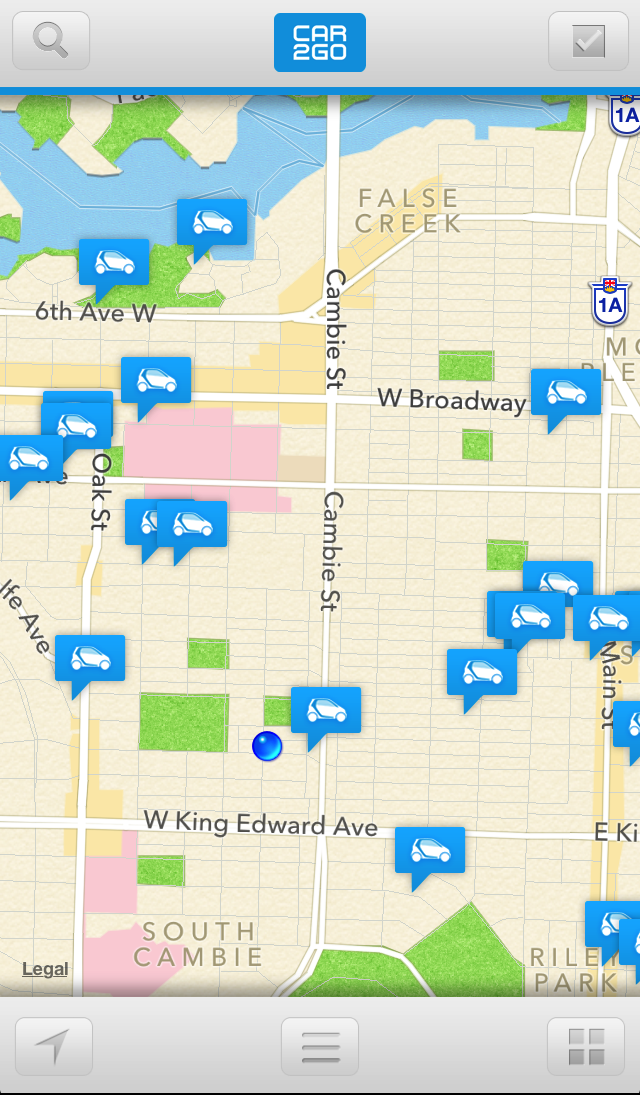
  2. Locate the nearest car (see screen shot to right)
  3. Reserve it (this allows you to lock the car down for 15 minutes)
  4. Walk to your car, access it using your Car2Go card and pin number
  5. Drive off!

Here is the problem. The process now regularly breaks down for me at step 3. At first blush, this may not seem like a big deal… I mean, if the car is only a few blocks away why not just walk over and grab it?

Alas, I do. But, often when you really want a car someone else does too! This is even more the case when say… it’s raining, or it’s the end of the business day. Indeed, many of the times when you would really like that car are times when someone else might also really want it. So being able to lock it down is important. Because if you can’t…? Well, the other week I walked 12 blocks in the rain trying to get to 4 different Car2Go cars that I could see in the app but couldn’t reserve. Why four? Because by  the time I got each of them, they were gone, scooped by another suer. After 30 minutes of walking around and getting wet, I gave up, abandoned my appointment (very suboptimal) and went home. This is not the first time this has happened.

The impact is that Car2Go is increasingly not a service I see myself relying on. Yes, I keep using it, but I no longer think of it as a service I can count on if I just cushion a little extra time. It’s just… kind of reliable because the split between really frustrating outcome and totally delight, is starting to be 40/60, and that’s not good.

Car2go-login-150x150But here is the killer part. Car2Go could fix this problem in a day. Tops.

The reason I can’t reserve a car is a because the Car2Go app forces you to log back in every once and a while. Why? I don’t know. Even if someone stole my phone and used it to reserve a car it would be useless. Let’s say they managed to also steal my wallet so had my Car2Go card. Even now it doesn’t help them since without my pin they couldn’t turn the car on. So having some rogue person with access to user’s account isn’t exactly putting Car2Go in any danger.

So maybe you’re thinking… well, just remember your password David! So here’s a big user moment.

I WISH I COULD.

But Car2Go has these insanely stupid, deeply unsafe password rules that require you to have at least one number, one letter and a capitalized letter (or a special character – god knows if I remember their rules) in your password. Since the multitude of default passwords I use don’t conform to their rules, I can never remember what my password is, leaving me locked out of my Car2Go app. And trust me, when you are late for a meeting, it’s raining and you’re getting soaked, the last thing you want to be doing is going through a password reset process on webpages built for desktop browsers that takes 10 t0 15 minutes to navigate and complete. Many a curse word has been directed at Car2Go in such moments.

What’s worse is there is evidence that shows that not only do these passwords rules create super crappy user experiences like the one I described above, they also user accounts less secure. Indeed, check out this Wired article on passwords and the tension between convenience and effectiveness:

Security specialists – and many websites – prompt us to use a combination of letters, numbers, and characters when selecting passwords. This results in suggestions to use passwords like “Pn3L!x8@H”, to cite a recent Wired article. But sorry, guys, you’re wrong: Unless that kind of password has some profound meaning for a user (and then he or she may need other help than password help), then guess what? We. Will. Forget. It.

It gets worse. Because you will you forget it, you’ll do something both logical and stupid. YOU’LL WRITE IT DOWN. Probably somewhere that will be easy to access. LIKE IN YOUR PHONE’S ADDRESS BOOK.

Stupid password rules don’t make users create smarter passwords. It makes them do dumb things that often make their accounts less secure.

The result? Car2Go’s design and workflow creates a process that suboptimizes the user experience, all in an effort to (I’m guessing) foster security but that, in reality, likely causes a number of Car2Go users to make terrible decisions and make their accounts more vulnerable.

So if you are creating an online service, I hope this cautionary tale about design, workflow is helpful and password authentication rules. Get them wrong and you can really screw up your product.

So please, don’t do to your service what Car2Go has done to theirs. As a potential user of your product, that would make me sad.
Call For Interest: Toronto Negotiation Unconference 2013

This is cross-posted from a site my friend Misha Gouberman’s created to explore an idea. We’ve been doing some very light scheming thinking about the following event. What follows is a piece he wrote that I’d love to get thoughts or reactions about from friends in the GTA…

A one-day event for people who work in negotiation, ADR, mediation, conflict resolution

Interested? Get in touch!

This post is a call for interest, to see if there are people out there who would like to take part in a one-day event in Toronto to assemble people who work in fields related to negotiation, alternative dispute resolution, mediation, and conflict resolution.

If you’d like to know more, send me an email at NegotiationUnconferenceTO@gmail.comand I’ll keep you posted about the project as it moves along. The event will only take place if people get in touch, so if you want this to happen, send me an email!

***

Why I’m doing this: I want to be part of community of people who share these interests

As part of my work, I teach classes to the general public through the Barnicke Gallery at the University of Toronto, in negotiation and difficult conversations. I love this subject. And my students are great. But I want more colleagues – I want to meet other people who share this interest, so I can learn about how other people are thinking about these subjects, how they’re applying them, and generally to feel more connected to a broad community of people working on this stuff.

My hope is that there are other people out there who want this, too.

A one-day unconference

To help create this sort of community, I’d like to run a one day unconference in Toronto for people interested in these fields. An unconference is a sort of highly-participatory conference, where participants get to define their own agenda. At an unconference, you spend most of the day talking about the subjects you most care about with people who share those particular interests. It’s an event specifically designed to allow people to learn from each other, to create meaningful connections, and to ensure that people who really need to meet can find each other.

These events are often organized in a grass-roots sort of way, by the people who want to take part in them. I’m hoping to organize a conference in this way. Working as a facilitator, I’ve organized a lot of unconferences like these for clients. People who come to these events generally really love them: the unconference structure is great at generating exciting conversation, serendipitous discovery, and connection. After years of running unconferences for clients, I’m excited to organize one motivated by my own interests.

Who’s behind this?

I’m Misha Glouberman. I’m the author of The Chairs are where the People Go, teacher ofHow to Talk to People About Things at the Barnicke Gallery at the U of T, and a few other things.

My friends Peter Hiddema and David Eaves are involved in the planning, too. David is a public policy entrepreneur, open government activist and negotiation expert. Peter is the CEO of Common Outlook Consulting and has taught negotiation skills in numerous countries on five continents.

How much would it cost, when would it happen, where would it take place?

These are all the things we’ll be figuring out as we go along. I’m eager to have the event soon, maybe as early as May of 2013. I’m hoping it wouldn’t take place any later than September 2013. If we can assemble sponsorships, the event might be free to attend. At most, there would be a nominal fee to cover the basic costs (venue rental, lunch, etc.) The event will take place in Toronto, but the venue is still to be decided.

Interested? Get in touch!!

My first step in this project is just to see if there are people out there who might be interested in this.

This event will only happen if people get in touch to express interest. So if this sounds good to you, drop me a line at NegotiationUnconferenceTO@gmail.com. I’ll email you any news as things move ahead.

Open Data Day: Lessons for Hacktivists

This piece is cross-posted on TechPresident where I post articles on the intersection of politics, technology and transparency and serve as an editor.

Three years ago, after a chance encounter with Daniela Silva and Pedro Markun of Sao Paulo and a meeting with Edward Ocampo-Gooding and Mary Beth Baker in Ottawa, with whom I shared a passion about open data, we agreed to simultaneously host events in our three cities on the same day. It would be a hackathon, and because it would take place in at least two countries … we liberally called it “international” inviting others to join us.

In that first year we had about six cities conduct events on every continent save Australia. Now in its third year, Open Data Day events is far bigger than we ever dared imagine. More interesting still is its impact, both expected and unexpected.

Reflecting on it all, I thought it might be worthwhile to share a little bit about the impact I think Open Data has, and some lessons hacktvists may find interesting to draw upon.

Build Community

From the beginning our goal was simple. It wasn’t code, or even opening data per se. It was about community.

We wanted to foster a friendly event where anyone would feel welcome to participate. The team in Ottawa had, in particular, done great work in reaching out an engaging new people in previous hackathons, they’d have a wealth of non-software developers and even full families attend their events. This was as much a hackathon as it was a community event.

So Open Data Day was always meant to serve as a catalyst for community and network creation. Yes, creating, adding to or working on a project was strongly encouraged, but the real output to help open data advocates find and connect with one another, as well as grow the movement by engaging new people. An effective community was always going to be the core ingredient for petitioning a government to make data open, teaching students or policy makers how to use data or have a group of developers launch a project. While we wanted to create cool software, visualizations and analysis, what I wanted even more was to foster local leaders, champions, social glue and community hubs.

And that’s what we got.

One of the strengths of Open Data Day is its incredible decentralized nature. I blog about it to encourage people to organize and help moderate a mailing list, but beyond that everything is done by local volunteers. From a capacity building perspective, it is an incredible event to watch unfold. I’d like to think Open Data Day has played a helpful role in connecting local stakeholders and even knitting them together with regional, national and international peers.

While I believe that a beautiful piece of code can be critical in making policy makers, the public or others see the world in a different light I also think that building community and developing allies who can share that story of that code with leaders and the public at large is, depending on the breadth of your goals, equally important.

What Works for Communities Can Work for Governments

Almost immediately upon launch of Open Data Day, government officials began showing up at the hackathons. Some came unofficially, others officially, and in some places, the hackathons were invited to take place at city hall. Because we set a venue Open Data Day created a predictable publicized space where governments that were curious, reluctant, eager or cautious could come and engage at a speed that worked for them.

When you build a safe place for a broader community – if your event has more of the feel of a public consultation or community meet-up than a gathering of subversive technologists – you can create space for governments. More importantly, the one thing that characterizes most open data hackathons I’ve witnessed or investigated,is that the participants share a desire to make their community better. That is something most government officials can easily wrap their heads around.

Thus, in a way that I don’t think anyone planned, Open Data Day events have become a place where governments want to understand more of what is possible, learn about the community that is interested in data and wrestle with how open data can change the way they work. What began with a few pioneering cities three years ago has evolved where now places like the Victoria Palace in Romania (the seat of government) and the White House in Washington DC are hosting Open Data Day events.

This type of engagement creates new opportunities, and new challenges, but that is exactly the type of progress many movements would like to see.

Plant a Flag

Setting a date and having people around the world step up and embrace had another interesting impact. It created a deadline not just for community organizers who were organizing their local open data day event, but also for governments that want to engage these communities.

Indeed in the past it has been amazing to see how many governments now see Open Data Day as a deadline for launching open data portals or releasing additional data sets. This is a fantastic outcome as it creates subtle pressure on governments to act.

This year was no exception. I heard of governments around the world releasing data sets in anticipation of Open Data Day. In particular there was a flurry of activity from European governments and agencies. Indeed the European Union chose to launch its open data portal in time for Open Data Day. But there was also much activity across the continent. This included that launch of data portals for the Building Performance Institute Europe, the Italian Senate, the city of Venice , the city ofTrento, the region of Puglia in the south of Italy, and the province of Bolzano. But the practice has become widespread. I was particularly happy to see a city a few kilometers from my home town do the same: the City of Victoria, BC launched its Open Data portal for the day.

These announcements show the amplifying effect of getting organized across geographies. The advocacy work of a group in one country helps reinforce a message that benefits advocates in other countries. This is pretty basic stuff — political advocacy 101 if you will — but it is a reminder of why congregating around a single date, and meeting in person still have value for those who are unpersuaded.

Ultimately Open Data Day is important because it serves the needs of local advocates and activists wherever they are. That means keeping the event coherent so that it can continue to be a global event that people understand, yet flexible so that it can satisfy local needs and desires. For example, the event in Manila focused on poverty while in Washington DC it focused on building community and capacity. These types of events are not, in of themselves, going to completely solve a problem, but I do believe that they are part of a broader political effort that activates a community, engages government and creates pressure for change.

How Hackers Will Blow Up The World: China, Cyber-Warfare and the Cuban Missile Crisis

I have a piece on TechPresident I really enjoyed writing about how certain technologies – as they become weaponized – can in turn become highly destabilizing to global stability. The current rash of Cyber-Warfare, or Cyber-Spying or Cyber-crime (depending on the seriousness and intent with which you rate it) could be one such destabilizing technology.

Here’s a long excerpt:

This would certainly not be the first time technology altered a balance of military power and destabilized global political orders everyone thought was robust. One reason the world plunged into global war in 1914 after a relatively minor terrorist attack — the assassination of Arch-Duke Ferdinand — was because the hot new technology of the day, the speedy railway, caused strategists to believe it would confer a decisive advantage on those who mobilized first. The advent of nuclear intercontinental ballistic missiles of the 1950s had a similar effect, with fears that a first strike “decapitation attack” against Moscow from Turkey, or against Washington from Cuba, could preempt a counter attack.

Cyber warfare may be evolving into a similarly destabilizing type of technology. Prior to the 21st century, cyber attacks were relatively localized affairs. People imagined the main threats of a cyber attack being with virtual thefts from banks, identify theft against individuals and even industrial piracy. Serious problems to be sure, but not end-of-the-world stuff. Even when targeted against the state, cyber attacks rarely pose an existential threat to a country. The loss of state secrets, the compromising of some officials could, cumulatively, be corrosive on a state’s ability to defend itself or advance its interests, but it was unlikely even a combination of operations would shake a mature state to its core.

Two things have changed….

You can read the full piece here. Always love feedback.