Tag Archives: free culture

Gen Y on Facebook – They Just Don’t Care

Last week I had the good fortune of being invited to give a talk and be part of a panel at a conference organized by Health Canada on Intergenerational Workplaces. I had a great time presenting, listening to the other speakers and meeting the participants.

Acknowledging the dangers of speaking in terms as broad as generations, there was a highlight moment about generational differences worth sharing. This moment reaffirmed to me how poorly Generation Y is understood – even the alleged “experts.”

During the panel someone asked (what has become and inevitable question) about Generation Y’s attitudes towards security and privacy. In short – don’t they know that the photo they are sharing on Facebook is accessible to the world?

Both the technology expert and the “generational” consultant on the panel talked about how Gen Yers obviously didn’t realize that when they post a picture (say, for example, a photo of them greedily swigging a beer at a conference they helped organize in Toronto) there are a ton of people who can access it – such as everyone in your municipal network (this could be, for example, all of Toronto). Both concluded that if Gen Yers realized what they were doing then they’d behave differently. As a result, it was up to us older – and obviously wiser – members of the audience to educate them.

deaves drinking on the job v2
This, to me, was a stunningly problematic diagnoses which in turn led to a flawed prescription.

My fellow panelists were basically asserting was that they – a boomer and a Gen Xer – had a better grasp of Facebook than the early adopting Gen Yers.  They were arguing that Gen Yers who share photos and information the panelists wouldn’t choose to share were – to put it bluntly – at best ignorant or naive, at worst, dumb. Remember, the conclusion is that these people mistakenly believe they are just sharing something with friends. If they knew it could end up getting shared more widely, they’d make a different choice.

Really?

When a young person shares a scandalous piece of news on Facebook or posts a picture of themselves drunk at a party you really think they believe others won’t be able to end up seeing it? More often than not… no! They know that all of Toronto may be able to see it. They just don’t care.

That’s right, many Gen Yers just don’t care.

Many take the attitude that what they do on their time is their business, and if you don’t like it… well that’s okay, I probably wouldn’t want to work for you anyway. And in an era of labour scarcity (who else is going to fill the jobs of all those retiring boomers) that attitude probably won’t push them out of the labour market.

What’s important here is that if you realize they don’t care – telling them that the photo they share is viewable by anyone isn’t going to change their behaviour. They already know it is viewable by everyone. While some may make different choices if they believed their career prospects might be impacted – many (and I mean many) will not. A number of Gen Yers (recognizing the enormous problems of using sweeping generalizations like generations) will be making different choices than both boomers and even Xers around both issues like privacy and what they feel is acceptable to share with the world.

I know many boomers believe this will impact Yers employment opportunities. Maybe. But then, boomers did elect a democratic president who admitted to smoking pot (but not inhaling) and a republican president whose done coke. Why shouldn’t a Gen Yer believe that if it is okay for the president to have engaged in that behaviour – how can a photo of me drunk at a party be a deal breaker?
Declaration on the Future of Open Education

My friend Mark Surman, all round nice guy and Open Philanthropy Fellow with the Shuttleworth Foundation, recently sent out an email asking people to take note of, and if possible sign, the Cape Town Declaration on the future of open education.

The Declaration is the brainchild of the Shuttleworth Foundation, Wikimedia and several other organizations, as is set to be released shortly.

What is it? This extract will give you a clue:

Educators worldwide are developing a vast pool of educational resources on the Internet, open and free for all to use. These educators are creating a world where each and every person on earth can access and contribute to the sum of all human knowledge. They are also planting the seeds of a new pedagogy where educators and learners create, shape and evolve knowledge together, deepening their skills and understanding as they go.

This emerging open education movement combines the established tradition of sharing good ideas with fellow educators and the collaborative, interactive culture of the Internet. It is built on the belief that everyone should have the freedom to use, customize, improve and redistribute educational resources without constraint. Educators, learners and others who share this belief are gathering together as part of a worldwide effort to make education both more accessible and more effective.

These are exciting times, and it is critical that the legal and network infrastructure that enables them to be exciting is preserved so that more people can use these newly emerging educational tools to grow and learn.

If you are interested in this movement, please be sure to check out there webpage and, sign their petition.

My “top 10″ 2007 blogging moments: #1

This is, quite possibly, my best moment of 2007. I’ve been promising some friends that I’d blog about it for quite some time – so here we go.

PART 1:

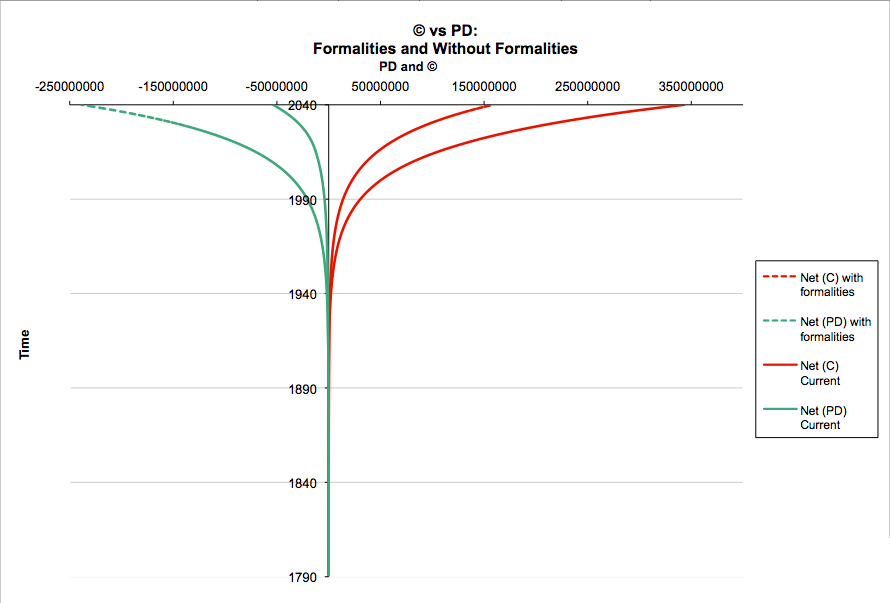
Khale v GonzalesBack in January, Lawrence Lessig – a man whose speeches and books: changed the way I see the world; got me excited about and engaged in open source; inspired me to start fighting for the internet; helped instigate my blog; pulls me (at times) towards law school; and regularly makes me want to move to San Francisco a be part of what is one of the most exciting community in the world – wrote this post.

The post essentially discusses two things. The first half reviews and assesses the U.S. District Court for the Northern District of California (or the Ninth Circuit for those who know their courts) decision on a copyright case called Kahle vs. Gonzales (broadly themed around the issue of Free Culture that Lessig has championed). The court ruled against Lessig and his team so he dissects their response. In the post’s second part Lessig diagnoses that his argument might have been better expressed visually. He then outlines a model, and a graph, he developed to do just this. Most importantly, he posts the basic spreadsheet on his blog and states:

Again, this is a beta model. I’d be very grateful for any errors identified, or for a better specification of the same. After a review by a couple friends, I will post any corrections to this. At that time, I’ll also include any corrections noted in the comments.

I would do virtually anything to help Lessig and the important work he, and others like him, are doing. Sadly, lacking a legal background I’m not sure how much help I would be in drafting an improved Supreme Court petition (I would probably just waste his time and actually do the cause more damage than good). Designing a better graph however, that is something I can do.

Consequently, I posted a comment on Lessig’s blog where I re-graphed his results but displayed them in a visual manner that I thought made it easier to convey his argument. You can see my comment, along with the reasoning and the new model, here. I of course also shared the model so that others could improve on it.

The best part was Lessig wrote me an email me and thanked me for the help. Words can’t convey how much I’ve wanted to help with this movement/cause. So getting a thank you email meant the world to me. In this space (and virtually every space) I’m a nobody – some guy on the other end of a wire – but I love living in a world where even I can spend a few hours (a lot of hours actually) working on something and do well enough that I can help an expert and leader of a movement I feel so much passion for. I still feel ill-equipped to help out, but that thank you email made me feel like that my small contribution was genuinely helpful. For both those who know me, and those who don’t, it may sound pathetic, but I really couldn’t stop smiling for days.

And then it got better.

Part 2:

One of the nicest people in the world – Virginia Law School professor Chris Sprigman emailed me out of the blue with a note that said:

Hello David.  Larry sent me the message you sent to him, and I’ve been puzzling through your graph.  I’m drafting a petition for rehearing in Kahle, and I’d like to speak with you and understand your methodology, in the hope that we might use your graph in the brief.  Do you have any time to speak later today?

We chatted and I went through a couple of iterations of my graph. And then at some point he asked: Would you be willing to do all the graphs for our Supreme Court petition?

Obviously, I agreed.

So you can see the petition here. Sadly, my original graph that got me involved didn’t make the cut. I don’t make any claims that my work was at all intellectual – I was making graphs. But I’m not sure I’ve ever been happier then the hours I spent tweaking things here and there to see if there was something – anything – I could do to help make this small part of a Supreme Court petition better.

So there it is, number one – for the simple reason that blogs and the internet can allow anyone, anywhere, to contribute to something they believe in. I’ve never met Chris or Larry and they didn’t know me from anyone, but the internet’s meritocratic culture meant that if they thought I could contribute – it didn’t matter – they’d bring me on. And for that I’m eternally gratefully, and will also be eternally willing to work my butt off for them and for the cause of free culture.

My “top 10″ 2007 blogging moments: #4

July of 2007 – the 10th anniversary of blogging comes and goes and no one in the Canadian media notices. Of course given that the traditional media spent as much of 1994 to mid-2007 as they could ignoring the internet, this should surprise no one.

So Taylor and I take matters into our own hands and publish this opinion piece in the Toronto Star where we try to reign in technophiles’ overhyped promise of a coming blogosphere instigated social media utopia while at the same time hammering at the Andrew Keen like technophobes who see only doom and gloom.

How we humbled the NYT

Taylor and I published this piece in the Tyee yesterday. In short, the newspapers are dying, and they have completely failed to understand the internet. Most importantly, they think they are above the rest of the online community… and so long as they act they way they won’t be above the community, they’ll be outside it.

It’s derived from a larger magazine styled piece on old and new media that we are looking for a home to publish. If anyone has any suggestions of a possible home I would be grateful for your ideas.

How We Educated the New York Times

A zillion clicks taught newspapers they aren’t in control.
Published: October 10, 2007

The New York Times made waves in the media world recently by dismantling its subscription paywall. As a result, anyone with a computer and an Internet connection can now read the entire paper online for free.

The failed paywall experiment of the New York Times is emblematic of the newspaper industry’s two-decade-old struggle to survive online. So long as the Internet is perceived as nothing more than a new tool for distributing the news to a passive audience — readers, citizen and the community more generally, will continue to tune out. For newspapers to survive, a more nuanced understanding of the online world is needed.

The key is grasping that the relationship between communities and their news has fundamentally changed.

You and I are in charge now

Prior to the Internet, people determined what was important by reading what newspaper editors thought was important. Today, people have a host of ways to determine what is important and to connect quickly with stories on those issues. Newspapers can shift their content, and advertising, online, but as long as they believe they are the arbiters of a community’s agenda, they will continue to struggle.

Online, people engage with news in two new ways, both of which deviate significantly from the traditional newspaper model.

First, algorithm-based aggregators, such as Google News and Del.icio.us, and human-run websites, such as National Newswatch and the Huffington Post, provide powerful alternatives to the traditional newspaper editor.


Aggregators, both human and algorithm-based, don’t care about content’s origins, only its relevance to readers. They ferret out the best content from across the web and deposit it on your computer screen. This begs the question: if you could read the best articles drawn from a pool of 100 authors (the approximate number of journalists at a daily newspaper) vs. a pool of 1.5 million posts (the amount of new content created online each day), which would you choose?But it is the second reason that should most concern newspapers. Younger readers don’t just use aggregators. They increasingly read articles found through links from blogs. Rather than roaming within a newspaper’s walled gardens, younger readers build their own media communities where a trusted network of bloggers guide them to interesting content. Online, bloggers are the new editors.

Take, for example, the relationship many Canadians have with the prominent blogger Andrew Potter. While most people have never met him in person, his readers know his perspectives and biases, and this personal connection creates a loyal following.

Antithetically, people are also drawn back because they are interested in the places Potter links to, virtually all of which direct readers away from the site he blogs for, Macleans.ca.

Share the good stuff

To most newspapers, the idea of directing traffic away from their news site remains an anathema. Newspaper websites contain virtually no external links. Ironically, this follows the design parameters of a Las Vegas casino — the goal is to get you in, and not let you leave. Does anyone really believe that all the news and perspectives relevant and important to a community can reside on a single website?

In this manner, newspapers are fighting the very thing that makes the Internet community compelling: its interconnectedness. Like Potter’s blog, the Internet’s best sites are attractive, not simply because their content is good, but rather because they link to content around the web. And if that content is compelling, readers keep coming back for more guidance.

People enjoy a sense of community, and democracy is strengthened when citizens are informed. The problem is, the New York Times, and virtually every traditional newspaper, fails to understand that a model has emerged that is far better at both delivering information and fostering community than the traditional news industries.

Bad neighbourhood?

Traditional media supporters will assert that these online communities are fragmented, in disagreement, full of scallywags, immature ranters, educated snobs and partisan hacks. And they’d be right. It’s messy and it’s imperfect. But then, so is the democratic community in which we live. The difference is, in an online community, everyone is telling us and directing us to issues and news items they believe are important.

The New York Times learned this lesson the hard way. After spending two years trying to wall its exclusive content off from the web, it discovered that rather than becoming more exclusive, it was becoming less relevant. Unable to link to its content, aggregators, bloggers and the online community more generally, simply stopped talking about them. Newspapers should heed this lesson. If newspapers want to transition into the online age — they’ll have to join this community, rather than seek to control it.

New York Times tears down its walled garden

Serendipity! Taylor and I just submitted a op-ed piece in reaction to Kathy English’s Toronto Star Editorial Journalism is Job 1 – As Always in which we question her vision of the Star’s role within an online enabled community.

One of the main thrusts of our piece is that it is not enough for newspapers to move their content online – they have to integrate with the online community they are a member of.

Not 24 hours has passed since we’ve submitted it (no word as of yet if the Star will run it) and the NYT has announced it is tearing down its firewall. No more exclusive, pay to view online content.

I’d make a comment but Andrew Sullivan has already done it justice (h/t to Taylor for passing along the link).

I do have one question though… what does the Globe and Mail know that the New York Times doesn’t?

Alan Greenspan – too smart to speak

Taylor and I were hanging out on Sunday wrestling for control of the remote control – I was interested in watching the Pats destroy the Chargers, he in Chris Matthews – when on came the 60 Minutes Interview with Alan Greenspan.

It was all very interesting until boom – the 10th minute of this clip reminded us why Jon Stewart’s job is so easy.

In the interview Leslie Stahl berates Greenspan for a speech he gave in March where he publicly suggested there was a one in three chance the US economy could go into recession. Although Greenspan – then retired from his role as Federal Reserve Chairman – gave the speech as both a private citizen and business owner soliciting clients, Stahl suggests that Greenspan’s critics were correct in asserting he should keep his mouth shut since his voice is influential.

So let me get this right. Greenspan is so smart, so reliable, and so trusted on economic matters, that we shouldn’t let him speak about the economy.

You know, just in case he may have bad news to deliver.

And this from 60 minutes! Yes, the press is giving Greenspan a hard time for not sufficiently self-censoring himself.

Needless to say, we went back to watching the ball game.

The past 7 years have been for censorship, and in particular self-censorship, particularly in the US. From discussions about weapons of mass destruction in the Oval Office, to the presses efforts to talk about the Iraq war, to transparency in the US economy, censorship is on the march… sponsored, apparently, by your national news broadcaster.

Let’s hope Stewart picks this one up…

review of small pieces loosely joined

I’m not sure where to begin with Small Pieces Loosely Joined.

Maybe with my regrets. My biggest regret is that it took me so long pick it up and read it. And I had no excuse, Beltzner had been trying to get me to read it for months. I now understand why.

Small Pieces Loosely Joined

Lawrence Lessig’s Free Culture took me into new territory by introducing me to the dangers and important issues confronting our emerging online world. In contrast, Small Pieces Loosely Joined did the opposite, it was a homecoming, a book that explained to me things I intuitively knew or felt, but in a manner that expanded my understanding and appreciation. It’s as though the author, David Weinberger, took me on a tour of my own home, a place I knew intimately, and explained to me its history, the reason and method of its construction, its impact on my life and its significance to my community. Suddenly, the meaning of a thing I use and live in everyday was expanded in ways that were consistent with what I already knew, but didn’t. Wienberger accomplishes all this, but in talking about the internet.

Weinberger achieves this by outlining how our sense of time, space, knowledge and matter is shaped by the online experience. Initially, the book could be mistaken as a more sophisticated Wikinomics, but as each concept builds on the other, the book becomes an increasingly philosophical and thoughtful treatise. Indeed, unlike Wikinomics, which anyone can scream through like a normal business book, Small Pieces took longer to read than anticipated because I wanted (and needed) to slow down and play with its ideas.

Indeed, you can see how so many ideas connect with this book. From The Naked Corporation (Weinberger’s discusses how our desire for authenticity drives form on the internet), to The Wisdom of Crowds to The Long Tail, this book is essential reading to those interesting in understanding of our emerging new world, one overlaid with an internet. Even I was caught in the vortex. For example, I recently wrote a post on the emerging trust economy (all while pitching in my two cents on Keen). I knew the ideas weren’t completely novel, but there was Weinberger, filling in the holes of my thoughts, outlining why we keep going back to the internet even though it is filled with so much disinformation (unlike FOX, CNN, or CBS or any corporate brochures that preceded the internet). Weinberger recognizes that:

…we don’t process information the way philosophers or computer programmers expect us to. We don’t use a systematic set of steps for evaluating what should be believed. Instead, we do on the web we do in the real world: we listen to the context, allow ourselves to be guided by details that we think embody the whole, and decide how much of what this person says were going to believe.

It’s not perfect. But then, neither are we.

But even without all that perfection, we still managed to create this amazing thing called the internet. This is singularly significant accomplishment and one Weinberger believes we must celebrate. And he’s right. At almost no time in history have we built something that is, and can become still more, broad and representative. And it is important that we remember the values that made it possible. A culture of freedom.

…consider how we would’ve gone about building the Web had we deliberately set out to do so. Generating the billions of pages on the web, all interlinked, would have required a mobilization on the order of world war. Because complexity requires management, we would have planned it, budgeted it, managed it,… and we would have failed miserably… We’d have editors pouring through those pages, authenticating them, vetting them for scandalous and pornographic material, classifying them, and obtaining signoff and permissions to avoid the inevitable lawsuits. Yet we — all of us — have built the global web without a single person with a business card that says “manager, WWW.”

Our biggest joint undertaking as a species is working out splendidly, but not only because we forgot to apply the theory that has guided us ever since determines were built. Whether we’ve thought about it explicitly or not, we all tacitly recognize — it’s part of the Web’s common sense — that what’s on the Web was put there without permission. We know that we can go where we want on the web without permission. The sense of freedom on the web is palpable. The web is profoundly permission free and management free, and we all know it.

More recently, Weinberger has emerged as a champion of the internet, probably most famously for taking on Andrew Keen in a now famous debate whose transcript can be read on the WSJ. His book explains the knowledge and understanding that allows Weinberger to be optimistic in the face of people like Keen. Indeed this book serves as a map to what has become Weinberger’s larger thesis – that the internet is not just a human project, but a humanizing project.

The Web is a social place. It is built page by page by people alone in groups of that other people can read those pages. It is an expression of points of view is diversion as human beings. In almost every case, what’s written is either explicitly or implicitly a view of how the world looks; the Web is a multimillion-part refraction of the world. Most of all, at the center of the web is human passion. We build each page because we care about something, whether we are telling other shoppers that a Maytag wasn’t as reliable as the ads promise, giving tips on how to build a faster racer for a soap box derby, arguing that the 1969 moon landing was a hoax, or even ripping off strangers.

What we see when we look into the internet is ourselves.

Increasingly, understanding humanity will require understanding the internet, and Weinberger’s book is a good departure point for that education.

The Fascinating Phenomenon that is Andrew Keen

So Andrew Keen oozed his way on to the Colbert Report the other night and I just caught the video off the website.

For those unfamiliar with Keen he is the author of “The Cult of the Amateur: How Today’s Internet Is Killing Our Culture” a book in which he describes how the internet is making arts and media unprofitable. As innumerable blogs, and most notable, David Weinberger have documented, there are so many holes in Keen’s thesis it is hard to know where to start.

On the Colbert Report Keen cycled through some of his regulars. He correctly pointed out that certain types of media and arts are unprofitable because of the internet… and ignored how the internet has simultaneously given rise to a multitude of new ways for artist to earn a living. New business models are emerging. On the hilarious side, Keen briefly tried to argue that it was blogs and the internet – not American’s old media institutions such as CNN and FOX – that allowed the American public to be hoodwinked into believing there were weapons of mass destruction in Iraq. My god, blogs were the only place in the US where an honest discussion about Iraqi WMDs took place! I could go on… but why repeat what so many others have said.

What it interesting to me is that a phenomenon like Keen even exists. Why is it that we repeatedly listen to people who take a simple ideas and overextend it in illogical ways. Does anyone else remember the fear mongering 1994 book – The End of Work – about how “worldwide unemployment will increase as new computer-based and communications technologies eliminate tens of millions of jobs in the manufacturing, agricultural and service sectors”? Keen’s book is similar in that it nicely capture our society’s paranoias and fears about change (this time wrought by “web 2.0”).

Interestingly I think Keen is a necessary and positive phenomenon. Indeed, Keen exists, is championed and raised up on a pedestal not because he is right, but because is so glamorously wrong. Societies need Keen so that his arguments can be publicly destroyed in a manner that satisfies even the strongest doubters. In this case, Keen’s book helps advance the larger narrative of how centralized authorities that offer the illusion of certainty are collapsing in the face of probabilistic networks that offer a reality of uncertainty. This narrative is hardly new – books that preceded “The Cult of the Amateur” like “The Long Tail” and “Free Culture” more than aptly dealt with Keen’s arguments, they just didn’t do it publicly enough. The publics’ appetite to understand and hear this debate is merely climaxing and has not yet been sated.

The San Francisco Chronicle is right to say “every good movement needs a contrarian. Web 2.0 has Andrew Keen.” Sometimes being contrarian is about offering a valuable insight and keeping the debate honest. And then, sometime its about encapsulating the worst fears, insecurities, and power dynamics of a dying era so that a society can exorcise it. I guess it’s a role someone has to play, and Keen will be well rewarded for it… as his book is reviewed and sold, online.

(NB: If you are looking for a good book on the internet, skip The Cult of the Amateur and consider David Weinberger’s Small Pieces Loosely Joined or Everything Is Miscellaneous: The Power of the New Digital Disorder they are both excellent).

Op-Ed in Yesterday's Toronto Star

Taylor Owen and I published this piece in the Toronto Star on the 10th anniversary of blogging and its impact on news media. (PDF version here)

Blogosphere at age 10 is improving journalism
Jul 30, 2007 04:30 AM
David Eaves & Taylor Owen

Although hard to believe, this month marks the 10th anniversary of blogging, a method for regularly publishing content online.

And what a milestone it is. A recent census of “the blogosphere” counted more than 70 million blogs covering an unimaginable array of topics.

Moreover, every day an astounding 120,000 new blogs are created and 1.5 million new posts are published (about 17 posts per second). Never before have so many contributed so much to our media landscape.

Despite this exponential growth, blogging continues to be misunderstood by both technophiles and technophobes. For the past decade the former have maintained that blogs will replace traditional journalism, ushering in an era of citizen-run media. Conversely, the latter have argued that a wave of amateurs threatens the quality and integrity of journalism – and possibly even democracy.

Both are wrong.

Blogging is not a substitute for journalism. If anything, this past decade shows that blogging and journalism are symbiotic – to the benefit of everyone.

To its many ardent advocates, blogging is displacing traditional journalism. But journalism – unlike blogging – is a practice with a particular set of norms and structures that guide the creation of content. Blogging, despite its unique properties (virtually anyone can reach a potentially enormous audience at little cost), has few, if any norms.

Consider another, more established medium. Books enable various practices, such as fiction, poetry, science and sometimes journalism, to be disseminated. Do books pose a threat to journalism? Of course not. They do the opposite. Journalistic books, like blogs, increase interest in the subjects they tackle and so promote further media consumption.

The same market forces that apply to books and newspapers apply to blogs.

Readers will judge and elect to read based on the same standard: Does it inform, is it well researched and does it add value?

Because blogs are cheaper to maintain they will always be numerous, but this makes them neither unique nor more likely to be read regularly.

Ultimately blogs, like books, don’t replace journalism; they simply provide another medium for its dissemination and consumption.

If technophiles mistakenly claim that blogging competes with – and will ultimately replace – traditional journalism, then technophobes’ fear of being swept away by a tsunami of irrelevant and amateurish blogs is equally misplaced.

Traditionalists’ concern with blogging is rooted in the fact that the average blog is of questionable quality. Ask anyone who has looked, and cringed, at a friend’s blog.

But this conclusion is based on a flawed understanding of how people use the Internet. The Internet’s most powerful property is its capacity to connect users quickly to exactly what they are looking for, including high-quality writing on any subject.

This accounts for the tremendous amount of traffic high-quality blogs receive and explains why these bloggers are print journalists’ true competition. As technology expert Paul Graham argues: “Those in the print media who dismiss online writing because of its low average quality miss the point. No one reads the average blog.”

Once this capability of the Internet is taken into account, the significance of blogging shifts. Imagine that only 5 per cent – or 75,000 – of daily posts are journalistic in content, and that only 1 per cent of these are of high quality. That still leaves 750 high-quality posts published every day.

Even by this conservative assessment, the blogo- sphere still yields a quantity of content that can challenge the world’s best newspapers.

In addition, as a wider range of writers and citizens try blogging, the diversity and quantity of high-quality blogs will continue to increase. Currently, the number of blogs doubles every 300 days. Consequently, the situation is going to get much worse, or depending on your perspective, much better.

As bloggers continue to gain tangible influence in public debates, our understanding of this phenomenon will mature.

And this past decade should serve as a good guide. Contrary to the predictions of both champions and skeptics, blogging has neither displaced nor debased the practice of journalism. If anything, it has made journalism more accurate, democratic and widely read.

Let’s hope blogging’s next decade will be as positive and transformative as the first.