Just started Who’s Your City by Richard Florida out of personal interest but also to better figure out why it is the Vancouver sometimes works, and sometimes really doesn’t work. Figuring out that puzzle, and doing something is part of the reason I joined Vision (and yes, I’m still recovering from the victory celebrations).


I’m already sensing a convergence between Florida and some of my other favourite authors – namely Friedman (who Florida references) and Thomas Barnett (author of The Pentagon’s New Map among other books).
All three are noticing the same thing, and are even writing along similar veins, but there remain important distinctions, with important policy implications.
Flat: Friedman (whom I’m least familiar with) says the world is flat, that innovation, industry, commerce, etc… can now happen anywhere, so we have to prepare for a flat world. Here, I’d argue the core unit of analysis is the individual. We are all free agents, able to do anything or be anything, so we’re going increasingly going to start doing it anywhere. Yes, Friedman believes that governments and industry have massively important roles, but he ultimately sees a world where any place can become a place where people can prosper. If they agitate for it and build it.
Spiky: Florida’s analysis is that world is quite spiky, dominated by a set of mega-regions and super-cities where the bulk of the economic activity and culture is produced. These hubs are connected to one another and largely uncaring of the enormous economic valleys that separate them. For Florida, the fundamental unit of analysis is the city (or mega-region). These determine where power and influence will flow. Importantly, mega-regions cannot be constructed overnight – indeed there is a powerful self-reinforcing mechanism at work. Mega-regions attract talent from around the world, both further increasing their status and starving smaller cities and regions of the key resource – social capital – they need to grow. Individuals are important – but only in so far as they cluster. Countries are important too – in the Friedman sense that they create a generally favourable atmosphere – but they are not critical to the equation.
Divided: Barnett sees a divided world. One on the one side is the Functioning Core, characterized by economic interdependence and incentives to abide by rules, one the other is the Non-Integrated Gap characterized by unstable leadership and absence of international trade and weaker incentives to abide by international rule sets. Barnett’s primary unit of analysis is the state. He is principally concerned with the impact of globalization (and the rule-sets it creates) on state actors – how it constrains them and incents them to behave certain ways. In this world citizens are influence, but it is connectivity, largely (but hardly completely) determined by the state that matters most. Convince a state to connect with the world, and it’s path towards free market democracy (or some close variant) is predetermined.
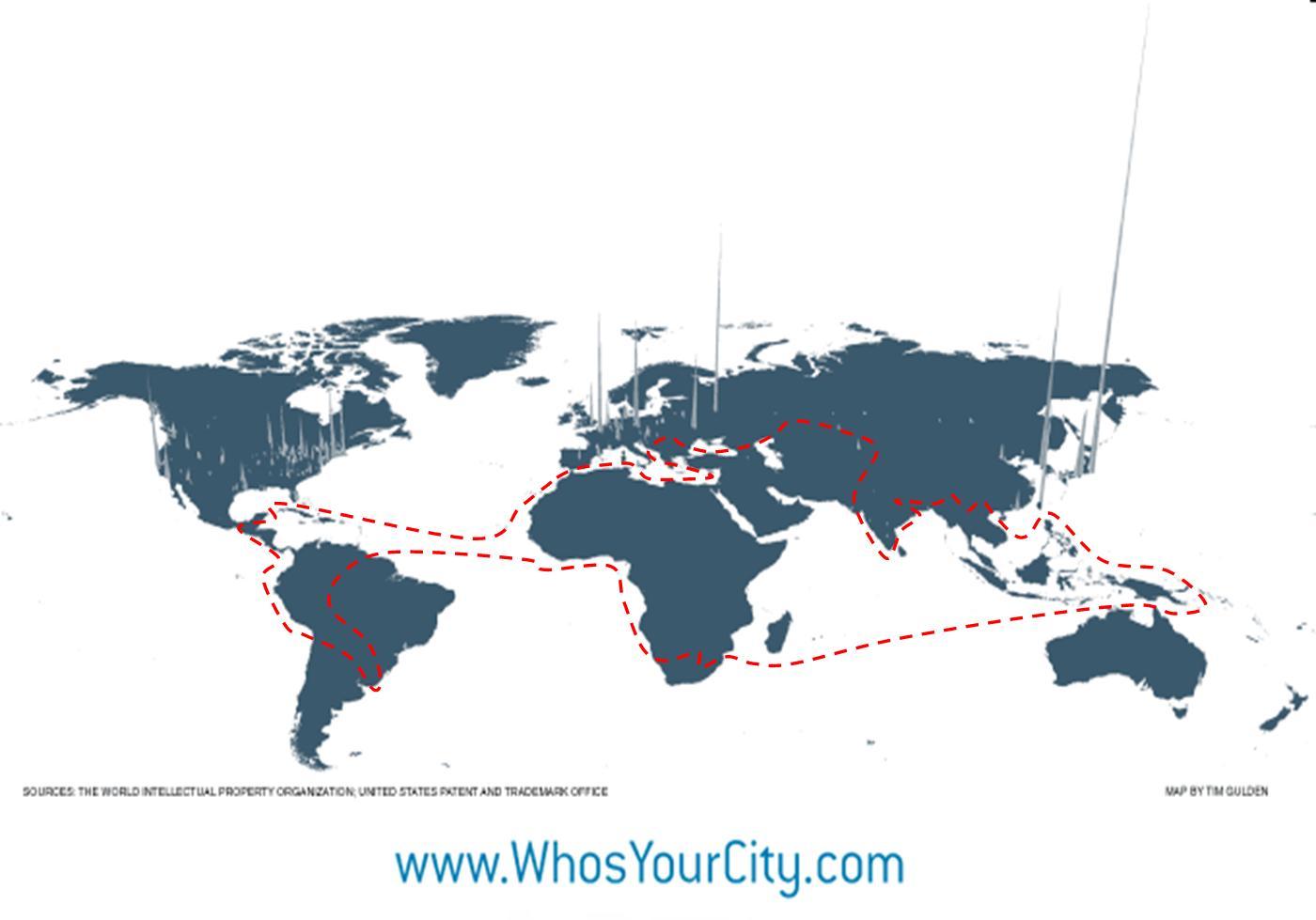
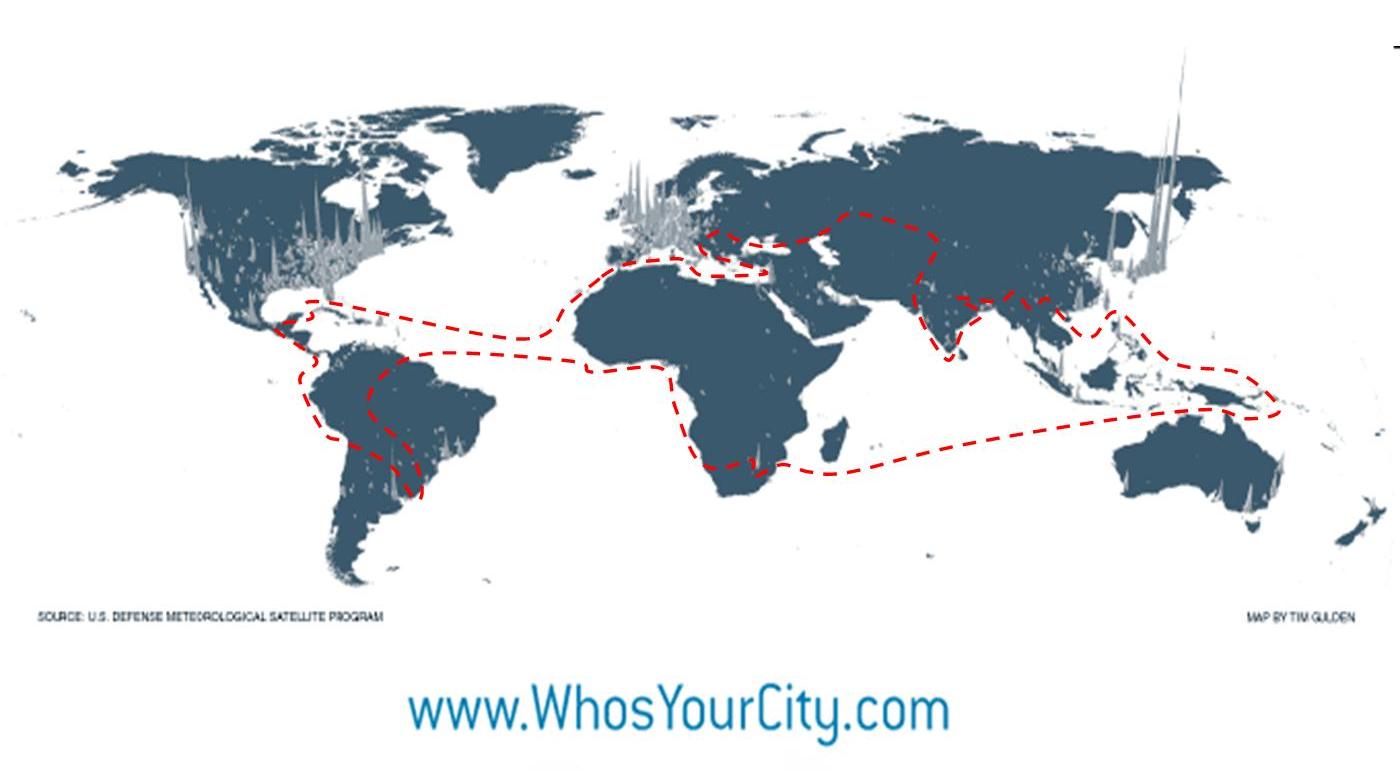
I had so much fun mashing up the Firefox download map with Barnett’s map (and had an incredible response) I thought I’d try to do the same again but with these three authors. Below is a Flat World, overlaid with Spiky depiction of where the most innovation (patents) occurs, overlaid with Barnett’s division between the Function Core and the Non-Integrated Gap. Hoping to write more about these three views of the world over the coming weeks.
What’s interesting about the map’s below is that Barnett and Florida correlate quite nicely. And while they are complimentary I think it Florida’s reinforces the best critique of Barnett’s map I’ve read to date:
“Connectedness is a network property and networks are fractal not contiguous. There is no contiguous region that is disconnected. Within each disconnected country there are islands of connection and within each connected country there are islands of disconnection. This is true at all levels, continents, nations, regions, cities, and companies, right down to individuals. There are terrorist cells in US cities fighting to disconnect the world and Journalists with satellite cell phones in remotest Afghanistan, Iraq, and Somalia working to connect everything.”
I’m willing to bet almost anything that Florida’s maps follow a power law distribution. And the above description – well in Florida’s map there are valleys of non-innovation and non-connectivity within Barnett’s Core. The question is: Can the Mega-Regions assert enough control over these values to ensure their rule-sets are followed?
Innovation (# of patents)
Connectivity (Light Based Regional Product per Square Kilometer)

 eaves.ca