
Tag Archives: open source

Why StatCan is (or could be) like Google

Statscan Google logoThe other week I gave a talk on Gen Y, Gen X, Technology and the Future of the Public Service at StatCan’s managers’ meeting. The speaker before me apparently told the gathering that they “should be more like Google” if they want to recruit young talent. During his Q&A one of the managers asked how a government agency could be like Google (a legitimate question, I thought) and the speaker didn’t have much to say. Frustrating, no?

Definitely.

But I think there is a good case. While the idea of StatCan emulating one of the best performing, young, hottest companies in Silicon Valley may sound far-fetched, it needn’t. StatCan can be like Google. In fact, it already is.

Look, for a second, a Google’s strategy. Google’s mission is encapsulated in its SEC filing statement:

“to organize the world’s information …. and make it universally accessible and useful”. Google explains that it believes that the most effective, and ultimately the most profitable, way to accomplish our mission is to put the needs of our users first. Offering a high-quality user experience has led to strong word-of-mouth promotion and strong traffic growth. Putting users first is reflected in three key commitments illustrated in the Google SEC filing: “1. We will do our best to provide the most relevant and useful search results possible, independent of financial incentives. Our search results will be objective and we will not accept payment for inclusion or ranking in them.

  1. We will do our best to provide the most relevant and useful advertising. Advertisements should not be an annoying interruption. If any element on a search result page is influenced by payment to us, we will make it clear to our users.
  2. We will never stop working to improve our user experience, our search technology and other important areas of information organization”.

To organize the world’s information… and make it universally accessible. This a huge part of StatCan’s mission. To organize Canada’s information… (now if only we made it universally accessible).

I think Google’s mission is similar to StatCan’s. Indeed the main difference is that StatCan not only organizes Canada’s information; it also creates that data. However, this is a space that Google has moved aggressively into — why do you think it has created platforms like Google Earth? To facilitate the creation of data so that it has more to organize and offer its users. Indeed, what is interesting about Google is that it knows the more information and data that is out there – for free – the more useful and important it becomes. It means more people doing searches, which means more advertising revenue.

So what does this mean for StatCan?:

First, distinguish and separate what you do: “Creating and organizing information about Canada” from what makes you valuable: making this information universally available to citizens.

Second, make yourself the centre of a data gathering, sharing and analyzing eco-system: There are thousands, if not hundreds of thousands of people out there who could do amazing things with StatCan’s data. The problem is, it isn’t easy to find, often you have to pay for it, and it is usually only available in HTML charts that aren’t easily accessed, and certainly not dynamically available. If StatCan data was available as API’s and Excel spreadsheets, then a whole ecosystem of multimillion dollar businesses, bloggers and other pro-ams would emerge around it as supporters, collaborators and complementors.

Finally, hire young people to make it happen because if you are open, they will come: Does StatCan want young people to come work for them? Then stop behaving like a 20th-century consulting firm whose job is to hoard data and conduct analyses for clients. (Don’t worry you can still do this). Instead, act like the 21st-century Google-like platform that you are. Your job should be to make your data as searchable, taggable, as pluggable, in short, as usable, as possible. This, in addition to collection, should be the top priority. If StatCan’s data were easily available (say as an API) people would start using it in all sorts of creative ways – this, and this alone will drive innovation, excitement, energy and buzz about Statcan into the workplace. In short, it will make Statcan relevant. StatCan should be a place where young Canadians want to work so they can learn how to handle and disseminate HUGE quantities of data to everyone from the smallest bloggers to the largest companies. That skill set is going to be critical in the 21st century and so such a mission will attract talent top talent, if StatCan gives them the freedom to play and build it.

StatCan is like Google — if it chooses to be. It can’t offer the stock options, but it can offer a cool opportunity to help build the country’s most critical data ecosystem for a 21st century economy. That’s a job lots of geeks would be interested in.
ABC Meme for FireFox 3.x users

The Meme

Show your the top Awesomebar results for each letter of the alphabet.

Instructions

  • Without opening any other tabs, pop open your Error Console (in the Tools menu) and enter the following into the “Code:” field:C=Components;d=C.classes['@mozilla.org/browser/nav-history-service;1'].getService(C.interfaces.nsPIPlacesDatabase).DBConnection;for(o=[],c=97;c<123;c++){h=String.fromCharCode(c);q=d.createStatement('SELECT title t, url u FROM moz_inputhistory JOIN moz_places ON id=place_id WHERE input LIKE ''+h+'%' ORDER BY use_count DESC LIMIT 1');if(q.step())o.push(['',h,': ',q.row.t,''].join(''))}open('data:text/html,'+o.join('n'))
  • Click “Evaluate”. A new tab will open showing your results
  • Copy the code from that new tab and paste it into a new blog entry

History

Benjamin started it
Mardak helped with the code snippet
I saw it on Beltzner’s blog

My Results

a: Air Canada
b: Bloomberg.com: Energy Prices
c: CNN Politics: News, Opinions and Analysis from CNN.com
d: Dopplr
e: eaves.ca
f: Feedburner:: Feed Stats Dashboard
g: Globe and Mail: Canada’s National Newspaper
h: eaves.ca > Edit Comments (password required)
i: CIBC Investor’s Edge
j: Plotting of Canadian Federal Government Offices
k: Gregor Robertson: Beware of the Kingsway NDP Mafia – Straight.com
l: Literary Review of Canada: Progressivism’s End
m: Google Maps
n: New York Times
o: Ottawa Citizen
p: Personalized Start Page
q: David Eaves | FSOSS 08
r: TheStar.com | Opinion | How about real Liberal renewal?
s: StatCounter Free invisible Web Tracker
t: Technorati: Home
u: United Airlines
v: Vote Vision | Leadership • Action • Vision
w: WordPress Plugins
x: Amazon.ca: Divided We Stand
y: Youtube – Rachael Blake – Video 9 (Lost Experience)
z: Polymorph

Cultural theories of risk and the rise of emergence systems

My (very cool) friend Alex T. recently introduced me to the grid/group typology. As explained in wikipedia:

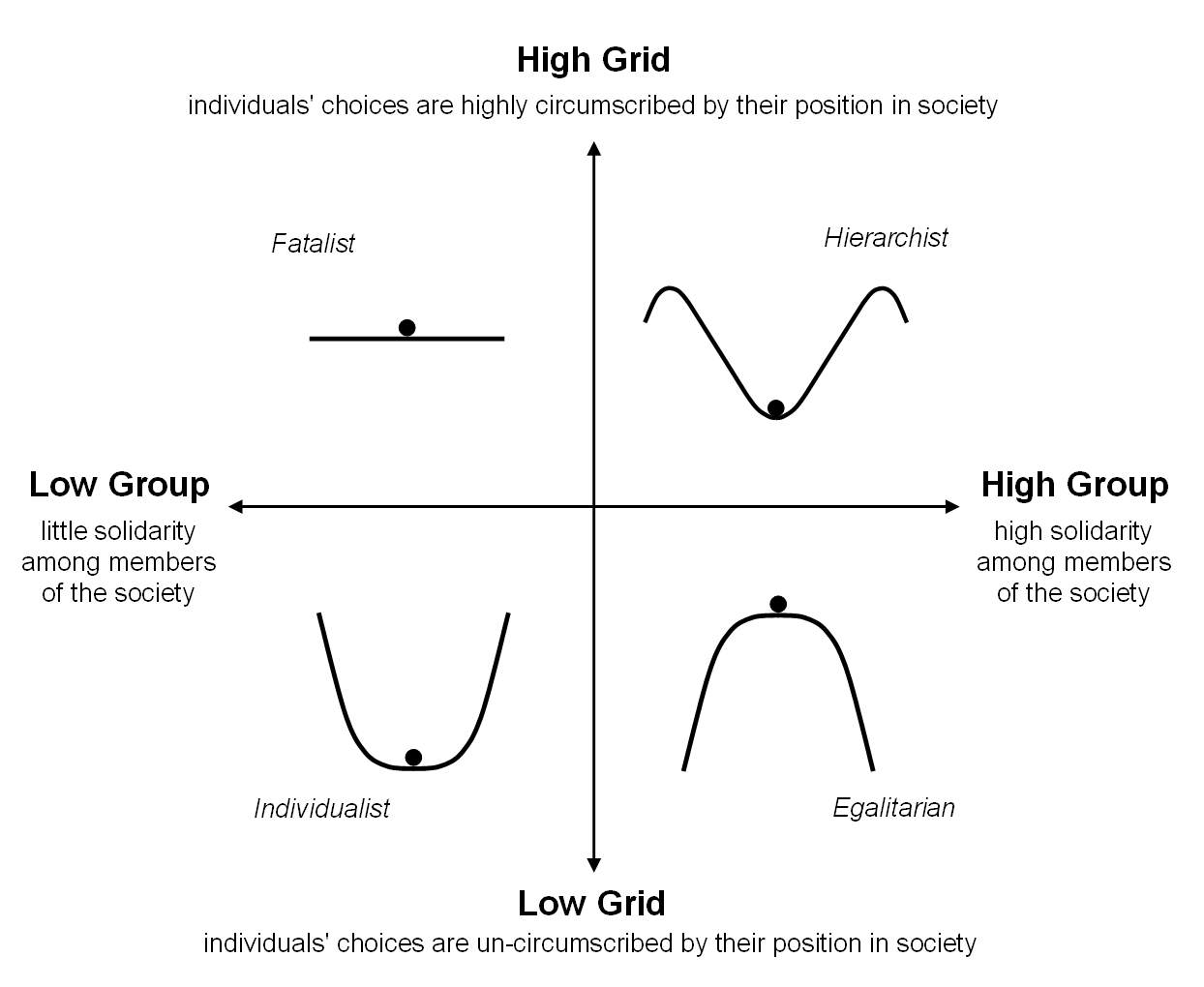
Mary Douglas, an anthropologist studying traditional African religion observed that different societies feared different sorts of threats, and that these differences correlated with differences in their social structure. Later, Douglas argued that social structures differ along two principal axes: “grid” and “group (see graph).”

The important things is – if your society organized itself along one of these structures – it is challenging, if not impossible to see a solution outside of that structure. What I think is exciting is that the egalitarian mode of thinking – thanks to the internet and social software – may be ascendant, explaining some of the reason market based systems (individualists) and bureaucracy based systems (hierarchist) feel threatened.

Grid vs Group

From Christopher Hood: The Art of The State (again via wikipedia):

Fatalists feel isolated in a world that imposes arbitrary constraints on them. They view nature as a ball on a flat surface, rolling randomly in any direction. There is little they can do to control their situation, and resign themselves to riding out whatever fate throws at them.

Hierarchist see a society with a well-defined role for each member. Thus , they believe in the need for a well-defined system of rules, and fear social deviance (such as crime) that disrupts those rules. Hierarchists see nature as “perverse/tolerant”: it can be exploited within certain limits, but if those limits are exceeded the system will collapse. They thus rely heavily on experts, who can identify those limits and establish rules to keep society within proper bounds.

Individualist see their choices as unconstrained by society and they lack close ties to other people. They value individual initiative in the marketplace, and fear threats like war that would hamper free exchange. The individualist view of nature as resilient. Like a ball resting at the bottom of a cup, nature will return to its original stable position after any disturbance. Thus, individualists embrace trial-and-error, as they have confidence that the system will fix itself in the end.

Arguably, much of the left-right axis of our politics is a battle between Individualists on the right (let the market rule!) and Hierarchists on the left (government oversight!) with fatalists abstaining (what’s the point?).

Hood’s description of Egalitarians is intriguing mostly because I think it is quite narrow and, if slightly tweaked, could help describe the rise of an important new block of voters (part of the neo-progressive movement Taylor and I write about).

Hood description (again, via wikipedia)

Egalitarians experience low grid and high group. They live in voluntary associations where everyone is equal and the good of the group comes before the good of any individual. In order to maintain their solidarity, egalitarians are sensitive to low probability-high consequence risks (such as nuclear power), and use them to paint a picture of impending apocalypse. Risk and Culture was, in part, a polemic against the environmental movement, which Douglas and Wildavsky saw as sharing the worldview and social organization of religious cults. Egalitarians see nature as fragile, like a ball balanced precariously on an overturned cup. Any small disturbance will send it crashing down. Thus egalitarians advocate the precautionary principle and cling to traditional ways of life that have proven to be sustainable, rather than risking disaster by trying new technologies.

Hood describes the Egalitarian way as one with high levels of cooperation within a group that is socially distinct from the outside world and which relies on dynamic rules set through constant debate and case-specific solutions to every issue as it arises.

Hood’s contempt is well placed. Many tightly held communities facing what they believe to be massive threats can indeed take on cult-like characteristics. But that is not their only possibility. Indeed, societies that organize along these lines have new powerful tools – namely the internet – to use to organize themselves. More importantly, these communities can coordinate themselves and achieve powerful outcomes even with weak bonds. Many of the “egalitarians” I see today are those creating projects that seek to engage citizens and pool individual resources to address collective problems. Indeed, many open-source projects fit this mold very well.

More importantly, most of these projects are not cult-like, but are self-organizing and emergent. They see that a situation (like the environment or the open web) is vulnerable and they don’t believe a) it is self-correcting (like individualists) b) it can be perfectly moderated or controlled by top down systems (like hierarchists); or c) that collective or individual action is futile (like fatalists).

There are few examples of egalitarians (or emergents) that spring to mind as successful – certainly the organizational and political discourse has been dominated by hierarchists and individualists. Maybe this explains why people have such a hard time defining new forms of organisation – like open-source projects. They are trying to peg their participants as either right-wing market loving individualists or left-wing regulation loving hierarchists. The fact is they are neither. While hardly uniform, my experience is that they are often libertarians (low-grid) who believe in free-association, collaboration and emergent systems (high-group).

The increased manifestation of this new structure in society could diversify how we perceive and try to solve problems. But in the short term observers (like pundits on CNN) will continue to try to put force this peg of a new circular group into an old square hole.


e-governance: How the White House may evolve

The other day Taylor emailed me this article on how the internet, and the communities it enables, may reshape politics in America.

What really struck me however was the subtle but important differences in language between the incoming Obama administration and the outgoing Bush administration. The quotes below say it all: On one side you have advisers talking about the internet as a tool to enable transparency and engagement. The subtext, citizens become an extension of government – helping improve program delivery. On the other side you have someone talking about the internet as a broadcast tool, a way to “get the message out.” Here, citizens are separate from government and merely passive recipients of “a message” or data the white house wants it to see.

Check it:

Craig Newmark, founder of online classifieds site craigslist.com, served as a technology adviser to Obama and is an advocate for a more open and responsive government.

“In New York and San Francisco there are so-called ‘311’ programs,” he said. “The idea is that it’s customer service for local government and if you need a pothole fixed you contact 311.

“Well let’s start expanding 311 systems to all of government,” he said.

“There’s also the whole transparency thing,” Newmark added. “The Internet is all about transparency. The first phase is the election campaign then, afterwards, getting some real grass-roots democracy in there.”

David Almacy, who served as Internet and e-communications director for President George W. Bush, said the Internet is “a very powerful tool in communicating the president’s agenda.”

“The Internet is basically a 24-hour seven-day-a-week spokesperson,”
Almacy said. “While we’re sleeping at night it’s still available for those who are searching on energy legislation or the war on terror or the war in Iraq.”

Improving the tools of open source

It is really important to recognize that free software and open source spring not just from a set of licenses but from a set of practices and often those practices are embodied in the tools that we use. We think through the tools that we use and if you give people different tools they think differently.

– Tim O’Reilly, O’Reilly Radar update, OSCON 2007 (min 9:16 of 22:03)

For those coming to the Free Software and Open Source Symposium at Seneca College, and for those who are not, I wanted to riff off of O’Reilly because he is speaking precisely to something that I hope Dan Mosedale and I are going to dive into during our discussion.

The key is that while the four freedoms and the licenses are important they are not the sum total of open source. Open source communities work because of the tools and practices we’ve developed. More importantly – as Tim points out – these tools shape our behaviour. Consequently, we should never treat the tools or practices in open source as assumptions, but rather things that my must be questioned and whose benefits and limitations must be understood. It is also why we must envision and innovate new tools.

This is why I blog and write on community management and collaboration in opens source. I am trying to imagine ways to port over the ideas developed at the Harvard Negotiation practice into the open source space. I see a set of practices and tools that I believe could further enable, grow and foster effective communities. I believe it is a small, but important piece, to enabling the next generation of open source communities.

I know Dan enjoyed the presentation from last year and has some of his own thinking on this subject – with luck some interesting new insights will emerge which I promise to blog about.

Open Government comes to Canada

I Believe in Open Badge

For those who are Canadian and who believe in open, I strongly encourage you to check out and register with Ibelieveinopen.ca modeled after its US counterpart Open Congress.

The goal of Ibelieveinopen.ca is to:

  1. Support reforms that increase government transparency and accountability.
  2. Make campaign promises specific and measurable, and report progress on promises and their metrics at least semi-annually.
  3. Publish the content of his or her daily schedule, including meetings with lobbyists and special interest groups.
  4. Support reforms allowing free access to scientific and survey data gathered by government institutions.
  5. Support reforms that make it easier for Canadians to obtain government information they have a right to know.

By registering, you can begin to let your preferred candidate and your MP know what you expect of them. Will this change things today, or tomorrow? No… but the goal is to begin developing awareness among politicians and the public about what we can and should expect from our representatives.

In the US Open Congress has encouraged its supporters to donate money to candidates that have signed on to its pledge but have asked that the donations ends in .09 cents (e.g. $50.09). By “tagging” donations in this way, candidates will know how much of much of the money they raise is tied to the fact that they have pledged to be open. It then becomes a way for them to understand its popularity and to prioritize the goal of being open. Very cool.

Will it work in Canada? Who knows. but it is definitely worth a try. No?

Wikipedia: Community Management as its core competency

Last week Paul Biondich lent me The Starfish and the Spider and I just finished reading it (I know, I didn’t put it in the sidebar). Indeed, a number of people I respect have had great things to say about it – John Lily suggested the book ages ago and I remember reading his review and wanting to pick a copy up.

Tons of exciting ideas in the book. One that excited me most related to an idea (articulated by many people) that I’ve been trying to advance – namely that Community Management is core to open source. Specifically there was this exciting piece on how Jimmy Wales, the “catalyst” behind Wikipedia, spends his time:

Jimmy focuses a great deal of attention on maintaining the health of the Wikipedia community. “I go to speaking engagements all over the world at conferences, and everywhere I go I meet Wikipedia volunteers,” he told us. “Usually we go off to dinner and talk shop about Wikipedia. The Wikipedia gossip is the same all over the world-just the characters are different. The problems that affect community are always the same problems.” When he doesn’t meet the members in person, Jimmy spends “a ton of time writing e-mails internally, to the community, touching base with people, discussing issues that come up on the mailing list.” But “as far as working with Wikipedia, I don’t write articles. Very, very little do I ever edit. But I do engage with people on policy matters and try to settle disputes. (page 112 – paperback edition)

It could be that in starfish organizations the role of managers and leaders isn’t to tell people what to do, but help settle disputes, grease the wheels and make sure that groups are working well. Is this to say other expertise are not needed? Not at all. But it is great to see another take on how soft skills such as dispute management, facilitation, negotiation and mediation may be essential for sustainable success of starfish organization (like open source communities).

The Evolution of Open – notes from Open Everything

Day 1 of Open Everything at Hollyhock has passed and I’m now up far too late blogging about it.

Numerous insights, but possibly the most interesting occured during the spectrogram exericse where we asked participants to physically locate themselves along an axis (in our case a piece of tape along the floor) in response to questions we asked them.

The most interesting was a two dimensional spectrogram where we first asked people if “The Organization I work for is open.” Then, after participants chose their spot along this first axis we asked them to migrate along a Y axis according to the question “I personally work in an open manner.” Below is a re-creation of how the participants distributed themselves around the room.

Obviously definitions of “open” and “how open” one is was up to each participant – but then this is the point of a spectrogram!

At first blush it simply seemed that many people were personally open (or trying to act in an open manner) in their jobs and that there was pretty equal distribution between who was in an open vs. closed organization.

However, the distribution of people in the quadrants was not random. Those in the bottom right quadrant (quadrant 2) tended to be people who were in more conservative institutions like universities, governments and traditional companies. These people were the IT professionals, consultants, organizers, etc… but more importantly, they were rabble-rousers within their respective organization, trying to initiate change. In short,  you had CHANGE MAKERS trying to shift their org into a more open space.

In the top right-hand quadrant (quadrant 3) were people in emerging open source projects and generally smaller organizations that were striving to be open. This was a group of people who’s organizations were become increasingly open. These ACTIVISTS believed in the open idea and were excited about where they – and their organizations – were.

Finally, in the top left hand quadrant (quadrant 4) were the VETERANS of the open movement. Here were people who worked in well established open source or open projects. Their challenge was they were experiencing the limits and issues of being and acting consistently in an open manner. As they push about against the most extreme limits of open they saw the necessity and value of not always been completely and totally open (for example, there are only so many thinking processes, conversations, and discussion, I can take the time to share).

So the big ah-ha was realizing the growth curve that people and organizations go through as they engage in, and become, more open. First you have change makers who agitate and work to enable organizations to adopt open methodologies. Then as the organization becomes more open people become activists, celebrating the open idea and pushing it into all areas of the organizations. Then those within the organizations begin to run into the operational and practical limits of open and, importantly, recognize the importance and role of “private” or “closed” as essential and so guard it. Critically, I also think that those in quadrant 2 or 3 are often measuring open differently then those in quadrant 4 – who because of their boards and/or stakeholders, hold themselves to a very high bar.



The best part about this is that it means there are individual and organzations lessons to be drawn as one migrates through these stages. It also means thatt those passionate about open, but in radically different quadrants (say 2 vs 4) may have very different priorities and/or concerns. This doesn’t mean that they aren’t both equally committed to a common ideal, just that they are looking at it from very different places.

Open Everything

This first stage of open source (which is drawing to and end) was proofing out the model.

The second stage is about a duopoly…A battle of ideas, so to speak of open versus closed… Where industry is going to be dominated by two platforms that really characterize these two concepts. These two platforms are likely to be Linux and, unfortunately, Microsoft… but I think increasingly the world is entering into this two horse race.

Jim Zemlin, Linux Foundation at Ubuntu Live

September 3-6 I’m co-hosting an event called Open Everything at hollyhock which seeks to explore what this second stage of open will look like and how it can be made more successful, not just in the world of Linux and Microsoft, but across all areas, software, hardware, philanthropy, public policy, business, etc..

In short, what does being “open” mean? What will it mean? And what could it mean?

A bunch of very cool cats are getting together to see if we can begin to answer that question. If you think you might be interested in joining us, click here.

There will obviously be much, much, much more to come on this.

ParticipAction 2.0 – Get Hal and Joanne on my Wii!

About a month ago a good friend lent me their WiiFit so that I could give it a try. I confess, I’ve become a fan.

wii-fit-01-540x540For those unfamiliar with the WiiFit it is a balance board you use with the Wii game consol to do strength building exerices, yoga, and balance games to develop flexibility, strengthen core muscles and burn calories. You can read more about the Wii Fit, its benefits and drawbacks here, and here.

The Wii Fit continues a trend of video games that find ways to get people to be active. Anyone whose tried Dance Dance Revolution, or even boxing and tennis on the Wii knows what I’m talking about. Still more amazing is how many households can now access this technology. 986,200 Wii’s have been sold in Canada as of July 1st, 2008. That is essentially one Wii for every 32 Canadians, one for every 12 households. Imagine if 1 in every 12 houses had a tread mill, or even a simple yoga video. Well, in a sense they do!

What is most interesting is that the Canadian government could help take this type of activity to the next level. Despite its success the WiiFit sufferes from a few shortcomings:

  1. there could be more exercises – ideally downloadable over the internet
  2. it would be nice if you could string together a customized series of exercises, that way you could create different workouts,
  3. the pace of the “trainers” is pretty slow, it be nice if you could eliminate their introductions and wrap ups to each exercise, by doing so you could increase the pace and a “workout” much more vigorous
  4. there could be cooler trainers guiding you during your work out
  5. it would be nice if more than one balance board could be connected to a given Wii – that way you could work out with friend(s)

180px-Participaction

In short, what we have is an increadible technology, one that touches millions of Canadians, and yet it is short on its potential. Thought of differently, every Wii Fit board, Nintendo Wii and television has the potential of becoming an instant gym.

hal_jo_06

Ideally, the community could create a game with several trainers or even “skins” – such a variety of themes could increase the appeal to different niches. I can already imagine someone grabbing and digitally editing a bunch of the old Hal and Joanne videos so that they appear to be doing exercises on the Wii balance board – one can imagine it being the must have retro cool game.What if the newly revived ParticipACTION partnered with Nintendo to create a new WiiFit game. ParticipACTION would agree to pay a discounted license fee to nintendo, and in exchange it would sponsor an open source community to create a ParticipACTION WiiFit game – one that could be cheaply distributed and customized to appeal to anyone, but especially the very kids who are most at risk of not exercising…

(the fact that, in researching this post, I discovered the participation archive project again reveals the mysteries and wonders of the internet. I mean, if there are transit geeks, why not participaction geeks?)