Category Archives: open data

CIDA announces Open Data portal: What it means to Canadians

For those who missed it, the Canadian International Development Agency (CIDA) has announced it is launching an open data portal.

This is exciting news. On Monday I was interviewed about the initiative by Embassy Magazine which published the resulting article (behind their paywall) here.

As (I hope) the interview conveys, I’m cautiously optimistic about the Minister’s announcement. I’m conservative in my reaction only because we don’t actually know what the Minister has announced. At the moment the CIDA open data page is, quite literally, a blank slate. I feel positive because pretty much anything that gets more information about Canada’s aid budget available online is a step in the right direction. I’m cautious however, because the text from the Minister’s speech leads me to believe that she is using the term “open data” to describe something that may, in fact, not be open data.

Donors and partner countries must be accountable to their citizens, absolutely, but both must also be accountable to each other.

Transparency underpins these accountabilities.

With this in mind, today I am pleased to announce the Open Data Portal on the CIDA website that will make our searchable database of roughly 3,000 projects quick and simple to access.

The Open Data portal will put our country strategies, evaluations, audits and annual statistical and results reports within easy reach.

One of the core elements of the definition of “open data” is that it be machine readable. I need to actually get the “data” (e.g an excel spreadsheet, or database I can download and/or access) so that I can play with it, mash it up, analyze it, etc… It isn’t clear that this is on offer. The minister’s announcements talks about a database that allows you to search, and quickly download, reports on the 3000 projects that CIDA funds or operates. A report however, is not data. It may cite data, it may (and hopefully does) even contain data in charts or tables, but if what we are getting is access to reports then this is not an open data portal.

What I hope is happening – and what I advocated for in an oped in the Toronto Star – is that the Minister is launching a true open data portal which will share actual data – not analysis – with Canadians. More importantly, I hope this means Canada will be joining the efforts of Publish What you Fund, as it pushes donor organizations to share their aid data in a single common structure, so that budgets, contributions, projects, timelines, geography and other information about aid can be compared across countries, agencies, and organizations.

Open data, and especially in a internationally recognized standardized format, matters because no one is going to read all 10,000 reports about all 3000 projects CIDA funds. However, if we had access to the data, in a structured manner, there are those at non-profits, in universities and colleges and in the media (among other places) that could map the projects, compare budgets and results more clearly, compare our efforts against those of other countries, and do their own analysis to say, find duplication and overlap. I don’t, for a second, believe that 99.9% of Canadians will use CIDA’s open data portal, but the .1% who do will be able to create products that can inform the rest of us, and allow us to better understand Canada’s role in the world. In other words, Open Data portal could be empowering and educating to a broad number of people. Access to 10,000 reports, while a good step, simply won’t be able to create a similar outcome on any scale. The difference is, quite frankly, dramatic.

So let’s wait and see. I’m excited that the Minister of International Cooperation is using the language of Open Data – it means that she and her staff understand it has currency. What I also hope is that they understand its meaning – so far we have no data on whether they do or do not, and I remain cautiously optimistic, they should, after all, realize the significance of the language they are using. Either way, they have set high expectations among those of us who think about, talk about and work in, this area. As a Canadian, I’m hoping those expectations get fulfilled.
The next Open Data battle: Advancing Policy & Innovation through Standards

With the possible exception of weather data, the most successful open data set out there at the moment is transit data. It remains the data with which developers have experimented and innovated the most. Why is this? Because it’s been standardized. Ever since Google and the City of Portland creating the General Transit Feed Specification (GTFS) any developer that creates an application using GTFS transit data can port their application to over 100+ cities around the world with 10s and even 100s of millions of potential users. Now that’s scale!

All in all the benefits of a standard data structure are clear. A public good is more effectively used, citizens receive enjoy better service and companies (both Google and the numerous smaller companies that sell transit related applications) generate revenue, pay salaries, etc…

This is why, with a number of jurisdictions now committed to open data, I believe it is time for advocates to start focusing on the next big issue. How do we get different jurisdictions to align around standard structures so as to increase the number of people to whom an application or analysis will be relevant? Having cities publish open data sets is a great start and has led to real innovation, next generation open data and the next leaps in innovation will require some more standards.

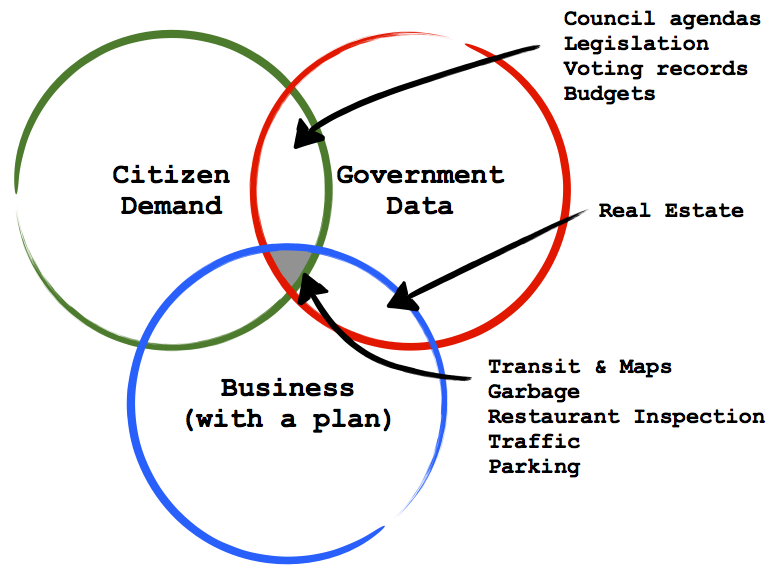
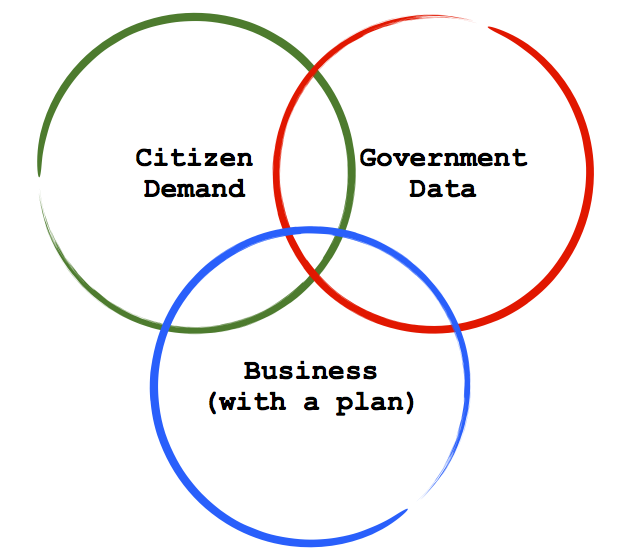
The key, I think, is to find areas that meet three criteria:

  • Government Data: Is there relevant government data about the service or issue that is available?
  • Demand: Is this a service for which there is regular demand? (this is why transit is so good, millions of people touch the service on a daily basis)
  • Business Model: Is there a business that believes it can use this data to generate revenue (either directly, or indirectly)


opendata-1.0151

Two comments on this.

First, I think we should look at this model because we want to find places where the incentives are right for all the key stakeholders. The wrong way to create a data structure is to get a bunch of governments together to talk about it. That process will take 5 years… if we are lucky. Remember the GTFS emerged because Google and Portland got together, after that, everybody else bandwagoned because the value proposition was so high. This remains, in my mind, not the perfect, but the fastest and more efficient model to get more common data structures. I also respect it won’t work for everything, but it can give us more successes to point to.

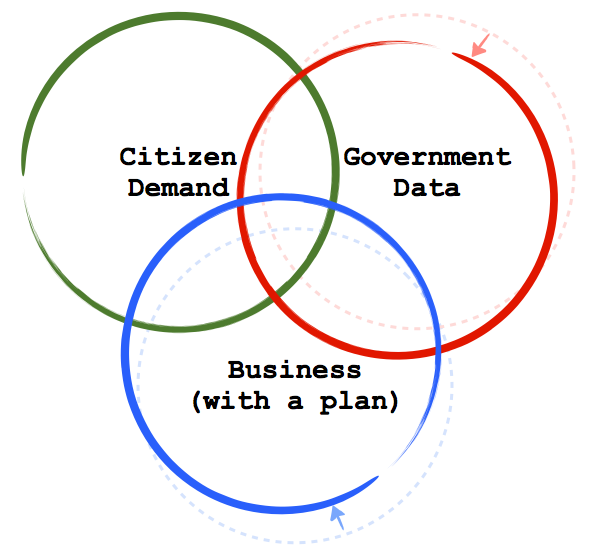
Which leads me to point two. Yes, at the moment, I think that target in the middle of this model is relatively small. But I think we can make it bigger. The GTFS shows cities, citizens and companies that there is value in open data. What we need are more examples so that a) more business models emerge and b) more government data is shared in a structured way across multiple jurisdictions. The bottom and and right hand circles in this diagram can, and if we are successful will, move. In short, I think we can create this dynamic:

opendata4.016

So, what does this look like in practice?

I’ve been trying to think of services that fall in various parts of the diagram. A while back I wrote a post about using open restaurant inspection data to drive down health costs. Specifically around finding a government to work with a Yelp!, Bing or Google Maps, Urban Spoon or other company to integrate the  inspection data into the application. That for me is an example of something that I think fits in the middle. Government’s have the data, its a service citizens could touch on a regular base if the data appeared in their workflow (e.g. Yelp! or Bing Maps) and for those businesses it either helps drive search revenue or gives their product a competitive advantage. The Open311 standard (sadly missing from my diagram), and the emergence of SeeClickFix strike me as another excellent example that is right on the inside edge of the sweet spot).

Here’s a list of what else I’ve come up with at the moment:

opendata3.015

You can also now see why I’ve been working on Recollect.net – our garbage pick up reminder service – and helping develop a standard around garbage scheduling data – the Trash & Recycling Object Notation. I think it is a service around which we can help explain the value of common standards to cities.

You’ll notice that I’ve put “democracy data” (e.g. agendas, minutes, legislation, hansards, budgets, etc…) in the area where I don’t think there is a business plan. I’m not fully convinced of this – I could see a business model in the media space for this – but I’m trying to be conservative in my estimate. In either case, that is the type of data the good people at the Sunlight Foundation are trying to get liberated, so there is at least, non-profit efforts concentrated there in America.

I also put real estate in a category where I don’t think there is real consumer demand. What I mean by this isn’t that people don’t want it, they do, but they are only really interested in it maybe 2-4 times in their life. It doesn’t have the high touch point of transit or garbage schedules, or of traffic and parking. I understand that there are businesses to be built around this data, I love Viewpoint.ca – a site that takes mashes opendata up with real estate data to create a compelling real estate website – but I don’t think it is a service people will get attached to because they will only use it infrequently.

Ultimately I’d love to hear from people on ideas they on why might fit in this sweet spot. (if you are comfortable sharing the idea, of course). Part of this is because I’d love to test the model more. The other reason is because I’m engaged with some governments interested in getting more strategic about their open data use and so these types of opportunities could become reality.

Finally, I just hope you find this model compelling and helpful.

Open Data Job Posting at MaRS in Toronto

The following job posting can be found on the MaRS website here.

So here’s a job for an open data advocate living in, or willing to move to, Toronto. For the right person with the right vision, this could be about getting a group of organizations to open up their data to drive innovation and broaden the adoption or development of public goods. I’ve lots of thoughts on this and think it could be an interesting opportunity, thought I’d share.

You’ve got until the end of the month to submit the necessary documents…

Program Director – Regional Strategic Resource Centre Program (ReSRC)

Posted June 14, 2011

Job Title: Program Director – Regional Strategic Resource Centre Program (ReSRC)

Company Name: MaRS

Position Type: Program Director – Regional Strategic Resource Centre Program (ReSRC)

Location: ON – Metro Toronto

Application Deadline: 2011-06-30

Category: Project Management

Position Overview:

The development of Regional Strategic Resource Centres (ReSRCs) is an exciting new initiative in Ontario’s innovation system, supported by the Ministry of Research and Innovation (MRI) and coordinated by MaRS in partnership with a range of stakeholders.

The ReSRCs will advance Ontario’s Innovation Agenda by creating the information infrastructure required to support 21st century knowledge economy decision-making, and by engaging the community to use this “open information” to strengthen innovation in the region.

The premise of this initiative is simple: By sharing and integrating disparate sets of data – often collected in institutional silos – from government, academia as well as the private and non-profit sectors, we will better understand the unique strengths, opportunities and needs of our communities and can more effectively work together to build vibrant, productive regional innovation economies.

Successful communities around the world increasingly rely on the information and insights garnered from of a wide range of sources, including civic organizations, businesses, academic institutions, non-profits and governments, among others. Significant amounts of data are collected by these organizations in the course of their work.  The aggregation of this data will create a rich virtual information hub that can be accessed by various community stakeholders to make more timely and better decisions on topics ranging from urban planning to drivers of economic development. Different models of these open data platforms are in development elsewhere; there is a unique opportunity for Ontario to become a leader in this arena, given the strong innovation network that is being developed across the Province.

As an example, the ReSRC may specifically focus on the role of high growth firms in the region, given their critical contribution to new job creation.  In this case, the hub will integrate relevant data sources and engage entrepreneurs and stakeholders working in/with these firms, in an effort to shed light on the following questions:  Where are the high growth firms located? What sectors are they in?  How old are these firms?  Where do the employees who work in these firms live?  How do they get to work?  What is their education?  How do the high growth firms collaborate with academic institutions in the region?  What other firms in the region do the high growth firms rely on or support?  Which public policy or program instruments are particularly effective in supporting the growth of these firms, or hinder their progress?  How can we do more of what works, to create more high growth firms in the region?  What barriers need to be removed?

We believe the time is right for Ontario to take a strong leadership position in the provisioning of open data to foster community leadership and collaboration.  This initiative will involve the creation of the inaugural ReSRC, which includes the identification and aggregation of disparate data sources, sourcing a data management infrastructure, and developing an online community engagement portal.  The small core ReSRC team will work closely with a range of partners – the success of the initiative will depend on the productive collaboration with stakeholders in different related sectors.  An Advisory Board, with representation of key partners, will meet regularly to provide strategic guidance, extend networks, and share expertise.

The qualified candidate for this exciting position will have strong skills and demonstrated experience in project management, open data / information management, data warehousing and integration, community engagement, IP policy / negotiations, and contract management.  Outstanding communication skills and ability to lead in a collaborative environment are critical attributes.

Key Responsibilities

  • Provide overall leadership and management through all elements of project planning and execution including:
  • Building and managing the project team and working with the Ontario Ministry of Research and Innovation to refine the project scope of work, activities, resources, and timelines
  • Developing the governance structure of ReSRC including the development and engagement of an Advisory Board to guide and Working Groups to drive the project
  • Leading and managing all Request for Proposal (RFP) processes and providing oversight and management of technology implementations (including relevant collaboration portal, data warehouses, and integration with legacy systems and data provider systems)
  • Building and managing negotiations and trusted relationships with key data providers, with respect to IP, privacy, data sharing and level of access, fee-for-service offerings, and support / value add services
  • Providing consistent project updates to MaRS and the extended project team, select community stakeholders, and the Ministry of Research and Innovation
  • Managing the overall decision-making processes and proactively identifying, analyzing and resolving issues
  • Managing the allocation of funds, project budget and ensuring adherence / compliance to Ontario procurement legislation
  • Managing the development of a brand and marketing strategy
  • Developing a best in class on-line portal for ReSRC; launch and maintain strong community engagement with the assets of the entity
  • Managing rollout strategy and maintaining documentation / lessons learned on project implementation to support future ReSRC launches in other Ontario regions
  • Demonstrate industry knowledge and leadership regarding innovation trends, emerging market shifts, economic development models, current events, major corporate and government initiatives, public policy, regulatory issues etc.
  • Effectively maintain key contacts related to open data, community engagement, and data integration
  • Leading the development of original thought leadership related to the project scope including open data, community engagement, data integration, GIS

Educational/Experience Requirements

  • Minimum Bachelor’s degree and 8+ years of relevant project management and/or business experience in information sciences, market research, management consulting, data management, or related sectors.
  • Demonstrated project management experience delivering complex technology or other projects; experienced in project management methodologies and the ability to apply them in a flexible manner; PMP certification considered an asset
  • Demonstrated effective approach to problem solving, understands the context and impact of problems and demonstrates an extensive knowledge of available resources and content
  • Strong understanding of open data, Geographic Information Systems (GIS), collaboration portals and wiki’s, data integration, IP / privacy, and market research
  • Familiar with the “language” and terminology of industry, finance, government and the tech/data community; deep knowledge business development process, including an extensive network of business contacts
  • Highly developed analytical and interpretive skills, conceptual thinker, able to solve complex problems
  • Demonstrated passion for leading successful, creative, and engaged teams
  • Strong capabilities in: MS Word, PowerPoint and Excel

Personal Requirements

  • Self-starter, creative thinker, and strong team player
  • Strong communications and organizational skills – oral, written, and presentation skills
  • Superior interpersonal skills; ability to influence others without formal authority
  • Ability to impact and influence key project participants and stakeholders (including strong negotiation skills)
  • Strong partnership development capabilities with an array of stakeholders including government, public sector, non-profit, academe, and the private sector
  • Ability to multi-task, comfortable working in a fast-paced, high energy environment
  • Consummate professional, able to represent the organization in all circumstances
  • Personal accountability and commitment to achieving and exceeding goals and objectives

How To Apply: Interested candidates should forward their resume to Elizabeth Pojedyniec at epojedyniec@marsdd.com by Thursday, June 30th, 2011

If the Prime Minister Wants Accountable Healthcare, let's make it Transparent too

Over at the Beyond the Commons blog Aaron Wherry has a series of quotes from recent speeches on healthcare by Canadian Prime Minister Stephen Harper in which the one constant keyword is… accountability.

Who can blame him?

Take everyone promising to limit growth to a still unsustainable 6% (gulp) and throw in some dubiously costly projects ($1 billion spent on e-health records in Ontario when an open source solution – VistA – could likely have been implemented at a fraction of the cost) and the obvious question is… what is the country going to do about healthcare costs?

I don’t want to claim that open data can solve the problem. It can’t. There isn’t going to be a single solution. But I think it could help spread best practices, improve customer choice and service as well as possibly yield other potential benefits.

Anyone who’s been around me for the last month knows about my restaurant inspection open data example (which could also yield healthcare savings) but I think we can go bigger. A Federal Government that is serious about accountability in Healthcare needs to build a system where that accountability isn’t just between the provinces and the feds, it needs to be between the Healthcare system and its users; us.

Since the feds usually attach several provisions to their healthcare dollars, the one I’d like to see is an open data provision. One where provinces, and hospitals are required to track and make open a whole set of performance data, in machine readable formats, in a common national standard, that anyone in Canada (or around the world) can download and access.

Some of the data I’d love to see mandated to be tracked and shared, includes:

  • Emergency Room wait times – in real time.
  • Wait times, by hospital, for a variety of operations
  • All budget data, down to the hospital or even unit level, let’s allow the public to do a cost/patient analysis for every unit in the country
  • Survival rates for various surgeries (obviously controversial since some hospitals that have the lowest rates are actually the best since they get the hardest cases – but let’s trust the public with the data)
  • Inspection data – especially if we launched something akin to the Institute for Health Management’s Protecting 5 Millions Lives Campaign
  • I’m confident there is much, much more…

I can imagine a slew of services and analysis that emerge from these, if nothing than a citizenry that is better informed about the true state of its healthcare system. Even something as simple as being able to check ER wait times at all the hospitals near you, so you can drive to the one where the wait times are shortest. That would be nice.

Of course, if the Prime Minister wants to go beyond accountability and think about how data could directly reduce costs, he might take a look at one initiative launched south of the border.

If he did, he might be persuaded to demand that the provinces share a set of anonymized patient records to see if academics or others in the country might be able to build better models for how we should manage healthcare costs. In January of this year I witnessed the launch of the $3 million dollar Heritage Health Prize at the O’Reilly Strata Conference in San Diego. It is a stunningly ambitious, but realistic effort. As the press release notes:

Contestants in the challenge will be provided with a data set consisting of the de-identified medical records of 100,000 patients from the 2008 calendar year. Contestants will then be required to create a predictive algorithm to predict who was hospitalized during the 2009 calendar year. HPN will award the $3 million prize(more than twice what is paid for the Nobel Prize in medicine) to the first participant or team that passes the required level of predictive accuracy. In addition, there will be milestone prizes along the way, which will be awarded to teams leading the competition at various points in time.

In essence Heritage Health is doing to patient management what Netflix (through the $1M Netflix prize) did to movie selections. It’s crowdsourcing the problem to get better results.

The problem is, any algorithm developed by the winners of the Heritage Health Prize will belong to… Heritage Health. This means the benefits of this innovation cannot benefit Canadians (nor anyone else). So why not launch a prize of our own. We have more data, I suspect our data is better (not limited to a single state) and we could place the winning algorithm in the public domain so that it can benefit all of humanity. If Canadian data helped find efficiencies that lowered healthcare costs and improved healthcare outcomes for everyone in the world… it could be the biggest contribution to global healthcare by Canada since Federick Banting discovered insulin and rescued diabetics everywhere.

Of course, open data, and sharing (even anonymized) patient data would be a radical experiment for government, something new, bold and different. But 6% growth is itself unsustainable and Canadians need to see that their government can do something bold, new and innovative. These initiatives would fit the bill.

Lost Open Data Opportunities

Even sometimes my home town of Vancouver gets it wrong.

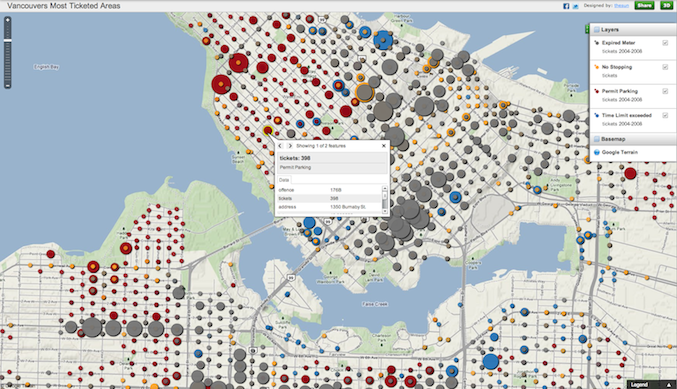
Reading Chad Skelton’s blog (which I frequently regularly and recommend to my fellow Vancouverites) I was reminded of the great work he did creating an interactive visualization of the city’s parking tickets as part of a series around parking in Vancouver. Indeed, it is worth noting that the entire series was powered by data supplied by the city. Sadly, it just wasn’t (and still isn’t) open data. Quite the opposite, it was data that was wrestled, with enormous difficulty, via an FOI (ATIP) request.

parking-tickets

In the same blog post Chad recounts how he struggled to get the parking data from the city:

Indeed, the last major FOI request I made to the city was for its parking-ticket data. I had to fight the city tooth and nail to get them to cough up the information in the format I wanted it in (for months their FOI coordinator claimed, falsely, that she couldn’t provide the records in spreadsheet format). Then, when the parking ticket series finally ran, I got an email from the head of parking enforcement. He was wondering how he could get reprints of the series — he thought it was so good he wanted to hand it out to new parking enforcement officers during their training.

What is really frustrating about this paragraph is the last sentence. Obviously the people who find the most value in this analysis and tool are the city staff who manage parking infractions. So here is someone who, for free(!), provides an analysis and some stories that they now use to train new officers and he had to fight to get the data. The city would have been poorer without Chad’s story and analysis. And yet it fought him. Worse, an important player in the civic space (and an open data ally) feels frustrated by the city.

There are of course, other uses I could imagine for this data. I could imagine the data embedded into an application (ideally one like Washington DC’s Park IT DC – which let’s you find parking meters on a map, identify if they are available or not, and see local car crime rates for the area) so that you can access the risk of getting a ticket if you choose not to pay. This feels like the worse case scenario for the city, and frankly, it doesn’t feel that bad and would probably not affect people’s behaviour that much. But there may be other important uses of this data – it may correlate in some interestingly and unpredictably against other events – connections that if made and shared, might actually allow the city to leverage its enforcement officers more efficiently and effectively.

Of course, we won’t know what those could be, since the data isn’t shared, but it is the kind of thing Vancouver should be doing, given the existence of its open data portal. But all government’s should take note. There is a cost to not sharing data. Lost opportunities, lost insights and value, lost allies and networks of people interested in contributing to your success. It’s all our loss.

Applications and Hardware Already Running On Open Data

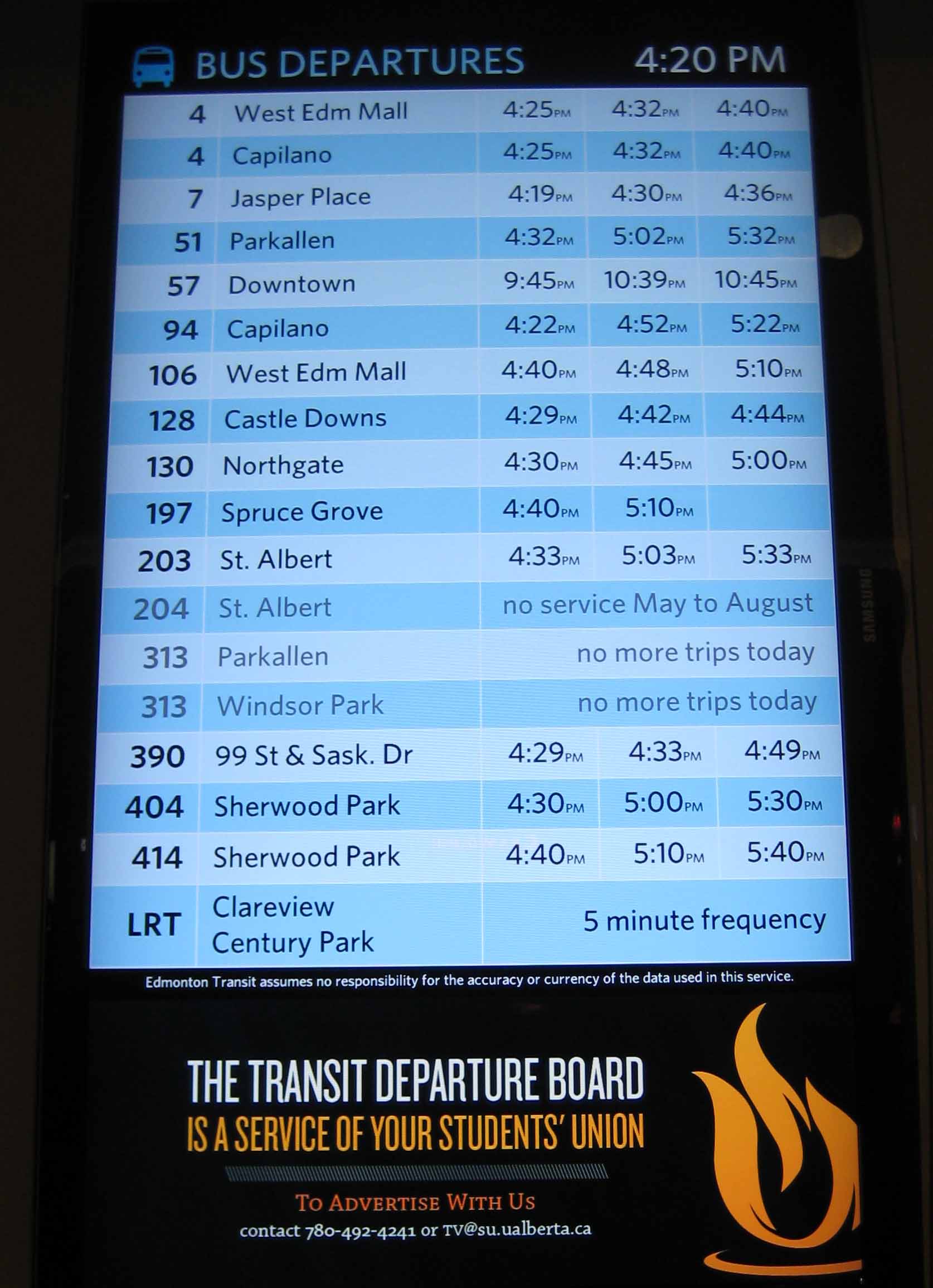
Yesterday, Gerry T shared a photo he snapped at the University of Alberta in Edmonton of a “departure board” in the university’s Student Union building that uses open transportation data from the city’s website.

Essentially the display board is composed of a simply application, displayed over a large flat screen TV turned vertically.

TransitApp_BusDepartures-217x300It’s exactly the kind of thing that I imagine University Students in many cities around the world wish they had – especially if you are on a campus that is cold and/or wet. Wouldn’t it be nice to wait inside that warm student union building rather than at the bus stop?

Of course in Boston they’ve gone further than just providing the schedule online. They provide real-time data on bus locations which some students and engineers have used to create $350 LED signs in coffee houses to let users know when the next bus is coming.

It’s the kind of simple innovations you wish you’d see in more places: government’s letting people help themselves at making their lives a little easier. Yes, this isn’t changing the world, but its a start, and an example of what more could happen.

Mostly it’s nice to see innovators in Canada like playing with the technology. Hopefully governments will catch up and let the even bigger ideas students around the country have be more than just visions in their heads.

Not sure who at the University created this, but nice work.

New York release road map to becoming a digital city

Yesterday, New York City released its “Road Map for the Digital City: Achieving New York City’s Digital Future.” For those who missed the announcement, especially those concerned about the digital economy, the future of government and citizen services, the document is definitely worth downloading and scanning.

At the heart of the document sits a road map which I’ve ripped from the executive summary and pasted below.What makes me particularly interested in it is how the Open Government section is not uniquely driven by the desire for transparency but with the goal of spurring innovation and increasing access to services. Of course, the devil is in the details but I’m increasingly convinced that open initiatives will be more successful when the government of the day has some specific policy objectives (beyond just transparency) it wishes to drive home, with open data as part of the mix (more on this in a post coming soon).

As such, “government as platform” works best when the government also builds atop the platform. It itself must be a consumer and stakeholder. This is why section 3 is so important and interesting. Essentially section 2 and 3 have parts that are strikingly similar, its just that section 2 outlines the platform and lays out that the government hopes others will build on top of it whereas parts of section 3 outline what the government intends to build atop of it. Of course section 3 goes further and talks as well about gathering information and data from the public which is the big thing in the Gov 2.0 space that many governments have not gotten around to doing effectively – so this will be worth watching more closely. All of this is great news and exactly what governments should be thinking about.

It is great when a big city comes out with a document like this because while New York is not the first to be thinking these ideas, but its profile means that others will start devoting resources to pursue these ideas more aggressively.

Exciting times.

1. Access

The City of New York ensures that all New Yorkers can access the Internet and take advan- tage of public training sessions to use it effectively. It will support more vendor choices to New Yorkers, and introduce Wi-Fi in more public areas.

  1. Connect high needs individuals through federally funded nyc Connected initiatives
  2. Launch outreach and education efforts to increase broadband Internet adoption
  3. Support more broadband choices citywide
  4. Introduce Wi-Fi in more public spaces, including parks

2. Open Government

By unlocking important public information and supporting policies of Open Government, New York City will further expand access to services, enable innovation that improves the lives of New Yorkers, and increase transparency and efficiency.

  1. Develop nyc Platform, an Open Government framework featuring APIs for City data
  2. Launch a central hub for engaging and cultivating feedback from the developer community
  3. Introduce visualization tools that make data more accessible to the public
  4. Launch App Wishlists to support a needs-based ecosystem of innovation
  5. Launch an official New York City Apps hub

3. Engagement

The City will improve digital tools including nyc.gov and 311 online to streamline service and enable citizen-centric, collaborative government. It will expand social media engagement, implement new internal coordination measures, and continue to solicit community input in the following ways:

  1. Relaunch nyc.gov to make the City’s website more usable, accessible, and intuitive
  2. Expand 311 Online through smartphone apps, Twitter and live chat
  3. Implement a custom bit.ly url redirection service on nyc.gov to encourage sharing and transparency
  4. Launch official Facebook presence to engage New Yorkers and customize experience
  5. Launch @nycgov, a central Twitter account and one-stop shop of crucial news and services
  6. Launch a New York City Tumblr vertical, featuring content and commentary on City stories
  7. Launch a Foursquare badge that encourages use of New York City’s free public places
  8. Integrate crowdsourcing tools for emergency situations
  9. Introduce digital Citizen Toolkits for engaging with New York City government online
  10. Introduce smart, a team of the City’s social media leaders
  11. Host New York City’s first hackathon: Reinventing nyc.gov
  12. Launch an ongoing listening sessions across the five boroughs to encourage input

4. Industry

New York City government, led by the New York City Economic Development Corporation, will continue to support a vibrant digital media sector through a wide array of programs, including workforce development, the establishment of a new engineering institution, and a more stream- lined path to do business.

  1. Expand workforce development programs to support growth and diversity in the digital sector
  2. Support technology startup infrastructure needs
  3. Continue to recruit more engineering talent and teams to New York City
  4. Promote and celebrate nyc’s digital sector through events and awards
  5. Pursue a new .nyc top-level domain, led by DOITT


Just a Click Away Keynote Slides

A little over two months ago I gave a keynote at the Just a Click Away Conference in Vancouver. The conference was a gathering for legal information and education experts – for example the excellent people that provide legal aid. My central challenge to them was thinking about how they could further collapse the transaction costs around getting legal assistance and/or completing common legal transactions.

I had a great time at the event and it was a real pleasure to meet Allan Seckel – the former head of British Columbia’s public service. I was deeply impressed by his comments and commitment to both effective and open government. As one of the key forces behind the Citizens at the Centre report he’s pushed a number of ideas forward that I think other governments should be paying attention to.

So, back to the presentation… I’ve been promising to get my slides from the event up and so here they are:

Back to Reality: The Politics of Government Transparency & Open Data

A number of my friends and advocates in the open government, transparency and open data communities have argued that online government transparency initiatives will be permanent since, the theory goes, no government will ever want to bear the political cost of rolling it back and being perceived as “more opaque.” I myself have, at times, let this argument go unchallenged or even run with it.

This week’s US budget negotiations between Congress and the White House should lay that theory to rest. Permanently.

The budget agreement that has emerged from most recent round of negotiations – which is likely to be passed by congress –  slashes funding to an array of Obama transparency initiatives such as USASpending, the ITDashboard, and data.gov from $34M to $8M. Agree or disagree, Republicans are apparently all too happy to kill initiatives which make the spending and activities of the US government more transparent as well as create a number of economic opportunities around open data. Why? Because they believe it has no political consequences.

So unsurprisingly, it turns out that political transparency initiatives – even when they are online – are as bound to the realities of traditional politics as dot.com’s were bound by the realities of traditional economics. It’s not enough to get a policy created or an initiative launched – it needs to have a community, a group of interested supporters, to nurture and protect it. Otherwise, it will be at risk.

Back in 2009, in the lead up to the drafting and launching of Vancouver’s Open Data motion I talked about creating an open-government bargain. Specifically, I argued that:

..in an open city, a bargain must exists between a government and its citizens. To make open data a success and to engage the community a city must listen, engage, ask for help, and of course, fulfill its promise to open data as quickly as possible. But this bargain runs both ways. The city must to its part, but so too must the local tech community. They must participate, be patient (cities move slower than tech companies), offer help and, most importantly, make the data come alive for each other, policy makers and citizens through applications and shared analysis.

Some friends countered that open data and transparency should simply exist because it is the right thing to do. I don’t disagree – and I wish we lived in a world where the existence of this ideal was sufficient enough to guarantee these initiatives. But it isn’t sufficient. It’s easy to kill something that no one uses (or in the case of data.gov, that hasn’t been given enough time to generate a vibrant user base). It’s much, much harder to kill something that has a community that uses it, especially if that community and the products it creates are valued by society more generally. This is why open data needs users, it needs developers, think tanks and above all, the media, to take interest in it and to leverage it to create content. It’s also why I’ve tried to create projects like Emitter.ca, recollect.net, taxicity and others, because the more value we create with open data for everyone, the more secure government transparency policies will be.

It’s use it or risk losing it. I wish this weren’t the case, but it’s the best defense I can think of.