Category Archives: public policy

Canadian Foreign Policy Press Job

Foreign Policy buffs and International Relations geeks take note:

Embassy Newspaper has just informed me that they are looking for an entry level journalist. This is a great paper to work for. It is small, but has an influential readership: the foreign policy community in Ottawa. If you are starting out and want to learn how the sausage is made, this is probably one of the best places to work.

Journalism Job Posting

Embassy Newspaper is seeking a fulltime journalist to join its Ottawa-based newsroom. The position involves writing in-depth news and features in a fast paced independent newsroom. The ideal candidate will have a strong interest in international issues and Canadian politics and be inclined to put time and energy into developing a deep understanding of the people and issues in these communities.

Strong writing, reporting and communication skills are a must.
Specialized knowledge or interest in an international area and language skills would be an asset.
Embassy has an influential readership of 49,000 and is published every Wednesday by The Hill Times. The newsroom environment is demanding but very positive and open.
Salary $26,000- 28,000 plus benefits and 3 weeks vacation per year and growth potential.

Applicants should submit a well written cover letter, a resume and writing samples in a word format or hard copy (No PDF’s) to:
Anne Marie Creskey
Publisher
Embassy Newspaper
69 Sparks St
Ottawa ON
K1P 5A5

Also, on a completely separate note I’ve recently discovered Picket Boy’s behind the lines coverage of the Vancouver municipal strike now in its 3rd (or is it 4th?) week. For those interested it is worth a look. The two line summary so far is: it’s been a ballad of incompetence (the mayor) vs. miscalculation (the unions). The result is a race for irrelevance. Instead of predicting who will win, I suspect that, as is often the case in these types of negotiations, everybody will lose.

Hope to blog on it shortly.

Why Cambie St. Should have been packed up.

* first up – apologies for no post yesterday. It was a holiday in BC. Sometime later this week I’ll describe in greater detail my ridiculously BC-like day of island hoping, sea kayaking and BBQing. And to complete the leftcoast feel, a Smart Car was involved too.<!–

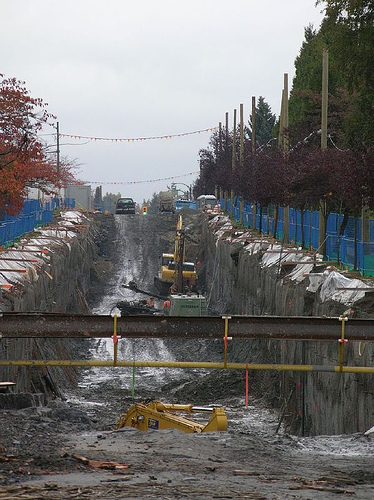
Second up… The Canada Line, the new subway being constructed between Richmond, the airport and Vancouver. The damage the construction has caused to businesses along the Cambie street corridor has been getting an increasing amount of buzz in the press. The whole situation is a fabulous lesson in urban planning and civic policy-making – one that sadly the press has not articulate.

For those out east who are not familiar with the Canada Line or its construction, it looks something like this:

cambie 2

Photo by Stephen Rees, (CC BY-NC-ND 2.0)

Sadly, these photos fail to do the situation justice. To put it bluntly, when there is a two story deep hole outside, traffic is at a stand still, the street is unpassable, and there is the endless sound of construction, people tend to stay away. This, needless to say, has made life difficult for the numerous businesses that populate the Cambie St. corridor.

As one can imagine, several businesses (most notably the restaurant Tomato) have moved, several others are complaining. The local MLA – Gregor Robertson – has even introducing a private member’s bill to provide affected businesses with direct financial support.

But is the construction responsible for the death of the Cambie st. businesses? Perhaps. But it is an inevitable death. And this is why the current public policy has so dramatically failed these businesses.

I’ve noted with interest that while businesses complain loudly about the construction and its impact, it is hard to find landowners who complain. One would think that the loss of tenants – and subsequent rental income – this would have generated a fuss. But it hasn’t.

Why? Because the landlords know that once the line is complete most of the Cambie corridor (currently composed of relatively low density commercial buildings) is going to be completely redeveloped. Higher density commercial and, more importantly, condos, are going to be common place along Cambie. Consequently, there is a good chance that if the construction hadn’t kicked these businesses out, their landlords would have in the ensuing rush to redevelop.

Thus the whole notion that Cambie businesses could be kept open was a mirage – a failure to look at the longer term implications of the Subway. Rather than waste time on a failed “Business is Open along the Canada Line” campaign (This is not a communication problem, advertising is not going to bring people to Cambie, only an end to the construction will) local businesses should have been offered money to move location and cover some of their transition costs. While this would have been painful for everyone involved, it would have been less painful then seeing their business dry up and having to move on their own dime.

I’m in favour of the Canada Line. I think it is great for the city. But that doesn’t mean that the Cambie St. businesses should have been left out to dry. The help they received wasn’t the help they needed. sadly, this is probably because giving them the help they needed wasn’t what they wanted to hear, or what politicians wanted to tell them…

* Aug 8th: The Vancouver Sun published this editorial piece on the same day as this post that provides a parallel but different perspective.

Canada as, err… a (cough) model power…

With Russia planting a flag on the Arctic Ocean floor, Peter Mckay’s observing “You can’t go around the world these days dropping a flag somewhere. This isn’t the 14th or 15th century” and the press corp pointing out the rich irony of the situation (see Hans Island), it’s an exciting week in Canadian Foreign Policy.

Of course no one could have prevented the Russians from sending out a submarine to plant a flag on the Arctic floor. However, the irony of the Canadian response was entirely preventable. Once again, Paul Martin’s short sighted, “ready, shoot, aim” policies designed to capture voters comes back to haunt us.

(BTW: If I were a Russian diplomat, I’d carry a photo of this to every meeting.)

Indeed, the only silver lining to the whole thing is a rather personal one. It isn’t often that pundits make predictions that are accurate, so when it happens you know we are going should “I told you so…”

Back in September of 2005 I wrote the following paragraphs in an article entitled “Reality vs. Fiction: Canadian Foreign Policy in Light of the International Policy Statement” for the Queen’s International Observer:

…the government’s recent tactics in the ongoing dispute with Denmark over the ownership of Hans Island appear to run counter to the strategic goals of the IPS. By resorting to jingoistic rhetoric and petty tit-for-tat flag planting symbolism the government has undermined the country’s reputation as a state that both perceives security as a “common interest” and strives to overcome disputes peacefully.

Ideally, the Hans Island issue should have presented Denmark and Canada – two NATO allies – with an opportunity to model effective international conflict-management diplomacy-based on a fair and respectful process. Instead, the government’s actions may have undermined one of the few arrows left in the quivers of small countries that have under invested in their foreign policy assets: moral legitimacy. One’s capacity to “build a more secure world” by advocating for a “responsibility to protect” in complex intra-state conflicts is necessarily undermined when one is incapable of handling maturely and responsibly one of the most traditional forms of inter-state conflict.

I’ll concede it isn’t a perfect prediction, but not bad in the chaotic world of international relations.

I’m sure trying to score some jingoist points in the polls seemed like a good idea at the time. Indeed, it was probably even designed to demonstrate that Canada would be serious about dealing with threats to our sovereignty by other arctic powers (such as, for example, Russia). In reality, all we did was give up any sense of honour in order to sanction the basest and most child-like behaviour.

Thank you Paul!

The end of TV and the end of CanCon?

A few weeks ago I blogged about how the arrival of Joost could eventually require the rethinking of Canadian content rules (CanCon).

For those unfamiliar with CanCon, it is a policy, managed (I believe) by Heritage Canada and enforced by Canada’s broadcasting regulator, the Canadian Radio-television and Telecommunications Commission (CRTC), that establishes a system of quotas to ensure a certain amount of Canadian programming (e.g. music, TV) is broadcast within Canada.

In laymen terms: CanCon ensures that Canadian radio and TV stations broadcast at least some Canadian content. This can be good – making stars out of artists that might not have have received airplay – think The Bare Naked Ladies. And it can be bad, making (usually temporarily) stars out of artists that should never have received airplay – think Snow.

Well I’ve been allowed to serve as a Joost beta tester. After getting my email invitation last week I downloaded a copy.

In essence Joost is like You-Tube, but bigger, faster,  and sleeker. It’s as though Apple’s design team revamped You-Tube from the ground up and, while they were at it, grabbed themselves some partners to provide some more professional content.

But what makes Joost so interesting is how it’s organized. Joost feels like on-demand TV, with content divided into “categories” – such as “documentaries films” – and subdivided into “channels” – such as the “Indieflix channel” and the “Witness channel.” There is already a fair amount of content already available including a number of hour long (or longer) documentaries that are worth watching. (I can’t WAIT until Frontline has a channel up and running. I’d love to be able to watch any Frontline episode, anywhere, anytime, on a full screen.)

So what happens to Canadian content rules when anyone, anywhere can create and distribute content directly to my computer, and eventually, my TV? At this point, the only options left appear to be a) give up, or b) regulate content on the internet. Problematically, regulating internet content and access may be both impossible (even China struggles with this policy objective) and unpopular (I hope you’re as deeply uncomfortable as I am with the government regulating internet content).

The internet has (so far) enabled users to vastly expand the number of media sources available to them, and even create their own media. This has been a nightmare for “traditional media” such as newspapers and television stations, whose younger market demographic has significantly eroded. As a result, these same forces are eroding the government’s capacity to control what Canadians watch.

Which brings us back to option (a). At worst, CanCon is going the way of the Dodo – it will be too difficult to implement and maintain. Indeed a crisis in cultural policy may be looming. On the bright side however, the internet enables ordinary Canadians to create their own media (blogs, podcasts and now even videos) and distribute it over the internet, across the country and around the world. This is a better outcome than CanCon – which essential supports large, established media conglomerates who do Canadian content out of necessity, not passion – could ever have hoped for. Ordinary canadians may now be in the driver seat in creating content. That is a good outcome. Let’s hope any policy that replaces CanCon bears this in mind.

If a tree falls in the forest…

If a debate happens in city council, and nobody is around to report on it, does it have an impact?

Last Thursday I noticed that the Toronto edition of the National Post had front page coverage of Toronto’s city council meeting.

Front Page – with a giant picture to boot!

I’m trying to remember the last time a council issue was the lead cover story in the Vancouver Sun… How about the last time there was a photo of a council meeting?

Sadly – from what I can tell – neither The Sun, nor The Province, nor anyone else, have a single reporter exclusively dedicated to Vancouver city hall and municipal politics (if I’m wrong about this please send me a note – who is it?). This is akin to the Globe or National Post failing to assign someone to cover Parliament Hill. Vaughn Palmer does an excellent job covering the BC legislature for The Sun – so why not have someone do the same for municipal politics?

The lack of coverage fosters a city whose political and policy ideas are often unheard and poorly debated, whose municipal scandals go unquestioned and unpublicized and whose council members and mayor go unscrutinized.

Maybe The Sun may feel it simply isn’t profitable to have such a column. I understand (although doubt it). But this function is so important, some solution must be found. Maybe the Vancouver Foundation or some other agency could endow a reporter to cover the City Hall beat.

Or maybe… the Sun should consider outsourcing the role.

Sounds crazy? Admittedly it’s hardly ideal. But a news website in Pasadena, California, recently hired an Indian journalist to cover local politics. The journalist can watch local council meetings over the internet (the same could be done in Vancouver), many documents are available through the city’s website (as they are in Vancouver), and as the editor of the news web site noted “Whether you’re at a desk in Pasadena or a desk in Mumbai, you’re still just a phone call or e-mail away from the interview.” It’s not my favoured solution, but it is better than nothing.

Vancouverites often claim they’re not jealous of Toronto, but maybe we should be. With the Globe, the National Post and the Toronto Star writing regularly about the city’s politics I know I’m feeling envious.

Addition 11:20am PST – David Beers, editor of The Tyee, has emailed me to say: “Was surprised to see you single us out as one who is stingy on coverage of Vancouver city hall. In fact we do have one reporter who has been dogging the issue of homeless housing, covering city council sessions and often the byline on a cover story. Check out Monte Paulsen’s work.”

It is true, the Tyee has more in depth coverage of city hall than anybody else in town… all to glad to be called out on the oversight and hope readers will check out Paulsen’s work. Also, to be fair, the Georgia Straigt does a review of city councilors and talks about municipal politics, but it doesn’t have consistent reporting on the subject.

Job Opportunity with Canada's World

Another Job Opportunity for those interested in Canadian Foreign Policy and International Issues.

Job Opportunity – Ethnocultural Outreach Coordinator

Term: 12 months, 28 hours per week
Rate: $27 per hour
Location: Vancouver
Ideal Start date: September 4, 2007
Application deadline: August 13, 2007

Canada’s World, a project of the SFU Centre for Dialogue, seeks a full-time Ethnocultural Outreach Coordinator to join our national team. Canada’s World is a national citizens’ dialogue aimed at creating a new vision for Canadian international policy. Our secretariat offices are based in Vancouver and we work in collaboration with a series of academic and non-profit organizations across the country.

The Ethnocultural Outreach Coordinator plays a pivotal role in this collaborative initiative. S/he will report to the Director of Canada’s World and work closely with staff, interns, volunteers and advisory committee members in engaging ethnocultural and diaspora communities in a series of dialogues about Canada’s place in the world.

The ideal candidate will be an excellent communicator, well organized, and detail oriented with a passion for, and knowledge of, international policy issues. S/he will be bilingual (French and English), enjoy working in a dynamic work environment and have strong networks within ethnocultural and diaspora communities. S/he will be experienced at facilitating community meetings, compiling tailored resource materials, organizing events and speaking to the media. S/he will possess a post-secondary degree in Arts, Social Sciences or a related field, and enjoy working with people.

Canada’s World is an equal opportunity employer. All interested applicants should submit their cover letter, resume and a 200 word response to the following question: What are the greatest challenges and opportunities facing Canada internationally in the next twenty years?

Applications should be mailed to:
Shauna Sylvestershaunas(at)canadasworld.ca,
Canada’s World Fellow,
SFU Centre for Dialogue,
3303 – 515 West Hastings Street,
Vancouver, B.C. V6B 5K3


Citizen Assemblies: Overstating the wisdom of crowds

On numerous occasions over the past few months I’ve heard people refer to Surowiecki’s “The Wisdom of Crowds” when explaining why any group driven project is inherently good.

My favourite has been the explanation regarding how citizen’s assemblies – because they tend to be composed of 100 or more members – are inherently wise and therefor produce a good outcome. To begin with, I find it interesting that those who defend electoral reform rarely talk about the merits of the proposal and instead refer to the soundness of the decision making process used to reach them. Citizen assemblies, it must be said, are not some magical process that produce inherently good outcomes. Indeed, if those who invoke his book had actually read it, they’d realize the Surowiecki’s analysis not only fails to support their contention about the process, it may actually do the opposite.

Pause for a second, and think about the logic that says a solution is good simply because it was arrived at by a large group of people. It is actually quite frightening. Indeed, one of the first things Surowiecki points out is that not all crowds are wise. The statement hardly needs supporting, but Surowiecki nonetheless trots out numerous examples of unwise crowds – angry mobs, investors in a stock bubble, and the various branches of US intelligence services. It’s not simply the size of a crowd that makes it “wise” it is also the rules that guide its behaviour. To be specific Surowiecki cites four key elements (which I’ve cribbed from wikipedia):

Diversity of opinion: Crowds – even those whose members hold ill-informed or eccentric interpretation of the known facts – will be wiser then groups that possess identical data, similar perspectives, or interpret data in a similar fashion.

Independence: Crowd members opinions aren’t determined by the opinions of those around them.

Decentralization: People are able to specialize and draw on local knowledge.

Aggregation: A mechanism for turning private judgments into a collective decisions.

Violate one of these elements and your crowd risks becoming a mob. By my estimation, citizen assemblies run the risk of violating three.

First, the diversity of opinion is at risk. While citizen assemblies’ proponents would have you believe they are composed randomly, this is in fact, not the case. Firstly, there are a number of people who, for reasons of work or family, would not participate. But what really interests me is that people opposed to change (and possibly those who are simply indifferent) are less likely to participate. If you thought a proposition (such as electoral reform) was silly, would you spend a year debating it – or would you simply await your opportunity to vote against it at the end of the process? Participation in these assemblies is almost assuredly tilted toward those predisposed to favour change – e.g. the crowd is more likely to be homogeneous in its desire for change and its perception of the electoral system.

Second, citizen assemblies are less likely to be independent. If you enter into a process to change the voting system the pressure to support change, any change, must be intense. Imagine if you sat around for a year listening, debating and arguing, and came out of the process agreeing that the status quo was ultimately superior to any other option. What a frustrating outcome! Tax payers would question why the money was spent and your friends would ridicule you for “wasting your time.” Worst still, what if the assembly couldn’t agree? What would that say about its constituent members? The internally created pressure on assembly members to put forward something, anything(!) new, and to have a clear majority of assembly members support this proposal was likely intense. I’d wager that once momentum for one solution began to emerge, other members were willing to bandwagon along “for the sake of the process.” In short, assembly members allowed their opinions to be determined by the opinions of those around them. (except, of course for those who held out. The same people who – from first hand accounts – were invariable referred to as stick in the muds and ‘difficult’ people. “Think like the rest of us or we’ll socially ostracize you…” isn’t that a sign of a mob?)

Finally, citizen assemblies have poor mechanisms for aggregation. Although neither the BC nor the Ontario Citizen assemblies required it, both placed strong emphasis on reaching consensus – articulating it as an ideal. If there is one system of decision-making Surowiecki believes makes a crowd dumb, it is a consensus-based approach. In order to reach consensus crowd members sacrifice the previous three elements – diversity, independence and decentralization – in order to gravitate towards the group’s mean. In effect the group’s collective knowledge and diversity of analytical ability is lost. This is the antithesis of a wise crowd. It is a crowd that actually gets dumber with time because it has less data, less analysis and fewer perspectives with which to assess the problem. It isn’t that people agree – they simply censor themselves to prevent disagreement.

This isn’t to say the Citizen Assemblies came to a bad solution for electoral reform (although to confess, I think in both BC and Ontario they did) . Again, all I wish to convey is that the citizen assemblies are not some magical process that produce inherently good outcomes. These process are neither democratic, representative, nor inherently superior – so don’t let supporters of the ballot initiatives bully you with process arguments. Let’s assess these proposals based on their contents – and what they do to democracy in Canada (which, in Ontario’s case, strengthens the parties and the backroom boys).
cut and run from cut and run

So it turns out that if you use Bush-like rhetoric people start to believe that you also share in his goals, aims and methods. And, given the president’s popularity is somewhere in the 20’s or 30’s in America, he’s almost certainly the most unpopular person in the world for Canadians.

Little wonder that Canadian support for the Afghan conflict has waned.

This is a serious problem, because contrary to what the NDP would have you believe, this is an important mission, one that benefits from the skills and experience a country like Canada brings to the table. Changing the rhetoric will be a good start, but the real question remains, are we prepared to tell the Americans how the mission should be run? Will we imprint a Canadian approach on the mission?

Sicko – I laughed, I cried, but I didn't think

I saw Sicko on Sunday night. No doubt, Michael Moore makes a fun movie. Clearly the US health insurance system is broken. It is, in all honesty, an embarrassment – a fact Moore ruthlessly exploits to great effect. That said, I nonetheless left the theater vaguely unsatisfied. I think it is because there is virtually no analysis of why the US healthcare system is broken, beyond of course the old stand by of “corporations are evil.”

As the film repeatedly demonstrates, health insurance firms often behave appallingly. But it isn’t because they are staffed entirely by evil people. This is a structural problem. For some reason, these firms are incented to literally turn their clients into their enemies (which is never a sound business strategy).

The best explanation I’ve seen comes from 5 pages in The Undercover Economist (an excellent book) where the author – Tim Harford – talks about the problems created in markets where there are asymmetries in knowledge. It is so good, I’ve reprinted (in an edited and very condensed form) the relevant bits:

“Economists have known for a while that when one participant in a transaction has inside information, markets may not work. It makes intuitive sense. But it wasn’t until an economist named George Akerlof published a revolutionary paper in 1970 that economists realized quite how profound the problem might be.

Using the used car market as an example, Akerlof showed that even if the market is highly competitive, it simply cannot work if sellers know the quality of their cars and buyers do not. For example, let’s say that half the used cars on sale are “peaches,” and half are “lemons.” The peaches are worth more to prospective buyers than to sellers – otherwise the buyers wouldn’t be buyers – say, $5,000 to prospective buyers and $4000 to sellers. The lemons are worthless pieces of junk. Sellers know if the car they’re selling is a lemon or peach. Buyers have to guess.

A buyer who doesn’t mind taking a fair gamble might think that anything between $2000 and $2500 would be a reasonable price for a car that has a 50/50 chance of being a peach. The seller of course don’t have to gamble: they know for certain whether their car is a peach or lemon. The problem is that sellers with lemons would snatch up a $2500 offer while sellers with peaches would find it insulting. Wander around offering $2500 for a car and you’ll discover that only lemons are for sale at that price. Of course, if you offered $4001 you would also see the peaches on the market – but the lemons won’t go away, and $4001 is not an attractive price for a car that only has a 50% chance of running properly.

This isn’t just about a trivial problem around the fringes of the market. In this scenario there is no market. Sellers won’t sell a peach for less than $4000, but buyers won’t offer that much for a car that has a 50% chance of being a lemon. With buyers only offering $2500 the sellers won’t sell their peaches, so in the end the only cars that get traded are worthless lemons, which get passed around for next nothing. Less extreme assumptions about the problem lead to less extreme breakdowns of the market, but the conclusions are similar.

Now let’s look at health insurance in this lens:

Let’s say that people who are likely prone to sickness are “lemons”; people who are likely to stay healthy are “peaches.” If, I suspect myself to be a lemon, I’d be advised to buy all the medical insurance I can. If, on the other hand, you feel fine and all your ancestors lived to be a hundred, then you may only buy medical insurance if it is cheap. After all, you hardly expect to need it.

Thanks to Akerlof’s proof that markets whose players have asymmetrical information are doomed, we can see how the insurance market may disappear. You, whose body is a succulent peach, will not find a typical insurance package a good deal; while I, whose body is a bitter lemon, will embrace a typical insurance package with open arms. The result is that the insurance company only sells insurance to people who are confident they will use it. As a result, the insurer loses clients who are unlikely to make claims and acquires the clients who are likely to make costly claims. As a result the insurer has to cut back on benefits and raise premiums. People of middling health now find the insurance is too expensive and cancel it, eliminating even more marginal “peaches” from the insurance pool and forcing insurance coming to raise premiums even higher to stay in business. More and more people cancel their policies, and in the end only the most sickly of the lemons will buy insurance at a price that will be nearly impossible to afford.”

Admittedly, this hardly covers all the problems facing the US healthcare system, but it does give an assessment of why the market for health insurance creates firms who behave so poorly (and yes, criminally). It is, in my mind, the best explanation for why a single insurer system (like what we have here in Canada) can work more effectively. However, this a single insurer system also creates problematic incentives, but more on that later in the week… (is anyone left reading a post this long?)

Taylormania sweeps the nation

Anyone who’s picked up the summer edition of The Walrus may have seen Taylor Owen and Patrick Travers piece – entitled 3D Vision – on Canada’s mission in Afghanistan. Interesting that The Walrus allows free access to their articles.

Taylor also interviewed on CKNW Radio on sunday at 2:30pm, you can hear the interview if you go here (creating a user name and password is a hassle, but free).

Also, on a completely different tack, for those that didn’t catch it, this post once again demonstrates why Andrew Potter is such a joy to read.