Category Archives: public service sector renewal

ChangeCamp: Pulling people and creativity out of the public policy long tail

ChangeCamp is a free participatory web-enabled face-to-face event that brings together citizens, technologists, designers, academics, policy wonks, political players, change-makers and government employees to answer one question: How do we re-imagine government and governance in the age of participation?

What is ChangeCamp? It is the application of “the long tail” to public policy.

It is a long held and false assumption that ordinary citizens don’t care about public policy. The statement isn’t, in of itself, false. Many, many, many people truly don’t care that much. They want to live their lives focusing on other things – pursuing other hobbies or interests – but there are many of us who do care. Public policy geeks, fans, followers, advocates, etc… we are everywhere, we’ve just been hidden in a long tail that saw the market place and capacity for developing and delivering public policy restricted to a few large institutions. The single most important lesson I learnt from my time with Canada25 is that it doesn’t have to be that way.

Did Canada25 get a new generation of Canadians, aged 20-35 engaged in public policy? I don’t know.

What I do know is, that at the very minimum, we harnessed and enormous, dispersed desire of many Canadians to participate in, and help shape, the public policy debates affecting the country. Most importantly, we did this by doing three things:

  1. we aggregated together the people who cared about public policy, we gave them peers, friends and a sense of community.
  2. we provided a vehicle through which to channel their energy
  3. by combining 1 and 2, and by using simple technology and a low cost approach – we dramatically lowered the barriers (and csots) to entry for credible participating in these national debates

Today, the technology to enable and aggregate people their ideas, to connect them with peers and to create community, is still more powerful. Our capacity to challenge, push, help, cooperate, leverage and compete with the large institutional public policy actors has never been greater. This, for me, is the goal of ChangeCamp. What concrete tools can we build, what information can we demand be opened up, what new relationships can we build to re-imagine how we – the citizens who care – participate in the creation of public policy and the effective delivery of public services. Not to compete or replace the traditional institutional actors, but to ensure more and better ideas are heard and increasingly effective and efficient services are created.
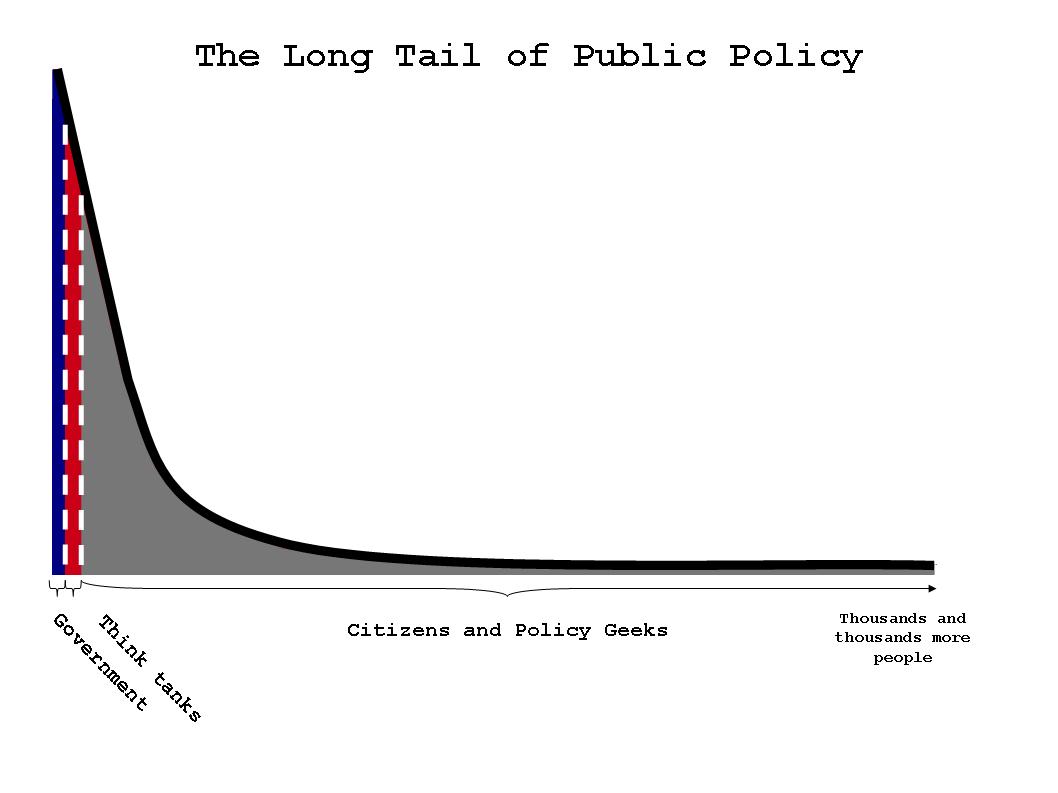
Long tail of public policy

Individually, none of us may have the collective power of a government ministry or even the resources of most think tanks. But collectively, linked together by technology and powered by our energy and spare capital, the long tail of policy geeks and ordinary citizens is bigger, nimbler, more creative and faster than anything else. Do I know that the long tail of policy can be set free? No. But ChangeCamp seems like a fun place to start experimenting, brainstorming and sharing ways we can make this country better.

Why StatCan is (or could be) like Google

Statscan Google logoThe other week I gave a talk on Gen Y, Gen X, Technology and the Future of the Public Service at StatCan’s managers’ meeting. The speaker before me apparently told the gathering that they “should be more like Google” if they want to recruit young talent. During his Q&A one of the managers asked how a government agency could be like Google (a legitimate question, I thought) and the speaker didn’t have much to say. Frustrating, no?

Definitely.

But I think there is a good case. While the idea of StatCan emulating one of the best performing, young, hottest companies in Silicon Valley may sound far-fetched, it needn’t. StatCan can be like Google. In fact, it already is.

Look, for a second, a Google’s strategy. Google’s mission is encapsulated in its SEC filing statement:

“to organize the world’s information …. and make it universally accessible and useful”. Google explains that it believes that the most effective, and ultimately the most profitable, way to accomplish our mission is to put the needs of our users first. Offering a high-quality user experience has led to strong word-of-mouth promotion and strong traffic growth. Putting users first is reflected in three key commitments illustrated in the Google SEC filing: “1. We will do our best to provide the most relevant and useful search results possible, independent of financial incentives. Our search results will be objective and we will not accept payment for inclusion or ranking in them.

  1. We will do our best to provide the most relevant and useful advertising. Advertisements should not be an annoying interruption. If any element on a search result page is influenced by payment to us, we will make it clear to our users.
  2. We will never stop working to improve our user experience, our search technology and other important areas of information organization”.

To organize the world’s information… and make it universally accessible. This a huge part of StatCan’s mission. To organize Canada’s information… (now if only we made it universally accessible).

I think Google’s mission is similar to StatCan’s. Indeed the main difference is that StatCan not only organizes Canada’s information; it also creates that data. However, this is a space that Google has moved aggressively into — why do you think it has created platforms like Google Earth? To facilitate the creation of data so that it has more to organize and offer its users. Indeed, what is interesting about Google is that it knows the more information and data that is out there – for free – the more useful and important it becomes. It means more people doing searches, which means more advertising revenue.

So what does this mean for StatCan?:

First, distinguish and separate what you do: “Creating and organizing information about Canada” from what makes you valuable: making this information universally available to citizens.

Second, make yourself the centre of a data gathering, sharing and analyzing eco-system: There are thousands, if not hundreds of thousands of people out there who could do amazing things with StatCan’s data. The problem is, it isn’t easy to find, often you have to pay for it, and it is usually only available in HTML charts that aren’t easily accessed, and certainly not dynamically available. If StatCan data was available as API’s and Excel spreadsheets, then a whole ecosystem of multimillion dollar businesses, bloggers and other pro-ams would emerge around it as supporters, collaborators and complementors.

Finally, hire young people to make it happen because if you are open, they will come: Does StatCan want young people to come work for them? Then stop behaving like a 20th-century consulting firm whose job is to hoard data and conduct analyses for clients. (Don’t worry you can still do this). Instead, act like the 21st-century Google-like platform that you are. Your job should be to make your data as searchable, taggable, as pluggable, in short, as usable, as possible. This, in addition to collection, should be the top priority. If StatCan’s data were easily available (say as an API) people would start using it in all sorts of creative ways – this, and this alone will drive innovation, excitement, energy and buzz about Statcan into the workplace. In short, it will make Statcan relevant. StatCan should be a place where young Canadians want to work so they can learn how to handle and disseminate HUGE quantities of data to everyone from the smallest bloggers to the largest companies. That skill set is going to be critical in the 21st century and so such a mission will attract talent top talent, if StatCan gives them the freedom to play and build it.

StatCan is like Google — if it chooses to be. It can’t offer the stock options, but it can offer a cool opportunity to help build the country’s most critical data ecosystem for a 21st century economy. That’s a job lots of geeks would be interested in.

The Financial collapse and the unsaid thoughts of public servants

Fascinating week in Ottawa. Been having a great time, enjoying brown bag lunches and meeting with friends old and new.

I’m here to talk about public service sector renewal and as the the issue comes up on many occasions people ask me if I think the financial crises and the poor economy will make the government a more attractive choice for gen Yers.

I think the generation lens is the wrong one, because the public service needs not only good gen yers, but also good gen xers. That said, I think the answer, broadly, is no. The crisis will not have a big impact on applications. Richard Florida hit on the reason why on Monday in his Globe and Mail piece about the asymmetrical distribution of unemployment the recession will visit upon the work force.

Critically, government needs to recognize that, these days, it is hiring creative class workers and that this group, by and large, will be significantly less hurt by the economic collapse than service sector and blue collar workers:

Unemployment rates among the working class have been more than triple the rate of those in the creative class and about double the rate of those in the service class over the past decade. Service-class unemployment has been about double the creative-class rate and has not diverged from it in the past 20 years.

And look at the last recession in Canada. Unemployment rates among the working class rose to nearly 16 per cent in 1991, while the creative class and service class experienced much more modest increases.

So will there be an uptick in people interested in working for government? Mostly likely. But expect it to be modest. But also remember. those who decide to apply may be motivated by safety and security, not a sense of public duty.

Oh, and one other thing. I’ve had several friends tell me that people who’ve applied for jobs that have had to wait 6, 9 or even 14 months before getting an offer. For those who are really made to wait, by the time they find out they have a job, the recession could be over…

CEO compensation – a symptom of institutional decay

So reading Emergence sprouted another thought regarding the increasingly bankrupt (literally and figuratively) model of the classic bureaucratic organizations. Again I point to Umair Haque’s post on the recent financial crisis:

The first step in building next-generation businesses is to recognize the real problem boardrooms face – that we’ve moved beyond strategy decay. Building next-gen businesses depends on recognizing that they are not about new business models or even new strategies.

The stunningly total meltdown we just witnessed in the investment banking sector – the end of Wall St as we know it – was something far darker and more remarkable. It wasn’t simple business model obsolescence – an old business model being superseded by a more efficient or productive one. The problem the investment banks had wasn’t at the level of business models – it had little to do with revenue streams, customer segmentation, or value propositions.

And neither was it what Gary Hamel has termed “strategy decay” – imitation and commoditization eroding the returns to a once-defensible strategic position, scarce resource, or painstakingly built core competence.

It was something bigger and more vital: institutional decay. Investment banks failed not just as businesses, but as financial institutions that were supposedly built to last. It was ultimately how they were organized and managed as economic institutions – poor incentives, near-total opacity, zero responsibility, absolute myopia – that was the problem. The rot was in their DNA, in their institutional makeup, not in their strategies or business models.

I think Umair is on to something and that CEO salaries may make for a great case in point.

For many years the left has decried growing CEO salaries as a sign of the market’s excesses – or worse, of a broader culture of greed. But excessive senior management salaries are, from an investors perspective, are a symptom of a staggeringly flawed institutional model. If your business depends that much on the one person at the top – if the current and future value of the entire organization rests in the hands of one person… then yikes! Shareholders beware.

The idea that a CEO is worth 1000, or even 100 times more than the “average” workers in an organization isn’t just a problem from a morale or ethical perspective (it may or may not be). If your average worker isn’t contributing that much value in relation to their ultimate superior than you have a massively top heavy – and hierarchical – organization. One where, I suspect, Umair would find there are poor incentives, near-total opacity, zero responsibility, absolute myopia. To be sure, ideas are probably not being floated about, and they are almost certainly not successfully emerging from the bottom up.

In short, it isn’t a happy place to be. And it turns out the markets may not think it is so good either.

Which government embraces Facebook? (hint: it's not ours)

A few weeks ago Dave D. kindly sent me this article out of England about how junior public servants are teaching their senior colleagues how to use facebook.

And just in case you think this is an ad hoc thing…

Cabinet Office minister Tom Watson yesterday said Whitehall mandarins had been given new guidelines ‘to encourage civil servants to take the first steps to engage with online social networks’.

I wonder if any Public Servant or Conservative Cabinet minister would be willing to share the same idea with our PM… likely not.

Oh, to live in a country with an open government

So the British Government doesn’t just release masses of data so the people can mash it up – they are now offering a prize to the best mash-up. Sadly, our (Canadian) government couldn’t be more secretive with it’s data.

Government EntropySure there are some low hanging fruit that I (with the help of my trusted colleague Jeremy V) was able to get and use to create this mash up of the location of government offices. Sadly, their ain’t much (that is publicly available!) to mash it up against…

Ah, the things the public would do with the data it is supposed to own and have access to, if only its government would let it…

Sometimes it’s hard not to feel like we’re uninspired, secretative and falling further, and further, behind.

The Open Source Public Service

Consider these to quotes side by side:

First,

“Human beings generally take pleasure in a task when it falls in a sort of optimal-challenge zone; not so easy as to be boring, not too hard to achieve. A happy programmer is one who is neither underutilized nor weighed down with ill-formulated goals and stressful process friction. Enjoyment predicts efficiency.

Relating to your own work process with fear and loathing (even in the displacing, ironic way suggested by hanging up Dilbert cartoons) should therefore be regarded in itself as a sign that the process has failed. Joy, humor, and playfulness are indeed assets…”

– Eric Raymond, The Cathedral & The Bazaar

(BTW: Who would have thought that the entire line of Dilbert cartoons – their humorous reflections on how organizations (dis)function – could be made depressingly painful in one brief phrase.)

Second,

“Disability claims and stress leaves are soaring. For many public service managers, the work-life balance is so unhealthy that one major federal department has tried to implement a BlackBerry ban between 7 p.m. and 7 a.m., so that people can reclaim some of their personal time. Management scholars are using the public service as a laboratory to study workplace dysfunction…

…The discussion about public service renewal is ongoing, but one valuable contribution arrived this week. In a report released Wednesday, the Public Policy Forum, an Ottawa-based think tank, succinctly identifies some of the key problems facing the public service. Few of these observations are likely to surprise Ottawa insiders, but it’s useful all the same to see them legitimized by respected researchers.

 var addthis_pub = ‘canada.com’;

function textCounter(field,cntfield,maxlimit)
{
if (field.value.length > maxlimit) // if too long…trim it!
field.value = field.value.substring(0, maxlimit);
// otherwise, update ‘characters left’ counter
else
{
var divLabel = document.getElementById(“divLabel”);
divLabel.innerHTML = maxlimit – field.value.length + ” characters remaining”;

}
}

The report confirms, for example, public servants feel so tangled up in procedure and regulations they are unable to get meaningful work done… Yes, public servants need to be accountable, especially in the post-Gomery universe, but if the “web of rules” is completely extinguishing every spark of innovation and producing the most risk-averse organization in the country, then there’s a problem.”

The Ottawa Citizen Editorial Board

The narrative of the public service as a byzantine, rule bound place has become so accepted it is now unquestioned gosple. The truth is always more complicated. I know of, and occasionally hear from, people who work in places where (usually small) teams of public servants work in flat collaborative groups that are able to achieve great things. But the narrative exists for a reason – as the above Ottawa Citizen piece attests. This is why where you work in the public service (and often who you work for) is far more important than what file you work on.

So how much work in the public service falls within the optimal-challenge zone described by Raymond? More importantly, how many public servants would continue to do their job if they weren’t paid? 10%? 35%? 50%?

My suspicion is that the open source community for public policy is actually quite large. It includes those in the public service – who are tied up and tied down in their silos, but also extends much further. The problem is that it is tied down by process and an industrial model to “churning out” policy that doesn’t work well with today’s knowledge workers.

Canada25 showed that hundreds and indeed thousands of young people wanted to think about, engage in, and write about public policy in their spare time. All we did was allow them to focus on whatever they wanted and create as frictionless a process as possible. The result? Four well received policy papers in 6 years on top of numerous smaller projects, debates, discussion groups and countless other outcomes I don’t even know about.

The main point is that “open” can work in policy development. So maybe it is time to set the public service free? To allow policy analysts to self-organize and focus their attention to where they believe they can best contribute, rather than having hundreds if not thousands of them babysitting files that simple don’t move?

Why not treat policy challenges like open source software programs. Create a policyforge (modeled after sourceforge) where the policy can reside and where the module policy owner, can foster a community and accept its ideas, opinions and edits.

Will it work? I can’t guarantee it. But we’d better start experimenting because the one thing we do know. The current system is beginning to crack.

The Public Service as a Gift Economy

In his description of why Open Source works Eric Raymond notes that open source communities don’t operate as command hierarchies or even as exchange economies. Instead they often operate as gift economies:

Gift cultures are adaptations not to scarcity but to abundance. They arise in populations that do not have significant material-scarcity problems with survival goods… Abundance makes command relationships difficult to sustain and exchange relationships an almost pointless game. In gift cultures, social status is determined not by what you control but by what you give away.

What is interesting about the public service is that it, in theory, could operate like an open source gift economy. Indeed, there are no survival necessities for those who work in the public service – their salaries are generally acceptable and their jobs secure.

This isn’t to say scarcity doesn’t exist within the public service. But it is driven by two variables – neither of which is intrinsically scarce – but have been made so by the public service’s cultural history and industrial structure.

giftThe first is resources, which are siloed into various functions and cannot allocate themselves to problems without the consent of a centralized administrator.

The second is information, which for primarily historical corporate cultural reasons is rarely shared, and is hoarded in order to maintain control over resources or agendas.

Neither of this are necessary for the public service to function. Indeed, it would function a whole lot more efficiently and effectively if such a scarcity model were abandoned. This is why I’ve been such an advocate for a social networking system within the public service – it would serve as a clearing house to allow information and resources (people) to move around the system more freely and allocate itself more efficiently.

Such a clearing house would reduce the benefits of hoarding information, as it would be increasingly difficult to leverage information into control over an agenda or resource. Instead the opposite incentive system would take over. Sharing information or your labour (as a gift) within the public service would increase your usefulness to, and reputation among, others within the system. Nor would this mean political actors at the centre of this system would have to abandon agenda control – a central authority can still have enourmous influence ascribing value to what should be worked on. It would simply no longer have absolute authority over that agenda (It is worth noting that under the current model this absolute agenda power is merely theoretical anyway – public servants have an amazing ability of doing whatever the hell they want regardless who which party is setting the agenda).

Indeed, the above contrast also explains, in part, the challenge around recuiting. As gift styled economies become more prevalent, the command hierarchy model of the public service is becoming an increasingly undesirable system within which to reside.

Update: Think a gift economy built around reputation and recognition still doesnt make sense? The Ottawa Citizen’s Katheryn May recently noted that “The “churn” of the public service, characterized by the rapid and high turnover of people in jobs, has been identified as a big problem. The APEX survey showed 64 per cent of executives think of leaving their organization at least every month. More than half want to leave because of lack of recognition. (H/T to CPRenewal)”

Public Service Recruitment

My friend Mike Morgan published a web-exclusive op-ed in yesterday’s Globe entitled “Attracting talent: How to make the civil service a sexy thing.”

The idea of having government pay for university tuition in exchange for a term of service is worth exploring. Interestingly it isn’t just the military that uses this model. Numerous elite consulting firms – such as McKinsey – often offer to pay the tuition of employees graduate school work in exchange for a period of service. If the employee elects to leave before the term of service is up then they take on a portion of the tuition. The model is not perfectly analogous since this is for graduate and not undergraduate work, but there are companies out there doing something similar.

One thing is for certain however, the government needs a scalable program that is front, as opposed to backend loaded. At the moment the “reward” for being in government comes after 20 plus years of service when you start gathering your pension. I know of few 20 year-olds who are thinking 25 years down the line, or who want a single employer for their entire life. Knowing that your entitlement is 25 years out isn’t as strong an incentive these days. Mike’s idea flips this, creating an immediate and tangible incentive – a university education – that can be leveraged for other opportunities across one’s career, not just at its end.

Most importantly, it is scalable. It addresses a system wide demand for talent, not just demand at the elite level, which is the focus of the Recruitment of Policy Leaders and Accelerated Economist Training Program target. We are not going to solve the recruitment problem by attracting 50 RPLers and 14 AETPers every year.

Special shout out to Jascha J. who caught a typo in this post. People regularly email me when the notice something is amiss – I’m deeply grateful to everyone for that.

Government social networking

Again, as a follow up to my talk at DPI on web 2.0 technologies and government, Nicolas sent me a brief article on IBM’s internal experimentation with of Socian Networking.

Those at DPI will know that one of the reasons I believe social networking for government is important is that enables employees of massive organizations – both in terms of geography and number of employees – to find and engage with one another. As such it is a clearing house for ideas and people, helping them find and connect with one another. Hence this paragraph in the article obviously tickled my goat (yeah, I said tickled my goat):

…in a global company with nearly 400,000 employees, most people are too far away to plop down in a teammate’s cubicle or grab a cup of coffee. These social tools, IBM hopes, will provide a substitute for personal connections that flew away with globalization—and help to build and strengthen far-flung teams. “People are putting up pictures of their family, the same way they’d put them up in the cubicle,” says Joan DiMicco, one of the research scientists.

People may not think of the public service as globalized (or like IBM) but it does have over 325,000 employees spread out over 3 and half time zones across a 5,187 km axis east to west. That’s pretty globalized and IBM-like right there.