Applications and Hardware Already Running On Open Data

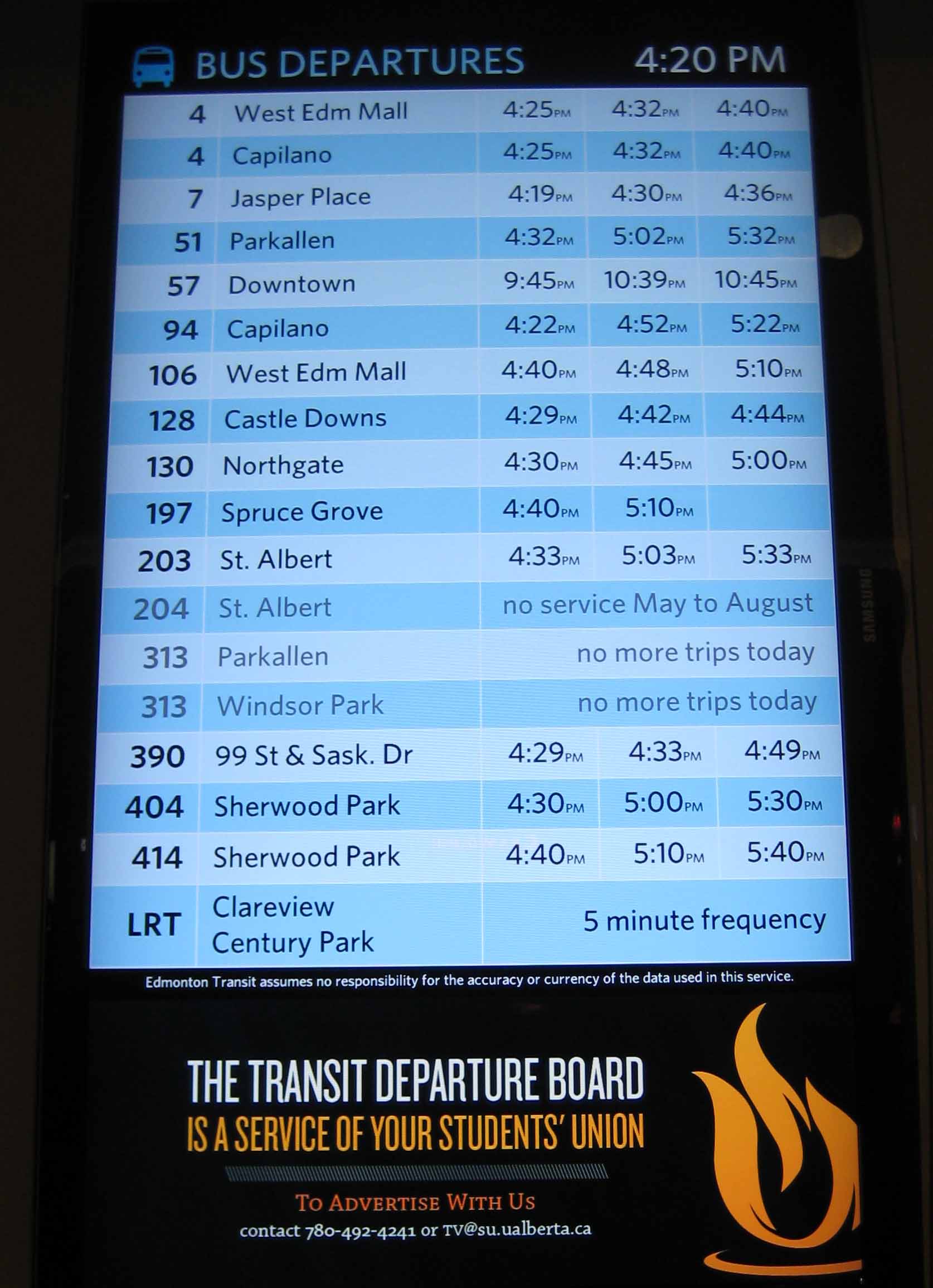
Yesterday, Gerry T shared a photo he snapped at the University of Alberta in Edmonton of a “departure board” in the university’s Student Union building that uses open transportation data from the city’s website.

Essentially the display board is composed of a simply application, displayed over a large flat screen TV turned vertically.

TransitApp_BusDepartures-217x300It’s exactly the kind of thing that I imagine University Students in many cities around the world wish they had – especially if you are on a campus that is cold and/or wet. Wouldn’t it be nice to wait inside that warm student union building rather than at the bus stop?

Of course in Boston they’ve gone further than just providing the schedule online. They provide real-time data on bus locations which some students and engineers have used to create $350 LED signs in coffee houses to let users know when the next bus is coming.

It’s the kind of simple innovations you wish you’d see in more places: government’s letting people help themselves at making their lives a little easier. Yes, this isn’t changing the world, but its a start, and an example of what more could happen.

Mostly it’s nice to see innovators in Canada like playing with the technology. Hopefully governments will catch up and let the even bigger ideas students around the country have be more than just visions in their heads.

Not sure who at the University created this, but nice work.

New York release road map to becoming a digital city

Yesterday, New York City released its “Road Map for the Digital City: Achieving New York City’s Digital Future.” For those who missed the announcement, especially those concerned about the digital economy, the future of government and citizen services, the document is definitely worth downloading and scanning.

At the heart of the document sits a road map which I’ve ripped from the executive summary and pasted below.What makes me particularly interested in it is how the Open Government section is not uniquely driven by the desire for transparency but with the goal of spurring innovation and increasing access to services. Of course, the devil is in the details but I’m increasingly convinced that open initiatives will be more successful when the government of the day has some specific policy objectives (beyond just transparency) it wishes to drive home, with open data as part of the mix (more on this in a post coming soon).

As such, “government as platform” works best when the government also builds atop the platform. It itself must be a consumer and stakeholder. This is why section 3 is so important and interesting. Essentially section 2 and 3 have parts that are strikingly similar, its just that section 2 outlines the platform and lays out that the government hopes others will build on top of it whereas parts of section 3 outline what the government intends to build atop of it. Of course section 3 goes further and talks as well about gathering information and data from the public which is the big thing in the Gov 2.0 space that many governments have not gotten around to doing effectively – so this will be worth watching more closely. All of this is great news and exactly what governments should be thinking about.

It is great when a big city comes out with a document like this because while New York is not the first to be thinking these ideas, but its profile means that others will start devoting resources to pursue these ideas more aggressively.

Exciting times.

1. Access

The City of New York ensures that all New Yorkers can access the Internet and take advan- tage of public training sessions to use it effectively. It will support more vendor choices to New Yorkers, and introduce Wi-Fi in more public areas.

  1. Connect high needs individuals through federally funded nyc Connected initiatives
  2. Launch outreach and education efforts to increase broadband Internet adoption
  3. Support more broadband choices citywide
  4. Introduce Wi-Fi in more public spaces, including parks

2. Open Government

By unlocking important public information and supporting policies of Open Government, New York City will further expand access to services, enable innovation that improves the lives of New Yorkers, and increase transparency and efficiency.

  1. Develop nyc Platform, an Open Government framework featuring APIs for City data
  2. Launch a central hub for engaging and cultivating feedback from the developer community
  3. Introduce visualization tools that make data more accessible to the public
  4. Launch App Wishlists to support a needs-based ecosystem of innovation
  5. Launch an official New York City Apps hub

3. Engagement

The City will improve digital tools including nyc.gov and 311 online to streamline service and enable citizen-centric, collaborative government. It will expand social media engagement, implement new internal coordination measures, and continue to solicit community input in the following ways:

  1. Relaunch nyc.gov to make the City’s website more usable, accessible, and intuitive
  2. Expand 311 Online through smartphone apps, Twitter and live chat
  3. Implement a custom bit.ly url redirection service on nyc.gov to encourage sharing and transparency
  4. Launch official Facebook presence to engage New Yorkers and customize experience
  5. Launch @nycgov, a central Twitter account and one-stop shop of crucial news and services
  6. Launch a New York City Tumblr vertical, featuring content and commentary on City stories
  7. Launch a Foursquare badge that encourages use of New York City’s free public places
  8. Integrate crowdsourcing tools for emergency situations
  9. Introduce digital Citizen Toolkits for engaging with New York City government online
  10. Introduce smart, a team of the City’s social media leaders
  11. Host New York City’s first hackathon: Reinventing nyc.gov
  12. Launch an ongoing listening sessions across the five boroughs to encourage input

4. Industry

New York City government, led by the New York City Economic Development Corporation, will continue to support a vibrant digital media sector through a wide array of programs, including workforce development, the establishment of a new engineering institution, and a more stream- lined path to do business.

  1. Expand workforce development programs to support growth and diversity in the digital sector
  2. Support technology startup infrastructure needs
  3. Continue to recruit more engineering talent and teams to New York City
  4. Promote and celebrate nyc’s digital sector through events and awards
  5. Pursue a new .nyc top-level domain, led by DOITT


TorStar Op-ed: Liberals have to create a next political centre

This past Saturday the Toronto Star published the following piece by Taylor Owen and myself on its op-ed page. Thought I’d put it here for those who might have missed it.

Liberals have to create a new political centre

Canadians may have once valued the Liberal party, but they reject what it has become. The reason is simple. The centre is dead. Worse still, Liberals let it die. What once was the pragmatic core of Canadian politics, today is a wasteland devoid of an imaginative, progressive vision, occupied by a largely obsolete electoral strategy.

Don’t believe us? Consider the issues the Liberal party managed over the 20th century. The creation of universal health care and the social safety net. The management of the Canada-U.S. relationship by balancing opportunities for Canadian businesses with our desire to preserve our identity. Engaging Quebec and seeking to affirm its place within the country. Cultivating multiculturalism while simultaneously securing individual rights in a charter. Fostering peacekeeping to ensure local conflicts did not escalate into nuclear confrontation.

These were significant accomplishments that defined three generations of Canadians. They are also no longer relevant.

Today Canadians, especially young Canadians, are confident about themselves and their identity — no longer is there a “lament for a nation.” The sovereignty movement, while not dead, struggles. Individual rights continue to erode discrimination and the hierarchical relationships that impeded free expression and liberty. While some progressives continue to bang these drums, no one should be surprised that they no longer resonate.

In other cases, the solutions offered in the 20th century are no longer relevant. Canadians know — as health care threatens to eat up 50 per cent of provincial budgets and service levels remain mixed — that their health-care system is broken. Young Canadians don’t even pretend to believe a pension system will exist for them. Anyone can see that peacekeeping cannot solve today’s international conflicts.

On all of these issues, the traditional offerings of progressive rings hollow. But there is an opportunity for progressives. An opportunity to build a new centre. A centre that moves beyond the debate between conservatives of the right and conservatives of the left.

On the right is a Conservative party that, at its core, doesn’t believe in the federal government. It’s a vision for Canada grounded in the 1860s, of a minimalist government that is responsible for little beyond law and order and defence. Its appeal is the offer to dismantle the parts of the system that are broken, but in so doing it will leave behind many of those who are protected and enabled by the government.

On the left is a party whose vision is to return Canada to the 1960s. It’s a world of a strong national government, of an even bigger health-care system, social safety net and welfare state. Its appeal is a defence of the status quo at all costs, which in the long run will be many. The conservatism of the left means protecting what is unsustainable. It is the unreformed arc of old ideas.

If there is going to be a new centre between these conservative poles, Liberals will need to stop lying to themselves — and to Canadians. They need to acknowledge — loudly and publicly — that they failed to reform the institutions of the 20th century and, as a consequence, health care is broken and the welfare state as presently constructed is financially insatiable. A progressive future lies in taking these challenges head on rather that passively avoiding them.

Moreover, a modern progressive view of government needs to meet the consumer expectations created by Google, Apple and WestJet. Fast, effective, personalized, friendly. In short, progressives need a vision that not only safeguards citizens against the extremes of a globalizing market, but also meets the rising expectations Canadians have of services in the 21st century — all this in a manner that will be sustainable given 21st century budgets and demographics.

No party has figured out how to accomplish this, on the left or the right. And trolling through 20th or 19th century ideologies probably isn’t going to get us there.

The future for progressives rests in figuring out the political axes of the 21st century around which new solutions can be mined and new coalitions built.

We suspect these will include open vs. closed systems; evidence-based policy vs. ideology; meritocratic governance vs. patronage; open and fair markets vs. isolationism; sustainability vs. disposability, and emergent networks vs. hierarchies. It is these political distinctions, not the old left versus right, that increasingly resonate among those we speak to.

The challenge is enormous but progressives have done it before. In the 19th century, the rise of industrial capitalism led to a series of tense societal changes, including the emergence of an urban working class, increasing inequality and the terrifying possibility of total war.

A centrist party turned out to be the place where three generations of pragmatically driven progressives were able to lead nearly a century of Canadian politics. Doing this again will require starting from scratch, but that is the task at hand.

David Eaves is a specialist on public policy, collaboration and open source methodologies.

Taylor Owen is a Banting Fellow at the Liu Institute for Global Issues at the University of British Columbia
An open letter to new MPs

Dear new MPs,

Congratulations on being elected! You’ve every right to be excited – as a fellow Canadian who is hoping that the house can be changed, I’m excited too. You are the largest group of young MPs to hit the house in a long time. You’re also mostly from the same province (Quebec) and of the same party (NDP). So you have a lot in common – you can act collectively. Don’t be afraid to use that power.

Because as exciting as everything is, things are stacked against you. Remember. Ottawa has worked itself into a nice groove around how MPs are supposed to behave and how the house is supposed to work. Everything will be pushing you into that mold.

First, you’ll arrive in Ottawa (maybe you already have) and you’ll partake in the one day (half-day?) new MP orientation. Don’t expect much. If you want a real orientation, find Aaron Wherry. Read his article here on why the House is broken (there is this video of him too). This is the orientation you really need.

But the real first test will come when you set up your office. The test will happen so quickly and so subtly you won’t even notice it. It will go something simple like this: you want to use a Mac or an Android phone as an MP. A friendly parliamentary IT staff will deferentially but sternly tell you that for reasons of security and compatibility this isn’t possible. There’ll be a moment of awkwardness and, the next thing you know, you’ll be sitting in your office, using a HP desktop computer with Windows 7 thinking “I’m so lucky to have been set up this quickly…”

Stop. Stop right there.

The real lesson that will be learned there is that – when it comes to parliamentary staff – you will do as you’re told. That you are young enough, pliant enough, naive enough to follow their lead. Remember. You are the elected officials. They are the staff. It’s their job to meet your needs. Not the other way around. If you are going to reshape parliament, make it more open, more democratic, more accessible to a broader group of possible MPs you cannot learn the first lesson they will try to teach you: compliance.

Sadly, it isn’t just the staff that will be trying to prod you into the gentle groove of an MP. One of your biggest obstacles will be your party elders. They will dangle a big carrot in front of you: the opportunity to be in government and the opportunity to be in Cabinet. In exchange they too will want compliance. You must read from the party line, sit on this committee, not that committee, ask this questions in the house, don’t ask that one. Be a good MP.

Stop. Stop right there.

Don’t believe it. Maybe you will have an opportunity to be in government, and even cabinet (and even if you do, even these positions are so controlled by the PMO as to have varying degrees of autonomy). But the reality is: it isn’t likely. Few people get into cabinet. Still more starkly, many people don’t get re-elected (it happens to even the best of politicians). You may think you are playing a long game, but the truth is, the opportunity to be difficult, to demand change in how the house works, to cause a fuss, is now. Not tomorrow. If you wait, you may think you’ll be able to change the house one day in the future, but in reality, the house will change you. The best way to change our house of parliament is to have a group of young MPs angry, hungry, carefree and naive enough to simply demand it. That’s you. That’s right now.

I don’t pretend it will be easy. You’ve got the government, parliamentary staff, even your own party leaders working against you in different ways. But don’t underestimate your influence. Even the small things you can demand could make everybody’s lives more interesting. Make CPAC pan out when MPs are talking so we can see how few people are in the house. Demand a bigger research budget so that you can display some independent thought on issues and not rely on your party’s research bureau for all your information. Blog about your committees so that Canadians don’t have to just rely on Kady O’Malley (who can only be in so many committee meetings at one time).

You’ve got a chance to make a fuss. I hope you’ll take it. But either way. Good luck.

PS Sorry for any typos, sadly lost the first draft of this, so have been rushing to publish this version before flying out the door.

How not to woo Liberals

There is no doubt that many Liberals are engaged in some (much needed) deep introspection.

But on the issue of a merger with the NDP Douglas Bell’s piece in the Globe may have been one of the worst thing proponents (on either the NDP or Liberal side) could have asked for.

Bell’s piece, which links to a West Wing clip that ends with the line “there needs to be TWO parties” is beset by all the things NDPers claim to hate about Liberals: smugness, hypocrisy, and callous insensitivity. If this is the opening move in a potential merger, it may have been on of the shortest windows of opportunity in the history of politics.

It begins with the fact that Bell – by choosing this video – suggests that Liberals have rolled over on every major policy issue and lack backbone. For a party whose members likely feel they have innumerable social justice victories under their belt this is not an effort to woo those with ideas and a desire to advance the progressive cause, it is cheap effort to insult them. While I work as a negotiation consultant, you don’t need to be an expert to know that if you are looking to create a partnership, mocking the people you seek to engage isn’t an effective a strategy.

What makes the piece more galling is that Bell himself rejected a proposition in the past. Indeed, only last year Bell noted that a merger might not work and worse, might compromise the NDP. Better, he said, for the NDP to wait until conditions were more in its favour. Of course, now that the tables have turned, Bell expects Liberals to do the very thing he himself was unwilling to do: compromise. If the terms of a merger are do as I say, not as I do, they probably aren’t that appealing. The NDP was patient and successful. Bell’s tone will – I suspect – leave Liberals thinking they’d be better off follow his advice from last year and not his dictate from this week. Plan, build and wait until conditions are more favorably. (Note to Liberals: if it should come to pass, be sure that you write a significantly kinder offer to the NDP.)

But more importantly, the longer term implications of the election are still unknown. Most federalists would agree that if you have several referendums for independence and win only the most recent one, your claim to secede is not completely firm. The same probably applies to elections. The NDP has run in elections for decades. A single “win” which sees it sitting in opposition (not government) does not a viable or sustainable alternative governing party one make. Today the NDP is much, much closer to that goal and its members have a wonderful opportunity to demonstrate that they can be a national political party that sustains a strong base. Many hope it can. But to simply demand Liberals fold up camp because of a single NDP success (not victory) takes the arrogance of well, the worst type of liberal.

Moreover, speaking of secession votes, there are real risks ahead. It’s worth noting that the NDP’s gains were largely made by opening up the pandora’s box of national unity. As bad as the Liberal’s “snakebite” may be in Quebec, the NDP may have just received its own, far more potent one, the type that bit Muroney. I pray, for the country, they have not. But consider this quote from the NDP’s youngest MP: “What I’ve said throughout the campaign is that sovereignty, we know, won’t happen in Ottawa. As long as Quebec hasn’t decided, why not have a [federal] government in Quebec’s image?… That’s how I campaigned: As long as we’re in Canada, why not have a government in Quebec’s image.” In short, the NDP is a pit stop on the way to sovereignty. If the choice is between defining a progressive agenda at the cost, or defining a progressive agenda within Canada – I suspect that most Liberals (and many Canadians) will choose the latter. Can Layton and the NDP make this coalition stick? And is it a coalition federalists want to be part of? These are tough questions and tradeoffs that will have to be debated. They are also debates that, historically, have ended in tears for all involved.

Does the country need two parties? Unclear. What is clear is that such an end game won’t emerge on the left if the terms of debate are defined by insults. The attitude in Bell’s article suggests that any kind of reconciliation and merger will be much, much more difficult then some people assume. Ultimately, politics is driven by those who believe in a vision they want others to share, to win them over that vision needs to feel inclusive for people, not degrading. I’m sure the post felt fun to write but it is hard to see how it advanced the cause of the NDP.


Vote and share

There is significant evidence that suggests that voting is a social behaviour – if you vote your friends, and your friends, friends, are more likely to vote as well. This of course matters only if your friends actually know that you voted, so be sure to let them know!

There’s no shortage of ways today, between facebook, twitter, or even a call on your cell phone or an SMS.

Another great and simple initiative is VoteSocial.ca which is helping people find voting booths, self-organize to get out the vote and share that they’ve voted with their friends.

Obviously today’s election with be exciting, hoping to have more to say on it shortly, trying to figure out if there is any truth in what Richard Florida wrote about the mid term elections in the US in 2010:

Democratic anger at Bush motivated massive voter enthusiasm in the ‘06 and ‘08 cycles among Democrat-leaning groups. The same kind of mobilization was apparent not just in the Tea Party but in Republican-leaning groups this cycle. According to a November 2 Gallup poll, 63 percent of Republicans surveyed reported that they were more enthusiastic than usual about voting—an all-time high. Americans are most enthusiastic about voting when they feel the least empowered—it is hardly an inspiring picture.  And the cycle is chronically unstable. No sooner is a new administration or a new congressional majority in place than anger begins to mount on the other side and the cycle begins again.

The consequences of this gridlock-backlash-gridlock cycle extend far beyond politics, paralyzing America’s ability to deal with the deep and fundamental economic issues it faces. Just when the United States needs bold, forward-looking leadership which can develop broad efforts to renew the economy, upgrade jobs, spur innovations, and address mounting inequality, it is stymied by a volatile political system propelled by anger and backlash, leaving it with gridlock and inertia.

My sense is that those opposed to Harper are becoming more and more vocal and active but not that there is some deep political realignment (except in Quebec where the bloc appears to be being abandoned), rather perhaps we continue to be in a period of volatility – propelled by “anger and backlash” leaving us with continued “gridlock and inertia.” More to ruminate on there.

Just a Click Away Keynote Slides

A little over two months ago I gave a keynote at the Just a Click Away Conference in Vancouver. The conference was a gathering for legal information and education experts – for example the excellent people that provide legal aid. My central challenge to them was thinking about how they could further collapse the transaction costs around getting legal assistance and/or completing common legal transactions.

I had a great time at the event and it was a real pleasure to meet Allan Seckel – the former head of British Columbia’s public service. I was deeply impressed by his comments and commitment to both effective and open government. As one of the key forces behind the Citizens at the Centre report he’s pushed a number of ideas forward that I think other governments should be paying attention to.

So, back to the presentation… I’ve been promising to get my slides from the event up and so here they are:

Why Does Election Canada Hate Young People?

This weekend the New York Times had an interesting article about how the BBC and other major media organizations are increasingly broadcasting new television episodes simultaneously around the world. The reason? The internet. Fans in the UK aren’t willing to wait months to watch episodes broadcast in the United States and vice versa. Here a multi-billion dollar industry, backed by copyright legislation, law enforcement agencies, and the world’s most powerful governments and trade organizations is recognizing a simple fact: people want information, and it is increasingly impossible to stop them from sharing and getting it.

Someone at Elections Canada should read the article.

Last week Elections Canada took special care to warn Canadian citizens that they risked $25,000 fines if they posted about election results on social network sites before all the polls are closed. Sadly, Election Canada’s approach to the rise of new internet driven technologies speaks volumes about its poor strategy for engaging young voters.

The controversy centers around Section 329 of the Canada Elections Act which prohibits transmitting election results before polling stations have closed. The purpose of the law is to prevent voters on the west coast from being influenced by outcomes on the east coast (or worse, choosing not to vote at all if the election has essentially be decided). Today however, with twitter, facebook and blogs, everybody is a potential “broadcaster.”

Westerner may have a hard time sympathizing with Election Canada’s quandary. It could simply do the equivalent to what the BBC is doing with its new TV shows: not post any results until after all the voting booths had closed. This is a much simpler approach then trying to police and limit the free speech of 10 million Canadian social media users (and to say nothing of the 100s of millions of users outside of Canada who do not fall under its jurisdiction).

More awkwardly, it is hard to feel that the missive wasn’t directed at the very cohort of Election’s Canada is trying to get engaged in elections: young people. Sadly, chastising and scaring the few young people who want to talk about the election with threats of fines seems like a pretty poor way to increase this engagement. If voting and politics is a social behaviour – and the evidence suggests that it is – then you are more likely to vote and engage in politics if you know that your friends vote and engage in politics. Ironically, this might make social media might be the best thing to happen to voting since the secret ballot. So not only is fighting this technology a lost cause, it may also be counter productive from a voter turnout perspective.

Of course, based on the experience many young voters I talk to have around trying to vote, none of this comes as a surprise.

In my first two Canadian elections I lived out of the country. Both times my mail in ballot arrived after the election and were thus ineligible. During the last election I tried to vote at an advanced poll. It was a nightmare. It was hard to locate on the website and the station ended up being a solid 15 minute walk away any of the three nearest bus routes. Totally commute time? For someone without a car? Well over an hour and a half.

This are not acceptable outcomes. Perhaps you think I’m lazy? Maybe. I prefer to believe that if you want people to vote – especially in the age of a service economy – you can’t make it inconvenient. Otherwise the only people who will vote will be those with means and time. That’s hardly democratic.

Besides, it often feels our voting infrastructure was essentially built by and for our grandparents. Try this out. In the 1960’s if you were a “young person” (e.g 20-30) you were almost certainly married and had two kids. You probably also didn’t move every 2 years. In the 60’s the average marriage age was 24 for men, 20 for women. Thinking in terms of the 1950s and 60s: What were the 3 institutions you probably visited on a daily basis? How about A) the local community centre, B) the local elementary school, and C) the local church.

Now, if you are between the age of 20 and 35 or under, name me three institutions you probably haven’t visited in over a decade.

Do young people not vote because they are lazy? Maybe. But they also didn’t have a voting system designed around them like their grandparents did. Why aren’t their voting booths in subway stations? The lobbies of office towers? The local shopping mall? How about Starbucks and Tim Hortons (for both conservatives and liberals)? Somewhere, anywhere, where people actually congregate. Heaven forbid that voting booths be where the voters are.

The fact is our entire voting structure is anti-young people. It’s designed for another era. It needs a full scale upgrade. Call it voting 2.0 or something, I don’t care. Want young people to vote? Then build a voting system that meets their needs, stop trying to force them into a system over a half century old.

We need voting that embraces the internet, social networks, voters without cars and voters that are transient.  These changes alone won’t solve the low voter turn out problem overnight, but if even 5% more young people vote in this election, the parties will take notice and adapt their platforms accordingly. Maybe, just maybe, it could end up creating a virtuous circle.

Back to Reality: The Politics of Government Transparency & Open Data

A number of my friends and advocates in the open government, transparency and open data communities have argued that online government transparency initiatives will be permanent since, the theory goes, no government will ever want to bear the political cost of rolling it back and being perceived as “more opaque.” I myself have, at times, let this argument go unchallenged or even run with it.

This week’s US budget negotiations between Congress and the White House should lay that theory to rest. Permanently.

The budget agreement that has emerged from most recent round of negotiations – which is likely to be passed by congress –  slashes funding to an array of Obama transparency initiatives such as USASpending, the ITDashboard, and data.gov from $34M to $8M. Agree or disagree, Republicans are apparently all too happy to kill initiatives which make the spending and activities of the US government more transparent as well as create a number of economic opportunities around open data. Why? Because they believe it has no political consequences.

So unsurprisingly, it turns out that political transparency initiatives – even when they are online – are as bound to the realities of traditional politics as dot.com’s were bound by the realities of traditional economics. It’s not enough to get a policy created or an initiative launched – it needs to have a community, a group of interested supporters, to nurture and protect it. Otherwise, it will be at risk.

Back in 2009, in the lead up to the drafting and launching of Vancouver’s Open Data motion I talked about creating an open-government bargain. Specifically, I argued that:

..in an open city, a bargain must exists between a government and its citizens. To make open data a success and to engage the community a city must listen, engage, ask for help, and of course, fulfill its promise to open data as quickly as possible. But this bargain runs both ways. The city must to its part, but so too must the local tech community. They must participate, be patient (cities move slower than tech companies), offer help and, most importantly, make the data come alive for each other, policy makers and citizens through applications and shared analysis.

Some friends countered that open data and transparency should simply exist because it is the right thing to do. I don’t disagree – and I wish we lived in a world where the existence of this ideal was sufficient enough to guarantee these initiatives. But it isn’t sufficient. It’s easy to kill something that no one uses (or in the case of data.gov, that hasn’t been given enough time to generate a vibrant user base). It’s much, much harder to kill something that has a community that uses it, especially if that community and the products it creates are valued by society more generally. This is why open data needs users, it needs developers, think tanks and above all, the media, to take interest in it and to leverage it to create content. It’s also why I’ve tried to create projects like Emitter.ca, recollect.net, taxicity and others, because the more value we create with open data for everyone, the more secure government transparency policies will be.

It’s use it or risk losing it. I wish this weren’t the case, but it’s the best defense I can think of.