Tag Archives: census

Minister Clement, privacy and (un)balanced views

Just moments ago Industry Minister Tony Clement, in response to growing criticism about his decision to end the mandatory long form census (now the Canadian Medical Association has come out in opposition), again cited “privacy concerns” from Canadians.

To quote Minister Clement via the Globe article:

“Just in the past 48 hours I’ve received dozens and dozens of [letters from] Canadians who despite the adverse publicity … have come forward and said, ‘We agree with your position,’” Mr. Clement said.

“I am not saying it’s every Canadian, but I am saying there are Canadians [who complained] and we should try to accommodate their concerns in a balanced way,” he said.

Of course, the minister made no reference to complaints made before he made his decision. That’s because it is rapidly becoming obvious their were none. The Privacy Commissioner registered just 3 complaints in the last decade. Statistics Canada’s survey about the last census generated no feedback regarding privacy. The minister’s claim about privacy concerns is a sham – he’s veering on the edge of having lied to Canadians. Now he’s trying to cover it up by citing complaints since his decision.

It is great to hear the Minister Clement is interested in Canadians concerns since he made his announcement because in contrast to the few dozen he’s received the rest of the country seems focused on a petition in opposition to his decision that has garnered 5800 Canadians names (and that grows at about 3 names a minute) in the last few days. Will he listen to their voices too?

I can’t say I’m confident. Even with conservatives like C.D. Howe Institute President William Robson speaking in opposition. Why? Two reasons.

First, let’s take a look at the last time the Minister consulted Canadians regarding a decision. How about last year on the issue of copyright, digital locks and circumvention. During this consultation 6641 speaking Canadians spoke against anti-circumvention provisions and a mere 46 Canadians spoke in favour. And yet, the desire of those 46 trumped the 6641. Or how about on Tuesday when Industry Canada suddenly pulled the second most popular discussion (about the census long form) from the Digital Economy Consultation.

It is the second, however, that is more important. I don’t think the Minster is the decision maker. Indeed, I don’t think he even wanted to do this. I don’t always agree with him but Minister Clement seems  smart and even fun. His twitter account is personable and engaging. More interestingly, the Minister allegedly spoke in opposition to this decision behind closed doors. The real decision maker was the Prime Minister. All the more reason why Canadians need to let their unhappiness with this decision known – they need to help Minister Clement reverse it.
The Census weak link: What the Liberals, Bloc & NDP should do

Public and the media condemnation of the government’s decision to end the long form census has been universal (see more fun quotes below). Now the political opposition has started to mobilize. The focus of the opposition has been on the secretive nature of the decision and the failure to consult any stakeholders. While this is problematic I’m not sure it is the most ironic and sensitive point. There is actually a much more juicy Achilles heel in this decision, one that might garner press attention.

In explaining the decision (such as in the quote to the Canadian Press below), Minister Clement has repeatedly claimed that MP offices has received numerous complaints about the long form census form:

“Every MP has had complaints like that so this year we decided to at least try another method that could be a sound method that would beat the issue of concern of degradation of data, and deal with the issue of coercion and too much intrusiveness”

The statement suggests broad base support but, ironically, anecdotal and, in theory, untestable.

The fun thing is, it doesn’t have to be that way. The opposition could bring more (and hard) information to this process and expose how the Conservatives are using a lack of information to at best mislead and at worse, lie, to ordinary Canadians. Better still, if the opposition parties have been organized, they should possess that data.

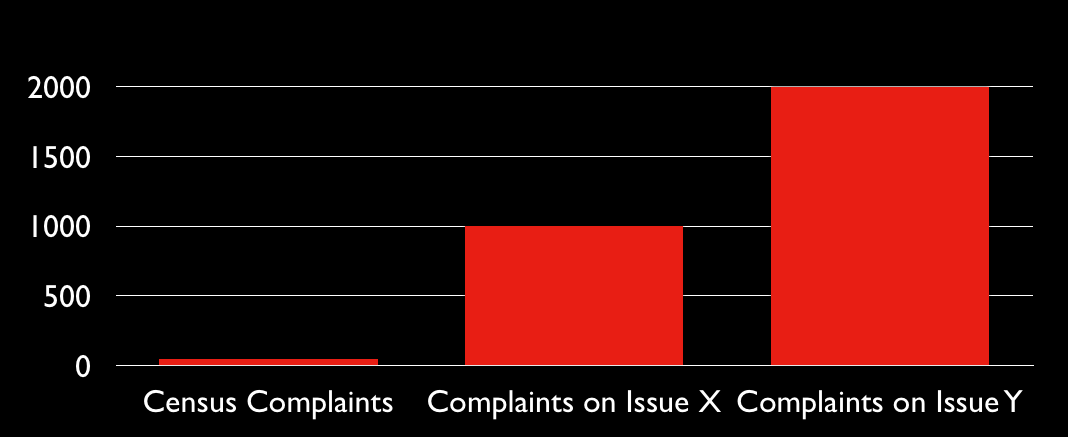
How is this? Well, I’d like to see the Liberals, Bloc and NDP ask each of their MPs to search and count every email and letter from constituents over the past 4 (or some sensible number) years that involved a complaint about the census.

My suspicion is that there are no more than 100 such letters (and, maybe even a lot less, like 10). You could then pick a couple of issues of your choice on which you have received 1000s of letters and which the conservatives have taken no action and put a simple chart up showing how they react to made up issues, but ignore real priorities of ordinary Canadians.

Of course, maybe there has been some massive, secret letter campaign targeted at Conservative only MPs but I think most Canadians will want to know how many letters the Minister and conservative MPs have actually received (sadly I don’t think you can FOI this) and most will suspect it is about as many as other MPs have.

Let’s show that better data leads to better decisions and that a little transparency can go a long way to exposing those who seek to mislead us. The minister says MPs get lots of letters – lets find out how many. And in comparison to what. Moreover, let’s show that those who seek to restrict the gathering of good information are generally those most inclined to use a lack of data to mislead the public and drive agendas that are not in the public interest. Canadians are sensible people, they want a smart government that makes good decisions. This, much more than secrecy, will rub them the wrong way.

The narrative isn’t as neat – but I suspect it could be turned into something more fun and more impactful.

Other fun articles…

Also, the universal condemnation of the Conservatives decision to end the mandatory long term census continues. My newest favourite is an article in the Globe where Derek Cook, Calgary’s the research and social planner at the City of Calgary and in the riding of the Prime Minister Harpers states that “If we don’t have that data at the neighbourhood level, we’re crippled.” Now, in addition to business groups, ngos, think tanks, cities, university researchers we are also seeing even more local and focused organizations such as those representing French Canadian communities, Inuit people and others starting to call for a reversal as well.

Your Government Just Got Dumber: how it happened and why it matters to you

This piece was published in the Globe and Mail today so always nice when you read it there and let them know it matters to you.

Last week the Conservative Government decided that it would kill the mandatory long census form it normally sends out to thousands of Canadians every five years. On the surface such a move may seem unimportant and, to many, uninteresting, but it has significant implications for every Canadian and every small community in Canada.

Here are 3 reasons why this matters to you:

1. The Death of Smart Government

Want to know who the biggest user of census data is? The government. To understand what services are needed, where problems or opportunities may arise, or how an region is changing depends on having accurate data. The federal government, but also the provincial and, most importantly, local governments use Statistics Canada’s data every day to find ways to save tax payers money, improve services and make plans. Now, at the very moment – thanks to computers – governments are finding new ways to use this information more effectively than ever before, it is to be cut off.

To be clear this is a direct attack on the ability of government to make smart decisions. In fact it is an attack on evidence based public policy. Moreover, it was a political decision – it came from the Minister’s office and does not appear to reflect what Statistics Canada either wants or recommends. Of course, some governments prefer not to have information, all that data and evidence gets in the way of legislation and policies that are ineffective, costly and that reward vested interests (I’m looking at you Crime Bill).

2. The Economy is Less Competitive

But it isn’t just government that will suffer. In the 21st century economies data and information are at the heart of economic activity, it is what drives innovation, efficiencies and productivity. Starve our governments, ngo’s, businesses and citizens of data and you limit the wealth a 21st century economy will generate.

Like roads to the 20th century economy, data is the core infrastructure for a 21st century economy. While just a boring public asset, it can nonetheless foster big companies, jobs and efficiencies. Roads spawned GM. Today, people often fail to recognize that the largest company already created by the new economy – Google – is a data company. Google is effective and profitable not because it sells ads, but because it generates and leverages petabytes of data every day from billions of search queries. This allows it to provide all sorts of useful services such as pointing us, with uncanny accuracy, to merchandises and services we want, or better yet, spam we’d like to avoid. It can even predict when communities will experience flu epidemics four months in advance.

And yet, it is astounding that the Minister in charge of Canada’s digital economy, the minister who should understand the role of information in a 21st century economy, is the minister who authorized killing the creation of this data. In doing so he will deprive Canadians and their businesses of information that would make them, and thus our economy, more efficient, productive and profitable. Of course, the big international companies will probably be able to find the money to do their own augmented census, so those that will really suffer will be small and medium size Canadian businesses.

3. Democracy Just got Weaker

Of course, the most important people who could use the data created by the census aren’t government or businesses. It is ordinary Canadians. In theory, the census creates a level playing field in public policy debates. Were Statistics Canada website usable and its data accessible (data, may I remind you we’ve already paid for) then citizens could use this information to fight ineffective legislation, unjust policies, or wasteful practices. In a world where this information won’t exist those who are able to pay for the creation of this information – read large companies – will have an advantage not only over citizens, but over our governments (which of course, won’t have this data anymore either). Today, the ability of ordinary citizens to defend themselves against government and businesses just got weaker.

So who’s to blame? Tony Clement, the Minister of Industry Canada who oversees Statistics Canada, is to blame. His office authorized this decision. But Statistics Canada also shares in the blame. In an era where the internet has flattened the cost of distributing information Statistics Canada: continues to charge citizens for data their tax dollars already paid for; has an unnavigable website where it is impossible to find anything; and often distributes data in formats that are hard to use. In short, for years the department has made its data inaccessible to ordinary Canadians. As a result it isn’t hard to see why most Canadians don’t know about or understand this issue. Sadly, once they do wake up to the cost of this terrible decisions, I fear it will be too late.