Tag Archives: government

ChangeCamp: Pulling people and creativity out of the public policy long tail

ChangeCamp is a free participatory web-enabled face-to-face event that brings together citizens, technologists, designers, academics, policy wonks, political players, change-makers and government employees to answer one question: How do we re-imagine government and governance in the age of participation?

What is ChangeCamp? It is the application of “the long tail” to public policy.

It is a long held and false assumption that ordinary citizens don’t care about public policy. The statement isn’t, in of itself, false. Many, many, many people truly don’t care that much. They want to live their lives focusing on other things – pursuing other hobbies or interests – but there are many of us who do care. Public policy geeks, fans, followers, advocates, etc… we are everywhere, we’ve just been hidden in a long tail that saw the market place and capacity for developing and delivering public policy restricted to a few large institutions. The single most important lesson I learnt from my time with Canada25 is that it doesn’t have to be that way.

Did Canada25 get a new generation of Canadians, aged 20-35 engaged in public policy? I don’t know.

What I do know is, that at the very minimum, we harnessed and enormous, dispersed desire of many Canadians to participate in, and help shape, the public policy debates affecting the country. Most importantly, we did this by doing three things:

  1. we aggregated together the people who cared about public policy, we gave them peers, friends and a sense of community.
  2. we provided a vehicle through which to channel their energy
  3. by combining 1 and 2, and by using simple technology and a low cost approach – we dramatically lowered the barriers (and csots) to entry for credible participating in these national debates

Today, the technology to enable and aggregate people their ideas, to connect them with peers and to create community, is still more powerful. Our capacity to challenge, push, help, cooperate, leverage and compete with the large institutional public policy actors has never been greater. This, for me, is the goal of ChangeCamp. What concrete tools can we build, what information can we demand be opened up, what new relationships can we build to re-imagine how we – the citizens who care – participate in the creation of public policy and the effective delivery of public services. Not to compete or replace the traditional institutional actors, but to ensure more and better ideas are heard and increasingly effective and efficient services are created.
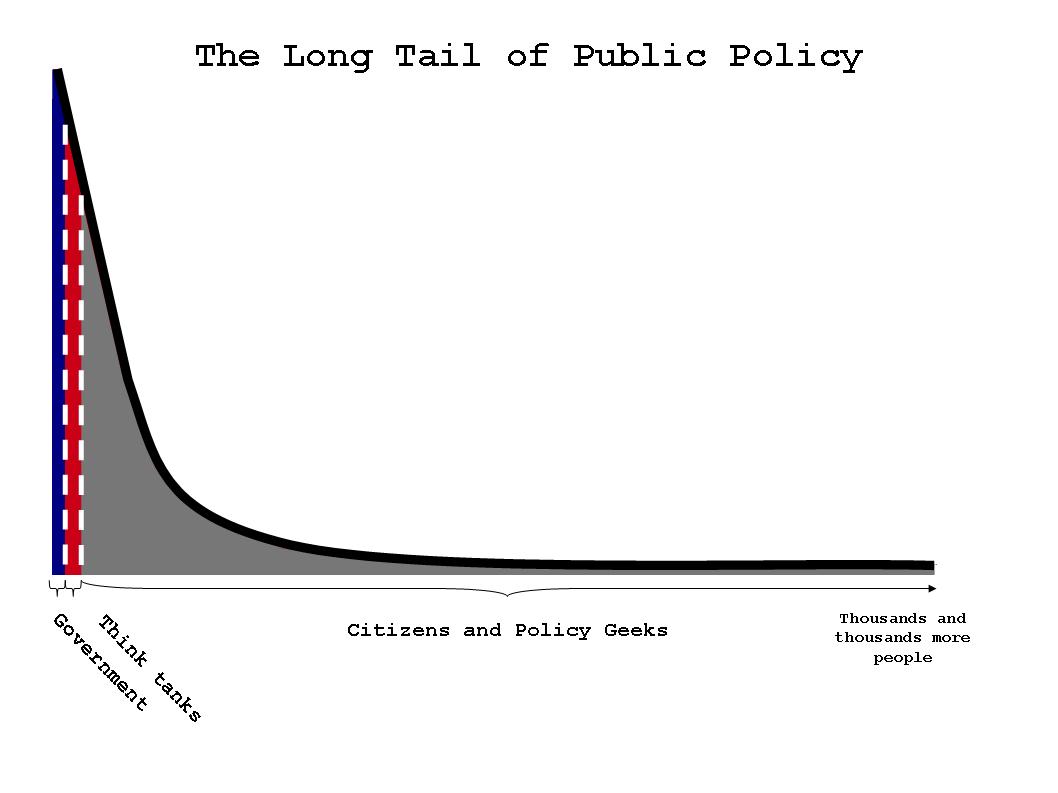
Long tail of public policy

Individually, none of us may have the collective power of a government ministry or even the resources of most think tanks. But collectively, linked together by technology and powered by our energy and spare capital, the long tail of policy geeks and ordinary citizens is bigger, nimbler, more creative and faster than anything else. Do I know that the long tail of policy can be set free? No. But ChangeCamp seems like a fun place to start experimenting, brainstorming and sharing ways we can make this country better.

The Next Economy – Why the wrong Stimulus today could fail us tomorrow

After reading The Great Crash it is hard to not feel that we are the cusp of another economic depression – the parallels between today and 1929 or almost eeire. Much like the last crash, a whole slew of business models, technologies and ways of thinking are simply going to become obsolete (or at least, not-profitable).

For example, I was talking to an American friend whose partner had been laid off by a bank and they were talking about what expenses they were going to try to eliminate. High on the list? Their land line and cable television. Low on the list? Cell phones and their high speed internet. This may finally be the beginning of the end for the old copper wire – this will accelerate a trend begun about a decade ago in which households have no fixed phone line. Indeed, Reuters is reporting that:

In the first half of 2008, 17.5 percent of households were wireless only, up from 13.6 percent a full year earlier…

…Service providers such as Verizon Communications, AT&T Inc, Qwest Communications International and others have seen a steep increase in customers cutting the cord on their home phones.

Qwest said recently that the trend was exacerbated by the weak economy as some customers were disconnecting home phones to save money.

It makes sense. Why keep a land line when you can just use your cell, or even Skype for free when you are at home?

What this means is that connectivity has never been more important to people – not just for social, but also for professional reasons. Can anyone imagine a professional, creative classer or service sector employee, under the age of 35 looking, for a job without an internet connection? Impossible. The simple fact is that a robust telecommunications network – specifically, access to the internet – is today what an electrical, phone or road network was in the 1930’s. That means, if you want to help invest for the economy of tomorrow, help bring the costs of accessing the internet today – and make sure everyone can get access.

At the moment, one reason why costs are high is because providers have agreed to build their networks out, even to “unprofitable” parts of the country. If the government provided – or helped to provide – such access internet access could be rendered cheaper and service could be improved.

My biggest fear is that here in Canada and the in United States the call for a “new” New Deal with result in a stimulus package that looks a lot like the new deal of the 1930’s – with big infrastructure projects receiving the bulk of the money. The fact is, unlike in the 1930’s new roads aren’t going to generate the same returns over the next 50 years like they did back then – there will be marginal returns at best and negative returns at worst. What we need to identify the infrastructure that is going to guide the next economy, not the last one.

And be afraid, because one thing is almost certain, the next economy almost certainly doesn’t include an auto sector of even remotely the same size or structure. (Think how much ZIP car reduces the need for cars.)

The Financial collapse and the unsaid thoughts of public servants

Fascinating week in Ottawa. Been having a great time, enjoying brown bag lunches and meeting with friends old and new.

I’m here to talk about public service sector renewal and as the the issue comes up on many occasions people ask me if I think the financial crises and the poor economy will make the government a more attractive choice for gen Yers.

I think the generation lens is the wrong one, because the public service needs not only good gen yers, but also good gen xers. That said, I think the answer, broadly, is no. The crisis will not have a big impact on applications. Richard Florida hit on the reason why on Monday in his Globe and Mail piece about the asymmetrical distribution of unemployment the recession will visit upon the work force.

Critically, government needs to recognize that, these days, it is hiring creative class workers and that this group, by and large, will be significantly less hurt by the economic collapse than service sector and blue collar workers:

Unemployment rates among the working class have been more than triple the rate of those in the creative class and about double the rate of those in the service class over the past decade. Service-class unemployment has been about double the creative-class rate and has not diverged from it in the past 20 years.

And look at the last recession in Canada. Unemployment rates among the working class rose to nearly 16 per cent in 1991, while the creative class and service class experienced much more modest increases.

So will there be an uptick in people interested in working for government? Mostly likely. But expect it to be modest. But also remember. those who decide to apply may be motivated by safety and security, not a sense of public duty.

Oh, and one other thing. I’ve had several friends tell me that people who’ve applied for jobs that have had to wait 6, 9 or even 14 months before getting an offer. For those who are really made to wait, by the time they find out they have a job, the recession could be over…

Real Renewal – Creating a post-boomer Liberal Party

Taylor Owen and I published an op-ed entitled “Real Renewal” in today’s Toronto Star. You can comment on the piece here.

—-

OPINION

How about real Liberal renewal?

Nov 20, 2008 04:30 AM

David Eaves
Taylor Owen

In the weeks since one of its worst ever electoral performances, the conversation within the Liberal Party of Canada has rightly turned to renewal. To date, the establishment consensus suggests two options: shift right and recapture the ideological “centre,” or unite the left and merge the votes of the Greens, NDP and Liberals.

Neither choice, however, represents renewal. Both are simply electoral tactics focused on the next election. Neither necessitates a rethinking of first principles, nor encourages reflection on how liberalism, and its agenda, must evolve to create a 21st century vision that will speak to Canadians.

Consequentially, both approaches are likely to alienate a new generation of activists, thinkers and policy-makers whose new ideas and energy are essential to transcending the country’s staid political debates.

Take for example our friends and colleagues. Confronted with parties whose politics, policies and priorities are perceived as out of touch and ineffective, many have simply opted out of organized politics. But many are deeply engaged. They start or work at non-governmental organizations, volunteer internationally, create social enterprises or advocate outside of organized politics. Among our peers, the progressive spirit is strong, but progressive politics is not.

To progressives searching for a political home a united left offers few new opportunities.

While acknowledging the left was instrumental in creating many of the social programs Canadians have come to trust – many of today’s emerging progressives see a left that is often loath to reform or rethink them in the face of globalization, the telecommunication revolution, and a changing citizenry. In the last election voters faced an ideological paradox. The more left the advocates, the more entrenched they were against innovation and reform, even when such reforms would serve progressive values.

Seen this way, the NDP’s vision is in many ways a conservative one – a vision of Canada locked in the 1960s or worse, the 1930s. This conservatism of the left – even if found under one tent – will not inspire forward looking progressives, or Canadians in general.

Nor will moving to the centre attract new people or inspire new ideas.

Centrism requires there to something inherently good in the position between two ideological poles. Rather than compromise between the conservatism of the left and the right, many of our peers want pragmatic policies and ideas based on a governing philosophy rather than political gamesmanship.

Take how Barack Obama has mobilized a new generation of progressives. He inspires not because he compromises between the left and right, but because he offers pragmatic policy solutions, unrestricted by ideology. Obama’s watershed speeches – “Ebenezer Baptist Church,” “Yes We Can” and “A More Perfect Union” – are powerful because they transcend the ideological divides of the past 40 years.

How then could the Liberal party attract new people and ideas? The first step is to understand that we are on the cusp of a neo-progressive revolution.

While traditional progressives promoted their values to smooth the transition from agrarian to industrial capitalism and to spread the latter’s benefits, a neo-progressive Liberal party should seek to manage the shift from the industrial to the knowledge economy. In short, to develop a New Deal for the 21st century.

This would mean, like their progressive forbearers identifying new political axes around which a new governing coalition – drawn from both the left and right – could be built.

These emerging political axes include open versus closed systems, evidence-based policy versus ideology, meritocratic governance versus patronage, open and fair markets versus isolationism, and emergent networks versus hierarchies. It is these political distinctions, not the old left versus right, that increasingly resonate among those we talk to.

Such a shift will not be easy for the Liberal party. Transformative politics requires a painful process of introspection and a willingness to let go of past battles. The Liberal party, however, continues to treat “renewal” as a side process. For example, after Paul Martin’s 2006 defeat party insiders chose 30 issues they felt were critical, and then a select group wrote reports on each. Little technology was used, neither the membership nor the public was engaged, and almost none of the reports were released to the public.

The result: Few new people were attracted to the party, almost no rigorous debates were stimulated and Liberals were unable to articulate a new progressive agenda.

This recent history offers one critical lesson. If Liberals are serious about renewal, the process can’t just be about the tactics for winning the next election, but about making progressive politics relevant to the 21st century.

David Eaves is a fellow at the Queen’s University’s Centre of the Study of Democracy. Taylor Owen is a Trudeau Scholar at the University of Oxford.

e-governance: How the White House may evolve

The other day Taylor emailed me this article on how the internet, and the communities it enables, may reshape politics in America.

What really struck me however was the subtle but important differences in language between the incoming Obama administration and the outgoing Bush administration. The quotes below say it all: On one side you have advisers talking about the internet as a tool to enable transparency and engagement. The subtext, citizens become an extension of government – helping improve program delivery. On the other side you have someone talking about the internet as a broadcast tool, a way to “get the message out.” Here, citizens are separate from government and merely passive recipients of “a message” or data the white house wants it to see.

Check it:

Craig Newmark, founder of online classifieds site craigslist.com, served as a technology adviser to Obama and is an advocate for a more open and responsive government.

“In New York and San Francisco there are so-called ‘311’ programs,” he said. “The idea is that it’s customer service for local government and if you need a pothole fixed you contact 311.

“Well let’s start expanding 311 systems to all of government,” he said.

“There’s also the whole transparency thing,” Newmark added. “The Internet is all about transparency. The first phase is the election campaign then, afterwards, getting some real grass-roots democracy in there.”

David Almacy, who served as Internet and e-communications director for President George W. Bush, said the Internet is “a very powerful tool in communicating the president’s agenda.”

“The Internet is basically a 24-hour seven-day-a-week spokesperson,”
Almacy said. “While we’re sleeping at night it’s still available for those who are searching on energy legislation or the war on terror or the war in Iraq.”

Oh, to live in a country with an open government

So the British Government doesn’t just release masses of data so the people can mash it up – they are now offering a prize to the best mash-up. Sadly, our (Canadian) government couldn’t be more secretive with it’s data.

Government EntropySure there are some low hanging fruit that I (with the help of my trusted colleague Jeremy V) was able to get and use to create this mash up of the location of government offices. Sadly, their ain’t much (that is publicly available!) to mash it up against…

Ah, the things the public would do with the data it is supposed to own and have access to, if only its government would let it…

Sometimes it’s hard not to feel like we’re uninspired, secretative and falling further, and further, behind.

Public Service Recruitment

My friend Mike Morgan published a web-exclusive op-ed in yesterday’s Globe entitled “Attracting talent: How to make the civil service a sexy thing.”

The idea of having government pay for university tuition in exchange for a term of service is worth exploring. Interestingly it isn’t just the military that uses this model. Numerous elite consulting firms – such as McKinsey – often offer to pay the tuition of employees graduate school work in exchange for a period of service. If the employee elects to leave before the term of service is up then they take on a portion of the tuition. The model is not perfectly analogous since this is for graduate and not undergraduate work, but there are companies out there doing something similar.

One thing is for certain however, the government needs a scalable program that is front, as opposed to backend loaded. At the moment the “reward” for being in government comes after 20 plus years of service when you start gathering your pension. I know of few 20 year-olds who are thinking 25 years down the line, or who want a single employer for their entire life. Knowing that your entitlement is 25 years out isn’t as strong an incentive these days. Mike’s idea flips this, creating an immediate and tangible incentive – a university education – that can be leveraged for other opportunities across one’s career, not just at its end.

Most importantly, it is scalable. It addresses a system wide demand for talent, not just demand at the elite level, which is the focus of the Recruitment of Policy Leaders and Accelerated Economist Training Program target. We are not going to solve the recruitment problem by attracting 50 RPLers and 14 AETPers every year.

Special shout out to Jascha J. who caught a typo in this post. People regularly email me when the notice something is amiss – I’m deeply grateful to everyone for that.

Government social networking

Again, as a follow up to my talk at DPI on web 2.0 technologies and government, Nicolas sent me a brief article on IBM’s internal experimentation with of Socian Networking.

Those at DPI will know that one of the reasons I believe social networking for government is important is that enables employees of massive organizations – both in terms of geography and number of employees – to find and engage with one another. As such it is a clearing house for ideas and people, helping them find and connect with one another. Hence this paragraph in the article obviously tickled my goat (yeah, I said tickled my goat):

…in a global company with nearly 400,000 employees, most people are too far away to plop down in a teammate’s cubicle or grab a cup of coffee. These social tools, IBM hopes, will provide a substitute for personal connections that flew away with globalization—and help to build and strengthen far-flung teams. “People are putting up pictures of their family, the same way they’d put them up in the cubicle,” says Joan DiMicco, one of the research scientists.

People may not think of the public service as globalized (or like IBM) but it does have over 325,000 employees spread out over 3 and half time zones across a 5,187 km axis east to west. That’s pretty globalized and IBM-like right there.

Make Government easier (part 1)

The other week I had the pleasure of giving a keynote at the annual DPI conference – put on by the Association of Public Service Professionals. (I’m hoping to slidecast the presentation soon – just trying to get my hands on a recording ofthe presentation).

In the audience were something like 800 IT professionals from the Public Service – a great group of people – many of whom I’m had a great time connecting over email with this past week.

direct.srv.gc.ca_direct500_images_english_titleObviously, I spent some time talking about social networking in a government context – Facebook.gc.ca as I’ve come to refer to it. As many people know (but don’t think about in these terms) the government does offer a social networking piece of software, its called the Government Electronic Directory Service or, for short, GEDS.

As I’ve mentioned before GEDS has limited functionality, it only helps you find someone whose name, phone number or title you already know. But that can still be useful and so a ton of people – both within and outside government. However, after talking to a number of people, I’ve discovered that not one person I’ve met actually knows how to get to the GEDS website. They all have to search for it in Google to find it! Talk about making one of the best IT tools within government difficult to find/use!

Why is that?

Because the GEDS URL (or web address) is the easy to remember:

http://direct.srv.gc.ca/cgi-bin/direct500/BE

Really? Why did the people who created this IT directory simply not make everyone’s life easier and make it:

http://geds.gc.ca

Now, while I think GEDS should be replaced but something more sophisticated, I nonetheless bet that its usage would be much higher – or at least, its users would be much happier – with this little address change.

It’s a simple change – but exactly the kind of thinking that applied more broadly, could make our government run just a little more smoothly.

So much data… locked away

I’m preparing for the keynote on Public Service Sector Renewal and technology I’ll be giving at this year’s DPI conference on Thurdsay in Ottawa. I’ve been working on creating a series of slides that I’m hoping will be quite interesting and tha I promise to share either here or via slideshare.net.

What has been most interesting is how hard it is to get data about the government. In my case, I’ve been trying to determine the address of every major ministry (or, if you must, department) in Ottawa in 1930, 1960, 1980 and today. I know this information exists – the problem is finding it. It would appear that it can only be found in the national archives – in hard form, from a protected document that people aren’t really allowed to access.

Sigh.

It makes me think of how much data the government has collected over the years – or even minute by minute that gets stored – even digitally – in inaccessible ways, making it harder for companies, non-profits or other entities to leverage the public resource.

If our government is going to get one thing right, it would be enabling its citizens to do that.