Tag Archives: open source

My first 911 call – lessons for open systems

So this Saturday morning, on my way downtown to conduct a negotiation workshop for several wonderful people in Vancouver’s environmental NGO community, my friend Rikia and I were stuck behind a white 16 cubic foot box van that began weaving very erratically (I mean, into oncoming traffic erratically).

After some initial hesitation I made my 911 call ever.

(As an aside, I think I’m a pretty lucky guy to have made it to the age of 31 before feeling like I was in a situation where I had to call 911 – and frankly while this situation was dangerous, I myself was never in danger)

During the call I was struck by how patient and restrained the operator was. Although he never sounded cavalier, nor did I pick up any sense of urgency – likely a tactic to ensure callers stay calm. In addition, I noticed how the operator never doubted the underlying veracity of my story.

This observation got me thinking about a post I wrote a while back about how 911 is a perfect example of how public services already use open source principles. Accepting this argument, my 911 experience actually affirmed some things  I’m sure many open source veterans already know.

Any open system (and many closed ones) rely on a community of people to provide it with important data (e.g. where eradic drivers are, or where critical bugs may exist in the code). Since people often come into the 911 community (or an open source project) with a problem or concern they are likely predisposed to be agitated. Consequently, I suspect that open systems that retain the most users are those that are predisposed to assuage them and keep them calm. Indeed this probably not only improves retention (increasing the likelihood a caller/bug register calls again) but likely also helps maintain the sanity of those helping them. So lesson one: a little patience is essential for long term success.

In addition, I mistook the road the truck was driving on not once but twice (talk about testing one’s patience!). However, if the operator was annoyed,  I didn’t know it. While it is important that 911 get accurate information a worse outcome would be for a call where the operator and the caller get into a dispute – if a user has a negative experience with 911 they may never call again – significantly diminishing the value of the system and increasing the risk to society. Obviously the stakes aren’t quite so high for an open source software project, but putting a premium on accuracy above all else probably isn’t wise either. While we want users to be accurate – a system that penalizes inaccuracy so heavily that they never return is probably not wise either. So lesson two – always lead by trusting, but of course, verify.

Open Everything

It’s official. A small cabale of us are running a conference entitled Open Everything about what is the value and the values of being “open” and how is it changing the way we live and work – for good and bad.

The main event will be a 3-day shindig up at Hollyhock on Cortes Island in British Columbia in September with several parrallel events occuring around the world (so far events have been confirmed for Toronto in June, London, UK in July, Cape Town in August and Singapore in September.

If you are interested in participating, know someone who you think should be in the know, or would simply like to know more yourself, please drop me a line.

Get the new Beta of Firefox 3

Mozilla recently released a new beta version of Firefox 3. If you haven’t been using it I highly recommend downloading a copy. I’ve been using Firefox 3 a few months now and there are 2 features I couldn’t imagine living without.

The first is the revamped address bar. Most address bars boast an auto-complete function (e.g. start typing http://www.ea… and it will fill in the rest). But Firefox 3’s address bar allows you to type in any word from the url and it will give you a list of choices, balanced between sites you frequently go to and the sites you most recently visited. So for example if, after reading this post, you simply type “beta” into the address bar, this page will almost certainly be one of your choices. It makes finding that web page you were at yesterday, but can’t remember than name of, really, really easy.

The second is that – upon request – Firefox will remember all the sites you are viewing when you shut it down. That way, when you load it back up – say, the next morning – all the tabs and sites you had open will reappear. I no longer to a bookmark a bunch of sites when I’m shutting down my computer. Super convenient.

On a seperate but parallel note, Apple recently released its Safari browser for the PC and has been bragging about how it is faster than Firefox. This is true, if you are using Firefox 2! According to an independent industry observer, Firefox 3 is actually faster than Safari.

TransitCamp

Want to say congratulations to Jay Goldman, Eli Singer and Mark Kuznicki. Their article on TransitCamp has been published in the February 2008 issue of the Harvard Business Review.

For those unfamiliar with the concept of an unconference – like TransitCamp or the opencities unconference we put on last year – the article is a great starting point.

It’s a wonderful example about how citizens can be engaged in a truly meaningful way. As the website states: TransitCamp was – and will continue to be – a solution playground, not a complaints department. It is as much a celebration of transit as it is a place where people gather to figure out how to make it better.

Much like a NFL game is as much about the tailgating, social/community oriented party in the stadium parking lot as it is about the serious game going on inside the stadium, TransitCamp is as much about celebrating and uniting the transit community as it is about the serious work of figuring out how to make the TTC better.

And, to top it all off, it was a place where ideas get to flourish and are not subjected to consensus and other lowest common denominator approaches.

This, and all sorts of other good reasons, is why HBR made it a breakthrough idea for 2008.

(BTW: Go Pats Go)

Take it, and make it better…

Here is why I love the internet. It allows anyone to take their idea or research and share it with the rest of us. In this case Johnny Lee shows us how $250 worth of gear can enable us to create something people have been trying for decades to get right. Better still, he shared the code so others could do it too – and even build on his work.

Everything about this video is great. From the idea, to Johnny’s presentation style (which is clear to the non-expert) as well as his casually humour and charming delivery.

It will be interesting to see how Nintendo reacts to this and Johnny’s other innovations.

Sony both set the bar and wrote the book on how to alienate your customers when it launched lawsuits against the owners of its digital AIBO dog (pictured right) who offered up software hacks that allowed the digital pet to do (cool) new things.

So far my google research shows they’ve been silent. This is at least one step up from Sony.

My “top 10″ 2007 blogging moments: #1

This is, quite possibly, my best moment of 2007. I’ve been promising some friends that I’d blog about it for quite some time – so here we go.

PART 1:

Khale v GonzalesBack in January, Lawrence Lessig – a man whose speeches and books: changed the way I see the world; got me excited about and engaged in open source; inspired me to start fighting for the internet; helped instigate my blog; pulls me (at times) towards law school; and regularly makes me want to move to San Francisco a be part of what is one of the most exciting community in the world – wrote this post.

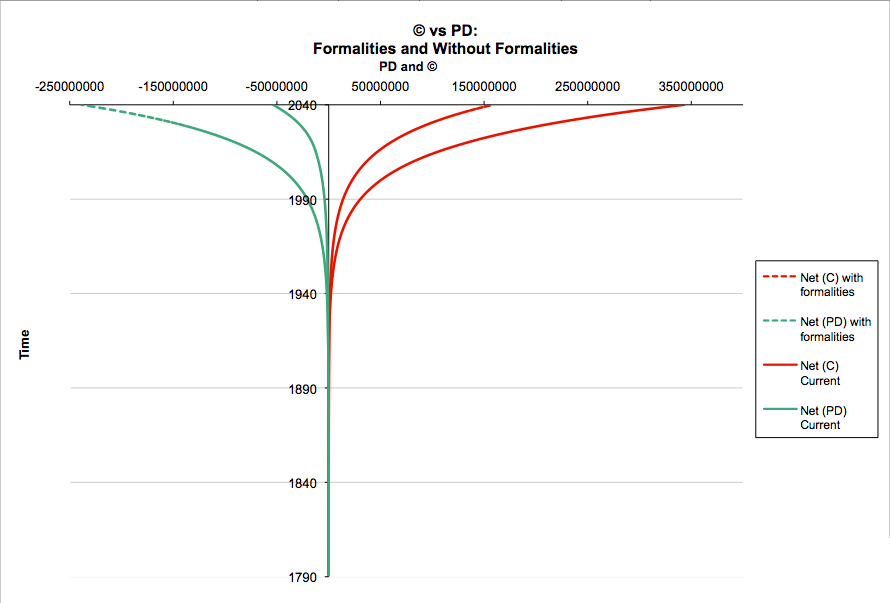
The post essentially discusses two things. The first half reviews and assesses the U.S. District Court for the Northern District of California (or the Ninth Circuit for those who know their courts) decision on a copyright case called Kahle vs. Gonzales (broadly themed around the issue of Free Culture that Lessig has championed). The court ruled against Lessig and his team so he dissects their response. In the post’s second part Lessig diagnoses that his argument might have been better expressed visually. He then outlines a model, and a graph, he developed to do just this. Most importantly, he posts the basic spreadsheet on his blog and states:

Again, this is a beta model. I’d be very grateful for any errors identified, or for a better specification of the same. After a review by a couple friends, I will post any corrections to this. At that time, I’ll also include any corrections noted in the comments.

I would do virtually anything to help Lessig and the important work he, and others like him, are doing. Sadly, lacking a legal background I’m not sure how much help I would be in drafting an improved Supreme Court petition (I would probably just waste his time and actually do the cause more damage than good). Designing a better graph however, that is something I can do.

Consequently, I posted a comment on Lessig’s blog where I re-graphed his results but displayed them in a visual manner that I thought made it easier to convey his argument. You can see my comment, along with the reasoning and the new model, here. I of course also shared the model so that others could improve on it.

The best part was Lessig wrote me an email me and thanked me for the help. Words can’t convey how much I’ve wanted to help with this movement/cause. So getting a thank you email meant the world to me. In this space (and virtually every space) I’m a nobody – some guy on the other end of a wire – but I love living in a world where even I can spend a few hours (a lot of hours actually) working on something and do well enough that I can help an expert and leader of a movement I feel so much passion for. I still feel ill-equipped to help out, but that thank you email made me feel like that my small contribution was genuinely helpful. For both those who know me, and those who don’t, it may sound pathetic, but I really couldn’t stop smiling for days.

And then it got better.

Part 2:

One of the nicest people in the world – Virginia Law School professor Chris Sprigman emailed me out of the blue with a note that said:

Hello David.  Larry sent me the message you sent to him, and I’ve been puzzling through your graph.  I’m drafting a petition for rehearing in Kahle, and I’d like to speak with you and understand your methodology, in the hope that we might use your graph in the brief.  Do you have any time to speak later today?

We chatted and I went through a couple of iterations of my graph. And then at some point he asked: Would you be willing to do all the graphs for our Supreme Court petition?

Obviously, I agreed.

So you can see the petition here. Sadly, my original graph that got me involved didn’t make the cut. I don’t make any claims that my work was at all intellectual – I was making graphs. But I’m not sure I’ve ever been happier then the hours I spent tweaking things here and there to see if there was something – anything – I could do to help make this small part of a Supreme Court petition better.

So there it is, number one – for the simple reason that blogs and the internet can allow anyone, anywhere, to contribute to something they believe in. I’ve never met Chris or Larry and they didn’t know me from anyone, but the internet’s meritocratic culture meant that if they thought I could contribute – it didn’t matter – they’d bring me on. And for that I’m eternally gratefully, and will also be eternally willing to work my butt off for them and for the cause of free culture.

My "top 10" 2007 blogging moments: #3

I’m invited to the June 2007 Executive Summit conference in Montebello to give a keynote on Gen X, Gen Y, Web 2.0 and the challenges of public service sector renewal. This is where Treasury Board gathers the CIO’s and other key IT people from across government.

After my presentation I end up in discussions with various friendly and engaging public servants. During one conversation a senior public servant challenges the notion that any government service – especially critical ones – could ever adopt the principles or ideas used by open source, or even Web 2.0 technologies. After all, he notes, we can’t rely on people, that’s why they pay taxes, so they can rely on government. This subject being a passion of mine we end up in a mini-debate during which he demands an example of an open system presently being used by government.

I ask him for a few hours and promise to blog my response.

Turns out one of the the most critical systems of our infrastructure – one that citizens expect to protect and save them from a variety of problems on a daily basis – is almost entirely dependent on a open system to deploy and allocate its resources with pinpoint accuracy. Is the entire system open source? No. But a critical component is. (Hint, it’s probably the one phone number we all know).

My top 10 2007 blogging moments: #10

The slidecast of my FSOSS presentation on Community Management as the core competency of Open Source gets 750 views in 2 weeks (and counting)

That’s like 50 people a day.

Is this a self-indulgent post? Absolutely. But then any top ten list that starts with the word “my” is probably going to be. That said, it is nice to take stock after just over a year of doing this.

Don’t worry, they’ll get better.

Community Management in Open Source Slidecast

A few weeks ago I gave a talk at the Free-Software and Open Source Symposium (FSOSS) on how community management is the core competency of Open Source projects. It is a concept I’ve been playing with for a while – thanks to both the prodding and help of my friend Mike Beltzner. Mark Surman, John Lily and the people at Web of Change have also been key in helping move these ideas forward.

A number of colleagues have been asking for the slides and/or the ability to watch the presentation. I’m pleased to say that you can now get both, thanks to SlideShare.

There was a fair amount of discussion during my presentation – which can’t be heard because the audience didn’t have microphones – so I edited the audio file down to 45 minutes. After listening to the presentation I realized I took too long to get to the meat of the subject, so for those in a rush, you may wish to fast forward through the first few slides.

The feedback from the talk itself has been great. You can reviews, good and bad, here, here, here, here, and in the comments here. I’m already working on a second version so if you have any thoughts or comments please do post them below or send me an email.

FireFox 3 Beta and other cool gadgets

If you aren’t technically inclined, but are interested in impressing your co-workers, consider downloading the recently released beta version of FireFox 3.

This is your chance to look cooler than everybody else in your cubicle farm… pimping out your computer with the latest in open-source coolware.

And since we are speaking of gadgets… Gayle D. recently gave me this very cool pedometer. As some of you know, I try to walk at least one direction to all my meetings. This little device isn’t radically radically changing my life… but it is keeping me aware of my decision to walk everywhere. More importantly it’s enabled me to both set a target of taking 10,000 steps and given me the capacity to measure my progress. This is definitely pushing me make better, healthier decisions.

I’d heard a while back that Ontario Health Promotion Minister Jim Watson pitched to Research in Motion the idea that Blackberry devices should have an integrated pedometer.

I thought was a fantastic idea. Obviously it hasn’t gone anywhere – and to be fair, these advanced pedometers would add to the size of any Blackberry device… but I hope RIM hasn’t dropped the idea altogether.