Tag Archives: open

What the post-bureaucratic era will mean for the public service

In a number of blog posts and, in greater detail, in a number of lectures and speeches I’ve been outlining how the social and organizational impact of  information technologies (like wikis and blogs) will uproot and transform the public service. Specifically, in the coming era of self-organizing, the public service will have to find new ways to balance accountability and control with decentralization, accelerated information flows and emergent problem-solving.

There is, obviously, a ton to dive into here, which is what I’ve been having fun doing in my lectures and seminars. The other week while doing a presentation in Ottawa to a group of Health Canada employees, one of the participants asked me what the implications of self-organizing systems and social media would be for the core values of the public service (the Canadian Federal Public Service is the case study here, but this discussion likely applies to most government bureaucracies). More importantly, he wanted to know if they would have to be amended or changed. I’m not certain they do, but that doesn’t mean they won’t need to be reviewed…

For example, zero in on one of the Public Service’s core values in particular:

Professional Values: Serving with competence, excellence, efficiency, objectivity and impartiality.

  • Public servants must work within the laws of Canada and maintain the tradition of the political neutrality of the Public Service.
  • Public servants shall endeavour to ensure the proper, effective and efficient use of public money.
  • In the Public Service, how ends are achieved should be as important as the achievements themselves.
  • Public servants should constantly renew their commitment to serve Canadians by continually improving the quality of service, by adapting to changing needs through innovation, and by improving the efficiency and effectiveness of government programs and services offered in both official languages.
  • Public servants should also strive to ensure that the value of transparency in government is upheld while respecting their duties of confidentiality under the law.

None of these values are wrong. What will be challenging is how emerging technologies will shift expectations among citizens around how these values should being interpreted and what that means for how government operates.

In his 2008 Bertha Bassam Lecture at the University of Toronto, David Weinberger points out that for the last several centuries we have associated credibility (read: professionalism) with objectivity and impartiality (note values listed above). However, the rise of the internet is beginning to erode the link that once bound credibility to objectivity and impartiality:

“Wikipedia is far more credible because it shows us how the sausage is made makes Wikipedia far more credible. Yet this is exactly the stuff that the Britannica won’t show us because they think it would make them look amateurish and take away from their credibility. But in fact transparency – which is what this is – is the new objectivity. We are not going to trust objectivity, we are not going to trust objectivity unless we can see the discussion that lead to it.”

Replace Britannica in this sentence with “the public service” or “government” and you see the problem. The values of the public service presume that objectivity and impartiality will lead to credibility.  Increasingly, however, this is no longer the case. We want the right to see how the sausage is made. More importantly, as an increasing number of organizations like Mozilla, Wikipedia and DirectLauncher make it clear that such transparency is both technically and practically feasible – even when managing highly complex and sensitive tasks – our expectations around what we expect of government is starting to shift. Who do you trust more? Wikipedia or the Government of Canada’s website? Who let’s you see the discussion? This answer to this question is getting less and less clear.

Indeed it is this increasing number of transparent organizations that throw the last bullet in the section on professional values into sharp relief:

Public servants should also strive to ensure that the value of transparency in government is upheld while respecting their duties of confidentiality under the law.

Even if the public’s expectations of what should be legal confidential does not shift, radical change will still be necessary. Already you see people beginning to demand better access to all sorts of government data sets (think the Sunlight Foundation). And we haven’t even mentioned the whole process of Freedom of Information Requests (FOI). Here is a system that is clearly overwhelmed. But think more carefully about the whole process of FOI. The fact that information is by default secret (or functionally secret since it is inaccessible to the public) and that it must be requested is itself a powerful indication of just how fundamentally opaque government is. In a world where information generation is growing exponentially, will the government really be able to manage and access all of it, and determine what is confidential and what isn’t? This seems like a system destined for real challenges. All of this to say that even if the last line of the value statement above does not change one iota, what it means – and citizens expectations around its implementations – is going to change radically.

This transition – the movement from a public service that is opaque by 21st century standards to one that is transparent is going to be gut-wrenching, challenging and painful, not because it isn’t technically possible, but because it is going to require reversing 200 years of culture, values and modes of operation that are embedded within the public service and deeply embedded within the political class. This isn’t to say that the transition will erode the power or influence of these groups, it won’t. But it will be different, and that in of itself is often scary enough to create resistance and a painful transition.

In conclusion, I suspect that the few of the values will, or need, to change – indeed most are necessary and good. However, while the values themselves won’t change, continuing to adhere to them will require dramatic changes to how the public service operates.
Journalism in an Open Era (follow up link)

Been getting a number of great comments and emails from people on the post on Journalism in an Open Era.

Another blogger I meant to link to he’s ideas on the future of organizations I find smart, edgy and thoughtful is Umair Haque, the Director of the Havas Media Lab who blogs for the Harvard Business Review.

In a piece entitled How to Build a Next-Generation Business Now, Haque’s concludes that the problem that dragged down wall street is in part, the same one that is killing (or transforming to be nicer) journalism. My journalism in an open era piece is set, in part, on the belief that the gut wrenching changes we are experiencing economically are part of a transition to a new rule-set, one that will favour, and possibility require, more “open” institutions and business models. This will require – in part – a new journalism but also real leadership in the private, public and non-profit sector (the type Henry Mintzberg raged about in his excellent oped in the Globe and Mail).

Here’s Haque (bold and italic text is mine) on the subject:

The first step in building next-generation businesses is to recognize the real problem boardrooms face – that we’ve moved beyond strategy decay. Building next-gen businesses depends on recognizing that they are not about new business models or even new strategies.

The stunningly total meltdown we just witnessed in the investment banking sector – the end of Wall St as we know it – was something far darker and more remarkable. It wasn’t simple business model obsolescence – an old business model being superseded by a more efficient or productive one. The problem the investment banks had wasn’t at the level of business models – it had little to do with revenue streams, customer segmentation, or value propositions.

And neither was it what Gary Hamel has termed “strategy decay” – imitation and commoditization eroding the returns to a once-defensible strategic position, scarce resource, or painstakingly built core competence.

It was something bigger and more vital: institutional decay. Investment banks failed not just as businesses, but as financial institutions that were supposedly built to last. It was ultimately how they were organized and managed as economic institutions – poor incentives, near-total opacity, zero responsibility, absolute myopia – that was the problem. The rot was in their DNA, in their institutional makeup, not in their strategies or business models.

The point is this: the central challenge 21st century boardrooms must face is not reinventing strategies, or business models, but reinventing businesses as institutions.

Old stuff is breaking fast. The rot is in the DNA – we may, in may circumstances, need a new institutional make up. And the new rule sets need to be understood quickly. Are we coming into an Open Era? I don’t know, but I think open and/or transparent organizations are going to have a leg up.

ChangeCamp: Pulling people and creativity out of the public policy long tail

ChangeCamp is a free participatory web-enabled face-to-face event that brings together citizens, technologists, designers, academics, policy wonks, political players, change-makers and government employees to answer one question: How do we re-imagine government and governance in the age of participation?

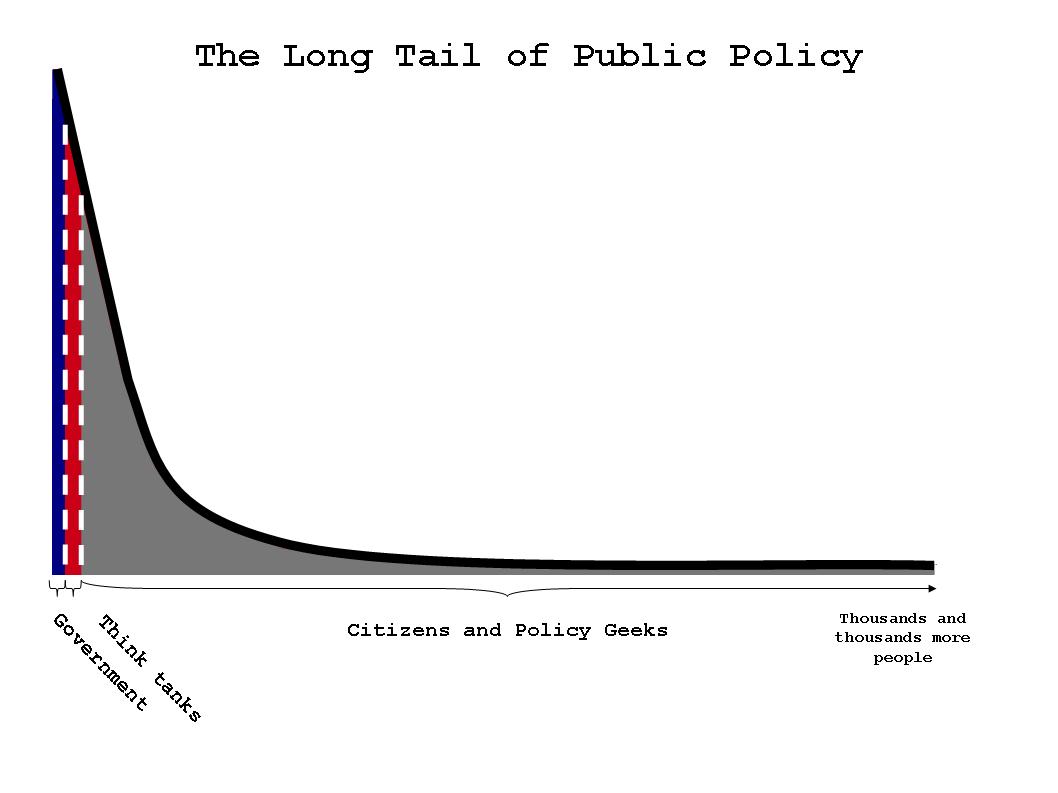
What is ChangeCamp? It is the application of “the long tail” to public policy.

It is a long held and false assumption that ordinary citizens don’t care about public policy. The statement isn’t, in of itself, false. Many, many, many people truly don’t care that much. They want to live their lives focusing on other things – pursuing other hobbies or interests – but there are many of us who do care. Public policy geeks, fans, followers, advocates, etc… we are everywhere, we’ve just been hidden in a long tail that saw the market place and capacity for developing and delivering public policy restricted to a few large institutions. The single most important lesson I learnt from my time with Canada25 is that it doesn’t have to be that way.

Did Canada25 get a new generation of Canadians, aged 20-35 engaged in public policy? I don’t know.

What I do know is, that at the very minimum, we harnessed and enormous, dispersed desire of many Canadians to participate in, and help shape, the public policy debates affecting the country. Most importantly, we did this by doing three things:

  1. we aggregated together the people who cared about public policy, we gave them peers, friends and a sense of community.
  2. we provided a vehicle through which to channel their energy
  3. by combining 1 and 2, and by using simple technology and a low cost approach – we dramatically lowered the barriers (and csots) to entry for credible participating in these national debates

Today, the technology to enable and aggregate people their ideas, to connect them with peers and to create community, is still more powerful. Our capacity to challenge, push, help, cooperate, leverage and compete with the large institutional public policy actors has never been greater. This, for me, is the goal of ChangeCamp. What concrete tools can we build, what information can we demand be opened up, what new relationships can we build to re-imagine how we – the citizens who care – participate in the creation of public policy and the effective delivery of public services. Not to compete or replace the traditional institutional actors, but to ensure more and better ideas are heard and increasingly effective and efficient services are created.

Long tail of public policy

Individually, none of us may have the collective power of a government ministry or even the resources of most think tanks. But collectively, linked together by technology and powered by our energy and spare capital, the long tail of policy geeks and ordinary citizens is bigger, nimbler, more creative and faster than anything else. Do I know that the long tail of policy can be set free? No. But ChangeCamp seems like a fun place to start experimenting, brainstorming and sharing ways we can make this country better.

Wikipedia: Community Management as its core competency

Last week Paul Biondich lent me The Starfish and the Spider and I just finished reading it (I know, I didn’t put it in the sidebar). Indeed, a number of people I respect have had great things to say about it – John Lily suggested the book ages ago and I remember reading his review and wanting to pick a copy up.

Tons of exciting ideas in the book. One that excited me most related to an idea (articulated by many people) that I’ve been trying to advance – namely that Community Management is core to open source. Specifically there was this exciting piece on how Jimmy Wales, the “catalyst” behind Wikipedia, spends his time:

Jimmy focuses a great deal of attention on maintaining the health of the Wikipedia community. “I go to speaking engagements all over the world at conferences, and everywhere I go I meet Wikipedia volunteers,” he told us. “Usually we go off to dinner and talk shop about Wikipedia. The Wikipedia gossip is the same all over the world-just the characters are different. The problems that affect community are always the same problems.” When he doesn’t meet the members in person, Jimmy spends “a ton of time writing e-mails internally, to the community, touching base with people, discussing issues that come up on the mailing list.” But “as far as working with Wikipedia, I don’t write articles. Very, very little do I ever edit. But I do engage with people on policy matters and try to settle disputes. (page 112 – paperback edition)

It could be that in starfish organizations the role of managers and leaders isn’t to tell people what to do, but help settle disputes, grease the wheels and make sure that groups are working well. Is this to say other expertise are not needed? Not at all. But it is great to see another take on how soft skills such as dispute management, facilitation, negotiation and mediation may be essential for sustainable success of starfish organization (like open source communities).

Communities within Slideshare

So my presentation on Community Management as a Core Competency of Open Source recently passed the 7000 views mark. I admit that I find it somewhat incredible that one can create a lecture that gets viewed this many times. But still more interesting is seeing how the content and community around Slidecast has evolved.

Presently my presentation is the 74th most viewed slidecast on Slideshare – it just got run over by “What Teachers Make” which blew by it on its way up the charts (and rightly so, it really is quite good even if it doesn’t have sound). I am also pleased to note thought that my bit recently passed “Paris Hilton Photo Collector” and is moving in on the Beautiful Women of Japan and 50 Funny Cats.

I’ve been visiting slideshare a fair bit since I first posted to it 8 months ago. What has been interesting is that as it has gets more popular it seems that both the slidecasts get better (for example “What Teachers Make”), and that the more interesting slidecasts are polling better (note “What Teachers Make” meteoric rise). Indeed my own presenetation’s relative rise against cats and sexy women is further example of this trend. A year ago it seemed at least a fifth involved scantily clad women – but the days of those slideshows doing well appears to be in relative decline (they are still there, don’t get me wrong). It just appears that once  you are this deep in the long tail, lots of other content is more interesting to people.

All this is to say that yet again Andrew Keen should be roundly ignored, but then the very fact you are here probably means you were already ignoring him…

Collaboration – a dirty word rescued by connectivity

Col·lab·o·ra·tion
n.

1. The act of working together; united labor.

2. the act of willingly cooperating with an enemy, especially an enemy nation occupying one’s own country.

During a conversation over breakfast yesterday I was asked to talk about my experience in open source public policy (through Canada25) which led me to talk about the differences between cooperation and collaboration I’ve ruminated upon before here.

After outlining the idea my friend stopped me and said

“You know, it is interesting, for people in my generation (re: boomers) collaboration was a dirty word.”

He went to explain that he’d talked with young people in his organization and had discovered that they had largely abandoned the word’s negative connotations, but he was again struck by how easily I embraced and used the term. For boomers – he explained – “collaboration” brings forward notions of Vichy France or narcs, people who sold out or who betrayed their origins in some way, often for gain or even to work (usually on behalf of) of a new (usually alien and/or evil) outsider.

What a difference a generation makes. Today I see more and more of my friends using the term. Which begs the question…

Why?

One hypothesis I have relates to the changing nature of our economy and how we work.

I don’t know if people have to work in teams more frequently then they use to, but i feel fairly confident that even if the frequency of teamwork has remained consistent, the emergent, or self-organizing, or even self-directed nature of those teams has probably increased. Thanks to the telecommunication revolution, and even just the rise of the knowledge economy, we are increasingly being asked to work together as we exchange, mix, re-mix and mash up ideas.

As a result, I think ours is a generation that is grasping for more nuanced and complex ways to describe working with others. No where is this more important than in the online world where the opportunities for both communicating, and miscommunicating, have never been easier. And within the online world nowhere is this more important than in the open source space where whole new models of how people can work together on large complex problems are emerging. With so much going on, is it any surprise our vocabulary is adjusting?

I say great. We need a more sophisticated and nuanced vocabulary to describe how we work together. The fact is people can work together in lots of different ways, conflating that variation with a single term is likely to make success harder to repeat.

Now… the revival of the word evangilism among non-religious coders is also interesting. I’ve done research as to where that came from and would be curious how it started getting used. The resistance to that word – especially given the culture wars in the US – is likely to be much greater. Outside the technology geek world that word still triggers LOTS of people.

Oh, to live in a country with an open government

So the British Government doesn’t just release masses of data so the people can mash it up – they are now offering a prize to the best mash-up. Sadly, our (Canadian) government couldn’t be more secretive with it’s data.

Government EntropySure there are some low hanging fruit that I (with the help of my trusted colleague Jeremy V) was able to get and use to create this mash up of the location of government offices. Sadly, their ain’t much (that is publicly available!) to mash it up against…

Ah, the things the public would do with the data it is supposed to own and have access to, if only its government would let it…

Sometimes it’s hard not to feel like we’re uninspired, secretative and falling further, and further, behind.

The Open Source Public Service

Consider these to quotes side by side:

First,

“Human beings generally take pleasure in a task when it falls in a sort of optimal-challenge zone; not so easy as to be boring, not too hard to achieve. A happy programmer is one who is neither underutilized nor weighed down with ill-formulated goals and stressful process friction. Enjoyment predicts efficiency.

Relating to your own work process with fear and loathing (even in the displacing, ironic way suggested by hanging up Dilbert cartoons) should therefore be regarded in itself as a sign that the process has failed. Joy, humor, and playfulness are indeed assets…”

– Eric Raymond, The Cathedral & The Bazaar

(BTW: Who would have thought that the entire line of Dilbert cartoons – their humorous reflections on how organizations (dis)function – could be made depressingly painful in one brief phrase.)

Second,

“Disability claims and stress leaves are soaring. For many public service managers, the work-life balance is so unhealthy that one major federal department has tried to implement a BlackBerry ban between 7 p.m. and 7 a.m., so that people can reclaim some of their personal time. Management scholars are using the public service as a laboratory to study workplace dysfunction…

…The discussion about public service renewal is ongoing, but one valuable contribution arrived this week. In a report released Wednesday, the Public Policy Forum, an Ottawa-based think tank, succinctly identifies some of the key problems facing the public service. Few of these observations are likely to surprise Ottawa insiders, but it’s useful all the same to see them legitimized by respected researchers.

 var addthis_pub = ‘canada.com’;

function textCounter(field,cntfield,maxlimit)
{
if (field.value.length > maxlimit) // if too long…trim it!
field.value = field.value.substring(0, maxlimit);
// otherwise, update ‘characters left’ counter
else
{
var divLabel = document.getElementById(“divLabel”);
divLabel.innerHTML = maxlimit – field.value.length + ” characters remaining”;

}
}

The report confirms, for example, public servants feel so tangled up in procedure and regulations they are unable to get meaningful work done… Yes, public servants need to be accountable, especially in the post-Gomery universe, but if the “web of rules” is completely extinguishing every spark of innovation and producing the most risk-averse organization in the country, then there’s a problem.”

The Ottawa Citizen Editorial Board

The narrative of the public service as a byzantine, rule bound place has become so accepted it is now unquestioned gosple. The truth is always more complicated. I know of, and occasionally hear from, people who work in places where (usually small) teams of public servants work in flat collaborative groups that are able to achieve great things. But the narrative exists for a reason – as the above Ottawa Citizen piece attests. This is why where you work in the public service (and often who you work for) is far more important than what file you work on.

So how much work in the public service falls within the optimal-challenge zone described by Raymond? More importantly, how many public servants would continue to do their job if they weren’t paid? 10%? 35%? 50%?

My suspicion is that the open source community for public policy is actually quite large. It includes those in the public service – who are tied up and tied down in their silos, but also extends much further. The problem is that it is tied down by process and an industrial model to “churning out” policy that doesn’t work well with today’s knowledge workers.

Canada25 showed that hundreds and indeed thousands of young people wanted to think about, engage in, and write about public policy in their spare time. All we did was allow them to focus on whatever they wanted and create as frictionless a process as possible. The result? Four well received policy papers in 6 years on top of numerous smaller projects, debates, discussion groups and countless other outcomes I don’t even know about.

The main point is that “open” can work in policy development. So maybe it is time to set the public service free? To allow policy analysts to self-organize and focus their attention to where they believe they can best contribute, rather than having hundreds if not thousands of them babysitting files that simple don’t move?

Why not treat policy challenges like open source software programs. Create a policyforge (modeled after sourceforge) where the policy can reside and where the module policy owner, can foster a community and accept its ideas, opinions and edits.

Will it work? I can’t guarantee it. But we’d better start experimenting because the one thing we do know. The current system is beginning to crack.