Tag Archives: public policy

G&M Op-Ed: Conservatives' misunderstand Canada's Foreign Policy History

Taylor Owen and I published this Op-ed in the online edition of the Globe & Mail today. It argues that the Conservative government’s intention to ignore the 50th anniversary of the Peace Prize is not only poor politics, it’s an indication that they don’t get Canada’s foreign policy history. If they did, they’d know that the principles of our foreign policy represented by Vimy and the Peace Prize may be very different, but they are very much dependent on one another.

Attached below is the original text… which includes a reference to the PM’s upcoming trip to the United Nations for the General Assembly (around the time of the Peace Prize anniversary) which could be a great opportunity to celebrate the achievement. But then… what is the plan?

We’ve celebrated Vimy’s 75th, but let’s not forget the Peace Prize’s 50th

2007 is a hallmark year for Canadian foreign policy. It marks the anniversaries of two events through which Canada contributed significantly on the international stage: the Battle of Vimy Ridge and the Pearson Peace Prize. This is a wonderful coincidence. These two moments, and the values they imbue, are defining pillars that have guided our foreign policy.

Sadly, the principles these events represent are frequently held up as opposing ideologically doctrines between which an absolute policy choice must be made. In reality, the very opposite is true. Not only are Vimy Ridge and the Peace Prize both real and important achievements, but the policies and values they embody function far better in collaboration than in isolation.

The first pillar, Vimy Ridge, is a defining moment in Canadian foreign policy. It compels us to remember, and give thanks to, those Canadians whose sense of duty and sacrifice contributed to a greater cause. Equally important, Vimy personifies a Canada that stood by its allies and contributed more than its share. It created a lasting legacy of values that continue to serve us well: courage, allegiance to allies, steadfastness, valour, bravery, principle.

However, we must also remember that the First World War reflects an enormous breakdown in political leadership. It is an example of what happens when Great Powers allow their rivalries to run unchecked. Wonderfully, Canadian foreign policy responded to this deficiency, and evolved to include a second foundational principle: Pearsonian diplomacy.

By providing an innovative solution to the Suez Crisis and preventing its allies from stumbling into a global conflict, Pearson’s prize reflects a different set of values than those of World War 1: honesty, integrity, leadership, principle, and a willingness to question and check our allies. The Peace Prize honours a tradition of diplomacy that prevents us from having to commemorate another Vimy.

While both pillars are critical to an effective Canadian foreign policy, many on both the left and right would prefer to celebrate only one of these great events. Each claims that either Vimy or the Peace Prize imbue ‘true Canadian values’. Both are mistaken. It is the interplay between them that makes Canada a credible and recognized actor in global politics. Notably, this is accomplished by being neither militaristic hawk, nor unwavering peacenik.

There is no doubt that diplomacy was ultimately what prevailed in the Suez crisis, yet it shouldn’t be forgotten that it was backed up by a credible military presence. An idealistic dependency on diplomacy has limits, as Romeo Dallaire is quick to point out. Sometimes it is the threat of force that is required to keep, and increasingly to build, the peace.

Likewise, the use of military force also has its limits. America’s predisposition to rely on force often taints the legitimacy of their military interventions. In contrast, countries respect Canadian interventions because they know of our diplomatic history and leadership in avoiding unnecessary conflicts.

Recent achievements continue to demonstrate the value of carefully weaving together these two pillars. For example, Canada did not participate in the second Iraq war because we rightfully believed diplomacy had not run its course. Ambassador Paul Heinbecker’s Pearsonian UN resolution, proposed on the eve of war, assuaged legitimate international concerns by balancing credible weapons inspections with the threat of force. Had it been adopted, and no weapons found, a disastrous war might have been avoided. As a result countless lives might have been saved and possibly another Peace Prize sent Canada’s way.

Contrast this to the First Gulf war, where diplomacy was allowed to take its course. An important norm of the international system – the unsanctioned use of force – was defended. Canadians fought valiantly not only alongside our Anglo-American allies, but with the legitimacy of a broad 30 nation coalition.

In both of these cases, the Vimy and Pearson pillars worked in tandem and resulted in principled international action.

Sadly, we may be drifting towards an over-emphasis on the Vimy pillar of Canadian foreign policy. The Harper government appears overly romanced by our military tradition, and negligent of our diplomatic history. The UN Peace University in Toronto has recently been closed down and funding for the Canadian International Model United Nations has been cut. More telling and in sharp contrast to the months of time, energy and money that were appropriately dedicated to the Vimy celebrations, the Conservative government’s plan for the Peace Prize anniversary are unclear.

The Prime Minister’s treatment of Peace Prize’s milestone will be telling. If he believes that the second pillar of Canadian foreign policy is indeed symbiotic with the first, the same priority will surely be placed on celebrating its 50th anniversary this fall.

David Eaves is public policy and negotiation consultant who served as lead author of Canada25’s Middle to Model Power. Taylor Owen, is a Doctoral student and Trudeau Scholar at the University of Oxford.

[tags]Vimy Ridge, Pearson, Peace Prize, Suez[/tags]
the trouble with citizen assemblies (part 3)

So those who of us who aren’t fans of citizen assemblies as a decision making process aren’t found too often in the press, but we are out there. Andrew Potter’s recent blog post may hopefully be thing beginning of a better debate about the merits and pitfalls of this process.

I haven’t seen much press assessing the citizen assembly process. If anyone’s seen any articles about the process (not the outcome) please send them along.

[tags]Citizen Assemblies, democratic renewal[/tags]

Free inter-provincial trade

Jake McEwan published this op-ed in today’s Toronto Star today. Inspired by a recently released Economist Intelligence Unit report his central point is that “while (canada) joined NAFTA and reduced some international barriers to trade, we have done little domestically to create an internal, national marketplace.

It is indeed disturbing that in certain sectors it is easier to trade with the US then within Canada. Not to mention that it is a sad commentary on federal and provincial leadership.

[tags]canadian politics, economy, trade, provinces, action canada[/tags]

history and writings on progressive politics

I’m deep into reading on the evolution of the welfare state/social policy and the origins of progressive politics. If you are wondering why these haven’t appeared on the site’s book section… I haven’t thrown any of them up but hope to eventually. Too many books, too little time. That said, if anyone has suggested readings on those topics please, please, please post, or send me, your thoughts, titles, ISBN #s, rants, raves, etc… the more the merrier.

I also want to thank to Beltzner for suggesting that book reviews appear on a scale (e.g. “5 out of 10” as opposed to just “5”). I’ve edited the php code so that it now does this.

Speaking of book reviews, they’ve been getting a ton of hits so thought I’d put them front a centre for once. Below are some of the books I’ve read over the past few months that I have managed to write reviews for. To be fair most are positive, but then it’s hard to keep reading books that I find boring or uninteresting. Moreover, since I’m not being paid to finish the book and write a review, those that aren’t good tend to drop off the radar… it is, admittedly, a somewhat Darwinian process.

Oh yeah, and here are a couple of books I really liked, but didn’t write reviews for…

See Mike McCurry sell his soul over Net Neutrality

Nicolas T. was kind enough to put me on the scent of this debate, featured on CNN, between Craig Newmark (arguing in favour of Net Neutrality) and Mike McCurry (arguing against).

If you are a blogger (or if you read blogs) this issue is of paramount importance. Essentially, the cable and phone companies want the right to charge content providers a premium to guarantee prefered access. This means that the entities who pay the premium will have their sites load faster then those who don’t.

For example, imagine a world where TSN elects to pay the premium and SportsNet doesn’t. In this world, TSN’s site loads faster then SportsNet’s. No big deal, eh? Maybe. Except, I can pretty much guarantee that you, the independent blogger, will never be able to afford this fee. So say goodbye to an internet culture where anyone, anywhere, can come up with a clever idea and have it easily spread across the web. Because the web would no longer be “neutral” the large (essentially corporate) website would be better able to show videos and display content. This is a system that will strongly favour established, and wealthy, players.

The “free culture” of the web, which allows for open debate, access to virtualy unlimited information and a level playing field for creating and spreading your ideas probably wouldn’t be eliminated, but it would be curtailed. In short, the cable companies want to turn the internet into a more controlled medium, like your TV, so they can guide you to the places that make them the most money. (About your TV, it’s that box in the corner of your living room likely covered in dust – if you’ve forgotten how to use it, don’t worry, it’s like riding a bike. There’s probably something called a “remote control” under some couch pillows, once you get your thumbs on it, it will call come back to you. Just make sure you are, by chance, at the right channel at the right time, or whatever you are looking at won’t interest you…) 

Don’t think Net Neutrality matters? The fact you are able to read my blog means that it does.

[tags]net neutrality[/tags]

Tools of Creation vs. Tools of Destruction

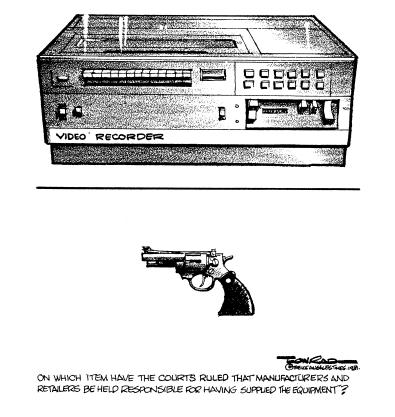
Larry Lessig put this cartoon in Free Culture to illustrate how Americans are (and Canadians are contemplating) regulating these two tools differently.

I love the image because of the clarity it brings to the debate… in ths US. What I’d love though is to find an image that might reasonate with us Canadians – if you have any suggestions please pass it along!

betamax%20vs%20gun

[tags]opensource, lessig, copyright[/tags]

If you only read one book – make it Free Culture

If you haven’t read Free Culture… do. In summary, it outlines the already raging battle being fought over who controls the infrastructure that sustains creativity. Sound unimportant? Think again.

If we are moving from an information society to a creativity society (as argued by the likes of Max Wyman in Defiant Imagination and Richard Florida in Rise of the Creative Class) then determining who is allowed to be creative, and how they are allowed to be creative, is possible the most important question confronting us. It’s answer will determine not only the rules of our economy, but the shape and nature of our culture and communities.

Moreover, because this battle will shape our capacity to think about, and respond to, every other issue, it may be the most important fight of our day.

So to celebrate this book (and its author, Lawrence Lessig), I’ve written this review, and have planned for a week of “Free Culture, not Permission Culture” posts!

[tags] Lessig, Free Culture, Copyright[/tags]

Toronto Star op-ed on Prime minister and the afghan prisoners

Thursday’s blog piece “the prime minister, the taliban and human rights” was published in the Toronto Star today as an op-ed. You can catch the Star’s version here.

My fear is that this piece will never attract any conservative readers (not because it is in the Toronto Star, but because it is critical of Harper). The fact is, this is an important issue. Ensuring our PoW’s are treated in accordance with the Geneva Convnetion is an essential tactical and strategic tool for our soldiers in Afghanistan. Ethics and values aside, it would be a mistake to discard even on purely military grounds, especially to simply win some small political points at home.

However unlikely the possibility, if the PMO reads this piece I’d understand why they might get angry. That said, I hope it doesn’t prevent them from taking its underlying advice to heart. This is not a partisan issue, this is a “how do we achieve success and protect our soliders in Afghanistan” issue.

(Updated 10:38AM PST) Want to say thank you to the numerous friendly emails. Also my friend Taylor Owen sent me this fantastic piece, which highlights how the current British PoW crisis in Iran feeds off this problem as well…

Liberal Renewal Commission – Report on Civic Engagement

As I discussed in this earlier post the Liberal Party has not published all the Renewal Commission Reports. Of those not published I had thought you could only download the Aboriginal Task Force Paper and the Environmental Task Force Paper.

Apparently, the paper by the task force on Civic Engagement has also been available for some time via its commissioner’s website. You can download it directly here.

Sadly, none of the above reports have been translated…

[Tags] Politics, Public Policy, Liberal Renewal Commission[/Tags]

Is the Conservative Budget Liberal?

Coyne appears to have given up on trying to distinguish Liberals politicians from Conservatives. This piece on the budget is acidic, and bang on.

Ever since I saw Coyne speak at the Canada2020 conference I’ve been reading him and enjoy his perspective. Also, a big shout out to Rikia S. for passing it along, thanks!

(10:00AM PST Update) Just saw Ibitison’s piece on the budget, entitled “A Budget so Liberal the Grits Should Sue” which seems to also agree. Open line is also stinging: “How Liberal is this allegedly Conservative budget? It’s so Liberal that it actually revives the sponsorship program.”