Category Archives: canadian foreign policy

Noam Chomsky name drops Taylor Owen

Check out this video of Noam Chomsky dropping my man Taylor Owen‘s name over and over again in regards to the excellent article he and Ben Kiernan wrote in The Walrus about the scope and impact of the bombing of cambodia.

Definitely check out the article if you haven’t already – it outlines a compelling case for why bombing campaigns are so problematic against insurgencies. It is a thread that Taylor and I picked up on in this op-ed in Embassy magazine last May.

name dropping begins around minute 46 – you can skip straight to it

Think Tank Watch

Did a brown bag lunch today at the Department of Foreign Affairs on network centric policy making. All kicked off by last week’s blog post on foreign policy as a disruptive innovation problem and the new world order. Great to reconnect with the department, make some new friends and meet up with some old ones.

Lots of interesting discussion which helped push some of my thinking and that I will try to blog on soon.

In the meantime, Daryl C. introduced me to Think Tank watch. A weekly service provided by the dept and its embassies. Think Tank Watch is a survey of what Think Tanks in the US, the UK and Canada are producing along with links to the articles and content. What would be great is if they also had the content on a website with an RSS feed.

To sign up for Think Tank Watch US just send email to this address asking to be on the list.

For Think Tank Watch UK send it here and for Think Tank watch Canada click here.

Another cool fact about Foreign Affairs? Free wifi in the lobby. It is, admittedly, a small thing. But it is an example of the fact that someone, somewhere in the department, understands the importance of connectivity.

It’s a positive sign and an concept that some other departments have yet to grasp.

Canadian Foreign Policy as a Disruptive innovation problem

After having a long brain storm session with some people interested in the future of Canadian Foreign Policy was inspired to write this thought experiment.

Perhaps a helpful way to frame our current Foreign Policy ennui is to see the Canadian Department of Foreign Affairs and International Trade (DFAIT) as facing a challenge analogous to that discussed in The Innovators Dilemma – sometimes referred to as disruptive innovation.

Disruptive innovations are products or services that rather than simply evolving, overturn the existing dominant approach in a marketplace. Often the disruptive innovations starts off serving the low end of the market but it eventually matures and serves more demanding and larger clients pushing the established players out of business.

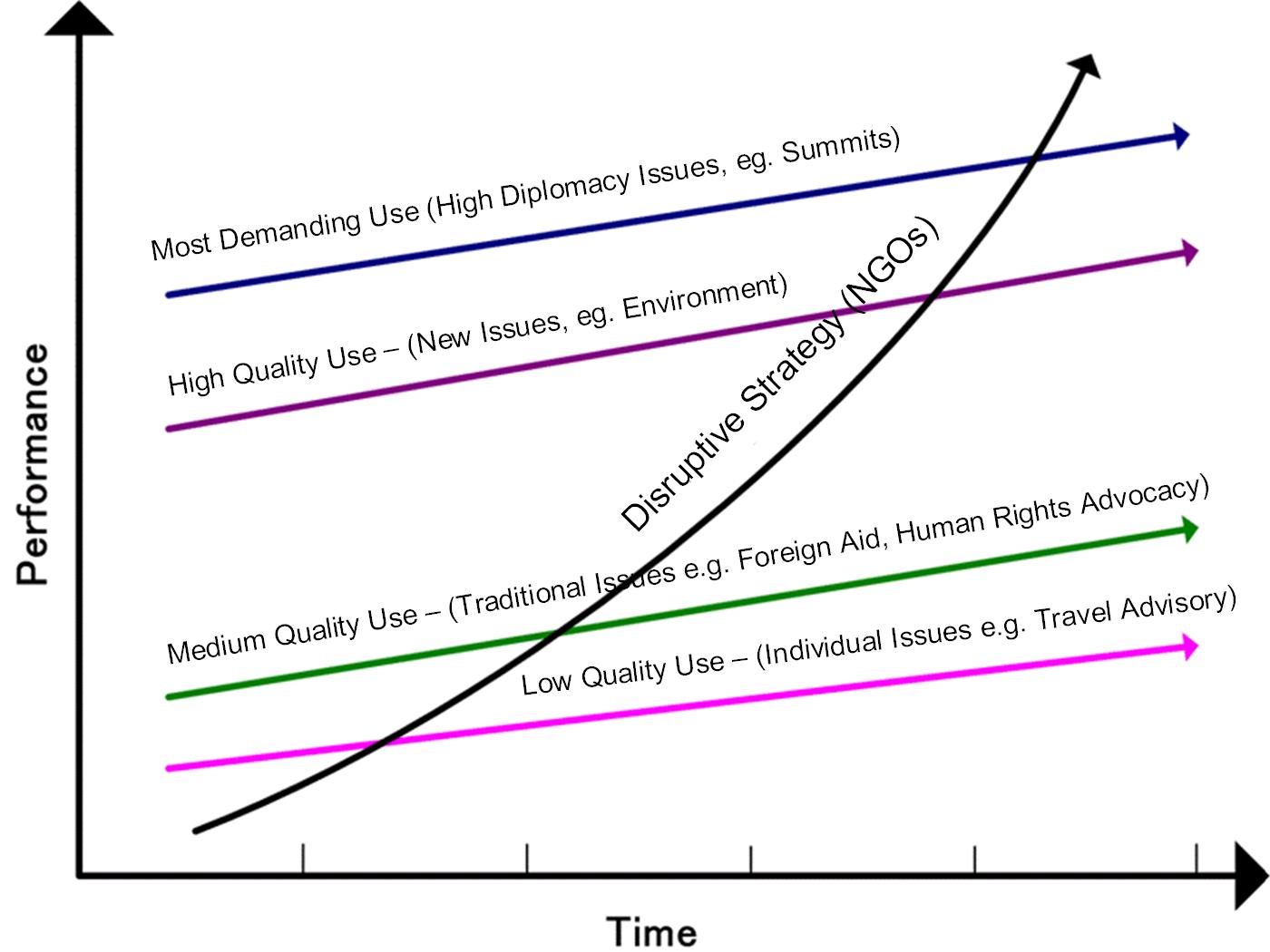
What does this have to do with DFAIT? Consider the graph below (a play on the wikipedia page graph). It used to be that DFAIT served four segments – from low quality all the through to the most demanding use. And yet, over the past decades other actors – sometimes in the private sector, but more frequently NGOs – began to offer services that more effectively deliver what political masters, or more often, citizens, were looking for. At first this was true merely of the lowest tier, travel agencies and news groups began to tell people where was safe and unsafe to travel and so the government ceased being a primary resource for this. Then NGOs began to effectively deliver services in the more traditional areas of advocacy and programs. Increasingly the government has retreated from that space. More recently, you’ve seen NGOs actually take the lead by moving into new areas of debate and creating supporting documentation for critical actors. At the same time you’ve seen other ministries become significantly more active in the management of “international files” that overlap with their areas of focus (eg. Health or the Environment).


Disruptive 3

This is classic innovators’ dilemma. A challenge to DFAIT from a community using a strategy that initially seemed marginal (and even helpful because it alleviated it of performing mundane tasks) has evolved into a true competitor, appealing (usually more effectively) not only for the hearts and minds of Canadians, but for the attention of other ministries and key influencers.

The real question is how does DFAIT compete? Again this is a thought experiment – I’m regularly impressed by the work done my people (many of them friends) at DFAIT. But the department has suffered over the past decade. It should be asking itself: can a (and how should a) centralized bureaucracy compete against an ecosystem of NGOs and other actors? DFAIT may be able to retreat to performing in only the “most demanding use” areas – but there is no guarantee that even this space is completely safe (although the government will maintain a monopoly on certain areas).

The real challenge as outlined in the Innovators Dilemma is that innovation is often difficult, if not impossible for the incumbent actor. One thing that gives me hope is that the department may shrink, helping it become more nimble. For example, I’m pleased to hear that International Trade may be heading over to Industry Canada. This makes all the sense in the world – can anyone today legitimately claim that there is a real difference between domestic and international industrial policy?

Smaller, leaner, and more partner oriented. I suspect one way or another this is the future of Foreign Policy. The question is, can Foreign Affairs innovate its way into that space? The author of the innovators dilemma isn’t optimistic – but then they were writing about private companies that could go bankrupt, not government ministries that can live on as the undead for extended periods of time… hardly an outcome Canadians or our Foreign Service officers, deserve.

Another foreign policy issue not on the election radar

I have a piece in Embassy Magazine today lamenting the fact that US-Canada relations are likely in for some significant changes over the next few years… and we’re unlikely to do much in the way of planning.

Certainly no one on the campaign trail is going to be talking about it.

Embassy, September 24th, 2008
OPED

Why Canada-U.S. Should Be an Election Issue

By David Eaves

Canada’s relationship with the United States has always experienced ebbs and flows. The question is not how do we prevent this cycle, but how Canadian governments choose to manage it?

And manage it we have not. Not since the Trudeau era has Canada been more marginal to debates in Washington. Even the basic elements that once kept the relationship running smoothly—such as quarterly meetings between senior Canadian and American officials—no longer occur. Consequently, when issues arise that relate directly to Canada—such as on the environment, protectionism, or energy security—our voice is frequently absent.

Today, Canada engages the United States not as a strategic partner, but as yet another country with a laundry list of complaints. Be it the border or softwood lumber, our concerns may be justified, but the tone and message is problematic: we have a concern, and you are the cause.

There are understandable reasons for this state of affairs. Over the past eight years, the United States has pursued policies, from Iraq to Kyoto, that, to understate the problem, made the vast majority of Canadians uncomfortable.

But the Bush era is coming to an end. And with elections taking place on both sides of the border, the political map of North America could look dramatically different by the end of November. A McCain or, more dramatically, an Obama administration could mark the beginning of a number of important policy shifts. Issues critical to Canada, and the Canada-U.S. relationship, will likely be reviewed. More importantly, policies that will shape the future of North America will be decided, with or without our participation.

Among the most important of these issues is energy security, something both presidential candidates have stated they will prioritize. As America’s largest energy supplier, Canada will factor significantly in these plans. In addition, at some point, a North American carbon regime will likely emerge, the environmental implications of the tar sands will need to be confronted, businesses will want to further facilitate the movement of goods and people across the border and, of course, Canadian and Americans will need to co-operate to ensure success in Afghanistan, especially as the United States refocuses its energies there. This is to say nothing of the unpredictable events and issues that will inevitably spring up.

And yet, none of the prime ministerial candidates will talk about renewing our relationship with the United States. The subject is simply too unpopular, and the outcome of the U.S. election too unpredictable. So at the very moment, when a plan and vision is most required from our leaders, when the opportunity for renewal is emerging, Canadians are least likely to receive one.

Perhaps others can begin strategizing and preparing. Canadians should hope so, for such a renewal is not only necessary but possible. In a recent Policy Options piece on renewing the Canada-U.S. relationship, Robin Sears notes: “Imagine the vision, the courage and imagination that it took in the harsh winter of European famine of 1947-48 for two powerless French statesmen to sit in a Paris café and begin to plan for a united Europe!”

Today, despite our differences, Canadians and Americans face not even a fraction of the obstacles that confronted Schuman and Monnet, nor do we want to even contemplate a vision half as grand.

Such planning will, as always, require Canadian leadership. Part of this is because of the asymmetric impact of any resolution. For Canadians the magnitude of the challenges is simply fundamental, but to America they are but a few of many pre-occupations. Their chess board is simply vastly more complex. But for domestic reasons, the Canadian public will demand their government lead, not follow, the Americans.

Somewhere in Ottawa, I hope, there is the Canadian equivalent of Schuman or Monnet, who see the opportunity and are planning a strategy to manage the next generation of Canada-U.S. relations. One thing is for certain, no one on the campaign trail will be.

David Eaves is a frequent speaker, consultant and writer on public policy and negotiation.

The challenge of Wal-Mart – the challenge of America

Just finished reading The Wal-Mart Effect by Charles Fishman and thoroughly enjoyed it. So much to discuss and share, which I intend to, in a future post. Right now, I’ve just landed in Chicago about 4 1/2 hours later than planned and it’s late so I’m going to head to bed.

The one thought I wanted to throw out there was that this book – which beautifully dissects the strengths and weaknesses of Wal-Mart (hint, they are one and the same) is a fantastic microcosm of the two critical challenge facing America at the start of the 21st century.

The first, centres around if and how America will renew its social contract in the face of globalization and the existence of companies like Wal-Mart that are simply so much larger in scale than anything it has previously experienced. This challenge is made all the more complex by the fact that despite being a retailer, Wal-Mart is, at its core, an information company. The story of Wal-Mart is the story of America’s transition from the industrial to the post-industrial era (I think this is fascinating because of course no one sees Wal-Mart as an information age company but it is a much more accurate reflection of what this change looks like than say, the story of MicroSoft).

The second has to do with how isolated Wal-Mart is from American mainstream culture (and by extension the world’s) and America’s isolation from the world’s culture. Check out these lines from the last few paragraphs of the book:

“No one likes to hear or read an accounting of his or her faults. Most of us would wave off such blunt recital, or avert our eyes. But Wal-Mart needs to continue to try to listen to what Americans are saying about it, and we have a responsibility to continue to insist on accountability.

What Wal-Mart is trying to do, really, is engage the world, understand the world, meet its customers and suppliers in a different setting than shelf price. To do that, Wal-Marters need to travel, to routinely get out and hear what people say about them-in city council meetings, in industry conferences, at public forums. The transformation of Wal-Mart itself must come from the buildings in Bentonville [it’s HQ], yes: but the motivation for change can’t be found in the supplier meeting rooms or the streams of sales data, no matter how cleverly analyzed. The motivation for change will be found in the passion of customers and vendors-the ones who like Wal-Mart, the ones who don’t like Wal-Mart but can’t resist, the ones who define themselves by their refusal to deal with Wal-Mart, the ones who fear Wal-Mart.

For Wal-Mart to really change, it needs to be able to see itself as we see it, it needs to see the world clearly, it needs to look out.”

Substitute Wal-Mart for America and think about this as not the marketplace, but the global stage and you pretty much sum up the challenge of America. The country no longer can see itself the way the rest of the world does – and it needs to, if it is going to play the role we need it to play. America, like Wal-Mart, is neither inherently good or evil, it is simply an increadibly powerful force that needs to figure out how it is going to choose to make its actions felt. And we all have a responsiblity in shaping those choices. Americans’ or not.

left wing tonic for Michael Byers

Recently I’ve been reading more and more of Policy Options. I’m not a reading every issue (although I’m not trying to) but I am enjoying much of what I do get through.

Going way back to the February issue there was an article by Robin Sears entitled “Canada in North America: From Political Sovereignty to Economic Integration.” The piece was a hard assessment about the limits of Canadian sovereignty and economic independence in light of our geographical position next to the United States. He notes that our position is one where we must work with our American cousins and try to gain as much influence as possible – a bold statement these days – but one that remains true. Perhaps no more so today. When things are at their worst (and I’ll admit, they are) that’s precisely when we need a map for a better path. As Sears points out…:

Imagine the vision, the courage and imagination that it took in the harsh winter of European famine of 1947-48 for two powerless French statesmen to sit in a Paris café and begin to plan for a united Europe! …They reflected grimly on “the success of the victorious Allied powers” in Europe.

The continent was being savaged by Soviet armies in the east and staggered under starvation in the west. The only European unity any rational person could foresee was a shared visceral hatred of Germany and everything it had stood for. The miracle that was the Marshall Plan was still in the future. Germany was a decade away from its economic leap forward. England, torn by its loss of empire, with its special relationship with the United States and its eternal ambivalence about Europe, was unreliable.

The simple fact is, we are stuck on this north american rock with the a powerful neighbor who knows little about us, and cares less and less every day. The only thing that will be worse is when they suddenly do care about us – like our border after 9/11. Sears’ is at pains to find ways to foster political structures to promote cooperation between Canada and the United States and he’s right. We need them. Those who wish to die at the altar of sovereignty, preserving it absolutely at no matter what cost, will find that they have significantly less influence, not only abroad, but at home as well. Worse, sovereignty is usually not what they care about. In perhaps the pieces most biting line, Sears points out:

“Canadian nationalists trying to ring-fence our sovereignty are engaged in an especially ironic struggle, given their citizenship in the nation that invented the modern, more supple form of sovereignty: federalism. Those who are most determined to draw deeper lines in the ongoing crusade against American encroachment on our national sovereignty are often the strongest advocates of Canada’s leadership in the development of global governance through multilateral institutions. The contradiction reveals less about their convictions about sovereignty than about their plain vanilla anti-Americanism.”

Ouch.

The piece is interesting and worth reading on its own merits. But what makes it still more compelling is its author. So who is this man? Excellent question. First, despite the article’s bent, analysis and conclusion, he’s not a Conservative. No, for the uninitiated (like me) Robin Sears was the national campaign director of the NDP during the Broadbent years and served as Bob Rae’s chief of staff when he was premier. He was also Deputy Secretary General of the Socialist International. For those on the left whose only prescription to our geographic conundrum is to seal the border and throw away the key (a proposition that would see no end of pain for the Canadian economy) it is interesting to find those, on the same side of the spectrum, who disagree. I hope we see more of them… frankly the debate needs their perspective.

The Conference of Defence Associations – Thinktank?

So I really wanted to write on Public Service Sector Renewal after last thursday speech – but it will have to wait a day or two because…

On Saturday I received my weekly email from the Conference of Defence Associations (CDA) with links to the week’s various defence related articles. Normally each article includes a link, a descriptive sentence and more rarely, a guide to the piece’s most relevant paragraphs or chapters. I was pleased to see that it included Taylor and I’s Embassy Magazine op-ed on the potential impact of aerial bombing on the insurgencies in Afghanistan.

I was displeasing however, to see that our article was the only one that included an editorial comment warning CDA members about or piece’s thesis. Below is a brief sample the suggested articles, ours is at the very end.

Much has been made in the media in the last week about reports that Canadian military personnel were ‘negotiating’ or ‘reaching out’ to the Taliban. Tara Brautigam for the Canadian Press reports Defence Minister’s Peter MacKay’s denial that Canadian soldiers were doing so, while Ryan Cormier for Canwest writes that Canadian soldiers’ outreach activities to Afghan civilians may have been misconstrued as negotiations with the Taliban.

Colin Freeze in the Globe and Mail reports on the issue of rules surrounding CSIS activities in Afghanistan.

James Travers in the Toronto Star explores the ability of individuals with “smarts and chutzpah,” such as General Rick Hillier and Auditor General Sheila Fraser, to “lever limited institutional authority into sweeping informal influence.”

Taylor Owen and David Eaves in Embassy draw parallels between the impact of aerial bombardment of Cambodia in the late 1960s and early 1970s and today in Afghanistan. The CDA urges its readers to not draw hasty parallels between two very different conflicts.

Glad to know that the CDA is there to inform their readers what to think.

This would conform with a larger trend however. I’ve noticed that the CDA tends to highlight articles that praise the Canadian military and more importantly, the mission in Afghanistan, rather than those that cast a critical eye. If it really is a clearing house for debate on the military you’d think that articles critical of the mission, and its execution, would more frequently find their way into its email list. While I haven’t done a statistical sampling, my anecdotal survey suggest they do not. When they do, they often include editorial comments from the Executive Director downplaying them.

If you are interested in this debate others have questioned the independence of the CDA, noting that it receives significant funding from the Department of National Defence (ay $100,000 a year at last check), and others have defended it.

For myself, both perspectives are correct. Although the CDA has been broadly supportive of the Afghan mission it has, at times, provided throughtful critiques. But I’m not concerned by the CDA’s discussions about how the war is prosecuted, this is at least a defence related issue. What I am concerned about is the CDA’s discussions about if the war should be prosecuted, as these are often political issues. A scan of the webpage of the CDA’s publications on Afghanistan reveals several letters and articles outlining why Canada should be in Afghanistan and why it shouldn’t pull out. Again, these are political decisions. It strikes me as problematic that an agency directly funded by the government echoes that government’s position (both Liberal and Conservative) while presenting itself to the press and public as independent.

Afghanistan Another Iraq? Try Another Cambodia

Taylor and I had the following oped published in this week’s Embassy magazine.

Afghanistan Another Iraq? Try Another Cambodia

By Taylor Owen and David Eaves

Of the many complexities to emerge from our mission in Afghanistan, one is particularly troublesome. Almost one-third of the Taliban recently interviewed by a Canadian newspaper claimed that at least one family member had died in aerial bombings in recent years, and many described themselves as fighting to defend Afghan villagers from air strikes by foreign troops.

This should come as no surprise. Last year, the UN reported that over 1,500 civilian were killed in Afghanistan. In the first half 2007, this casualty rate had increased by 50 per cent. The NGO community and NATO remain at odds over who is accountable for a majority of these deaths.

What is indisputable, however, is that air sorties have increased dramatically. According to the Center for Strategic and International Studies, sorties doubled from 6,495 in 2004 to 12,775 in 2007. More critically, aircraft today are 30 times more likely to drop their payloads than in 2004.

Civilian deaths are a moral tragedy. Equally importantly, however, they represent a critical strategic blunder. It has long been known that civilian casualties benefit insurgencies, who recruit fighters with emotional pleas. While an airstrike in a village may kill a senior Taliban, even a single civilian casualty can turn the community against the coalition for a generation.

This presents military commanders with an immensely challenging dilemma: Accept greater casualties in a media environment where any and all are scrutinized, or use counterproductive tactics that will weaken the enemy in the moment, but strengthen him over the long term.

While the choice is almost impossibly difficult, it is not new. Surprisingly, the case of U.S. air strikes in Cambodia offers a chilling parallel.

Between 1964 and 1973, the U.S. dropped over 2.7 million tonnes of munitions on Cambodia, making it potentially the most bombed country in history.

While the scale is shocking, the strategic costs were devastating. Over the course of the bombing period, the Khmer Rouge insurgency grew from an impotent force of 5,000 rural fighters to an army of over 200,000, capable of defeating a U.S.-backed government.

Recent research has shown a direct connection between casualties caused by the bombings and the rise of the insurgency.

Because Lon Nol, Cambodia’s president at the time, supported the U.S. air war, the bombing of Cambodian villages and the significant civilian casualties it caused provided ideal recruitment rhetoric for the insurgent Khmer Rouge.

As civilian casualties grew, the Khmer Rouge shifted their rhetoric from that of a Maoist agrarian revolution to anti-imperialist populism.

This change in strategy achieved stunning results. As one survivor explained:

“Every time after there had been bombing, they would take the people to see the craters…. Terrified and half-crazy, the people were ready to believe what they were told…. It was because of their dissatisfaction with the bombing that they kept on co-operating with the Khmer Rouge, joining up with the Khmer Rouge, sending their children off to go with them.”

Compare this to what one Taliban fighter explained to a Globe and Mail researcher: “The non-Muslims are unjust and have killed our people and children by bombing them, and that’s why I started jihad against them. They have killed hundreds of our people, and that’s why I want to fight against them.”

The coalition risks repeating the same mistakes, and like the Khmer Rouge 30 years ago, the Taliban are capitalizing on its misguided tactics.

Amazingly, in Cambodia, American administration knew of the strategic costs of the bombing. The CIA’s Directorate of Operations reported during the war that the Khmer Rouge were “using damage caused by B-52 strikes as the main theme of their propaganda.” Yet blinded by grandeurs of military might, the sorties continued.

The Khmer Rouge forced the U.S. out of Phnom Penh, took over the country, and the rest is a tragic history.

We know our tactics in Afghanistan have a similar effect. Civilian casualties drive a generation into the hands of an insurgency we are there to oppose.

Initially Canada deployed without Leopard tanks and CF-18s with the goal of prioritizing personal engagement and precision over brute military might. Today, however, our allies’ tactics—and increasingly our own—do not adequately reflect strategic costs incurred by civilian causalities. In addition, Canada has not allied itself with other NATO members—particularly the British—to reign in the coalition’s counterproductive use of aerial bombings.

Cambodia offers a powerful example of aerial warfare run amok. What is Canada doing to ensure we don’t relive the failures of the past?

Taylor Owen is an Action Canada fellow and a Trudeau Scholar at the University of Oxford. David Eaves is a fellow at the Centre for the Study of Democracy at Queen’s University.
The Border: Something there is that doesn't love a wall…

It would appear that even the Americans are beginning to notice that a tighter border is a drag on everyone.

My suspicion… that once the current president is gone, some of the more stricter proposals (such as the neccessity of a passport when crossing by land, may be dropped. At the very least there is a window of opportunity come January 2009. I hope the department of foreign affairs has its briefs ready for the new administration and is corralling northern governors and senators, getting them ready to jump into the fray in support of the cause.

Forum on April 24th: Global City, Global Citizens

Next Thursday, April 24 I’ll be part of the respondent panel for Global City, Global Citizens, a Forum organized by Vision Vancouver. The event will take place at the Vancouver Public Library and will begin at 7.30 p.m.

Global City, Global Citizens will cover a range of international issues that Vancouver faces in the 21st century.

Moderated by Geoff Meggs the Forum will open up with a presentation by Michael Byers, professor at the Liu Institute of UBC, author of Intent For a Nation. (Taylor Owen and I wrote a review of Michael’s book in Embassy Magazine – you can read the Embassy version here, or an extended version on this blog.

After Michael’s presentation, I and Monica Urrutia – of the Philippine Women’s Centre – will offer a response. Discussion will then open up to the public.

If you are interested in the event I hope you’ll come down and join us.