Category Archives: public policy

Think Tank Watch

Did a brown bag lunch today at the Department of Foreign Affairs on network centric policy making. All kicked off by last week’s blog post on foreign policy as a disruptive innovation problem and the new world order. Great to reconnect with the department, make some new friends and meet up with some old ones.

Lots of interesting discussion which helped push some of my thinking and that I will try to blog on soon.

In the meantime, Daryl C. introduced me to Think Tank watch. A weekly service provided by the dept and its embassies. Think Tank Watch is a survey of what Think Tanks in the US, the UK and Canada are producing along with links to the articles and content. What would be great is if they also had the content on a website with an RSS feed.

To sign up for Think Tank Watch US just send email to this address asking to be on the list.

For Think Tank Watch UK send it here and for Think Tank watch Canada click here.

Another cool fact about Foreign Affairs? Free wifi in the lobby. It is, admittedly, a small thing. But it is an example of the fact that someone, somewhere in the department, understands the importance of connectivity.

It’s a positive sign and an concept that some other departments have yet to grasp.

Canadian Foreign Policy as a Disruptive innovation problem

After having a long brain storm session with some people interested in the future of Canadian Foreign Policy was inspired to write this thought experiment.

Perhaps a helpful way to frame our current Foreign Policy ennui is to see the Canadian Department of Foreign Affairs and International Trade (DFAIT) as facing a challenge analogous to that discussed in The Innovators Dilemma – sometimes referred to as disruptive innovation.

Disruptive innovations are products or services that rather than simply evolving, overturn the existing dominant approach in a marketplace. Often the disruptive innovations starts off serving the low end of the market but it eventually matures and serves more demanding and larger clients pushing the established players out of business.

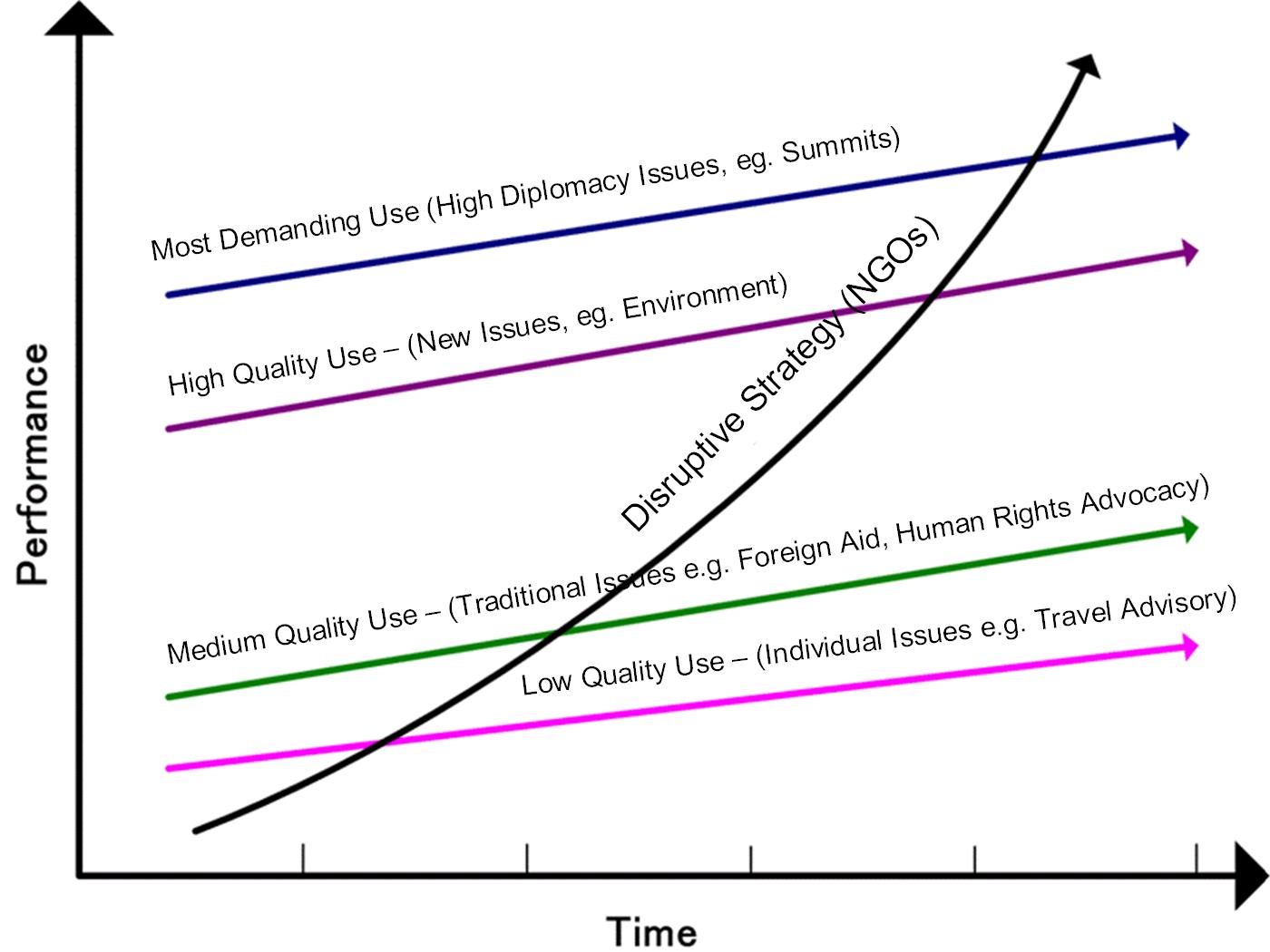
What does this have to do with DFAIT? Consider the graph below (a play on the wikipedia page graph). It used to be that DFAIT served four segments – from low quality all the through to the most demanding use. And yet, over the past decades other actors – sometimes in the private sector, but more frequently NGOs – began to offer services that more effectively deliver what political masters, or more often, citizens, were looking for. At first this was true merely of the lowest tier, travel agencies and news groups began to tell people where was safe and unsafe to travel and so the government ceased being a primary resource for this. Then NGOs began to effectively deliver services in the more traditional areas of advocacy and programs. Increasingly the government has retreated from that space. More recently, you’ve seen NGOs actually take the lead by moving into new areas of debate and creating supporting documentation for critical actors. At the same time you’ve seen other ministries become significantly more active in the management of “international files” that overlap with their areas of focus (eg. Health or the Environment).


Disruptive 3

This is classic innovators’ dilemma. A challenge to DFAIT from a community using a strategy that initially seemed marginal (and even helpful because it alleviated it of performing mundane tasks) has evolved into a true competitor, appealing (usually more effectively) not only for the hearts and minds of Canadians, but for the attention of other ministries and key influencers.

The real question is how does DFAIT compete? Again this is a thought experiment – I’m regularly impressed by the work done my people (many of them friends) at DFAIT. But the department has suffered over the past decade. It should be asking itself: can a (and how should a) centralized bureaucracy compete against an ecosystem of NGOs and other actors? DFAIT may be able to retreat to performing in only the “most demanding use” areas – but there is no guarantee that even this space is completely safe (although the government will maintain a monopoly on certain areas).

The real challenge as outlined in the Innovators Dilemma is that innovation is often difficult, if not impossible for the incumbent actor. One thing that gives me hope is that the department may shrink, helping it become more nimble. For example, I’m pleased to hear that International Trade may be heading over to Industry Canada. This makes all the sense in the world – can anyone today legitimately claim that there is a real difference between domestic and international industrial policy?

Smaller, leaner, and more partner oriented. I suspect one way or another this is the future of Foreign Policy. The question is, can Foreign Affairs innovate its way into that space? The author of the innovators dilemma isn’t optimistic – but then they were writing about private companies that could go bankrupt, not government ministries that can live on as the undead for extended periods of time… hardly an outcome Canadians or our Foreign Service officers, deserve.

The New World Order: Flat, Spiky or Divided?


Just started Who’s Your City by Richard Florida out of personal interest but also to better figure out why it is the Vancouver sometimes works, and sometimes really doesn’t work. Figuring out that puzzle, and doing something is part of the reason I joined Vision (and yes, I’m still recovering from the victory celebrations).

I’m already sensing a convergence between Florida and some of my other favourite authors – namely Friedman (who Florida references) and Thomas Barnett (author of The Pentagon’s New Map among other books).

All three are noticing the same thing, and are even writing along similar veins, but there remain important distinctions, with important policy implications.

Flat: Friedman (whom I’m least familiar with) says the world is flat, that innovation, industry, commerce, etc… can now happen anywhere, so we have to prepare for a flat world. Here, I’d argue the core unit of analysis is the individual. We are all free agents, able to do anything or be anything, so we’re going increasingly going to start doing it anywhere. Yes, Friedman believes that governments and industry have massively important roles, but he ultimately sees a world where any place can become a place where people can prosper. If they agitate for it and build it.

Spiky: Florida’s analysis is that world is quite spiky, dominated by a set of mega-regions and super-cities where the bulk of the economic activity and culture is produced. These hubs are connected to one another and largely uncaring of the enormous economic valleys that separate them. For Florida, the fundamental unit of analysis is the city (or mega-region). These determine where power and influence will flow. Importantly, mega-regions cannot be constructed overnight – indeed there is a powerful self-reinforcing mechanism at work. Mega-regions attract talent from around the world, both further increasing their status and starving smaller cities and regions of the key resource – social capital – they need to grow. Individuals are important – but only in so far as they cluster. Countries are important too – in the Friedman sense that they create a generally favourable atmosphere – but they are not critical to the equation.

Divided: Barnett sees a divided world. One on the one side is the Functioning Core, characterized by economic interdependence and incentives to abide by rules, one the other is the Non-Integrated Gap characterized by unstable leadership and absence of international trade and weaker incentives to abide by international rule sets. Barnett’s primary unit of analysis is the state. He is principally concerned with the impact of globalization (and the rule-sets it creates) on state actors – how it constrains them and incents them to behave certain ways. In this world citizens are influence, but it is connectivity, largely (but hardly completely) determined by the state that matters most. Convince a state to connect with the world, and it’s path towards free market democracy (or some close variant) is predetermined.

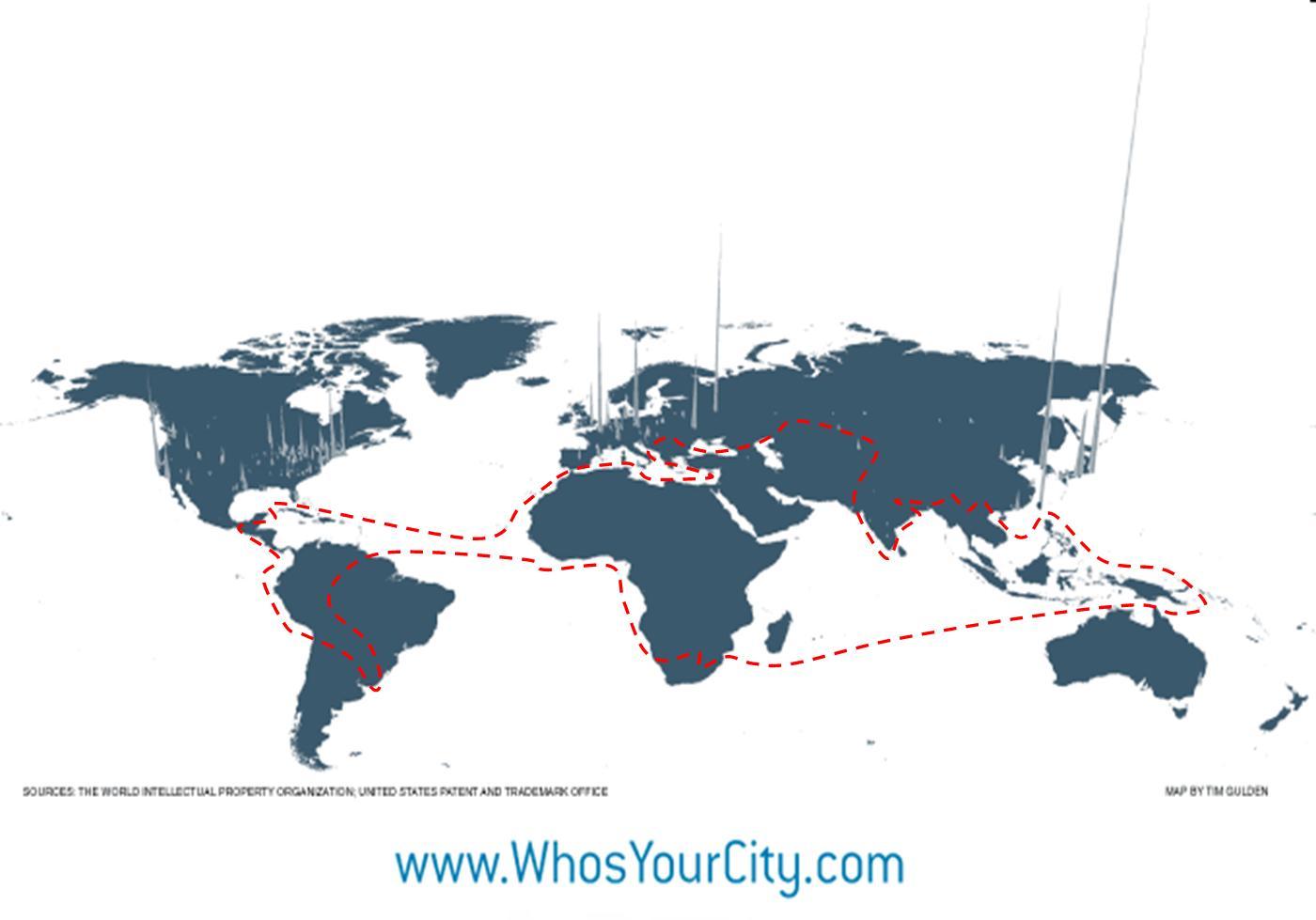
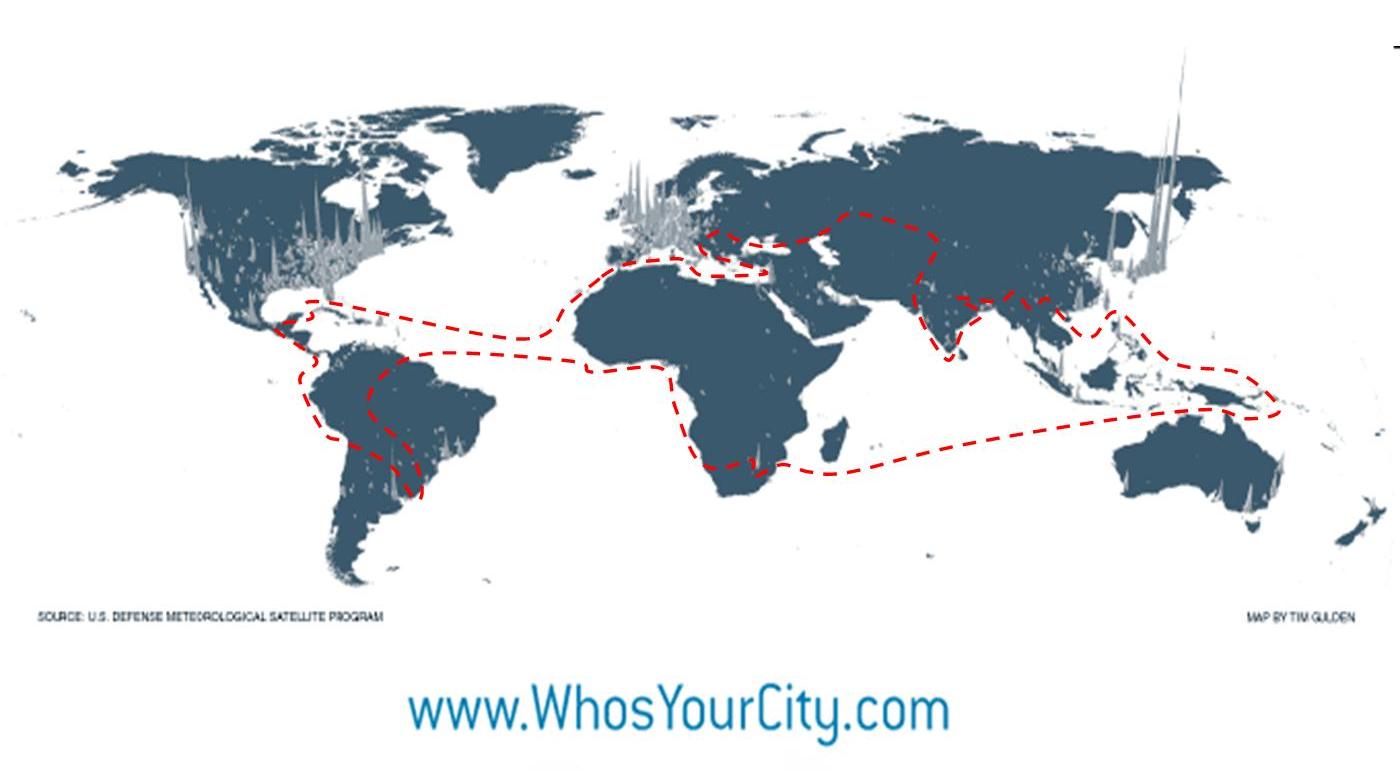
I had so much fun mashing up the Firefox download map with Barnett’s map (and had an incredible response) I thought I’d try to do the same again but with these three authors. Below is a Flat World, overlaid with Spiky depiction of where the most innovation (patents) occurs, overlaid with Barnett’s division between the Function Core and the Non-Integrated Gap. Hoping to write more about these three views of the world over the coming weeks.

What’s interesting about the map’s below is that Barnett and Florida correlate quite nicely. And while they are complimentary I think it Florida’s reinforces the best critique of Barnett’s map I’ve read to date:

“Connectedness is a network property and networks are fractal not contiguous. There is no contiguous region that is disconnected. Within each disconnected country there are islands of connection and within each connected country there are islands of disconnection. This is true at all levels, continents, nations, regions, cities, and companies, right down to individuals. There are terrorist cells in US cities fighting to disconnect the world and Journalists with satellite cell phones in remotest Afghanistan, Iraq, and Somalia working to connect everything.”

I’m willing to bet almost anything that Florida’s maps follow a power law distribution. And the above description – well in Florida’s map there are valleys of non-innovation and non-connectivity within Barnett’s Core. The question is: Can the Mega-Regions assert enough control over these values to ensure their rule-sets are followed?

Innovation (# of patents)

Flat spiky and divided

Connectivity (Light Based Regional Product per Square Kilometer)

Flat spiky and divided (econ)


Liberal Renewal: Indentify good questions, not answers

The following was a memo I wrote for some friends back in May, 2006 as the Liberal Renewal Commission was just getting going. I was sensing that we needed a process that was emergent – one that leveraged its reputation (and meager resources) not to do something top down, but facilitate something bottom-up.

Recently a friend asked me to dig it up. After a little touch up, I thought I’d post it, as I believe much of it is as true to today as it was two years ago.

Memo: How Can the Liberal Party Renewal Committee maximize its impact?

Most Liberals agree the party needs to re-examine its policies, priorities and ideology to ascertain what, if anything, must change to enable the it to regain office.

The process and output of the Renewal Committee will determine its reception both among party members and the leadership candidates. This one pager assessment will argue that, to maximize its impact the committee should help define the debate liberals – through their leadership candidates – must have, not resolve it.

A robust output that outlines a new liberal party platform will likely have little impact. First, leadership candidates will be disinclined to use it. Adopting the committee’s recommendations could either damage the candidates credibility as an innovative thinker (they are ‘borrowing’ someone else’s work) or, more likely, candidates will ignore the recommendations as they won’t allow them to distinguish themselves from their opponents. Second, for a liberal party platform to be credible it must, in some capacity, emerge and/or receive buy-in from the grassroots of the party. This isn’t a plea for wide spread consultations. However, the opposite, hand picking a group of ‘best and brightest’ risks alienating members not included in the process and undermines the democratic ideals that should be core to the party’s DNA. Sitting on the civic engagement committee, I am forced to wonder how does this process measure up against the standards of engagement our policy recommendations will suggest for government programs?

How then can the Renewal Committee have impact, in the midst of a leadership race and without conducting broad, time consuming and questionably helpful consultations?

The liberal party does not need answers. The key to solving any problem, including the renewal of the Liberal Party and the creation of a platform, it is in ascertaining the right questions. The Renewal Committee should thus do two things: 1) Determine what, for each sub-committee topic, are the three emerging questions ANY political party must possess answers for to be the dominant Canadian political force in the 21st century. 2) Provide some criteria for an effective answers and some initial insights. Committee members could then publicly sign a letter committing themselves to pressing the leadership candidates for answers to each of the questions – a test to their capacity for leadership of the party and country for not just the next election, but for the 21st century.

This approach will maximize the impact of the committee by enabling it to provoke a real debate within the leadership race and, ultimately, among party members. If the commission simply provides answers it will  alienate the leadership candidates and the party at large. By asking questions it can attempt to position itself as a force for thinking about and opening up, the debate over liberalism and ideas. Moreover, by asking questions it enables all members to participate in this process – by proposing answers – and can ensure that the issues the committee believes to be essential to renewal are placed front and centre.

Another foreign policy issue not on the election radar

I have a piece in Embassy Magazine today lamenting the fact that US-Canada relations are likely in for some significant changes over the next few years… and we’re unlikely to do much in the way of planning.

Certainly no one on the campaign trail is going to be talking about it.

Embassy, September 24th, 2008
OPED

Why Canada-U.S. Should Be an Election Issue

By David Eaves

Canada’s relationship with the United States has always experienced ebbs and flows. The question is not how do we prevent this cycle, but how Canadian governments choose to manage it?

And manage it we have not. Not since the Trudeau era has Canada been more marginal to debates in Washington. Even the basic elements that once kept the relationship running smoothly—such as quarterly meetings between senior Canadian and American officials—no longer occur. Consequently, when issues arise that relate directly to Canada—such as on the environment, protectionism, or energy security—our voice is frequently absent.

Today, Canada engages the United States not as a strategic partner, but as yet another country with a laundry list of complaints. Be it the border or softwood lumber, our concerns may be justified, but the tone and message is problematic: we have a concern, and you are the cause.

There are understandable reasons for this state of affairs. Over the past eight years, the United States has pursued policies, from Iraq to Kyoto, that, to understate the problem, made the vast majority of Canadians uncomfortable.

But the Bush era is coming to an end. And with elections taking place on both sides of the border, the political map of North America could look dramatically different by the end of November. A McCain or, more dramatically, an Obama administration could mark the beginning of a number of important policy shifts. Issues critical to Canada, and the Canada-U.S. relationship, will likely be reviewed. More importantly, policies that will shape the future of North America will be decided, with or without our participation.

Among the most important of these issues is energy security, something both presidential candidates have stated they will prioritize. As America’s largest energy supplier, Canada will factor significantly in these plans. In addition, at some point, a North American carbon regime will likely emerge, the environmental implications of the tar sands will need to be confronted, businesses will want to further facilitate the movement of goods and people across the border and, of course, Canadian and Americans will need to co-operate to ensure success in Afghanistan, especially as the United States refocuses its energies there. This is to say nothing of the unpredictable events and issues that will inevitably spring up.

And yet, none of the prime ministerial candidates will talk about renewing our relationship with the United States. The subject is simply too unpopular, and the outcome of the U.S. election too unpredictable. So at the very moment, when a plan and vision is most required from our leaders, when the opportunity for renewal is emerging, Canadians are least likely to receive one.

Perhaps others can begin strategizing and preparing. Canadians should hope so, for such a renewal is not only necessary but possible. In a recent Policy Options piece on renewing the Canada-U.S. relationship, Robin Sears notes: “Imagine the vision, the courage and imagination that it took in the harsh winter of European famine of 1947-48 for two powerless French statesmen to sit in a Paris café and begin to plan for a united Europe!”

Today, despite our differences, Canadians and Americans face not even a fraction of the obstacles that confronted Schuman and Monnet, nor do we want to even contemplate a vision half as grand.

Such planning will, as always, require Canadian leadership. Part of this is because of the asymmetric impact of any resolution. For Canadians the magnitude of the challenges is simply fundamental, but to America they are but a few of many pre-occupations. Their chess board is simply vastly more complex. But for domestic reasons, the Canadian public will demand their government lead, not follow, the Americans.

Somewhere in Ottawa, I hope, there is the Canadian equivalent of Schuman or Monnet, who see the opportunity and are planning a strategy to manage the next generation of Canada-U.S. relations. One thing is for certain, no one on the campaign trail will be.

David Eaves is a frequent speaker, consultant and writer on public policy and negotiation.
Changed your lightbulbs? Now let's change some laws…

Just returned Sunday evening from SVI. Interesting times and interesting conversations. One quick action item to share with everyone and anyone.

Tzeporah Berman (featured in our LRC article) has started a new organization called Power Up Canada that seeks to promote the environment as an issue around which people will make their decision at the ballot box.

If you have 30 seconds today, please join (and consider donating money to) Power Up Canada.

Neo-Progressivism: The Next Political Cycle?

lrc_0908_largeSeveral months ago the Literary Review of Canada put out a request for articles about the rise of Obama and what it means for politics in general and Canada specifically. Mine and Taylor’s proposal won out and is the lead essay in this month’s edition of the LRC. Needless to say we are pretty excited.

The essay explores how the Left has been killing progressive politics. Those on the right have always been clear about their disdain for progressivism and their desire to rollback its success. On the left however, an equally strong conservatism has emerged. Fearful that any debate, or worse reform, will threaten successes of the past century many progressives have become anti-change. It is a more subtle conservatism, but it has helped foster a political environment within the left and centre-left that is defined by silence and stagnation.

But change is afoot. A new generation is challenging old assumptions. It is these same people – the neo-progressives – that helped propel Obama to the top of the democratic party. This new generation of progressives could similarly reshape Canadian politics.

You can read the article here.

ParticipAction 2.0 – Get Hal and Joanne on my Wii!

About a month ago a good friend lent me their WiiFit so that I could give it a try. I confess, I’ve become a fan.

wii-fit-01-540x540For those unfamiliar with the WiiFit it is a balance board you use with the Wii game consol to do strength building exerices, yoga, and balance games to develop flexibility, strengthen core muscles and burn calories. You can read more about the Wii Fit, its benefits and drawbacks here, and here.

The Wii Fit continues a trend of video games that find ways to get people to be active. Anyone whose tried Dance Dance Revolution, or even boxing and tennis on the Wii knows what I’m talking about. Still more amazing is how many households can now access this technology. 986,200 Wii’s have been sold in Canada as of July 1st, 2008. That is essentially one Wii for every 32 Canadians, one for every 12 households. Imagine if 1 in every 12 houses had a tread mill, or even a simple yoga video. Well, in a sense they do!

What is most interesting is that the Canadian government could help take this type of activity to the next level. Despite its success the WiiFit sufferes from a few shortcomings:

  1. there could be more exercises – ideally downloadable over the internet
  2. it would be nice if you could string together a customized series of exercises, that way you could create different workouts,
  3. the pace of the “trainers” is pretty slow, it be nice if you could eliminate their introductions and wrap ups to each exercise, by doing so you could increase the pace and a “workout” much more vigorous
  4. there could be cooler trainers guiding you during your work out
  5. it would be nice if more than one balance board could be connected to a given Wii – that way you could work out with friend(s)

180px-Participaction

In short, what we have is an increadible technology, one that touches millions of Canadians, and yet it is short on its potential. Thought of differently, every Wii Fit board, Nintendo Wii and television has the potential of becoming an instant gym.

hal_jo_06

Ideally, the community could create a game with several trainers or even “skins” – such a variety of themes could increase the appeal to different niches. I can already imagine someone grabbing and digitally editing a bunch of the old Hal and Joanne videos so that they appear to be doing exercises on the Wii balance board – one can imagine it being the must have retro cool game.What if the newly revived ParticipACTION partnered with Nintendo to create a new WiiFit game. ParticipACTION would agree to pay a discounted license fee to nintendo, and in exchange it would sponsor an open source community to create a ParticipACTION WiiFit game – one that could be cheaply distributed and customized to appeal to anyone, but especially the very kids who are most at risk of not exercising…

(the fact that, in researching this post, I discovered the participation archive project again reveals the mysteries and wonders of the internet. I mean, if there are transit geeks, why not participaction geeks?)

Injection site lies

So the conservatives have started sending around this flier which very subtly uses language to undermine the Insite injection site and harm reduction strategies. It also, of course, misleads the public about the course of action that is effective in addressing drug use. Pumping billions of dollars into a 3 decades old “drug war” that has seen drug use increase and narcotics become more available and cheaper, is portrayed as the only effective answer.

It is a fear based approach more and more people are starting to question. For example, in this piece, Mark Easton of the BBC charts how the war on drugs has actually helped grow the drug industry in the UK.

So in order to help fight the disinformation of the Conservative machine, I’ve taken a quick stab at highlighting some of the fliers problems.

Update: Turns out that the Vancouver Sun has deemed this news worthy as well. 24 hours after this post they published this story.

The challenge of Wal-Mart – the challenge of America

Just finished reading The Wal-Mart Effect by Charles Fishman and thoroughly enjoyed it. So much to discuss and share, which I intend to, in a future post. Right now, I’ve just landed in Chicago about 4 1/2 hours later than planned and it’s late so I’m going to head to bed.

The one thought I wanted to throw out there was that this book – which beautifully dissects the strengths and weaknesses of Wal-Mart (hint, they are one and the same) is a fantastic microcosm of the two critical challenge facing America at the start of the 21st century.

The first, centres around if and how America will renew its social contract in the face of globalization and the existence of companies like Wal-Mart that are simply so much larger in scale than anything it has previously experienced. This challenge is made all the more complex by the fact that despite being a retailer, Wal-Mart is, at its core, an information company. The story of Wal-Mart is the story of America’s transition from the industrial to the post-industrial era (I think this is fascinating because of course no one sees Wal-Mart as an information age company but it is a much more accurate reflection of what this change looks like than say, the story of MicroSoft).

The second has to do with how isolated Wal-Mart is from American mainstream culture (and by extension the world’s) and America’s isolation from the world’s culture. Check out these lines from the last few paragraphs of the book:

“No one likes to hear or read an accounting of his or her faults. Most of us would wave off such blunt recital, or avert our eyes. But Wal-Mart needs to continue to try to listen to what Americans are saying about it, and we have a responsibility to continue to insist on accountability.

What Wal-Mart is trying to do, really, is engage the world, understand the world, meet its customers and suppliers in a different setting than shelf price. To do that, Wal-Marters need to travel, to routinely get out and hear what people say about them-in city council meetings, in industry conferences, at public forums. The transformation of Wal-Mart itself must come from the buildings in Bentonville [it’s HQ], yes: but the motivation for change can’t be found in the supplier meeting rooms or the streams of sales data, no matter how cleverly analyzed. The motivation for change will be found in the passion of customers and vendors-the ones who like Wal-Mart, the ones who don’t like Wal-Mart but can’t resist, the ones who define themselves by their refusal to deal with Wal-Mart, the ones who fear Wal-Mart.

For Wal-Mart to really change, it needs to be able to see itself as we see it, it needs to see the world clearly, it needs to look out.”

Substitute Wal-Mart for America and think about this as not the marketplace, but the global stage and you pretty much sum up the challenge of America. The country no longer can see itself the way the rest of the world does – and it needs to, if it is going to play the role we need it to play. America, like Wal-Mart, is neither inherently good or evil, it is simply an increadibly powerful force that needs to figure out how it is going to choose to make its actions felt. And we all have a responsiblity in shaping those choices. Americans’ or not.