Category Archives: reviews

Research on the 1960 Kingston Conference… any leads?

I recently read John Beal’s 1964 book “The Pearson Phenomenon” I found this little gem in the library while looking for books that would have something to say about to Kingston conference that the liberal party held the week of September 6, 1960.

The book is interesting for two reasons. The first is that it is written by an American. (and I thought Americans didn’t care about Canadian politics, especially in 1960?) The second is that it was written in 1964, while Pearson was in office and so reflects the optimism and challenges of that time.

What drew me to the book was what it had to say about the Kingston conference – for which it had a reasonable blow-by-blow account, some transcripts and interviews with key player. Not a ton of material, but at least 15-20 pages worth.

I’ve been struck by how little has been written about the Kingston conference. For those who are also looking for accounts of the event, this book has some of the play-by-play but will almost certainly leave you wanting. If you found a good account of the conference, both of its organization and/or a description of the events, please let me know by e-mailing me or posting a comment. Would appreciate any thoughts ot help…

Stephen Clarkson's Big Red Machine

Not sure I’ll ever get around to writing a full review of this book but, I thought I’d share these thoughts.

Stephen Clarkson’s writes from an old school left perspective. At its best, this perspective can have some significant benefits, as it teases out certain types of conflicts that can be profoundly important. However, in this regard it is also a fairly blunt instrument. By focusing on certain data points and trends it can be helpful in analysing the past, but it locks one into the prism that prevents you from seeing the opportunity of future change (the very problem with this book – as it seems to predict an endless future of liberal victories). At its worst however, it is barely even an instrument of analysis. For example, Uncle Sam and Us : Globalization, Neoconservatism, and the Canadian State was very long on opinion and quite short on analysis. Moreover, data was carefully selected that would confirm his thesis, while contradictory data was summarily ignored.

Everyone is entitled to their opinion. But what interests me are perspectives that spark new insights and new debate. With Clarkson, one knows his conclusions before reading the book and as a result, I suspect the readership generally self-selects itself. Those who already agree with Clarkson pick up his books, those who don’t, don’t.

Big Red Machine is in keeping with this approach and so has its own hard to swallow statements, like this one of page 5:

“Surprisingly for a party that ultimately help build and manage the capitalist state, it (the Liberal Party) emerged to express the grievances and demands for social justice and economic freedom of those oppressed by the oligarchic power structure that prevailed in the British North American colonies drain the first half of the 19th century.”

Why are social justice and economic freedom incompatible with a capitalist state? From what I have seen social justice is no more at odds with capitalism then it is with every political economic system, be it authoritarian, communist, socialist, nationalist, etc… The real question is how do we manage our political economy to maximize its benefits and minimize social injustice. This was the goal of the progressive movement for much of the 20th century: applying the minimum rule set necessary to enable capitalism to sustain itself and ensure its compatibility with our democratic and social justice values.

In sum, Big Red Machine is an okay book (mind you, having never written a book myself I still have enourmous respect for those who’ve written one, not to mention five or more). But if you’ve must prioritize your time, I might skip it.

To be fair, I’m also bummed that this book displaced Free Culture on my “recently read” list. Now there’s a book that should be mandatory reading!

Why does the daily show feel like crossfire?

Just finished watching tonight’s daily show. Everything was typically funny until Senator John McCain came on…

All of the sudden the show turned (ironically) into a crossfire-like mess of mindless interruptions, accusations, and crowd pandering rants. Isn’t this everything that Jon Stewart makes fun of?

Sigh… I wish there more Assif Mandvi. He is by far the funniest guy on the show.

[tags]The Daily Show, Jon Stewart, John McCain[/tags]

history and writings on progressive politics

I’m deep into reading on the evolution of the welfare state/social policy and the origins of progressive politics. If you are wondering why these haven’t appeared on the site’s book section… I haven’t thrown any of them up but hope to eventually. Too many books, too little time. That said, if anyone has suggested readings on those topics please, please, please post, or send me, your thoughts, titles, ISBN #s, rants, raves, etc… the more the merrier.

I also want to thank to Beltzner for suggesting that book reviews appear on a scale (e.g. “5 out of 10” as opposed to just “5”). I’ve edited the php code so that it now does this.

Speaking of book reviews, they’ve been getting a ton of hits so thought I’d put them front a centre for once. Below are some of the books I’ve read over the past few months that I have managed to write reviews for. To be fair most are positive, but then it’s hard to keep reading books that I find boring or uninteresting. Moreover, since I’m not being paid to finish the book and write a review, those that aren’t good tend to drop off the radar… it is, admittedly, a somewhat Darwinian process.

Oh yeah, and here are a couple of books I really liked, but didn’t write reviews for…

If you only read one book – make it Free Culture

If you haven’t read Free Culture… do. In summary, it outlines the already raging battle being fought over who controls the infrastructure that sustains creativity. Sound unimportant? Think again.

If we are moving from an information society to a creativity society (as argued by the likes of Max Wyman in Defiant Imagination and Richard Florida in Rise of the Creative Class) then determining who is allowed to be creative, and how they are allowed to be creative, is possible the most important question confronting us. It’s answer will determine not only the rules of our economy, but the shape and nature of our culture and communities.

Moreover, because this battle will shape our capacity to think about, and respond to, every other issue, it may be the most important fight of our day.

So to celebrate this book (and its author, Lawrence Lessig), I’ve written this review, and have planned for a week of “Free Culture, not Permission Culture” posts!

[tags] Lessig, Free Culture, Copyright[/tags]

Wikinomics: A book on the internet for your parents

Just finished reading wikinomics and have reviewed it here. My advice? Definitely wait for the paperback and consider skipping it altogether. I’m an open-source and wiki fan and I found the book wildly wide-eyed and optimistic. Moreover, it is filled with unsubstantiated claims about the future of the economy and corporations. Most frustratingly, for a book about mass collaboration, the authors never get granular about their definition of collaboration…

Read it all here if you are interested. Plus here are a couple of alternative books that are much, much better, especially this one, which I’ll be talking about more soon.

New Book Review: Robert Axelrod's "The Evolution of Cooperation"

About 6 weeks ago during a trip to Ottawa David Brock urged me (for a second time!) to pick up a copy of Robert Axelrod’s “The Evolution of Cooperation.” As the title suggests it is a book about the conditions under which cooperation might emerge. While I’m willing to concede that this book may not be for everyone’s cup of tea, it is still a fine cup I belive many would enjoy. Indeed, given how frustrating and empty game theory felt while I was in grad school I wish I’d had this book at my desk.

I’ve written a review of the book you can find here. In short, I’m glad I moved it to the top of the batting order – it was completely worth it. Thanks D-Rock.

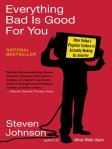
Review of Steven Johnson’s "Everything Bad is Good For You"

Everything bad is good for youSteven Johnson’s contrarian book “Everything Bad is Good For You” argues that, for the past three decades, a combination of economic, technological and neurological forces have increased the complexity of popular culture. The result? Popular culture is causing us to exercise our minds in new and increasingly strenuous ways. In short, popular culture isn’t making us dumber, it is making us smarter.

To understand Johnson thesis it is essential to distinguish between the content and structure of pop culture. This is because Johnson is not applauding or even condoning the content of pop culture, what he is celebrating is how the increasing complexity of TV shows, video games and internet content is forcing us to work harder to explore, understand, engage and even guide, the content. Better yet, our brains want it this way. The result is a virtuous loop created within the pop culture industry. People who want and demand more engaging and complicated pop culture foster a media industry keen to serve it up. Don’t believe it? Try following Johnson’s advice and watch a TV show from 20 years ago. Invariably, you’ll quickly notice is how linear, simple and boring it is.

What makes this book compelling – particularly when juxtaposed against those who rant about the decline of culture – is its style. Everything Bad is Good For You is not a social commentary piece, anecdotally comparing a rose tinted past to the present (or vice versa). It is a book grounded in evidence and research relying, in particularly, on improving IQ tests as its principal data source. The result is a book filled with little gems. For example, contrary to all stereotypes, white collared professionals who play video games are actually more social, more confident and more adept at solving problems than their colleagues. Revenge of the nerds anyone?

The highlight though, was how the book provided an indirect explanation of a broader societal shift I’ve noticed, commented on, but have had difficulty articulating. Before it properly penetrated the popular consciousness the term ‘network’ kept cropping up in within Canada25. By the time we wrote From Middle to Model Power report the word was such a touchstone for the organization we decided to explicitly make it the central theme of the report. This turned out to be a wise decision.

Whenever I presented on or spoke about the report, the network theme resonated strongly, particularly but not exclusively, with younger members in the audience. Suddenly, everywhere I turned people were thinking in terms of networked systems. Up until this book I’d assumed that this was the result of the internet – that somehow its architecture was influencing how people thought and understood the world. It appears that that answer was only partly correct. Everything Bad is Good For You persuasively argues that the influences behind this emerging perspective are more pervasive than just the internet – they have permeated every medium of our pop culture including games, TV, movies, etc… Consequently, pop culture has been shaping the minds of an entire generation, turning them into system thinkers for whom the network is the structure they most naturally and intuitively identify with. Now there’s an idea I can’t wait to sink my teeth into further…

[tags] book review, Everything bad is good for you, steven johnson, popular culture[/tags]

too many good restaurants… must try all…

If Vancouver has anything it is a plethora of good, affordable restaurants. For those who’ve never been to the city, it’s one of its charms… Having only just returned from a 10 year hiatus I’m doing my best to track down and check out the best places. This weekend I finally went to Vij’s, one of the city’s most celebrated hangouts.

The one thing you should know about Vij’s is that you can’t make a reservation, which means you should be prepared for an hour and half wait. But that’s okay, cause they have a great space where you can hang out, sip on drinks and eat the free appetizers that are floating around.

More importantly, it was worth the wait. The food was excellent but the best part is the warm atmosphere created, in large part, by the presence of the restaurant’s namesake and owner, Vikram, who runs around checking in on guests, offering advice and generally being a gracious host. Indeed, Vikram provided one of the evenings highlight moments. After being asked if he would open a sister restaurant in North Van he responded: ‘More is not necessarily better. At this size I can ensure the quality of my food. More importantly, I couldn’t call another location Vij’s. If I’d called my restaurant Taj Mahal or Indian Spice, then it would be okay if I wasn’t there. But since I named it Vij’s people know I will be here – ready to take care of them.’

Pretty much sums up the whole experience – while also maybe taking a little dig at Feenie’s?

[tags] restaurant review, Vij’s, vancouver [/tags]

Review of Paul Graham's Hackers & Painters

You can also read this review here.

In the “Note to Readers” section at the start of Hackers and Painters: Big Ideas from the Computer Age Paul Graham points out that the book’s chapters stand alone and can be read in any order or skipped altogether. While true, it also is misleading. While each chapter may stand on its own the book does possess a single theme. Hackers and Painters is about creativity. It’s about our individual capacity to be creative, a society’s capacity to let us be creative, and the degree to which we allow our tools to limit our creativity. Graham is concerned about these questions in relation to software programmers (whom he believes should think like painters – hence the title) but the ideas are pertinent to any profession that requires creativity.
For those unfamiliar with the author, Paul Graham is the geek’s geek. In 1995 he and Robert Morris developed the first web-based application, ViaWeb, which was acquired by Yahoo in 1998. For those less technically inclined, web-based applications are the programs we use over the internet and that don’t reside on your computer (while common place today this was ground breaking stuff back in 1995…). To put it bluntly Graham understands technology and its implications. Sadly, I suspect few people outside of the technology world will read his book. For Graham, particularly in the first half of this book, can write about technology the way few can: in English. Moreover, he’s enjoyable to read because he’s blunt, funny and, by necessity, contrarian. Why contrarian? Because Graham is all about beating the average. And to avoid being average you have to be creative, and to be creative you’ve got to… break rules.

That’s right, the enemy of creativity are rules. Indeed, Paul defines a hacker as a rule-breaker: “(To hack) can be either a compliment or an insult. It’s called a hack when you do something in an ugly way. But when you do something so clever that you somehow beat the system, that’s also called a hack… Believe it or not the two senses of ‘hack’ are connected. Ugly and imaginative solutions have something in common: they both break rules. And there is a gradual continuum between rule breaking that’s merely ugly (using duct tape to attach something to your bike) and rule breaking that is brilliantly imaginative (discarding Euclidean geometry).” If this quote gets your juices flowing then this book is for you. I was intuitively comfortable with this idea because I see it in my own world. A good negotiator operates in a similar way. He or she sees the written and unwritten rules behind an impasse and finds a clever ways to ‘hack’ them – to generate a clever solution the parties can agree to.

If Hackers and Painters is about maximizing creativity, and if the enemy of creativity are rules then, as James Burke would say “there is only one place to go.” Get rid of the rules (or at least learn how to ignore them). Consequently, the subtext running through this book is a libertarian plea for individuals to choose how and if they will limit their creativity. But there is a tension in all this. As Paul notes in Chapter 7 (Mind the Gap) a society with too many rules stifles creativity. But a society without rules can extinguish it altogether. So where is the balance? It is an issue I wish Graham would explore further. Also, readers faint of heart should be warned, Graham likes to make bold (and at times unsubstantiated) claims. My favorite is : “… most physicists could, if necessary, make it through a PhD program in French literature, but few professors of French literature could make it through a PhD program in physics.” While I suspect a lot of people might agree with this statement, those that disagree with it would vehemently disagree with it. It certainly is a little outlandish. Finally, the last few chapters dive fairly heavily into discussions regarding programing language… a debate that has broader, interesting implications, but which might cause many readers to stray. But these are small quibbles with what is otherwise an interesting and provoking read.

Because this book is so different then what my friends would normally read, I’ve decided to throw in two fun quotes and passages, in an effort to tempt you into checking it out:

“One often hears a policy criticized on the grounds that it would increase the income gap between rich and poor. As if it were an axiom that this would be bad… I’d like to propose an alternative idea: that in a modern society, increasing variation in income is a sign of health. Technology seems to increase the variation in productivity at faster than linear rates. If we don’t see corresponding variation in income, there are three possible explanations: (a) that technical innovation has stopped, (b) that the people who would create the most wealth aren’t doing it, or (c) they aren’t getting paid for it.”

“The best writing is rewriting,” wrote E. B. White. Every good writer knows this, and it’s true for software too. The most important part of design is redesign. To write good software you must simultaneously keep two opposing ideas in your head. You need the young hacker’s naïve faith in his abilities, and at the same time the veteran’s scepticism. You have to be able to think how hard can it be? With one half of your brain while thinking it will never work with the other. The trick is to realize that there’s no real contradiction here. You want to be optimistic and sceptical about two different things. You have to be optimistic about the possibility of solving the problem, but sceptical about the value of whatever solution you’ve got so far.”

[tags] Paul Graham, Hackers & Painters, book review, creativity[/tags]