Category Archives: vancouver

21st Century Olympics

Just resting now after a few wild days closing off out the Olympics.

My sense is that, despite the grumblings of the UK press (which has some pretty good reasons to set the bar low), these Olympics will get good marks. Athletes got to venues on time, the infrastructure was able to handle the crowds and people had fun. For Canadians there were the added benefits of owning the podium working and, of course, a gold medal in hockey. Things did go wrong, but they were in largely beyond the control of the organizers (it would be great if we could make it snow or stop an El Nino but happily, we can’t) or – in the case of the Olympic Cauldron – they were dealt with.

I had a number of wonderful experiences. I was able to be at the Canada-Russia game. I met a few athletes, even saw a few medalists – and was (very generously) given 5th row tickets to the men’s hockey bronze medal games by Bryce Davidson. I held an Olympics torch, saw the Stanley Cup and got to see the fireworks display at LiveCity in Yaletown. Moreover, I get to ride the Canada Line – the subway to Richmond and the Airport that was built for the Olympics – almost everyday.

All this to say – I had a great time.

But having witnessed two weeks of Olympics I can help but feel there is an underlying challenge for the Olympics – one that emerges from the security concerns of a post-September 11th world and the Olympic Committees obsession with ensuring that only its sponsors are able to advertise, broadcast or even talk about the Olympics.

As technology improves the capacity of the Olympics to prevent people from broadcasting live from the Olympics is going to become increasingly challenging. The Olympics is maybe one of the best examples of an entire jurisdiction being controled so that – to paraphrase Lawrence Lessig – a legal structure, as opposed to technology, becomes the limit free speech and expression. Increasingly, truly free societies may begin to balk at the restrictions the IOC wishes to place not just on corporations but on citizens who are hosting the games. This is also true of the security required to host theses events. The Winter Olympics are relatively small and – security he was very present but not overwhelming. But only by post-September 11th standards. The fact is that, unlike in Calgary, today the venues are fenced off and secured – leaving the Olympics at times feeling a little more like a G20 event than a celebration. Or perhaps, to be more fair, there are really two Olympics – that going on behind the fence, and the rest taking place in the city.

In short, I begin to wonder how many communities – especially those within liberal democracies where individual rights are well established – are going to want to bid on the Olympics. Perhaps the biggest risk is that the IOC, in a bid to sustain its business model, will find itself increasingly having to partner with cities in countries with perhaps not the strongest human rights or democratic standards precisely because it is only those places that can enforce the rules (both in terms of safety and licensing) that that IOC will demand.

I think Vancouver avoided the security excesses people feared about but it isn’t hard to see – looking at Vancouver – the dangerous direction the Olympics could be headed in. And that would be tragedy. Whatever people may say, the Olympics remain a powerful symbol for peace and global brotherhood. Moreover, if done right they can leave host cities with important legacy infrastructure projects (again – the Canada Line stands out). But if the business model of the Olympics mean that it must lock down the cities that host it the costs may simply become too high for most communities.

My sense is that a re-imagining of the Olympics business model is probably in order – one that will allow it to respond to the realities of a networked 21st century world and that re-balance safety concerns with the need to create an environment that is fun and open. Moreover, such a re-imagining would be a fantastic project – something that might revitalize the Olympics in other powerful ways – making it more open, accessible and inspiring, in short, an Olympics that is relevant and ready for the 21st century.

Conservative Senator Talks Harm Reduction

First, for those who have not seen it Maxine Davis, Executive Director of the Dr. Peter Foundation has an important op-ed in the Vancouver Sun titled Attention Ottawa: Insite is a health care service.

More intriguing Safe Games 2010 and the Keeping the Door Open Society (which, for full disclosure, I sit on the board of) are hosting a panel discussion on harm reduction. One of the speakers will be Senator Pierre Claude Nolin, who sits as a Conservative and has been deeply supportive of harm reduction strategies generally and the four pillars strategy specifically here in Vancouver.

For those in Vancouver who are interested in the event – details below. Hope to see you there.

Keeping the Door Society and SafeGames 2010

invite you to attend

Global Insite – A panel discussion and public dialogue on Vancouver’s

innovative response to the international question of What to do About Drugs?

WHEN:

Friday 19th February 2010

7.00 pm – 9.00 pm; doors open 6.30 pm

WHERE:

Japanese Language Hall

487 Alexander Street @ Jackson Street / Vancouver

SPEAKERS

  • DR. ETHAN A. NADELMANN Executive Director, Drug Policy Alliance; New York
  • SENATOR PIERRE CLAUDE NOLIN, Senate of Canada; Ottawa
  • LIZ EVANS Executive Director, Portland Hotel Society; Vancouver
  • DONALD MACPHERSON Co-founder, Canadian Drug Policy Consortium; Vancouver
  • SHARON MESSAGE Past President, Vancouver Area Network of Drug Users; Vancouver
  • TARA LYONS Executive Director, Canadian Students for Sensible Drug Policy; Canada
  • GILLIAN MAXWELL (mc) Project Director, Keeping the Door Open Society, Vancouver

Please join us to hear a panel of experts discuss the Canadian Government’s recent announcement that it will continue its efforts to close down Insite – North America’s only legal supervised injection site.  We invite you to participate in the dialogue that will follow.

How Vancouver's Open Data Community Helped Open Up the French CBC

For those uninterested in the story below and who just want the iCal feed of cultural events in Vancouver, click here.

Also, I had a piece on the Globe site yesterday, was in the air all day, but was told it hit #1 most viewed, which, if true, is nice. You can read it here.

A couple of weeks ago – at a party – I met someone working at the CBC who talked about how they were organizing a calendar of all the cultural events at the Olympics. Turns out the French CBC is placing a strong emphasis on the Cultural Olympiad that is taking place concurrently to the Olympics and they were gathering all the events they could find into a spread sheet.

I commented that CBC views and listeners – French and English – would probably find such a calendar useful and that it would quite interesting if the CBC shared it as an iCal feed so that anyone could download it into their computer’s calendar.

He agreed, but was unsure how to create such a feed. Admittedly, neither was I – but I did know some people who might…

So at Vancouver’s last Open Data Hackathon – kindly hosted by the City Archives and organized by Luke C – I asked around to see if anyone might be interested in converting the spreadsheet into an ical feed. Up stepped Jason M. who did a little trouble shooting, figured out how the spreadsheet needed to be reformatted and then figured out how to convert it.

So now, if you want, you can download a fairly comprehensive list of the cultural events taking place during the Olympics straight into the calendar on your iPhone, computer, google calendar, etc…

It’s got more events than a lot of the other calendars and includes concerts being played at Maison du Quebec, Saskachewan, Alberta, Ontario and Atlantic Canada House.

This is a bit of a shift for the CBC, the kind of shift that I think we need to be supportive of… a little more open, a little more sharing and a lot more useful. Most importantly it is a great example of how the idea of open data spreads – by being useful.

Carbon Chaos – Celebrating the Launch of an iPhone App

At the beginning of September Gerri Sinclair and I began scheming around me working with a group of her students at the Centre for Digital Media on a project. My initial idea didn’t pan out (more on that in another post) but the students pitched a new idea, one the maintained the original idea of a game that would be fun and that would carry an environmental message.

The result?

Carbon Chaos – an iPhone game designed and built to be fun while educating those who download it about the various advantages and activities of Translink – the transit authority here in the Greater Vancouver area.

And so, with a ton of pride in the students who worked really long hours to create this in a few short weeks here is some beautiful art work they created…

And here is what the game looks like in action…

In short order I hope to share what I learned from the experience and from the students who worked on this (lots of interesting lessons). Needless to say the students deserve infinite praise and I’m eternally grateful to have had the chance to work with them. Amazing, every last one of them. Big thank you’s should also go to their faculty adviser Patrick Pennfather. And finally I know everyone is grateful to TransLink, who sponsored this application and gave it a home. A forward looking organization TransLink, one thinking hard about how technology can transform it – first they opened up their google transit API to the public, then they launched a partnership with Four Square (making each station and a bus a location where you can check in) and of course, they were willing to engage some students on a game they built.

Never, in all my dreams growing up and playing games did I believe that I might one day be a video game producer. Fun, fun, fun. If you have an iPhone, hope you get a chance to download it and see what some emerging developers were able to code up.

My Vancouver – Remixing Gary Stephen Ross

If you haven’t read Gary Stephen Ross’s article A Tale of Two Cities in the Walrus, go do it. It is brilliant. Probably the best reflection on Vancouver I’ve read in a long, long time. The piece resonated deeply in a personal way, not only hitting all the right themes about my home city but touching on what about it keeps pushing me away and pulling me back.

(Of course, if you are coming for the Olympics, this is a must read backgrounder.)

I’ve always wanted to write a long form piece on Open Vancouver/Closed Vancouver which ideas in Ross’s piece touch on. So with the lens of that project still in mind I’ve posted some of the piece’s best quotes below as well as some thoughts and the occasional mild remix:

The main reason I moved back was to be close to my family and to explore what I thought was a city on the verge of becoming a place for ideas. It hasn’t been disappointing.

Laugh at the clichés, but understand that leading-edge thinking elsewhere is often the norm here. From North America’s only supervised injection site to a police chief who openly supports the idea of making addiction a public health issue, not a criminal one; from UBC’s breakthroughs in sports medicine to the bold social experiment of the Woodward’s development, which combines public housing with high-end units; from inventors like Phil Nuytten, the father of the underwater Newtsuit, to Internet millionaires like Markus Frind (plentyoffish.com) and Stewart Butterfield (flickr.com); from D-Wave’s breakthrough in quantum computing to Saltworks Technologies’ cost-effective desalination system, Vancouver incubates far more than its share of striking new ideas.

I wasn’t sure of this when I first moved home… But this is a place where ideas get thought. Being part of that is fun. More happens here then people know.

Indeed, if the measure of an idea is how widely it’s disseminated and how passionately it’s embraced, this city is anything but the kayaking, navel-gazing, pot-smoking Lotus Land of popular imagination. It’s a hotbed of entrepreneurship and creativity. “Doesn’t anybody here work?” a visitor joked one October afternoon as we walked past a surprisingly active Kits Beach. Yes, people do work, all the time — just not in head offices, since we have very few. They launch start-ups, they freelance, they find Wi-Fi spots, they unfurl blueprints at Starbucks. They invent, imagine, concoct.

The challenge is that all those ideas don’t create the radiant energy that feeds more ideas. It is hard to feel what is happening in Vancouver. For whatever reason the energy dissipates rather that build and feed others. Is it that too much of it is forced to leave for bigger pastures? Maybe. But at the moment there is something about Vancouver that closes itself not only to outsiders, but to itself.

Ross picks up on this in a quote from Bob Rennie about the failure of Vancouver to leverage its energy and talent.

“‘We need the grand gesture: let’s hire a starchitect, let’s make a statement, let’s go for the splashiest exhibition.’ It grows out of a small-town mentality. We have people here who are royalty in the international art world: Jeff Wall, Ian Wallace, Roy Arden, Brian Jungen. Did you know that Rodney Graham has a major show in Basel this June? But oh no, we couldn’t possibly be good enough to stand on our own merits.”

This is why it sometimes feels like the ideas here go abroad or fade – we don’t incubate or get excited about them.

Part of that is the fault of the cities culture – it is a strangely closed placed. I grew up here but I’ll be the first to say it isn’t always easy meeting people in Vancouver, not like in Toronto (where I can’t stop meeting new people) or Halifax (where everybody is very friendly):

Amid the stereotypes, of course, obscured by them, Vancouverites live substantial, complicated, inaccessible lives. Newcomers say folks here are quick to engage you in a friendly chat but slow to invite you over for dinner. There may be a flaky, hippie vibe to the lineup at Trout Lake Farmers Market on Saturday mornings, but there is a seriousness of purpose as well, an act-on-it conviction that organic tomatoes from the Okanagan are in every way superior to industrial tomatoes from Mexico.

Serious? Maybe. Sometimes the line between seriousness and escapism gets pretty blurry. Many people come to Vancouver to get away – away from the east, away from the head office, away from relatives… away to strike out on their own. And that makes it a city, to a certain degree, of loners. Or at least a city of people who aren’t sure they want you to penetrate their dream.

But the other part of it has to do with the Vancouver’s history which thematically Ross has right…

“Partly it’s that idea of generational wealth that Will and Ariel Durant talk about in The Lessons of History,” says Tom Cooper of City in Focus. “Vancouver’s rich are still in acquisition mode. It’s the third and fourth generation that starts thinking about endowing a chair or funding the arts or charities. We don’t have Carnegies and Rockefellers here, because the wealthy families are still too busy making money to stop and wonder what to do with it.”

…but my feeling is the diagnosis is off (he’s far too nice). It’s not about acquisition. This is a city built with hardworking, sweaty, pioneering (in its day) but conservative money. By that I mean money generated from pulling things off or out of the mountain or ocean. There hasn’t historically been much innovation in mining or logging or fishing – these are relatively conservative industries. And so the money it created is often conservative in that it looks for surefire hits. Projects people know will work before hand. In short, in Vancouver, no one gets fired for flying in three tenors.

Maybe in a bigger city, with more industry and confidence, things would be different. And Ross is smart to point out how small Vancouver actually is.

With a population of about 600,000, it’s a quarter the size of Toronto proper. Edmonton, Calgary, Montreal, and Ottawa have more citizens. Hell, Mississauga has more. Winnipeg has more. Vancouver’s American analogues are not Chicago and New York, but Charlotte, Memphis, El Paso. Include the metro area, and the population swells to 2.2 million, a third of metropolitan Toronto’s. If this city were an actor, it would acquit itself beautifully in a supporting role — Philip Seymour Hoffman before Capote. If it were a fighter, it would be a middleweight, albeit one so slick and well marketed that you think of it as belonging among the heavyweights — any of which would, in fact, clobber it.

To be fair, Vancouver is more dense than Ottawa, Calgary and Edmonton (which is important) but it is also fractured by inlets and rivers. In Toronto probably a million people live within a 10 minute walk of the subway lines… that means a million people have quick access to one another – that’s a lot of connections that can be quickly made, a lot of groups that can easily gather. In Vancouver, it is tougher – although getting better. But Vancouver’s geography may be beautiful, but it is challenging to create a networked city in. Maybe this is why the city has so few of the trappings of a great city:

He rhymes off a list of shortcomings you won’t find in great cities: no downtown university with an adjoining student neighbourhood; no broad pedestrian promenade; no major civic square. A great city is a world unto itself, defying attempts to break it into its constituent elements. Berlin, Rome, New York: these are urban confabulations, memory vying with amnesia, civic magma bubbling and hardening under the weight of history. World-class city? It’s the world, not the city, that gets to decide. Penelope Chester, the daughter of a French publisher, studied in Paris and New York and Boston and travelled the planet before spending a year and a half in Vancouver working for an international NGO. Now based in Liberia, she liked Vancouver but noted that locals “have an exalted sense of their city’s standing in the world, without much experience of the world to support it.”

There is the escapism again. It’s as though the city is gun shy to really face the world, to welcome the harsh sting of criticism, especially when competing on things beyond its beauty. Unchecked the city’s conservative culture could turn it into a Pacific Northwest French Riviera – a play ground and escape for the world’s wealthy. I’m hoping we aim for some kind of green San Francisco/Portland hybrid. But that require competing with our brains. Which we can do, if we choose to. We just have to pick our spaces and align our brains with out values. And hey, when we do it things aren’t that bad:

By the most dependable benchmark we’ve devised — GHGs, or annual greenhouse gas emissions per capita — Vancouver (at 4.9 tonnes) is already the most eco-friendly city in North America, well ahead of New York (10.5 tonnes), Los Angeles (13 tonnes), Seattle (11.5 tonnes), and Toronto (11.6 tonnes). And in just about every reckoning of the world’s eco-friendly cities, Vancouver ranks up there with Reykjavik, Copenhagen, and Malmö.

But being green alone does not make for a great city. It requires a vision, an ability to weave together the different visions of what Vancouver could be, and, most of all, to acknowledge and talk to one another. Here Ross understands Vancouver like few other observers I’ve read. He’s right the Two Solitudes are different in Vancouver. While this city barely even knows its part of a national solitude (Indeed, it often barely knows its part of a country, – national identity isn’t disliked, people are quite found of and proud of being Canadian – its just more that its a vague afterthought) here the Solitudes that matter here are in the city, solitudes of neighbourhoods, wealth and ethnic communities…

You want drug addiction and wrenching, in-your-face psychosis the likes of which you’ll find nowhere else? Stroll through the Downtown Eastside, a twenty-square-block human zoo. Want to visit an Asian enclave that’s a cyberlike parallel universe? Check out the Aberdeen mall in Richmond, south of the city proper: two solitudes, Pacific variety.

Overcoming these solitudes is no insignificant challenge – and maybe the challenge for a city looking to its next step. Do its citizens want to tackle it? I don’t know. Vying to be a great city vs. staying in the velvet rut and settling for a really nice northern Charlotte. The former requires work, the latter… is effortless.

The great paradox of Vancouver is that as green and hippy as it is, it is also the most conservative city in Canada – not in how it votes, but it how it sees itself going forward. If the world tells you you are the best place on earth (which the UN or the Economist does almost every now) the natural question that emerges is… why change anything?

That’s the collective inertia that sometimes defines the place. So much individual talent, but collectively the energy, and the confidence, dissipates too quickly. Every once in a while it doesn’t… and that’s when the magic here really happens. My hope is that we can find a find a way to be like that all the time. That’s what I hope happens when we grow up.

More Open Data Apps hit Vancouver

Since the launch of Vancouver’s open data portal a lot of the talk has focused on independent or small groups of programmers hacking together free applications for citizens to use. Obviously I’ve talked a lot about (and have been involved in) Vantrash and have been a big fan of the Amazon.ca/Vancouver Public Library Greasemonkey script created by Steve Tannock.

But independent hackers aren’t the only ones who’ve been interested. Shortly after the launch of the city’s Open Data Portal, Microsoft launched an Open Data App Competition for developers at the Microsoft Canadian Development Centre just outside Vancouver in Richmond, British Columbia. On Wednesday I had the pleasure of being invited to the complex to eat free pizza and, better still, serve as a guest judge during the final presentations.

So here are 5 more applications that have been developed using the city’s open data. (Some are still being tweaked and refined, but the goal is to have them looking shiny and ready by the Olympics.)

Gold

MoBuddy by Thomas Wei: Possibly the most ambitious of the projects, MoBuddy enables you to connect with friends and visitors during Olympics to plan and share experiences through mobile social networking including Facebook.

Silver

Vancouver Parking by Igor Babichev: Probably the most immediately useful app for Vancouverites, Vancouver Parking helps you plan your trip by using your computer in advanced to find parking spots, identify time restrictions, parking duration and costs… It even knows which spots won’t be available for the Olympics. After the Olympics are over, it will be interesting to see if other hackers want to help advance this app. I think a mobile or text message enabled version might be interesting.

Bronze (tie):

Free Finders by Avi Brenner: Another app that could be quite useful to Vancouver residents and visiting tourists, Free Finders uses your facebook connection to find free events and services across the city. Lots of potential here for some local newspapers to pick up this app and run with it.

eVanTivitY by Johannes Stockmann: A great play on creativity and Vancouver, eVanTivity enables you to find City and social events and add-in user-defined data-feeds. Once the Olympics are over I’ve got some serious ideas about how this app could help Vancouver’s Arts & Cultural sector.

Honourable Mention:

MapWay by Xinyang Qiu: Offers a way to find City of Vancouver facilities and Olympic events in Bing Maps as well as create a series of customized maps that combine city data with your own.

More interestingly, in addition to being available to use, each of these applications can be downloaded, hacked on, remixed and tinkered with under an open source license (GNU I believe) once the Olympics are over. The source codes will be available at Microsoft’s Codeplex.

In short, it is great to see a large company like Microsoft take an active interest in Vancouver’s Open Data and try to find some ways to give back to the community – particularly using an open source licenses. I’d also like to give a shout out to Mark Gayler (especially) as well as Dennis Pilarinos and Barbara Berg for making the competition possible and, of course, to all the coders at the Development Centre who volunteered their time and energy to create these apps. These are interesting times for a company like Microsoft and so I’d also like to give a shout out to David Crow who’s been working hard to get important people inside the organization comfortable with the idea of open source and open to experimenting with it.

Why David Suzuki Matters

Last night I had the enormous privilege of being able to attend David Suzuki’s “The Legacy Lecture.” The lecture which took place at the Chan Centre out at the University of British Columbia was premised on a simple idea: If I had one last lecture to give, what would I say?

I confess I’ve never seen David Suzuki speak in person – and he is compelling. Yes, he is a skilled orator – especially when he relaxes, jokes with us and is self-deprecating – but that isn’t what really struck me while watching him speak, alone, on stage.

What struck me was how David Suzuki has always managed to have an appeal to me and my friends – that he has spoken to and engaged us right from when we were little, to today, when we are (mostly) adults. This is no small feat. Having grown up at the tail end of Gen X (or front end of Gen Y – depends who you ask) I would say that if one thing defines this cohort it is a constant (sometimes important and sometimes vicious) sense of ironic detachment from almost everything. As a teenager my media exposure to stories and people “who were me” were found in films like Reality Bites, Pump up the Volume, Singles, Office Space, Swingers, or Fight Club, where the characters lived in worlds that are far from ideal, or worse unraveling, and in which the leads had limited (if any) control. More importantly, these characters all struggled to believe in anything and to genuinely become part of something. Detachment: that is our thing. There is a reason Seinfeld was so iconic.

Boomers, of course, have a cliched lament that we don’t protest, and sing protest songs. But, (and this will be odd to hear for those who know me) it wasn’t through politics that I became aware of this difference, instead, our collective detachment came home to me while listening to my Dad’s favourite (and now mine too) Ramsey Lewis albums where often the crowd can be heared enthusiastically clapping and singing alone. For most Gen Xers this would require a sense of presence and a willingness to submit to an immediate sense of community, or a moment, that is simply – and for reasons that are not totally clear to me – uncomfortable.

But this is what, I think, David Suzuki has been able to do his entire career. In a quiet and intense way, he enabled Gen Xers to watch his show without the need to be ironically detached. His message – the environment – his mode of inquire – science – and his humble but unrelenting approach appealed to boomers yes, but more importantly, and rarer among CBC type presenters, it appealed to the rest of us. Rare among his generation was an ability to connect, even with those who sometimes shunned being connected with.

Sitting in that theater and watching him speak, that talent came crashing home. With David, I still listen critically (we don’t lose that facility) but, I don’t feel the need to be ironically detached. I enjoy being part of the community he creates and want to enjoy the moment and even feel emotionally connected.

It’s a brave thing to give a legacy lecture. To lay out everything you believe you have been, are and will be, and then share that publicly. But alone, and somewhat naked up there on stage, I got a real insight into why I – and I believe so many of my friends – love David Suzuki. That even if they sometimes call him Dr. Doom & Gloom he still reaches out to us, makes us think, and wants us to feel part of something bigger, greater and more beautiful than we knew. And for those of us who grew up in the 80’s and 90’s that is a gift that cannot be underestimated.

My home, winning prizes and making the news

As long time readers of my blog already know I live on a green a roof (which is so amazing I wrote about it twice). I also live above a couple of box stores including a Winners and Home Depot and not to mention a sushi restaurant, a cellphone shop, and a Starbucks as well as a Save-on-Foods.

As I tell my friends, I have the world’s largest pantry and workshop in my basement… I just don’t own anything in it yet.

Sounds weird? It would. And, it is awesome.

The building is called The Rise and yesterday, a few more people across the country got a chance to read about how great it (and other mixed-use developments are) are with the publication of Frances Bula’s piece in the Globe about it.

The piece (oddly) doesn’t even mention the green roof and garden we have in the middle of our complex. It does however go into significant detail about mixed use developments. Also odd is that the piece has the weird subtitle of “but not everyone is on board” where the reservations are few and limited to people in Toronto who, I suspect, have never seen the building:

In spite of that, many Torontonians, such as Mr. Klein and Mr. Jackson, are skeptical about Vancouver’s radical experiments in putting people on top of giant stores.

“The jury is very much out on the idea of residential on top of big box, like we’re seeing in Vancouver,” Mr. Klein says.

But Vancouver’s planning director, Brent Toderian, said he believes the Rise is a wonderful new example of mixed use. It’s one that the city went out of its way to encourage.

From my perspective, the jury is only out for those who’ve never lived or visited this place.

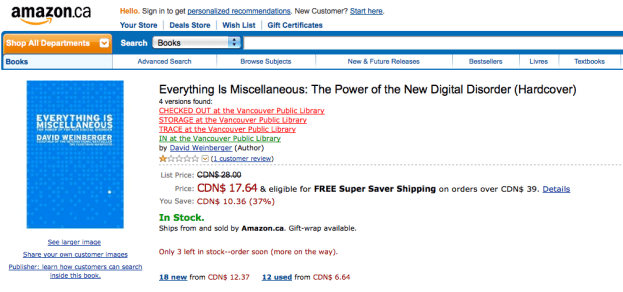
Searching The Vancouver Public Library Catalog using Amazon

A few months ago I posted about a number of civic applications I’d love to see. These are computer, iphone, blackberry applications or websites that leverage data and information shared by the government that would help make life in Vancouver a little nicer.

Recently I was interviewed on CBC’s spark about some of these ideas that have come to fruition because of the hard work and civic mindedness of some local hackers. Mostly, I’ve talked about Vantrash (which sends emails or tweets to remind people of their upcoming garbage day), but during the interviewed I also mentioned that Steve Tannock created a script that allows you to search the Vancouver Public Library (VPL) Catalog from the Amazon website.

Firstly – why would you want you want to use Amazon to search the VPL? Two reasons: First, it is WAY easier to find books on the Amazon site then the library site, so you can leverage Amazon’s search engine to find books (or book recommendations) at the VPL. Second, it’s a great way to keep the book budget in check!

To use the Amazon website to search the VPL catalog you need to follow these instructions:

1. You need to be using the Firefox web browser. You can download and install it for free here. It’s my favourite browser and if you use it, I’m sure it will become yours too.

2. You will need to install the greasemonkey add-on for Firefox. This is really easy to do as well! After you’ve installed Firefox, simply go here and click on install.

3. Finally, you need to download the VPL-Amazon search script from Steve Tannock’s blog here.

4. While you are at Steve’s blog, write something nice – maybe a thank you note!

5. Go to the Amazon website and search for a book. Under the book title will be a small piece of text letting you know if the VPL has the book in its catalog! (See example picture below) Update: I’m hearing from some users that the script works on the Amazon.ca site but not the Amazon.com site.

I hope this is helpful! And happy searching.

Also, for those who are more technically inclined feel free to improve on the script – fix any bugs (I’m not sure there are any) or make it better!

Amazon shot

The Sad State of Vancouver's Entrepreneur of the Year Awards

Last week I noticed Business in BC published its Entrepreneurs of the Year Awards list. The list is filled with deserving and excellent candidates as well as inspiring stories of businesses that are thriving and innovating in a difficult business environment. The recipients are worthy of praise as many embrace values and determination that any city would want to see reflected in its business community.

There is however one thing you won’t find in either the winners, or Runners Ups lists.

Women.

That’s right, of the 8 winners and 16 runner ups, which included a total of 29 people, only a single woman made the list (Queenie Chu, and her business partners Kin Wah and Kin Hun Leung of Kin’s Farm Market, were winners of the Business to Consumer Category).

This, quite frankly, is scandalous. According to the Government of British Columbia research on small business and business in BC:

In 2008, 34.3 per cent of all business owners in British Columbia were women. This was on par with the national average of 34.4 per cent and the fourth-highest rate among the provinces. British Columbia trailed New Brunswick (38.3 per cent), Quebec (36.7 per cent), and Ontario (34.5 per cent) in terms of the share of businesses owned by women.

So 34% of all businesses in the province are owned by women, and yet the number of women cracking the Entrepreneur of the Year finalists’ list is… 1 out 29. So roughly, 3% of the finalists if you are being generous (counting by people), 1.3% if you are being accurate and counting by category.

There are a couple of theories that might explain this.

1) There are no excellent women entrepreneurs.

2) There are excellent women entrepreneurs, but they aren’t on the radar of E&Y and BCB.

3) Business culture defines excellence in terms that were created and modeled by men – and so the selection committee and nominators tend to (without malice or intent) favour men.

4) More men than women care about these types of awards, and so they go more out of their way be noticed and nominated

5) Women have less access to capital and inherit fewer businesses so will have a harder time growing businesses that would meet E&Y’s criteria

6) Answers 2-5, plus a myriad of other reasons…

This post is not an effort to take a swipe at BCB or E&Y – although I would encourage a little introspection on their part to assess why their survey (keeps) producing few, if any, women nominees. I’m not looking for parity but it would be a start if 20% of the field were women. Yes, such a number is still far too low, but it would at least come a little closer to reflecting the actual gender breakdown. I’m quite confident that the reason (1) from above is not why they are not making the list. Indeed, the E&Y committee in Ontario was able to hit this low bar for Ontario’s Entrepreneur of the Year Award. 20% (10/50) of its nominees were women.

It would be nice if these awards instigated a greater degree of introspection in the business community at large, for while no one likes to think sexism exists in Canada, we are, sadly, still not at a place of gender parity. In a recent Accenture survey, approximately two-thirds of Canadian male and female executives (67 percent of men and 64 percent of women) believed gender equality in the workplace has improved in the last 10 years. However, one-third (32 percent) of those executives surveyed believed that men and women have equal opportunities in the workplace, and one-third (34 percent) of the female executives believed that their gender limits their career opportunities. While those demonstrate things have improved from where we were a decade or more ago, they are still sobering numbers.