Open Source Communities – Mapping and Segmentation

I’ve just finished “Linked” by Albert-Laszlo Barabasi (review to come shortly) and the number of applications of his thesis are startling.

A New Map for Open Source Communities

The first that jumps to mind is how it nicely the book’s main point provides a map that explains both the growth and structure of open source communities. Most people likely assume that networks (such as an open source community) are randomly organized – with lots people in the network connected to lots of other people. Most likely, these connections would be haphazard, randomly created (perhaps when two people meet or work together) and fairly evenly distributed.
linked1

If an open-source community was organized randomly and experienced random growth, participants would join the community and over time connect with others and generate new relationships. Some participants would opt to create more relationships (perhaps because they volunteer more time), others would create fewer relationships (perhaps because they volunteer less time and/or stick to working with the same group of people). Over time, the law of averages should balance out active and non-active users.

New entrants would be less active in part because they possess fewer relationships in the community (let’s say 1 or 2 connections). However, these new entrants would eventually became more active as they made new relationships and became more connected. As a result they would join the large pool of average community members who would possess an average number of connections (say 10 other people) and who might be relatively active. Finally, at the other extreme we would find veterans and/or super active members. A small band of relatively well connected members who know a great deal of people (say 60 or even 80 people).

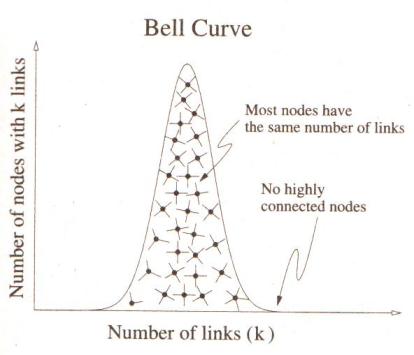
Map out the above described community and you get a bell curve (taken from the book Linked). A few users (nodes) with weak links and a few better connected than the average. The bulk of the community lies in the middle with most people possessing more or less the same number of links and contributing more or less the same amount as everyone else. Makes sense, right?

Or maybe not. People involved in open-source communities probably will remark that their community participation levels does not look like this. This, according to Barabasi, should not surprise us. Many networks aren’t structured this way. The rules that govern the growth and structure of many network – rules that create what Barabasi terms “scale-free networks” – create something that looks, and acts, very differently.

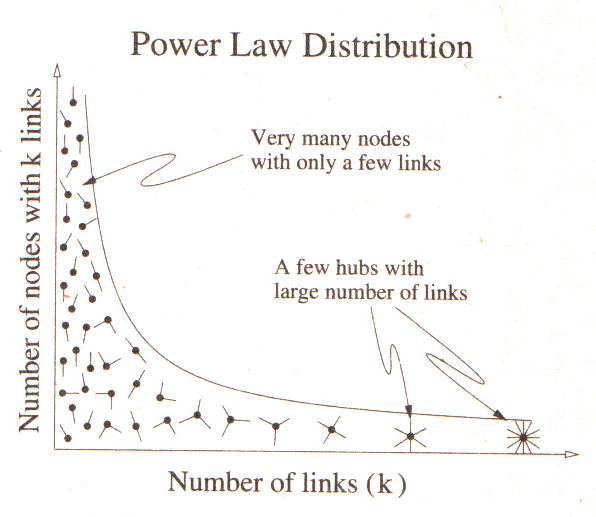
In the above graph we can talk about about the average user (or node) with confidence. And this makes sense… most of us assume that there is such thing as an average user (in the case of opensource movements, it’s probably a “he,” with a comp-sci background, and an avid Simpson’s fan). But in reality, most networks don’t have an average node (or user). Instead they are shaped by what is called a “power law distribution.” This means that there is no “average” peak, but a gradually diminishing curve with many, many, many small nodes coexisting with a few extremely large nodes.
linked2

In an open source community this would mean that there are a few (indeed very few, in relation to the community’s size) power users and a large number of less active or more passive users.

Applying this description to the Firefox community we should find the bulk of users at the extreme left. People who – for example – are like me. They use Firefox and have maybe even registered a bug or two on Firefox’s Bugzilla webpage. I don’t know many people in the community and I’m not all the active. To my right are more active members, people who probably do more – maybe beta test or even code – and who are better connected in the community. At the very extreme and the super-users (or super nodes). These are people who contribute daily or are like Mike Shaver (bio, blog) and Mike Beltzner (bio, blog): paid employees of the Mozilla corporation with deep connections into the community.

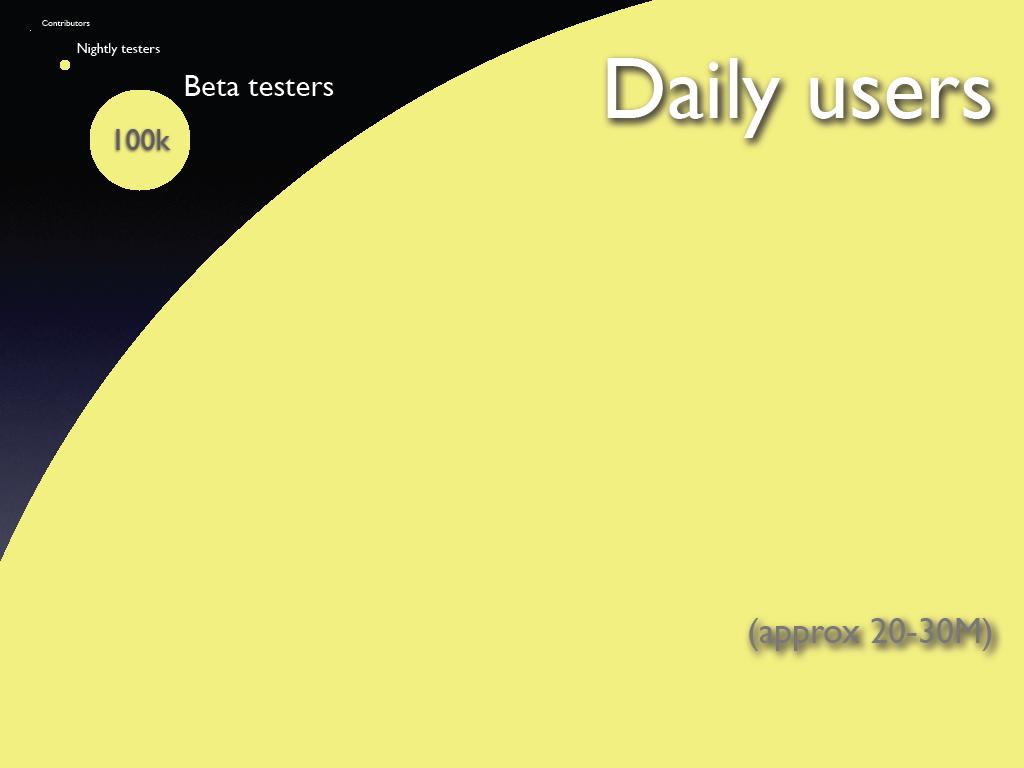
Indeed, Beltzner’s presentation on the FireFox community (blog post here, presentation here and relevant slides posted below) lists a hierarchy of participation level that appears to mirror a power law distribution.
mbslide3

I think we can presume that those at the beginning of the slide set (e.g Beltzner, the 40 member Mozilla Dev Team and the 100 Daily Contributors) are significantly more active and connected within the community than the Nightly Testers, Beta Testers and Daily Users. So the FireFox community (or network) may be more accurately described by a Power Law Distribution.

Implications for Community Management

So what does this mean for open source communities? If Barabasi’s theory of networks can be applied to open source communities – there are at least 3 issues/ideas worth noting:

1. Scaling could be a problem

If open source communities do indeed look like “scale-free networks” then it maybe be harder then previously assumed to cultivate (and capitalize on) a large community. Denser “nodes” (e.g. highly networked and engaged participants) may not emerge. Indeed the existence of a few “hyper-nodes” (super-users) may actually prevent new super-users (i.e. new leaders, heavy participants) from arising since new relationships will tend to gravitate towards existing hubs.

Paradoxically, the problem may be made worse by the fact that most humans can only maintain a limited number of relationships at any given time. According to Barabasi, new users (or nodes) entering the community (or network) will generally attempt to forge relationships with hub-like individuals (this is, of course, where the information and decision-making resides). However, if these hubs are already saturated with relationships, then these new users will have hard time forging the critical relationships that will solidify their connection with the community.

Indeed, I’ve heard of this problem manifesting itself in open source communities. Those central to the project (the hyper nodes) constantly rely on the same trusted people over and over again. As a result the relationships between these individuals get denser while the opportunities for forging new relationships (by proving yourself capable at a task) with critical hubs diminishes.

2. Segmentation model

Under a Bell Shaped curve model of networks it made little sense to devote resource and energy to supporting and helping those who participate least because they made up a small proportion on the community. Time and energy would be devoted to enabling the average participant since they represented the bulk of the community’s participants.

A Power Law distribution radically alters the makeup of the community. Relatively speaking, there are an incredibly vast number of users/participants who are only passively and/or loosely connected to the community compared to the tiny cohort of active members. Indeed, as Beltzner’s slides point out 100,000 Beta testers and 20-30M users vs. 100 Daily Contributors and 1000 Regular Contributors.

The million dollar question is how do we move people up the food chain? How do we convert users and Beta testers and contributors and daily contributors? Or, as Barabasi might put it: how do increase nodes density generally and the number of super-nodes specifically?Obviously Mozilla and others already do this, but segmenting the community – perhaps into the groups laid out by Beltzner – and providing them with tools to not only perform well at that level, but that enable them to migrate up the network hierarchy is essential. One way to accomplish this task would be to have more people contributing to a given task, however, another possibility (one I argue in an earlier blog post) is to simply open source more aspects of the project, including items such as marketing, strategy, etc…

3. Grease the networks nodes

Finally, another way to over come the potential scaling problem of open source is to improve the capacity of hubs to handle relationships thereby enabling them to a) handle more and/or b) foster new relationships more effectively. This is part of what I was highlighting on my post about relationship management as the core competency of open source projects.

Conclusion

This post attempts to provide a more nuanced topology of open source communities by describing them as scale-free networks. The goal is not to ascertain that there is some limit to the potential of open source communities but instead to flag and describe possible structural limitations so as to being a discussion on how they can be addressed and overcome. My hope is that others will find this post interesting and use its premise to brainstorm ideas for how we can improve these incredible communities.

As a final note, given the late hour, I’m confident there may be a typo or two in the text, possible even a flawed argument. Please don’t hesitate to point either out. I’d be deeply appreciative. If this was an interesting read you may find – in addition to the aforementioned post on community management – this post on collaboration vs cooperation in open source communities to be interesting.

If a tree falls in the forest…

If a debate happens in city council, and nobody is around to report on it, does it have an impact?

Last Thursday I noticed that the Toronto edition of the National Post had front page coverage of Toronto’s city council meeting.

Front Page – with a giant picture to boot!

I’m trying to remember the last time a council issue was the lead cover story in the Vancouver Sun… How about the last time there was a photo of a council meeting?

Sadly – from what I can tell – neither The Sun, nor The Province, nor anyone else, have a single reporter exclusively dedicated to Vancouver city hall and municipal politics (if I’m wrong about this please send me a note – who is it?). This is akin to the Globe or National Post failing to assign someone to cover Parliament Hill. Vaughn Palmer does an excellent job covering the BC legislature for The Sun – so why not have someone do the same for municipal politics?

The lack of coverage fosters a city whose political and policy ideas are often unheard and poorly debated, whose municipal scandals go unquestioned and unpublicized and whose council members and mayor go unscrutinized.

Maybe The Sun may feel it simply isn’t profitable to have such a column. I understand (although doubt it). But this function is so important, some solution must be found. Maybe the Vancouver Foundation or some other agency could endow a reporter to cover the City Hall beat.

Or maybe… the Sun should consider outsourcing the role.

Sounds crazy? Admittedly it’s hardly ideal. But a news website in Pasadena, California, recently hired an Indian journalist to cover local politics. The journalist can watch local council meetings over the internet (the same could be done in Vancouver), many documents are available through the city’s website (as they are in Vancouver), and as the editor of the news web site noted “Whether you’re at a desk in Pasadena or a desk in Mumbai, you’re still just a phone call or e-mail away from the interview.” It’s not my favoured solution, but it is better than nothing.

Vancouverites often claim they’re not jealous of Toronto, but maybe we should be. With the Globe, the National Post and the Toronto Star writing regularly about the city’s politics I know I’m feeling envious.

Addition 11:20am PST – David Beers, editor of The Tyee, has emailed me to say: “Was surprised to see you single us out as one who is stingy on coverage of Vancouver city hall. In fact we do have one reporter who has been dogging the issue of homeless housing, covering city council sessions and often the byline on a cover story. Check out Monte Paulsen’s work.”

It is true, the Tyee has more in depth coverage of city hall than anybody else in town… all to glad to be called out on the oversight and hope readers will check out Paulsen’s work. Also, to be fair, the Georgia Straigt does a review of city councilors and talks about municipal politics, but it doesn’t have consistent reporting on the subject.

Job Opportunity with Canada's World

Another Job Opportunity for those interested in Canadian Foreign Policy and International Issues.

Job Opportunity – Ethnocultural Outreach Coordinator

Term: 12 months, 28 hours per week
Rate: $27 per hour
Location: Vancouver
Ideal Start date: September 4, 2007
Application deadline: August 13, 2007

Canada’s World, a project of the SFU Centre for Dialogue, seeks a full-time Ethnocultural Outreach Coordinator to join our national team. Canada’s World is a national citizens’ dialogue aimed at creating a new vision for Canadian international policy. Our secretariat offices are based in Vancouver and we work in collaboration with a series of academic and non-profit organizations across the country.

The Ethnocultural Outreach Coordinator plays a pivotal role in this collaborative initiative. S/he will report to the Director of Canada’s World and work closely with staff, interns, volunteers and advisory committee members in engaging ethnocultural and diaspora communities in a series of dialogues about Canada’s place in the world.

The ideal candidate will be an excellent communicator, well organized, and detail oriented with a passion for, and knowledge of, international policy issues. S/he will be bilingual (French and English), enjoy working in a dynamic work environment and have strong networks within ethnocultural and diaspora communities. S/he will be experienced at facilitating community meetings, compiling tailored resource materials, organizing events and speaking to the media. S/he will possess a post-secondary degree in Arts, Social Sciences or a related field, and enjoy working with people.

Canada’s World is an equal opportunity employer. All interested applicants should submit their cover letter, resume and a 200 word response to the following question: What are the greatest challenges and opportunities facing Canada internationally in the next twenty years?

Applications should be mailed to:
Shauna Sylvestershaunas(at)canadasworld.ca,
Canada’s World Fellow,
SFU Centre for Dialogue,
3303 – 515 West Hastings Street,
Vancouver, B.C. V6B 5K3


It's friday. We should all have a laugh…

Yesterday’s posting on the flaws in the Citizen Assembly process generated a lively debate – one I hope will continue today and tomorrow.

In the meantime, for some comic relief, I’m keen to share my newest geek chic find. It’s called “Piled Higher and Deeper” and it is a comic strip by a grad student at Stanford. For anyone who has been a grad student, the child of professors or worse, both, this comic is painfully, indeed sometimes cruelly, hilarious.

I chose this sample, not because it is the funniest, but because it jives with the main point of this post:

Just in case you were wondering, if you found this funny, you are a geek.

For those brave enough to take the plunge, I recommend starting at the beginning and reading them sequentially.

Citizen Assemblies: Overstating the wisdom of crowds

On numerous occasions over the past few months I’ve heard people refer to Surowiecki’s “The Wisdom of Crowds” when explaining why any group driven project is inherently good.

My favourite has been the explanation regarding how citizen’s assemblies – because they tend to be composed of 100 or more members – are inherently wise and therefor produce a good outcome. To begin with, I find it interesting that those who defend electoral reform rarely talk about the merits of the proposal and instead refer to the soundness of the decision making process used to reach them. Citizen assemblies, it must be said, are not some magical process that produce inherently good outcomes. Indeed, if those who invoke his book had actually read it, they’d realize the Surowiecki’s analysis not only fails to support their contention about the process, it may actually do the opposite.

Pause for a second, and think about the logic that says a solution is good simply because it was arrived at by a large group of people. It is actually quite frightening. Indeed, one of the first things Surowiecki points out is that not all crowds are wise. The statement hardly needs supporting, but Surowiecki nonetheless trots out numerous examples of unwise crowds – angry mobs, investors in a stock bubble, and the various branches of US intelligence services. It’s not simply the size of a crowd that makes it “wise” it is also the rules that guide its behaviour. To be specific Surowiecki cites four key elements (which I’ve cribbed from wikipedia):

Diversity of opinion: Crowds – even those whose members hold ill-informed or eccentric interpretation of the known facts – will be wiser then groups that possess identical data, similar perspectives, or interpret data in a similar fashion.

Independence: Crowd members opinions aren’t determined by the opinions of those around them.

Decentralization: People are able to specialize and draw on local knowledge.

Aggregation: A mechanism for turning private judgments into a collective decisions.

Violate one of these elements and your crowd risks becoming a mob. By my estimation, citizen assemblies run the risk of violating three.

First, the diversity of opinion is at risk. While citizen assemblies’ proponents would have you believe they are composed randomly, this is in fact, not the case. Firstly, there are a number of people who, for reasons of work or family, would not participate. But what really interests me is that people opposed to change (and possibly those who are simply indifferent) are less likely to participate. If you thought a proposition (such as electoral reform) was silly, would you spend a year debating it – or would you simply await your opportunity to vote against it at the end of the process? Participation in these assemblies is almost assuredly tilted toward those predisposed to favour change – e.g. the crowd is more likely to be homogeneous in its desire for change and its perception of the electoral system.

Second, citizen assemblies are less likely to be independent. If you enter into a process to change the voting system the pressure to support change, any change, must be intense. Imagine if you sat around for a year listening, debating and arguing, and came out of the process agreeing that the status quo was ultimately superior to any other option. What a frustrating outcome! Tax payers would question why the money was spent and your friends would ridicule you for “wasting your time.” Worst still, what if the assembly couldn’t agree? What would that say about its constituent members? The internally created pressure on assembly members to put forward something, anything(!) new, and to have a clear majority of assembly members support this proposal was likely intense. I’d wager that once momentum for one solution began to emerge, other members were willing to bandwagon along “for the sake of the process.” In short, assembly members allowed their opinions to be determined by the opinions of those around them. (except, of course for those who held out. The same people who – from first hand accounts – were invariable referred to as stick in the muds and ‘difficult’ people. “Think like the rest of us or we’ll socially ostracize you…” isn’t that a sign of a mob?)

Finally, citizen assemblies have poor mechanisms for aggregation. Although neither the BC nor the Ontario Citizen assemblies required it, both placed strong emphasis on reaching consensus – articulating it as an ideal. If there is one system of decision-making Surowiecki believes makes a crowd dumb, it is a consensus-based approach. In order to reach consensus crowd members sacrifice the previous three elements – diversity, independence and decentralization – in order to gravitate towards the group’s mean. In effect the group’s collective knowledge and diversity of analytical ability is lost. This is the antithesis of a wise crowd. It is a crowd that actually gets dumber with time because it has less data, less analysis and fewer perspectives with which to assess the problem. It isn’t that people agree – they simply censor themselves to prevent disagreement.

This isn’t to say the Citizen Assemblies came to a bad solution for electoral reform (although to confess, I think in both BC and Ontario they did) . Again, all I wish to convey is that the citizen assemblies are not some magical process that produce inherently good outcomes. These process are neither democratic, representative, nor inherently superior – so don’t let supporters of the ballot initiatives bully you with process arguments. Let’s assess these proposals based on their contents – and what they do to democracy in Canada (which, in Ontario’s case, strengthens the parties and the backroom boys).

Sam Suillivan: Public Policy or Personal Gain?

Imagine if, while sitting as Foreign Minister, Lloyd Axworthy had decided to not only place the new concept of “Human Security” at the heart of the Ministry’s agenda but had also decided to trade mark the term – under his personal name.

Clearly the opposition members would have a field day… highlighting how the Minister was using his office for personal gain – using his political influence to create a brand that ultimately he owned the rights to.

Sadly, this hypothetical example is all too real here in my home town of Vancouver. Our Mayor, Sam Sullivan, has personally trade-marked “ecodensity” a term he’s been using to describe the municipal government’s a new initiative to reducie Vancouver’s environmental impact by creating a more compact city. As a few legal experts have noted, this is something that would normally be trademarked by the city’s lawyers… oddly it wasn’t. If that wasn’t enough it was again the mayor, and not the city or its staff, that registered the domain name ecodensity.ca.

None of the Mayor’s gaffe’s – like taking 30 item long priority list to a meeting with the Prime Minister (you should take a list of 3 items and you’ll probably get to talk about one) and then refusing to share anything about the discussion with taxpayers (who footed the bill) – have been so heavy so as to cost him an election, cumulatively however this errors will start to take their toll.

Fortunately for the Mayor, no one is really paying attention to municipal politics in Vancouver.

Keeping the internet free

For those worried (or not yet worried, but who should be) about maintaining the internet as a open platform upon which anyone can participate and attract an audience, please let me point you to David Weinberger’s most recent ramblings on the subject.

He makes a strong case for why companies that provide us with internet access may have to be regulated.

I recently discovered Weinberger while listening to am interview on his newest book “Everything is Miscellaneously.” Great stuff. Vancouver Public Library has been kind enough to hook me up with his other books as well… (these libraries, they are amazing! Did you know you can read a book without buying it? Crazy.)

He also maintains a blog, for those who are curious.

cut and run from cut and run

So it turns out that if you use Bush-like rhetoric people start to believe that you also share in his goals, aims and methods. And, given the president’s popularity is somewhere in the 20’s or 30’s in America, he’s almost certainly the most unpopular person in the world for Canadians.

Little wonder that Canadian support for the Afghan conflict has waned.

This is a serious problem, because contrary to what the NDP would have you believe, this is an important mission, one that benefits from the skills and experience a country like Canada brings to the table. Changing the rhetoric will be a good start, but the real question remains, are we prepared to tell the Americans how the mission should be run? Will we imprint a Canadian approach on the mission?

Anatomy of a Positional Negotiation (redux)

Back in March I wrote this post about the breakdown in negotiations between Ryan Smyth (a hockey star) and the Edmonton Oilers. Because things fell apart despite the fact that Smyth, the Oilers and their fans all wanted an agreement, this negotiation remains my favourite example about how process, and not substance, can torpedo agreements and destroy relationships. Indeed, the case is so good, it has become a key teaching tool in my negotiation workshops (when in Canada, of course…).

Interestingly, recent events have added to the important negotiation lessons that can be drawn.

When sharing the case some people contended that Smyth and the Oilers didn’t fall out but instead cut a secret deal, one that would bring Ryan back to Edmonton once he became a free-agent. The fact that, after being traded, Ryan stood crying in the Edmonton Airport while awaiting his flight to New York didn’t dissuade these doubters. This was of course, all part of the act.

Well, on July 2nd, on the first day of free-agency, Ryan Smyth signed a contract with the Colorado Avalanch for $31.25 million. A bad outcome for Oilers fans, but a good outcome for my credibility as a negotiation consultant.

So why didn’t Smyth go back to Edmonton?

I can think of two reasons – both of which spring from the positional negotiation process Smyth and the Oilers adopted.

Firstly, the previous negotiations permanently damaged relations between Smyth and the Oilers. A haggling process never builds a stronger relationship. It generally involves the parties slugging it out as they tell one another why the other’s current offer is insulting. Of course none of it’s “personal.” But isn’t it is telling that the Oilers broke off negotiations and traded Smyth without notifying him (I believe he learnt he’d been traded by watching TV). Moreover, as I mentioned before, Smyth was distraught enough to cry during the interview in the airport. You don’t have to be a negotiation consultant to know that when one person makes another cry, the agrieved party is looking for ways to work with them again. In this case, Smyth probably wasn’t receptive to any new offers from the Oilers. Their prior negotiation burnt that bridge.

Second, the Oilers painted themselves into a corner on the issue of price. I’ve maintained that Smyth probably wanted to be in Edmonton or Calgary. In the above linked to YouTube video Smyth says his heart is in Edmonton, and he probably wants to be close to family, community, charitable work, etc… I suspect he might have accepted a marginally reduced salary in order to stay there. But with other teams now offering over $31 million, the Oilers probably needed to offer $29-30 million in order to compete. Given their previous “best” offer had been $27 million, any new higher offer would be an admission that they’d undervalued Smyth. That left them with two options. Option 1: Eat humble pie, offer $30 million and admit they’d been lowballing Smyth. In the testosterone world of hockey I suspect the Oilers GM’s ego couldn’t stomach that choice… Not that it would have mattered, any such an offer would have been tainted. It would be like saying “sorry we tried to screw you in our previous negotiations, but we hope that you’ll come work for us now that we’ve been forced to offer you more.” That left option 2: Save face by walking away and claiming the Avalanch over-paid.

Of course, the Oilers’ GM may genuinely believe that Smyth isn’t worth $30 million. Who knows, he may be right. Only time will tell. But, the negotiation process he adopted – and not the substance – destroyed an opportunity for getting Smyth at a much lower price. Most people believe negotiations succeed or fail based on substance (can buyers and sellers agree on a price), sadly that is only sometimes the case. All too often, the determining factor is how we conduct negotiations.

Job Posting @ Mars

This job opportunity came through from Ross W., a very cool looking job indeed. I know the MaRS team is excited about this new development. Contact info is at the bottom. Enjoy!

Director, Social Entrepreneurship

The MaRS Discovery District is seeking a Director, Social Entrepreneurship. Reporting to the CEO, the Director will assemble and lead a team of advisors focused on helping new and emerging social entrepreneurs refine, launch and scale their innovative ideas for creating transformative social change.

S/he will also lead Social Innovation Generation @ MaRS (SiG@MaRS) – a node in a new national network linking MaRS, the McConnell Foundation, the University of Waterloo and PLAN. Finally, the successful candidate will become a member of MaRS’ senior leadership team and contribute to the development and evolution of MaRS itself.

Position Overview

The person hired for this position will leverage MaRS’ expertise and networks in supporting emerging entrepreneurs to develop a new suite of programs and services focused on social entrepreneurship.

Responsibilities will include:

  • Liaising with the other SiG nodes to develop a national social innovation network, spanning idea generation, incubation, evolution and expansion
  • Building and leading a team with the expertise to help emerging social entrepreneurs test and launch their ideas and strengthen and grow their organizations
  • Selecting and coordinating a group of external mentors and advisors to work with emerging social ventures and their leadership teams
  • Developing course material/curricula/programming content, and assembling tools and templates that support social innovation
  • Creating opportunities to connect social innovators and their commercial counterparts
  • Build strategic initiatives in financing social ventures, knowledge transfer, and enabling technology platforms for social change
  • Identifying the key organizations active in this field across the country – and internationally – and developing a partnership strategy that includes government and the private sector
  • As a young, entrepreneurial organization, everyone at MaRS is expected to be flexible; specific duties/responsibilities will evolve, and staff will be expected to contribute to various projects as needed.

Skills/Qualifications

  • At least 5 years of experience in the social sector, including roles that involved team formation and leadership
  • Entrepreneurial experience either creating or building an early-stage venture
  • Knowledge of public policy and a proven ability to work with public, private and third sector partners
  • Ability to work both independently and in teams
  • Exceptional communications skills, both oral and written

About MaRS

MaRS is a not-for-profit organization dedicated to maximizing the economic and social mpact of Canadian innovation. The MaRS Centre – a 700,000 sf convergence centre in downtown Toronto houses over 65 organizations, from investors and scientists to entrepreneurs and policymakers.

Contact Information

Ross Wallace – Director, Corporate Strategy (416) 673-8126 – rwallace@marsdd.com
Applications for this position must be received by July 31, 2007.