Tag Archives: canada

Wedding Open Source to Government Service Delivery

One of the challenges I’m most interested in is how we can wed “open” systems to government hierarchies. In a lecture series I’ve developed for Health Canada I’ve developed a way of explaining how we do this already with our 911 service.

To begin, I like using 911 as an example because people are familiar and comfortable with it. More importantly, virtually everyone agrees that it is not only an essential piece of modern government service but also among the most effective.

What is interesting is that 911, unlike many government programs, relies on constant citizen input.  It is a system that has been architected to be participatory. Indeed it only works because it is participatory – without citizen input the system falls apart. Specifically, it aggregates, very effectively, the long-tail 0f knowledge within a community to deliver, with pin point accuracy, an essential service to the location it is needed at a time it is needed.

I’ve visualized in this slide below (explanation below the fold)
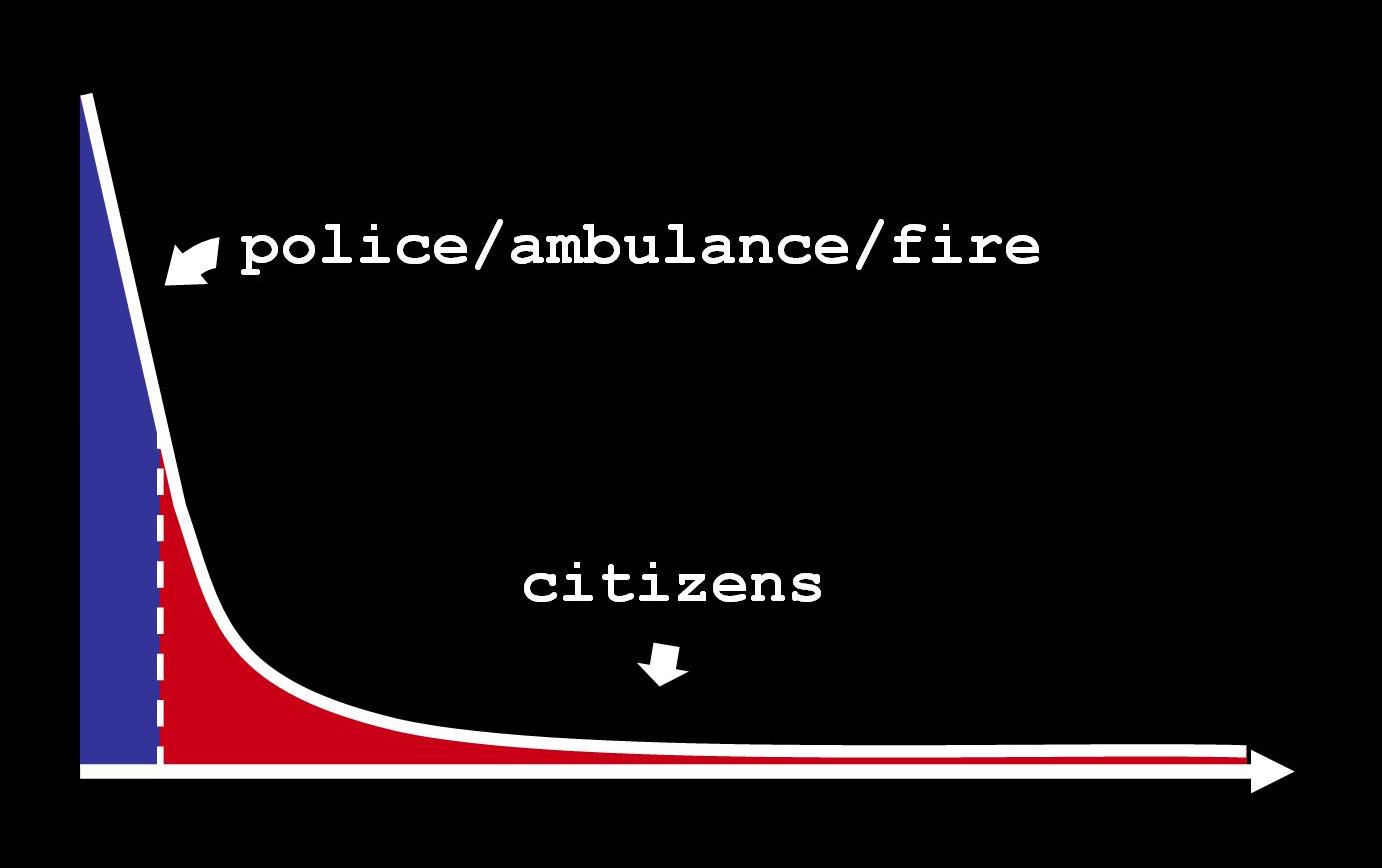
long tail public policy

Imagine the white curve represents all of the police, fire and ambulance interventions in a city. Many of the most critical interventions are ones the police force and ambulance service determine themselves (shaded blue). For example, the police are involved in an investigation that results in a big arrest, or the ambulance parks outside an Eagles reunion concert knowing that some of the boomers in attendance will be “over-served” and will suffer a heart attack.

However, while investigations and predictable events may account for some police/fire/ambulatory actions (and possibly those that receive the most press attention) the vast majority of arrests, fire fights and medical interventions result from plain old 911 calls made by ordinary citizens (shaded red). True, many of these are false alarms, or are resolved with minimal effort (a fire extinguisher deals with the problem, or minor amount of drugs are confiscated but no arrests made). But the sheer quantity of these calls means that while the average quality may be low, they still account for the bulk of successful (however defined) interventions. Viewed in this light 911 is a knowledge aggregator, collecting knowledge from citizens to determine where police cars, fire trucks and ambulances need to go.

Thus to find a system that leverages citizens knowledge and is architected for participation we don’t need to invent something new – there are existing systems, like 911, that we can learn from.

With this in mind, two important lessons about 911 leap out at me:

1) It is a self-interested system: While many 911 callers are concerned citizens calling about someone else I suspect the majority of calls – and the most accurate calls – are initiated by those directly or immediately impacted by a situation. People who have been robbed, are suffering from a heart attack, or who have a fire in their kitchen are highly incented to call 911. Consequently, the system leverages our self interest, although it also allows for good Samaritans to contribute as well.

2) It is narrowly focused in its construct: 911 doesn’t ask callers or permit callers to talk about the nature of justice, the history of fire, or the research evidence supporting a given medical condition. It seeks a very narrow set of data points: the nature of the problem and its location. This is helpful to both emergency response officials and citizens. It limits the quantity of data for the former and helps minimize the demands on the latter.

These, I believe, are the secret ingredients to citizen engagement of the future. A passive type of engagement that seeks specific, painless information/preferences/knoweldge from citizens to augment or redistribute services more effectively.

It isn’t sexy, but it works. Indeed we have 20 years of evidence showing us how well it works with regards to one of our most important services.

The CRTC’s broadcast nationalism won’t matter in a networked world

nocrtcWoke up today was confronted by yet another headline demonstrating why the Canadian Radio-television and Telecommunications Commission (CRTC) must go.

For those who’ve never heard of the CRTC, it is the government agency that regulates Canadian broadcasting and telecommunications activities, the best-known of which is probably the Canadian content rules.

At the core of the proposal is a fundamental misunderstanding of the internet. The CRTC wishes to treat it like a broadcast medium – one where there are distinct roles of creators and consumers. Happily for us, this is not what the internet is. Instead it is what Clay Shirky describes as a communications medium – one where we are all talking to one another and where the distinction between creator and consumer has broken down.

So with that lens in mind, I encourage you to read the article. Below is my analysis:

Amid fears that Canada’s culture is being drowned in a sea of online video from around the world, federal regulators are looking at setting up a $100-million fund to support homegrown programming on the Internet… under a scenario proposed yesterday, Internet service providers could be asked to surrender 3 per cent of their subscriber revenue – roughly $100-million – to a fund that would help produce Canadian programs for the Web.

Is Canadian content being drowned out in a sea of online videos? I suppose. But so is everybody’s. It is the nature of the medium. What % of content on the internet is American, Indian, Chinese? Does it matter? Not really. Because people don’t surf the internet like they surf the radio or television – most often the seek out content. But the CRTC is used to a certain % of content being Canadian on the radio and television because it controlled how much content ended up on those mediums. This is their frame and why they can’t understand the internet.

Ironically, even though we don’t know what % of online content is Canadian what the CRTC cannot grasp is that since the advent of the internet ordinary Canadian both produced more content and – I’ll wager – consumed more Canadian content than ever before. Think of all the blogs, videos, podcasts made by ordinary Canadians that are sharing Canadian stories over the web. Think of this blog. Ensuring Canadian stories get shared is core to the CRTC’s mandate. And yet, for all their discussion about Canadian content the CRTC does not include content created by all those Canadians who’ve previously could never tell their stories.

Why? Because none of us have title of “producer” or “writer” or “actor” in the CRTC’s eyes. We (Canadians) don’t count as culture.

More ironically, the one thing you often can’t find online (and/or has been slow to get online) is the very media the CRTC does count as culture and that it seeks to protect – the Canadian TV and radio shows broadcast on CTV, CBC and Global. These artifacts of the broadcast era have fought or denied the existence if the internet, who have been the slowest to make their content available to us, now want us to foot the bill for creating their content.

What I can be certain of is that the $100 million raised by the CRTC will not go towards Canadians telling their story on the web. My blog, your blog, your podcast, or your video of the play you wrote, none of these will never see the CRTC’s money. Instead a public servant somewhere in Ottawa will determine what is “Canadian” not so we can promote Canadians stories, but so that we can prop the old and dying business model of broadcast media – the expensive production facilities, the hierarchies of managers and staffers that are necessary to produce older media like television.

Nor is this is not about protecting artists – writers, actors, singers – they all thrived before the advent of television, and they will thrive after its demise in ways we cannot imagine. Again, this is not about them. It is about an industry trying to prop up a dying broadcast medium and a government agency trying to assert control over what can be defined as Canadian.

Both are problematic and have no place in a networked world. As a closing counter factual, imagine a tax on your phone designed to raised funds to ensure a certain % of all phone calls in the world were being conducted by Canadians. A fund designed to pay people to make “Canadian” phone calls. That is what this is. At the very time when we need the internet to be free and as cheap as possible so those with the fewest resources can make use of it to tell their stories, organize protests, create a new business or just find a job, we are going to try to make it more expensive.

In short. Are Canadians lost in a sea of content? Yes. And they are thriving in it. More Canadian stories are being told than ever before. Moreover, I never watched Canadian content on television, but today I read numerous Canadian blogs, and listen to the occasional podcast. I never consumed so much Canadian media in my life.  Moreover, never has Canadian content been so widely viewed. Readers of even this small blog come from around the world.

What we don’t need is a tax that makes it more expensive for ordinary Canadians to tell their stories. We don’t need a levy that props up a dying business model. We don’t need a government agency that defines what is “Canadian culture.” Arguing against this proposal is not the most important battle of our time, but it is worth fighting against. Today Canadian culture is a free culture, increasingly defined and created by Canadians. That’s the promise of the internet, why would we fight that?

Articles I'm digesting – Feb 13 2009

New Planets & an Unknown Object Discovered Beyond the Solar System

Future telescopes such as NASA’s Kepler, set for launch in 2009, would be able to discover dozens or hundreds of Earth-like worlds. The Space Interferometry Mission (SIM), to be launched early in the next decade, consists of multiple telescopes placed along a 30 foot structure. With an unprecedented resolution approaching the physical limits of optics, the SIM is so sensitive that it almost defies belief: orbiting the earth, it can detect the motion of a lantern being waved by an astronaut on Mars.

The last sentence says it all. My mind = blown.

Fareed Zakaria – Worthwhile Canadian Initiative (via Sameer Vasta)

Canada has done more than survive this financial crisis. The country is positively thriving in it. Canadian banks are well capitalized and poised to take advantage of opportunities that American and European banks cannot seize. The Toronto Dominion Bank, for example, was the 15th-largest bank in North America one year ago. Now it is the fifth-largest. It hasn’t grown in size; the others have all shrunk.

So what accounts for the genius of the Canadians? Common sense. Over the past 15 years, as the United States and Europe loosened regulations on their financial industries, the Canadians refused to follow suit, seeing the old rules as useful shock absorbers. Canadian banks are typically leveraged at 18 to 1—compared with U.S. banks at 26 to 1 and European banks at a frightening 61 to 1. Partly this reflects Canada’s more risk-averse business culture, but it is also a product of old-fashioned rules on banking.

I’ve always thought Zakaria was one of the smartest commentators in the US. I’ve unbelievably excited he has his own show on CNN. Finally a show where real ideas are discussed not by pundits but by actual wonks. His show single-handedly elevates the entire CNN brand. Now he’s saying nice things about us. Hopefully we won’t let it go to our heads.

How the Crash Will Reshape America: The Last Crisis of the Factory Towns by Richard Florida.

When work disappears, city populations don’t always decline as fast as you might expect. Detroit, astonishingly, is still the 11th-largest city in the U.S. “If you no longer can sell your property, how can you move elsewhere?” said Robin Boyle, an urban-planning professor at Wayne State University, in a December Associated Press article. But then he answered his own question: “Some people just switch out the lights and leave—property values have gone so low, walking away is no longer such a difficult option.”

Perhaps Detroit has reached a tipping point, and will become a ghost town. I’d certainly expect it to shrink faster in the next few years than it has in the past few. But more than likely, many people will stay—those with no means and few obvious prospects elsewhere, those with close family ties nearby, some number of young professionals and creative types looking to take advantage of the city’s low housing prices. Still, as its population density dips further, the city’s struggle to provide services and prevent blight across an ever-emptier landscape will only intensify.

Many of the old industrial clusters are dying and we’ll have to manage this decline while helping figure out what the next wave will look like. This is part of the reason why think the federal government’s failure to invest in green technology/innovation will stand as one of the biggest lost opportunities of the century. At the peak of a financial crises and at the moment when our cities – particularly our mid-sized cities – need to think about what their economies will look like for the next 100 years (think renewable energy, green roofs/architecture, mobile computing, next-generation social services) we’ve plowed $30B into 20th century buildings and roads. Hopefully the good news of Zakaria will outweigh the bad news from Florida. I hope so, since it appears this crisis won’t be sufficiently significant to spur us to rethink our future.

Articles I'm digesting at the moment

While I keep track of the books I’m reading to the right I don’t often get to talk about the articles I’m reading and loving. Here are a few I’ve stumbled over in the past week that I’m still digesting.

1) Via Mike T, Obama and the dawn of the Fourth Republic by Michael Lind on the cycles of American progress and why the next 36 years are going to be very exciting.

During the first 36-year period of a republic, ambitious nation-builders in the tradition of Alexander Hamilton strengthen the powers of the federal government and promote economic modernization. During the second 36-year phase of a republic, there is a Jeffersonian backlash, in favor of small government, small business and an older way of life. During the backlash era, Jeffersonians manage to modify, but never undo, the structure created by the Hamiltonians in the previous era.

2) Via Alo, Why Canada has to wait for it’s Obama Moment, by Jeff Roberts. A piece few Canadians would be willing to write about why the politics of Aboriginals and the rest of Canada remain separated.

In the case of black Americans, their ascension to the political mainstream came in part from leaving behind talk of rights and identity and embracing a postracial style of politics. Barack Obama’s rise has followed his willingness to move away from the swamp of identity politics.

It’s a thesis that parallels that of Calvin Helin’s in Dances with Dependency that I thoroughly enjoyed. Moreover, Roberts is only half right. There is an emerging generation of (particularly urban) First Nations who are going to transform the politics of both the First Nations community and Canada.

3) Via Jeff A, Printing The NYT Costs Twice As Much As Sending Every Subscriber A Free Kindle by Nicholas Carlson . Shocked? You should be. As the author concludes:

Are we trying to say the the New York Times should force all its print subscribers onto the Kindle or else? No. That would kill ad revenues and also, not everyone loves the Kindle.

What we’re trying to say is that as a technology for delivering the news, newsprint isn’t just expensive and inefficient; it’s laughably so.

Besides, think of the forests that would be saved.

4) Via Amy L, The $300 Million Dollar Button, by Jared Spool. As Amy said to me, “you’re a believer in small changes” which I am. Very often I find people jump for the big lever to create big change which often creates numerous unanticipated (and almost always unwanted) changes. I’m much more interested in finding the small lever that creates big change. This piece is about precisely one of those moments in the design of a webpage.

It’s hard to imagine a form that could be simpler: two fields, two buttons, and one link. Yet, it turns out this form was preventing customers from purchasing products from a major e-commerce site, to the tune of $300,000,000 a year. What was even worse: the designers of the site had no clue there was even a problem.

Which University will be smart enough to make Masoda Younasy an offer?

Yesterday, Michael Adams pointed me to this great story in the Globe and Mail about the Masoda Younasy – the granddaughter of Afghanistan’s former king, Mohammad Zahir Shah – who, because she created and ran her own construction business, advocated for reform and mused about entering politics has had death threats hurled against her.

In an extraordinary move, Canada has offered her a permit to live here while her life is at risk. A fantastic start.

So what does she want to do? According to the article:

…her aim is to attend a Canadian university and obtain a political-science degree she might some day put to use in her home country.

What an amazing opportunity. Not only for Ms. Younasy, but for Canadians and, more specifically, the university smart enough and agile enough to offer her a speedy enrollment. My own preference is that Queen’s, which is home to the Centre for the Study of Democracy, might make her an offer. Here is a women keen on bringing democracy and opportunity to a country that has seen little of either – her goals couldn’t be more aligned with those of the institution and her perspective and experience would greatly enrich the discussions in all her classes.

These are the types of opportunities that are easily missed, often because the long term opportunities and benefits – to the student, the university and the country – get trumped by bureaucracy and lack of vision. Well, for those who wonder if it is worthwhile, take note that unwittingly done something similar before and everyone was better off because of it.

ChangeCamp: Pulling people and creativity out of the public policy long tail

ChangeCamp is a free participatory web-enabled face-to-face event that brings together citizens, technologists, designers, academics, policy wonks, political players, change-makers and government employees to answer one question: How do we re-imagine government and governance in the age of participation?

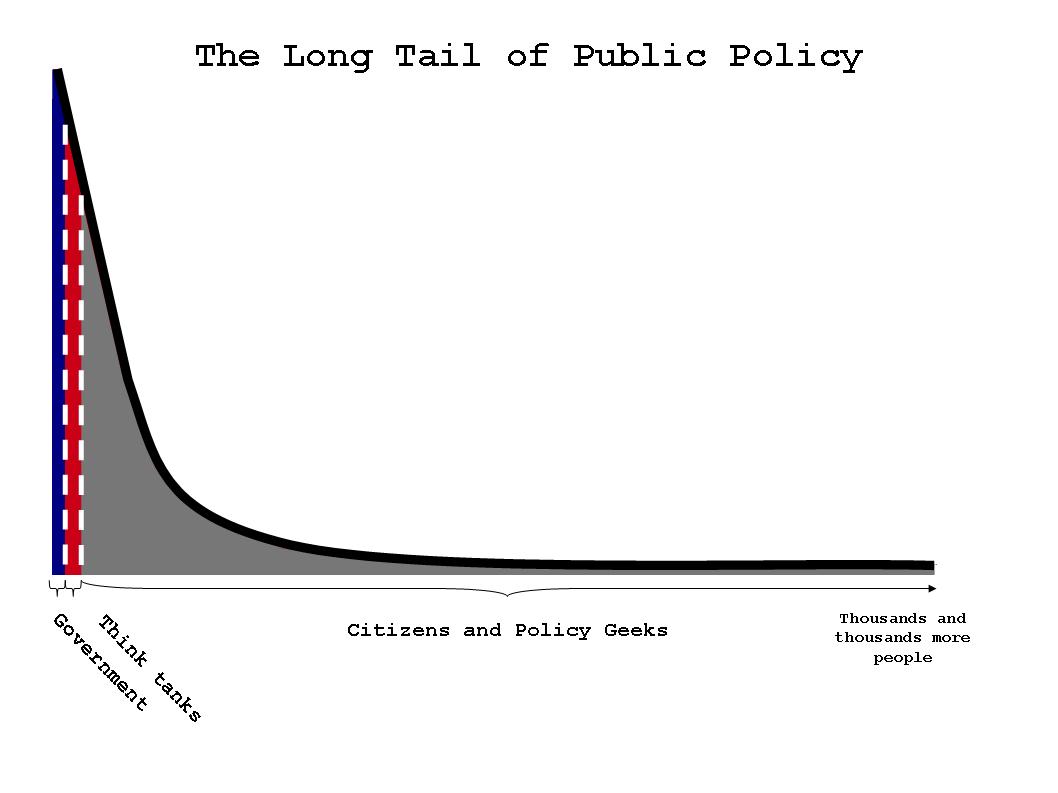
What is ChangeCamp? It is the application of “the long tail” to public policy.

It is a long held and false assumption that ordinary citizens don’t care about public policy. The statement isn’t, in of itself, false. Many, many, many people truly don’t care that much. They want to live their lives focusing on other things – pursuing other hobbies or interests – but there are many of us who do care. Public policy geeks, fans, followers, advocates, etc… we are everywhere, we’ve just been hidden in a long tail that saw the market place and capacity for developing and delivering public policy restricted to a few large institutions. The single most important lesson I learnt from my time with Canada25 is that it doesn’t have to be that way.

Did Canada25 get a new generation of Canadians, aged 20-35 engaged in public policy? I don’t know.

What I do know is, that at the very minimum, we harnessed and enormous, dispersed desire of many Canadians to participate in, and help shape, the public policy debates affecting the country. Most importantly, we did this by doing three things:

  1. we aggregated together the people who cared about public policy, we gave them peers, friends and a sense of community.
  2. we provided a vehicle through which to channel their energy
  3. by combining 1 and 2, and by using simple technology and a low cost approach – we dramatically lowered the barriers (and csots) to entry for credible participating in these national debates

Today, the technology to enable and aggregate people their ideas, to connect them with peers and to create community, is still more powerful. Our capacity to challenge, push, help, cooperate, leverage and compete with the large institutional public policy actors has never been greater. This, for me, is the goal of ChangeCamp. What concrete tools can we build, what information can we demand be opened up, what new relationships can we build to re-imagine how we – the citizens who care – participate in the creation of public policy and the effective delivery of public services. Not to compete or replace the traditional institutional actors, but to ensure more and better ideas are heard and increasingly effective and efficient services are created.

Long tail of public policy

Individually, none of us may have the collective power of a government ministry or even the resources of most think tanks. But collectively, linked together by technology and powered by our energy and spare capital, the long tail of policy geeks and ordinary citizens is bigger, nimbler, more creative and faster than anything else. Do I know that the long tail of policy can be set free? No. But ChangeCamp seems like a fun place to start experimenting, brainstorming and sharing ways we can make this country better.

The murky future of BC-STV

I confess to reading, with great disappointment, Gordon Gibson’s comments about the upcoming referendum on STV:

“I have watched and taken part in our politics for more than 50 years,” former Liberal leader Gordon Gibson said.

“I have never seen such an opportunity,” he added.

I have. It was about 4 years ago. Something, Gibson briefly began to acknowledge before drifting back into platitudes:

“the last chance in the lifetimes of anyone in this room … a once-in-a-lifetime opportunity that we must not miss.”

Actually, this would be a twice in a lifetime opportunity, which is the problem.

Unlike in America, where ballot propositions are immediately binding, in Canada referendum’s have no legal relevance. That said, they remain an important source of legitimacy. Which is why the upcoming referendum on BC-STV is troubling. How legitimate is a referendum whose question was asked – and answered – a mere 4 years ago? Why is this referendum more valid than the last one? Why not – for example – take an average of the two?

Collectively, Canadians have endured this dilemma for decades. I remember being at a formal dinner, sitting beside a friendly Quebec sovereigntist who joked about how he would play squash with his good friend who happened to be a federalist politician. Sadly, he said, he lost every time. However, he quipped, he liked to remind his friend that he only had to win once…

Issues like the sovereignty of a province, or the structure of our electoral systems are not squash games, they are core questions about our identity and how we govern ourselves. Any proposal to alter or change them must be made through a process that bestows as much legitimacy as possible unto the new system. Pursuing a process in which you give yourself multiple kicks at the can, and deem valid the one time you reach the threshold does not accomplish this.

At least in Quebec the referendum question was separated by 15 years. This period of time meant it was possible to argue that there had been a generational change (true), that conditions had changed (also true), and that a similar, but new question could be asked once again (again, true).

The same cannot be said for BC-STV. It has only been four years, little has changed in terms of context and the exact same question will be asked.

While it supporters will claim that BC-STV is a better system (a topic for another post) derived from a legitimate process (something I believe to be contestable), the simple fact is voters rejected it a mere 4 years ago.

And herein lies the problem for BC-STV. It’s not clear there can be a positive result for its supporters. If they lose, they will be unhappy. However, if they win, what does it mean? Will the result carry sufficient credibility and legitimacy? What if it barely passes? Say 60.1%? My sense is that, barring an overwhelming or near unanimous vote – say 80% the result will be, at the very minimum, tainted. An ominous beginning for a process which all citizens should feel was enacted in a fair and legitmate manner.

eaves.ca… the 5th most popular political blog in Canada?

According to a list compiled by A Dime a Dozen I’ve been ranked as one of Canada’s top political blogs. Last month I think I was something like 17th, but this month I’ve rocketed to 5th place.

The accuracy of any blog list can be contested (and with so many political bloggers not making the cut, this one certain is being contested). So readers should make up their own mind on whether a list is good, helpful or important. That said, it is in nice to make anyone’s list, be it one built around strict criteria, or just a list of someone’s favourite blogs.

As an aside, I am surprised to find my blog ahead of Warren Kinsella and Michael Geist and pleased to see it ahead of Ezra Levant and The Western Standard and SteynOnline (whose critique of the American legal system after Conrad Black’s guilty conviction still stands as one of the worst pieces of blog commentary ever written by a professional). To see them ranking lower than my site says more about their limited appeal than it does about my readership levels.

Of course, not everyone is happy with the list and so other, alternative lists have been proposed – and I appear on some (13th), but not on another.

In the end though, it is great that others enjoy stopping by to visit and linking to me from time to time. I owe readers a big thank you. Two years in I’m still trying to stay true to some sage advice from a good friend who told me to write for myself – as though no one is going to read what I post. In part that was because in the blogosphere there is a good chance few will read what you write, but it is wiser still because blogging should be about letting your audience find you, not about finding an audience (I could get larger audiences by writing outrageous things – that temptation is often there for bloggers). So in that spirit I continue to try to be guided by my tag line: this place is my gym, somewhere to exercise my writing muscle and my mind. If it spurs others to exercise their brain muscles – or even their own writing muscles – all the better!

Canadian Foreign Policy as a Disruptive innovation problem

After having a long brain storm session with some people interested in the future of Canadian Foreign Policy was inspired to write this thought experiment.

Perhaps a helpful way to frame our current Foreign Policy ennui is to see the Canadian Department of Foreign Affairs and International Trade (DFAIT) as facing a challenge analogous to that discussed in The Innovators Dilemma – sometimes referred to as disruptive innovation.

Disruptive innovations are products or services that rather than simply evolving, overturn the existing dominant approach in a marketplace. Often the disruptive innovations starts off serving the low end of the market but it eventually matures and serves more demanding and larger clients pushing the established players out of business.

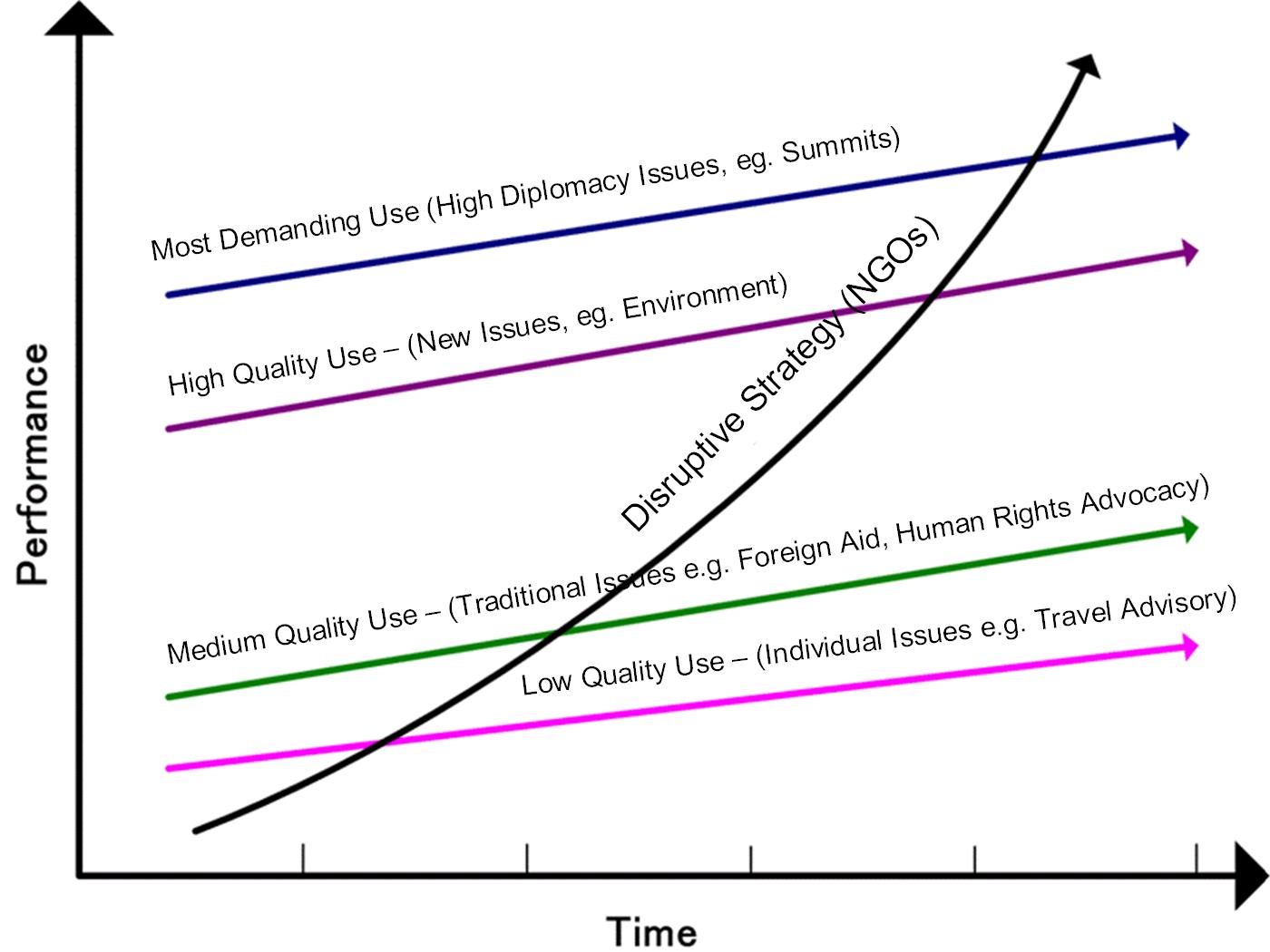
What does this have to do with DFAIT? Consider the graph below (a play on the wikipedia page graph). It used to be that DFAIT served four segments – from low quality all the through to the most demanding use. And yet, over the past decades other actors – sometimes in the private sector, but more frequently NGOs – began to offer services that more effectively deliver what political masters, or more often, citizens, were looking for. At first this was true merely of the lowest tier, travel agencies and news groups began to tell people where was safe and unsafe to travel and so the government ceased being a primary resource for this. Then NGOs began to effectively deliver services in the more traditional areas of advocacy and programs. Increasingly the government has retreated from that space. More recently, you’ve seen NGOs actually take the lead by moving into new areas of debate and creating supporting documentation for critical actors. At the same time you’ve seen other ministries become significantly more active in the management of “international files” that overlap with their areas of focus (eg. Health or the Environment).


Disruptive 3

This is classic innovators’ dilemma. A challenge to DFAIT from a community using a strategy that initially seemed marginal (and even helpful because it alleviated it of performing mundane tasks) has evolved into a true competitor, appealing (usually more effectively) not only for the hearts and minds of Canadians, but for the attention of other ministries and key influencers.

The real question is how does DFAIT compete? Again this is a thought experiment – I’m regularly impressed by the work done my people (many of them friends) at DFAIT. But the department has suffered over the past decade. It should be asking itself: can a (and how should a) centralized bureaucracy compete against an ecosystem of NGOs and other actors? DFAIT may be able to retreat to performing in only the “most demanding use” areas – but there is no guarantee that even this space is completely safe (although the government will maintain a monopoly on certain areas).

The real challenge as outlined in the Innovators Dilemma is that innovation is often difficult, if not impossible for the incumbent actor. One thing that gives me hope is that the department may shrink, helping it become more nimble. For example, I’m pleased to hear that International Trade may be heading over to Industry Canada. This makes all the sense in the world – can anyone today legitimately claim that there is a real difference between domestic and international industrial policy?

Smaller, leaner, and more partner oriented. I suspect one way or another this is the future of Foreign Policy. The question is, can Foreign Affairs innovate its way into that space? The author of the innovators dilemma isn’t optimistic – but then they were writing about private companies that could go bankrupt, not government ministries that can live on as the undead for extended periods of time… hardly an outcome Canadians or our Foreign Service officers, deserve.

Another foreign policy issue not on the election radar

I have a piece in Embassy Magazine today lamenting the fact that US-Canada relations are likely in for some significant changes over the next few years… and we’re unlikely to do much in the way of planning.

Certainly no one on the campaign trail is going to be talking about it.

Embassy, September 24th, 2008
OPED

Why Canada-U.S. Should Be an Election Issue

By David Eaves

Canada’s relationship with the United States has always experienced ebbs and flows. The question is not how do we prevent this cycle, but how Canadian governments choose to manage it?

And manage it we have not. Not since the Trudeau era has Canada been more marginal to debates in Washington. Even the basic elements that once kept the relationship running smoothly—such as quarterly meetings between senior Canadian and American officials—no longer occur. Consequently, when issues arise that relate directly to Canada—such as on the environment, protectionism, or energy security—our voice is frequently absent.

Today, Canada engages the United States not as a strategic partner, but as yet another country with a laundry list of complaints. Be it the border or softwood lumber, our concerns may be justified, but the tone and message is problematic: we have a concern, and you are the cause.

There are understandable reasons for this state of affairs. Over the past eight years, the United States has pursued policies, from Iraq to Kyoto, that, to understate the problem, made the vast majority of Canadians uncomfortable.

But the Bush era is coming to an end. And with elections taking place on both sides of the border, the political map of North America could look dramatically different by the end of November. A McCain or, more dramatically, an Obama administration could mark the beginning of a number of important policy shifts. Issues critical to Canada, and the Canada-U.S. relationship, will likely be reviewed. More importantly, policies that will shape the future of North America will be decided, with or without our participation.

Among the most important of these issues is energy security, something both presidential candidates have stated they will prioritize. As America’s largest energy supplier, Canada will factor significantly in these plans. In addition, at some point, a North American carbon regime will likely emerge, the environmental implications of the tar sands will need to be confronted, businesses will want to further facilitate the movement of goods and people across the border and, of course, Canadian and Americans will need to co-operate to ensure success in Afghanistan, especially as the United States refocuses its energies there. This is to say nothing of the unpredictable events and issues that will inevitably spring up.

And yet, none of the prime ministerial candidates will talk about renewing our relationship with the United States. The subject is simply too unpopular, and the outcome of the U.S. election too unpredictable. So at the very moment, when a plan and vision is most required from our leaders, when the opportunity for renewal is emerging, Canadians are least likely to receive one.

Perhaps others can begin strategizing and preparing. Canadians should hope so, for such a renewal is not only necessary but possible. In a recent Policy Options piece on renewing the Canada-U.S. relationship, Robin Sears notes: “Imagine the vision, the courage and imagination that it took in the harsh winter of European famine of 1947-48 for two powerless French statesmen to sit in a Paris café and begin to plan for a united Europe!”

Today, despite our differences, Canadians and Americans face not even a fraction of the obstacles that confronted Schuman and Monnet, nor do we want to even contemplate a vision half as grand.

Such planning will, as always, require Canadian leadership. Part of this is because of the asymmetric impact of any resolution. For Canadians the magnitude of the challenges is simply fundamental, but to America they are but a few of many pre-occupations. Their chess board is simply vastly more complex. But for domestic reasons, the Canadian public will demand their government lead, not follow, the Americans.

Somewhere in Ottawa, I hope, there is the Canadian equivalent of Schuman or Monnet, who see the opportunity and are planning a strategy to manage the next generation of Canada-U.S. relations. One thing is for certain, no one on the campaign trail will be.

David Eaves is a frequent speaker, consultant and writer on public policy and negotiation.