Tag Archives: cdnpoli

Open Government Consultation, Twitter Townhalls & Doing Advocacy Wrong

Earlier this week the Canadian Federal Government launched its consultation process on Open Government. This is an opportunity for citizens to comment and make suggestions around what data the federal government should make open and what information it should share, and provide feedback on how it can consult more effectively with Canadians. The survey (which, handily, can be saved midway through completion) contains a few straightforward multiple choice questions and about eight open ended questions which I’ve appended to the end of this post so that readers can reflect upon them before starting to fill out the form.

In addition to the online consultations, Tony Clement – the Minister responsible for the Open Government file – will host a Twitter townhall on Open Government this Thursday (December 15). Note! The townhall will be hosted by the treasury board twitter account @TBS_Canada (English) and @SCT_Canada (French) not Minister Clement’s personal (and better known) twitter account. The townhall will first take place in French from 4-4:45pm EST using the hashtags #parlonsgouvert and then in English from 5-5:45 EST using the hashtag #opengovchat.

Some of you may have also noticed that Democracy Watch issued a strongly worded press release last week with the (somewhat long) headline “Federal Conservatives break all of their international Open Government Partnership commitments by failing to consult with Canadians about their draft action plan before meeting in Brazil this week.” This seems to have prompted the CBC to write this article.

Now, to be clear, I’m a strong advocate for Open Government, and there are plenty of things for which one could be critical about this government for not being open about. However, to be credible – especially around issues of transparency and disclosure – one must be factual. And Democracy Watch did more than just stretch the truth. The simple fact is, that while I too wish the government’s consultations had happened sooner, this does not mean it has broken all of its Open Government Partnership commitments. Indeed, it hasn’t broken any of its commitments. A careful read of the Open Government Partnership requirements would reveal that the recent December meeting was to share drafts plans (including the plans by which to consult). The deadline that Democracy Watch is screaming about does not occur until March of 2012.

It would have been fair to say the government has been slow in fulfilling its commitments, but to say it has broken any of them is flatly not true. Indeed the charge feels particularly odd given that in the past two weeks the government signed on greater aid transparency via IATI and released an additional 4000 data sets, including virtually all of StatsCan’s data, giving Canadian citizens, non profits, other levels of governments and companies access to important data sets relevant for social, economic and academic purposes.

Again, there are plenty of things one could talk about when it comes to transparency and the government.  Yes, the consultation could have gotten off the ground faster. And yes, there is much more to done. But this screaming headline is somewhat off base. Publishing it damages both the credibility of the organization making the charge, and risk hurting the credible of open government advocates in general.


List of Open Ended Questions in the Open Government Consultation.

1. What could be done to make it easier for you to find and use government data provided online?

2. What types of open data sets would be of interest to you? Please pick up to three categories below and specify what data would be of interest to you.

3. How would you use or manipulate this data?

4. What could be done to make it easier for you to find government information online?

7. Do you have suggestions on how the Government of Canada could improve how it consults with Canadians?

8. Are there approaches used by other governments that you believe the Government of Canada could/should model?

9. Are there any other comments or suggestions you would like to make pertaining to the Government of Canada’s Open Government initiative?


Statistics Canada Data to become OpenData – Background, Winners and Next Steps

As some of you learned last night, Embassy Magazine broke the story that all of Statistics Canada’s online data will not only be made free, but released under the Government of Canada’s Open Data License Agreement (updated and reviewed earlier this week) that allows for commercial re-use.

This decision has been in the works for months, and while it does not appear to have been formally announced, Embassy Magazine does appear to have managed to get a Statistics Canada spokesperson to confirm it is true. I have a few thoughts about this story: Some background, who wins from this decision, and most importantly, some hope for what it will, and won’t lead to next.

Background

In the embassy article, the spokesperson claimed this decision had been in the works for years, something that is probably technically true. Such a decision – or something akin to it – has likely been contemplated a number of times. And there have been a number of trials and projects that have allowed for some data to be made accessible albeit under fairly restrictive licenses.

But it is less clear that the culture of open data has arrived at StatsCan, and less clear to me that this decision was internally driven. I’ve met many a Statscan employee who encountered enormous resistance while advocating for data open. I remember pressing the issue during a talk at one of the department’s middle managers conference in November of 2008 and seeing half the room nod vigorously in agreement, while the other half crossed it arms in strong disapproval.

Consequently, with the federal government increasingly interested in open data, coupled with a desire to have a good news story coming out of statscan after last summer census debacle, and with many decisions in Ottawa happening centrally, I suspect this decision occurred outside the department. This does not diminish its positive impact, but it does mean that a number of the next steps, many of which will require StatsCan to adapt its role, may not happen as quickly as some will hope, as the organization may take some time to come to terms with the new reality and the culture shift it will entail.

This may be compounded by the fact that there may be tougher news on the horizon for StatsCan. With every department required to have submitted proposal to cut their budgets by either 5% and 10%, and with StatsCan having already seen a number of its programs cut, there may be fewer resources in the organization to take advantage of the opportunity making its data open creates, or even just adjust to what has happened.

Winners (briefly)

The winners from this decision are of course, consumers of statscan’s data. Indirectly, this includes all of us, since provincial and local governments are big consumers of statscan data and so now – assuming it is structured in such a manner – they will have easier (and cheaper) access to it. This is also true of large companies and non-profits which have used statscan data to locate stores, target services and generally allocate resources more efficiently. The opportunity now opens for smaller players to also benefit.

Indeed, this is the real hope. That a whole new category of winners emerges. That the barrier to use for software developers, entrepreneurs, students, academics, smaller companies and non-profits will be lowered in a manner that will enable a larger community to make use of the data and therefor create economic or social goods.

Such a community, however, will take time to evolve, and will benefit from support.

And finally, I think StatsCan is a winner. This decision brings it more profoundly into the digital age. It opens up new possibilities and, frankly, pushes a culture change that I believe is long over due. I suspect times are tough at StatsCan – although not as a result of this decision – this decision creates room to rethink how the department works and thinks.

Next Steps

The first thing everybody will be waiting for is to see exactly what data gets shared, in what structure and to what detail. Indeed this question arose a number of times on twitter with people posting tweets such as “Cool. This is all sorts of awesome. Are geo boundary files included too, like Census Tracts and postcodes?” We shall see. My hope is yes and I think the odds are good. But I could be wrong, at which point all this could turn into the most over hyped data story of the year. (Which actually matters now that data analysts are one of the fastest growing categories of jobs in North America).

Second, open data creates an opportunity for a new and more relevant role for StatsCan to a broader set of Canadians. Someone from StatsCan should talk to the data group at the World Bank around their transformation after they launched their open data portal (I’d be happy to make the introduction). That data portal now accounts for a significant portion of all the Bank’s web traffic, and the group is going through a dramatic transformation, realizing they are no longer curators of data for bank staff and a small elite group of clients around the world but curators of economic data for the world. I’m told a new, while the change has not been easy, a broader set of users have brought a new sense of purpose and identity. The same could be true of StatsCan. Rather than just an organization that serves the government of Canada and a select groups of clients, StatsCan could become the curators of data for all Canadians. This is a much more ambitious, but I’d argue more democratized and important goal.

And it is here that I hope other next steps will unfold. In the United States, (which has had free census data for as long as anyone I talked to can remember) whenever new data is released the census bureau runs workshops around the country, educating people on how to use and work with its data. StatsCan and a number of other partners already do some of this, but my hope is that there will be much, much more of it. We need a society that is significantly more data literate, and StatsCan along with the universities, colleges and schools could have a powerful role in cultivating this. Tracey Lauriault over at the DataLibre blog has been a fantastic advocate of such an approach.

I also hope that StatsCan will take its role as data curator for the country very seriously and think of new ways that its products can foster economic and social development. Offering APIs into its data sets would be a logical next step, something that would allow developers to embed census data right into their applications and ensure the data was always up to date. No one is expecting this to happen right away, but it was another question that arose on twitter after the story broke, so one can see that new types of users will be interested in new, and more efficient ways, of accessing the data.

But I think most importantly, the next step will need to come from us citizens. This announcement marks a major change in how StatsCan works. We need to be supportive, particularly at a time of budget cuts. While we are grateful for open data, it would be a shame if the institution that makes it all possible was reduced to a shell of its former self. Good quality data – and analysis to inform public policy – is essential to a modern economy, society, and government. Now that we will have free access to what our tax dollars have already paid for, let’s make sure that it stays that way, by both ensure it continues to be available, and that there continues to be a quality institution capable of collecting and analyzing it.

(sorry for typos – it’s 4am, will revise in the morning)

The New Government of Canada Open Data License: The OGL by another name

Last week the Minister Clement issued a press release announcing some of the progress the government has made on its Open Government Initiatives. Three things caught my eye.

First, it appears the government continues to revise its open data license with things continuing to trend in the right direction.

As some of you will remember, when the government first launched data.gc.ca it had a license that was so onerous that it was laughable. While several provisions were problematic, my favourite was the sweeping, “only-make-us-look-good-clause” which, said, word for word: “You shall not use the data made available through the GC Open Data Portal in any way which, in the opinion of Canada, may bring disrepute to or prejudice the reputation of Canada.”

After I pointed out the problems with this clause to then Minister Day, he managed to have it revoked within hours – very much to his credit. But it is a good reminder to the starting point of the government license and to the mindset of government Canada lawyers.

With the new license, almost all the clauses that would obstruct commercial and non-profit reuse have effectively been eliminated. It is no longer problematic to identify individual companies and the attribution clauses have been rendered slightly easier. Indeed, I would argue that the new license has virtually the same constraints as the UK Open Government License (OGL) and even the Creative Commons CC-BY license.

All this begs the question… why not simply use the language and structure of the OGL in much the same manner that British Columbia Government tried to with its own BC OGL? Such a standardized license across jurisdictions might be helpful, it would certainly simply life for think tanks, academics, developers and other users of the data. This is something I’m pushing for and hope that we might see progress on.

Second, the idea that the government is going to post completed access to information (ATIP) requests online is also a move in the right direction. I suspect that the most common ATIP request is one that someone else has already made. Being able to search through previous requests would enable you to find what you are looking for without having to wait weeks or make public servants redo the entire search and clearing process. What I don’t understand is why only post the summaries? In a digital world it would be better for citizens, and cheaper for the government to simply post the entire request whenever privacy policies wouldn’t prevent it.

Third, and perhaps most important were the lines noting that “That number (of data sets) will continue to grow as the project expands and more federal departments and agencies come onboard. During this pilot project, the Government will also continue to monitor and consider national and international best practices, as well as user feedback, in the licensing of federal open data.”

This means that we should expect more data to hit the site. I seems as though more departments are being asked to figure out what data they can share – hopefully this means that real, interesting data sets will be made public. In particular one hopes that data sets which legislation mandates the government collect, will be high on the list of priorities. Also interesting in this statement is the suggestion that the government will consider national and international best practices. I’ve talked to both the Minister and officials about the need to create common standards and structures for open data across jurisdictions. Fostering and pushing these is an area where the government could take a leadership role and it looks like there may be interesting in this.


As Canada Searches for its Open Government Partnership Commitments: A Proposal

Just before its launch in New York on September 20th, the Canadian Government agreed to be a signatory of the Open Government Partnership (OGP). Composed of over 40 countries the OGP signatories are required to create a list of commitments they promise to implement. Because Canada signed on just before the deadline it has not – to date – submitted its commitments. As a result, there is a fantastic window for the government to do something interesting with this opportunity.

So what should we do? Here are the top 5 suggestions I propose for Canada’s OGP Commitments:

Brief Background on Criteria:

Before diving in, it is worth letting readers know that there are some criteria for making commitments. Specifically, any commitment must tackle at least one of the five “core” challenges: improve public services, increase public integrity, more effectively manage public resources, create safer communities, and increase corporate accountability.

In addition, each recommendation should reflect at least one of the core OGP principles, which are: transparency, citizen participation, accountability, and technology and innovation.

The Top Ten

Having reviewed several other countries commitments and being familiar with both what Canada has already done and what it could do, attached are 10 commitments I would like to see our government make to the OGP.

1. Be open about developing the commitments

Obviously there are a number of commitments the government is going to make since they are actions or programs that government was going to launch anyways. In addition, there will be some that will be new ideas that public servants or politicians have been looking for an opportunity to champion and now have an excuse. This is all fine and part of the traditional way government works.

But wouldn’t it be nice if – as part of the open government partnership – we asked citizens what they thought the commitments should be? That would make the process nicely consistent with the principles and goals of the OGP.

Thus the government should launch a two week crowd sourced idea generator, much like it did during the Digital Economy consultations. This is not suggestion that the ideas submitted must become part of the commitments, but they should inform the choices. This would be a wonderful opportunity to hear what Canadians have to say. In addition, the government could add some of its own proposal into the mix and see what type of response they get from Canadians.

2. Redefine Public as Digital: Pass an Online Information Act

At this year’s open government data camp in Warsaw, the always excellent Tom Steinberg noted that creating a transparent government and putting in place the information foundations of a digital economy will be impossible unless access to government data is not a gift from government (that can be taken away) but a right every citizen has. At the same time Andrew Rasiej of Tech President advocated that we must redefine public as digital. A paper print out in a small office in the middle of nowhere, does not make for  “public disclosure” in the 21st century. It’s bad for democracy, it’s bad for transparency, and it is grossly inefficient for government.

Thus, the government should agree to pass a Online Information Act, perhaps modeled on that proposed in the US Senate, that

a) Any document it produces should be available digitally, in a machine readable format. The sham that the government can produce 3000-10,000 printed pages about Afghan detainees or the F-35 and claim it is publicly disclosing information must end.

b) Any data collected for legislative reasons must be made available – in machine readable formats – via a government open data portal.

c) Any information that is ATIPable must be made available in a digital format. And that any excess costs of generating that information can be born by the requester, up until a certain date (say 2015) at which point the excess costs will be born by the ministry responsible. There is no reason why, in a digital world, there should be any cost to extracting information – indeed, I fear a world where the government can’t cheaply locate and copy its own information for an ATIP request as it would suggest it can’t get that information for its own operations.

3. Sign the Extractive Industries Transparency Initiative

As a leader in the field of resource extraction it is critical that Canada push for the highest standards in a sector that all too often sees money that should be destined for the public good get diverted into the hands of a few well connected individuals. Canada’s reputation internationally has suffered as our extractive resource sector is seen as engaging in a number of problematic practices such as bribing public officials – this runs counter to the Prime Minister’s efforts to promote democracy.

As a result, Canada should sign, with out delay, the Extractive Industries Transparency Initiative, much like the United States did in September. This can help signal our desire for a transparent extractive industry, one in which we play a significant role.

4. Sign on to the International Aid Transparency Initiative

Canada has already taken significant steps to publishing its aid data online, in machine readable formats. This should be applauded. The next step is to do so in a way that conforms with international standards so that this data can be assessed against the work of other donors.

The International Aid Transparency Initiative (IATI) offers an opportunity to increase transparency in foreign aid, better enable the public to understand its aid budget, compare the country’s effectiveness against others and identify duplication (and thus poorly used resources) among donors. Canada should agree to implement IATI immediately. In addition, it should request that the organizations it funds also disclose their work in ways that are compliant with IATI.

5. Use Open Data to drive efficiency in Government Services: Require the provinces to share health data – particularly hospital performance – as part of its next funding agreement within the Canada Health Act.

Comparing hospitals to one another is always a difficult task, and open data is not a panacea. However, more data about hospitals is rarely harmful and there are a number of issues on which it would be downright beneficial. The most obvious of these would be deaths caused by infection. The number of deaths that occur due to infections in Canadian hospitals is a growing problem (sigh, if only open data could help ban the antibacterial wipes that are helping propagate them). Having open data that allows for league tables to show the scope and location of the problem will likely cause many hospitals to rethink processes and, I suspect, save lives.

Open data can supply some of the competitive pressure that is often lacking in a public healthcare system. It could also better educate Canadians about their options within that system, as well as make them more aware of its benefits.

6. Reduce Fraud: Find Fraud by Creating a Death List

In an era where online identity is a problem it is surprising to me that I’m unable to locate a database of expired social insurance numbers. Being able to querry a list of social security numbers that belong to dead people might be a simple way to prevent fraud. Interestingly, the United States has just such a list available for free online. (Side fact: Known as the Social Security Death Index this database is also beloved by genealogist who use it to trace ancestry).

7. Save lives by publishing a API of recall data

The only time the public finds out about a product recall is after someone has died. This is a terribly tragic, not to mention grossly inefficient, outcome. Indeed, the current approach is a classic example of using 21st century technology to deliver a service in a 19th century manner. If the government is interested in using the OGP to improve government services it should stop just issuing recall press releases and also create an open data feed of recalled products. I expand on this idea here.

If the government were doubly smart it would work with major retailers – particularly in the food industry – to ensure that they regularly tap into this data. In an ideal world any time Save-on-Foods, Walmart, Safeway, or any other retailers scans product in their inventory it would immediately check it against the recall database, allowing bad food to be pulled out of production before it hits the shelves. In addition, customers who use loyalty cards could be called or emailed to be informed that they had bought a product that had been recalled. This would likely be much more effective than hoping the media picks the story up.

8. Open Budget and Actual Spending Data

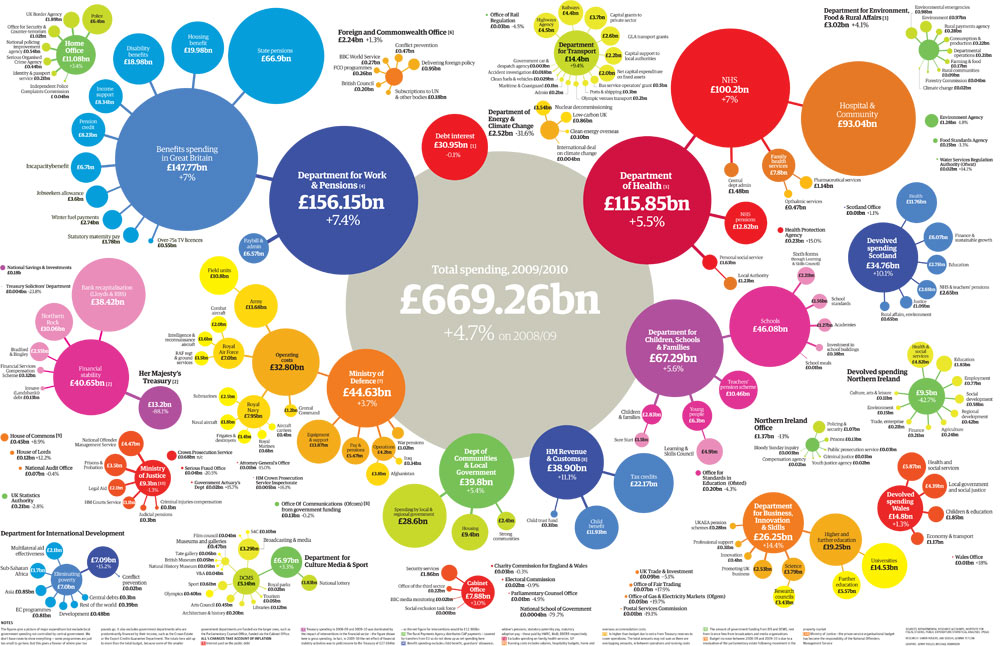
For almost a year the UK government has published all spending data, month by month, for each government ministry (down to the £500 in some, £25,000 in others). More over, as an increasing number of local governments are required to share their spending data it has lead to savings, as government begin to learn what other ministries and governments are paying for similar services.

Another bonus is that it becomes possible to talk about the budget in new and interesting ways. This BEAUTIFUL graphic was published in the Guardian, while still complicated it is much easier to understand than any government document about the budget I have ever seen.
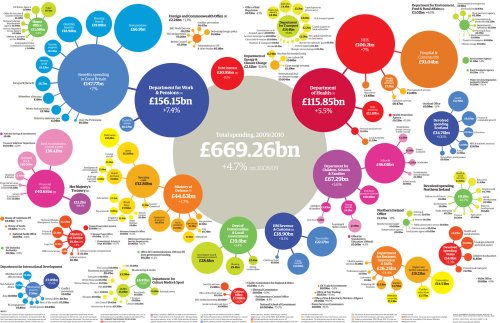
Public-spending-graphic-0051

9. Allow Government Scientists to speak directly to the media about their research.

It has become a reoccurring embarrassment. Scientists who work for Canada publish an internationally recognized ground break paper that provides some insight about the environment or geography of Canada and journalists must talk to government scientists from other countries in order to get the details. Why? Because the Canadian government blocks access. Canadians have a right to hear the perspectives of scientists their tax dollars paid for – and enjoy the opportunity to get as well informed as the government on these issues.

Thus, lift the ban that blocks government scientists from speaking with the media.

10. Create a steering group of leading Provincial and Municipal CIOs to create common schema for core data about the country.

While open data is good, open data organized the same way for different departments and provinces is even better. When data is organized the same way it makes it easier to citizens to compare one jurisdiction against another, and for software solutions and online services to emerge that use that data to enhance the lives of Canadians. The Federal Government should use its convening authority to bring together some of the countries leading government CIOs to establish common data schemas for things like crime, healthcare, procurement, and budget data. The list of what could be worked on is virtually endless, but those four areas all represent data sets that are frequently requested, so might make for a good starting point.
Shared IT Services across the Canadian Government – three opportunities

Earlier this week the Canadian Federal Government announced it will be creating Shared Services Canada which will absorb the resources and functions associated with the delivery of email, data centres and network services from 44 departments.

These types of shared services projects are always fraught with danger. While they sometimes are successful, they are often disasters. Highly disruptive with little to show for results (and eventually get unwound). However, I suspect there is a significant amount of savings that can be made and I remain optimistic. With luck the analogy here is the work outgoing US CIO Vivek Kundra accomplished as he has sought to close down and consolidate 800 data centres across the US which is yielding some serious savings.

So here’s what I’m hoping Shared Services Canada will mean:

1) A bigger opportunity for Open Source

What I’m still more hopeful about – although not overly optimistic – is the role that open source solutions could play in the solutions Shared Services Canada will implement. Over on the Drupal site, one contributor claims government officials have been told to hold off buying web content management systems as the government prepares to buy a single solution for across all departments.

If the government is serious about lowering its costs it absolutely must rethink its procurement models so that open source solutions can at least be made a viable option. If not this whole exercise will mean the government may save money, but it will be the we move from 5 expensive solutions to one expensive solution variety.

On the upside some of that work has clearly taken place. Already there are several federal government websites running on Drupal such as this Ministry of Public Works website, the NRCAN and DND intranet. Moreover, there are real efforts in the open source community to accommodate government. In the United States OpenPublic has fostered a version of Drupal designed for government’s needs.

Open source solutions have the added bonus of allowing you the option of using more local talent, which, if stimulus is part of the goal, would be wise. Also, any open source solutions fostered by the federal government could be picked up by the provinces, creating further savings to tax payers. As a bonus, you can also fire incompetent implementors, something that needs to happen a little more often in government IT.

2) More accountability

Ministers Ambrose and Clement are laser focused on finding savings – pretty much every ministry needs to find 5 or 10% savings across the board. I also know both speak passionately about managing tax payers dollars: “Canadians work hard for their money and expect our Government to manage taxpayers dollars responsibly, Shared Services Canada will have a mandate to streamline IT, save money, and end waste and duplication.”

Great. I agree. So one of Shared Service Canada’s first act should be to follow in the footsteps of another Vivek Kundra initiative and recreate his incredibly successful IT Dashboard. Indeed it was by using the dashboard Vivek was able to “cut the time in half to deliver meaningful [IT system] functionality and critical services, and reduced total budgeted [Federal government IT] costs by over $3 billion.” Now that some serious savings. It’s a great example of how transparency can drive effective organizational change.

And here’s the kicker. The White House open sourced the IT Dashboard (the code can be downloaded here). So while it will require some work adapting it, the software is there and a lot of the heavy work has been done. Again, if we are serious about this, the path forward is straightforward.

3) More open data

Speaking of transparency… one place shared services could really come in handy is creating some data warehouses for hosting critical government data sets (ideally in the cloud). I suspect there are a number of important datasets that are used by public servants across ministries, and so getting them on a robust platform that is accessible would make a lot of sense. This of course, would also be an ideal opportunity to engage in a massive open data project. It might be easier to create policy for making the data managed by Shared Service Canada “open.” Indeed, this blog post covers some of the reasons why now is the time to think about that issue.

So congratulations on the big move everyone and I hope these suggestions are helpful. Certainly we’ll be watching with interest – we can’t have a 21st century government unless we have 21st century infrastructure, and you’re now the group responsible for it.

The State of Open Data Licenses in Canada and where to go from here

(for readers less interested in Open Data – I promise something different tomorrow)

In February I wrote how 2011 would be the year of the license for Canada’s open data community. This has indeed been the case. For public servants and politicians overseeing the various open data projects happening in Canada and around the world, here is an outline of where we are, and what I hope will happen next. For citizens I hope this will serve as a primer and help explain why this matters. For non-Canadians, I hope this can help you strategize how to deal with the different levels of government in your own country.

This is important stuff, and will be important to ensure success in the next open data challenge: aligning different jurisdictions around common standards.

Why Licenses Matter

Licenses matter because they determine how you are able to use government data – a public asset. As I outlined in the three laws of open data, data is only open if it can be found, be played with and be shared. The license deals with the last of these. If you are able to take government data, find some flaw or use it to improve a service, it means nothing if you are not able to share what you create with others. The more freedom you have in doing this, the better.

What we want from the license regime (and for your government)

There are a couple of interests one is trying to balance in creating a license regime. You want:

  • Open: there should maximum freedom for reuse (see above, and this blog post)
  • Secure: it offers governments appropriate protections for privacy and security
  • Simplicity: to keep down legal costs low, and make it easier for everyone to understand
  • Standardized: so my work is accessible across jurisdictions
  • Stable: so I know that the government won’t change the rules on me

At the moment, two licenses in Canada meet these tests. The Public Domain Dedication and License (PDDL) used by Surrey, Langley, Winnipeg (for its transit data) and the BC government open data portal license (which is a copy of the UK Open Government license).

Presently a bunch of licenses do not. This includes the Government of Canada Open Data Licence Agreement for Unrestricted Use of Canada’s Data (couldn’t they choose a better name? But for a real critique of why, read this blog post). It also includes the variants of the license created by Vancouver and now used by Toronto, Ottawa and Edmonton (among others). Full disclosure, I was peripherally involved in the creation of this license – it was necessary at the time.

Both these licenses are not standardized, have restrictions in them not found in the UK/BC Open Government License and the PDDL and are anything but simple. Nor are they stable. At any time the government can revoke them. In other words, many developers and companies interested in open data dislike them immensely.

Where do we go from here?

At the moment there are a range of licenses available in Canada – this undermines the ability of developers to create software that uses open data across multiple jurisdictions.

First, the launch of BC’s open data portal and its use of the UK Open Government License has reset the debate in this country. The Federal government, which has an awkward, onerous and unloved license should stop trying to create a new license that simply adds unnecessary complexity and creates confusion for software developers. (I detail the voluminous problems with the Federal license here.)

Instead the Feds should adopt the UK Open Government Licence and push for it to be a standard, both for the provinces and federal government agencies, as well as for other common wealth countries. Its refusal to adopt the UK license is deeply puzzling. It has offered no explanation about why it can’t, indeed, it would be interesting to hear what the Federal Government believes it knows that the UK government (which has been doing this for much longer) and the BC government doesn’t know.

What I predict will happen is that more and more provinces will adopt the UK license and increasingly the Feds will look isolated and ridiculous. Barring some explanation, this silliness should end.

At the municipal level, things are more complicated. If you look at the open data portals of Vancouver, Toronto, Edmonton and Ottawa (sometimes referred to as the G4) you’ll notice each has a similar paragraph:

The Cities of Vancouver, Edmonton, Ottawa and Toronto have recently joined forces to collaborate on an “Open Data Framework”. The project aims to enhance current open data initiatives in the areas of data standards and terms of use agreements. Please contact us for further information.

This paragraph has been sitting on these sites for well over a year now (approaching almost two years) but in terms of data standards and common terms of use the work, to date, the G4 has produced nothing tangible for end users. (Full disclosure, I have sat in on some of these meetings.) The G4 cities, which were leaders, are now languishing with a license that actually puts them in the middle, not the front of the pack. They remain ahead of the bulk of Canadian cities that have no open data, but, in terms of license, behind the aforementioned cities of Surrey, Langley, Winnipeg (for its transit data).

These second generation open data cities either had fewer resources or drew the right lessons and have leap-frogged the G4 cities by adopting the PDDL – something they did because it essentially outsourced the management of the license to a competent third party. It maximized the effectiveness of their data, while limiting their costs all while giving them the same level of protection.

The UK and BC versions of the Open Government License could work for the cities, but the PDDL is a better license. Also, it is well managed. If the cities were to adopt the OGL it wouldn’t be the end of the world but it also isn’t necessary. It probably makes more sense for them to simply follow the new leaders in the space and adopt the PDDL as this will less restrictive and easier to adopt.

Thus, speaking personally, the ideal situation in Canada would be that:

  • the Federal and Provincial Governments to adopt the UK/BC Open Government License. I’d love to live in a world where the adopted the PDDL, but my conversations with them lead me to believe this simply is not likely in the near to mid term. I think 99% of software developers out there will agree that the Open Government License is an acceptable substitute. and
  • the municipalities push to adopt the PDDL. Already several municipalities have done this and the world has not ended. The bar has been set.

The worse outcome would be:

  • the G4 municipalities invent some new license. The last thing the world needs is another open data license to confuse users and increase legal costs.
  • the federal government continues along the path of evolving its own license. Its license was born broken and is unnecessary.

Sadly, I see little evidence for optimism at the federal level. However, I’m optimistic about the cities and provinces. The fact that most new open data portals at the municipal level have adopted the PDDL suggests that many in these governments “get it”. I also think the launch of data.gov.bc.ca will spur other provinces to be intelligent about their license choice.


Province of BC launches Open Data Catalog: What works

As revealed yesterday, the province of British Columbia became the first provincial government in Canada to launch an open data portal.

It’s still early but here are some things that I think they’ve gotten right.

1. License: Getting it Right (part 1)

Before anything else happens, this is probably the single biggest good news story for Canadians interested in the opportunities around open data. If the license is broken, it pretty much doesn’t matter how good the data is, it essential gets put in a legal straightjacket and cannot be used. For BC open data portal this happily, is not the case.

There’s actually two good news stories here.

The first is that the license is good. Obviously my preference would be for everything to be unlicensed and in the public domain as it is in the United States. Short of that however, the most progressive license out there is the UK Government’s Open Government License for Public Sector Information. Happily the BC government has essentially copied it. This means that many of that BC’s open data can be used for commercial purposes, political advocacy, personal use and so forth. In short the restrictions are minimal and, I believe, acceptable. The license addresses the concerns I raised back in March when I said 2011 would be the year of Open Data licenses in Canada.

2. License: The Virtuous Convergence (part 2)

The other great thing is that this is a standardized license. The BC government didn’t invent something new they copied something that already worked. This is music to the ears of many as it means applications and analysis developed in British Columbia can be ported to other jurisdictions that use the same license seamlessly. At the moment, that means all of the United Kingdom. There has been some talk of making the UK Open Government Licenses (OGL) a standard that can be used across the commonwealth – that, in my mind, would be a fantastic outcome.

My hope is that this will also put pressure on other jurisdictions to either improve their licenses or converge them with BC/UK or adopt a better license still. With the exception of the City of Surrey, which uses the PDDL license, the BC government’s license far superior to the licenses being used by other jurisdictions:  – the municipal licenses based on Vancouver’s license (used by Vancouver, Edmonton, Ottawa, Toronto and a few others) and the Federal Government’s open data license (used by Treasury Board and CIDA) are both much more restrictive. Indeed, my real hope is that BC’s move will snap the Federal Government out of their funk, make them realize their own licenses are confusing, problematic and a waste of time, and encourage them to contribute to making the UK’s OGL a new standard for all of Canada. It would be much better than what they have on offer.

3. Tools for non-developers

Another nice thing about the data.gov.bc.ca website is that it provides tools for non-developers, so that they can play with, and learn from, some of the data. This is, of course, standard fare on most newer open data portals – indeed, it’s seems to be the primary focus on Socrata, a company that specializes in creating open government data portals. The goal everywhere is to increase the number of people who can make use of the data.

4. Meaty Data – Including Public Accounts

One of the charges sometimes leveled against open data portals is that they don’t publish data that is important, or that could drive substantive public policy debates. While this is not true of what has happened in the UK and the United States, that charge probably is someone fair in Canada. While I’m still exploring the data available on data.gov.bc.ca one thing seems clear, there is a commitment to getting the more “high-value” data sets out to the public. For example, I’ve already noticed you can download the Consolidated Revenue Fund Detailed Schedules of Payments-FYE10-Suppliers which for the fiscal year 2009-2010 details the payees who received $25,000 or more from the government. I also noticed that the Provincial Obstacles to Fish Passage are available for download – something I hope our friends in the environmental movement will find helpful. There is also an entire section dedicated to data on the provincial educational system, I’ll be exploring that in more detail.

Wanted to publish this for now, definitely keen to hear about others thoughts and comments on the data portal, data sets you find interesting and helpful, or anything else. If you are building an app using this data, or doing an analysis that is made easier because of the data on this site, I’d love to hear from you.

This is a big step for the province. I’m sure I’ll discover some shortcomings as I dive deeper, but this is a solid start and, I hope, an example to other provinces about what is possible.

If the Prime Minister Wants Accountable Healthcare, let's make it Transparent too

Over at the Beyond the Commons blog Aaron Wherry has a series of quotes from recent speeches on healthcare by Canadian Prime Minister Stephen Harper in which the one constant keyword is… accountability.

Who can blame him?

Take everyone promising to limit growth to a still unsustainable 6% (gulp) and throw in some dubiously costly projects ($1 billion spent on e-health records in Ontario when an open source solution – VistA – could likely have been implemented at a fraction of the cost) and the obvious question is… what is the country going to do about healthcare costs?

I don’t want to claim that open data can solve the problem. It can’t. There isn’t going to be a single solution. But I think it could help spread best practices, improve customer choice and service as well as possibly yield other potential benefits.

Anyone who’s been around me for the last month knows about my restaurant inspection open data example (which could also yield healthcare savings) but I think we can go bigger. A Federal Government that is serious about accountability in Healthcare needs to build a system where that accountability isn’t just between the provinces and the feds, it needs to be between the Healthcare system and its users; us.

Since the feds usually attach several provisions to their healthcare dollars, the one I’d like to see is an open data provision. One where provinces, and hospitals are required to track and make open a whole set of performance data, in machine readable formats, in a common national standard, that anyone in Canada (or around the world) can download and access.

Some of the data I’d love to see mandated to be tracked and shared, includes:

  • Emergency Room wait times – in real time.
  • Wait times, by hospital, for a variety of operations
  • All budget data, down to the hospital or even unit level, let’s allow the public to do a cost/patient analysis for every unit in the country
  • Survival rates for various surgeries (obviously controversial since some hospitals that have the lowest rates are actually the best since they get the hardest cases – but let’s trust the public with the data)
  • Inspection data – especially if we launched something akin to the Institute for Health Management’s Protecting 5 Millions Lives Campaign
  • I’m confident there is much, much more…

I can imagine a slew of services and analysis that emerge from these, if nothing than a citizenry that is better informed about the true state of its healthcare system. Even something as simple as being able to check ER wait times at all the hospitals near you, so you can drive to the one where the wait times are shortest. That would be nice.

Of course, if the Prime Minister wants to go beyond accountability and think about how data could directly reduce costs, he might take a look at one initiative launched south of the border.

If he did, he might be persuaded to demand that the provinces share a set of anonymized patient records to see if academics or others in the country might be able to build better models for how we should manage healthcare costs. In January of this year I witnessed the launch of the $3 million dollar Heritage Health Prize at the O’Reilly Strata Conference in San Diego. It is a stunningly ambitious, but realistic effort. As the press release notes:

Contestants in the challenge will be provided with a data set consisting of the de-identified medical records of 100,000 patients from the 2008 calendar year. Contestants will then be required to create a predictive algorithm to predict who was hospitalized during the 2009 calendar year. HPN will award the $3 million prize(more than twice what is paid for the Nobel Prize in medicine) to the first participant or team that passes the required level of predictive accuracy. In addition, there will be milestone prizes along the way, which will be awarded to teams leading the competition at various points in time.

In essence Heritage Health is doing to patient management what Netflix (through the $1M Netflix prize) did to movie selections. It’s crowdsourcing the problem to get better results.

The problem is, any algorithm developed by the winners of the Heritage Health Prize will belong to… Heritage Health. This means the benefits of this innovation cannot benefit Canadians (nor anyone else). So why not launch a prize of our own. We have more data, I suspect our data is better (not limited to a single state) and we could place the winning algorithm in the public domain so that it can benefit all of humanity. If Canadian data helped find efficiencies that lowered healthcare costs and improved healthcare outcomes for everyone in the world… it could be the biggest contribution to global healthcare by Canada since Federick Banting discovered insulin and rescued diabetics everywhere.

Of course, open data, and sharing (even anonymized) patient data would be a radical experiment for government, something new, bold and different. But 6% growth is itself unsustainable and Canadians need to see that their government can do something bold, new and innovative. These initiatives would fit the bill.

How the War on Drugs Destabilized the Global Economy

This is truly, truly fantastic. If you haven’t already read this stunning story from the Guardian: How a big US bank laundered billions from Mexico’s murderous drug gangs. This is, in essence a chronicle how the dark and sordid side of banking and about how one US bank – Wachovia – essentially allowed Mexican drug cartels to launder a whopping $378B.

But this interestingly, is just the tip of the iceberg. It turns out that Mexican money may have been the only thing holding the US financial system together. Check out the following and the last paragraph especially (I’ve bolded it, it is so stunning):

More shocking, and more important, the bank was sanctioned for failing to apply the proper anti-laundering strictures to the transfer of $378.4bn – a sum equivalent to one-third of Mexico’s gross national product – into dollar accounts from so-called casas de cambio (CDCs) in Mexico, currency exchange houses with which the bank did business.

“Wachovia’s blatant disregard for our banking laws gave international cocaine cartels a virtual carte blanche to finance their operations,” said Jeffrey Sloman, the federal prosecutor. Yet the total fine was less than 2% of the bank’s $12.3bn profit for 2009. On 24 March 2010, Wells Fargo stock traded at $30.86 – up 1% on the week of the court settlement.

The conclusion to the case was only the tip of an iceberg, demonstrating the role of the “legal” banking sector in swilling hundreds of billions of dollars – the blood money from the murderous drug trade in Mexico and other places in the world – around their global operations, now bailed out by the taxpayer.

At the height of the 2008 banking crisis, Antonio Maria Costa, then head of the United Nations office on drugs and crime, said he had evidence to suggest the proceeds from drugs and crime were “the only liquid investment capital” available to banks on the brink of collapse. “Inter-bank loans were funded by money that originated from the drugs trade,” he said. “There were signs that some banks were rescued that way.”

But the more interesting part of the story, that picks up on the above quote by Antonio Maria Costa, lies deeper in the story:

“In April and May 2007, Wachovia – as a result of increasing interest and pressure from the US attorney’s office – began to close its relationship with some of the casas de cambio.”

and, a paragraph later…

“In July 2007, all of Wachovia’s remaining 10 Mexican casa de cambio clients operating through London suddenly stopped doing so.”

In other words from April through July, with increasing intensity, Wachovia got out of the drug money laundering business. Of course, this just also happens to be at the exact same time that the liquidity crisis starts hitting US banks prompting “The Bank Run We Knew So Little About.”

This is not to say that the financial crises was caused by drug money – it wasn’t. All those crazy mortgages and masses of consumer debt created a house of cards that was teetering away. But it could be that the sudden end to access of vast billions of Latin America drug money did tip the system over the edge.

I say this because here in Canada we have a government that not only does not believe in harm reduction as an effective way to deal with the drug problem, but it intends to pursue a prison focused US style approach to crime that even the most ardent US conservatives are calling a failure. And why does this matter? I mention the above stories because it is worth noting the size, scope and complexity of problem with face. This is a structural, systemic problem, not something that is going to be solved by throwing an additional 1,000 or even 100,000 people in jail. $378B. Through one bank. One third of Mexico’s GDP. And that’s all just pure profit. That’s probably 80 times more than we spend on fighting the war on drugs every year. Through one bank.

And, as the US authorities appear to have demonstrated it may be that the only thing more expensive than losing the war on drugs is winning a major battle – as apparently that can throw the entire global financial system into disarray. So if we think that upping the amount we spend on this war by $1B or even $10B is going to make a lick of difference, we’ve got another thing coming. But I suppose in the mean time, it will secure a few votes.

TorStar Op-ed: Liberals have to create a next political centre

This past Saturday the Toronto Star published the following piece by Taylor Owen and myself on its op-ed page. Thought I’d put it here for those who might have missed it.

Liberals have to create a new political centre

Canadians may have once valued the Liberal party, but they reject what it has become. The reason is simple. The centre is dead. Worse still, Liberals let it die. What once was the pragmatic core of Canadian politics, today is a wasteland devoid of an imaginative, progressive vision, occupied by a largely obsolete electoral strategy.

Don’t believe us? Consider the issues the Liberal party managed over the 20th century. The creation of universal health care and the social safety net. The management of the Canada-U.S. relationship by balancing opportunities for Canadian businesses with our desire to preserve our identity. Engaging Quebec and seeking to affirm its place within the country. Cultivating multiculturalism while simultaneously securing individual rights in a charter. Fostering peacekeeping to ensure local conflicts did not escalate into nuclear confrontation.

These were significant accomplishments that defined three generations of Canadians. They are also no longer relevant.

Today Canadians, especially young Canadians, are confident about themselves and their identity — no longer is there a “lament for a nation.” The sovereignty movement, while not dead, struggles. Individual rights continue to erode discrimination and the hierarchical relationships that impeded free expression and liberty. While some progressives continue to bang these drums, no one should be surprised that they no longer resonate.

In other cases, the solutions offered in the 20th century are no longer relevant. Canadians know — as health care threatens to eat up 50 per cent of provincial budgets and service levels remain mixed — that their health-care system is broken. Young Canadians don’t even pretend to believe a pension system will exist for them. Anyone can see that peacekeeping cannot solve today’s international conflicts.

On all of these issues, the traditional offerings of progressive rings hollow. But there is an opportunity for progressives. An opportunity to build a new centre. A centre that moves beyond the debate between conservatives of the right and conservatives of the left.

On the right is a Conservative party that, at its core, doesn’t believe in the federal government. It’s a vision for Canada grounded in the 1860s, of a minimalist government that is responsible for little beyond law and order and defence. Its appeal is the offer to dismantle the parts of the system that are broken, but in so doing it will leave behind many of those who are protected and enabled by the government.

On the left is a party whose vision is to return Canada to the 1960s. It’s a world of a strong national government, of an even bigger health-care system, social safety net and welfare state. Its appeal is a defence of the status quo at all costs, which in the long run will be many. The conservatism of the left means protecting what is unsustainable. It is the unreformed arc of old ideas.

If there is going to be a new centre between these conservative poles, Liberals will need to stop lying to themselves — and to Canadians. They need to acknowledge — loudly and publicly — that they failed to reform the institutions of the 20th century and, as a consequence, health care is broken and the welfare state as presently constructed is financially insatiable. A progressive future lies in taking these challenges head on rather that passively avoiding them.

Moreover, a modern progressive view of government needs to meet the consumer expectations created by Google, Apple and WestJet. Fast, effective, personalized, friendly. In short, progressives need a vision that not only safeguards citizens against the extremes of a globalizing market, but also meets the rising expectations Canadians have of services in the 21st century — all this in a manner that will be sustainable given 21st century budgets and demographics.

No party has figured out how to accomplish this, on the left or the right. And trolling through 20th or 19th century ideologies probably isn’t going to get us there.

The future for progressives rests in figuring out the political axes of the 21st century around which new solutions can be mined and new coalitions built.

We suspect these will include open vs. closed systems; evidence-based policy vs. ideology; meritocratic governance vs. patronage; open and fair markets vs. isolationism; sustainability vs. disposability, and emergent networks vs. hierarchies. It is these political distinctions, not the old left versus right, that increasingly resonate among those we speak to.

The challenge is enormous but progressives have done it before. In the 19th century, the rise of industrial capitalism led to a series of tense societal changes, including the emergence of an urban working class, increasing inequality and the terrifying possibility of total war.

A centrist party turned out to be the place where three generations of pragmatically driven progressives were able to lead nearly a century of Canadian politics. Doing this again will require starting from scratch, but that is the task at hand.

David Eaves is a specialist on public policy, collaboration and open source methodologies.

Taylor Owen is a Banting Fellow at the Liu Institute for Global Issues at the University of British Columbia