Tag Archives: politics

Open Data: If British Conservatives get it right, the French…

This is a pretty stunning press release from Access Info Europe concerning the French government’s response to the open data movement. Statist government’s were always going to struggle with the internet and open data… but this shows just how bad things can get.

Press Release

For immediate publication

France proposes police controls on who uses public information

Madrid/Paris, 23 November 2010 – A law to be discussed in the French parliament before the end of 2010 will result in the police carrying out “behaviour” checks on members of the public and organisations wanting to reuse information obtained from public bodies. The likely effect is to severely limit access to information and freedom of expression.

The draft law currently before the French National Assembly amends the 1995 Police Security Act and will extend the scope of police “behaviour” checks from legitimate purposes such as checking on those to have access to dangerous substances and high security zones to those who want to reuse information obtained from public bodies. The criteria for the background checks are not specified in the law.

The information affected could include, for example, databases on public spending, copies of laws, or electoral results. Much data held by local authorities which is of great interest to the public such as schedules and real-time locations of trains and buses, information about recycling schemes, and construction works permits would also fall under these new controls.

The associations Access Info Europe and Regards Citoyens today expressed concerns that the law, if adopted, will significantly complicate and slow access to information in France.

“This is an extremely dangerous law which would seriously limit freedom of expression in France,” said Helen Darbishire, Executive Director of Access Info Europe.

“Subjecting those who wish to access and reuse public datasets to vaguely-defined morality controls runs counter to the basic principles of the freedom of expression and information enshrined in the French Constitution, and is a violation of European Court of Human Rights jurisprudence and EU law,” added Darbishire.

Access Info Europe notes that in 2010 many leading democracies such as the US and the UK, Norway and Spain, Australia and New Zealand, are posting on line large volumes of public data making them free for anyone in the world to use. They do this out of recognition of the societal and economic benefits that flow from the reuse of public sector information.

“If this provision were to be adopted, France would be closing down public access to information rather than opening it up,” concluded Benjamin Ooghe-Tabanou, co-founder of Regards Citoyens.

Notes for Editors:

1. Access Info Europe is a human rights organisation head-quartered in Madrid which promote the right of access to information and open government data in Europe. Access Info Europe believes that more public information means better participation in and greater accountability of public bodies.

2. Regards Citoyens is a civic association which promotes the opening of public data to secure greater transparency of democratic institutions in France.

3. The proposed reform is to 1995 Security Law (Loi n°95-73 du 21 janvier 1995 d’orientation et de programmation relative à la sécurité).

4. The amendment would impact on the right of access to public information granted under the 1978 Access to Administrative Documents Law as modified by European Union Directive 2003/98/EC of the European Parliament and of the Council of 17 November 2003 on the re-use of public sector information. The EU Directive requires that governments to create “fair, proportionate and non-discriminatory conditions for the re-use of [public sector] information.” The European Commission is currently reviewing this Directive. This case and the broader impact of this Directive on the fundamental right of access to information should be carefully reviewed by the Commission.

5. The Council of Europe Convention on Access to Official Documents from 2009, not yet signed by France, requires that all requesters be treated equally and without discrimination. It is illegitimate under this and other international standards to ask why someone wants information or what they will do with it.

6. The European Court of Human Rights has ruled that access to information held by public bodies when these are monopolies is an inherent part of the right to freedom of expression: information is needed to participate in democratic public debate. See, inter alia Társaság a Szabadságjogokért v. Hungary (App no 37374/05), ECHR, 14 April 2009.

7. Examples of online portals for accessing public data include www.data.gov, www.data.gov.uk, www.data.gov.au, www.data.gov.nz.

For more information – in English or French – please contact:

Victoria Anderica, Access Info Europe, victoria@access-info.org

Office phone: +34 91 366 5344

Mobile: +34 606 592 976

Helen Darbishire, Access Info Europe (www.access-info.org)

helen@access-info.org, mobile: +34 667 685 319

Not all Maclean’s Covers are Created (or Treated) Equal

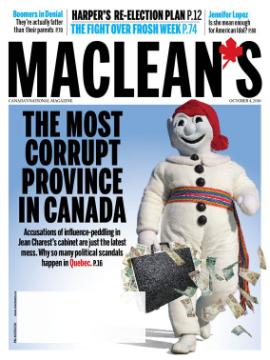
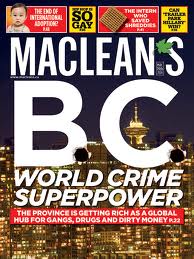
Which one of these covers is more damning?

Macleans-Cover vs.  images

Now that a little time has passed I was reflecting on the controversy about the Maclean’s cover about Quebec as “The Most Corrupt Province in Canada” and remain amazed at the outcry it generated. It is stunning that Parliament took time out to condemn the cover. I don’t say this because I think the article is true. Let’s face it, Canada really isn’t that corrupt. In 2009 Transparency International ranked us as tied for 8th as the least corrupt country in the world. What is more interesting is that so many people felt it was in their interests to take seriously (or exploit) what was obvious link bait.

Indeed what made the outcry all the more fascinating was the a mere 2 years earlier Maclean’s called BC a “World Crime Superpower” and that elicited no response. No outcry from parliament… no screams of protest… Again, in the grand scheme of things claiming BC us a World Crime Superpower on par with countries like say Mexico, Afghanistan and Colombia feels, like a stretch. (Although the economic impact on BC of California decriminalization marijuana is fascinating topic)

Lots of reasons can account for the difference. Part of it may be that BCers frankly don’t care what the rest of the country – not to mention Maclean’s – think. It’s also possible the BCers have less of a sense of common identity – especially one sensitive to how the central Canada describes it. It may also be a reflection of how political power doesn’t always flow with demographics or even opportunity. Today there are few seats to be won in Quebec – the bloc is entrenched and unlikely to move. making a big stink probably isn’t going to change one’s fortunes. In contrast, in BC, vast swaths of the province are up for grabs for all the parties (save the Bloc) – defending the honour of BC might actually yield something. And then, of course, all the parties may not be interested in condemning the Superpower of Crime label – a real, or imagined – creates a mega-crime menace in BC that would play well with a party interested in finding kingpins to fill the empty prisons it plans to build. Perhaps not coming to BCs defense is the shrewd move for some (although one is left wondering, where were the others?).

I think what is most interesting though is that it suggests that for all of the past challenges Quebec has had regarding being in Canada, it is an activist member of the dominion, both in its politics and in its populace. Quebecers seem to care what the rest of the country thinks and they’ll sharpen their elbows and let themselves be heard if necessary. In short, they’ll play in the game. BC has never cared to separate, but sometimes it feels like the province the least part of the dominion. Federal politics don’t get much play in BC, its provincial politicians rarely play the federal game (well) and its population is usually oblivious to what goes on east of the Rockies. Hence the irony of a province that has at times wanted out still cares so much, and a province that defined the country by asking to come in, cares so little.

Or maybe it’s just all a fun note about the fun country we live in and how old stereotypes sometimes send us into a tizzy… and sometimes not.

A Government built on Failure

At a certain point Governments need to govern. Yesterday, a strange new trend emerged. Canada has its first government for whom not governing is the new strategy and failure is the new success.

Mere minutes after Canada lost the vote for a seat on the United Nations Security Council to Portugal the Government had identified who was at fault: the leader of the opposition. Dimitri Soudas, Harper’s communications director told the Canadian Press: “I would say a big deciding factor was the fact that Canada’s bid did not have unity because we had Mr. Ignatieff questioning and opposing Canada’s bid.”

Allegedly, before the vote even took place, the Conservatives had attack ads ready to blame the opposition leader. Did the Prime Minister want a seat on the Security Council? Desperately. But short of that, the whole event was to be converted into a attack the opposition event. Let’s celebrate our failure and blame someone else.

It is, of course, a repeat of a similar story from last month: Gun Registry. As Don Martin so persuasively argues in the National Post, the Conservatives couldn’t be happier that its demise was defeated. The party has been able to use the issue to drive fundraising and “rally its base.” Once again, did the Prime Minister want the gun registry eliminated? Absolutely. But, once again, failure becomes success. Let’s celebrate and blame someone else.

At some point Canadians are going to start to wonder? Can a government be built on the failure to govern? The Conservatives seem to believe that retreating to their 30% core support will win them minority governments forever. But at some point the public may actually look for a government that wants to succeed, and a brand built around celebrating failure and playing on divisions could backfire.

Indeed, this strategy erodes the one thing the conservatives claimed lay at the heart of their brand. Accountability. As the list of failures – from the gun registry, to proroguing parliament, to the census, and now the security council debacle – grows one can always try to blame others, but voters will start to ask… are governments at least somewhat accountable for its decisions? To its choices? For its failures?

There are hints that such accountability exists, if fleeting. Back in New York, Foreign Minister Lawrence Cannon said “I do not in any way see this as a repudiation of Canada’s foreign policy… The principles underlying our foreign policy, such as freedom, democracy, respect for human rights and the rule of law, were the basis of all our decisions… Some would even say that because of our attachment to those values that we lost a seat on the council. If that’s the case, then so be it.”

It may be a bitter statement, but at least the Minister displayed a shred of accountability. An acknowledgement that it was decisions this government made – not statements by the opposition leader few inside (forget about outside) Canada were aware of – that were possibly responsible for ending Canada’s bid. It would be nice if this – and not failure – were the metric the government choice to measure itself by.

How you know a government is broken

Last Friday Gloria Galloway and Bill Curry ran an excellent piece about how the government’s promise to strengthen Canada’s access-to-information laws is now five years old.

It is of course all so laughable it is sad. Here we have an issue that the public is universally supportive of – making government more transparent and accountable – and yet the government contends the issue requires extensive consultation. And so… no action.

Meanwhile, on issues to which the public is almost universally opposed – for example the long form census – the government acts without consultation, without evidence and in the dead of night, hoping that no one will notice.

Again, it would be laughable if the implications weren’t so serious. It’s also a big reversal of what should have been and maybe the clearest sign yet this government is broken.

And it didn’t have to be this way. Looking back at the Conservative’s 2006 election platform under the header “Strengthen Access to Information legislation” The government promised it would (this is verbatim)

  • Implement the Information Commissioner’s recommendations for reform of the Access to Information Act. Give the Information Commissioner the power to order the release of information.
  • Expand the coverage of the act to all Crown corporations, Officers of Parliament, foundations, and organizations that spend taxpayers’ money or perform public functions.
  • Subject the exclusion of Cabinet confidences to review by the Information Commissioner. Oblige public officials to create the records necessary to document their actions and decisions.
  • Provide a general public interest override for all exemptions, so that the public interest is put before the secrecy of the government.
  • Ensure that all exemptions from the disclosure of government information are justified only on the basis of the harm or injury that would result from disclosure, not blanket exemption rules.
  • Ensure that the disclosure requirements of the Access to Information Act cannot be circumvented by secrecy provisions in other federal acts, while respecting the confidentiality of national security and the privacy of personal information.

How many of these promises have been implemented? To date, only one (the one that is italicized)

As an aside, take a look at that platform. Guess what isn’t mentioned once: The long form census.

One of the great pledges of the Conservative government was that they were going to make government more accountable and more transparent. So far, when it comes to managing information – the collective documents our tax dollars paid to create – today our government is more opaque, more dumb and less inspiring to Canadians than it has ever been. For a government that was supposed to restore Canadians confidence in their country, it has been a sad decline to observe.

Census Update: It's the Economy, Stupid

Yesterday during a press conference newly minted House leader John Baird announced “The next few months will be sharply focused on Canadians’ No. 1 priority: jobs and the economy… The economic recovery remains fragile and it is increasingly clear that we are not out of the woods yet.”

Fantastic news.

I just hope someone sends Industry Minister Tony Clement the memo.

The effects and impacts of ending the mandatory long form census continues to spill out with a number of Canada’s most senior business and economic leaders pointing out how the decision will negatively impact the economy and… job growth.

First, there was Bank of Canada Governor Mark Carney (voted one of the most influential people in the world by Time Magazine) noting that the bank relies on data found in the mandatory long form to assess the economy and, presumably, to inform decisions on interest rates and other issues. The bank’s capacity to make informed decisions has now been compromised – not exactly a win for jobs or the economy.

As an interesting side note, Carney goes on to say that this may cause the bank to have to supplement StatsCan’s research with its own. Expect to hear more and more statements like this from Government agencies (which are still allowed to talk to the press) as more and more ministries and agencies get plunged into the dark regarding what is going on in the country and are no longer able to assess programs and issues they’ve been tasked to monitor. Various arms of the government (and thus you, taxpayer) will be spending 10s if not 100s of millions to pay for Industry Minister Clement’s mistake.

Then, in the same Globe article in which Carney makes these statements, Roger Martin, dean of the Rotman School of Management notes that ending the long form census hampers Canadian companies capacity to both compete globally and boost productivity. More damning, and further echoing arguments I’ve been making here, he states it will prevent Canadians from having “a sophisticated economy that uses information to its best.” Unkind words from one of the world’s recognized business leaders.

Sadly, it doesn’t end there. The always excellent Stephen Gordon lists the emerging academic literature chronicling the havoc the demise of the long form census is about to wreck. Especially relevant is “The Importance of the Long-Form Census to Canada” by UBC economists David Green and Kevin Milligan. Interestingly, it turns out that the Canadian Mortgage and Housing Corporation uses long form data to fulfill its legislative mandate, and also by local governments and private sector actors to learn about trends in housing. Something that might be of interest to those concerned about the economy and jobs given Canada is rumored to possible have a housing bubble.

Still more damning is how Green and Milligan show the mandatory long form serves as the foundation for the Labour Force Survey (LFS) from which we derive unemployment levels. Compromising the long form survey has, in short, compromised our ability to assess how many Canadians actually have jobs, something that, if you really believed Canadians felt the economy and jobs were the number 1 priority, your government should care about measuring accurately.

Maybe John Baird will sit down with Tony Clement and the Prime Minister and explain to them how, if the economy and jobs are priority 1 then perhaps the government should rethink its decision on the long form census.

Just don’t hold your breath. Instead, do write another email or letter to your local MP. Our country’s economic recovery and competitiveness is being eroded by a government either too dumb to understand the implications of its decision and too stubborn to admit a mistake. Those of us who will be paying the price should remind them of how they can best serve their own priorities.

Twitter, Criminal Investigations & Fox News North

Today, in a headline that came as somewhat of a shock (that, of course, I first saw on twitter) Kory Teneycke, the Quebecor Media vice-president and main advocate for the proposed Sun TV News Channel, announced his resignation. As backgrounder for those not familiar with this story, the proposed Sun TV News Channel is seeking to bring a conservative, Fox styled cable news channel to Canada. There has been a little bit of a battle over what type of license they should get which is covered very well in this blog post. What’s important is that Avaaz launched a petition against the proposed channel which subsequently had a number of false names added to it (adding someone else’s name to a petition is, I’m told, illegal in Canada).

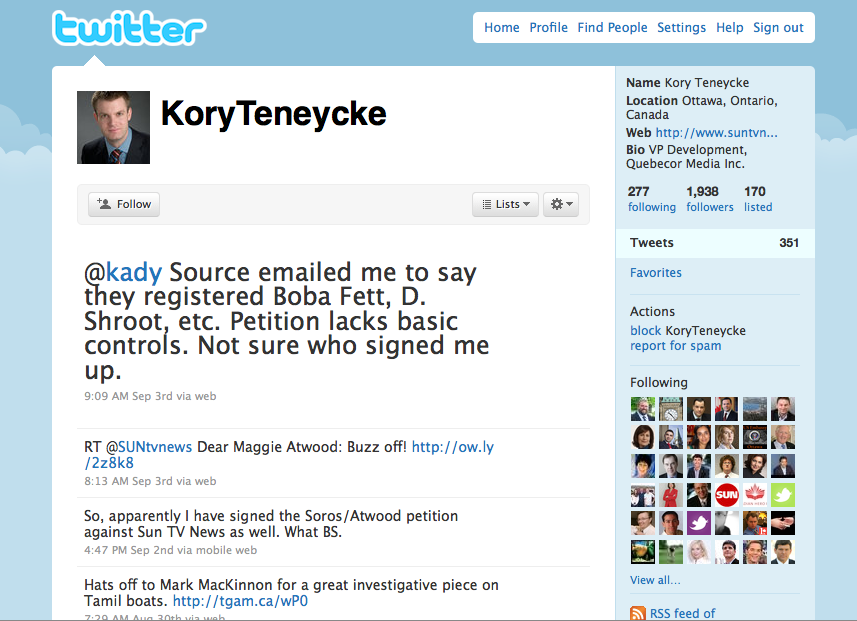
What makes Teneycke’s resignation so interesting is that it comes on the heels of Avaaz asking the police to investigate the additions. It appears that, thanks to technology, figuring out who was illegally adding the names may not be that hard:

On September 2, 2010, Avaaz became aware that an individual operating from an Ottawa IP address was adding both fictional and actual names and email addresses to a petition to stop Prime Minister Harper from pushing biased crony media onto Canadian airwaves. The next morning, Quebecor executive and Sun TV front man Kory Teneycke published several pieces in Quebecor owned newspapers attacking Avaaz and accusing them of running a fraudulent petition – even quoting actual names added by the fraudster. Teneycke later admitted to insider knowledge of both the perpetrator and crimes committed.

Days later, Quebecor threatened to sue Avaaz for the content of its petition site.

In short, it appears that either Teneycke or someone he knew was adding false names to the petition so that a) Teneycke could write a story to discredit the petition and b) prompt Quebeccor to launch a lawsuit to have it taken down. This is serious stuff. Especially from someone who intends to run a news channel. (although, to be fair, it is consistent with the type of thing one might expect from Fox News).

Perhaps Teneycke’s resignation has nothing to do with the false names on the petition? But it is also worth noting that Teneycke’s twitter account is no longer active. This also means that the original offending tweet where he admits that he knew the person adding the false names can no longer be seen. Fortunately, on a lark, I took a screen shot of it the day it went up since, after reading CBC reporter Kady O’malley’s excellent coverage of the back and forth, since given her coverage something seemed very odd about the whole affair.

So what are some key lesson here?

a) Things on twitter don’t disappear

b) Manipulating the press in a world of social media is not as easy as you think it is, even for a former Prime Minister spokes person

c) It appears that Sun TV executives are every bit as slimy as the counterparts feared they would be. If even 10% of this is true then this is shocking behaviour from a proposed News television executive.

d) This may yet lead to Canada’s first high-profile criminal investigation involving twitter

Interesting stuff indeed.

Census Update and other chuckles

Sorry for the lack of posts this week, blog was offline for a bit. (For geeks out there, I now have a company managing my blog for me and we we’re moving from a shared hosting service to a virtual private server – I should have less down time in the future – very excited).

Sadly, in that time there have been a bunch of fascinating developments on the census. As some of you may be aware a new poll by EKOS emerged today that has the Liberals and Conservatives dead even. More interesting however is how the census is playing a key role in the shift:

In seeking an explanation for these movements, we need look no further than the government’s ill-received decision to end the mandatory long form census. Not only does the shift of the highly educated support this conclusion, but a direct question on public approval for this decision provides compelling evidence that this move precipitated the current woes that the Conservative Party now faces.

When asked whether they felt that the privacy intrusion of the census justified a voluntary census or whether the lack of representativeness would cost us vital data, a clear majority of the public (56%) picked the latter (compared 26% who felt the mandatory long form was a violation of privacy). Even among Tory supporters, this appeal is not selling and there is an overwhelming lean to disapproval in the rest of the spectrum. Opposition to this decision is strongest among the university educated.

Of course, one of the retorts from pundits in favour of scrapping the long form census has been that only a few people care about this issue, it won’t matter in the medium term and it certainly won’t impact any election. For example:

Two things: I still standby my thesis that I believe that chucking mandatory nature of the long-form is a move to dismantle the welfare state (and that this is a move in the right direction). And two, nobody cares outside of the beehive. It’s the media that is pushing the story outside of the beehive walls propelled by the loud buzz of special interests.

Sigh, I suppose that 56% of  Canadians represent “a special interest.”

For me, both groups (56% and 26%) have legitimate concerns. As such, efforts by those in favour of this decision opposition as “special interest” driven are wrong and, frankly, disingenuous. Happily, they have failed. Indeed, the more these pundits try, the more they seem to make this a wedge issue in favour of those opposed to the decision. Mostly, I just think it would have been nice to have the issue debated before a decision was made.

More interesting has been another effort to defend trashing the long form census. I think Jack Mintz has thoroughly damaged his credibility with a terrible, contradictory and misleading op-ed in the Financial Post. Rather than dive into it, I encourage everyone to wander over to Aaron Wherry’s fantastic (and, unlike this post, short) dismantling of it. He’s already done all the heavy lifting.

Finally, just because I could help but notice the irony… I see that Conservative MP Garry Breitkreuz has an oped in the Mark in which he is worried about the role that the police is taking lobbying to keep the registry alive:

Taxpayers should be incensed at the CACP for co-opting the role of policy-maker. When law enforcement managers try to write the laws they enforce, history has taught us we risk becoming a state where police can dictate our personal freedoms.

I, of course, agree that it is dangerous for the police to get involved in policy debates. I now eagerly away for Garry Breitkreuz to demand that the RCMP own up to the funding of fake “research” in an effort to distort the debate on Insite and harm reduction policies. It would seem that someone at the RCMP, or higher up, doesn’t believe that should happen.

But on further review, maybe we shouldn’t get to excited. Looking at Garry’s website, and specifically, this PDF he’s made available for download, it seems like he’s actually quite keen to have police force members be outspoken about the gun registry as long as they agree with his view.

Ah, hypocrisy. If only he didn’t make it so easy.

Good Statistical Data: We fund it in Africa, but not in Canada

It turns out that the Canadian government is a supporter of collecting good statistical data – especially data that can be used to alleviate poverty and address disease. There’s only one catch. It can’t help Canadians.

As the fall out from the canceling of the mandatory long form census continues to grow – today the head of Alberta Health Services spoke out, saying the the census decision will hamper the province’s ability to deliver health care efficiently – we  now learn that the very arguments the government dismisses here in Canada, it supports on the international stage.

As it happens, the Canadian International Development Agency contributes to the Trust Fund for Statistical Capacity Building (TFSCB) an international fund designed to support the Marrakech Action Plan for Statistics. And what, you should legitimately ask, is the Marrakech plan? It is a general agreement by international actors to support building developing countries statistical capacity. It has, specifically, as a primary objective, the goal of developing countries capacity to perform censuses. More interestingly, it has a secondary goal, to: “Set up an international Household Survey Network.” the very same part of the census the government just gutted here in Canada.

Both the Trust Fund and the Marrakech Action plan websites explain this in detail. But so to does the CIDA website, where the government acknowledges that this work is essential as:

“The projects supported aim to improve in the collection, processing, analysis, storage, dissemination, and use of quality statistics to support poverty reduction and economic and social development. Developing countries can submit funding proposals to the Trust Fund. The proposals are ideally based on a national strategy for the development of statistics. By implementing such a strategy, countries can improve their statistical capacities to measure development progress and results, notably with regard to the Millennium Development Goals, and to better plan and utilize scarce resources.”

In short, our government accepts that the Household Survey is essential to helping marginalized people. It recognizes that such a survey will help other governments tackle poverty, health care and other social development issues. Indeed, it believes it so strongly, we will spend millions of dollars a year funding the development of statistical capacity abroad to ensure that other governments don’t do what we just did to the long form census.

I’m grateful that our government believes that good statistics and the types of questions found on the long form are essential to developing good policy – I’m just sad they don’t believe it to be true for Canada citizens.

Open Canada – Hello Globe and Mail?

Richard Poynder has a wonderful (and detailed) post on his blog Open and Shut about the state of open data in the UK. Much of it covers arguments about why open data matters economically and democratically (the case I’ve been making as well). It is worthwhile reading for policy makers and engaged citizens.

There is however a much more important lesson buried in the article. It is in regard to the role of the Guardian newspaper.

As many of you know I’ve been advocating for Open Data at all levels of government, and in particular, at the federal level. This is why I and others created datadotgc.ca: If the government won’t create an open data portal, we’ll create one for them. The goal of course, was to show them that it already does open data, and that it could do a lot, lot more (there is a v2 of the site in the works that will offer some more, much cooler functionality coming soon).

What is fascinating about Poynder’s article is the important role the Guardian has played in bringing open data to the UK. Consider this small excerpt from his post.

For The Guardian the release of COINS marks a high point in a crusade it began in March 2006, when it published an article called “Give us back our crown jewels” and launched the Free Our Data campaign. Much has happened since. “What would have been unbelievable a few years ago is now commonplace,” The Guardian boasted when reporting on the release of COINS.

Why did The Guardian start the Free Our Data campaign? Because it wanted to draw attention to the fact that governments and government agencies have been using taxpayers’ money to create vast databases containing highly valuable information, and yet have made very little of this information publicly available.

The lesson here is that a national newspaper in the UK played a key role in pressuring a system of government virtually identical to our own (now also governed by a minority, conservative lead government) to release one of the most important data in its possession – the Combined Online Information System (COINS). This on top of postal codes and what we would find in Stats Canada’s databases.

All this leads me to ask one simple question. Where is the Globe and Mail? I’m not sure its editors have written a single piece calling for open data (am I wrong here?). Indeed, I’m not even sure the issue is on their radar. It certainly has done nothing close to launching a “national campaign.” They could do the Canadian economy, democracy and journalism and world of good. Open data can be championed by individual advocates such as myself but having a large media player repeatedly raising the issue, time and time again brings out the type of pressure few individuals can muster.

All this to say, if the Globe ever gets interested, I’m here. Happy to help.

The Prime Minister, The Press and The Fear Disintermediation

Last week the Prime Minister announced that he would use YouTube to answer citizen submitted questions. Over the past seven days thousands of Canadians have submitted and voted on questions that they would like to Prime Minister to answer.

Is this novel or new? Not really – on a smaller scale politicians have been doing Town Hall meetings for decades and, in the US, President Obama has answered questions posed over YouTube and indeed, some YouTube questions were even inserted into the Presidential debates in the 2008 presidential election.

Is it, however, good? Absolutely. Giving Canadians the opportunity to submit questions to the Prime Minister – and to vote on questions that they think are important – is a fantastic way to let the government (and media) know about the priorities and concerns of citizens. Some will laugh at the fact that the top questions revolve around the decriminalization of cannabis. But then, there is a significant and vocal minority who both feel strongly about this subject and unrepresented by the political parties and the media. I think it is fantastic that they get to ask the Prime Minister their question.

Then there are those who wonder if this YouTube press conference is another death knell for traditional media. Some journalists have scoffed at the idea of citizens asking questions. Citizens don’t know the issues well enough or aren’t articulate enough to ask questions. Maybe, but journalists should remember that they are talking about their audience. Can one really write for an audience you hold in contempt? Maybe it would be worth listening to them… Underling it all is a concern that the press will be cut out of the picture. If the Prime Minister can connect directly with citizens… what role is left for the press? The fact is there will always be a role of intelligent, informed people to comment on what is going on in Ottawa. Indeed, smart traditional media outlets should welcome this developing. By drawing people into the political process YouTube is growing the audience of people who care about politics and who will want to read about it.

But will the Q&A help the Prime Minister attract voters and even engage citizens? That is a completely different question. Where the journalists have a point is that they – sometimes deservedly, sometimes not – have brought credibility to the process of holding the Prime Minister and government to account. Their job (performed with a mixed degree of success) is to ask hard questions. They bring credibility to the process. What I’m not sure the PMO (or politicians generally) realize is that removing journalists doesn’t make the process easier – it makes it harder. Now the credibility of the process lies completely in their hands. If the Prime Minister does not address questions that received a lot of votes – the whole experiment will be labeled a communications gimmick and could end up costing him. Moreover, if he only answers softball questions or doesn’t actually engage the tough components of some of the questions posed, he will lose credibility. No longer can the PMO blame the media for spinning him badly, Canadians will now see if, left completely to his own devices, will the Prime Minister actually talk about issues or just issue talking points, reach out to Canadians or firm up his base.

And actually engaging votes will require a big shift for the PMO (or most politicians). As most online experts will tell you, and as Ivor Tossell aptly discussed yesterday, online interactions work best when you actually interact with the audience. Issuing press releases and spouting sound bites over a blog, or a YouTube video, won’t cause the online world to take interest, in fact, it will positively turn them against you. But then, maybe this is a constituency most politicians simply don’t care about and so simply being online will be sufficient, as it gives the Prime Minister and other politicians the appearance of being online to the offline world…

Some questions I hope the PM answers:

“A majority of Canadians when polled say they believe marijuana should be legal for adults and taxes like alcohol. Why don’t you end the war on drugs and focus on violent criminals.” (Cause it is the most voted for)

“Sir, the US Government much larger yet they disclose much more information about contracts, grants and lobbyists. When will the Government of Canada disclosure more information to the taxpayers of Canada” (cause I care about open government)

Since research has shown that mandatory minimum sentencing does not deter future crime, what makes you believe this is still an effective way of prosecuting criminals? (cause evidence based public policy matters)

Why is the government not more open about the Afghan detainee issue? Every time a legitimate question is asked, the response is that we should “support our troops” and look the other way (because every Canadian wants this questions answered)

Mid-last year, the CBC stated that the GST cuts introduced by your government have hiked the deficit by as much as $10 BILLION. Since most everyday purchases only end up saving Canadians pennies, why not raise the GST back to previous levels? (a great accountability question)

“Canadians seemed happy about your decision to match donations to Haiti after the devastating Earthquake; however, it has recently been discovered that the money has not gone out. Why was there a delay and when can we expect to see the money spent?” (great accountability question)

“As a gay Canadian, why should I support your government?” (was told about this question but couldn’t find it – google, filter failure! – I think this is precisely the type of question the media will never ask…)