Tag Archives: technology

Firefox pledge map – pledges as a % of population

(sorry this post was initially messy – when you get off a transatlantic red-eye and have fifteen minutes to copy and paste in your post, things are bound to get ugly. It should be all cleaned up now)

Mozilla kindly sent me a preliminary data set of download pledges. This data is about 2 days old but should still be more or less instructive. I hope to get more up to date data soon and will update accordingly.

According to the raw data the 20 countries where the most people – as a % of the population – pledged to download Firefox. Population figures are based on those available on Wikipedia.

Country % of the pop that pledged to download
Anguilla 5.78
Falkland Islands 2.00
Montserrat 0.66
Andorra 0.60
Faeroe Islands 0.40
Iceland 0.35
Liechtenstein 0.27
Slovenia 0.26
Greenland 0.25
Estonia 0.25
Poland 0.23
Palau 0.20
Aruba 0.19
Netherlands 0.17
Maldives 0.17
Malta 0.17
Antigua And Barbuda 0.16
Latvia 0.15
Turks And Caicos Islands 0.15
Lithuania 0.15

On the one hand it is no surprise that many of these – about half – are small island countries with populations under 100,000 people. Moreover, 14 have populations under 500,000. Consequently, for many of these countries even a small number of absolute pledges translates into a high total percentage of the population. But I also think this says something about the economics of open source and the internet. It enables small isolated and sometimes neglected parts of the world economy to get effective, top of the line software for free, software that in turn enables them to participate in the global economy.

But things get more interesting if we strip out the countries with populations under 500,000. This picture eliminates the small countries (which are, in some ways, outliers) and allows us to focus on the rest of the world (167 countries made this list). Here are the results for the top and bottom 20 countries.

Top 20 (with population greater than 500,000
Country Core or Gap % of the pop that pledged to download
Slovenia Gap 0.263
Estonia Core 0.248
Poland Core 0.235
Netherlands Core 0.170
Latvia Core 0.154
Lithuania Core 0.146
Finland Core 0.144
Norway Core 0.143
Belgium Core 0.139
Portugal Core 0.131
Albania Gap 0.130
Denmark Core 0.126
Singapore Gap 0.125
Croatia Gap 0.124
Hungary Core 0.123
Canada Core 0.110
Chile Core 0.107
New Zealand Core 0.109
France Core 0.106
Australia Core 0.105
Bottom 20 (with population greater than 500,000
Country Core or Gap % of the pop that pledged to download
Ghana Gap 0.001
Burundi Gap 0.001
Kenya Gap 0.0006
Chad Gap 0.0006
Uganda Gap 0.0005
Burkina Faso Gap 0.0005
Mali Gap 0.0005
Rwanda Gap 0.0005
Cameroon Gap 0.0005
Guinea Gap 0.0004
Mozambique Gap 0.0004
Bangladesh Gap 0.0004
Malawi Gap 0.0004
Niger Gap 0.0004
Myanmar Gap 0.0003
Sudan Gap 0.0003
Nigeria Gap 0.0002
Tanzania Gap 0.0002
Dem. Republic Of The Congo Gap 0.0002
Ethiopia Gap 0.0001

I admit that when I wrote the post on Monday about the correlation between the pentagon’s new map and the firefox pledge download map I thought that once the per capita data was analyzed it would sharply change the outcome. The reality is, it doesn’t. Core countries are far and away dominant on the list. In the bottom half of the list (84 of the 167 countries with populations over 500,000) only 4 countries are in the core: India, China, Mongolia and South Africa. (of course as a % of Function Core, or even the worlds’ population, this is a lot of people!).

Eastern Europe is clearly an emerging open source powerhouse. Of the top 20 countries as a percentage pf population who pledged the top 3 are Eastern Europe and a total of 8 make the list. Only 4 of the countries are “non-integrated gap” countries all of which are transitioning (or arguably have transitioned, into “New Core” countries. Indeed, there is an argument that open source software allows new core countries to integrate into the core more rapidly by not only making some of the key tools that facilitate this transition more readily and cheaply, available but also by enabling the population to participate in their development thus building world class skills without the requisite FDI or multinational corporate investment.

The more grim news is at the bottom of the list. Perhaps unsurprisingly, but still another sad reminder, virtually every country on the bottom 20 is African (Bangladesh and Myanmar are the exceptions). In short, the countries most in need of this software, software that is freely available, still are least likely to have the capacity and infrastructure to download it.

Other notable placements were Venezuela (62) and Iran (77), much lower down the list than I initially suspected they would be.

Also interesting, and perhaps a possible challenge for Barnett (and the world) is that the 3 Core countries with fewest number of pledges were (in order from fewest to most) China (123), India (116) and South Africa (89)

Also, just in case you were wondering, I believe the distribution of the countries rank by percentage of population makes a power law graph :)
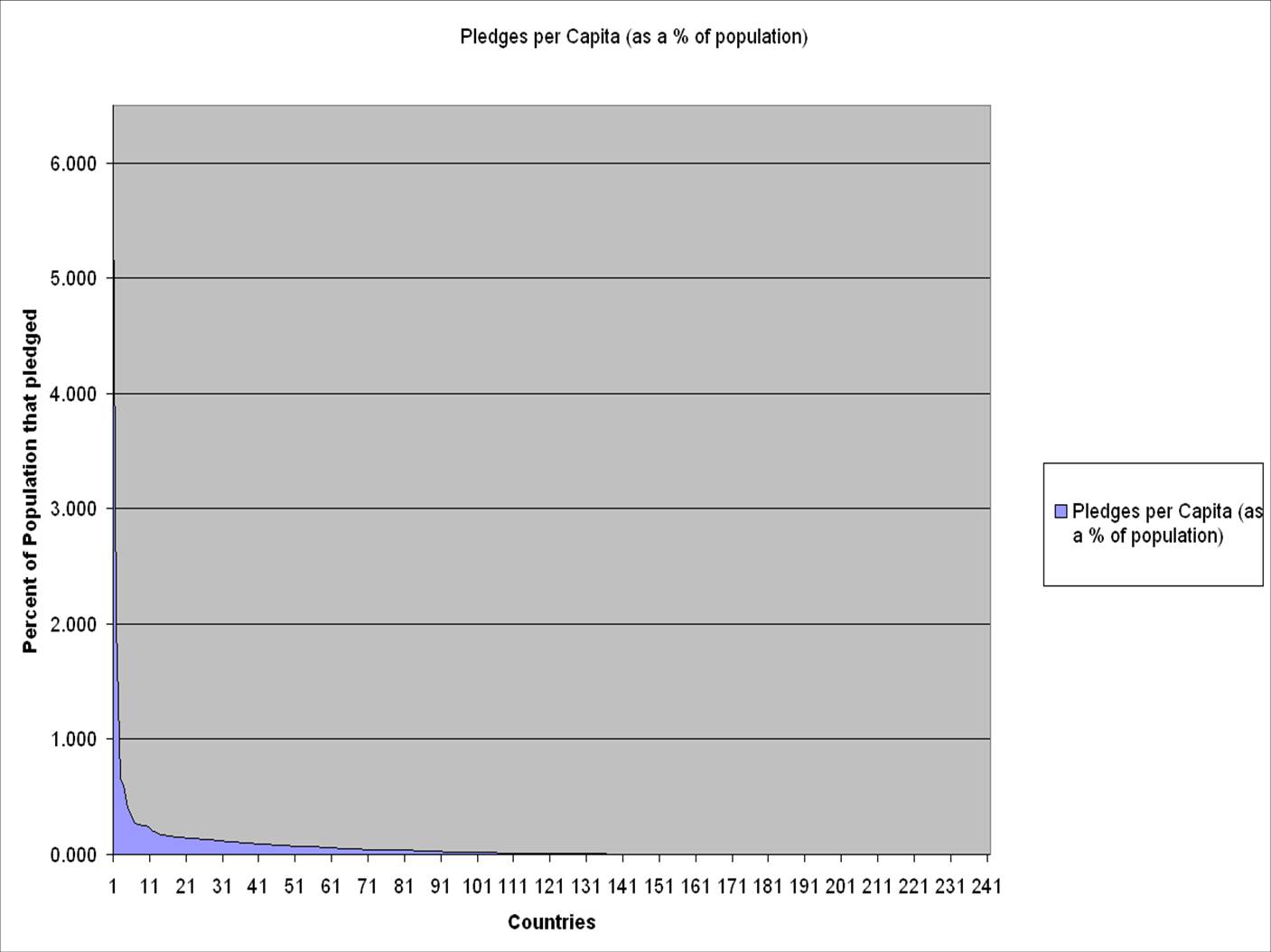
Powerlaw pledge graph


Shocker.

Firefox 3 pledge map vs. the Pentagon’s new map

What are the geopolitics of open source? To find out I thought it would be interested to see how Thomas Barnett’s map meshed with the Spread Mozilla Firefox 3 download pledge map.

Some brief background for those not familiar with “The Pentagon’s New Map.” It is a map that sits at the heart of a book of the same title written a few years ago by Barnett. It is a compelling take on what America’s grand strategy should be for the 21st century and how it is, and more importantly isn’t, ready to execute on it. Better yet, it is engaging, thought provoking, interesting, and written so anyone can read and understand it.

The core of the book’s thesis (remixed from Wikipedia and very high level) is as follows:

  1. International systems of rules reduce the likelihood of violent conflict (e.g., the WTO Dispute Settlement Understanding)
  2. The world is divided between the Functioning Core and the Non-Integrated Gap.
    Function Core = economic interdependence, incented to abide by rules
    Non-Integrated Gap = unstable leadership and absence of international trade, weaker incentives
  3. Integration of the Gap into the global economy provides opportunities for individuals to improve their lives, presenting a desirable alternative to violence and terrorism
  4. US grand strategy for the 21st century… help countries migrate from the Non-Integrated Gap into the Functioning Core

According to Barnett’s thesis, countries in the Non-integrated Gap, because they are less connected, should probably have fewer computer users, fewer people downloading software and fewer people participating in Open-Source projects. Mashing up his map with the Firefox pledge map might give us some a clue to how well open-source conforms to his thesis.

(Note, I’ve remixed Barnett’s map to make it is easier to read on a computer with the Function Core countries in green and the Non-Integrated Gap countries in red . You can find the original map here.

PNM remixed

Below is the spread Firefox pledge map, which tracks how many people around the world have pledged to download Firefox on its release day (June 17th). I’ve overlaid the Non-Integrated Gap/Function Core border over it.

firefox PNM mash up

Some comments/thoughts:

  • Interesting correlation between low pledge totals and Non-Integrated Gap countries
  • All but two Non-Integrated Gap countries (Colombia & Turkey) have 10,000 download pledges or fewer. (I also think it is interesting that Barnett doesn’t include Turkey in the Functioning Core…)
  • Most countries within the Functioning Core have 10,000 pledges or greater (South Africa, Nordic Countries and the Baltic States are notable exceptions)
  • Non-Integrated Gap countries with the most pledges are Iran, Turkey, Venezuela, Peru, and Indonesia – interesting list. Seems to suggest that many of the countries the US tries to isolate are actually the most connected.
  • According to my Mozilla friends Poland (yes, Poland) was the first to hit the 100K pledge mark. Many new Core countries are adopting Open Source en mass to avoid paying for expensive Microsoft software. Open source may be offering them a cheap way to increase connectivity and integrate with the core faster, and on their terms. Fantastic outcome.
  • This map DOES NOT account for population variation – would be fascinating to see a map based on per capita pledges (I’ve contacted my friends at Mozilla and they’ve passed the raw data along to me so I will follow up with that analysis ASAP)
  • I will try to update the map with the final data on download day (June 17th) when all the pledges have been tallied
  • Note: Firefox pledge map copied on June 15th, 2008, 8:30 pm PST

Lots more thoughts and analysis to be done on this. I hope to blog more on this shortly. If Barnett responds in any way I promise to update – would love to hear his thoughts/reflections on this.

(One final aside, if you get the chance to see Barnett present, do so. He’s up there with Lessig in his delivery. I remember seeing him at a conference. He went long by 10 minutes. The US ambassador to Canada was in the next room waiting to give the next presentation but if any of the organizers had tried to intervene and hurry Barnett up, they would have been lynched. FYI, You can see his TED talk here.)

The Open Web is a social movement

Social movements are collective actions in which the populace is alerted, educated, and mobilized, over years and decades, to challenge the powerholders and the whole society to redress social problems or grievances and restore critical social values.
– Bill Moyes in the Movement Action Plan

The mission of the Mozilla Foundation is to create and promote the Internet as an open platform that supports the principles set out in the Mozilla Manifesto.
– Mozilla Foundation’s Statement of Direction

The open web is a social value. It’s not a fact, it’s not necessity, and it’s not a requirement. It’s a value – one that a growing community of people believe in and are willing to fight for. Indeed an emergent community in support of this value, initially composed of coders and technophiles, has steadily grown in size and scope. Today, there are hundreds of thousands (if not millions) of people who believe in the open web. They want the internet to be an open platform, indeed, they know the internet must be an open platform.

This means the message and goals of organizations like the Mozilla foundation and others that promote an open web, have broad appeal and resonate with a increasingly diverse community.

This is exciting.

It will also create new challenges.

Those involved in promoting an open web need to know that they are part of a social movement. Yes, it is language and terminology that make some of us uncomfortable. But it is the reality of our situation.

Embracing the notion that the open web is a social movement does not mean that we must start lobbying politicians or chaining ourselves to Microsoft servers (although some people may already be doing these things). I will be the first to admit that this social movement is very unlike those of the past. We do not need to employ the industrial and hierarchical model of influence and power that underlies the Bill Moyes document that, in part, inspired this post. It is for another era, or at least, for other movements.

This social movement is different in that, so far, it has been able to derive its power from a narrow set of people – mostly coders – who by volunteering their labour, have given the movement neither political power, nor economic power, but hard consumer power. This power has enabled projects like Mozilla to out-create, out-innovate, and out-perform the largest, best financed, and most successful software and IT companies in the world. As such, it does not need to rely on persuading government to create structural changes the way past social movements have. It has simply been able to force change though its market position.

This success however, does not mean it has nothing to learn from the past. Indeed, understanding and embracing the fact that the open web is a social movement would not only give the open web project structure – an organizing principle – upon which further success can be built but it would also allow it to reflect and leverage on the lessons of past movements.

Possibly the most important of these past lessons is that social movements may emerge organically but often do not succeed until at least some primitive form of organization or basic structure takes form around which resources, supporters, and eventually the general public, can coalesce.

This structure does not need to be hierarchical, but it does need to at least anchor or provide a platform around which the movement can build identity and direction. I sense a number of people look to Mozilla to be that rallying point. Indeed, last year when Chris Messina ranted online about Mozilla – which some in the Mozilla Corporation incorrectly felt was an unhelpful critique of the corporation – he was asking this very question. (I know Chris’ comments weren’t very popular with many people and that a major motivating factor for his rant was an effort to bring attention to his new consulting firm, but I’m still going to address his comments at face value) I don’t think Messina was being critical of the corporation per se, a large part of what he was asking was why Mozilla wasn’t serving as a rallying point for people (like him) who cared about the Open Web and Open Source.

The Berkman Center at Harvard, the CIS at Stanford, the Mozilla Foundation, Electronic Frontier Foundation, the Shuttleworth Foundation, along with a handful of other organizations are already part of the movement’s ecosystem. Perhaps one of them could credibly take on a leadership/organizing/convening role for such a social movement. Perhaps not. At the moment, it seems unclear if anyone is.

Again, this social movement can and probably should be more decentralized than any past movement. But could we push ourselves harder? Are we creating enough hooks for new participants to latch on to? Are we creating an ecosystem where non-coders, but passionate open web believers, can find a niche? What are the big harry audacious goals that a larger community can get behind, and support? Are we willing to talk about ourselves as a social movement? What are the opportunities and dangers in doing that? I’m not sure. But it would be great if someone were thinking about who, or whom, might be asking these questions.

Please know this post is a draft and treat as such. Please tear it to shreds or build on it in the comments or in an email to me.

Warning! The social networking site you are about to enjoy is very social.

So the globe had an article yesterday about a group of University of Ottawa law students who lodged a complaint that Facebook breaches Canadian privacy law.

Regarding concerns that Facebook might be sharing the information with advertisers without users consent… fair enough.

But in regards to people not understanding their information is going to be shared publicly? I’m less sure. This quote really struck me:

“There’s definitely some significant shortcomings with Facebook’s privacy settings and with their ability to protect users,” said Harley Finkelstein, 24, one of the four students behind the complaint.

“If a 14-year-old kid in Toronto decides to join Facebook, and is prompted to add a network, and he decides to join the Toronto network – because that’s where he lives – does he really know that everyone on that network – by default – will have access to his personal information?”

Coffee Warning LabelI think the answer is yes. Indeed, that’s probably why the kid’s joining.

So this strikes me as akin to labels on paper coffee cups that say “Warning. Hot!” The fact that coffee is hot is as self-evident as the fact that social networking sites are about enabling people to, well, connect socially with others over the internet.

So we can soon expect to see this post’s title as a warning label on any social networking site. I’m sure they’ll be read as closely as the coffee cup labels are.

Coming: Firefox 3 Download Day – Pledge Now!

As part of its strategy to launch Firefox 3, reach out to new users and help foster an open web, our friends at Mozilla want to set a Guinness World Record for the most software downloaded in 24 hours.

They are also maintaining a cool heat map of how many pledges from each country they’ve received.

If you haven’t tried Firefox 3 yet, I can’t recommend it enough. The awesome bar is going to change your browsing experience. Trust me.

Government social networking

Again, as a follow up to my talk at DPI on web 2.0 technologies and government, Nicolas sent me a brief article on IBM’s internal experimentation with of Socian Networking.

Those at DPI will know that one of the reasons I believe social networking for government is important is that enables employees of massive organizations – both in terms of geography and number of employees – to find and engage with one another. As such it is a clearing house for ideas and people, helping them find and connect with one another. Hence this paragraph in the article obviously tickled my goat (yeah, I said tickled my goat):

…in a global company with nearly 400,000 employees, most people are too far away to plop down in a teammate’s cubicle or grab a cup of coffee. These social tools, IBM hopes, will provide a substitute for personal connections that flew away with globalization—and help to build and strengthen far-flung teams. “People are putting up pictures of their family, the same way they’d put them up in the cubicle,” says Joan DiMicco, one of the research scientists.

People may not think of the public service as globalized (or like IBM) but it does have over 325,000 employees spread out over 3 and half time zones across a 5,187 km axis east to west. That’s pretty globalized and IBM-like right there.

Open Updates: Firefox 3 and open office

So Firefox 3 RC 1 has been released and again, if you haven’t downloaded it I strongly encourage you to do so.

Having used the FF 3 Beta for months now I can honestly say it is everything it’s cracked up to be. Especially its coolest feature – the Awesome Bar (some boring people are still referring to it as the Smart Location Bar, but ignore them).You can read more about this feature, along with an interview of my man Beltzner who’s making some pretty bold claims about it, here. That said, I think Beltzner is right, the Awesome Bar has already changed how I surf the net and use my browser.

In other exciting Open Source news Microsoft has announced that Office 2007 SP2 will add support for Open Document Format. This is a real win for the Open Office crew.  It also means the day I switch to Open Office has been moved up dramatically.

Exciting times to be open…

So much data… locked away

I’m preparing for the keynote on Public Service Sector Renewal and technology I’ll be giving at this year’s DPI conference on Thurdsay in Ottawa. I’ve been working on creating a series of slides that I’m hoping will be quite interesting and tha I promise to share either here or via slideshare.net.

What has been most interesting is how hard it is to get data about the government. In my case, I’ve been trying to determine the address of every major ministry (or, if you must, department) in Ottawa in 1930, 1960, 1980 and today. I know this information exists – the problem is finding it. It would appear that it can only be found in the national archives – in hard form, from a protected document that people aren’t really allowed to access.

Sigh.

It makes me think of how much data the government has collected over the years – or even minute by minute that gets stored – even digitally – in inaccessible ways, making it harder for companies, non-profits or other entities to leverage the public resource.

If our government is going to get one thing right, it would be enabling its citizens to do that.

Open Source Legislation

The American Sunlight Foundation – which seeks to reduce corruption by using the power of information technology to enable citizens to monitor Congress and their elected representatives – has recently put its draft legislation online.

In a sense the draft legislation, entitled the Transparency in Government Act 2008 has been open sourced in that it can be read and commented on by anyone. Of course some may disagree since the process is not a wiki – people cannot edit the document directly (which would be much cooler) but it is nonetheless very interesting model. Indeed, the Sunlight Foundation very much views this project as an experiment.

Private members bills are allowed in Canada… one wonders how long before some intrepid MP uses this approach refine his or her proposed legislation and build popular support?

Get the new Beta of Firefox 3

Mozilla recently released a new beta version of Firefox 3. If you haven’t been using it I highly recommend downloading a copy. I’ve been using Firefox 3 a few months now and there are 2 features I couldn’t imagine living without.

The first is the revamped address bar. Most address bars boast an auto-complete function (e.g. start typing http://www.ea… and it will fill in the rest). But Firefox 3’s address bar allows you to type in any word from the url and it will give you a list of choices, balanced between sites you frequently go to and the sites you most recently visited. So for example if, after reading this post, you simply type “beta” into the address bar, this page will almost certainly be one of your choices. It makes finding that web page you were at yesterday, but can’t remember than name of, really, really easy.

The second is that – upon request – Firefox will remember all the sites you are viewing when you shut it down. That way, when you load it back up – say, the next morning – all the tabs and sites you had open will reappear. I no longer to a bookmark a bunch of sites when I’m shutting down my computer. Super convenient.

On a seperate but parallel note, Apple recently released its Safari browser for the PC and has been bragging about how it is faster than Firefox. This is true, if you are using Firefox 2! According to an independent industry observer, Firefox 3 is actually faster than Safari.