Tag Archives: technology

Open Source Communities – Mapping and Segmentation

I’ve just finished “Linked” by Albert-Laszlo Barabasi (review to come shortly) and the number of applications of his thesis are startling.

A New Map for Open Source Communities

The first that jumps to mind is how it nicely the book’s main point provides a map that explains both the growth and structure of open source communities. Most people likely assume that networks (such as an open source community) are randomly organized – with lots people in the network connected to lots of other people. Most likely, these connections would be haphazard, randomly created (perhaps when two people meet or work together) and fairly evenly distributed.
linked1

If an open-source community was organized randomly and experienced random growth, participants would join the community and over time connect with others and generate new relationships. Some participants would opt to create more relationships (perhaps because they volunteer more time), others would create fewer relationships (perhaps because they volunteer less time and/or stick to working with the same group of people). Over time, the law of averages should balance out active and non-active users.

New entrants would be less active in part because they possess fewer relationships in the community (let’s say 1 or 2 connections). However, these new entrants would eventually became more active as they made new relationships and became more connected. As a result they would join the large pool of average community members who would possess an average number of connections (say 10 other people) and who might be relatively active. Finally, at the other extreme we would find veterans and/or super active members. A small band of relatively well connected members who know a great deal of people (say 60 or even 80 people).

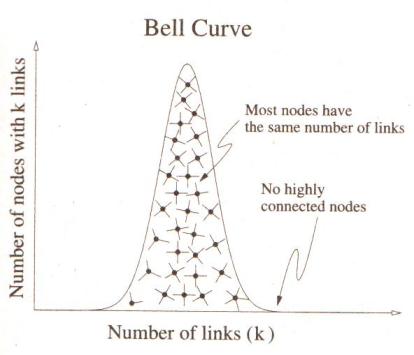
Map out the above described community and you get a bell curve (taken from the book Linked). A few users (nodes) with weak links and a few better connected than the average. The bulk of the community lies in the middle with most people possessing more or less the same number of links and contributing more or less the same amount as everyone else. Makes sense, right?

Or maybe not. People involved in open-source communities probably will remark that their community participation levels does not look like this. This, according to Barabasi, should not surprise us. Many networks aren’t structured this way. The rules that govern the growth and structure of many network – rules that create what Barabasi terms “scale-free networks” – create something that looks, and acts, very differently.

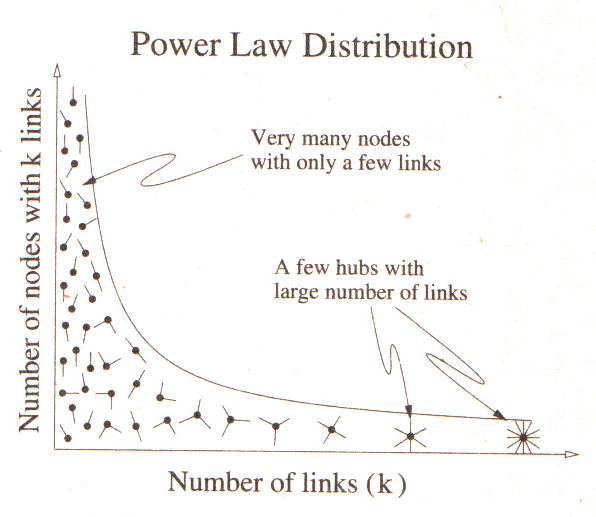
In the above graph we can talk about about the average user (or node) with confidence. And this makes sense… most of us assume that there is such thing as an average user (in the case of opensource movements, it’s probably a “he,” with a comp-sci background, and an avid Simpson’s fan). But in reality, most networks don’t have an average node (or user). Instead they are shaped by what is called a “power law distribution.” This means that there is no “average” peak, but a gradually diminishing curve with many, many, many small nodes coexisting with a few extremely large nodes.
linked2

In an open source community this would mean that there are a few (indeed very few, in relation to the community’s size) power users and a large number of less active or more passive users.

Applying this description to the Firefox community we should find the bulk of users at the extreme left. People who – for example – are like me. They use Firefox and have maybe even registered a bug or two on Firefox’s Bugzilla webpage. I don’t know many people in the community and I’m not all the active. To my right are more active members, people who probably do more – maybe beta test or even code – and who are better connected in the community. At the very extreme and the super-users (or super nodes). These are people who contribute daily or are like Mike Shaver (bio, blog) and Mike Beltzner (bio, blog): paid employees of the Mozilla corporation with deep connections into the community.

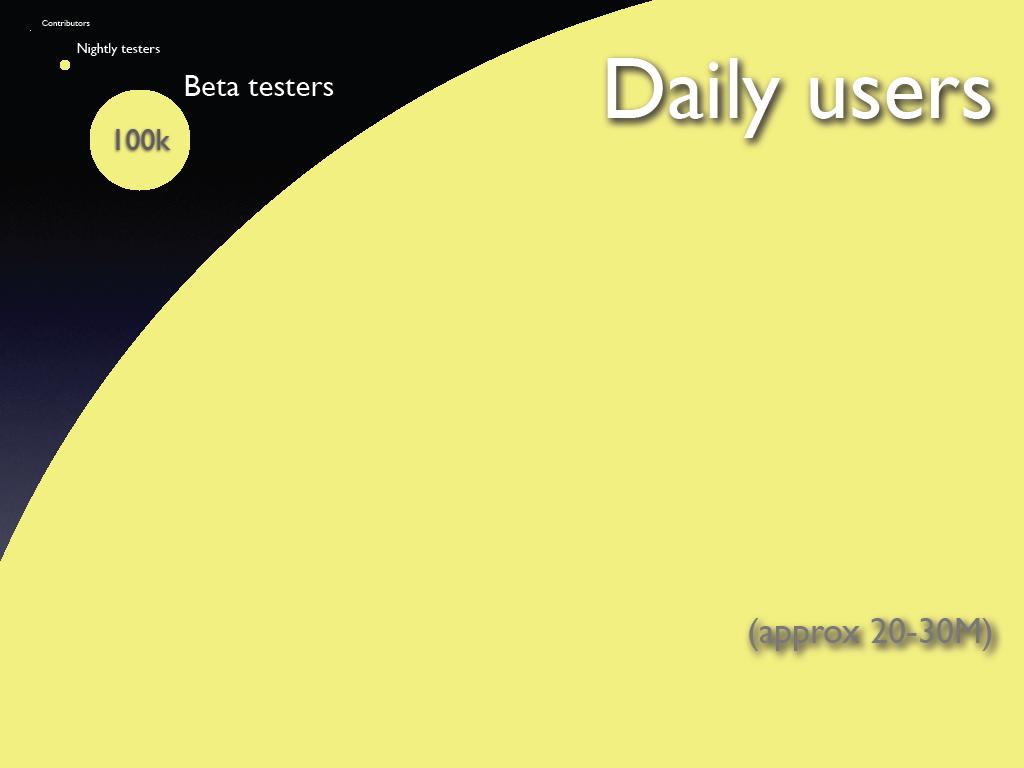
Indeed, Beltzner’s presentation on the FireFox community (blog post here, presentation here and relevant slides posted below) lists a hierarchy of participation level that appears to mirror a power law distribution.
mbslide3

I think we can presume that those at the beginning of the slide set (e.g Beltzner, the 40 member Mozilla Dev Team and the 100 Daily Contributors) are significantly more active and connected within the community than the Nightly Testers, Beta Testers and Daily Users. So the FireFox community (or network) may be more accurately described by a Power Law Distribution.

Implications for Community Management

So what does this mean for open source communities? If Barabasi’s theory of networks can be applied to open source communities – there are at least 3 issues/ideas worth noting:

1. Scaling could be a problem

If open source communities do indeed look like “scale-free networks” then it maybe be harder then previously assumed to cultivate (and capitalize on) a large community. Denser “nodes” (e.g. highly networked and engaged participants) may not emerge. Indeed the existence of a few “hyper-nodes” (super-users) may actually prevent new super-users (i.e. new leaders, heavy participants) from arising since new relationships will tend to gravitate towards existing hubs.

Paradoxically, the problem may be made worse by the fact that most humans can only maintain a limited number of relationships at any given time. According to Barabasi, new users (or nodes) entering the community (or network) will generally attempt to forge relationships with hub-like individuals (this is, of course, where the information and decision-making resides). However, if these hubs are already saturated with relationships, then these new users will have hard time forging the critical relationships that will solidify their connection with the community.

Indeed, I’ve heard of this problem manifesting itself in open source communities. Those central to the project (the hyper nodes) constantly rely on the same trusted people over and over again. As a result the relationships between these individuals get denser while the opportunities for forging new relationships (by proving yourself capable at a task) with critical hubs diminishes.

2. Segmentation model

Under a Bell Shaped curve model of networks it made little sense to devote resource and energy to supporting and helping those who participate least because they made up a small proportion on the community. Time and energy would be devoted to enabling the average participant since they represented the bulk of the community’s participants.

A Power Law distribution radically alters the makeup of the community. Relatively speaking, there are an incredibly vast number of users/participants who are only passively and/or loosely connected to the community compared to the tiny cohort of active members. Indeed, as Beltzner’s slides point out 100,000 Beta testers and 20-30M users vs. 100 Daily Contributors and 1000 Regular Contributors.

The million dollar question is how do we move people up the food chain? How do we convert users and Beta testers and contributors and daily contributors? Or, as Barabasi might put it: how do increase nodes density generally and the number of super-nodes specifically?Obviously Mozilla and others already do this, but segmenting the community – perhaps into the groups laid out by Beltzner – and providing them with tools to not only perform well at that level, but that enable them to migrate up the network hierarchy is essential. One way to accomplish this task would be to have more people contributing to a given task, however, another possibility (one I argue in an earlier blog post) is to simply open source more aspects of the project, including items such as marketing, strategy, etc…

3. Grease the networks nodes

Finally, another way to over come the potential scaling problem of open source is to improve the capacity of hubs to handle relationships thereby enabling them to a) handle more and/or b) foster new relationships more effectively. This is part of what I was highlighting on my post about relationship management as the core competency of open source projects.

Conclusion

This post attempts to provide a more nuanced topology of open source communities by describing them as scale-free networks. The goal is not to ascertain that there is some limit to the potential of open source communities but instead to flag and describe possible structural limitations so as to being a discussion on how they can be addressed and overcome. My hope is that others will find this post interesting and use its premise to brainstorm ideas for how we can improve these incredible communities.

As a final note, given the late hour, I’m confident there may be a typo or two in the text, possible even a flawed argument. Please don’t hesitate to point either out. I’d be deeply appreciative. If this was an interesting read you may find – in addition to the aforementioned post on community management – this post on collaboration vs cooperation in open source communities to be interesting.

Keeping the internet free

For those worried (or not yet worried, but who should be) about maintaining the internet as a open platform upon which anyone can participate and attract an audience, please let me point you to David Weinberger’s most recent ramblings on the subject.

He makes a strong case for why companies that provide us with internet access may have to be regulated.

I recently discovered Weinberger while listening to am interview on his newest book “Everything is Miscellaneously.” Great stuff. Vancouver Public Library has been kind enough to hook me up with his other books as well… (these libraries, they are amazing! Did you know you can read a book without buying it? Crazy.)

He also maintains a blog, for those who are curious.

Open Source Chamber of Commerce

One of my favourite sessions from last week’s Open Cities unconference was a session Mark Surman proposed around what an Open Source Chamber of Commerce might look like.

So what is an Open Source Chamber of Commerce? Good question. Mark’s initial thinking was…

…to focus and build buzz around the significant volume of open source activity that is quietly (and disconnectedly) happening in Toronto. The number of companies, projects and research labs focused on open source is growing in this city, yet they are spread out a thousand nooks and crannies. There is no sense of community, no sense of anything bigger. Of course, that’s totally okay on one level. No need to invent community, especially when most people are tapped in globally. However, there is another level where staying disconnected locally represents a missed opportunity to make Toronto a better place to work on open source. (read Mark’s full post here.)

The session sparked a good debate about what such a Chamber might look like – or even what membership would entail.

The possibility that most excited me was how such a Chamber could serve as a home and talk shop for corporations or organizations that agree to “donate” a specific number or percent of their workforces’ hours, towards an open source projects. Many organizations (indeed most) use open source products, and some of them allow their IT employees to contribute towards them (for which there is a good business case). The Chamber could serve to connect CIO’s and other representatives from these firms and organizations with one another as well as with key figures within open-source projects. Up and coming open-source communities could pitch their software and community. Members could exchange best practices on how to best contribute to OS projects and on how their organizations can most effectively leverage OS software.

In addition, the Chamber could serve as an interest group, an advocate for infrastructure and policies that would make Toronto a more attractive location for Open-Source projects and contributors specifically and IT workers generally. According to the Municipal Government, Toronto already has the third largest cluster of Information and Communication Technology in North America (around 90,000 ITC facilities with 100 employees or greater) so there is a rich pool to draw from. On top of that – as Mark also notes – there is an interesting group of people affiliated with various open-source projects in Toronto. Why not figure out what Toronto is doing right and amplify it?

(As a brief aside, check out the Seneca FSOSS conference website if you haven’t yet – here’s a group that’s been doing a lot of heavy lifting on this front already.)

Mark and I are simply batting around the idea and would love feedback (positive and critical).

Open Cities – A Success…

Finally beginning to relax after a hectic week of speeches, work and helping out with the Open Cities unconference.

Open Cities was dynamite – it attracted an interesting cross section of people from the arts, publishing, IT, non-profit and policy sectors (to name a few). This was my first unconference and so the most interesting take away was seeing how an openly conducted (un)conference – one with virtually no agenda or predetermined speakers – can work so well. Indeed, it worked better than most conferences I’ve been to. (Of course, it helps when it is being expertly facilitated by someone like Misha G.)

Here’s a picture chart of the agenda coming together mid-morning (thank you to enigmatix1 for the photos)

There was no shortage of panels convened by the participants. I know Mark K. is working on getting details from each of them up on the Open Cities wiki as quickly as possible. Hopefully these can be organized more succinctly in the near future (did I just volunteer myself?).

There were several conversation I enjoyed – hope to share more on them over the coming days – but wanted to start with the idea of helping grow the Torontopedia. The conversation was prompted by several people asking why Toronto does not have its own wiki (it does). Fortunately, Himy S. – who is creating the aforementioned Torontopedia – was on hand to share in the conversation.

A Toronto wiki – particularly one that leverages Google Maps’ functionality could provide an endless array of interesting content. Indeed the conversation about what information could be on such a wiki forked many times over. Two ideas seemed particularly interesting:

The first idea revolved around getting the city’s history up on a wiki. This seemed like an interesting starting point. Such information, geographically plotted using Google Maps, would be a treasure trove for tourists, students and interested citizens. More importantly, there is a huge base of public domain content, hidden away in the city’s archives, that could kick start such a wiki. The ramp up costs could be kept remarkably low. The software is open sourced and the servers would not be that expensive. I’m sure an army of volunteer citizens would emerge to help transfer the images, stories and other media online. Indeed I’d wage a $100,000 grant from the Trillium Foundation, in connection with the City Archives, Historica and/or the Dominion Institute, as well as some local historical societies could bring the necessary pieces together. What a small price to pay to give citizens unrestricted access to, and the opportunity to add to, they stories and history of their city.

The interesting part about such a wiki is that it wouldn’t have to be limited to historical data. Using tags, any information about the city could be submitted. As a result, the second idea for the wiki was to get development applications and proposals online so citizens can learn about how or if their neighborhoods will be changing and how they have evolved.

Over the the course of this discussion I was stunned to learn that a great deal of this information is kept hidden by what – in comparison to Vancouver at least – is a shockingly secretive City Hall. In Vancouver, development applications are searchable online and printed out on giant billboards (see photo) and posted on the relevant buildings.Development application According to one participant, Toronto has no such requirements! To learn anything about a development proposal you must first learn about it (unclear how this happens) and then go down to City Hall to look at a physical copy of the proposal (it isn’t online?). Oh, and you are forbidden to photocopy or photograph any documents. Heaven forbid people learn about how their neighbourhood might change…

Clearly a wiki won’t solve this problem in its entirety – as long as Toronto City Hall refuses to open up access to its development applications. However, collecting the combined knowledge of citizens on a given development will help get more informed and hopefully enable citizens to better participate in decisions about how their neighbourhood will evolve. It may also create pressure on Toronto City Hall to start sharing this information more freely.

To see more photo’s go to flickr and search the tags for “open cities.”

Open Media

For those interested in how ‘open source‘ systems can drive down the costs of establishing a media presence should take a look at The Article 13 Initiative.

By leveraging open-source technologies and providing training The Article 13 Initiative reduces the barriers to entry into the journalism market and reduces the costs of technology for established players (Article 13 is currently working closely with Rafigui, a French language journal focused on the youth market). With less money being spent on software, more money can be devoted to other priorities, like reporters and/or other staffers.

For those interested in open-source, be it in the arts, policy, software, media, etc… consider signing up for the Open Cities unconference taking place in Toronto on June 23rd. No one has updated me on how many slots are left so apologies if it is already full…

The Creative Econom(ii)

As many of you know I’ve recently become an owner of a Nintendo Wii – that fun games console you control, not by pressing buttons, but my using a motion controlled wand (e.g. when you play video game golf, you actually swing the wand like a golf club). Needless to say it’s hilarious and fun.

One interesting feature of the Wii is that it allows you to download channels that bring content to you via your console. One of these is the Everybody Votes channel. This channel offers up a constantly updated set of questions – such as “Graffiti is…: Urban Art or Defacing Property?” – on which you vote. What makes it particularly interesting is that you get to see the result broken down by gender, province, country, etc…

Obviously, the survey data gathered by the Everybody Votes channel is deeply skewed and not representative of the population as a whole. But I think this is also what makes it so interesting.

For example, recently, the program asked the question “Which is worse to have stolen from you: Things or Ideas?”

Interestingly 50.6% of participating Canadian Wii users selected “Ideas.” So just over half of Canadian Wii users believe it’s worse to have recognition for an idea stolen than it is a tangible, likely fungible, asset.

Young people valuing ideas over things? Video-gamers valuing ideas over things? Could be a sign of the creative economy – where one’s ability dream or mash up new ideas is what’s valued most. I’m willing to bet that most Wii users are young professionals acculturated to this new reality.

Don't Ban Facebook – Op-ed in today's G&M

You can download the op-ed here.

The Globe and Mail published an op-ed I wrote today on why the government shouldn’t ban face book, but hire it.

The point is that Web 2.0 technologies, properly used, can improve communication and coordination across large organizations and communities. If the government must ban Facebook then it should also hire it to provide a similar service across its various ministries. If not it risks sending a strong message that it wants its employees to stay in your little box.

One thing I didn’t get into in the op-ed is the message this action sends to prospective (younger) employees. Such a ban is a great example of how the government sees its role as manager. Essential the public service is telling its employees “we don’t trust that you will do your job and will waste your (and our) time doing (what we think are) frivolous things. Who wants to work in an environment where there own boss doesn’t trust them? Does that sound like a learning environment? Does it sound like a fun environment?

Probably not.

—–

Facebook Revisited

DAVID EAVES
SPECIAL TO GLOBE AND MAIL
MAY 17, 2007 AT 12:38 AM EDT

Today’s federal and provincial governments talk a good game about public-service renewal, reducing hierarchy, and improving inter-ministry co-operation. But actions speak louder than words, and our bureaucracies’ instincts for secrecy and control still dominate their culture and frame their understanding of technology.

Last week, these instincts revealed themselves again when several public-service bureaucracies — including Parliament Hill and the Ontario Public Service — banned access to Facebook.

To public-service executives, Facebook may appear to be little more than a silly distraction. But it needn’t be. Indeed, it could be the very opposite. These technology platforms increasingly serve as a common space, even a community, a place where public servants could connect, exchange ideas and update one another on their work. Currently, the public service has a different way of achieving those goals: It’s called meetings, or worse, e-mail. Sadly, as anyone who works in a large organizations knows, those two activities can quickly consume a day, pulling one away from actual work. Facebook may “waste time” but it pales in comparison to the time spent in redundant meetings and answering a never-ending stream of e-mails.

An inspired public service shouldn’t ban Facebook, it should hire it.

A government-run Facebook, one that allowed public servants to list their interests, current area of work, past experiences, contact information and current status, would be indispensable. It would allow public servants across ministries to search out and engage counterparts with specialized knowledge, relevant interests or similar responsibilities. Moreover, it would allow public servants to set up networks, where people from different departments, but working on a similar issue, could keep one another abreast of their work.

In contrast, today’s public servants often find themselves unaware of, and unable to connect with, colleagues in other ministries or other levels of government who work on similar issues. This is not because their masters don’t want them to connect (although this is sometimes the case) but because they lack the technology to identify one another. As a result, public servants drafting policy on interconnected issues — such as the Environment Canada employee working on riverbed erosion and the Fisheries and Oceans employee working on spawning salmon — may not even know the other exists.

One goal of public-sector renewal is to enable better co-operation. Ian Green, the Public Policy Forum chair of Public Service
Governance noted in an on-line Globe and Mail commentary (Ensuring Our Public Service Is A Force For Good In The Lives Of Canadians — May 8) that governments face “increasingly complex and cross-cutting issues … such as environmental and health policy.” If improving co-ordination and the flow of information within and across government ministries is a central challenge, then Facebook isn’t a distraction, it’s an opportunity.

Better still, implementing such a project would be cheap and simple. After all, the computer code that runs Facebook has already been written. More importantly, it works, and, as the government is all too aware, government employees like using it. Why not ask Facebook to create a government version? No expensive scaling or customization would be required. More importantly, by government-IT standards, it would be inexpensive.

It would certainly be an improvement over current government online directories. Anyone familiar with the federal government’s Electronic Directory Services (GEDS) knows it cannot conduct searches based on interests, knowledge or experience. Indeed, searches are only permissible by name, title, telephone and department. Ironically, if you knew any of that information, you probably wouldn’t need the search engine to begin with.

Retired public servants still talk of a time when ministries were smaller, located within walking distance of one another, and where everyone knew everyone else. In their day — 60 years ago — inter-ministerial problems were solved over lunch and coffee in a shared cafeteria or local restaurant. Properly embraced, technologies like Facebook offer an opportunity to recapture the strengths of this era.

By facilitating communication, collaboration and a sense of community, the public services of Canada may discover what their
employees already know: Tools like Facebook are the new cafeterias, where challenges are resolved, colleagues are kept up to date, and inter-ministerial co-operation takes place. Sure, ban Facebook if you must. But also hire it. The job of the public services will be easier and Canadians interests will be more effectively served.

David Eaves is a frequent speaker and consultant on public policy and negotiation. He recently spoke at the Association of Professional Executives conference on Public Service Renewal.

wireless number portability

So I may have simply been out of the loop but… did anybody else see this CRTC statement announcing that, as of March 14th 2007, wireless phone numbers will be portable? This means that when you switch from Bell to Rogers or Telus (or vice-versa) you can take your current phone number with you. Great news! For those thinking about renewing your contract you may want to wait two months, that way if you change service providers you won’t have to deal with the hassle of informing everyone about your new number.

Maybe I’ve been in a bubble, but I’m not sure word of this has gotten out. With this issue now out of the way what the teleco industry really needs to heat up is for skype to offer its SkypeIn service in Canada. Sadly, that ball is in Skype’s court and there is no sign of any movement.

PS – Thank you Sahar for the link

The iPhone – Apple Crumble?

A lot of hoopla being made here up north about Apple’s new iPhone. I admit I’m a bit of a contrarian, but I’m not sure what all the fuss is about or if Apple’s stock deserves the big bump it’s received from this announcement.

Like the iPod this item is targeted at consumers and not business people. This however, presents some interesting problems. US$500 is a lot of money to pay for what is essential a cell phone that will likely only last 2-3 years tops. Moreover, if you are at all interested in having email functionality on your phone (e.g. attention all blackberry users) it’s worth noting that the iphone lacks a key board. It is unclear how easy it will be to type out emails using a screen as a keyboard (Like Homer Simpson, I’m pretty sure my fingers will be too big to type on a key board displayed on the screen).

In addition, the iPod works because of its simplicity… it only requires one program (itunes) that is available and compatible across both the PC and Mac platforms. To make full use of the its functional a suer will have to sync their iphone with not only iTunes (no problem here) but also their email server or software and their calendaring software and their contact manager. That’s a lot of syncing and a great opportunity for things to go wrong – especially when, for most users, this will be across the windows-mac platforms. With luck Mac will make this all seamless and easy for the casual users – one hopes so because at the moment it is probably beyond the skills of the ordinary computer user. Don’t forget there is a whole industry of “sync providers” out there, non of whom have really squared the problem.

On top of all this is the problem that the iphone will only work on a GSM network. Consequently, if you buy the on your own it will only work on Rogers’ network in Canada and Cingular’s Network in the US, effectively locking you into one service provider. Alternatively, if you choose to buy the iphone as part of a subscription package from Cingular or Rogers you know they are going lock you into a 3 year contract.

Maybe Apple’s got all these issues figured out – if so great! It will put pressure on everybody else (like RIM) to get these features done right. If not… well I guess it won’t matter. I’m sure Apple’s stock will be fine and that no one will remember this terrible 7-day stretch of uncritical and dubious story choices that graced the cover of the Globe and Mail.

[tags]iphone, technology, apple[/tags]