Tag Archives: vancouver

the strike that never was…?

Job actions just aren’t what they used to be.

Here we are in the middle of summer and the pools and library’s are all closed, plus the garbage isn’t being picked up. Interestingly I haven’t read about throngs of Vancouverites complaining (are they? has anybody heard?). Indeed, many businesses and condo associations seem to have private garbage pick up which may explain why.

So far it Vancouverites appear to be blaming neither the union nor city hall. Rather, most Vancouverites simply don’t seem to care. Perhaps what the strike reveals more than anything is that, aside from Police, Fire Department and Public Transport (none of whom are involved in this strike) municipal government services don’t seem to touch the day to day lives of most Vancouverites. That’s a sobering thought for the state of “public services” It certainly isn’t a winning outcome for either City Hall or the union.

That said, the union had better be careful. Mayor Sullivan appears to finally be under lock and key, so the union can no longer rely on his public blunders to boost their case. Indeed, the news stories seem increasingly focused on their blunders: First they expressed outrage at volunteers who pick up the trash after public events. Then they blocked cars from entering a private members club, because that club was offering to dispose of their garbage for $5 a bag. As picket boy documents quite well, what could have been a positive story quickly turned ugly.

If the emerging narrative becomes the union against the city’s citizens, it’s the union that will come out looking bad.

Either way, the optics aren’t good when 240 lb men are pushing around private citizens… regardless of how wealthy they may be.
Canadian Foreign Policy Press Job

Foreign Policy buffs and International Relations geeks take note:

Embassy Newspaper has just informed me that they are looking for an entry level journalist. This is a great paper to work for. It is small, but has an influential readership: the foreign policy community in Ottawa. If you are starting out and want to learn how the sausage is made, this is probably one of the best places to work.

Journalism Job Posting

Embassy Newspaper is seeking a fulltime journalist to join its Ottawa-based newsroom. The position involves writing in-depth news and features in a fast paced independent newsroom. The ideal candidate will have a strong interest in international issues and Canadian politics and be inclined to put time and energy into developing a deep understanding of the people and issues in these communities.

Strong writing, reporting and communication skills are a must.
Specialized knowledge or interest in an international area and language skills would be an asset.
Embassy has an influential readership of 49,000 and is published every Wednesday by The Hill Times. The newsroom environment is demanding but very positive and open.
Salary $26,000- 28,000 plus benefits and 3 weeks vacation per year and growth potential.

Applicants should submit a well written cover letter, a resume and writing samples in a word format or hard copy (No PDF’s) to:
Anne Marie Creskey
Publisher
Embassy Newspaper
69 Sparks St
Ottawa ON
K1P 5A5

Also, on a completely separate note I’ve recently discovered Picket Boy’s behind the lines coverage of the Vancouver municipal strike now in its 3rd (or is it 4th?) week. For those interested it is worth a look. The two line summary so far is: it’s been a ballad of incompetence (the mayor) vs. miscalculation (the unions). The result is a race for irrelevance. Instead of predicting who will win, I suspect that, as is often the case in these types of negotiations, everybody will lose.

Hope to blog on it shortly.

Why Cambie St. Should have been packed up.

* first up – apologies for no post yesterday. It was a holiday in BC. Sometime later this week I’ll describe in greater detail my ridiculously BC-like day of island hoping, sea kayaking and BBQing. And to complete the leftcoast feel, a Smart Car was involved too.<!–

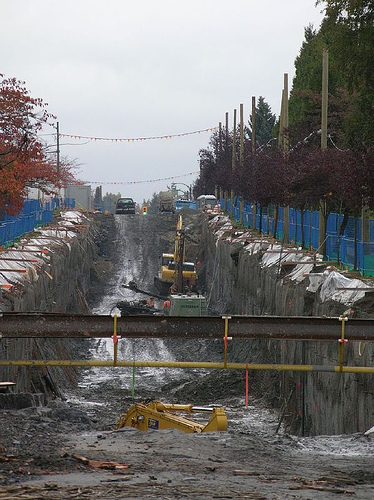
Second up… The Canada Line, the new subway being constructed between Richmond, the airport and Vancouver. The damage the construction has caused to businesses along the Cambie street corridor has been getting an increasing amount of buzz in the press. The whole situation is a fabulous lesson in urban planning and civic policy-making – one that sadly the press has not articulate.

For those out east who are not familiar with the Canada Line or its construction, it looks something like this:

cambie 2

Photo by Stephen Rees, (CC BY-NC-ND 2.0)

Sadly, these photos fail to do the situation justice. To put it bluntly, when there is a two story deep hole outside, traffic is at a stand still, the street is unpassable, and there is the endless sound of construction, people tend to stay away. This, needless to say, has made life difficult for the numerous businesses that populate the Cambie St. corridor.

As one can imagine, several businesses (most notably the restaurant Tomato) have moved, several others are complaining. The local MLA – Gregor Robertson – has even introducing a private member’s bill to provide affected businesses with direct financial support.

But is the construction responsible for the death of the Cambie st. businesses? Perhaps. But it is an inevitable death. And this is why the current public policy has so dramatically failed these businesses.

I’ve noted with interest that while businesses complain loudly about the construction and its impact, it is hard to find landowners who complain. One would think that the loss of tenants – and subsequent rental income – this would have generated a fuss. But it hasn’t.

Why? Because the landlords know that once the line is complete most of the Cambie corridor (currently composed of relatively low density commercial buildings) is going to be completely redeveloped. Higher density commercial and, more importantly, condos, are going to be common place along Cambie. Consequently, there is a good chance that if the construction hadn’t kicked these businesses out, their landlords would have in the ensuing rush to redevelop.

Thus the whole notion that Cambie businesses could be kept open was a mirage – a failure to look at the longer term implications of the Subway. Rather than waste time on a failed “Business is Open along the Canada Line” campaign (This is not a communication problem, advertising is not going to bring people to Cambie, only an end to the construction will) local businesses should have been offered money to move location and cover some of their transition costs. While this would have been painful for everyone involved, it would have been less painful then seeing their business dry up and having to move on their own dime.

I’m in favour of the Canada Line. I think it is great for the city. But that doesn’t mean that the Cambie St. businesses should have been left out to dry. The help they received wasn’t the help they needed. sadly, this is probably because giving them the help they needed wasn’t what they wanted to hear, or what politicians wanted to tell them…

* Aug 8th: The Vancouver Sun published this editorial piece on the same day as this post that provides a parallel but different perspective.

If a tree falls in the forest…

If a debate happens in city council, and nobody is around to report on it, does it have an impact?

Last Thursday I noticed that the Toronto edition of the National Post had front page coverage of Toronto’s city council meeting.

Front Page – with a giant picture to boot!

I’m trying to remember the last time a council issue was the lead cover story in the Vancouver Sun… How about the last time there was a photo of a council meeting?

Sadly – from what I can tell – neither The Sun, nor The Province, nor anyone else, have a single reporter exclusively dedicated to Vancouver city hall and municipal politics (if I’m wrong about this please send me a note – who is it?). This is akin to the Globe or National Post failing to assign someone to cover Parliament Hill. Vaughn Palmer does an excellent job covering the BC legislature for The Sun – so why not have someone do the same for municipal politics?

The lack of coverage fosters a city whose political and policy ideas are often unheard and poorly debated, whose municipal scandals go unquestioned and unpublicized and whose council members and mayor go unscrutinized.

Maybe The Sun may feel it simply isn’t profitable to have such a column. I understand (although doubt it). But this function is so important, some solution must be found. Maybe the Vancouver Foundation or some other agency could endow a reporter to cover the City Hall beat.

Or maybe… the Sun should consider outsourcing the role.

Sounds crazy? Admittedly it’s hardly ideal. But a news website in Pasadena, California, recently hired an Indian journalist to cover local politics. The journalist can watch local council meetings over the internet (the same could be done in Vancouver), many documents are available through the city’s website (as they are in Vancouver), and as the editor of the news web site noted “Whether you’re at a desk in Pasadena or a desk in Mumbai, you’re still just a phone call or e-mail away from the interview.” It’s not my favoured solution, but it is better than nothing.

Vancouverites often claim they’re not jealous of Toronto, but maybe we should be. With the Globe, the National Post and the Toronto Star writing regularly about the city’s politics I know I’m feeling envious.

Addition 11:20am PST – David Beers, editor of The Tyee, has emailed me to say: “Was surprised to see you single us out as one who is stingy on coverage of Vancouver city hall. In fact we do have one reporter who has been dogging the issue of homeless housing, covering city council sessions and often the byline on a cover story. Check out Monte Paulsen’s work.”

It is true, the Tyee has more in depth coverage of city hall than anybody else in town… all to glad to be called out on the oversight and hope readers will check out Paulsen’s work. Also, to be fair, the Georgia Straigt does a review of city councilors and talks about municipal politics, but it doesn’t have consistent reporting on the subject.

Job Opportunity with Canada's World

Another Job Opportunity for those interested in Canadian Foreign Policy and International Issues.

Job Opportunity – Ethnocultural Outreach Coordinator

Term: 12 months, 28 hours per week
Rate: $27 per hour
Location: Vancouver
Ideal Start date: September 4, 2007
Application deadline: August 13, 2007

Canada’s World, a project of the SFU Centre for Dialogue, seeks a full-time Ethnocultural Outreach Coordinator to join our national team. Canada’s World is a national citizens’ dialogue aimed at creating a new vision for Canadian international policy. Our secretariat offices are based in Vancouver and we work in collaboration with a series of academic and non-profit organizations across the country.

The Ethnocultural Outreach Coordinator plays a pivotal role in this collaborative initiative. S/he will report to the Director of Canada’s World and work closely with staff, interns, volunteers and advisory committee members in engaging ethnocultural and diaspora communities in a series of dialogues about Canada’s place in the world.

The ideal candidate will be an excellent communicator, well organized, and detail oriented with a passion for, and knowledge of, international policy issues. S/he will be bilingual (French and English), enjoy working in a dynamic work environment and have strong networks within ethnocultural and diaspora communities. S/he will be experienced at facilitating community meetings, compiling tailored resource materials, organizing events and speaking to the media. S/he will possess a post-secondary degree in Arts, Social Sciences or a related field, and enjoy working with people.

Canada’s World is an equal opportunity employer. All interested applicants should submit their cover letter, resume and a 200 word response to the following question: What are the greatest challenges and opportunities facing Canada internationally in the next twenty years?

Applications should be mailed to:
Shauna Sylvestershaunas(at)canadasworld.ca,
Canada’s World Fellow,
SFU Centre for Dialogue,
3303 – 515 West Hastings Street,
Vancouver, B.C. V6B 5K3


Sam Suillivan: Public Policy or Personal Gain?

Imagine if, while sitting as Foreign Minister, Lloyd Axworthy had decided to not only place the new concept of “Human Security” at the heart of the Ministry’s agenda but had also decided to trade mark the term – under his personal name.

Clearly the opposition members would have a field day… highlighting how the Minister was using his office for personal gain – using his political influence to create a brand that ultimately he owned the rights to.

Sadly, this hypothetical example is all too real here in my home town of Vancouver. Our Mayor, Sam Sullivan, has personally trade-marked “ecodensity” a term he’s been using to describe the municipal government’s a new initiative to reducie Vancouver’s environmental impact by creating a more compact city. As a few legal experts have noted, this is something that would normally be trademarked by the city’s lawyers… oddly it wasn’t. If that wasn’t enough it was again the mayor, and not the city or its staff, that registered the domain name ecodensity.ca.

None of the Mayor’s gaffe’s – like taking 30 item long priority list to a meeting with the Prime Minister (you should take a list of 3 items and you’ll probably get to talk about one) and then refusing to share anything about the discussion with taxpayers (who footed the bill) – have been so heavy so as to cost him an election, cumulatively however this errors will start to take their toll.

Fortunately for the Mayor, no one is really paying attention to municipal politics in Vancouver.

Mike Harcourt – Canada’s Al Gore on Urban Sustainability?

Yesterday evening, at Vanessa T’s prompting, I headed down to the SFU downtown campus to catch Mike Harcourt (former Mayor of Vancouver and Premier of BC) and Ken Cameron (former regional planner) present on City Making in Paradise their upcoming book about the history of city planning in Vancouver.

Two things struck me about the presentation.

The first was how the successes of municipal planning in Vancouver have largely been made possible by a history of local governments thinking, organizing and acting in coordination at the regional level. As Harcourt pointed out, growth and development meant the political and organic borders of the city ceased to be aligned after the Second World War. The regions cooperative approach to this dilemma – which began in the 1970s and that continues today – makes for an interesting case study. In addition to being broadly successful, it appears to have preempted an effort at amalgamation that was so contentious in Quebec and Ontario.

I’ve known for a while that Harcourt is laser focused on urban sustainability and will work with anyone, regardless of political affiliation, who will help advance this goal. That said, I was nonetheless struck by the degree to which he’s transcended partisan politics. While outlining the 9 decisions that “saved Vancouver” Harcourt was happy to praise individuals who’d once been bitter rivals. Given the recent (unusual) trend of provincial parties racing for the centre maybe this is just a sign of the times. Or maybe Harcourt pragmatic, results focused tonic that BC politics so desperately needs. Maybe it’s both. Anyway, for a guy who was dragged through the provincial political ringer, it’s nice see him so motivated and positive.

The Walking Strategy

As my friends are all too aware, I’ve adopted the “walking strategy” in my life. My rule is that, whenever in Vancouver, I must walk at least one direction to any meeting. Why?

Well here are 3 few reasons:

  • Having spent a decade away from Vancouver, I thought walking the city would help me get reacquainted with it (it has!)
  • After learning that you essentially burn as many calories walking a specific distance as running it, I thought this might enable me to maintain my love affair chocolate chip cookies and brownies
  • My job – which has me on the road a lot – has few demands of me when I’m in Vancouver, so I have the time

However, two other technologies really clinched it for me.

The first was the discovery of books on CD, or, more precisely, books on MP3. The number of lectures (such as those by Larry Lessig) and books (such as the beautifully narrated A Short History of Nearly Everything) that I’ve been able to devour through my shuffle has been astounding.

The second has been the mapping software made possible by Web 2.0 technologies. I use GMaps Pedometer to map out my routes (in part because I’m A-type) but more because, by knowing the distance I can gauge how long it will take me to walk to my destination. This ensures that I arrive (mostly) on time. Also, I can plan out the quietest routes (away from traffic) to ensure I can hear my lecture or book.

I’d also talk about the benefits of keeping one’s carbon emissions low, but with the amount of air travel I engage in, I cannot , at the moment, even begin to go down that road.

So, in short: It’s summer, and you have to try it.

All you nee is an ishuffle. Some books on MP3 and access to Gmaps.

Vision Vancouver Policy Conference

For those living in Vancouver and interested in progressive politics at the municipal level, Vision Vancouver is hosting a day long policy conference on Saturday June 9th at BCIT’s downtown campus.

The plan is to have three panels, one on “A Liveable City,” one on “Housing Affordability,” and one on “Cultural Communities.” Vision councilors will be on hand through out the day and available for some formal Q&A at the end of the day. In addition, I will be giving a short lunchtime talk on the challenges of progressive politics in the 21st century.

If you are interested in reserve a spot (and free lunch) RSVP at conference@votevision.ca