Tag Archives: vancouver

More ways to make open data sexy: 5 Municipal Apps I'd love to see (what are yours?)

One of the big goals of the open data project is to get many citizens interested in different ways the data can be used. Many citizens lack the skills to code up an application and creating a website is intimidating, but they may have ideas that could improve the city or be useful to many citizens.

In the hopes of spurring more interest in the open data and getting those not tradition involved, well… involved, I’ve created an “Ideas for the Taking” page on the Vancouver Open Data wiki. I’ve seeded the page with some of the ideas I promised I would share at the Open Data Hackathon last week . Some use open data, others don’t. Mostly however, I hop they spurn others to think of what is possible and what interests them. (PS. If you are a reader and the wiki is too confusing, just email me your idea and I’ll add it to the wiki with (or without, if you prefer) you’re name attached.

So here are some ideas I’ve brainstormed:

1. Stolen Bike Tracker

Vancouver’s cycling community is huge, sadly however, the city is plagued by a serious problem: stolen bicycles. There is no solution to this problem but I think a well crafted app could help minimize the nuisance. I can imagine an app or website in which you take a photo of your bike and upload it along with some identifying information(like the serial number) to a website. The picture stays hidden, however, if your bike gets tragically stolen you load up the apps and press the “my bike was stolen button.” This marks the physical place where your bike was stolen and activates your bike photo and marks it as stolen. Now cyclists, bike shop owners and the police can check bikes to see if they are stolen before buying them (or return them to their owner if they are recovered). In addition, a street map of bike theft would also be created. This could be particularly relevant since I suspect a great deal of bike theft is not reported. Finally, for those worried about privacy, I could imagine the app using a Craigslist style contact system that would preserve the anonymity of the original owner.

2. A Downtown East Side Landlord wiki

There are a few data sets that might allow for someone to create a geo-wiki of the DTES. I think it would be interesting to have a wiki that – on a building by building level – outlined who owned which residential buildings, what they charged in rent, a list of the room amenities and comments about the property’s management. It might also be interesting to enable photos to be posted so people can show the living conditions. Such a wiki might give the public (and prospective renters) a window into the deplorable conditions and poor practices of the worst offenders. It might also help City Staff deploy resources for investigating code violations and other questionable practices.

3. Everyblock+

Obviously, I think an Everyblock app for Vancouver would be great. The one new layer I’d love to see added to it is a charity button. With this button you would see what charities are operating on the block/area you are standing on. This is harder to imagine realizing, but cooler still would be a button that would allow you to then donate to that charity.

4. Burrard Bridge Trial Website

While not located on the Open Data Portal, the city has been releasing weekly data sets on vehicle, pedestrian and cycle trip across the Burrard Bridge Trial on the Burrard Trial blog. The data is not particularly well organized (you’d have to scrape it and its only granular to the 24hr time block – so no hour by hour data sets) but it is a start. I’d be fascinating to have a site that does a deeper analysis of the data and maybe shows it in a more interesting format. Maybe a discussion on carbon emissions reduced… still more interesting would be an analysis of bicycle accidents at present versus before the trial (data that is, sadly, not obviously available).

5. City Services vs. Land Value Mashup

It would be interesting to see what impact city services have on land values. I’m not sure if land value data is available (anyone know?) but mashing it up against the location of parks, community centres, schools, firehalls, and other city amenities would be interesting. While potentially interesting to prospective home owners (maybe a real estate agency should develop – or pay to develop – this app) I think it might also be of interest to the electorate and politicians.

One last one: A Library-Amazon Greasemonkey script

A Library-Amazon Greasemonkey search script allows a user to see if a book being displayed on an Amazon.ca website is available in the Vancouver Public Library. This has two benefits. First, it is WAY easier to find books on the Amazon site then the library site, so you can leverage Amazon’s search engine to find books (or book recommendations) at the VPL. Second, it’s a great way to keep the book budget in check!

The Vancouver Public Library has said that it will share access to its database that would allow such an app to work. I believe I have the email address for the relevant person somewhere on my computer who can make this happen. (I can get the contact info for the right person if someone nudges me.) Better still the necessary Greasemonkey script is already available (scripts exist for Palo  Alto, Seattle and Ottawa), it would be great if someone tweaked the script so it worked with the VPL.

Of course, I’m hoping that others are already hatching plans about how they’d like to use the city’s data to create something they feel passionate about. And remember, if there is an app you’d like to create but the data set isn’t available – take the Open Data survey to let your voice be heard! If any of these ideas interest you, go for it. If I can help in any way, let me know, I’m keen to contribute.

Garbage Collection now IS sexy: Introducing VanTrash

garbage-can_rgbA few months ago some of you will remember I blogged about How Open Data even makes Garbage collection sexier, easier and cheaper. I suggested that, with open data, coders could digitize the city’s garbage collection schedule and city maps and enable citizens to download it into their calendar or even set up a recurring email reminder.

The post went fairly viral being picked up places like here and here. As a result, two weeks later Luke Closs and Kevin Jones, two Vancouver based coders with a strong sense of fun and civic duty emailed me and said they’d actually scrapped the data and had created an alpha version of the site. I offered my (meagre) skills to help move the application forward and we began working on it.

Today, I’m pleased to say that VanTrash has been launched. If you live in Vancouver (or don’t) please do take a look at the website.

Our goal with VanTrash is twofold. First: we want a great service that leverages public data to helpmake our fellow citizens’ lives a little better or easier. Second: we’d like to sign up 3000 or more users.

Since there are about 260,000 households in Vancouver (although many have private contracted garbage pick up) 3000 users would represent between 1-2% of all households for whom the city collects their garbage. There are not that many services that citizens opt in for that get this market penetration – especially services created for virtually nothing. The more users we get, the stronger the message we send to government’s everywhere that government is a platform and that we need to let citizens built on top of it. More importantly, we demonstrate that great, and useful, things can be done for cheap, a lesson citizens and governments need to constantly relearn.

So if you live in Vancouver, and you think there service would be helpful to you (or perhaps to a forgetful or absent minded friend, family member or neighbour) please sign up or spread the word.

Vancouver's Open Data Portal: Use it, or Lose it.

As some of you saw yesterday via Twitter, Vancouver has launched a beta version of its open data portal. This is a major milestone for Vancouver on several levels. It is a testament to our politicians, who had the vision and foresight to embrace this idea. It is a tribute to the city’s staff who have worked unbelievably hard to make this project come alive so quickly. It is a triumph for those of us who advocate and have been working with the city to move us towards open government and government as platform. Finally, it represents an enormous opportunity for coders and citizens alike, and it is to this group that I’d like to address this blog post.

The Data Portal represents an opportunity for citizens, especially citizen coders, to help create a City that Thinks Like the Web: a city that enables citizens to create and access collective knowledge and information to create new services, suggest new ideas, and identify critical bugs in the infrastructure and services, among other a million other possibilities.

But the open data is only the part of the puzzle. Yes, our data is now beginning to be set free. But we have to use it.

If not, we’ll risk losing it.

I wish I could say that the city will share data no matter what and that political support will continue forever. But the fact is, municipal resources are limited. While the potential of open data is enormous, we need more than potential; we need some wins. More importantly, we need an active and engaged community working to make Vancouver better, more efficient, and more interesting because of our open data. We need to show politicians and public servants in Vancouver, but also in Edmonton, Calgary, Ottawa, Toronto, Montreal, Nanaimo, Moncton and other places across the country that citizens want access to data, and that if we get it, we will help their city (or province, or country) come alive in new and inventive ways.

Back in June, shortly after City Council passed Open3 (the nickname for the Open Motion), I gave this presentation to both City staff and at Open Web Vancouver. In it I described how “the bargain” Clay Shirky says exists on every successful web 2.0 site also exists in cities that want to think like the web.

In our case the bargain is simple: On one side, the city agrees to share as much data as it possibly can, in open formats, as quickly as it can. On the other side, the community – and in particular citizen coders – must make that data come alive in applications, websites and analysis. The city has taken the first step in fulfilling its side of the bargain. (And yes, we need to keep adding more data; there is work to be done.) Now it is time to activate the other half of the bargain. If we don’t, we put the deal at risk.

So what can you do?

First, you can code up an app, or find ways to help those who are. Indeed, there is going to be a Hackathon tomorrow evening at the Vancouver Archives to do just this. A number of projects are already underway that you can join – or start one yourself! I will be there myself, and I encourage you to swing by too.

Second, if you’d like to build an application, but the dataset you need is currently not available, then complete the city’s Open Data priority survey!

Third, come add ideas, resources and projects to the Vancouver Open Data Wiki.

I’m enormously excited to see what evolves next. As many of you know, I’ve been advising the Mayor’s Office on open data and open government for several months now – and through my work with them and with city staff, I’ve been deeply impressed by the energy and commitment that I’ve seen. As far as I know, only three major cities have created data portals such as this, and to do this in three months is incredible. Over the next few days I’m going to share some more thoughts on what the Open Data portal means for Vancouver. If you get a chance I hope you’ll send me your thoughts as well, or post some to your own blog if you have one.

Opendata & Opencities: Proposed panel for SXSWi

panel pickerOver the past year I’ve been inspired by the fact that an increasing number of cities are thinking about how to more effectively share the data they generate with their citizens.

As most readers of this blog are probably aware, I’ve been engrossed advising the Mayor’s Office here in Vancouver on the subject and am excited about the progress being made on the City’s open data project.

Since there is so much energy around this topic across North America I thought there might be interest among SXSWers on the opportunities, challenges and benefits surrounding open data.

Here’s my proposed panel, and if you think it is a good idea I’d be elated if you took the time to head over to the panel picker website and voted for it!

Title:

OpenData: Creating Cities That Think Like the Web

Level:

Beginner

Category:

Community / Online Community, Government and Technology, Social Issues, User Generated Content, Web Apps / Widgets

Questions:

  1. What is open data?
  2. How can I effectively mobilize people to get my local government to share data?
  3. How can open data be shared most effectively?
  4. What are the benefits of open data?
  5. What business models are emerging around municipal open data?
  6. How can citizens/citizen coders help government bureaucracies share open data?
  7. How do government bureaucracies centered on secrecy and security shift to being interested in open?
  8. How is open data changing the role of government?
  9. How is open data changing the relationship between citizens and government?

Description:

Across North America municipal governments are opening up their data and encouraging citizens to create online applications, mash-ups and tools to improve city services and foster engagement. Panelists from cities leading this open movement will discuss the challenges, lessons, benefits and opportunities of open data and open government.

Some of the people I’d love to have as panelists include:

Kelly Pretzer (@kellypretzer) Is a City of SF employee who has been working with a team on an open data initiative with the city of SF. You can track their work here.

Peter Corbett (@corbett3000) is CEO of iStrategyLabs. iStrategy Labs is the organization that ran the Apps for Democracy competition in Washington DC. If Peter can’t make it, we’d hope iStrategy could send a representative.

Ryan Merkley (@ryanmerkley) Political advisor to the Mayor of Toronto and helping oversee the open Toronto Initiative.

Myself! (@david_a_eaves) I’ve been advising the Mayor of Vancouver on open government and open data and co-drafted the Open Motion, passed by the City of Vancouver on May 21st.

It would, of course, be nice to have Vivek Kundra, but I’ll confess, I’m not sure I have that kind of pull…

A Case Study in Open Government: The Burrard Bridge Trial

Background

On Monday, July 13th the City of Vancouver began the Burrard Bridge lane trial. For those unfamiliar with the trial, the Burrard Bridge is a 6 lane bridge that connects the downtown core of Vancouver with one of the cities major suburban (but still relatively dense) neighbourhoods.

Historically bikers and pedestrians have shared the narrow sidewalks on either side of the bridge. This has resulted in a number of dangerous accidents (the Burrard bridge has more cyclist accidents than any other bridge in the city) and deters cyclists from using the bridge. During the trial the three vehicle lanes headed into downtown have remained unchanged. However, one lane headed out of downtown has been converted to a protected cycling lane.

Pre-trial: cyclists and pedestrians share a narrow sidewalk

Present: Southbound, Northbound cyclists and pedestrians each have their own sidewalk or lane.

A Case Study in Open Government

So what does this have to do with open government?

To access the trial’s impact the city began measuring traffic, cycling, and pedestrian levels 2 weeks prior to the trial started and has continued to measure them ever since. Traditionally, the data generated by a trial like this would kept hidden from the public until a certain date when a report is presented to council to determine if the trial should be made permanent.

Interestingly however, the City of Vancouver has opted to share the raw data on a regularly basis, as well as blog about the trial and give citizens an opportunity to leave comments and feedback. Indeed, the whole Burrard Street Lane Trial website – including twitter account and facebook page – is a well organized affair. Unsurprisingly, the data shows that the number of people cycling over the bridge has increased significantly.

The real story here isn’t about whether the Burrard Bridge Lane Trial becomes permanent or not. It’s about the process. For perhaps the first time in the history of the city citizens and interested groups can conduct their own analysis of the trials significance, in real time, using credible data. Better yet, the analysis won’t be limited to what public servants think. Anyone, in the city, or in the world for that matter, can take this data and mash it up with other data sets or simply analyze as it is. A debate grounded in fact, not emotions or anecdotes, can now take place.

This means cycling advocates or commuter/car advocacy groups can mash the data up with other data sets or take a crack at explaining why the trial is good or bad. I, for example, would love to see if the members of the cycling community who created this website might create a site that measures the reduction in carbon emissions made possible by the trial. Or if anti-cycle lane advocates can mash the data up with traffic reports to show if commuting times have been increased.

Regardless of the outcome however, the process, created by an open government, has ensured that Vancouver’s citizens are better equipped to see what is actually happening, to make suggestions for improvement and to explain to their fellow citizens the significance of the trial. That is the essence of what Open Government allows – it enables anyone who wants to become more engaged in their community by giving them more and better information.

Making it better

As great as the City’s website is, it could be better. To begin with, there is no RSS feed on the blog, so you’ve actually got to go to the website to get updates.

Much more important, there is no way for citizens to subscribe to or download the raw data. An RSS feed or XML feed for the data would allow other websites to automatically get updates. Creating such a feed would cost the city nothing and would vastly enhance the ability of news organizations and interested citizens to re-use, re-mix and re-purpose the data.

A final note. For full disclosure it should be known that I sit on the executive of Vision Vancouver, the political party that proposed and made possible, the Burrard Bridge Lane Trial.

Creating the Open Data Bargain in Cities

Embedded below is the talk I’ve given to both community hackers (at Open Web Vancouver) as well as City of Vancouver Staff regarding the opportunities and challenges around open data and the open motion. (Here’s an update on where Vancouver is at courtesy of some amazing work by city staff).

For those willing to brave through the presentation (or simply fast forward to the end) one piece I felt is most important is the talk’s last section which outlines what I term “The Bargain” in a reference to the informal contract Clay Shirky says exists between every Web 2.0 site and their users.

The bargain comes last, because it matters only if there is a promise (open and shared data) and a set of tools (applications languages) that are already working together. The bargain is also the most complex aspect of a functioning group, in part because it is the least explicit aspect and in part because it is the one the users have the biggest hand in creating, which means it can’t be completely determined in advance… A bargain helps clarify what you can expect of others and what they can expect of you.

Clay Shirky in Here Comes Everybody (my italics, page 270)

I believe that in an open city, a similar bargain exists between a government and its citizens. To make open data a success and to engage the community a city must listen, engage, ask for help, and of course, fulfil its promise to open data as quickly as possible. But this bargain runs both ways. The city must to its part, but so, on the flip side, must the local tech community. They must participate, be patient (cities move slower than tech companies), offer help and, most importantly, make the data come alive for each other, policy makers and citizens through applications and shared analysis.

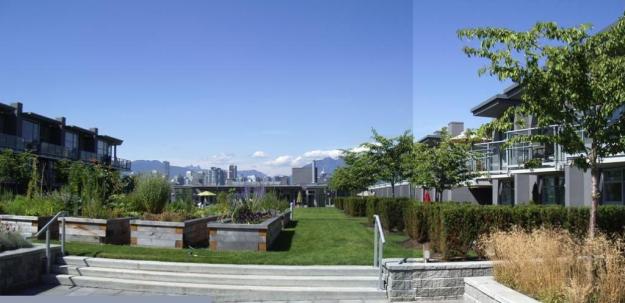
I Live on a Green Roof – and you should too! (summer update)

A few months ago I blogged about how I lived on a green roof, how much I enjoyed it, and outlined some of the economic benefits green roofs create (as well as why they should be part of our stimulus package).

At the time I promised to repost pictures of the roof in the summer since – at the time – it was winter and so it wasn’t that vibrant. Part of me wished I’d taken these in the spring when the cherry blossoms were bursting but these pics are pretty nice too.

5 months later I can confirm that this building still is an example of urban planning done right.

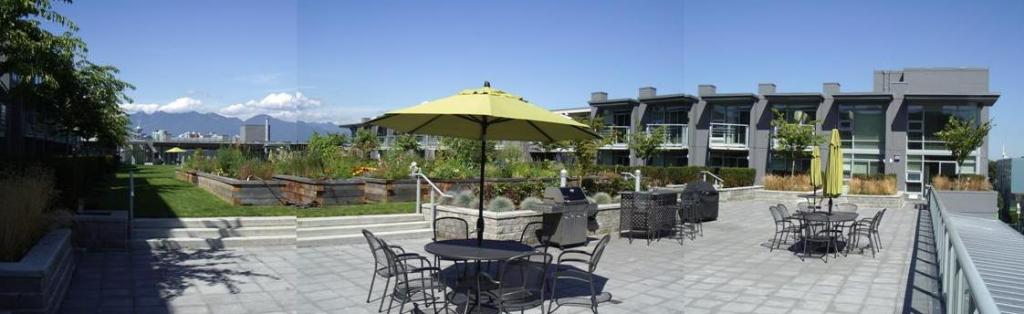
The nicest thing about the roof is that it’s just an inordinate amount of green space to have just outside your apartment/townhouse in a urban setting. I confess that unlike some of the other tenants I haven’t played bocce or croquet in the green space in the middle of the building but at some point this summer I hope to. I do however use the collective BBQ’s quite frequently which is a real joy. Indeed, running across the street to the Whole Foods Paycheck and grabbing a pre-made burger and dropping it on the grill is just awesome.

Mostly though it is nice to open one’s door to a quiet city side walk, trees, grass and shrubs – despite being on a 5th story rooftop.

Now that it has gotten quite hot here in Vancouver I’d be curious how much lower the electrical bill is for the Winners, Starbucks, Save-on-Foods, Home Depot, TD Bank and other stores that are below us. (Of course, I wonder the same in winter as I’m assuming they are better insulated from both the heat and cold. One the downside my apartment (it is really more like a row house that is on the building’s roof) does not have a green roof above it and on warm days it gets pretty hot – especially the loft office space where I do most of my work/writing. Of course, this is probably true of many Vancouver apartments give  buildings here don’t tend to have central AC.

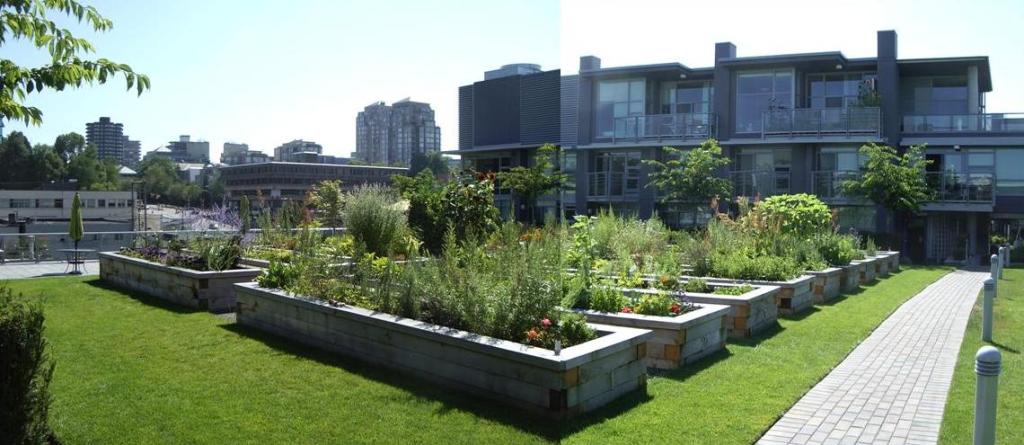
Also apologies for the stitching job with these photos – I’m working with some pretty rudimentary tools.

Roof 2c

This is the BBQ I use most, gives me a great view of downtown at the mountains, on the other side I look up at City Hall.

This is the BBQ I use most, gives me a great view of downtown at the mountains, on the other side I look up at City Hall.

roof-4c

I (embarrassingly) don’t use any of the planters but from what I can tel some residents grow herbs and vegetables, others just grow flowers…

Open Data at the City of Vancouver – An Update 16/7/2009

matrix

For those interested in the progress around the Open Motion (or Open3 as city staff have started to call it) I’ve a little update.

Last week during a visit to city hall to talk about the motion I was shown a preview of the website the city has created to distribute and share data sets. For those unsure what such a website would look like, the baseline and example I’m measuring the city against is, of course, the Washington DC website. At the moment the city’s prospective website looks more like the (also impressive) beta site the City of Nanaimo set up after ChangeCamp – a little simpler and with a lot fewer data sets, but it is the first step.

As an aside kudos to the City of Nanaimo team which has been pushing open data and especially geo-data for quite some time as this must read Time magazine piece (yes, a must read Time magazine piece) will attest.

Anyway… back to Vancouver. The fact that the city has a beta website with a (very) modest amount of data ready to launch is a testament to the hard work and effort of the City’s IT staff. Rarely in my work with government’s have I seen something move so quickly and so needless to say… I’m quite excited. At the moment, I don’t know when the beta data site will go live – there are still a few remaining issues being worked on – but as soon as it launches I will be writing a blog post.

In the interim, big kudos should also go to the City’s Archives who posted a number of videos from the archives online and created it’s own YouTube Channel. They received so much traffic over the videos that the servers almost ground to a halt. Awesome, I say. It just goes to show how much interest there is out there.

Also exciting is that my post on how open data makes garbage collection sexy has inspired two local hackers (Luke and Kevin) to scrape the city’s garbage calendar and hand created digital versions of the city’s garbage maps to create the app I spec’ed out in the blog post. (I’ll have more on that, including links, in a few weeks) Luke also suggested I start recording other app ideas that come to me so over at the Vancouver Data Google group which was created on the fly by local coders in the audience during my and Andrea’s presentation at Open Web Vancouver. I’ve asked people to share their ideas for applications (mobile or desktop) that they’d like to see created with open data.

Sooooo… if there is an app you’d like to see created please post it to the google group or send me an email or write it in the comments below. No guarantees that it will be created but I’m hoping to help organize some hack-a-thons (or as my city friends prefer… code sprints). Having some ideas for people to sink their teeth into is always helpful.

How Open Data even makes Garbage collection sexier, easier and cheaper

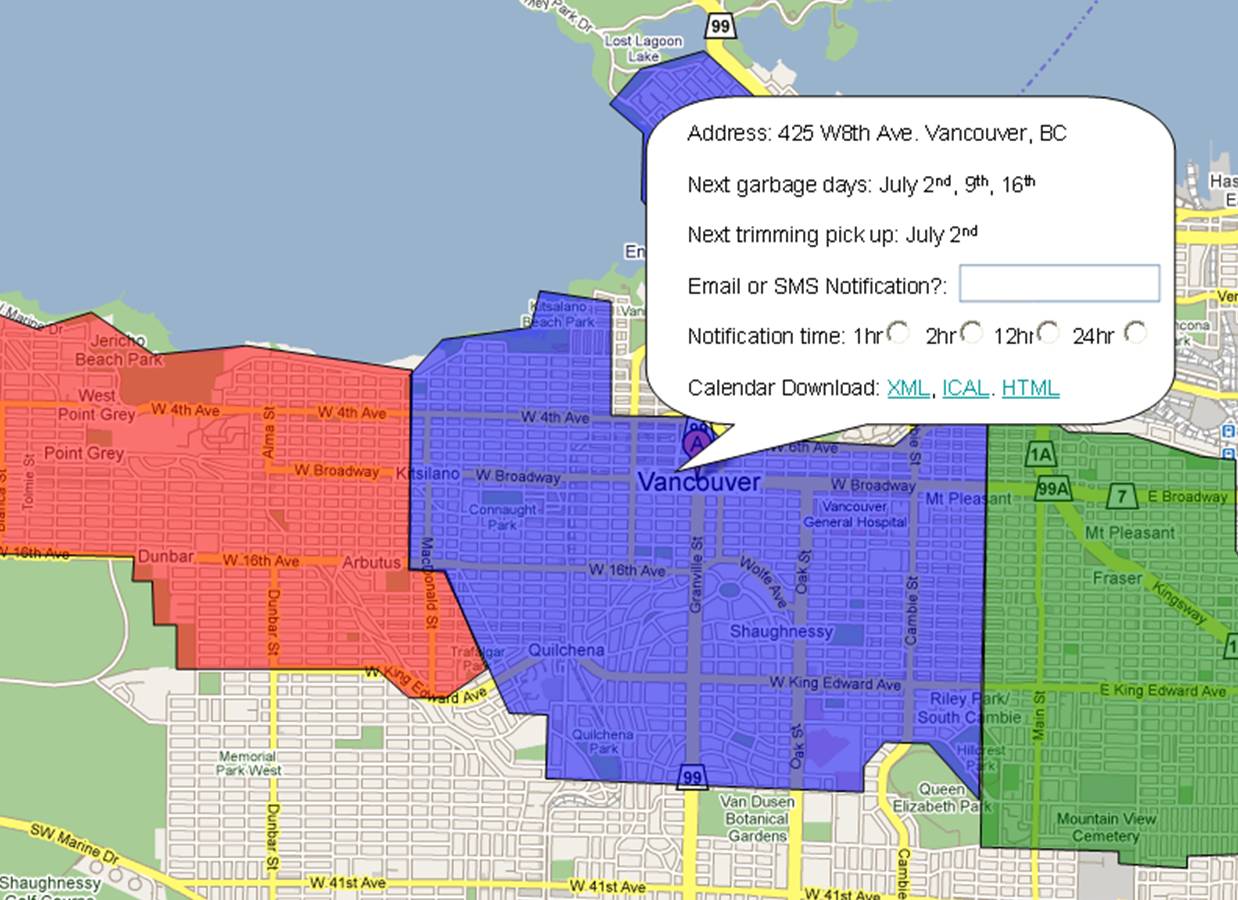
So presently the City of Vancouver only shares its garbage schedule (which it divides into north and south) as a PDF file. This is a pity as it means that no one can build any apps around it. Imagine a website or Iphone app that mashed up google maps with a constantly up to date city garbage pick up schedule. With such a application one could:

  • Simply punch in your address and find out your garbage zone (no more guessing if you live on the border of a zone)
  • Get an email or SMS notification 15 minutes, 1 hour, 12 hours (whenever!) before pick up
  • Download the garbage schedule into your calendar using XML, HTML or ICAL

Garbage-App

Let’s face it, everyone could do with a garbage day reminder. I can imagine that there are 1000’s of Vancouverites who’d sign up for an email notification.

Maybe this seems all very simply, nice but unimportant. But this is more than just creating convenience. What are the implications for such an application?

For citizens:

  • Let’s face it, for many of us, it would be a convenient and nice to get a reminder of when the garbage is going to be picked up
  • It would improve citizen’s appreciation for city services
  • It might also increase the likelihood citizen will recycle as the notification would enable them to better plan and prepare for garbage pick up

For the city & taxpayers

  • Every day 100s of Vancouverites forget to put out there garbage out for pick up. If garbage isn’t picked up, it piles up. This creates several new risks and costs to the city including: increasing likelihood of rodents and health hazards and an increased risk that some residents will dispose of their garbage inappropriately/illegally
  • When garbage is not put out an expensive city asset (the garbage truck, fuel, garbage men) all pass by unused. This means that taxpayers money is not used as efficiently as it could.
  • Moreover,  when garbage isn’t put out there will be twice as much at the house the next week. Multiply that by 100’s of houses and the very quickly the city must deploy extra garbage trucks to deal with this unusually large volume of garbage – costing city taxpayers.

What would be the total value/savings of such an application? Hard to gauge. But add up, time saved by citizens better able to plan around garbage pick up, a small reduction in illegal garbage disposal, a small increase in recycling, slight increase in garbage pick up efficiency and I’m sure the total value would be in the low millions, and the direct savings for the city in the low $100,000 per year. That is not insignificant – especially if all the city had to do was free the data and allow an intrepid hacker to code up the website.

Of course it doesn’t end there. A reliable source tells me the city collects far more data about garbage collection. For example when the driver can’t pick up the garbage can, they make an entry on their device as to why (e.g., it is under a tree). This entry is sent via a wireless connection back to a City database, and includes the highly precise coordinates of the truck at that moment. Then when a resident calls in to find out why the crew did not pick up the garbage can from their residence, the operator can bring up the address on a map and pinpoint the problem.

Such data could also be on the website in an option with something like “Why didn’t my garbage get picked up?” By sharing this data the city could reduce its call volume (and thus costs). With open data, the possibilities, savings and convenience is endless.

ChangeCamp Vancouver

This weekend ChangeCamp comes to Vancouver. If you are interested definitely sign up early.

I’ll be there of course. But better still Shari Wallace (Director of IT for the City of Vancouver) and I will be running a session together from 3-4 pm to brainstorm what data the City of Vancouver should prioritize on opening up. It’s an opportunity for coders to suggest what might help them build the local apps they’ve always wanted to build.

That, and numerous other sessions will try to help us dive deeper into The Long Tail of Public Policy

So what is ChangeCamp and where will it be?

Saturday June 20th 2009 |  8:30 am – 5:30 pm

555 Seymour Street, Vancouver, BC (BCIT Downtown Campus)

$20 in advance | $25 at the door

Vancouver ChangeCamp is a participatory web-enabled face-to-face event that brings together citizens, technologists, designers, academics, social entrepreneurs, policy wonks, political players, change-makers and government employees to answer these questions:

  • How can we help government become more open and responsive?
  • How do we as citizens organize to get better outcomes ourselves?

The event is a partly structured unconference. One track of the conference will introduce the kinds of projects that harness new ideas and tools for social change. Other tracks at the conference will be participant-driven, with the agenda created collaboratively at the start of the event, allowing participants to share their experiences and expertise.

Hope to see you there!