Category Archives: canadian politics

Ethical Oil and the Northern Gateway Pipeline Process

This piece is cross-posted from the Toronto Star’s Op-Ed Page.

This week the “ethical oil” argument adopted by the federal government took an interesting twist. While billions from China pour into Canada to develop the oilsands and fund the construction of the Northern Gateway pipeline, on Monday the government announced its desire to revise the rules so that Canadians will have less time to share their concerns and properly review these massive projects.

Why the change? Because environmental organizations, “other radical groups” and, ironically, foreign money, are allegedly corrupting the process. Is this the future of ethical oil — a world where the Canadian government limits its citizens’ ability to talk over an issue so that China, a country the Prime Minister’s communications director calls a dictatorship, can be allowed to own and exploit Canada’s natural resources?

It’s a curious twist. Many Canadians — me included — agree with one part of Ezra Levant’s ethical oil argument: oil should be evaluated by its environmental impact as well as its effect on the respect for human rights and international stability.

But where does it leave the government’s case for ethical oil if Canadians are sidelined in the decision-making process to please a country both Levant and the Prime Minister have accused of human rights violations? Indeed, on his show The Source, Levant is often critical of China, hosting discussions on how “the freedoms of its people are still on the decline” and labelling the country a “dictatorship.”

Prime Minister Stephen Harper has had equally strong words about China. He once said of the country: “I don’t think Canadians want us to sell out important Canadian values — our belief in democracy, freedom, human rights. They don’t want to sell that out to the almighty dollar.”

So why start now? Especially when Canadians share the Prime Minister’s former concern. A recent poll of British Columbians showed that 73 per cent were worried or very worried about China investing in or owning Canada’s natural resources. Given the environmental implications, the broader ethical concerns raised by Levant, as well as the government’s promise to be more transparent and more engaged with Canadians, this is precisely the wrong time to limit discussion.

There is also a great deal to discuss with regard to foreign influence. Although the word “China” only appears once on the Northern Gateway pipeline website, Sinopec, China’s second largest energy company, was part of a group that recently invested $100 million in the pipeline, the terms of which also enable it to buy an ownership stake in the future. It also spent $4.65 billion (U.S.) to buy 9 per cent of Syncrude Canada. Another company affiliated with the Chinese government just paid $673 million (U.S.) for the remaining 40 per cent of the MacKay River oilsands development, completing its takeover of the project.

If the Northern Gateway pipeline is built, the influence of foreign money in Canada — especially from China — will increase, not decrease. Doesn’t the ethical oil argument demand that Canadians be given a comprehensive opportunity to discuss the pipeline and its impact?

Ultimately, this is why Canadians should be cautious about changing the rules for reviewing projects like the Northern Gateway pipeline. As more money flows in, the numerous decisions risk becoming less and less about Canada and more and more about China. This is something that deserves more conversation, not less.

Finally, I don’t know if the pipeline should be built, and suspect most Canadians don’t either. But this is probably the most important reason Canada needs a process that allows for a far-reaching consultation, so that a broad set of perspectives and issues may be heard. Maybe the new rules would be sensible. But proposing to change the rules on the fly, decrying the trickle of foreign money from the United States while ignoring billions from China and labelling those who would question or criticize the oilsands as “radicals” doesn’t inspire confidence as an opening move.

As leader of the opposition, a younger Stephen Harper once correctly asserted: “When a government starts trying to cancel dissent or avoid dissent is frankly when it’s rapidly losing its moral authority to govern.” The Prime Minister tapped into a powerful truth in that moment — a truth that Canadians still hold dear today. If the government’s approach to the pipeline amounts to nothing more than disempowering Canadians — and in particular the project’s critics — then its cancelling and avoidance of dissent will inspire confidence in neither the ethical oil brand nor the government itself.

What I'm Digesting: Good Reads from the First Week of January

Government Procurement is Broken: Example #5,294,702 or “The Government’s $200,000 Useless Android Application” by Rich Jones

This post is actually a few months old, but I stumbled on it again the other day and could help but laugh and cry at the same time. Written by a freelance computer developer, the post traces the discovery of a simply iphone/android app the government paid $200,000 to develop that is both unusable from a user interface perspective and does not actually work.

It’s a classic example of how government procurement is deeply, deeply broken (a subject I promise to write more about soon). Many governments – and the bigger they are, the worse it gets – are incapable of spending small sums of money. Any project, in order to work in their system, must be of a minimum size, and so everything scales up. Indeed simply things are encouraged to become more expensive so that the system can process them. There is another wonderful (by which I mean terrifying) example of this in one of the first couple of chapter of Open Government.

How Governments Try to Block Tor by Roger Dingledine

For those who don’t know what Tor is, it’s “free software and an open network that helps you defend against a form of network surveillance that threatens personal freedom and privacy, confidential business activities and relationships, and state security known as traffic analysis.” Basically, if you are someone who doesn’t want anyone – particularly the government – seeing what websites you visit, you need Tor. I don’t think I need to say how essential this service is, if say, you live China, Iran or Syria or obviously Egypt, Libya, Tunisia or any of the other states still convulsing from the Arab Spring.

The hour and 10 minute long speech is a rip roaring romp through the world of government surveillance. It’s scary than you want to know and very, very real. People die. It’s not pretty but it is incredible. For those of you not technically inclined, don’t be afraid, there is techno-babble you won’t understand but don’t worry, it won’t diminish the experience.

The Coming War on General Computation by Cory Doctorow

Another video, also from the Chaos Communication Conference in Berlin (how did I not know about this conference? pretty much everything I’ve seen out of it has been phenomenal – big congrats to the organizers).

This video is Cory Doctorow basically giving everybody in the Tech World a solid reality check the state of politics and technology. If you are a policy wonk who cares about freedom of choice, industrial policy, copyright, the economy or individual liberty, this strikes video is a must view.

For those who don’t know Cory Doctorow (go follow him on Twitter right now) he is the guy who made Minister Moore look like a complete idiot on copyright reform (I also captured their twitter debate here).

Sadly, the lunacy of the copyright bill is only going to be the beginning of our problems. Watch it here:

Open Government Consultation, Twitter Townhalls & Doing Advocacy Wrong

Earlier this week the Canadian Federal Government launched its consultation process on Open Government. This is an opportunity for citizens to comment and make suggestions around what data the federal government should make open and what information it should share, and provide feedback on how it can consult more effectively with Canadians. The survey (which, handily, can be saved midway through completion) contains a few straightforward multiple choice questions and about eight open ended questions which I’ve appended to the end of this post so that readers can reflect upon them before starting to fill out the form.

In addition to the online consultations, Tony Clement – the Minister responsible for the Open Government file – will host a Twitter townhall on Open Government this Thursday (December 15). Note! The townhall will be hosted by the treasury board twitter account @TBS_Canada (English) and @SCT_Canada (French) not Minister Clement’s personal (and better known) twitter account. The townhall will first take place in French from 4-4:45pm EST using the hashtags #parlonsgouvert and then in English from 5-5:45 EST using the hashtag #opengovchat.

Some of you may have also noticed that Democracy Watch issued a strongly worded press release last week with the (somewhat long) headline “Federal Conservatives break all of their international Open Government Partnership commitments by failing to consult with Canadians about their draft action plan before meeting in Brazil this week.” This seems to have prompted the CBC to write this article.

Now, to be clear, I’m a strong advocate for Open Government, and there are plenty of things for which one could be critical about this government for not being open about. However, to be credible – especially around issues of transparency and disclosure – one must be factual. And Democracy Watch did more than just stretch the truth. The simple fact is, that while I too wish the government’s consultations had happened sooner, this does not mean it has broken all of its Open Government Partnership commitments. Indeed, it hasn’t broken any of its commitments. A careful read of the Open Government Partnership requirements would reveal that the recent December meeting was to share drafts plans (including the plans by which to consult). The deadline that Democracy Watch is screaming about does not occur until March of 2012.

It would have been fair to say the government has been slow in fulfilling its commitments, but to say it has broken any of them is flatly not true. Indeed the charge feels particularly odd given that in the past two weeks the government signed on greater aid transparency via IATI and released an additional 4000 data sets, including virtually all of StatsCan’s data, giving Canadian citizens, non profits, other levels of governments and companies access to important data sets relevant for social, economic and academic purposes.

Again, there are plenty of things one could talk about when it comes to transparency and the government.  Yes, the consultation could have gotten off the ground faster. And yes, there is much more to done. But this screaming headline is somewhat off base. Publishing it damages both the credibility of the organization making the charge, and risk hurting the credible of open government advocates in general.


List of Open Ended Questions in the Open Government Consultation.

1. What could be done to make it easier for you to find and use government data provided online?

2. What types of open data sets would be of interest to you? Please pick up to three categories below and specify what data would be of interest to you.

3. How would you use or manipulate this data?

4. What could be done to make it easier for you to find government information online?

7. Do you have suggestions on how the Government of Canada could improve how it consults with Canadians?

8. Are there approaches used by other governments that you believe the Government of Canada could/should model?

9. Are there any other comments or suggestions you would like to make pertaining to the Government of Canada’s Open Government initiative?


Canada’s Foreign Aid Agency signs on to IATI: Aid Data get more transparent

Last night, while speaking at the High Level Forum on Aid Effectiveness in Busan Korea, Minister of International Cooperation Bev Oda announced that Canada would be signing on to the International Aid Transparency Initiative (IATI).

So what is IATI and why does this matter?

IATI has developed a common, open and international standard for sharing foreign aid data. By signing on to IATI Canada is agreeing to publish all the data about its projects and who it funds in a form and structure that makes it easy to compare with others who use the IATI standard. This should make it easier to understand where Canadian aid money ends up, in turn allowing analysts to spot efficiencies as well as compare funding and efforts across donor and recipient countries as well as other stakeholders. In short, aid data should become easier to understand, to compare, and to use.

In the medium term it should also make the data available on CIDA’s open data portal (already helpful to non-profits, development groups and students) even more useful.

This is an enormous win for the good people at Engineers Without Borders, as well as the team at Publish What You Fund. Both groups have been working hard for over a year talking Canadian politicians and public servants through the ins and outs – as well as the benefits – of signing onto IATI. I’ve been working with both groups as well, pushing IATI when meeting with Federal Ministers (I recommended we make it part of our Open Government Partnership goals) as well as writing supportive op-eds in newspapers, so needless to say I’m excited about this development.

This really is good news. As governments become increasingly aware of the power data can have in facilitating cooperation and coordination as well as in improving effectiveness and efficiency, it will be critical to push standards around structuring and sharing data so that such coordination can happen easily across and between jurisdictions. IATI is a great example of such an effort and I hope there are more of these, with Canada taking an early lead, in the months and years ahead.


Statistics Canada Data to become OpenData – Background, Winners and Next Steps

As some of you learned last night, Embassy Magazine broke the story that all of Statistics Canada’s online data will not only be made free, but released under the Government of Canada’s Open Data License Agreement (updated and reviewed earlier this week) that allows for commercial re-use.

This decision has been in the works for months, and while it does not appear to have been formally announced, Embassy Magazine does appear to have managed to get a Statistics Canada spokesperson to confirm it is true. I have a few thoughts about this story: Some background, who wins from this decision, and most importantly, some hope for what it will, and won’t lead to next.

Background

In the embassy article, the spokesperson claimed this decision had been in the works for years, something that is probably technically true. Such a decision – or something akin to it – has likely been contemplated a number of times. And there have been a number of trials and projects that have allowed for some data to be made accessible albeit under fairly restrictive licenses.

But it is less clear that the culture of open data has arrived at StatsCan, and less clear to me that this decision was internally driven. I’ve met many a Statscan employee who encountered enormous resistance while advocating for data open. I remember pressing the issue during a talk at one of the department’s middle managers conference in November of 2008 and seeing half the room nod vigorously in agreement, while the other half crossed it arms in strong disapproval.

Consequently, with the federal government increasingly interested in open data, coupled with a desire to have a good news story coming out of statscan after last summer census debacle, and with many decisions in Ottawa happening centrally, I suspect this decision occurred outside the department. This does not diminish its positive impact, but it does mean that a number of the next steps, many of which will require StatsCan to adapt its role, may not happen as quickly as some will hope, as the organization may take some time to come to terms with the new reality and the culture shift it will entail.

This may be compounded by the fact that there may be tougher news on the horizon for StatsCan. With every department required to have submitted proposal to cut their budgets by either 5% and 10%, and with StatsCan having already seen a number of its programs cut, there may be fewer resources in the organization to take advantage of the opportunity making its data open creates, or even just adjust to what has happened.

Winners (briefly)

The winners from this decision are of course, consumers of statscan’s data. Indirectly, this includes all of us, since provincial and local governments are big consumers of statscan data and so now – assuming it is structured in such a manner – they will have easier (and cheaper) access to it. This is also true of large companies and non-profits which have used statscan data to locate stores, target services and generally allocate resources more efficiently. The opportunity now opens for smaller players to also benefit.

Indeed, this is the real hope. That a whole new category of winners emerges. That the barrier to use for software developers, entrepreneurs, students, academics, smaller companies and non-profits will be lowered in a manner that will enable a larger community to make use of the data and therefor create economic or social goods.

Such a community, however, will take time to evolve, and will benefit from support.

And finally, I think StatsCan is a winner. This decision brings it more profoundly into the digital age. It opens up new possibilities and, frankly, pushes a culture change that I believe is long over due. I suspect times are tough at StatsCan – although not as a result of this decision – this decision creates room to rethink how the department works and thinks.

Next Steps

The first thing everybody will be waiting for is to see exactly what data gets shared, in what structure and to what detail. Indeed this question arose a number of times on twitter with people posting tweets such as “Cool. This is all sorts of awesome. Are geo boundary files included too, like Census Tracts and postcodes?” We shall see. My hope is yes and I think the odds are good. But I could be wrong, at which point all this could turn into the most over hyped data story of the year. (Which actually matters now that data analysts are one of the fastest growing categories of jobs in North America).

Second, open data creates an opportunity for a new and more relevant role for StatsCan to a broader set of Canadians. Someone from StatsCan should talk to the data group at the World Bank around their transformation after they launched their open data portal (I’d be happy to make the introduction). That data portal now accounts for a significant portion of all the Bank’s web traffic, and the group is going through a dramatic transformation, realizing they are no longer curators of data for bank staff and a small elite group of clients around the world but curators of economic data for the world. I’m told a new, while the change has not been easy, a broader set of users have brought a new sense of purpose and identity. The same could be true of StatsCan. Rather than just an organization that serves the government of Canada and a select groups of clients, StatsCan could become the curators of data for all Canadians. This is a much more ambitious, but I’d argue more democratized and important goal.

And it is here that I hope other next steps will unfold. In the United States, (which has had free census data for as long as anyone I talked to can remember) whenever new data is released the census bureau runs workshops around the country, educating people on how to use and work with its data. StatsCan and a number of other partners already do some of this, but my hope is that there will be much, much more of it. We need a society that is significantly more data literate, and StatsCan along with the universities, colleges and schools could have a powerful role in cultivating this. Tracey Lauriault over at the DataLibre blog has been a fantastic advocate of such an approach.

I also hope that StatsCan will take its role as data curator for the country very seriously and think of new ways that its products can foster economic and social development. Offering APIs into its data sets would be a logical next step, something that would allow developers to embed census data right into their applications and ensure the data was always up to date. No one is expecting this to happen right away, but it was another question that arose on twitter after the story broke, so one can see that new types of users will be interested in new, and more efficient ways, of accessing the data.

But I think most importantly, the next step will need to come from us citizens. This announcement marks a major change in how StatsCan works. We need to be supportive, particularly at a time of budget cuts. While we are grateful for open data, it would be a shame if the institution that makes it all possible was reduced to a shell of its former self. Good quality data – and analysis to inform public policy – is essential to a modern economy, society, and government. Now that we will have free access to what our tax dollars have already paid for, let’s make sure that it stays that way, by both ensure it continues to be available, and that there continues to be a quality institution capable of collecting and analyzing it.

(sorry for typos – it’s 4am, will revise in the morning)

The New Government of Canada Open Data License: The OGL by another name

Last week the Minister Clement issued a press release announcing some of the progress the government has made on its Open Government Initiatives. Three things caught my eye.

First, it appears the government continues to revise its open data license with things continuing to trend in the right direction.

As some of you will remember, when the government first launched data.gc.ca it had a license that was so onerous that it was laughable. While several provisions were problematic, my favourite was the sweeping, “only-make-us-look-good-clause” which, said, word for word: “You shall not use the data made available through the GC Open Data Portal in any way which, in the opinion of Canada, may bring disrepute to or prejudice the reputation of Canada.”

After I pointed out the problems with this clause to then Minister Day, he managed to have it revoked within hours – very much to his credit. But it is a good reminder to the starting point of the government license and to the mindset of government Canada lawyers.

With the new license, almost all the clauses that would obstruct commercial and non-profit reuse have effectively been eliminated. It is no longer problematic to identify individual companies and the attribution clauses have been rendered slightly easier. Indeed, I would argue that the new license has virtually the same constraints as the UK Open Government License (OGL) and even the Creative Commons CC-BY license.

All this begs the question… why not simply use the language and structure of the OGL in much the same manner that British Columbia Government tried to with its own BC OGL? Such a standardized license across jurisdictions might be helpful, it would certainly simply life for think tanks, academics, developers and other users of the data. This is something I’m pushing for and hope that we might see progress on.

Second, the idea that the government is going to post completed access to information (ATIP) requests online is also a move in the right direction. I suspect that the most common ATIP request is one that someone else has already made. Being able to search through previous requests would enable you to find what you are looking for without having to wait weeks or make public servants redo the entire search and clearing process. What I don’t understand is why only post the summaries? In a digital world it would be better for citizens, and cheaper for the government to simply post the entire request whenever privacy policies wouldn’t prevent it.

Third, and perhaps most important were the lines noting that “That number (of data sets) will continue to grow as the project expands and more federal departments and agencies come onboard. During this pilot project, the Government will also continue to monitor and consider national and international best practices, as well as user feedback, in the licensing of federal open data.”

This means that we should expect more data to hit the site. I seems as though more departments are being asked to figure out what data they can share – hopefully this means that real, interesting data sets will be made public. In particular one hopes that data sets which legislation mandates the government collect, will be high on the list of priorities. Also interesting in this statement is the suggestion that the government will consider national and international best practices. I’ve talked to both the Minister and officials about the need to create common standards and structures for open data across jurisdictions. Fostering and pushing these is an area where the government could take a leadership role and it looks like there may be interesting in this.


Weaving Foreign Ministries into the Digital Era: Three ideas

Last week I was in Ottawa giving a talk at the Department of Foreign Affairs talking about how technology, new media and open innovation will impact the department’s it work internally, across Ottawa and around the world.

While there is lots to share, here are three ideas I’ve been stewing on:

Keep more citizens safe when abroad – better danger zone notification

Some people believe that open data isn’t relevant to departments like Foreign Affairs or the State Department. Nothing could be further than the truth.

One challenge the department has is getting Canadians to register with them when they visit or live in a country labeled by the department as problematic for traveling in its travel reports (sample here). As you can suspect, few Canadians register with the embassy as they are likely not aware of the program or travel a lot and simply don’t get around to  it.

There are other ways of tackling this problem that might yield broader participation.

Why not turn the Travel Report system into an open data with an API? I’d tackle this by approaching a company like TripIt. Every time I book an airplane ticket or a hotel I simply forward TripIt the reservation, which they scan and turn into events that then automatically appear my calendar. Since they scan my travel plans they also know which country, city and hotel I’m staying in… they also know where I live and could easily ask me for my citizenship. Working with companies like TripIt (or Travelocity, Expedia, etc…) DFAIT could co-design an API into the departments travel report data that would be useful to them. Specifically, I could imagine that if TripIt could query all my trips against those reports then any time they notice I’m traveling somewhere the Foreign Ministry has labelled “exercise a high-degree of caution” or worse trip TripIt could ask me if I’d be willing to let them forward my itinerary to the department. That way I could registry my travel automatically, making the service more convenient for me, and getting the department more information that it believes to be critical as well.

Of course, it might be wise to work with the State Department so that their travel advisories used a similarly structured API (since I can assume TripIt will be more interested in the larger US market than the Canadian market) But facilitating that conversation would be nothing but wins for the department.

More bang for buck in election monitoring

One question that arose during my talk came from an official interested in elections monitoring. In my mind, one thing the department should be considering is a fund to help local democracy groups spin up installations of Ushahidi in countries with fragile democracies that are gearing up for elections. For those unfamiliar with Ushahidi it is a platform developed after the disputed 2007 presidential election in Kenya that plotted eyewitness reports of violence sent in by email and text-message on a google map.

Today it is used to track a number of issues – but problems with elections remain one of its core purposes. The department should think about grants that would help spin up a Ushahidi install to enable citizens of the country register concerns and allegations around fraud, violence, intimidation, etc… It could then verify and inspect issues that are flagged by the countries citizens. This would allow the department to deploy its resources more effectively and ensure that its work was speaking to concerns raised by citizens.

A Developer version of DART?

One of the most popular programs the Canadian government has around international issues is the Disaster Assistance Response Team (DART). In particular, Canadians have often been big fans of DART’s work in purifying water after the boxing day tsunami in Asia as well as its work in Haiti. Maybe the department could have a digital DART team, a group of developers that, in an emergency could help spin up Ushahidi, Fixmystreet, or OpenMRS installations to provide some quick but critical shared infrastructure for Canadians, other countries’ response teams and for non-profits. During periods of non-crisis the team could work on these projects or supporting groups like CrisisCommons or OpenStreetMaps, helping contribute to open source projects that can be instrumental in a humanitarian crisis.


As Canada Searches for its Open Government Partnership Commitments: A Proposal

Just before its launch in New York on September 20th, the Canadian Government agreed to be a signatory of the Open Government Partnership (OGP). Composed of over 40 countries the OGP signatories are required to create a list of commitments they promise to implement. Because Canada signed on just before the deadline it has not – to date – submitted its commitments. As a result, there is a fantastic window for the government to do something interesting with this opportunity.

So what should we do? Here are the top 5 suggestions I propose for Canada’s OGP Commitments:

Brief Background on Criteria:

Before diving in, it is worth letting readers know that there are some criteria for making commitments. Specifically, any commitment must tackle at least one of the five “core” challenges: improve public services, increase public integrity, more effectively manage public resources, create safer communities, and increase corporate accountability.

In addition, each recommendation should reflect at least one of the core OGP principles, which are: transparency, citizen participation, accountability, and technology and innovation.

The Top Ten

Having reviewed several other countries commitments and being familiar with both what Canada has already done and what it could do, attached are 10 commitments I would like to see our government make to the OGP.

1. Be open about developing the commitments

Obviously there are a number of commitments the government is going to make since they are actions or programs that government was going to launch anyways. In addition, there will be some that will be new ideas that public servants or politicians have been looking for an opportunity to champion and now have an excuse. This is all fine and part of the traditional way government works.

But wouldn’t it be nice if – as part of the open government partnership – we asked citizens what they thought the commitments should be? That would make the process nicely consistent with the principles and goals of the OGP.

Thus the government should launch a two week crowd sourced idea generator, much like it did during the Digital Economy consultations. This is not suggestion that the ideas submitted must become part of the commitments, but they should inform the choices. This would be a wonderful opportunity to hear what Canadians have to say. In addition, the government could add some of its own proposal into the mix and see what type of response they get from Canadians.

2. Redefine Public as Digital: Pass an Online Information Act

At this year’s open government data camp in Warsaw, the always excellent Tom Steinberg noted that creating a transparent government and putting in place the information foundations of a digital economy will be impossible unless access to government data is not a gift from government (that can be taken away) but a right every citizen has. At the same time Andrew Rasiej of Tech President advocated that we must redefine public as digital. A paper print out in a small office in the middle of nowhere, does not make for  “public disclosure” in the 21st century. It’s bad for democracy, it’s bad for transparency, and it is grossly inefficient for government.

Thus, the government should agree to pass a Online Information Act, perhaps modeled on that proposed in the US Senate, that

a) Any document it produces should be available digitally, in a machine readable format. The sham that the government can produce 3000-10,000 printed pages about Afghan detainees or the F-35 and claim it is publicly disclosing information must end.

b) Any data collected for legislative reasons must be made available – in machine readable formats – via a government open data portal.

c) Any information that is ATIPable must be made available in a digital format. And that any excess costs of generating that information can be born by the requester, up until a certain date (say 2015) at which point the excess costs will be born by the ministry responsible. There is no reason why, in a digital world, there should be any cost to extracting information – indeed, I fear a world where the government can’t cheaply locate and copy its own information for an ATIP request as it would suggest it can’t get that information for its own operations.

3. Sign the Extractive Industries Transparency Initiative

As a leader in the field of resource extraction it is critical that Canada push for the highest standards in a sector that all too often sees money that should be destined for the public good get diverted into the hands of a few well connected individuals. Canada’s reputation internationally has suffered as our extractive resource sector is seen as engaging in a number of problematic practices such as bribing public officials – this runs counter to the Prime Minister’s efforts to promote democracy.

As a result, Canada should sign, with out delay, the Extractive Industries Transparency Initiative, much like the United States did in September. This can help signal our desire for a transparent extractive industry, one in which we play a significant role.

4. Sign on to the International Aid Transparency Initiative

Canada has already taken significant steps to publishing its aid data online, in machine readable formats. This should be applauded. The next step is to do so in a way that conforms with international standards so that this data can be assessed against the work of other donors.

The International Aid Transparency Initiative (IATI) offers an opportunity to increase transparency in foreign aid, better enable the public to understand its aid budget, compare the country’s effectiveness against others and identify duplication (and thus poorly used resources) among donors. Canada should agree to implement IATI immediately. In addition, it should request that the organizations it funds also disclose their work in ways that are compliant with IATI.

5. Use Open Data to drive efficiency in Government Services: Require the provinces to share health data – particularly hospital performance – as part of its next funding agreement within the Canada Health Act.

Comparing hospitals to one another is always a difficult task, and open data is not a panacea. However, more data about hospitals is rarely harmful and there are a number of issues on which it would be downright beneficial. The most obvious of these would be deaths caused by infection. The number of deaths that occur due to infections in Canadian hospitals is a growing problem (sigh, if only open data could help ban the antibacterial wipes that are helping propagate them). Having open data that allows for league tables to show the scope and location of the problem will likely cause many hospitals to rethink processes and, I suspect, save lives.

Open data can supply some of the competitive pressure that is often lacking in a public healthcare system. It could also better educate Canadians about their options within that system, as well as make them more aware of its benefits.

6. Reduce Fraud: Find Fraud by Creating a Death List

In an era where online identity is a problem it is surprising to me that I’m unable to locate a database of expired social insurance numbers. Being able to querry a list of social security numbers that belong to dead people might be a simple way to prevent fraud. Interestingly, the United States has just such a list available for free online. (Side fact: Known as the Social Security Death Index this database is also beloved by genealogist who use it to trace ancestry).

7. Save lives by publishing a API of recall data

The only time the public finds out about a product recall is after someone has died. This is a terribly tragic, not to mention grossly inefficient, outcome. Indeed, the current approach is a classic example of using 21st century technology to deliver a service in a 19th century manner. If the government is interested in using the OGP to improve government services it should stop just issuing recall press releases and also create an open data feed of recalled products. I expand on this idea here.

If the government were doubly smart it would work with major retailers – particularly in the food industry – to ensure that they regularly tap into this data. In an ideal world any time Save-on-Foods, Walmart, Safeway, or any other retailers scans product in their inventory it would immediately check it against the recall database, allowing bad food to be pulled out of production before it hits the shelves. In addition, customers who use loyalty cards could be called or emailed to be informed that they had bought a product that had been recalled. This would likely be much more effective than hoping the media picks the story up.

8. Open Budget and Actual Spending Data

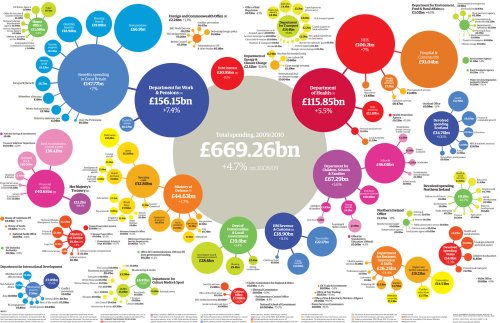
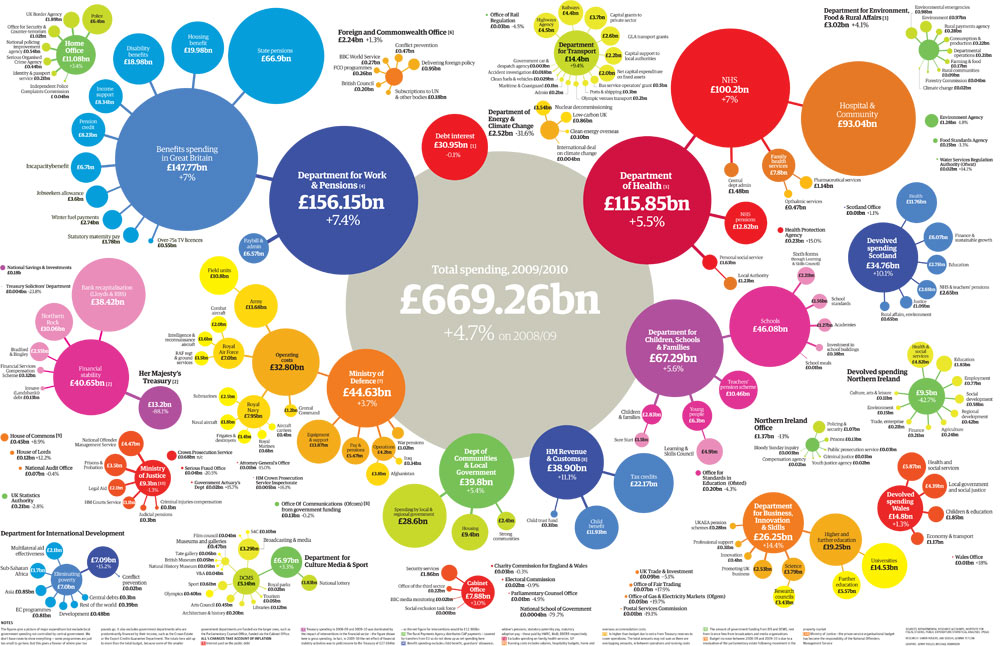
For almost a year the UK government has published all spending data, month by month, for each government ministry (down to the £500 in some, £25,000 in others). More over, as an increasing number of local governments are required to share their spending data it has lead to savings, as government begin to learn what other ministries and governments are paying for similar services.

Another bonus is that it becomes possible to talk about the budget in new and interesting ways. This BEAUTIFUL graphic was published in the Guardian, while still complicated it is much easier to understand than any government document about the budget I have ever seen.
Public-spending-graphic-0051

9. Allow Government Scientists to speak directly to the media about their research.

It has become a reoccurring embarrassment. Scientists who work for Canada publish an internationally recognized ground break paper that provides some insight about the environment or geography of Canada and journalists must talk to government scientists from other countries in order to get the details. Why? Because the Canadian government blocks access. Canadians have a right to hear the perspectives of scientists their tax dollars paid for – and enjoy the opportunity to get as well informed as the government on these issues.

Thus, lift the ban that blocks government scientists from speaking with the media.

10. Create a steering group of leading Provincial and Municipal CIOs to create common schema for core data about the country.

While open data is good, open data organized the same way for different departments and provinces is even better. When data is organized the same way it makes it easier to citizens to compare one jurisdiction against another, and for software solutions and online services to emerge that use that data to enhance the lives of Canadians. The Federal Government should use its convening authority to bring together some of the countries leading government CIOs to establish common data schemas for things like crime, healthcare, procurement, and budget data. The list of what could be worked on is virtually endless, but those four areas all represent data sets that are frequently requested, so might make for a good starting point.
Insite: Evidence, compassion and effectiveness overcome fear and reactiveness

I’m so deeply pleased to hear that the Supreme Court has ordered the federal government to allow Insite, Vancouver’s supervised injection site, to stay open. While on one level the case was about a battle of powers between the provincial and federal government – does health policy trump criminal law – at a deeper level it was a case about evidence based public policy. The question was, when lives are at stake and people will die as a result of a policy choice, can ideology trump evidence?

The answer, for now, is no.

Thank god.

It is great to know that data, analysis, evidence, along with compassion and effectiveness can overcome fear and closed mindedness.

For those unfamiliar with Insite, it is a needle injection site, where heroine users can use drugs under the supervision of a nurse. There has not been one death at the injection site since its opening in 2003 (unlike on the streets), and the facility reduces the spread of AIDS and other diseases, puts users in contact with the health system where they are more likely to ask for help and get into detox, as well as takes pressure off (and reduces costs) the regular medical system, in particular ambulatory services and the emergency room. In Vancouver, it is a measure that has support across the spectrum, from the left to the right.

To read more on the Supreme Court ruling it can be found here. My friend DR points out that paragraph 140 is particularly relevant. It is in this piece that the court discusses how the government may set policy, but it cannot do so in a way that violates Canadians “right to life.” Removing access to Insite diminishes greatly the prospect of an addict to not only live, but to find the help they need and so meets that test:

[139]                     Canada submits that exempting Insite from the prohibitions in the CDSA “would effectively turn the rule of law on its head by dictating that where a particular individual breaks the law with such frequency and persistence that he or she becomes unable to comply with it, it is unconstitutional to apply the law to that person” (A.F., at para. 101).  Canada raises the spectre of a host of exempt sites, where the country’s drug laws would be flouted with impunity.

[140]                     The conclusion that the Minister has not exercised his discretion in accordance with the Charter in this case, is not a licence for injection drug users to possess drugs wherever and whenever they wish.  Nor is it an invitation for anyone who so chooses to open a facility for drug use under the banner of a “safe injection facility”.  The result in this case rests on the trial judge’s conclusions that Insite is effective in reducing the risk of death and disease and has had no negative impact on the legitimate criminal law objectives of the federal government.  Neither s. 56 of the CDSA nor s. 7 of the Charter require condonation of crime.  They demand only that, in administering the criminal law, the state not deprive individuals of their s. 7 rights to life, liberty and security of the person in a manner that violates the principles of fundamental justice.

There will be lots of coverage on this. I’ve already linked to the Globe article above. It also appears Maclean’s will be writing quite a it on this (good for them) as they have had some truly excellent and disturbing coverage on this issue in the past.

Canada Joins the Open Government Partnership

I’m in New York today for the launch of the Open Government Partnership and it looks as the Canada is now a signatory (or at least has signed a letter of intent).

No commitments are outlined, but I will link to them when they are posted.

The Open Government Partnership was launched by the White House and the State Department earlier this year with 8 founding countries. The goal is to get a coalition of governments around the world to commit to implementing a series of initiatives to improve government transparency, effectiveness and accountability. You can read more here.

For those interested, the launch of the event will be livestreamed here. If you’re at the event, I’ll be hosting the lunch on “How to identify and prioritize core classes of information for public disclosure.”

Updated: here’s a video…