Category Archives: canadian politics

How Tories could do transparency – Globe and Mail

Today’s blog post appears in the Globe and Mail. You can read it there (please do, also give it a vote).

How Tories could do transparency

Britain’s new Conservative government did something on Friday that Canadians would fine impossible to imagine. After a brief video announcement from Prime Minister David Cameron about the importance of the event, Francis Maude, Minister of the Cabinet Office, and Tim Berners-Lee, inventor of the World Wide Web, announced that henceforth the spending data for every British ministry on anything over £25,000 (about $40,000) would be available for anyone in the world to download. The initial release of information revealed thousands and thousands of lines of data and almost £80-billion (about $129.75-billion) in spending. And starting in January, every ministry must update the data once a month.

For the British Conservative Party, this is a strategic move. Faced with a massive deficit, the government is enlisting the help of all Britons to identify any waste. More importantly, however, they see releasing data as a means by which to control government spending. Indeed, Mr. Maude argues: “When you are forced to account for the money you spend, you spend it more wisely. We believe that publishing this data will lead to better decision-making in government and will ultimately help us save money.” And they might be right. Already, organizations like Timetric, the Guardian newspaper and the Open Knowledge Foundation have visualized, organized and indexed the data so it is easier for ordinary citizens understand and explore how their government spends their money.

These external sites are often more powerful than what the government has. After observing the way these sites handle the data, the minister noted how he wished he’d had access to them while negotiating with some of the government’s largest contractors.

For Canadians, the Conservative-Liberal Democrat coalition government is but a distant example of a world that a truly transparent government could – and should – create. In contrast, Stephen Harper’s Conservatives seem stuck in a trap described by Mr. Maude in his opening sentences: “Opposition parties are always remarkably keen on greater government transparency, but this enthusiasm mysteriously tends to diminish once they actually gain power.” Canada’s Conservatives have been shy about sharing any information with anyone. Afghan detainee files aren’t shared with Parliament; stimulus package accounts were not emailed to the Parliamentary Budget Office, but uselessly handed over in 4,476 printed pages. Even the Auditor-General is denied MP expense data. All this as access-to-information wait times exceed critical levels and Canada, unlike the United States, Britain , Australia and New Zealand, languishes with no open-data policy. Only once has the government pro-actively shared real “data,” when it shared some stimulus data that could be downloaded.

The irony is not only that the Tories ran on an agenda of accountability and transparency, but that – as their British counterparts understand – actually implementing a transparency and open-data policy may be one of the best ways to stamp a conservative legacy on the government’s future. Moreover, it could be a very popular move.

During the digital economy strategy consultations, open data was the second-most popular suggestion. Interestingly, it would appear the Liberals are prepared to explore the opportunity. They are the only party with a formal policy on open data that matches the standards recently set by Britain and, increasingly, in the United States.

Open data will eventually come to Canada. When, however, is unclear. In the meantime it is our colleagues elsewhere that will reap the benefits of savings, improved analysis and better civic engagement. So until Mr. Harper’s team changes its mind, Canadians must look abroad to see what a Conservative government that actually believes in transparency could look like.

David Eaves is a public-policy entrepreneur, open government activist and negotiation expert based in Vancouver


Patch Culture, Government and why Small Government Advocates are expensive

So earlier today I saw this post by Kevin Gaudet, Federal Director of the Canadian Taxpayers Federation and retweeted by Andrew Coyne (one of the country’s best commentators).

It pretty much sums up why Governments (incorrectly) fear open data and open government:

Screen-shot-2010-11-17-at-6.57.05-AM

The link is to a story on The Sun’s website: Government agencies caught advertising on sex sites!!!! (okay, the exclamation marks are mine).

This is exactly the type of headline every public servant and politician is terrified of. The details, of course, aren’t nearly as salacious. A screenshot Photoforum.ru reveals its a stock photo website (which probably does violate all sorts of copyrights) and, I am sure, there are some photos, somewhere on the site, of nude women, much like there are on say Flickr or Facebook.

Screen-shot-2010-11-17-at-7.09.04-AM1


Three interesting things here:

1. The challenge: Non-stories suck time and energy. The government, of course, didn’t choose to advertise on Photoforum.ru. It hired an agency, Cossette, that placed the ads through Google AdSense. (this is actually the good part of the story – great to hear that the government is using Google AdSense which is a cheap and effective way to advertise). But today, I assure you that dozens of public servants, at least one member of the Heritage Minister’s political staff and a few Canada Post employees are spending the next few days running around like chickens with their heads cut off trying to find out how an ad in a $5000 contract ended up on a relatively harmless site. The total cost of all that investigative work and the reports they will generate to address this “scandal” will probably cost taxpayers $10,000s, if not $100,000s in staff time and energy. No wonder governments fear disclosure. The distraction and cost in time and energy needed to fix a non-story is enormous.

2. The diagnosis: The accountability systems trap: What’s interesting of course, is everybody is acting rationally. The Sun (while stretching the truth) is reporting on the misuse (however minor) of taxpayer dollars. Same with the Canadian Taxpayers Federation (CTF). But the solutions are terrible. The CTF demand that the government eliminate all advertising is nonsensical. We can debate whether every ad is needed, but a flat out ban is silly. There are lots of things governments need to inform citizens about. So we can talk about reducing the government’s ad budget, but this news story doesn’t advance that aim either. Indeed, the Canadian Taxpayers and the Sun have, indirectly, helped inflate the cost of government. As noted, the government, acting rationally, now has dozens of people spending their time solving a crisis around a some minor ad campaigns.

So we have a system where everyone is behaving rationally. But the outcome are terrible. This is the scandal. Indeed, if one were really concerned about the effective spending of taxpayer dollars what one would quickly realize that what’s actually broken here isn’t government advertising, it’s the process by which governments react to and address problems.

3. One Approach: Patch-Culture and Open Data. So it is understandable that government types fear disclosure as, presently, they often seeing it leading to the above situtation.

But what’s interesting is that we could handle it differently.

This same story, in the software world, would have been quite different. The Sun article would have simple been understand as someone pointing out a (minor) bug. The software developers (in the case the public servants) would have patched it (which they did, ending the ads deployment to these sites) and the whole thing would have been a non-event. But at least, for minimal cost and effort, the software (ad program) would be better making both the developers (public servants/politicians) and users (taxpayers) happy. So why is it so different with government?

Two reasons.

First. Government’s pretend that everything they do is perfect. They live with an industrial worldview where you had to get something perfect before launching it since you were going to stamp out 100,000 copies of the things and any bug would get replicated that many times. Of course, very little of government is like this, much more of it is like software where you can make fixes along the way. What makes software so great (although sometimes frustrating too) is that they acknowledge this and so patch it on the fly. Patch-culture – as my friend David Humphrey likes to call it – where people help software get better by point out flaws, and even offering solutions, is exactly what our government needs to learn.

Second. People jump to the worst conclusions because governments appear secretive. Because they don’t proactively disclose (and because Access to Information process is sooooo slow) they always look like they are hiding something. Consequently, when people find mistakes they presume people have been hiding it, trying to cover it up and/or that it was made with some malicious intent. In an open source community, when people find a bug, they often assume it was a (dumb) mistake – not a nefarious plot to do achieve some dubious ends. Open data makes a patch culture easier to create because when you share what you are doing it is hard to believe you have some evil intent. Yes, people may just assume you are dumb – but that is actually better than evil (especially for powerful institutions like government).

Open data is about changing the culture everywhere, both inside and outside government. It won’t do it over night and it won’t do it perfectly but it can help. And it’s a shift we need to make.

Conclusion

I could easily have imagined the above story playing differently in world where patch culture has taken shape within government. Someone discovers the ads on photoforum.ru, thinks it is an error (someone made a dumb choice), submits a bug to the government, the ads are removed, the bug is patched, everybody is happy and… no wasteful non-story about government spending.

Indeed, we could have instead allocated all that wasted time and energy to have the debate the CTF actually wants to have: how much of the budget should go towards advertising.

What we need to be thinking about is what is the system we are in, what are the incentives it creates for the various actors and then think of the system we’d like, and figure out how to get from here to there. I think Open Data is an important (but not exclusive) part of the puzzle for changing the relationship between the government, the press and citizens. It may even create some new problems, but I think they will be better, less costly and more interesting problems then the ones we have now, we are frankly destroying budgets and the institutions we need to serve us.

Not all Maclean’s Covers are Created (or Treated) Equal

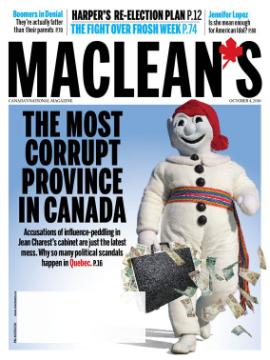
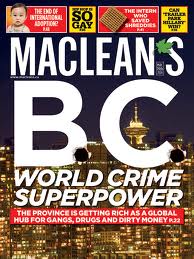
Which one of these covers is more damning?

Macleans-Cover vs.  images

Now that a little time has passed I was reflecting on the controversy about the Maclean’s cover about Quebec as “The Most Corrupt Province in Canada” and remain amazed at the outcry it generated. It is stunning that Parliament took time out to condemn the cover. I don’t say this because I think the article is true. Let’s face it, Canada really isn’t that corrupt. In 2009 Transparency International ranked us as tied for 8th as the least corrupt country in the world. What is more interesting is that so many people felt it was in their interests to take seriously (or exploit) what was obvious link bait.

Indeed what made the outcry all the more fascinating was the a mere 2 years earlier Maclean’s called BC a “World Crime Superpower” and that elicited no response. No outcry from parliament… no screams of protest… Again, in the grand scheme of things claiming BC us a World Crime Superpower on par with countries like say Mexico, Afghanistan and Colombia feels, like a stretch. (Although the economic impact on BC of California decriminalization marijuana is fascinating topic)

Lots of reasons can account for the difference. Part of it may be that BCers frankly don’t care what the rest of the country – not to mention Maclean’s – think. It’s also possible the BCers have less of a sense of common identity – especially one sensitive to how the central Canada describes it. It may also be a reflection of how political power doesn’t always flow with demographics or even opportunity. Today there are few seats to be won in Quebec – the bloc is entrenched and unlikely to move. making a big stink probably isn’t going to change one’s fortunes. In contrast, in BC, vast swaths of the province are up for grabs for all the parties (save the Bloc) – defending the honour of BC might actually yield something. And then, of course, all the parties may not be interested in condemning the Superpower of Crime label – a real, or imagined – creates a mega-crime menace in BC that would play well with a party interested in finding kingpins to fill the empty prisons it plans to build. Perhaps not coming to BCs defense is the shrewd move for some (although one is left wondering, where were the others?).

I think what is most interesting though is that it suggests that for all of the past challenges Quebec has had regarding being in Canada, it is an activist member of the dominion, both in its politics and in its populace. Quebecers seem to care what the rest of the country thinks and they’ll sharpen their elbows and let themselves be heard if necessary. In short, they’ll play in the game. BC has never cared to separate, but sometimes it feels like the province the least part of the dominion. Federal politics don’t get much play in BC, its provincial politicians rarely play the federal game (well) and its population is usually oblivious to what goes on east of the Rockies. Hence the irony of a province that has at times wanted out still cares so much, and a province that defined the country by asking to come in, cares so little.

Or maybe it’s just all a fun note about the fun country we live in and how old stereotypes sometimes send us into a tizzy… and sometimes not.

The Open Data Debate Arrives in Ottawa

The Liberals are promising to create an open data portal – opendata.gc.ca – much like President Obama has done in the United States and both Gordon Brown and David Cameron have done in the United Kingdom.

It’s a savvy move.

In May 2010 when it launched a public consultation on the Digital Economy, the government invited the public to submit proposals and vote on them. Two of the top three most voted ideas involved asking the government to open up access to government collected data. Three months after the submissions have closed it appears the opposition has decided to act on Canadians wishes and release a 21st century open government strategy that reflects these popular demands.

Today, at 1pm EST, I’ve discovered the Liberals will announce that, if elected, they will adopt a government-wide directive in which “the default position for all departments and agencies will be for the release of information to the public, both proactively and responsively, after privacy and other legal requirements are met.”

There is much that both ordinary citizens and advocates of greater government transparency will like in the proposal. Not only have the Liberals mirrored the most aggressive parts of President Obama’s transparency initiatives they are also promising some specific and aggressive policies of their own. In addition to promising to launching opendata.gc.ca to share government data the document proposes the creation of accesstoinformation.gc.ca where citizens could search past and current access to information requests as well as see response times. A third website, entitled accountablespending.gc.ca is also proposed. It would allow government grants, contributions and contracts to be searched.

The announcement brings to the Canadian political debate an exciting issue that first gained broad notoriety in early 2009 when Tim Berners-Lee, the inventor of the world wide web, called on the world’s governments to share their data. By May of that year the United States launched data.gov and in September of 2009 the British Government launched data.gov.uk both of which garnered significant domestic attention. In addition, dozens of cities around the world – including Vancouver, Edmonton and, most recently, Ottawa – have launched websites where they shared information that local charities, non-profits, businesses and ordinary citizens might find useful.

Today, citizens in these jurisdictions enjoy improved access to government information about the economy, government spending, access to information requests, and statistical data. In the United States developers have created websites that empower citizens by enabling them to analyze government data or see what government data exists about their community while a British program alerts citizens to restaurant’s health inspections scores.  The benefit however, not limited to improved transparency and accountability. An independent British estimated that open data could contribute as much as £6 billion to British economy. Canada’s computer developers, journalists and entrepreneurs have been left wondering, when will their government give them access to the data their tax dollars paid to collect?

One obvious intent of the Liberals is to reposition themselves at the forefront of a debate around government transparency and accountability. This is ground that has traditionally been Conservative, but with the cancellation of the long form census, the single source jet fighter contract and, more recently, allegations that construction contracts were awarded to conservative party donors, is once again contestable.

What will be interesting to see is the Conservative response. It’s been rumored the government has explored an open data portal but to date there has been no announcement. Open data is one area where, often, support exists across the political spectrum. In the United Kingdom Gordon Brown’s Labour government launched data.gov.uk but David Cameron’s Conservative government has pursued the project more aggressively still, forcing the release of additional and higher value data to the public. A failure to adopt open data would be tragedy – it would cause Canada to lag in an important space that is beginning to reshape how governments work together and how they serve and interact with citizens. But perhaps most obviously, open data and open government shouldn’t be a partisan issue.

Congratulations to Naheed & other fabulous people

(On a separate note, I’m giving a talk tomorrow at 3pm at UBC.)

For those who weren’t paying attention to the Calgary municipal election last night, Naheed Nenshi came out of third place and won the mayoral race. Of course, the articles are already focusing on the wrong things: he’s Muslim, his a minority, etc…

What really matters about Naheed is that he smart, he is about ideas and he’s progressive. That he’s managed to capture the imagination of a place like Calgary speaks volumes both about how hard he campaigned and how cosmopolitan Canada’s urban centres are becoming.

But back to ideas. I first met Naheed way back when he served as lead author of Building Up: Making Canada’s Cities Magnets for Talent and Engines of Development for Canada25. Essentially for as long as I’ve known him he’s cared about cities (and his passion predates my meeting him). There isn’t much more you could want from someone who is about to become your mayor. For me personally, his work became the template for me later when I worked as lead author first on Canada25’s report written at the request of the Privy Council Office and then, of course, on From Middle to Model Power.

It also speaks volumes about the types of people I had the pleasure to meet through Canada25 and watch grow over the years. Indeed, yesterday I ended up having lunch with Chris Kennedy – another Canada25 alum – who as Superintendent of Schools with the West Vancouver School District is also driven by a sense of public service and policy. Alison Loat, Executive Director of Samara, is another passionate believer in public service and public policy. I’m not sure whether to be more impressed by her own work or simply grateful for her unfailing belief and support of me and my work. And Andrew Medd, who gave me what may have become the best advice about blogging when I first started eaves.ca years ago: “Write for yourself, as though no one will read it.” (advice that actually was fact for the first while – you should only blog if you’re prepared to be alone with your thoughts). Of course there are so many I’m not mentioning like Ross Wallace, Debbie Chachra, Mike Morgan…

Watching the celebrations taking place in Calgary, all I can think of is how lucky I was to get to meet some of these people early on and how much I can’t wait to watch them going forward.

On a separate note, it is very much worth looking at MasterMaq’s election website powered by open election data from the city of Edmonton. From Naheed’s election (in which social media paid a powerful role), to the coverage through Twitter (that’s how I followed the events), social media continues to evolve and have an impact, especially at the local level.

A Government built on Failure

At a certain point Governments need to govern. Yesterday, a strange new trend emerged. Canada has its first government for whom not governing is the new strategy and failure is the new success.

Mere minutes after Canada lost the vote for a seat on the United Nations Security Council to Portugal the Government had identified who was at fault: the leader of the opposition. Dimitri Soudas, Harper’s communications director told the Canadian Press: “I would say a big deciding factor was the fact that Canada’s bid did not have unity because we had Mr. Ignatieff questioning and opposing Canada’s bid.”

Allegedly, before the vote even took place, the Conservatives had attack ads ready to blame the opposition leader. Did the Prime Minister want a seat on the Security Council? Desperately. But short of that, the whole event was to be converted into a attack the opposition event. Let’s celebrate our failure and blame someone else.

It is, of course, a repeat of a similar story from last month: Gun Registry. As Don Martin so persuasively argues in the National Post, the Conservatives couldn’t be happier that its demise was defeated. The party has been able to use the issue to drive fundraising and “rally its base.” Once again, did the Prime Minister want the gun registry eliminated? Absolutely. But, once again, failure becomes success. Let’s celebrate and blame someone else.

At some point Canadians are going to start to wonder? Can a government be built on the failure to govern? The Conservatives seem to believe that retreating to their 30% core support will win them minority governments forever. But at some point the public may actually look for a government that wants to succeed, and a brand built around celebrating failure and playing on divisions could backfire.

Indeed, this strategy erodes the one thing the conservatives claimed lay at the heart of their brand. Accountability. As the list of failures – from the gun registry, to proroguing parliament, to the census, and now the security council debacle – grows one can always try to blame others, but voters will start to ask… are governments at least somewhat accountable for its decisions? To its choices? For its failures?

There are hints that such accountability exists, if fleeting. Back in New York, Foreign Minister Lawrence Cannon said “I do not in any way see this as a repudiation of Canada’s foreign policy… The principles underlying our foreign policy, such as freedom, democracy, respect for human rights and the rule of law, were the basis of all our decisions… Some would even say that because of our attachment to those values that we lost a seat on the council. If that’s the case, then so be it.”

It may be a bitter statement, but at least the Minister displayed a shred of accountability. An acknowledgement that it was decisions this government made – not statements by the opposition leader few inside (forget about outside) Canada were aware of – that were possibly responsible for ending Canada’s bid. It would be nice if this – and not failure – were the metric the government choice to measure itself by.

How you know a government is broken

Last Friday Gloria Galloway and Bill Curry ran an excellent piece about how the government’s promise to strengthen Canada’s access-to-information laws is now five years old.

It is of course all so laughable it is sad. Here we have an issue that the public is universally supportive of – making government more transparent and accountable – and yet the government contends the issue requires extensive consultation. And so… no action.

Meanwhile, on issues to which the public is almost universally opposed – for example the long form census – the government acts without consultation, without evidence and in the dead of night, hoping that no one will notice.

Again, it would be laughable if the implications weren’t so serious. It’s also a big reversal of what should have been and maybe the clearest sign yet this government is broken.

And it didn’t have to be this way. Looking back at the Conservative’s 2006 election platform under the header “Strengthen Access to Information legislation” The government promised it would (this is verbatim)

  • Implement the Information Commissioner’s recommendations for reform of the Access to Information Act. Give the Information Commissioner the power to order the release of information.
  • Expand the coverage of the act to all Crown corporations, Officers of Parliament, foundations, and organizations that spend taxpayers’ money or perform public functions.
  • Subject the exclusion of Cabinet confidences to review by the Information Commissioner. Oblige public officials to create the records necessary to document their actions and decisions.
  • Provide a general public interest override for all exemptions, so that the public interest is put before the secrecy of the government.
  • Ensure that all exemptions from the disclosure of government information are justified only on the basis of the harm or injury that would result from disclosure, not blanket exemption rules.
  • Ensure that the disclosure requirements of the Access to Information Act cannot be circumvented by secrecy provisions in other federal acts, while respecting the confidentiality of national security and the privacy of personal information.

How many of these promises have been implemented? To date, only one (the one that is italicized)

As an aside, take a look at that platform. Guess what isn’t mentioned once: The long form census.

One of the great pledges of the Conservative government was that they were going to make government more accountable and more transparent. So far, when it comes to managing information – the collective documents our tax dollars paid to create – today our government is more opaque, more dumb and less inspiring to Canadians than it has ever been. For a government that was supposed to restore Canadians confidence in their country, it has been a sad decline to observe.

Census Update: It's the Economy, Stupid

Yesterday during a press conference newly minted House leader John Baird announced “The next few months will be sharply focused on Canadians’ No. 1 priority: jobs and the economy… The economic recovery remains fragile and it is increasingly clear that we are not out of the woods yet.”

Fantastic news.

I just hope someone sends Industry Minister Tony Clement the memo.

The effects and impacts of ending the mandatory long form census continues to spill out with a number of Canada’s most senior business and economic leaders pointing out how the decision will negatively impact the economy and… job growth.

First, there was Bank of Canada Governor Mark Carney (voted one of the most influential people in the world by Time Magazine) noting that the bank relies on data found in the mandatory long form to assess the economy and, presumably, to inform decisions on interest rates and other issues. The bank’s capacity to make informed decisions has now been compromised – not exactly a win for jobs or the economy.

As an interesting side note, Carney goes on to say that this may cause the bank to have to supplement StatsCan’s research with its own. Expect to hear more and more statements like this from Government agencies (which are still allowed to talk to the press) as more and more ministries and agencies get plunged into the dark regarding what is going on in the country and are no longer able to assess programs and issues they’ve been tasked to monitor. Various arms of the government (and thus you, taxpayer) will be spending 10s if not 100s of millions to pay for Industry Minister Clement’s mistake.

Then, in the same Globe article in which Carney makes these statements, Roger Martin, dean of the Rotman School of Management notes that ending the long form census hampers Canadian companies capacity to both compete globally and boost productivity. More damning, and further echoing arguments I’ve been making here, he states it will prevent Canadians from having “a sophisticated economy that uses information to its best.” Unkind words from one of the world’s recognized business leaders.

Sadly, it doesn’t end there. The always excellent Stephen Gordon lists the emerging academic literature chronicling the havoc the demise of the long form census is about to wreck. Especially relevant is “The Importance of the Long-Form Census to Canada” by UBC economists David Green and Kevin Milligan. Interestingly, it turns out that the Canadian Mortgage and Housing Corporation uses long form data to fulfill its legislative mandate, and also by local governments and private sector actors to learn about trends in housing. Something that might be of interest to those concerned about the economy and jobs given Canada is rumored to possible have a housing bubble.

Still more damning is how Green and Milligan show the mandatory long form serves as the foundation for the Labour Force Survey (LFS) from which we derive unemployment levels. Compromising the long form survey has, in short, compromised our ability to assess how many Canadians actually have jobs, something that, if you really believed Canadians felt the economy and jobs were the number 1 priority, your government should care about measuring accurately.

Maybe John Baird will sit down with Tony Clement and the Prime Minister and explain to them how, if the economy and jobs are priority 1 then perhaps the government should rethink its decision on the long form census.

Just don’t hold your breath. Instead, do write another email or letter to your local MP. Our country’s economic recovery and competitiveness is being eroded by a government either too dumb to understand the implications of its decision and too stubborn to admit a mistake. Those of us who will be paying the price should remind them of how they can best serve their own priorities.

Twitter, Criminal Investigations & Fox News North

Today, in a headline that came as somewhat of a shock (that, of course, I first saw on twitter) Kory Teneycke, the Quebecor Media vice-president and main advocate for the proposed Sun TV News Channel, announced his resignation. As backgrounder for those not familiar with this story, the proposed Sun TV News Channel is seeking to bring a conservative, Fox styled cable news channel to Canada. There has been a little bit of a battle over what type of license they should get which is covered very well in this blog post. What’s important is that Avaaz launched a petition against the proposed channel which subsequently had a number of false names added to it (adding someone else’s name to a petition is, I’m told, illegal in Canada).

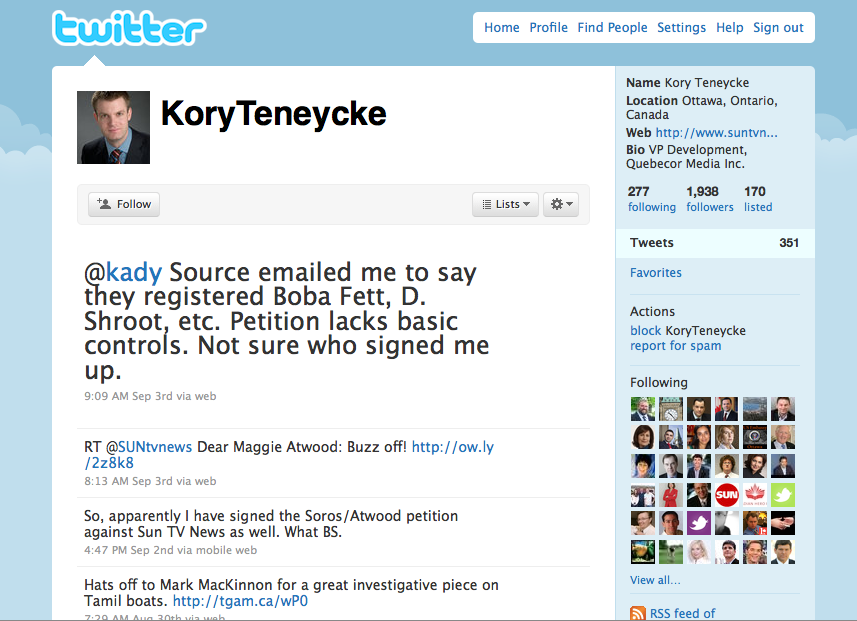
What makes Teneycke’s resignation so interesting is that it comes on the heels of Avaaz asking the police to investigate the additions. It appears that, thanks to technology, figuring out who was illegally adding the names may not be that hard:

On September 2, 2010, Avaaz became aware that an individual operating from an Ottawa IP address was adding both fictional and actual names and email addresses to a petition to stop Prime Minister Harper from pushing biased crony media onto Canadian airwaves. The next morning, Quebecor executive and Sun TV front man Kory Teneycke published several pieces in Quebecor owned newspapers attacking Avaaz and accusing them of running a fraudulent petition – even quoting actual names added by the fraudster. Teneycke later admitted to insider knowledge of both the perpetrator and crimes committed.

Days later, Quebecor threatened to sue Avaaz for the content of its petition site.

In short, it appears that either Teneycke or someone he knew was adding false names to the petition so that a) Teneycke could write a story to discredit the petition and b) prompt Quebeccor to launch a lawsuit to have it taken down. This is serious stuff. Especially from someone who intends to run a news channel. (although, to be fair, it is consistent with the type of thing one might expect from Fox News).

Perhaps Teneycke’s resignation has nothing to do with the false names on the petition? But it is also worth noting that Teneycke’s twitter account is no longer active. This also means that the original offending tweet where he admits that he knew the person adding the false names can no longer be seen. Fortunately, on a lark, I took a screen shot of it the day it went up since, after reading CBC reporter Kady O’malley’s excellent coverage of the back and forth, since given her coverage something seemed very odd about the whole affair.

So what are some key lesson here?

a) Things on twitter don’t disappear

b) Manipulating the press in a world of social media is not as easy as you think it is, even for a former Prime Minister spokes person

c) It appears that Sun TV executives are every bit as slimy as the counterparts feared they would be. If even 10% of this is true then this is shocking behaviour from a proposed News television executive.

d) This may yet lead to Canada’s first high-profile criminal investigation involving twitter

Interesting stuff indeed.

Least Shocking Headline: Our Government Ignored Data about the Census

Since the resignation of Deputy Minister Munir Sheikh and his public repudiation of voluntary long form census it has become clear that Industry Minister Clement has – at best – been misleading the public about the advice he received from statscan.

Now more evidence has emerged showing how the Government was well informed about the significant problems their plan would create. As Steven Chase of the Globe and Mail writes:

For instance, the real 2006 census long-form found that renting households as a percentage of the population in Canada had dropped by 3.08 percentage points from the 2001 census.

But when the Statscan study simulated the results of a voluntary 2006 long-form – which reflect the lower response rates expected in optional surveys – it got a markedly different answer. Calculations instead indicated that rented dwellings in Canada as a share of the population declined by 8.07 percentage points from 2001.

The difference – nearly five percentage points – suggests a voluntary survey in 2006 would have massively undercounted renting households.

So a mere 150% difference. Which, of course, might affect how every city in Canada considered zoning issues and adjust policies around the housing and rentals stock.

Again, if the Government wants to scrap the long-form census, that’s their prerogative. And I suppose we can’t be surprised that a government that wants less data and information to inform decisions would ignore data that showed them the negative consequence of their proposal. I mean, when you’ve already decided evidence doesn’t matter in crime policy, health policy and a myriad of other issues, you aren’t suddenly going to decide the collecting evidence is important…

But if that is your conclusion, stick with it! Don’t lie to me and the Canadian public and claim it won’t have a dramatic impact on the quality of data the Government collects or an impact on how policy and services for Canadians are affected.

And, of course, given how sensitive the decision is, and how it will cascade down and impact businesses, non-profits, local, provincial and federal government decision making, I wish we’d had a chance to debate the merits of it before the decision was made. Who knows, such a debate might not have just saved the long form census, it might have save government a 10-point decline in the polls.