Category Archives: commentary

Social Media and Rioters

My friend Alexandra Samuel penned a piece titled “After a Loss in Vancouver, Troubling Signals of Citizen Surveillance” over at the Harvard Business Review. The piece highlights her concern with the number of people willing to engage in citizen surveillance.

As she states:

It’s one thing to take pictures as part of the process of telling your story, or as part of your (paid or unpaid) work as a citizen journalist. It’s another thing entirely to take and post pictures and videos with the explicit intention of identifying illegal (or potentially illegal) activity. At that moment you are no longer engaging in citizen journalism; you’re engaging in citizen surveillance.

And I don’t think we want to live in a society that turns social media into a form of crowdsourced surveillance. When social media users embrace Twitter, Facebook, YouTube and blogs as channels for curating, identifying and pursuing criminals, that is exactly what they are moving toward.

I encourage you to read the piece, and, I’m not sure I agree with much of it on two levels.

First, I want to steer away from good versus bad and right versus wrong. Social Media isn’t going to create only good outcomes, or only bad outcomes, it is going to create both (something I know Alex acknowledges). This technology will, like previous technologies, reset what normal means. In the new world we are becoming more powerful “sensors” in our society. We can enable others to know what, good and bad, is going on around us. To believe that we won’t share, and that others won’t use our shared information to inform their decisions, is simply not logical. As dBarefoot points out in the comments there are lots of social good that can come for surveillance. In the end you can’t post videos of human right injustices without also being able to post videos of people at abortion clinics, you can’t post videos of officials taking bribes without also being able to post videos of people smoking drugs at a party. The alternative, a society where people are not permitted to share, strikes me as even more dangerous than a society where we can share but where one element of that sharing ends up being used as surveillance. My suspicion is that we may end up regulating some use – there will be some things people cannot share online (visiting abortion clinics may end up being one of those) but I’m not confident of even this.

But I suspect that in a few decades my children will be stunned that I grew up in a world of no mutual surveillance. That we tolerated the risks of a world where mutual surveillance didn’t exist – they may wonder at a basic level, how we felt safe at night or in certain circumstances (I really recommend David Brin’s Science Fiction writing, especially Earth in which he explores this idea). I can also imagine they will find the idea of total anonymity and having an untraceable past to both eerie, frightening and intriguing. In their world, having grown up with social media will be different, some of the things we feel are bad, they will like, and vice versa.

Another issues missing from Alex’s piece is the role of the state. It is one thing for people to post pictures of each other, it is another about how, and if, the state does the same. As many tweeters stated – this isn’t 1994 (the last time there were riots in Vancouver). Social media is going to do is make the enforcement of law a much and the role of the state a much trickier subject. Ultimately, they cannot ignore photos of rioters engaged in illegal acts. So the question isn’t so much on what we are going to share, it is about what we should allow the state to do, and not to do, with the information we create. The state’s monopoly on violence gives it a unique role, one that will need to be managed carefully. This monopoly, combined with a world of perfect (or at least, a lot more) information will I imagine necessitate a state and justice system that that looks very, very different than the one we have right now if we are to protect of civil liberties as we presently understand them. (I suspect I’ll be writing some more about this)

But I think the place where I disagree the most with Alex is in the last paragraph:

What social media is for — or what it can be for, if we use it to its fullest potential — is to create community. And there is nothing that will erode community faster, both online and off, than creating a society of mutual surveillance.

Here, Alex confuses the society she’d like to live in with what social media enables. I see nothing to suggest that mutual surveillance will erode community, indeed, I think it already has demonstrated that it does the opposite. Mutual surveillance fosters lots of communities – from communities that track human rights abuses, to communities that track abortion providers to communities that track disabled parking violators. Surveillance builds communities, it may be that, in many cases, those communities pursue the marginalization of another community or termination of a specific behaviour, but that does not make them any less a part of our society’s fabric. It may not create communities everyone likes, but it can create community. What matters here is not if we can monitor one another, but what ends up happening with the information we generate, and why I think we’ll want to think hard about what we allow the state to do and to permit others to do, more and more carefully.

The Review I want to Read of "What Technology Wants"

A few weeks ago I finished “What Technology Wants” by Kevin Kelly. For those unfamiliar with Kelly (as I was) he was one of the co-founders of Wired magazine and sits on the board of the Long Now Foundation.

What Technology Wants is a fascinating read – both attracting and repulsing me on several occasions. Often I find book reading to be a fairly binary experience – either I already (explicitly or intuitively) broadly agree with the thesis and the book is an exercise in validation and greater evidence, or I disagree, and the book pushes me to re-evaluate assumptions I have. More rare is a book which does both at the same time.

For example, Kelly’s breakdown of the universe as a series of systems for moving around information so completely resonated with me. From DNA, to language, to written word, our world keeps getting filled with systems the transmit, share and remix more information faster. The way Kelly paints this universe is fascinating and thought provoking. In contrast, his determinist view of technology, that we are pre-ordained to make the next discovery and that, from a technological point of view, our history is already written and is just waiting to unwind, ran counter to so many of my values (a strong believer in free-will). It was as if the tech-tree from a game like Civilization actually got it all right – that technology had to be discovered in a preset order and that if we rewound the clock of history, it would (more or less) this aspect of it would play out the same.

The tech tree is civilization always bothered me on a basic level – it challenged the notion that someone smart enough, with enough vision and imagination could have in a parallel universe, created a completely different technology tree in our history. I mean, Leonardo De Vinci drafted plans for helicopters, guns and tanks (among other things) in the 14th century? And yet, Kelly’s case is so compelling and with the simplest of arguments: No inventor ever sits around unworried that someone else is going to make the same discovery – quite the opposite, inventors know that a parallel discovery is inevitable, just a matter of time, and usually not that much time.

Indeed, Kelly convinces me that the era of the unique idea, or the singular discovery may be over, in fact the whole thing was just an illusion created by the limits of time, space and capacity. Previously, it took time for ideas to spread, so they could appear to come from a single source, but in a world of instant communication, we increasingly see that ideas spring up simultaneously everywhere – an interest point given the arguments over patents and copyright.

But what I’d really like to read is a feminist critique of What Technology Wants (if someone knows of one, please post it or send it to me). It’s not that I think that Kelly is sexist (there is nothing that suggests this is the case) it is just that the book reads like much of what comes out of the technology space – which sadly – tends to be dominated by men. Indeed, looking at the end of the book, Kelly thanks 49 thinkers and authors who took time to help him enhance his thesis, and the list is impressive including names such as Richard Dawkins, Chris Anderson, David Brin, and Paul Hawken. But I couldn’t help but notice only 2 of the 49 were obviously women (there may be, tops 4 women, who made the list). What Technology Wants is a great read, and I think, for me, the experience will be richer once I see how some other perspectives wrap their heads around its ideas.

Why Does Election Canada Hate Young People?

This weekend the New York Times had an interesting article about how the BBC and other major media organizations are increasingly broadcasting new television episodes simultaneously around the world. The reason? The internet. Fans in the UK aren’t willing to wait months to watch episodes broadcast in the United States and vice versa. Here a multi-billion dollar industry, backed by copyright legislation, law enforcement agencies, and the world’s most powerful governments and trade organizations is recognizing a simple fact: people want information, and it is increasingly impossible to stop them from sharing and getting it.

Someone at Elections Canada should read the article.

Last week Elections Canada took special care to warn Canadian citizens that they risked $25,000 fines if they posted about election results on social network sites before all the polls are closed. Sadly, Election Canada’s approach to the rise of new internet driven technologies speaks volumes about its poor strategy for engaging young voters.

The controversy centers around Section 329 of the Canada Elections Act which prohibits transmitting election results before polling stations have closed. The purpose of the law is to prevent voters on the west coast from being influenced by outcomes on the east coast (or worse, choosing not to vote at all if the election has essentially be decided). Today however, with twitter, facebook and blogs, everybody is a potential “broadcaster.”

Westerner may have a hard time sympathizing with Election Canada’s quandary. It could simply do the equivalent to what the BBC is doing with its new TV shows: not post any results until after all the voting booths had closed. This is a much simpler approach then trying to police and limit the free speech of 10 million Canadian social media users (and to say nothing of the 100s of millions of users outside of Canada who do not fall under its jurisdiction).

More awkwardly, it is hard to feel that the missive wasn’t directed at the very cohort of Election’s Canada is trying to get engaged in elections: young people. Sadly, chastising and scaring the few young people who want to talk about the election with threats of fines seems like a pretty poor way to increase this engagement. If voting and politics is a social behaviour – and the evidence suggests that it is – then you are more likely to vote and engage in politics if you know that your friends vote and engage in politics. Ironically, this might make social media might be the best thing to happen to voting since the secret ballot. So not only is fighting this technology a lost cause, it may also be counter productive from a voter turnout perspective.

Of course, based on the experience many young voters I talk to have around trying to vote, none of this comes as a surprise.

In my first two Canadian elections I lived out of the country. Both times my mail in ballot arrived after the election and were thus ineligible. During the last election I tried to vote at an advanced poll. It was a nightmare. It was hard to locate on the website and the station ended up being a solid 15 minute walk away any of the three nearest bus routes. Totally commute time? For someone without a car? Well over an hour and a half.

This are not acceptable outcomes. Perhaps you think I’m lazy? Maybe. I prefer to believe that if you want people to vote – especially in the age of a service economy – you can’t make it inconvenient. Otherwise the only people who will vote will be those with means and time. That’s hardly democratic.

Besides, it often feels our voting infrastructure was essentially built by and for our grandparents. Try this out. In the 1960’s if you were a “young person” (e.g 20-30) you were almost certainly married and had two kids. You probably also didn’t move every 2 years. In the 60’s the average marriage age was 24 for men, 20 for women. Thinking in terms of the 1950s and 60s: What were the 3 institutions you probably visited on a daily basis? How about A) the local community centre, B) the local elementary school, and C) the local church.

Now, if you are between the age of 20 and 35 or under, name me three institutions you probably haven’t visited in over a decade.

Do young people not vote because they are lazy? Maybe. But they also didn’t have a voting system designed around them like their grandparents did. Why aren’t their voting booths in subway stations? The lobbies of office towers? The local shopping mall? How about Starbucks and Tim Hortons (for both conservatives and liberals)? Somewhere, anywhere, where people actually congregate. Heaven forbid that voting booths be where the voters are.

The fact is our entire voting structure is anti-young people. It’s designed for another era. It needs a full scale upgrade. Call it voting 2.0 or something, I don’t care. Want young people to vote? Then build a voting system that meets their needs, stop trying to force them into a system over a half century old.

We need voting that embraces the internet, social networks, voters without cars and voters that are transient.  These changes alone won’t solve the low voter turn out problem overnight, but if even 5% more young people vote in this election, the parties will take notice and adapt their platforms accordingly. Maybe, just maybe, it could end up creating a virtuous circle.

Game Theory: Coalition, Libya, Gaddafi and the exit strategy

Great question Andrew – one that deserves answering.

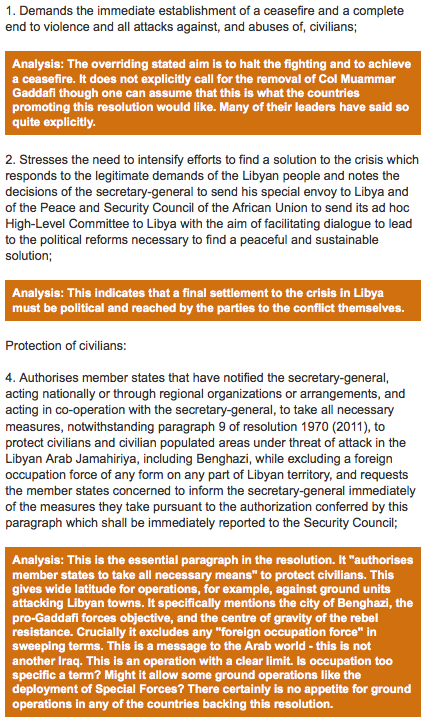
Here’s my quick assessment. My guess is that the intention of the military action is to give Gaddafi alternatives to fighting. The goal of the no-fly zone and other military activities is designed to bring about a stalemate in the Libyan conflict. It’s goal is to provide the rebels with a clear safe haven which they can defend and sustain themselves. This fact, over time, would foster circumstances by which a negotiated agreement (or internationally mediated agreement) between the Libyan government and the rebels would be seen as necessary by both parties. This could, of course, come about with (or without) Gaddafi’s endorsement – but it would leave him some leverage if he chose to go down this path. Indeed, this political negotiated outcome is an explicit goal of the UN resolution. Moreover, the removal of Gaddafi is not called for. There is a wonderful analysis of the resolution on the BBC website, I’ve extracted the relevant parts below:

Screen-shot-2011-03-20-at-4.48.03-PM

The stalemate outcome analysis also feels plausible given it is hard to imagine the Libyan rebels have either the equipment, training, resources and resolve to topple the Libyan government, with or without air support. Occupying vast swaths of the country may simply be sufficient for the rebels to achieve their goals – to force Gaddafi to accept he can no longer rule the country alone.

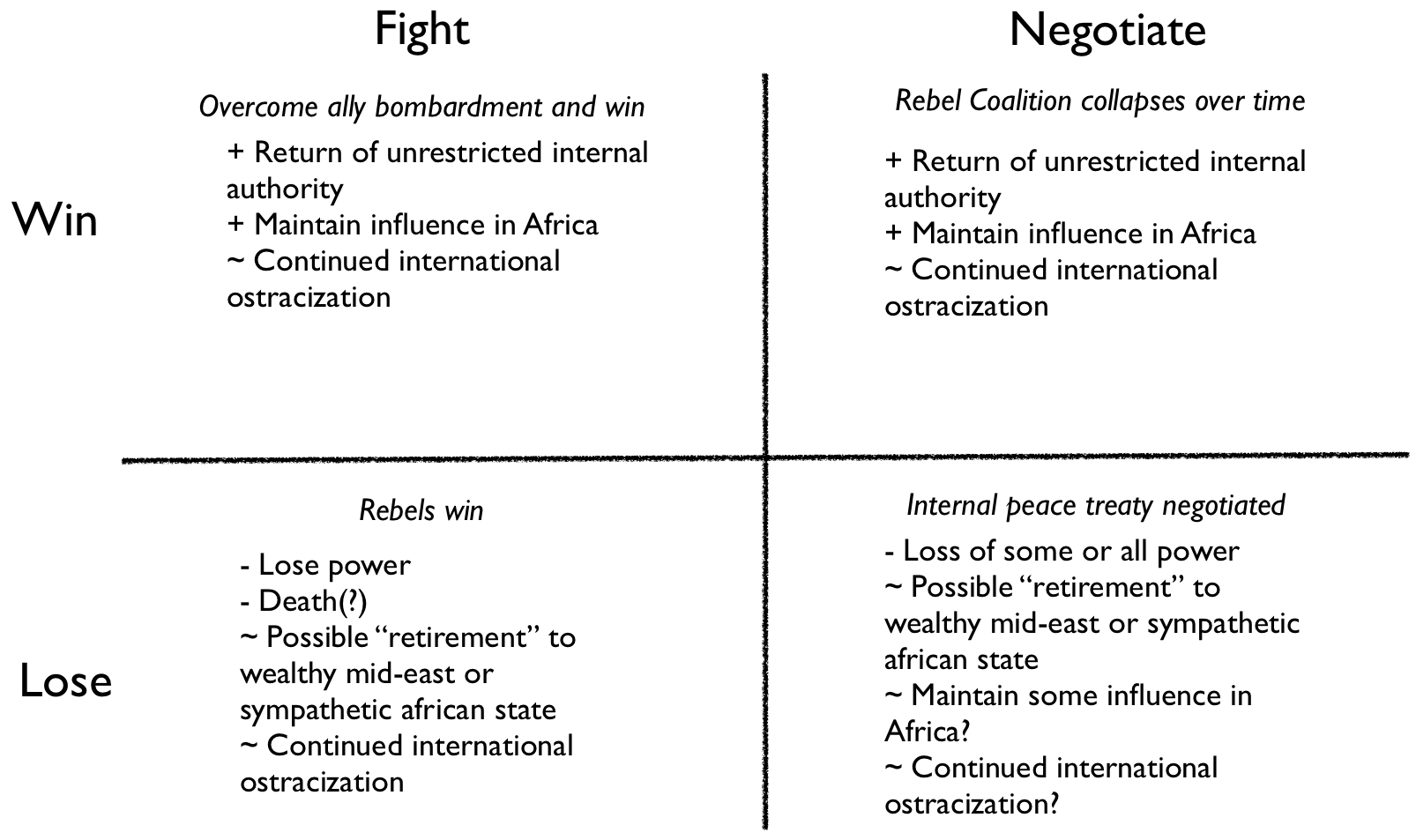
So in short, Gaddafi has as simple choice. He can fight and try to win outright (or gain enough leverage so as to create a negotiated outcome that would achieve the same outcome as winning). This has the benefit of huge upside if he wins (with disastrous outcomes from the west – expect some retaliatory terrorism) but it also has more dramatic downsides. If he loses, a complete loss of power, death and/or imprisonment all seem very likely. So this is a high stakes path.

Alternatively, he can choose to negotiate. This route has more ambiguity, something that presents a risk in of itself (a reason why the back channels will matter so much – see below). Here the upsides and downsides are slightly less extreme, although there is a possibility of an outright “win” for Gaddafi is not off the table completely.

Given these choices it wouldn’t be inconceivable for Gaddafi to choose to fight at first to test the resolve of the Allies and the rebels (something we are seeing now) and, should that not work (which it probably won’t, but could) he can always change gears and retreat into a stalemate negotiation and put forward offers that attempt to fracture the rebel coalition. If he can do that, he could still win back enough support to retake the country, find some way to influence the next government, or at worst, be forced to retire.

I’ve tried to sum all this up on a choice matrix below. The sum of it is, the top lefthand outcome seemed a certain outcome a few days ago. Now the allies are forcing the right column back into the picture. Have downsides down the left become significant enough? And the upsides or exit strategies for Gaddafi on the right certain enough to chance the calculus? That’s really the question – but I do think it remains a possibility.

david-eaves-gaddafi-analysis

There are, of course, at least two other parts of the puzzle that need to be in place to ensure that Gaddafi isn’t forced into fighting.

1. Someone would need to back channel to him the allies intentions: that the UN resolution is designed only to force a stalemate, not oust the current government. It might be logical for Gaddafi to then try to continue fighting and see if he can win despite the airstrikes (as this would maximize his leverage) and, he can always choose to back down later.

2. The western allies and the rebels would need to not interpret the retreat or adoption of a defensive posture by Gaddafi forces as signs of imminent collapse and try to press the advantage.

Obviously I do not know if condition number 1 is in place. In regards to condition number 2, this is also unclear, although I suspect the risks are relatively low. The UN resolution would appear to suggest this isn’t as possible but maybe the biggest unknown is France, which appears unusually keen for battle. The worst case scenario here is that Sarkozy sees the conflict as a way to establish is “presidentialness” in the lead up to an election and so seeks to exploit it, dragging the rebels, and the rest of the allies down a path that needn’t be trodden. But even here, the likelihood feels relatively low.

Of course, there are always thousands of other variables and I’m sure there are more than a few holes to poke in this analysis (I’m all ears for those who want to take a stab – would be great to hear more), but hope this is a helpful attempt to answer that important question. If the only choice you give someone is to fight, expect a fight. And it isn’t clear that we have the resources or stomach to fight back to the bitter end, so I hope someone in Paris or Washington DC has thought this through from this perspective.

Lazy Journalist Revealer. This. Is. Awesome.

Everybody keeps thinking that transparency and improved access to content is something that is only going to affect government, or, maybe some corporations.

I’ve tried to argue differently in places like this blog post and in Taylor and I’s chapter in The New Journalist.

Here’s a wonderful example of how new tools could start to lay more bare the poor performance of many newspapers in actually reporting news and not simple regurgiatating press releases.

Check out the site – called Churnalism.com – that allows you to compare any UK news story against a database of UK press releases. Brilliant!

Wish we had one of these here in North America.

Found this via the Future Journalism Project, which also links to a story on the Guardian website.

The problem with the UBB debate

I reley dont wan to say this, but I have to now.

This debate isso esey!

– Axman13

Really, it is.

The back and forth for and against UBB has – for me – sadly so missed the mark on the real issue it is beyond frustrating. It’s been nice to see a voice or two like Michael Geist begin to note the real issue – lack of competition – but by and large, we continue to have the wrong debate and, more importantly, blame the wrong people.

This really struck home with me while reading David Beers’s piece in the Globe. The first half is fantastic, demanding greater transparency into the cost of delivering bandwidth and of developing a network; this is indeed needed. Sadly, the second half completely lost me, as it makes no argument, notably doesn’t call for foreign investment (though he wants the telcos’ oligarchy broken up – so it’s unclear where he thinks that competition is going to come from) and worse, the CRTC is blamed for the crisis.

It all prompted me – reluctantly – to outline what I think are the three problems with the debate we’ve been having, from least to most important.

1. It’s not about UBB; it’s about cost.

Are people mad about UBB? Maybe. However, I’m willing to wager that most people who have signed the petition about UBB don’t know what UBB is, or what it means. What they do know is that their Internet Service Provider has been charging a lot for internet access. Too much. And they are tired of it.

A more basic question is: do people hate the telcos? And the answer is yes. I know I dislike them all. Intensely. (You should see my cell phone bill; my American friends laugh at me as it is 4x theirs). The recent decision has simply allowed for that frustration to boil over. It has become yet another example of how a telecommunication oligarchy is allowed to charge whatever it wants for service that is substandard to what is often found elsewhere in the world. Of course Canadians are angry. But I suspect they were angry before UBB.

So, if getting gouged is the issue the problem of making the debate about UBB is we risk taking our eye off the real issue – the cost of getting online. Even if the CRTC reverses its decision, we will still be stuck with some of the highest rates in for internet access in the world. This is the real issue and should be the focus of the debate.

2. If the real issue is about price, the real solution is competition.

Here Geist’s piece, along with the Globe editorial, is worth reading. Geist states clearly that the root of the problem is a lack of competition. It may be that UBB – especially in a world of WiMax or other highspeed wireless solutions – could become the most effective way to charge for access and encourage investment. Why would we want to forestall such a business model from emerging?

I’m hoping, and am seeing hints, that that this part of the debate is beginning to come to the fore, but so long as the focus is on banning UBB, and not increasing competition, we’ll be stuck having the wrong conversation.

3. The real enemy is not the CRTC; it’s the Minister of Industry Canada.

This, of course, is both the most problematic part of this debate and the most ironic. The opponents to UBB have made the wrong people the enemy. While people may not agree with the CRTC’s decision, the real problem is not of their making. They can only act within the regulatory regime they have been given.

The truth of the matter is, after 40 years of the internet, Canada has no digital economy strategy. Given it is 2011 this is a stunning fact. Of course, we’ve been promised one but we’ve heard next to nothing about it since the consultation has been closed. Indeed – and I hope that I’ll be corrected here – we haven’t even heard when it will land.

The point, to make it clear, is that this is not a crisis or regulatory oversight. This is a crisis of policy mismanagement. So the real people to blame are the politicians – and in particular the Industry Minister who is in charge of this file. But since those in opposition to UBB have made it their goal to scream at the CRTC, the government has been all too happy to play along and scream at them as well. Indeed, the biggest irony of this all is that it has allowed the government to take a populist approach and look responsive to a crises that they are ultimately responsible for.

P.S. Left-wing bonus reason

So if you are a left leaning anti-UBB advocate – particularly one who publishes opinion pieces – the most ironic part about this debate is that you are the PMO’s favourite person. Not only have you deflected blame over this crisis away from the government and onto the CRTC you’ve created the perfect conditions for the government to demand an overhaul (or simply just the resignation) of key people on the CRTC board.

The only reson this is ironic is beacuase Konrad W. von Finckenstein (head of the CRTC) may be the main reason why Sun Media’s Category 1 application for its “Fox News North” channel was denied. There is probably nothing the PMO would like more than to brush Kinchenstein aside and be to reshape the CRTC so as to make this plan a reality.

Wouldn’t it be ironic if a left-leaning coalition enabled the Harper PMO and Sun Media to create their Fox News North?

And who said Canadian politics was boring?

P.P.S. If you haven’t figured out the spelling mistake easter eggs, I’ll make it more obvious: click here. It’s an example of why internet bandwidth consumption is climbing at double digits.

Why the CRTC was right on Usage-Based Billing

Up here in Canada (and I say that in the identity sense, since at the moment I’m in Santa Clara at the Strata Conference) a lot of fuss has been made about the CRTC’s decision regarding the approval of usage-based billing. So much fuss, in fact, that appears the government is going to over turn it.

One thing that has bothered me about these complaints is that they have generally come from people who also seem to oppose internet service providers throttling internet access. It’s unclear to me that you can have it both ways – you can’t (responsibly) be against both internet throttling and usage-based billing. As much as I wish it were the case there is not unlimited internet access in Canada. At some point this genuinely is a scarce resource and if you give people unlimited access at a fixed price at some point the system is going to collapse…

Indeed, what really concerns me is the incentive structure forbidding usage-based billing creates. There is a finite market for broadband access in Canada so the capital for increasing capacity can’t come exclusively from signing up new users. If you make it so that fixed bills are the only way to bill customers then what incentives do internet providers have to improve capacity? At best they will be incented only to provide a minimally viable service. I mean, why build out when you won’t be able to get a return on investment for the extra capacity?

I’d prefer to have an internet provider market where the players are building out their network in order to meet the needs of the most demanding users who are willing to pay for the extra bandwidth. Why? Because it will ensure that capacity keeps increasing as the large players continue to fight to meet the needs of that market. This means there is a financial incentive to increase bandwidth – which is ultimately what you want the incentives to be.

Besides, if – like me – you happen to believe that roads should be tolled then it’s unclear why you shouldn’t also feel like  consumers of large quantities of bandwidth should pay more than someone who barely consumes any at all. Why should low bandwidth users subsidize high-bandwidth users (or worse, that innovative services be made useless because the other solution is throttling).

I want to be clear. All of this isn’t to say that we shouldn’t regulate the ISP business or that we should treat the internet service providers as trustworthy. We are still in an oligarchy, something their behaviour reminds me of every day. I agree that the ISPs demands are in part an effort to make less attractive services like Netflix that threaten many of the ISPs other business – cable TV. So, if we are going to engage in usage-based billing then I’d expect a few things, including:

  • a generous baseline of fixed-fee internet usage a month. (In an ideal world I’d actually say a basic amount should be free – as I believe access to the internet, like access to books in a library, is increasingly becoming a necessary basic service of our society)
  • let’s have REAL usage-based billing. This means, let’s do usage-based billing that will make us more efficient. Charge me more at peak times, less during off peak times the way electricity companies do. That way I’ll bittorrent my files at night when it costs next to nothing, and be smarter about consumption during peak hours.
  • real transparency into how much the ISPs are investing into increasing their capacity.
  • bandwidth from certain IP addresses – like Parliament, Provincial Legislatures and City Halls should be unlimited. No one should be eating into their fix-priced limit or charged extra while engaging in their most basic democratic rights (so unlimited CSPAN video watching)
  • your network now must be neutral. One reason I like usage-based billing is that it destroys a major argument used to justify traffic shaping – that the network can’t handle the demand. Well, not you get rewarded for high demand – so satisfy it! If consumer advocates can’t oppose both usage-based billing and throttling, then telcos and cable companies can’t have both either.

I can imagine that this post will make some of my colleagues upset. Please fire away, tell me how I’ve got it all wrong. But please make sure that you’ve got an answer that addresses some of the concerns raised here. If you’ve been against throttling (and you know who you are), explain to me how it is that we can both (sustainably) have zero throttling and unlimited fixed fee internet access? In a world where online video is taking off, I’m just not sure I see it. Unless, of course, we think Google is going to provide the answer.

Finally, if you haven’t read it, Richard French has a very thoughtful piece in the Globe and Mail entitled Second-Guessing the CRTC Comes at a Price check it out. It certainly helped reaffirm some of my own thinking.

Egypt: Connected to revolution

This piece is cross-posted from the Opinion Page of the Toronto Star which was kind enough to publish it this morning.

Over the weekend something profound happened. The Egyptian government, confronted with growing public unrest, attempted to disconnect itself. It shut down its cellular and telephone networks and unplugged from the Internet.

It was a startling recognition of this single most powerful force driving change in our world: connectivity. Our world is increasingly divided between the connected and the disconnected, between open and closed. This could be the dominant struggle of the 21st century and it forces us to face important questions about our principles and the world we want to live in.

Why does connectivity matter? Because it allows for free association and self-expression, both of which can allow powerful narratives to emerge in a society beyond the control of any elite.

In Egypt, the protests do not appear driven by some organized cabal. The Muslim Brotherhood — so long held up as the dangerous alternative to the regime — was caught flat-footed by the protests. The National Coalition for Change, headed by Nobel laureate Mohamed ElBaradei, seems to have emerged as the protesters’ leader, not their instigator.

Instead, Egypt may simply have reached a tipping point. Its citizens, having witnessed the events in Tunisia, came to realize they were no longer atomized and uncoordinated in the face of a police state. They could self-organize, connect with one another, share stories and videos, organize meetings and protests. In short, they could tell their own narratives to one another, outside the government’s control.

These stories can be powerful.

In Egypt, a video of an unknown protester being shot and carried away has generated a significant viewership. In Iran, the video of Neda Agha-Soltan dying from a gunshot wound transformed her into a symbol. In Tunisia, videos of protestors being shot also helped mobilize the public.

Indeed, as the family of Mohamed Bouazizi — the man who by setting himself on fire out of frustration with local authorities, triggering the Tunisian protests — noted to an Al Jazeera reporter, people are protesting with “a rock in one hand, a cellphone in the other.”

This is what makes movements like this so hard to fight. There is no opposition group to blame, no subversive leadership to decapitate, no central broadcast authority to shut down. The only way to stop the protests is to eliminate the participants’ capacity to self-organize. During the Green Revolution in Iran, that meant shutting down some key websites; in Egypt, it appears to mean shutting down all communication.

Of course, this state of affairs cannot continue indefinitely. Too much of the Egyptian economy depends on people being able to connect. The network that makes possible a modern economy also makes possible a popular uprising.

At some point Egypt will have to decide: disconnect forever like North Korea, or reconnect and confront the reality of the connected world.

For those of us who believe in freedom, individuality, self-expression and democracy, connectivity is among our most powerful tools because it makes possible alternative narratives.

From East Germany to the Philippines, Iran to Tunisia, connectivity has played a key role in helping people organize against governments that would deny them their rights. It’s a tool democracies have often used, from broadcasts like Radio Free Europe during the Cold War to the U.S. government’s request that Twitter not conduct a planned upgrade to its website that would have disrupted its service during the recent Iranian Green Revolution.

But if we believe in openness, we must accept its full consequences. Our own governments have a desire to disconnect us from one another when they deem the information to be too dangerous.

Today most U.S. government departments, and some Canadian ministries, still deny their employees access to WikiLeak documents, disconnecting them from information that is widely available to the general public.

More darkly, the government pressured companies such as Amazon and Paypal to not offer their services to WikiLeaks — much like the Iranian government tried to disrupt Twitter’s service and the Tunisian government attempted to hijack Facebook’s. Nor is connectivity a panacea. In Iran, the regime uses photos and videos from social networks and websites to track down protestors. Connectivity does not guarantee freedom; it is simply a necessary ingredient.

The events in Egypt are a testament to the opportunity of the times we live in. Connectivity is changing our world, making us more powerful individually and collectively. But ultimately, if we wish to champion freedom and openness abroad — to serve as the best possible example for countries like Egypt — we must be prepared to do so at home.

David Eaves is a Vancouver-based public policy entrepreneur and adviser on open government and open data. He blogs at eaves.ca

What Canada’s Realtors could learn from Canada’s Lawyers

Lawyers aren’t generally known to be the most technologically forwarding looking group – but here in Canada they have done one thing really, really well. Making radically efficient the transaction costs around sharing critical information regarding their industry.

CanLII – the non-profit managed by the Federation of Law Societies of Canada has the goal “to make Canadian law accessible for free on the Internet.” In essence CanLII copies all of the materials produced by the courts, organizes it and makes it searchable and re-usable by anyone. For realtors wondering about their future, looking over this service might be a good place to start.

Consider MLS.ca (now rebranded as realtor.ca) the website run by the Canadian Real Estate Association (CREA) that shares information on what homes are for sale where. A few of you may also know that the Competition Bureau and CREA have recently been tangling over access to MLS. While the it is now easier for people to list properties on MLS, the data within MLS is very restricted. Much of the data only realtors can see and re-use of the data appears strictly verboten. These restrictions cause Canadians to suffer from what I like to call the Hulu Syndrome – they can see what a more open system would look like by surfing the various property websites in the United States – but they are stuck using MLS when trying to browse for a home to buy.

Canadian realtors wanting to know what the future looks like for a professional service in a world where data and information is widely available, CanLII offers both a window and a model. Unlike MLS, the great thing about CanLII is that it serves everyone, not just lawyers. It isn’t hard to imagine a world where lawyers insisted that only they can access the cataloging system they pay for (lawyers pay a small annual fee to support CanLII) much like only realtors can access the full database of MLS. In such world if you wanted to read a judgement, or view court documents on a specific case, only a lawyer could access it for you, and then they would interpret it for you, and, to carry the analogy to its logically conclusion, you would rarely or likely never see the original documents.

Thankfully for both the legal system, the market place for legal services and for our democracy, CanLII doesn’t work this way. As mentioned anyone can search, find and download all the information. Indeed, look at CanLII’s Terms of Use:

Subject to the following paragraph and the below conditions pertaining to prohibited use, legal materials published on the CanLII website, such as legislation, regulations and decisions, including editorial enhancements inserted into the documents by CanLII, such as hyperlinks and information in headers and footers, can be copied, printed and distributed by Users free of charge and without any other authorization from CanLII, provided that CanLII is identified as the source of the document.

Compare this to MLS’s terms of use:

This database and all materials on this site are protected by copyright laws and are owned by The Canadian Real Estate Association (CREA) or by the member who has supplied the data. Property listings and other data available on this site are intended for the private, non-commercial use by individuals. Any commercial use of the listings or data in whole or in part, directly or indirectly, is specifically forbidden except with the prior written authority of the owner of the copyright.

(Side note, I’m pretty sure you can’t copyright data – so not sure what the legal rights being exercised here are).

Of course, even though CanLI makes legal documents are freely available, many people still want to use lawyers because they don’t have time or, just as often, realize they need expert advice in this complicated field.

The same would be true of MLS. Many, many buyers will still want to use a realtor, although the buyers and sellers in the market place would be smarter and more informed – but this would probably lead to a better marketplace and happier customers. There are of course, a number of buyers and sellers who will simply freeload off MLS’s data to sell or buy their home on their own (much like some people probably “freeload” off CanLII to represent themselves or do research). But these are probably clients who would prefer to be doing it this way anyway – giving them full access to the database may cause them to a) realize they do need professional help or b) remove customers who don’t really want to use a realtor in the first place and are thus… terrible customers.

This isn’t to say that sharing MLS data won’t be disruptive, I suspect that some people will automate the buying/selling process which a percentage of the market place will prefer to a handheld process – but I suspect that, at some point, this will happen anyway (someone will figure out a model to make it work) at which point CREA and the realtors will have been firmly entrenched in the minds of Canadians as the obstacle to a better, more efficient marketplace, not the leaders who helped foster it.

Lawyers aren’t often known for clarity and simplicity, but clearly when they get it right, they get it right. I hope other professional services will look at what they are up to.

My wish for 2011: Greater comfort with decline and death

Just before Christmas the always awesome Al Emanski asked me if I would write a short answer to a question he was asking a number of people he thought might have interesting answers:

What would you like to become more visible in 2011?

A number of us responded (there are a fair number of cool people on the list and my favourite response so far is by Christian Bason of Mind-Lab in Denmark, who’ve I’ve not met, and whose project I love). You can download all the 500 word responses here.

I wrote the following as my answer. Al was kind enough to include it in his collection and I’m reposting it below as I was rereading it last night, and still feel it’s true a few weeks later. If you want new and better things, it means we also have to learn to let some old ways of doing things go.

Greater comfort with decline and death.

It sounds shocking – and Iʼm being a little over the top. But I mean it.

We are surrounded by institutions, business models and processes that serve us poorly. To me, the definitive example is the Yellow Pages. Here is an unsolicited “service” that is forced upon millions of Canadians, consumes enormous resources to create and distribute, and that is increasingly obsolete with the rise of 411 and the Internet.

Indeed, the stacks of unwanted yellow pages in residential apartment buildings across the country have become alarmingly large. The Yellow Pages are quickly becoming the definitive metaphor of our times: a business that can continue to exist and consume vast resources long after it serves individual or even a collective good. Inertia, not innovation, is the core value.

We can do better. But it means letting things die.

So what Iʼd like is to be more visible in 2011 is death. For Canadians everywhere to look at their lives, their governments, their business or place of work and ask the metaphorical question: Whatʼs the Yellow Pages of my organization?

This is a hard question. And it challenges us in many ways.  Sometimes it may mean we have to stop doing the thing we have become good at, or comfortable with. But we live in such an exciting era where so many new things are possible. But this will only matter if we get comfortable with letting go of the old. As we manage a scarcity of money, resources and time, being able to do this is only going to become more important. It isnʼt easy, but the alternative – a future of continued poorly allocated and inefficiently used resources – is even worse.