Category Archives: commentary

How the Globe Editorial Board is Misleading You About Journalism

It was completely fascinating to read the Globe and Mail’s editorial board crow over its “victory” last week regarding the protection of confidential news sources.

Standing up for newshounds!” screamed the headlines, with a bold opening paragraph proclaiming:

The Supreme Court of Canada demonstrated respect and understanding on Friday for news reporting that depends on confidential sources. It set an appropriately high bar for judges who may wish to order journalists to reveal those sources, in civil or criminal cases. The court has in effect given the organized news media the tools to do investigative journalism in the public interest. [Emphasis mine.]

Wow, organized media has been *given tools* to protect the public interest? Yes! (According to the G&M…) Well, if this is true… Cue self-congratulatory text that plays into the trope (and myth) that traditional news media is essential for democracy!

In an era in which every blogger is a self-proclaimed journalist, the court clearly puts great stock in the organized media’s ability to probe behind the closed doors of powerful institutions. [Emphasis mine.]

The Supreme Court – again, according to the G&M – has ruled. Only journalists for the big news companies are real journalists that can enjoy the protection of the court.

This, if it were true, would be really big news. It might even justify such self-congratulatory rhetoric. The ruling however, is not this cut and dry. In truth, it provides no real new tools; the Globe‘s lawyers extracted little from the courts in the form of new protections; and the protections that do exist exist for everyone, not just journalists.

As a result, what is really disappointing about all this is that the Globe‘s editorial is at best misleading, attempting to lure Canadians into believing that traditional news media companies enjoy rights that are special and unique to them (and further, implies those rights are new). At worst, the piece suggests the editorial board clings to a world before the web – confined to an outdated worldview where “creators” who could legitimately report on or talk about the news were separated from “consumers” who passively absorb it. Previously, this worldview was made possible by the technology of the printing press, which kept production in the hands of a few; now that publishing is available to virtually anyone, the Globe‘s editorial board seems interested in finding a new way to limit this freedom – when they should be expanding it – by attempting to cast the law as a restrictive force whose benefits are enjoyed by only a few (them) and not everyone (us). It’s a dark perspective for the country’s leading editorial board to take.

Intrigued? I hope so, because what the ruling did say matters.

So what did the ruling say and what does it actually mean? Let’s look closer.

This Was a Draw, Not a Win.

Conversing with the eaves.ca legal team*, the consensus is that the ruling is a draw, not a win for the media. Very little has changed. Prior to the ruling, ascertaining if a confidential source deserved protection was up to the courts who used the four part Wigmore framework to make their assessment:

  1. the relationship must originate in a confidence that the source’s identity will not be disclosed;
  2. anonymity must be essential to the relationship in which the communication arises;
  3. the relationship must be one that should be sedulously fostered in the public interest; and
  4. the public interest served by protecting the identity of the informant must outweigh the public interest in getting at the truth.

Nothing about this case changes this framework. Courts, not the media, continue to determine if a source should be confidential, and the criteria have not changed. In short, the media has not been given “new” tools. Essentially the same tools as before apply.

Indeed, this case is at best a draw (albeit an important one) for the Globe‘s lawyers. This is because they were arguing for new and special rights, specifically the recognition that “the basis of the journalist-source privilege is a constitutional one.” In other words, they wanted to court to state that journalists have an inherent right to protect sources in the same way lawyers have a special solicitor-client privilege or medical doctors have doctor-patient confidentiality privilege. However, as the decision states:

the Court was unprepared “[t]o throw a constitutional immunity around the interactions of such a heterogeneous and ill-defined group of writers and speakers and whichever ‘sources’ they deem worthy of a promise of confidentiality and on whatever terms they may choose to offer it.”

Ouch. That’s not a victory, it’s outright defeat. Indeed, the court doesn’t even think journalists are a group with any unique rights as it:

also rejected the existence of a class-based privilege, on the basis that there is no formal accreditation or licensing process for journalists in place, as there is for lawyers for example, and no professional organization regulates the profession and maintains professional standards.

But that’s not it. On the fourth Wigmore criteria – the question of public interest – the Globe‘s lawyers also wanted the onus to shift to the party seeking production/testimony. In other words, to keep a source secret it shouldn’t be up to the Globe to persuade the courts that the story IS in the public interest, but up to the other party (person, corporation and government) to persuade the courts that it ISN’T in the public interest.

But the court did not agree with this request either:

The Court rejected this argument. Given that the evidence is presumptively compellable and admissible, the burden of persuasion remains on the media to show that the public interest in protecting a secret source outweighs the public interest in criminal investigations. The Court ultimately concluded that every claim to journalist-source privilege — be it in the face of testimonial compulsion or the production of documents — is situation specific, with the public’s interest in the freedom of expression always weighing heavily in the court’s balancing exercise. [my bold/italics]

Strike two.

So, to recap so far: First, the court has not made journalists a special class.  We all enjoy the rights to publish content and if that content were tested legally, the Wigmore framework would be applied to our sources. Second, the court essentially preserved the Wigmore test, so it has not “given media the tools”; it has simply preserved and reaffirmed the tools that already existed. Essentially the courts mostly sustained the status quo that existed before the lower court upset the apple cart.

I don’t want to belittle this outcome. This is an important victory for all Canadians as it preserves everyone’s ability to engage in investigative journalism if they so choose.

So what’s with the language in the Globe‘s editorial? Why claim a big victory and dump on bloggers? What you are really reading is a lot of spin. Which is part of what makes the editorial so frustrating – I hold the editorial board to a high standard, and I expect them to not spin stories, especially about themselves and a subject as serious as freedom of speech.

So let’s unpack that spin…

Mixed Messages

The first is the effort to qualify the victory.

As we previously saw, the Globe‘s lawyers argued that journalists should be a protected class and journalist-source relationships should enjoy constitutional protection. As we also saw, however, the Supreme Court did not agree. But look at the quote from the piece below:

“Bearing in mind the high societal interest in investigative journalism, it might be that he [Mr. Leblanc] could only be compelled to speak if his response was vital to the integrity of the administration of justice.” That is a high bar, indeed. The protection of sources should never be absolute, but the Quebec Superior Court will have to give it full consideration, in light of the important public interest at stake, when it ultimately decides the matter.

So first, the bar did not really move. Yes, the court overturned the lower court, but it essentially re-affirmed the Wigmore framework. Again, this is great news, but this is something preserved, not gained.

But more intriguing was the editorial board saying that the protection of sources should never be absolute. A constitutionally protected journalist-source relationship either is absolute, or if I understand it correctly, pretty close to absolute. So why say it shouldn’t be absolute when this is what your legal team was essentially asking for? One suspects that had the court given journalists a special, constitutionally protected relationship with sources (which really would have demanded a dramatic editorial) than the paper would have argued that the journalists sources had finally achieved the absolute protection they so richly deserve and need.

Burying the Lead

But what is particularly interesting about the Globe‘s editorial piece is its treatment of pretty much everyone who isn’t employed by the mainstream media. The entire framing of the piece is that this is a win for journalists and the media, even though the court goes out of its way to say they are not a protected or even recognized class.

Indeed the real story is that important rights that belong to all Canadians have been preserved! But that story is buried.

Rather, the Globe seems very keen to divide the country into two groups – creators (that’s them) and (passive) consumers (that’s you).  Coming back to the first quote from the piece, the Globe notes that.

In an era in which every blogger is a self-proclaimed journalist, the court clearly puts great stock in the organized media’s ability to probe behind the closed doors of powerful institutions.

In fact, the court does no such thing. First, the Wigmore framework applies to anyone who publishes. That would include people like myself who blog. That also means you (since really anyone can blog, or tweet, or publish something these days).

Second – and this is where it feels like the editorial board really misleads the public – the court did not put great stock in organized media. Indeed, if anything, it went out of its way to say it put very little stock in it.

The basis of the above line in the editorial is, I presume, this part of the ruling:

Justice Binnie put particular emphasis on the significance of the third and fourth factors [of the Wigmore framework], in the journalist-source context. The third factor, whether the relationship is one that the community should sedulously foster (para. 57), introduces a certain degree of flexibility in the evaluation of the different types of sources and different types of journalists. He suggested that whether the relationship is between a source and a blogger, or between a source and a professional journalist, will impact upon the court’s weighing exercise.

So yes, the credibility of the person will matter. But this also means a fly-by-night newspaper may not enjoy the same protection as an established blogger. But even here the wording is quite conservative – “a certain degree of flexibility” and the difference is “suggested.” This is all pretty qualified, and hardly a sign of the court putting “great stock” in established media.

Of course, what little there is gets watered down even further in the next line of the ruling:

But, according to Justice Binnie, the fourth factor [of the Wigmore framework] does the lion’s share of the work, and the court’s task is to “achieve proportionality in striking a balance among the competing interests” (para. 59).

So the public interest is what really matters – not who (e.g. blogger or newspaper) is seeking to preserve the confidentiality of the source.

In Conclusion

This piece is, in many way, a continuation to a piece I wrote in December after a previous Supreme Court ruling which the court went out of its way to put journalists, bloggers and citizens on a equal footing. In the same vein, my problem with the editorial board’s piece isn’t that they played up the significance of their victory – it is still an important victory. It’s that the piece suggests the victory is the (large) news industry’s to enjoy exclusively (or at least, that we ordinary citizens may only enjoy its benefits through them). This is not the case and it does a disservice to citizens, bloggers and journalists to suggest as such.

The Globe and Mail will likely have a long and illustrious reign as the newspaper of record of Canada – but that reign is more likely to continue if it provides credible insights into both the technological and legal realities of the digital world. This editorial suggests that it does not; and I believe that the country, and the paper, are weaker for it.


*Thank you for those who helped me with the legal legwork on this piece, and for those who’ve stuck through to the end; I know this is an unusually long post.
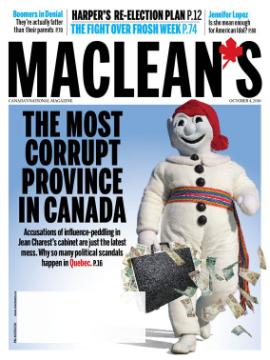

Not all Maclean’s Covers are Created (or Treated) Equal

Which one of these covers is more damning?

Macleans-Cover vs.  images

Now that a little time has passed I was reflecting on the controversy about the Maclean’s cover about Quebec as “The Most Corrupt Province in Canada” and remain amazed at the outcry it generated. It is stunning that Parliament took time out to condemn the cover. I don’t say this because I think the article is true. Let’s face it, Canada really isn’t that corrupt. In 2009 Transparency International ranked us as tied for 8th as the least corrupt country in the world. What is more interesting is that so many people felt it was in their interests to take seriously (or exploit) what was obvious link bait.

Indeed what made the outcry all the more fascinating was the a mere 2 years earlier Maclean’s called BC a “World Crime Superpower” and that elicited no response. No outcry from parliament… no screams of protest… Again, in the grand scheme of things claiming BC us a World Crime Superpower on par with countries like say Mexico, Afghanistan and Colombia feels, like a stretch. (Although the economic impact on BC of California decriminalization marijuana is fascinating topic)

Lots of reasons can account for the difference. Part of it may be that BCers frankly don’t care what the rest of the country – not to mention Maclean’s – think. It’s also possible the BCers have less of a sense of common identity – especially one sensitive to how the central Canada describes it. It may also be a reflection of how political power doesn’t always flow with demographics or even opportunity. Today there are few seats to be won in Quebec – the bloc is entrenched and unlikely to move. making a big stink probably isn’t going to change one’s fortunes. In contrast, in BC, vast swaths of the province are up for grabs for all the parties (save the Bloc) – defending the honour of BC might actually yield something. And then, of course, all the parties may not be interested in condemning the Superpower of Crime label – a real, or imagined – creates a mega-crime menace in BC that would play well with a party interested in finding kingpins to fill the empty prisons it plans to build. Perhaps not coming to BCs defense is the shrewd move for some (although one is left wondering, where were the others?).

I think what is most interesting though is that it suggests that for all of the past challenges Quebec has had regarding being in Canada, it is an activist member of the dominion, both in its politics and in its populace. Quebecers seem to care what the rest of the country thinks and they’ll sharpen their elbows and let themselves be heard if necessary. In short, they’ll play in the game. BC has never cared to separate, but sometimes it feels like the province the least part of the dominion. Federal politics don’t get much play in BC, its provincial politicians rarely play the federal game (well) and its population is usually oblivious to what goes on east of the Rockies. Hence the irony of a province that has at times wanted out still cares so much, and a province that defined the country by asking to come in, cares so little.

Or maybe it’s just all a fun note about the fun country we live in and how old stereotypes sometimes send us into a tizzy… and sometimes not.

The Open Data Debate Arrives in Ottawa

The Liberals are promising to create an open data portal – opendata.gc.ca – much like President Obama has done in the United States and both Gordon Brown and David Cameron have done in the United Kingdom.

It’s a savvy move.

In May 2010 when it launched a public consultation on the Digital Economy, the government invited the public to submit proposals and vote on them. Two of the top three most voted ideas involved asking the government to open up access to government collected data. Three months after the submissions have closed it appears the opposition has decided to act on Canadians wishes and release a 21st century open government strategy that reflects these popular demands.

Today, at 1pm EST, I’ve discovered the Liberals will announce that, if elected, they will adopt a government-wide directive in which “the default position for all departments and agencies will be for the release of information to the public, both proactively and responsively, after privacy and other legal requirements are met.”

There is much that both ordinary citizens and advocates of greater government transparency will like in the proposal. Not only have the Liberals mirrored the most aggressive parts of President Obama’s transparency initiatives they are also promising some specific and aggressive policies of their own. In addition to promising to launching opendata.gc.ca to share government data the document proposes the creation of accesstoinformation.gc.ca where citizens could search past and current access to information requests as well as see response times. A third website, entitled accountablespending.gc.ca is also proposed. It would allow government grants, contributions and contracts to be searched.

The announcement brings to the Canadian political debate an exciting issue that first gained broad notoriety in early 2009 when Tim Berners-Lee, the inventor of the world wide web, called on the world’s governments to share their data. By May of that year the United States launched data.gov and in September of 2009 the British Government launched data.gov.uk both of which garnered significant domestic attention. In addition, dozens of cities around the world – including Vancouver, Edmonton and, most recently, Ottawa – have launched websites where they shared information that local charities, non-profits, businesses and ordinary citizens might find useful.

Today, citizens in these jurisdictions enjoy improved access to government information about the economy, government spending, access to information requests, and statistical data. In the United States developers have created websites that empower citizens by enabling them to analyze government data or see what government data exists about their community while a British program alerts citizens to restaurant’s health inspections scores.  The benefit however, not limited to improved transparency and accountability. An independent British estimated that open data could contribute as much as £6 billion to British economy. Canada’s computer developers, journalists and entrepreneurs have been left wondering, when will their government give them access to the data their tax dollars paid to collect?

One obvious intent of the Liberals is to reposition themselves at the forefront of a debate around government transparency and accountability. This is ground that has traditionally been Conservative, but with the cancellation of the long form census, the single source jet fighter contract and, more recently, allegations that construction contracts were awarded to conservative party donors, is once again contestable.

What will be interesting to see is the Conservative response. It’s been rumored the government has explored an open data portal but to date there has been no announcement. Open data is one area where, often, support exists across the political spectrum. In the United Kingdom Gordon Brown’s Labour government launched data.gov.uk but David Cameron’s Conservative government has pursued the project more aggressively still, forcing the release of additional and higher value data to the public. A failure to adopt open data would be tragedy – it would cause Canada to lag in an important space that is beginning to reshape how governments work together and how they serve and interact with citizens. But perhaps most obviously, open data and open government shouldn’t be a partisan issue.

Congratulations to Naheed & other fabulous people

(On a separate note, I’m giving a talk tomorrow at 3pm at UBC.)

For those who weren’t paying attention to the Calgary municipal election last night, Naheed Nenshi came out of third place and won the mayoral race. Of course, the articles are already focusing on the wrong things: he’s Muslim, his a minority, etc…

What really matters about Naheed is that he smart, he is about ideas and he’s progressive. That he’s managed to capture the imagination of a place like Calgary speaks volumes both about how hard he campaigned and how cosmopolitan Canada’s urban centres are becoming.

But back to ideas. I first met Naheed way back when he served as lead author of Building Up: Making Canada’s Cities Magnets for Talent and Engines of Development for Canada25. Essentially for as long as I’ve known him he’s cared about cities (and his passion predates my meeting him). There isn’t much more you could want from someone who is about to become your mayor. For me personally, his work became the template for me later when I worked as lead author first on Canada25’s report written at the request of the Privy Council Office and then, of course, on From Middle to Model Power.

It also speaks volumes about the types of people I had the pleasure to meet through Canada25 and watch grow over the years. Indeed, yesterday I ended up having lunch with Chris Kennedy – another Canada25 alum – who as Superintendent of Schools with the West Vancouver School District is also driven by a sense of public service and policy. Alison Loat, Executive Director of Samara, is another passionate believer in public service and public policy. I’m not sure whether to be more impressed by her own work or simply grateful for her unfailing belief and support of me and my work. And Andrew Medd, who gave me what may have become the best advice about blogging when I first started eaves.ca years ago: “Write for yourself, as though no one will read it.” (advice that actually was fact for the first while – you should only blog if you’re prepared to be alone with your thoughts). Of course there are so many I’m not mentioning like Ross Wallace, Debbie Chachra, Mike Morgan…

Watching the celebrations taking place in Calgary, all I can think of is how lucky I was to get to meet some of these people early on and how much I can’t wait to watch them going forward.

On a separate note, it is very much worth looking at MasterMaq’s election website powered by open election data from the city of Edmonton. From Naheed’s election (in which social media paid a powerful role), to the coverage through Twitter (that’s how I followed the events), social media continues to evolve and have an impact, especially at the local level.

The Social Network and the real villains of the old/new economy

The other week I finally got around to watching The Social Network. It’s great fun and I recommend going out and watching it whether you’re a self-professed social media expert or don’t even have a Facebook account.

Here are some of my thoughts about the movie (don’t worry, no spoilers here).

1. Remember this is a Hollywood movie: Before (or after) you watch it, read Lawrence Lessig’s fantastic critique of the movie. This review is so soundly brilliant and devastating I’m basically willing to say, if you only have 5 minutes to read, leave my blog right now and go check it out. If you are a government employee working on innovation, copyright or the digital economy, I doubly urge you to read it. Treble that if you happen to be (or work for) the CIO of a major corporation or organization who (still) believes that social media is a passing phase and can’t see its disruptive implications.

2. It isn’t just the legal system that is broken: What struck me about the movie wasn’t just the problems with the legal system, it was how badly the venture capitalists come off even worse. Here is supposed to be a group of people who are supposed to help support and enable entrepreneurs and yet they’re directing lawyers to draft up contracts that screw some of the original founders. If the story is even remotely true it’s a damning and cautionary tale for anyone starting (or looking to expand) a company. Indeed, in the movie the whole success of Facebook and the ability of (some) of the owners to retain control over it rests on the fact that graduates of the first internet bubble who were screwed over by VCs are able to swoop in and protect this second generation of internet entrepreneurs. Of course they – played by Sean Parker (inventor of Napster) – are parodied as irresponsible and paranoid.

One thought I walked away with was: if, say as a result of the rise of cloud computing, the costs of setting up an online business continue to drop, at a certain point the benefits of VC capital will significantly erode or their value proposition will need to significantly change. More importantly, if you are looking to build a robust innovation cluster, having it built on the model that all the companies generated in it have the ultimate goal of being acquired by a large (American) multinational doesn’t seem like a route to economic development.

Interesting questions for policy makers, especially those outside Silicon Valley, who obsess about how to get venture capital money into their economies.

3. Beyond lawyers and VCs, the final thing that struck me about the movie was the lack of women doing anything interesting. I tweeted this right away and, of course, a quick Google search reveals I’m not the only one who noticed it. Indeed, Aaron Sorkin (the film’s screenwriter) wrote a response to questions regarding this issue on Emmy winner Ken Levine’s blog. What I noticed in The Social Network is there isn’t a single innovating or particularly positive female character. Indeed, in both the new and old economy worlds shown in the film, women are largely objects to be enjoyed, whether it is in the elite house parties of Harvard or the makeshift start-up home offices in Palo Alto. Yes, I’m sure the situation is more complicated, but essentially women aren’t thinkers – or drivers – in the movie. It’s a type of sexism that is real, and in case you think it isn’t just consider a TechCrunch article from the summer titled “Too Few Women In Tech? Stop Blaming The Men” in which the author, Michael Arrington, makes the gobsmacking statement:

The problem isn’t that Silicon Valley is keeping women down, or not doing enough to encourage female entrepreneurs. The opposite is true. No, the problem is that not enough women want to become entrepreneurs.

Really? This is a country (the United States) where women start businesses at twice the rate of men and where 42% of all businesses are women owned? To say that women don’t want to be entrepreneurs is so profoundly stupid and incorrect it perfectly reflects the roles women are shoveled into in The Social Network. And that is something the new economy needs to grapple with.

When Canada makes the US border thicker

Canadians spend a lot of time worrying about the “thickening” border with the United States. This is for good reason. Given the importance of the US market and the sheer number of exports between the two countries, issues that thicken the border – like the requirement to use a passport or more strict rules around shipping goods – have an enormous impact on Canada’s economy.

Usually, Canadian officials complain that it is hard to get Americans to engage on this issue. So it is exceedingly frustrating when the Canadian government takes actions that thicken the border and simultaneously discouraging and encouraging when it is senior American officials have to intervene to make it thinner.

Last week, despite lobbying from the Mayor of Vancouver, the Premier of British Columbia, a number of business and tourism representatives and even conservative party caucus members, the Federal Goverment looked set on killing a program that saw a set of Border Guards pre-clearing trains that run from Vancouver to Seattle. Without this pre-clearance the trains would run much, much slower and so Amtrak, who runs the trains, said it would end the service.

It now appears that the border service was saved only after U.S. Homeland Security Secretary Janet Napolitano and U.S. ambassador to Canada David Jacobson personally intervene. Yes, you read that right. US officials were racing trying to persuade Canadian officials to keep the border more open. The problematic nature of such a headline cannot be underscored. Yes, it is great that senior officials in the US care about ensure the Canada-US border remains as open as possible. But, as a country still dependent on an open and friction free border with the Unites States it is disturbing their intervention was necessary.

Indeed, as the country with the most to suffer when the border gets thicker (we feel the loss of exports and trade more than the Americans do) we need to model behaviour and be a leader in striving to make it as open and as accessible as possible. Secretary Janet Napolitano and U.S. ambassador to Canada David Jacobson intervention now means that two senior US officials may now believe that Canada’s commitment to friction free and accessible border is not as strong as we have claimed. If we aren’t concerned here, maybe we aren’t as concerned  on other, even greater areas of concern regarding the increased thickening of the Canada-US border.

And the damage has not been undone. Public Safety Minister Vic Toews, who is responsible for the decision, has only only preserved the service for one year. Indeed, in his statement he added “In this period of time, the residents of British Columbia and Washington State primarily will demonstrate whether, in fact, this is a necessary service.” Of course, the second train has already doubled the number of people traveling via rail between the two cities and, according to BC’s transportation minister, has injected $11.8 million into the BC economy.

Canadians should be thrilled that Public Safety Minister Vic Toews and the government ultimately made the right decision around keeping this service in place. But as a country still concerned about the weakened economy, the US border and our relationship with the United States, we should be concerned that the government took the most painful and costly route to arrive at this decision.

How you know a government is broken

Last Friday Gloria Galloway and Bill Curry ran an excellent piece about how the government’s promise to strengthen Canada’s access-to-information laws is now five years old.

It is of course all so laughable it is sad. Here we have an issue that the public is universally supportive of – making government more transparent and accountable – and yet the government contends the issue requires extensive consultation. And so… no action.

Meanwhile, on issues to which the public is almost universally opposed – for example the long form census – the government acts without consultation, without evidence and in the dead of night, hoping that no one will notice.

Again, it would be laughable if the implications weren’t so serious. It’s also a big reversal of what should have been and maybe the clearest sign yet this government is broken.

And it didn’t have to be this way. Looking back at the Conservative’s 2006 election platform under the header “Strengthen Access to Information legislation” The government promised it would (this is verbatim)

  • Implement the Information Commissioner’s recommendations for reform of the Access to Information Act. Give the Information Commissioner the power to order the release of information.
  • Expand the coverage of the act to all Crown corporations, Officers of Parliament, foundations, and organizations that spend taxpayers’ money or perform public functions.
  • Subject the exclusion of Cabinet confidences to review by the Information Commissioner. Oblige public officials to create the records necessary to document their actions and decisions.
  • Provide a general public interest override for all exemptions, so that the public interest is put before the secrecy of the government.
  • Ensure that all exemptions from the disclosure of government information are justified only on the basis of the harm or injury that would result from disclosure, not blanket exemption rules.
  • Ensure that the disclosure requirements of the Access to Information Act cannot be circumvented by secrecy provisions in other federal acts, while respecting the confidentiality of national security and the privacy of personal information.

How many of these promises have been implemented? To date, only one (the one that is italicized)

As an aside, take a look at that platform. Guess what isn’t mentioned once: The long form census.

One of the great pledges of the Conservative government was that they were going to make government more accountable and more transparent. So far, when it comes to managing information – the collective documents our tax dollars paid to create – today our government is more opaque, more dumb and less inspiring to Canadians than it has ever been. For a government that was supposed to restore Canadians confidence in their country, it has been a sad decline to observe.

How Governments misunderstand the risks of Open Data

When I’m asked to give a talk about or consult on policies around open data I’ve noticed there are a few questions that are most frequently asked:

“How do I assess the risks to the government of doing open data?”

or

“My bosses say that we can only release data if we know people aren’t going to do anything wrong/embarrassing/illegal/bad with it”

I would argue that these question are either flawed in their logic, or have already been largely addressed.

Firstly, it seems problematic to assess the risks of open data, without also assessing the opportunity. Any activity – from walking out my front door to scaling Mount Everest carries with it risks. What needs to be measured are not the risks in isolation but the risks balanced against the opportunity and benefits.

But more importantly, the logic of the question is flawed in another manner. It suggests that the government only take action if every possible negative use can be prevented.

Let’s forget about data for a second – imagine you are building a road. Now ask: “what are the risk’s that someone might misuse this road?” Well… they are significant. People are going to speed and they are going to jay walk. But it gets worse. Someone may rob a bank and then use the road as part of their escape route. Of course, the road will also provide more efficient transportation for 1000s of people, it will reduce costs, improve access, help ambulances save peoples lives and do millions of other things, but people will also misuse it.

However, at no point in any policy discussion in any government has anyone said “we can’t build this road because, hypothetically, someone may speed or use it as an escape route during a robbery.”

And yet, this logic is frequently accepted, or at least goes unchallenged, as appropriate when discussing open data.

The fact is, most governments already have the necessary policy infrastructure for managing the overwhelming majority of risks concerning open data. Your government likely has provisions dealing with privacy – if applied to open data this should address these concerns. Your government likely has provisions for dealing with confidential and security related issues – if applied to open data this should address these concerns. Finally, your government(s) likely has a legal system that outlines what is, and is not legal – when it comes to the use of open data, this legal system is in effect.

If someone gets caught speeding, we have enforcement officials and laws that catch and punish them. The same is true with data. If someone uses it to do something illegal we already have a system in place for addressing that. This is how we manage the risk of misuse. It is seen as acceptable for every part of our life and every aspect of our society. Why not with open data too?

The opportunity, of both roads and data, are significant enough that we build them and share them despite the fact that a small number of people may not use them appropriately. Should we be concerned about those who will misuse them? Absolutely. But do we allow a small amount of misuse to stop us from building roads or sharing data? No. We mitigate the concern.

With open data, I’m happy to report that we already have the infrastructure in place to do just that.

UK Adopts Open Government License for everything: Why it's good and what it means

In the UK, the default is open.

Yesterday, the United Kingdom made an announcement that radically reformed how it will manage what will become the government’s most important asset in the 21st century: knowledge & information.

On the National Archives website, the UK Government made public its new license for managing software, documents and data created by the government. The document is both far reaching and forward looking. Indeed, I believe this policy may be the boldest and most progressive step taken by a government since the United States decided that documents created by the US government would directly enter the public domain and not be copyrighted.

In almost every aspect the license, the UK government will manage its  “intellectual property” by setting the default to be open and free.

Consider the introduction to the framework:

The UK Government Licensing Framework (UKGLF) provides a policy and legal overview for licensing the re-use of public sector information both in central government and the wider public sector. It sets out best practice, standardises the licensing principles for government information and recommends the use of the UK Open Government Licence (OGL) for public sector information.

The UK Government recognises the importance of public sector information and its social and economic value beyond the purpose for which it was originally created. The public sector therefore needs to ensure that simple licensing processes are in place to enable and encourage civil society, social entrepreneurs and the private sector to re-use this information in order to:

  • promote creative and innovative activities, which will deliver social and economic benefits for the UK
  • make government more transparent and open in its activities, ensuring that the public are better informed about the work of the government and the public sector
  • enable more civic and democratic engagement through social enterprise and voluntary and community activities.

At the heart of the UKGLF is a simple, non-transactional licence – the Open Government Licence – which all public sector bodies can use to make their information available for free re-use on simple, flexible terms.

An just in case you thought that was vague consider these two quotes from the frame work. This one for data:

It is UK Government policy to support the re-use of its information by making it available for re-use under simple licensing terms.  As part of this policy most public sector information should be made available for re-use at the marginal cost of production. In effect, this means at zero cost for the re-user, especially where the information is published online. This maximises the social and economic value of the information. The Open Government Licence should be the default licence adopted where information is made available for re-use free of charge.

And this one for software:

  • Software which is the original work of public sector employees should use a default licence.  The default licence recommended is the Open Government Licence.
  • Software developed by public sector employees from open source software may be released under a licence consistent with the open source software.

These statements are unambiguous and a dramatic step in the right direction. Information and software created by governments are, by definition, public assets. Tax dollars have already paid for their collection and/or development and the government has already benefited by using from them. They are also non-rivalrous good. This means, unlike a road, if I use government information, or software, I don’t diminish your ability to use it (in contrast only so many cars can fit on a road, and they wear it down). Indeed with intellectual property quite the opposite is true, by using it I may actually make the knowledge more valuable.

This is, obviously, an exciting development. It has generated a number of thoughts:

1.     With this move the UK has further positioned itself at the forefront of the knowledge economy:

By enacting this policy the UK government has just enabled the entire country, and indeed the world, to use its data, knowledge and software to do whatever people would like. In short an enormous resource of intellectual property has just been opened up to be developed, enhanced and re-purposed. This could help lower costs for new software products, diminish the cost of government and help foster more efficient services. This means a great deal of this innovation will be happening in the UK first. This could become a significant strategic advantage in the 21st century economy.

2.     Other jurisdictions will finally be persuaded it is “safe” to adopt open licenses for their intellectual property:

If there is one thing that I’ve learnt dealing with governments it is that, for all the talk of innovation, many governments, and particularly their legal departments, are actually scared to be the first to do something. With the UK taking this bold step I expect a number of other jurisdictions to more vigorously explore this opportunity. (it is worth noting that Vancouver did, as part of the open motion, state the software developed by the city would have an open license applied to it, but the policy work to implement such a change has yet to be announced).

3.     This should foster a debate about information as a public asset:

In many jurisdictions there is still the myth that governments can and should charge for data. Britain’s move should provide a powerful example for why these types of policies should be challenged. There is significant research showing that for GIS data for example, money collected from the sale of data simply pays for the money collection system. This is to say nothing of the policy and managerial overhead of choosing to manage intellectual property. Charging for public data has never made financial sense, and has a number of ethical challenges to it (so only the wealthy get to benefit from a publicly derived good?). Hopefully for less progressive governments, the UK’s move will refocus the debate along the right path.

4.     It is hard to displace a policy leader once they are established.

The real lesson here is that innovative and forward looking jurisdictions have huge advantages that they are likely to retain. It should come as no surprise that the UK made this move – it was among the first national governments to create an open data portal. By being an early mover it has seen the challenges and opportunities before others and so has been able to build on its success more quickly.

Consider other countries – like Canada – that may wish to catch up. Canada does not even have an open data portal as of yet (although this may soon change). This means that it is now almost 2 years behind the UK in assessing the opportunities and challenges around open data and rethinking intellectual property. These two years cannot be magically or quickly caught up. More importantly, it suggests that some public services have cultures that recognize and foster innovation – especially around key issues in the knowledge economy – while others do not.

Knowledge economies will benefit from governments that make knowledge, information and data more available. Hopefully this will serve as a wake up call to other governments in other jurisdictions. The 21st century knowledge economy is here, and government has a role to play. Best not be caught lagging.

Why Blockbuster’s success in Canada is a bad news story

I noticed today in the Globe that while Blockbuster (the movie rental company) has declared bankruptcy in the United States, here in Canada the branch of the company is doing fine, indeed it is still profitable:

Blockbuster Canada vice-president and general manager Barry Guest said in a statement early Thursday that its operations are still profitable. “Blockbuster Canada operates independently of the U.S. and is financially stable,” he said.

So how can this be a bad news story?

Clues to the answer lie deeper in the article, in this paragraph:

Once a home entertainment powerhouse in the United States, Blockbuster has been losing market share and money for years as more Americans rent DVDs from subscription service Netflix Inc. and popularity surged for streaming video over the Internet.

Let’s be clear, Blockbuster in Canada is profitable not because it has been innovative. Not because it has reinvented itself in a digital era. Not because it has been visionary. Blockbuster is okay because the innovations and services that have devastated its southern partner basically aren’t available in Canada. In short, when it comes to rolling out cutting edge services (or even kind-of cutting edge services) in the digital media/infrastructure space Canada falls short.

bbcanada1This, of course, is well documented (hello cellphone contracts!) and it is the real story here! How can Canada – and Canadian companies – expect to be leaders in the digital space (I’m looking at you, forthcoming Digital Economy Strategy) if even the most mainstream services available in the US (mainstream enough to destroy an incumbent) haven’t even made it north of the border? Domestically, who are we competing with, competitors from an analog era? This is not a marketplace that is likely to produce the next Tivo, Netflix or whatever.

This story feels like a metaphor for pretty much everything that is wrong with innovation and competitiveness in this space in Canada, right down to the fact that we appear to celebrating the ongoing success of blockbuster. Sigh.