Category Archives: reviews

How bad design led to a lost decade

First, I’m away on vacation (hence the scarce number of posts) and am consumed writing a few chapters for a couple of books that I’m contributing to – more on those in the near future I hope.

In the interim, I became profoundly depressed this morning after reading the passage below. I’m certain that history will look back at the Bush presidency as a “lost decade” when not only did the economy go off the rails and America’s standing in the world plummeted, but hundreds of thousands of lives were lost and billions were wasted in Iraq, human rights were hurled decades backwards and the benefits and progress of work in the humanities and sciences were put on hold (and in many cases, simply wasted).

Thinking these thoughts can itself be depressing. But this excerpt made it worse:

If you’re still unconvinced that design can have consequences beyond the carport and cutting board, point your memory back to the 2000 U.S. presidential elections and the thirty-six-day snarl over whether Al Gore or George W. Bush won the most votes in Florida. That election and its aftermath may seem like a bad dream today. But buried in that brouhaha was an important, and mostly ignored, lesson…

…According to an exhaustive examination of all of Florida’s ballots that several newspapers and academics conducted a year after the election-and whose findings were largely lost amid the coverage of the September 11th, 2001, terrorist attacks and utterly forgotten after Bush’s 2004 reelection-what determined who won the U.S. presidency was the infamous butterfly ballot that voters in Palm Beach county used to mark their choice for President. In Palm Beach County – a heavily Democratic enclave populated by tens of thousands of elderly Jewish voters – ultraconservative fringe candidate Pat Buchanan recieved 3,407 votes, three times as many votes as he did in any other county in the state. (According to one statistical analysis, if the voting pattern of the state’s other sixty-six counties had held in Palm Beach, Buchanan would have won only 603 votes.) What’s more, 5,237 Palm Beach County voters marked ballots for both Al Gore and Pat Buchanan, and therefore had their ballots invalidated. Bush carried the entire state by 537 votes.

Less well known is the ballot in Duval County in which the presidential ballot showed five candidates on one page and another five candidates on the next page, along with instructions to “vote every page.” In that county, 7,162 Gore ballots were tossed out because voters selected two candidates for President. Had the instructions been clearer, Duval County, too, would have provided Gore the margin of victory.

A Whole New Mind: Why Right-Brainers Will Rule the Future, Daniel H. Pink

Design does matter. In this case, poor design costs America (and much of the world) a decade of progress and, possibly, countless billions (if not trillions).

The Neo-Progressive Manifesto Prelude (or why Generation M must be remixed)

On Wednesday Umair Haque’s posted a Manifesto for Generation M. The post has received some praise and some serious criticism.

I’d be lying if I said the post didn’t resonate with me on certain level – heck, that is why I remixed it (lightly) on Friday night. Many of the manifesto’s ideas and links – and above all, its message of institutional failure – tapped into the challenges and issues Taylor and I sought to weave together in Progressivism’s End: How the Left is Killing Progressive Politics.

Now, at the end of the weekend, having reflected on it further alone, with friends and with Taylor, there is still lots I agree with. We do face a crisis of institutions and, frankly, there are a large number of people who would like to simply dial back the clock (some 10 years, others 35) and say – that’s it, problem solved. I believe Umair is saying that isn’t going to work. And I agree with him.

So having said that, I’ve got two observations and a final mega-remix to make to the Generation M Manifesto.

1. It Ain’t a Generational Divide

In reading the comments (especially this one) and talking with friends I was reminded how Taylor and I shied away from using a generational analysis like that adopted by Umair. This was an explicit choice. Our piece is about the death of progressive politics and what we believe is emerging in its place – it is the kind of narrative that, on the surface, appears to lend itself intuitively to generational divide. But the divide is not generational. First, let’s be honest, there are lots of Social Darwinian, self-centered, materially driven people in every generation.

Consider Canada, which many falsely believe is broadly immune to such thinking despite producing Mark Steyn. But consider the research in Sex in the Snow by Michael Adams. Drawing from his social values surveys, Adams concluded that Gen X could be divided into 5 “tribes.” Two of these tribes – the ‘New Aquarians‘ (13% of Gen Xers) and the ‘Autonomous Post-Materialists‘ (20%) would probably find the ideas in Umair’s Manifesto (as well as, hopefully, Taylor and I’s piece) resonate with them. However, among the other three ‘Gen X’ tribes, many of the ‘Aimless Dependents‘ (27%), the ‘Thrill-Seeking Materialists‘ (25%) and ‘Social Hedonists‘ (13%) would likely fall along a spectrum defined at one extreme by mild interest and the other by outright hostility. Still more would probably feel complete indifference to either Umair’s Manifesto or our piece.

This breakdown is true among Baby Boomers as well. I suspect that Autonomous Rebels (25% of boomers) and Connected Enthusiasts (14%) would be more inclined to identify with much of the Manifesto while Anxious Communitarians, (20% ) and Disengaged Darwinists, (41%) would be less inclined.

In short, a generational analysis simply isn’t accurate. But that is only the half of it. The other reason Taylor and I shied away from generational analysis because such an analysis is likely to hamper the development of a self-identifying and self-organizing group to champion and implement the ideas we (and Umair) highlight. While the Manifesto will inspire some, it’s analytical lens will, however, also alienate potential allies while simultaneously assuming those potentially indifferent or even hostile to its ideas are in agreement. If there is going to be a movement, it is wise to know who’s in, who’s out, and who doesn’t care.

2. It’s About Values

What is notably absent from Umair’s manifesto is any mention of values. It’s not that they aren’t there – it’s that they are left implicit. The values I see reflected in Umair’s post aren’t new; in fact they are quite old. This is the central piece to Taylor and I’s argument – that progressives have become more attached to the institutions they inherited than to the values those institutions were built to serve:

The rise of industrial capitalism during the 19th century led to a series of tense societal changes. These included the emergence of an urban working class, increasing inequality and the new possibility of total war. In response, three generations of pragmatically driven “progressives” emerged. Opposing both the socialist left and the laissez-faire right, they championed values such as equality of opportunity, meritocracy, government transparency and empirical inquiry.

This is the source of the crisis. It is not that one generation held values that another didn’t. It’s that the institutions we inherited don’t always reflect those values in a world where globalization, technology and social values have altered how we work, play and live. Taylor and I (and I suspect Umair) are frustrated because we see enormous time, money and energy being spent in an effort to architect our economy, our government and our public spaces to serve and preserve these institutions, rather than ensuring these institutions support us and an economy, government and public space we believe are essential for a prosperous and sustainable future.

So the question becomes how to ensure the values of equality of opportunity, meritocracy, government transparency, empircal inquiry – along with human rights, and the environment, get imbued into the policies, institutions, communities and companies we will inherit and create? It feels like the first step is to articulate them clearly. This way, when some of these new institutions begin to change we’ll know it is time to reform, abandon or simply move on.

3. Post-Potter Authenticity; and Where are the Women?

Finally, some quick hits. In a post-Rebel Sell world we need to be really careful about talking about authenticity. Even the “authentic” is constructed…  (If you haven’t read The Rebel Sell – go find a copy. Heath and Potter are brilliant).

Also, where are the women? Umair’s manifesto lists Generation Mers but there is almost nary a women among them. (I only counted one – Flickr had a female co-founder).

Gen M is about passion, responsibility, authenticity, and challenging yesterday’s way of everything. Everywhere I look, I see an explosion of Gen M businesses, NGOs, open-source communities, local initiatives, government. Who’s Gen M? Obama, kind of. Larry and Sergey. The Threadless, Etsy, and Flickr guys. Ev, Biz and the Twitter crew. Tehran 2.0. The folks at Kiva, Talking Points Memo, and FindtheFarmer. Shigeru Miyamoto, Steve Jobs, Muhammad Yunus, and Jeff Sachs are like the grandpas of Gen M. There are tons where these innovators came from.

I’m sure this is a problem that can be crowd sourced – but it had better happen quickly. In our piece, Taylor and I used Tzeporah Berman (Environmental Activisit), Calvin Helin (First Nations Lawyer) and Dan Florizone (Public Servant) as cases. Here I think is another place the manifesto could do with more examples – those doing work in the non-profit and government sector.

A real remix

Again – there are a lot of people who are going to jump on Umair. Indeed on some sites the Law of Fail has already been reached:

Once a web community has decided to dislike a person, topic, or idea, the conversation will shift from criticizing the idea to become a competition about who can be most scathing in their condemnation.

I’m not one of them. I understand why Umair is frustrated. I’m not certain that a generational analysis is the right approach but I do agree that we are not sufficiently wrestling with the question of how we redesign market regulation, democratic institutions, financial regulation, etc… to help foster the communities, environment and economy we want for the 21st century.

So with this in mind I’m going to take another cut at remixing the Manifesto. Indeed, it may be so dramatically different it is simply a re-purposing.  Increasingly, I sense that we’ve got to put values back into the equation and tackle figure out what are the cleavages in our society that do distinguish those opposed to reform from those in favour – in short, I’m going to remix it into a Neo-Progressive Manifesto.
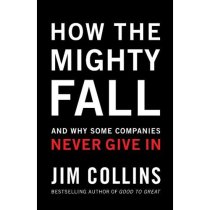
How the Mighty Fall vs. The Black Swan

blackswanI’ve almost finished listening to Nassim Nicholas Taleb’s The Black Swan, a book about how large-impact, hard-to-predict, and rare event beyond the realm of normal expectations. At the same time, Tim O’Reilly caused me to stumble upon this article previewing Jim Collins‘ (author of Good to Great and Built to Last) new book “How the Mighty Fall.”

In some way the two authors’ could not be more different. Taleb writes in a harsh, sarcastic, cutting tone that heaps scorn on many of the worlds finest minds as well as, one senses, the books readers. His harshest barbs are reserved for academics, who if often sees as being to interested in theory to help with real world problems. I’ve never seen Taleb in person or on video, but after listening to The Black Swan I can’t help but see him as an lethal and angry intellectual street fighter, mad at a world that didn’t notice his brilliance earlier.

How the Might FallCollins, in contrast, reads like a classic business academic writer who has gone mainstream. He never offends, and his tone is never harsh – he seems like the archtype westcoast Business school Professor – smart, driven and direct, but slightly geeky in that friendly way and not overly intense (hence westcoast).

But while their styles (and I hypothesize, personalities) are dramatically different, they overlap in some curious and interesting ways. Both are concerned with business issues and both are writing about outliers. Taleb is concerned with the outlying events that can completely alter one’s world. Collins in concerned with outlier companies – those that experience impressive and continuous success. And while I’m sure there are lots of areas where the two will disagree, it is interesting to focus on where the two almost completely overlap.

The first appears where Collins talks about the first symptom of a company going into decline: Hubris Born of Success:

“The best leaders we’ve studied never presume they’ve reached ultimate understanding of all the factors that brought them success. For one thing, they retain a somewhat irrational fear that perhaps their success stems in large part from fortuitous circumstance. Suppose you discount your own success (“We might have been just really lucky/were in the right place at the right time/have been living off momentum/have been operating without serious competition”) and thereby worry incessantly about how to make yourself stronger and better-positioned for the day your good luck runs out. What’s the downside if you’re wrong? Minimal: If you’re wrong, you’ll just be that much stronger by virtue of your disciplined approach. But suppose instead you succumb to hubris and attribute success to your own superior qualities (“We deserve success because we’re so good/so smart/so innovative/so amazing”). What’s the downside if you’re wrong? Significant. You just might find yourself surprised and unprepared when you wake up to discover your vulnerabilities too late.”

This whole paragraph sounds like a friendly version of Taleb. Praising leaders who don’t claim to understand the full complexity of their world, their business or even their own success? Classic Taleb.

More interesting however, is the emphasis on luck. Taleb regularly argues that luck is (at a minimum) underestimated and more often ignored outright, as a factor in a businesses success. No CEO wants to stand up and say, yes, we become $10B dollar company not just because we were good, but because we were lucky – it doesn’t exactly send a positive message to share holders (or does it justify their enormous bonus). But Collins not only agrees that luck is a factor, he argues that good companies admit to themselves that luck was a factor.

In hockey you hear people say you’ve got to be good to be lucky and lucky to be good. The point is, if you work hard, bounces will eventually come your way and you’ve got to be good enough to pounce on them and make those opportunities count. Begin to think you don’t need luck, you stop seeing the opportunities and also begin to believe you are inherently better than anyone. Fact is, you’re not. You’ve got to work. Hard. And hope for some luck. Even then, you probably never become Google.

The second interesting place of overlap is in Collins discussion about how companies begin to deny that they are at risk or in peril.

“Bill Gore, founder of W.L. Gore & Associates, articulated a helpful concept for decision-making and risk-taking, what he called the “waterline” principle. Think of being on a ship, and imagine that any decision gone bad will blow a hole in the side of the ship. If you blow a hole above the waterline (where the ship won’t take on water and possibly sink), you can patch the hole, learn from the experience, and sail on. But if you blow a hole below the waterline, you can find yourself facing gushers of water pouring in, pulling you toward the ocean floor. And if it’s a big enough hole, you might go down really fast, just like some of the financial firm catastrophes of 2008. To be clear, great enterprises do make big bets, but they avoid big bets that could blow holes below the waterline.”

In The Black Swan, Taleb has an entire piece on assessing risk which parallels this quote. He notes that too often business people and – in particular – financial types, focus on predicting the likelihood of an event – even when a prediction model is deeply flawed or essentially meaningless. Since often assessing the likelihood of an event is often impossible Taleb argues it becomes much more important to ascertain the likely magnitude of it’s impact. So avoid doing things or exposing yourself to risks that, if they go wrong, will blow out your hull. Indeed, the Black Swan is essentially a 250 page book on this paragraph.

Why Canada’s public services need faith

As I mentioned the otherday, I recently finished Thomas S. Kuhn’s classic 1962 book “The Structure of Scientific Revolutions.” For those unfamiliar with the text, it is the book that gave us the important and oft over-used term, “paradigm shift.”

Here, in this book about how progress is made in the sciences I was completely floored by this paragraph in penultimate chapter: The Resolution of Revolutions.

…the issue is which paradigm should in the future guide research on problems many of which neither competitor can yet claim to resolve completely. A decision between alternate ways of practicing science is called for, and in the circumstances that decision must be based less on past achievement than on future promise. The man who embraces a new paradigm at an early stage must often do so in defiance of the evidence provided by problem-solving. He must, that is, have faith that the new paradigm will succeed with the many large problems that confront it, knowing only that the old paradigm has failed with a few. A decision of that kind can only be made on faith. (pages 157-158/3rd edition)

This describes precisely how I feel about Public Service Sector Renewal (reforming the public service). When I talk and write about an open and networked government I understand it raises questions around accountability, ministerial responsibility and human resource management. I’m aware that these are “large problems” for which our present structure has some – albeit highly imperfect and I’d argue, quickly eroding – answers.

Moreover it is true, that if we decided on how and if to reform government based solely on the performance of past models then we would always choose the status quo. The corporate hierarchy has served us well. Any new model will appear, relatively speaking, untested. But a growing number of us know that the status quo is unsustainable.

I know that any new system, however slight the change, will bring with it new challenges and questions, but the paralyzing and untenable problems with the current system will ultimately outweigh these unknowns – even in an organization as conservative as the public service. Ultimately, I am saying that a new system can succeed with many large problems confronting it even as the old system has failed only with a few.

So, as odd as it is to admit, I am, in part, acting on faith. Not only that, I believe the public service is going to learn to have faith as well. Why? Because in the end we won’t have a choice – the old problems this system cannot solve will demand it. We will have to change, and that will mean, someone, somewhere in the public service have put their foot forward into the unknown.

Indeed, many already have.

Structure of Scientific Revolutions vs. The Black Swan (Journalism remix)

Structure of Scientific Revolutions CoverI’ve just finished Thomas S. Kuhn’s classic 1962 book “The Structure of Scientific Revolutions.” For those unfamiliar with the title, it is the book that gave us the important and oft over-used term: “paradigm shift.”

I won’t pretend it was an easy to read. Written in a classic academic style, what is a fascinating topic and set of ideas struggles to shine. However, don’t hear me blaming the author for this… it is both that the book comes from another era, and that it springs from a cannon of academic writing that simply doesn’t seek to be as penetrable outside a certain community.

That said, I did enjoy it immensely. One reason is that I once again lucked out and ended up reading it at the same time as another book – Nassim Nicholas Taleb‘s The Black Swan – that despite being on a different topics and written 45 years later, dovetails nicely.

blackswan-199x300Paradigm shifts are black swan events. They can be hard, if not impossible to predict. They can arise because of the appearance of a single unforeseen data point (a black swan in a world where all swans were previously believed to be white) and they overthrow systems that we have become overly, comfortably, complacent and reliant on. Finally, although paradigms shifts are rare, because they force us to see the world in an entirely new way they have a disproportional and possibly even unparalleled, impact.

I often like to refer to Schopenhauer’s three stages of truth: “All truth passes through three stages. First, it is ridiculed. Second, it is violently opposed. Third, it is accepted as being self-evident.”

Both Taleb and Kuhn’s books play on this theme. For Taleb, our problem is that we can’t see or predict the changes in our world. We expect that we can predict them and that they’ll arrive in a nice orderly – or bell curve distributed – manner.

They don’t.

Despite the mental image we have of history (and our lives), history doesn’t crawl. It moves it fits and starts. Oscillating between long steady states and sudden change. We often believe the steady states will last forever, and when change comes we trivialize it and then fight it, until it becomes the new steady state, at which point, we come to believe it was always that way.

This is also Kuhn point. Look at how he sees paradigm shifts as being important for both the science and politics changes:

Political revolutions are inaugurated by a growing sense, often restricted to a segment of the political community, that existing institutions have ceased adequately to meet the problems posed by an environmental that they have in part created. In much the same way, scientific revolutions are inaugurated by growing sense, again restricted to a narrow subdivision of the scientific community, that an existing paradigm has ceased to function adequately in the exploration of an aspect of nature to which that paradigm itself had previously led the way. In both political and scientific development the sense of malfunction that can lead to crisis is prerequisite to revolution…

…The parallel has, however, a second and more profound aspect upon which the significance of the first depends. Political revolutions aim to change political institutions in ways that those institutions themselves prohibit. Their success therefore necessitates the partial relinquishment of one set of institutions in favour of another, and in the interim, society is not fully governed by institutions at all. Initially it is crisis alone that attenuates the role of political institutions as we have already seen it attenuate the role of paradigms. In increasing numbers individuals become increasingly estranged from political life and behave more and more eccentrically within it. Then, as the crisis deepens, many of these individuals commit themselves to some concrete proposal for the reconstruction of society in a new institutional framework. At that point the society is divided into competing camps or parties, one seeking to defend the old institutional constellation, the others seeking to institute some new one. And, once that polarization has occurred, political recourse fails. Because they differ about the institutional matrix with which political change is to be achieved and evaluated, because they acknowledge no supra-institutional framework for the adjudication of revolutionary difference, the parties to a revolutionary conflict must finally resort to the techniques of mass persuasion, often including force. Though revolutions have had a vital role in the evolution of political institutions, that role depends upon their being partially extrapolitical or extrainstitutional events. (Kuhn, Pages 92-93 of the 3rd edition)

If you don’t think the world operates this way, just look as far as the news industry.

When Shirky says revolutions are times when “The old stuff gets broken faster than the new stuff is put in its place” he is paraphrasing Kuhn. Journalism is already dividing into camps, those defending the old, and those seeking to figure out what the “new” will be.

But despite all the discussion, we are still very early on in the debate. How do I know? Because we haven’t even begun to shed the old paradigm? The entire debate about journalism, what it is, how it should be practiced and what makes it good or bad is still being largely being evaluated and adjudicated by the old matrix. When journalism finally gets saved I suspect it will be because it will be, in part, radically redefined – a redefinition affirmed and made possible by the establishment of some new institutions, organizations and/or processes. (That’s what my post on the death of journalist was seeking to do).

So yes, we’ve left the ridiculed phase (that lasted 20 years), but we are still early on in the violently oppose phase. All thos unhappy journalists are angry because they may be the midst of a paradigm shift, and that means much like Newtonian physicists confronting Einstein’s theory of relatively everything, absolutely everything they believed in, fought for, taught and lived. is probably going to get redefined and altered beyond recognition. It will still be there, but it will forever be understood differently.

That’s a scary thought. But it is fun one as well, filled with possibility. Which is why Kuhn and Taleb are fun to read together.

Reforming Government on the Globe & Mail's Wiki

A few months ago John Ibbitson – the Globe and Mail columnist who used to cover Ottawa and now covers Washington, DC – asked me if I’d help edit the 3rd chapter of his new book, Open & Shut.

The chapter, entitled Yes, Mr. President; No, Prime Minister asks why is it that after 8 years of President Bush, President Obama is able to quickly change the direction of government whereas in Canada, newly elected parties often struggle to implement their agenda.

Last week the book was released. As part of the launch process the Globe and Mail created a wiki dedicated to the book’s themes where readers can critic or expand on its ideas and analysis. More interestingly, as readers post to the wiki John will respond to their  ideas, critics and thoughts on a blog hosted by the Globe.

To kick off the wiki on Open Government, John asked me if I would write a short essay answering the following the question:

Federal politicians, and federal public servants, seem increasingly remote and disconnected from the lives of Canadians. Open and Shut maintains that this is because the public service remains closed to outsiders, and because Ottawa has ceded so much power to the provinces. Do we want our federal government to matter more in our lives, and if so, what should we do to give it meaning?

You can see my response, and what I hope will eventually become a growing number of comments on the future of the public service, here.

As an aside, two other sections have been created. One is on Open Politics, which is teed up by John Duffy (political strategist). The other is on Canada/US integration, which is kicked off by Scotty Greenwood (executive Director of the Canadian-American Business Council).

Articles I'm Digesting 24/4/2009

Here are some pieces from around the web that I’ve been digesting this week.

Why the bluster has given way to bland by Patrick Brethour in the Globe and Mail

This excellent article summarizes what I think is the most exciting trend in BC right now – the race for the pragmatic centre in our politics. Those from outside BC often fail to understand its politics (if I’d got a nickel in college for every time I was asked: how can the same people vote for the NDP provincials and The Reform Party federally???). This piece goes some way in explaining the province’s political history to those not from here.

Also of note… despite the claims of some reformers, British Columbia has already experiment with a Single Transferable Vote (STV). In twice in 1952 (the first election generated an unstable government that lasted 9 months) with the Social Credit Party winning out both times. This isn’t to say that we shouldn’t discuss electoral reform, but let us not pretend that it is something untried and completely novel.

Clinton says US shares responsibility for Mexico’s drug violence by By Warren P. Strobel in the Christian Science Monitor

This isn’t a fancy or insightful piece – but it is important. For the first time in memory a senior figure in the US administration has said what everybody has long known, that:

“Our insatiable demand for illegal drugs fuels the drug trade. Our inability to prevent weapons from being illegally smuggled across the border to arm these criminals causes the deaths of police officers, soldiers and civilians,”

The war on drugs is now so deeply a part of the American political way of life I have little hopes of seeing a dramatic shift anytime soon (no matter how good or accurate the movie Traffic was). Nonetheless, this is a critical step. More importantly, it starts the US down a path where discussions around address addiction as well as curbing and managing demand become more plausible strategies.

As many of you know, I’m sadly confident we are never going to “win” the war on drugs and drug violence, especially by curbing supply – indeed, as I wrote the other week, not even the RCMP believes this anymore. This is what makes strategies like Harm Reduction, and places like the Insite injection site so important. They don’t replace policing and prevention, but as the last 40 years have helped demonstrate, progress will be impossible if harm reduction is not part of the mix.

hbus, the transit day tripper by Holly Gordon in The Coast

He’s a great little story about a scrappy programmer in Halifax who is trying to build a parallel – and better – transit route planner on line. Cities should be begging for people like William Lachance – the create of hbus.ca beta – which “scrapes” bus information from the official site and repackages it in a more helpful and useful way. Imagine that – a citizen helping the city deliver a service more effectively!

Sadly, the City of Halifax doesn’t see it that way:

“We can’t give our information out for somebody else to put up and run their own Metro Transit trip planning because we ultimately are accountable for it,” she explains.

This concern is of course, nonsense. By her logic, she should be preventing someone from calling a friend and asking them to look at the bus schedule and telling them when the next bus will come because… well now that friend “controls” the data and not the City of Halifax. This really is 19th century thinking run amok.

Of course ask William what responses he gets and you hear a slightly different answer:

“You get one of two responses,” says Lachance of Metro Transit’s replies to his friend’s—and later his own—requests. “One is just ‘no.’ The other one is that they give you their policy on the dissemination of geographical data, something on the order of ‘give us a lot of money and we’ll give you the information you can basically only use for personal use.'”

While both responses sound different, they are functionally the same. “We, the city, will not give you data your taxes paid to create.” Why? Because we don’t want to, or… because we think we can extract still more money from you. This despite the fact that most local governments actually lose money trying to sell their data. Heavens forbid that actual citizens try to make their city easier to navigate.

The No-Stats All-Star by Michael Lewis in the New York Times Magazine

This is one of these delightfully insightful pieces about how really digging into the numbers can reveal truths that often go unseen. Here is the story of Shane Battier, an NBA player who is relatively unknown and whose basics stats suggest is an ordinary player. And yet… dig a little deeper and it is reveal that when he is playing the stats of players on his team are better, and those of players on opposing teams are worse.

Battier clearly has some basketball styled “soft” skills that make him effective, but that would likely be ignored or remain unseen to the majority of sport’s scouts and observers.

I’ll admit, one reason I really enjoyed this story is that I think there is a little bit of Battier in all of us, and in certain special people around us. There are people in my life who are like Shane Battier, I perform better, react faster, think more clearly, when they are around me. In addition, I’d like to think that there are boards I’m on, people I work with that, while no one can say “yeah, David is excellent at doing that” that nonetheless I help the group work more effectively… Indeed, I often fear this is most of what my professional life is like – that I help everywhere, but in a way that is to hard to pin down in manner that is tangible or recognizable.

Articles I'm digesting 6/2/2009

The Quiet Unravelling of Canadian Democracy by James Travers

This poignant piece by James Travers is long overdue. The concentration of power in the Prime Minister’s Office – which started with Trudeau and has continued with each successive Prime Minister – along with the decline of cabinet and of parliamentary committees, is corroding our governing institutions. Travers sums it all up succinctly and frighteningly.

My sense is that – while no one would articulate it this way – people may be disengaged from politics because we expect so little from our MPs, so little from the system itself. Our governing system has – I believe – been durable because it relies less on hard rules and more on conventions and norms. This has given it flexibility but also demands a certain degree of self-restraint and self-managed code of conduct among its participants.What makes the corrosion hard to point at specifically is that there is rarely a single, specific triggering event – no moment when a “rule” is broken, but rather a slow process where conventions and norms are abandoned. Take the recent Conservative Party tactic of engaging in personal attacks during member statements. No “rules” were broken, but another norm, one that tried to help elevate the level of discussion in the house, was weakened.

I’m less interested in radical changes – such as new ways to elect members – since it is unclear to me why or how these would change things (and the unanticipated consequences are more troubling still). Instead, there are small steps that could have dramatic results. Giving MPs real money for research and policy staff (like their counterparts in the US) would be one area where I think a small change could – over time – shift some (admittedly not all) power back to MPs. But in the mean time let us get better aware of the problem – so if you can, take a look at Travers piece.

Einstein, Franklin, and the Role of Creativity in Today’s World” (a lecture) by Walter Isaacson (via David B)

After listening to this beautiful lecture Saturday morning I realized that I’d read (or listened to, to be precise) Isaacson’s book Benjamin Franklin: An American Life. The lecture tries to tease out what made Einstein and Franklin great men – it wasn’t enough that they were intelligent (lots of people are intelligent) but what is it that made them creative? In short, it is to do what is important to you and to maintain the capacity to challenge – to be intolerant of assumptions, institutional inertia and lazy thinking – while remaining hyper-tolerant of others, their thinking and their perspectives.

If you don’t have the patience to listen to the whole talk (which is 44 minutes, there are 25 minutes of Q&A) then consider fast forwarding to the 37th minute of talk where he talks of both men’s final moments. The way they are at humble, aware of their sins and successes, inspiring to those around them but, most of all, consistently dedicated to the values and tasks they love, well, honestly, it left me teary. Consider Franklin’s funeral in 1790 where:

“All 35 Ministers, Preachers and Priests of Philadelphia link arms with the Rabbi of the Jews to march with him to the grave. It is that type of creativity of tolerance, of looking for new ways of doing things that they were fighting for back in Franklin’s time and I really do think that’s a struggle we are fighting for both at home and in the world today.”

The lecture reminded me of why Isaacson’s book transformed Franklin into a hero to me.

The Quiet Coup by Simon Johnson

This article has been circulating around for a couple of weeks now and it is the most damning admonition of both the financial collapse and both Bush’s and Obama’s response that I have read.

But there’s a deeper and more disturbing similarity [between the US and the financial collapses in South Korea, Malaysia, Russia and Argentina]: elite business interests—financiers, in the case of the U.S.—played a central role in creating the crisis, making ever-larger gambles, with the implicit backing of the government, until the inevitable collapse. More alarming, they are now using their influence to prevent precisely the sorts of reforms that are needed, and fast, to pull the economy out of its nosedive. The government seems helpless, or unwilling, to act against them.

It gets worse.

But these various policies—lightweight regulation, cheap money, the unwritten Chinese-American economic alliance, the promotion of homeownership—had something in common. Even though some are traditionally associated with Democrats and some with Republicans, they all benefited the financial sector. Policy changes that might have forestalled the crisis but would have limited the financial sector’s profits—such as Brooksley Born’s now-famous attempts to regulate credit-default swaps at the Commodity Futures Trading Commission, in 1998—were ignored or swept aside.

The biggest danger? The crises gets somewhat resolved… and nothing changes. This is why I’m such a big fan of Umair Haque’s blog.

Is Charest ready to pounce? by Rheal Seguin

A while back I predicted that, after the Conservatives bungled the budget and the coalition was struck that Layton, Dion and Harper would all lose their jobs before the end of 2009. I stand by the claim (and now have money riding on it with some good people out there). It would appear that the press is increasingly smelling blood in the water around Harper…

The creative age, the budget and the future of class conflict

Yesterday the Martin Prosperity Institute released its report Ontario in the Creative Age. I’ve been reading through it with great, great interest. The influence of Rise of the Creative Class and Who’s Your City is obvious (and expected) and the report is an important and fantastic read. Regardless of whether or not you live in the GTA/Ontario, I highly recommend it. Indeed, I would love to see the Province of British Columbia and the Metro Vancouver commission a similar report. I can imagine the methodology is now in place to do one relatively quickly, and it is urgently needed on the west coast. (Can anyone point to an economic development plan for the Greater Vancouver Area? For the City of Vancouver?)

The report also plays on a theme that has interested me for a while now. The nature of class conflict in networked and creative economy. The report tackles the issue more directly than anything else I’ve seen by Florida to date. This line from the report is illustrative:

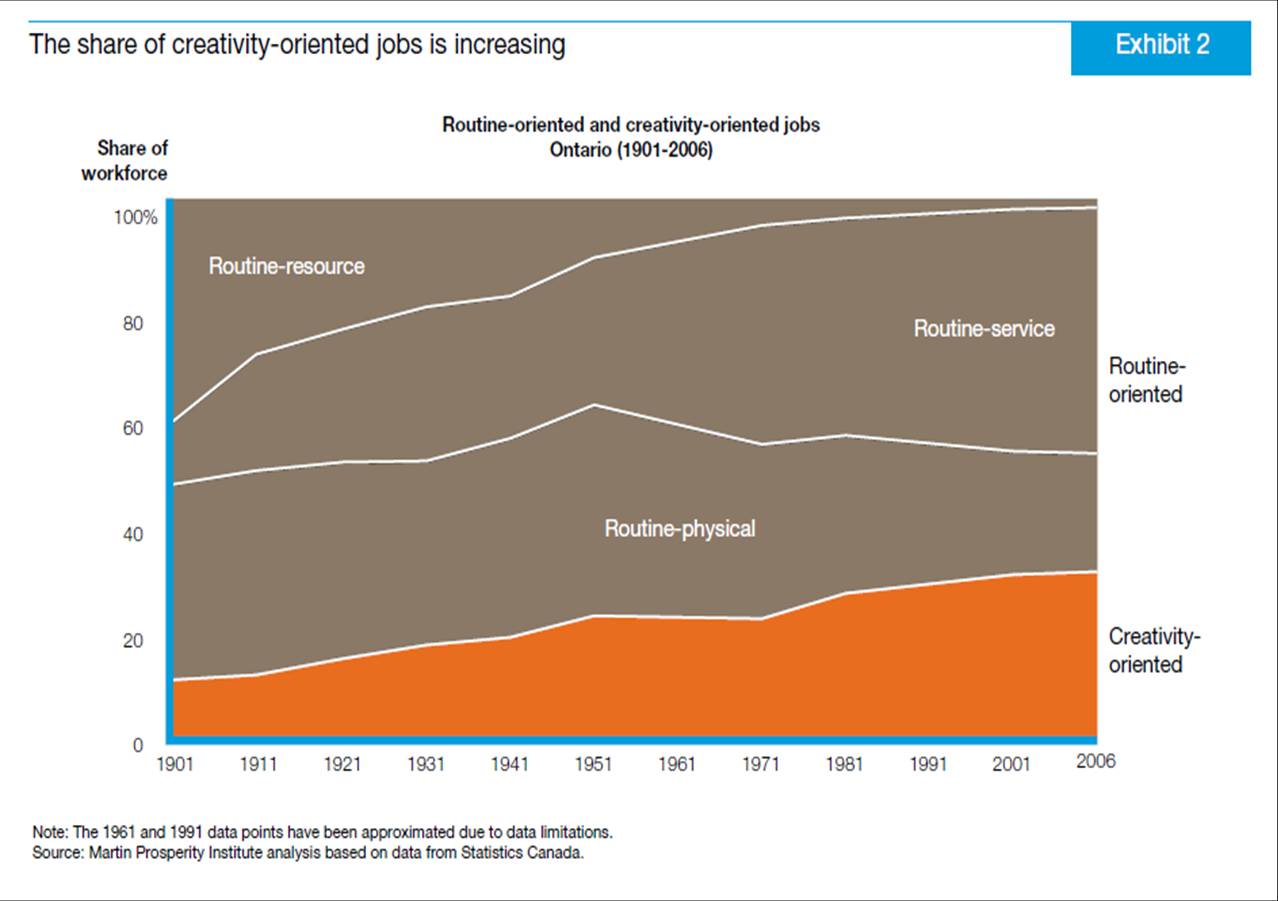
The rise of creativity is a double-edged sword. It creates tremendous wealth creation opportunities for some. Yet it can leave many behind – particularly those in jobs built on routine, and those who do not have the opportunity to gain the skills to participate advantageously in the economic transformation we are going through.

Still more interesting are the trends:
class conflict

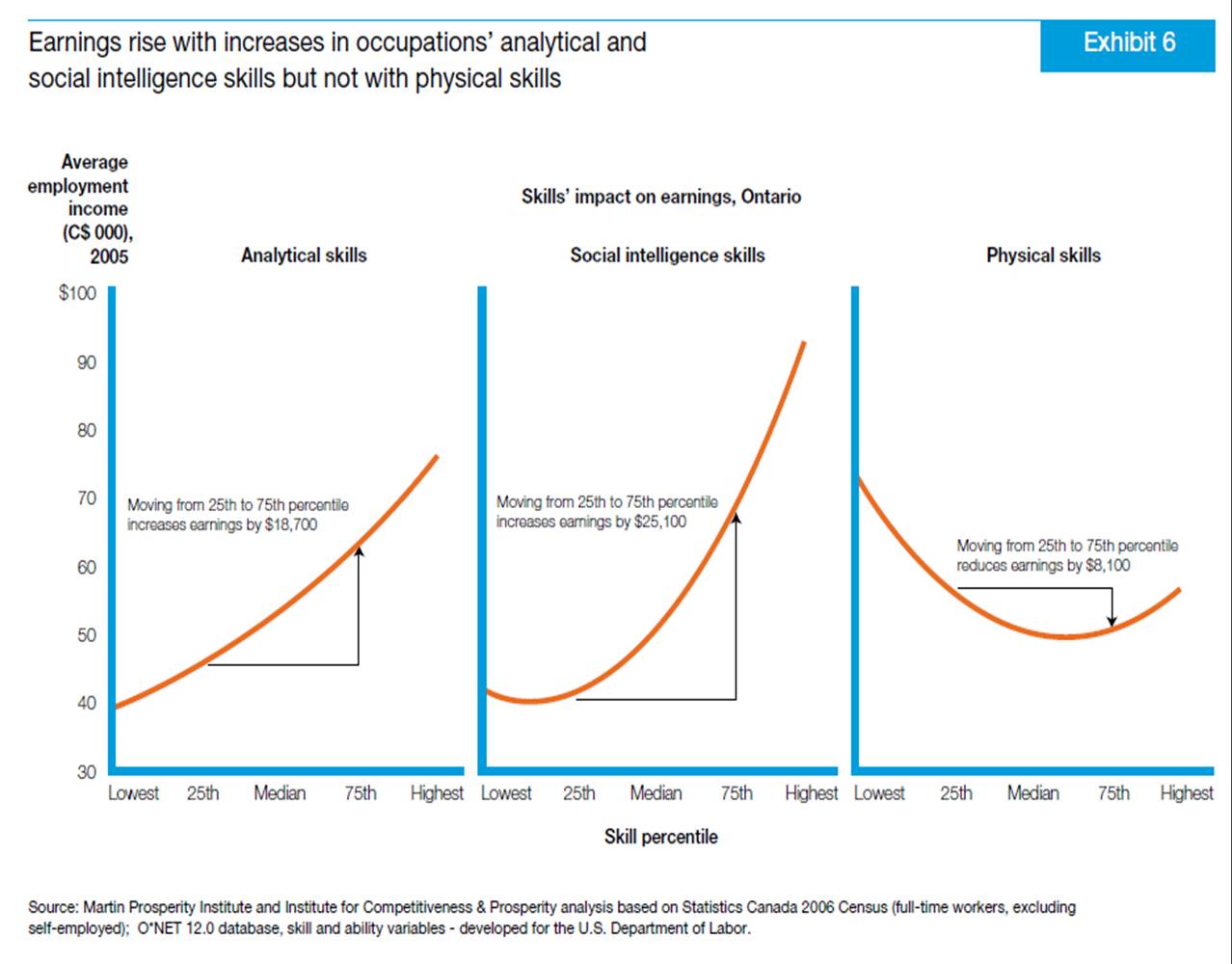
Combine this chart with there second chart that shows how wages grow depending on skill sets (no prizes for figuring out the Routine-physical-oriented jobs correlate with Physical Skills and that Social intelligence skills correlate with Creativity-Oriented jobs).

class wages

It is easy to see that the possibility of tension between routine-oriented and creativity-oriented workers could grow, especially as wage differences continue to increase.

Perhaps the most depressing conclusion to draw from this report is that the stimulus package will do little to address this inequity. A lot items that get funding in such packages (for example, some shovel ready projects) not only generate only temporary growth, but many of the jobs they foster are both becoming fewer – so we are encouraging job growth in shrinking job markets – and have a declining return on investment – so we are encouraging the development of skill-sets in workers that will not increase wages. Consequently, the very actions that traditionally might have helped stave of wage inequality (and in turn class conflict) may actually me exasperating the future likelihood of such inequality.

It’s hard to sell funding for R&D and research as these are often seen as “elite” activities, but interestingly they may offer us the greatest hope in reducing future tension and inequality. Sadly, research, science and education received little attention in the budget.

Articles I'm digesting at the moment

While I keep track of the books I’m reading to the right I don’t often get to talk about the articles I’m reading and loving. Here are a few I’ve stumbled over in the past week that I’m still digesting.

1) Via Mike T, Obama and the dawn of the Fourth Republic by Michael Lind on the cycles of American progress and why the next 36 years are going to be very exciting.

During the first 36-year period of a republic, ambitious nation-builders in the tradition of Alexander Hamilton strengthen the powers of the federal government and promote economic modernization. During the second 36-year phase of a republic, there is a Jeffersonian backlash, in favor of small government, small business and an older way of life. During the backlash era, Jeffersonians manage to modify, but never undo, the structure created by the Hamiltonians in the previous era.

2) Via Alo, Why Canada has to wait for it’s Obama Moment, by Jeff Roberts. A piece few Canadians would be willing to write about why the politics of Aboriginals and the rest of Canada remain separated.

In the case of black Americans, their ascension to the political mainstream came in part from leaving behind talk of rights and identity and embracing a postracial style of politics. Barack Obama’s rise has followed his willingness to move away from the swamp of identity politics.

It’s a thesis that parallels that of Calvin Helin’s in Dances with Dependency that I thoroughly enjoyed. Moreover, Roberts is only half right. There is an emerging generation of (particularly urban) First Nations who are going to transform the politics of both the First Nations community and Canada.

3) Via Jeff A, Printing The NYT Costs Twice As Much As Sending Every Subscriber A Free Kindle by Nicholas Carlson . Shocked? You should be. As the author concludes:

Are we trying to say the the New York Times should force all its print subscribers onto the Kindle or else? No. That would kill ad revenues and also, not everyone loves the Kindle.

What we’re trying to say is that as a technology for delivering the news, newsprint isn’t just expensive and inefficient; it’s laughably so.

Besides, think of the forests that would be saved.

4) Via Amy L, The $300 Million Dollar Button, by Jared Spool. As Amy said to me, “you’re a believer in small changes” which I am. Very often I find people jump for the big lever to create big change which often creates numerous unanticipated (and almost always unwanted) changes. I’m much more interested in finding the small lever that creates big change. This piece is about precisely one of those moments in the design of a webpage.

It’s hard to imagine a form that could be simpler: two fields, two buttons, and one link. Yet, it turns out this form was preventing customers from purchasing products from a major e-commerce site, to the tune of $300,000,000 a year. What was even worse: the designers of the site had no clue there was even a problem.