Category Archives: united states

Fatness Index – Canada vs. United States

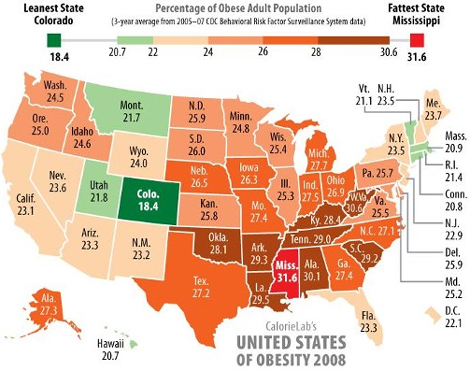
Yesterday I noticed that Richard Florida and Andrew Sullivan re-posted a map (created by calorielab) that color coded US states by the percentage of the population that was obese. I wondered if a similar map existed for Canada. Although there are several that highlight obesity – such as this one and this one – none are quite like this one. More importantly, none allowed for an easy and direct comparison between the two countries.

So I’ve taken the calorielab map, remade it, and extend it to all of North America by applying its criteria to Canadian provinces (and by using some Statistics Canada figures found here). The result is a “green armband” (of relative health) stretching across the continent.

Obese Map of NA 2

If Canadian provinces were ranked along side US States, they would rank 1st (BC), 2nd (QC), 3rd (ON), 4th (AB) and tied for 5th (MB) (YK) as the least obese provinces/states. Colorado would be the first American state placing 7th, with the provinces of NS in 8th and SK in 9th. PEI and NB would appear 15th and 16th and NFLD would appear 19th. NWT and NU would close out in 30th and 31st position. You can see the original chart at the bottom of this page.

Actually even some of the grimmer looking patches of Canada’s map have a silver lining. The Arctic Territories, specifically Nunavut (NU) and the North-West Territories (NWT), appear obese and thus unhealthy. However, Statistics Canada notes that obesity criterion for Inuit populations should be more relaxed since a high BMI does not appear to have the same health risk for Inuit as for non-Inuit. Interesting, eh?

And here is the original map I’m riffing off of…

obesitystates


Firefox 3 pledge map vs. the Pentagon’s new map

What are the geopolitics of open source? To find out I thought it would be interested to see how Thomas Barnett’s map meshed with the Spread Mozilla Firefox 3 download pledge map.

Some brief background for those not familiar with “The Pentagon’s New Map.” It is a map that sits at the heart of a book of the same title written a few years ago by Barnett. It is a compelling take on what America’s grand strategy should be for the 21st century and how it is, and more importantly isn’t, ready to execute on it. Better yet, it is engaging, thought provoking, interesting, and written so anyone can read and understand it.

The core of the book’s thesis (remixed from Wikipedia and very high level) is as follows:

  1. International systems of rules reduce the likelihood of violent conflict (e.g., the WTO Dispute Settlement Understanding)
  2. The world is divided between the Functioning Core and the Non-Integrated Gap.
    Function Core = economic interdependence, incented to abide by rules
    Non-Integrated Gap = unstable leadership and absence of international trade, weaker incentives
  3. Integration of the Gap into the global economy provides opportunities for individuals to improve their lives, presenting a desirable alternative to violence and terrorism
  4. US grand strategy for the 21st century… help countries migrate from the Non-Integrated Gap into the Functioning Core

According to Barnett’s thesis, countries in the Non-integrated Gap, because they are less connected, should probably have fewer computer users, fewer people downloading software and fewer people participating in Open-Source projects. Mashing up his map with the Firefox pledge map might give us some a clue to how well open-source conforms to his thesis.

(Note, I’ve remixed Barnett’s map to make it is easier to read on a computer with the Function Core countries in green and the Non-Integrated Gap countries in red . You can find the original map here.

PNM remixed

Below is the spread Firefox pledge map, which tracks how many people around the world have pledged to download Firefox on its release day (June 17th). I’ve overlaid the Non-Integrated Gap/Function Core border over it.

firefox PNM mash up

Some comments/thoughts:

  • Interesting correlation between low pledge totals and Non-Integrated Gap countries
  • All but two Non-Integrated Gap countries (Colombia & Turkey) have 10,000 download pledges or fewer. (I also think it is interesting that Barnett doesn’t include Turkey in the Functioning Core…)
  • Most countries within the Functioning Core have 10,000 pledges or greater (South Africa, Nordic Countries and the Baltic States are notable exceptions)
  • Non-Integrated Gap countries with the most pledges are Iran, Turkey, Venezuela, Peru, and Indonesia – interesting list. Seems to suggest that many of the countries the US tries to isolate are actually the most connected.
  • According to my Mozilla friends Poland (yes, Poland) was the first to hit the 100K pledge mark. Many new Core countries are adopting Open Source en mass to avoid paying for expensive Microsoft software. Open source may be offering them a cheap way to increase connectivity and integrate with the core faster, and on their terms. Fantastic outcome.
  • This map DOES NOT account for population variation – would be fascinating to see a map based on per capita pledges (I’ve contacted my friends at Mozilla and they’ve passed the raw data along to me so I will follow up with that analysis ASAP)
  • I will try to update the map with the final data on download day (June 17th) when all the pledges have been tallied
  • Note: Firefox pledge map copied on June 15th, 2008, 8:30 pm PST

Lots more thoughts and analysis to be done on this. I hope to blog more on this shortly. If Barnett responds in any way I promise to update – would love to hear his thoughts/reflections on this.

(One final aside, if you get the chance to see Barnett present, do so. He’s up there with Lessig in his delivery. I remember seeing him at a conference. He went long by 10 minutes. The US ambassador to Canada was in the next room waiting to give the next presentation but if any of the organizers had tried to intervene and hurry Barnett up, they would have been lynched. FYI, You can see his TED talk here.)

Why does Kinsella support Obama?

So I’ve just finished Kinsella’s new book – The War Room – which I thoroughly enjoyed, but not for the reasons I thought I would (more on that in another post).

I find it interesting that Kinsella is an Obama fan, and that he’s been one since early on (e.g. long before Hillary went off the deep end and her campaign started imploding). After finishing his book I was even more surprised. Here’s why:

First – Kinsella’s fighter:

Kinsella is the ultimate Canadian political fighter (second to Chretien, I’m sure he’d add). As his book testifies, he’s unafraid to pull out the brass knuckles and pummel his opponent. But which Presidential aspirant does that sounds like? Who talks about beating up Republicans, of the dangers of ones political opponents? No one is more partisan, nor more of a scrapper, than Hillary. She’s practically remolded her campaign around the notion that she is a “fighter.”

It doesn’t stop there though. Not only is Kinsella a fighter, he’s also not a believer in any type of “new politics” – such as that advocated by Obama. In his book’s intro he states (page 27):

“So they [politicians] will make soothing noises about the need to “do politics differently” and to avoid “the old politics” (or what has been called “the politics of personal destruction”). They make these disclaimers because they know it is what the voting public wants to hear (even if it isn’t what the voting public necessairly believes, but more on that later). Watching them, you would think such politicos would seldom utter a discouraging word about anyone.
But that is a pile of crap.”

Given that Obama talks regularly of how people are tired of the politics of division, does Kinsella think this is all a clever ruse?  Either way, I’d have put him squarely in the Hillary camp (on a philosophical level at least).

Second – her war room runs like his war room:

To my (untrained and unsophisticated) eye, Obama campaign conducts itself in manner counter to the approaches Kinsella argues for in his book. This is in contrast to the Clinton war room, which hits back hard and fast at any opportunity.

(I’d love to hear Kinsella’s take on the Obama war room – I’m pretty sure my blog will never get on his radar but with luck he’ll blog about the democrates respective war rooms). For example on page 90 Kinsella shares the rule “Leave No Charge Unanswered:”

Any critical statement offered up by a reporter or the other side, no matter how imbecilic or nonsensical it may seem at first blush, must be taken seriously, and pronto. If the charge appears to be getting ready to blast off into the political stratosphere, fight back.

Again, unlike the Clinton campaign, the Obama campaign appears to ignore this rule on some occasions. On numerous points through out this campaign the Hillary camp has claimed to have won the popular vote, the states that count, and criticaldemographics. Often, the Obama camp does not seem to hit back, or at least hit back hard. (This strategy frustrated me enormously a few months ago) Indeed, on occasion they’ve been near silent – especially on the charge that Hillary has won the popular vote. There is rarely a counter-quote from the Obama campaign team in articles about Hillary making this claim (especially on CNN).

Finally – Legitimate Policy differences:

While there are few legitimate policy differences between Hillary and Obama, one area where people are concerned there might be differences is over Israel and Middle East policies. In his book Kinsella self-identifies himself as a ZIonist… and if any candidate can be defined as pro-Israel it is Hillary Clinton. Indeed, this one part of the Democratic Party that Obama has been working hard to assuage.

That, and the fact the (like me) Kinsella is a huge fan of Carville and Bill Clinton (and unlike me, Begala) I would have landed Kinsella squarely in the Hillary camp.

In sum:

Obviously, these are only 3 of thousands of reasons why anyone might choose to support one of the nominees. As an Obama supporter I’m pretty pleased that Kinsella is a fan as well. It’s just that his book has left me more puzzled, not less, about why he’s a supporter. I’d be interested to know what Kinsella thinks the Obama campaign has done effectively, and what it has done poorly, and if he thinks Obama is going to redefine politics, or if he’s a just a brilliant new spin on an old theme.

It's over

So over at Oxblog Taylor’s posted the video of news coveraga I wish I’d seen last night CNN.

Stick a fork in it, it is over. Barack Obama is the candidate. The only question is how long before Hilary is aware of it and how much of her personal fortune will she need to burn before figuring it out.

These are dangerous waters for the democrats… everyone is tired, weary, on edge, and of course emotions are frayed. The real question is… will Hilary demand the VP slot?

I’d guess more, but I’ve got to run for a flight to Ottawa. Next two weeks will be intense, I promise to blog about my travels to Johannesburg.

The Border: Something there is that doesn't love a wall…

It would appear that even the Americans are beginning to notice that a tighter border is a drag on everyone.

My suspicion… that once the current president is gone, some of the more stricter proposals (such as the neccessity of a passport when crossing by land, may be dropped. At the very least there is a window of opportunity come January 2009. I hope the department of foreign affairs has its briefs ready for the new administration and is corralling northern governors and senators, getting them ready to jump into the fray in support of the cause.

Young, left and voting

As we all know young people don’t vote. That’s why these charts shouldn’t surprise anyone… right?

(These charts are stolen from the New Politics Institute).

But don’t worry, You may soon be able to retreat to the old stereotype of the apathetic young voter since Hillary Clinton is doing everything she can to turn this new generation of democrats off of politics all together.

Primary (racial) colours conflict on CNN

First off, I did not see this one coming. The editorial page of the NYT endorsed Clinton and so this piece is a serious slap on the wrist.

CNN’s pro-Clinton coverage continued in full steam last night. What is most interesting however is how the coverage broke down racially.

Below are statements from a piece called “The Clinton campaign: What’s Next?” and “The Obama Campaign: What’s next?” I haven’t included all the comments but two of the commentators included below are white, and two are African-American. Can you guess who made which statements?

“At some point, facts are stubborn things. Sen. Obama has extraordinary talent. He took 35,000 people to a rally in a primary. He spent $11 million on advertising. That’s 9,950 ads… ad he lost… he ran against a candidate who has been hammered and pounded and yet she won. I think these things do matter, and they may matter to superdelegates.”

“I think its’ been a key test for Barack Obama to not only withstand these attacks, but to weather the storm. And clearly tonight, if you look at the margin, he’s weathered the storm. He’s weathered the attacks on his former pastor. He’s weathered the storm on the statements he made in San Francisco.”

“He was closing in on Clinton in Pennsylvania. he was getting down to three, four, five points in some of the polls… I think what [Clinton’s larger win] suggests is that as he was closing, not only did he stall, but he actually ot hirt in the white community by these controversies.”

“If you look at the numbers, the question is, how can she expand her base? She can’t. So in order to go after [Obama], you’ve got to cut him up. You got to cut him down, drive up his negatives. They don’t care if her negatives go even higher. They have to win.”

Indeed, was what fascinating was how much the racial divide was reflected in the coverage last night. I would love to be a fly on the wall in the CNN studio after the camera’s are shut off, I’m wondering how much of all this is show, and how much of it is getting very personal on the CNN stage.

What happened to Ibbitson?

The Globe’s John Ibbitson has always been one of my favourite columnists – Paul Wells may capture the politics of Ottawa best, but Ibbitson got and wrote most effectively on the issues, challenges and tensions that drove public policy in the capital. For a policy junkies like myself his Globe column was a daily must read.

This is why I’ve been unsure how to approach his coverage of the US primaries.

Firstly, and very much forgivable, he read the whole thing wrong when, back in October he pronounced that:

No, we’re not declaring that the New York senator has as good as won the 2008 presidential election. Anything can happen in politics, and anything usually does. But Ms. Clinton is the leading candidate, in both the Democratic and the Republican campaigns: Her own nomination is virtually assured… (Italics mine)

As stated above, many people believed that Obama would never go anywhere (except, of course, us Obama fans – in part out of blind faith and in part out of a belief that because many independents view Hillary as unelectable democrats would not easily nominate her).

But more recently there have been stories that haven’t jived with what I’ve been reading in the US papers. Take for example, yesterday’s article entitled Can his money trump her machine in the most expensive primary yet?. Which, I believe, misrepresents the dynamics of the race. The best example of this is in the 4th paragraph:

It all comes down to organization. Who can get out more of their vote? The answer reveals a simple but profound difference between the Obama and Clinton campaigns. In Pennsylvania, as elsewhere, he has the money; she has the machine. (my italics)

The analysis is correct – the machine often matters more than money – the problem is that few American commentaries agree with that assessment. From everything I’ve read in the US press the broad consensus is that Obama’s machine has been more effective and better organized (according to Time Magazine, The International Herald Tribune, The New York Times, as well as Chris Tucker and Chris Matthews of MSNBC. Indeed, the one exception to this is New Hampshire where pretty much everyone agreed Clinton had a better organization.)

Obama’s superior organization accounts for why he’s dominated the caucuses (where organization matters most) and why, earlier on in the primary season, when Hillary had the money, he was still able to compete. Things may have shifted and Hillary may now have the superior machine, but I’ve not read that elsewhere. She clearly does have deeper roots into the party – but this is a different matter and not the same thing as an organization. (Interestingly, one reason her machine may be weak is that she may have counted on her party connections and a media blitz funded by her initial financial advantage to enable her to crush her opponents quickly, causing her to underinvest in a national organization.)

Clinton’s lead in Pennsylvania has far more to do with the fact that it simply has more voters she appeals to: white, middle-aged and baby boomer, blue collar workers. If anything, Pennsylvania was designed for Clinton (just like North Carolina is designed for Obama). The problem is, she may only barely beat him in Pennsylvania, whereas he’ll thump her in North Carolina.

Which brings us to the final part of this piece – don’t expect Clinton to move on, even with a win. Machines may matter more than money, but you’ve got to at least have some dough. If Clinton doesn’t win big in Pennsylvania, she may (but may not!) hobble into Indiana and North Carolina. Either way she simply won’t have the resources to go beyond that barring some catastrophic failure on the part of the Obama campaign.

This campaign is probably over. All Obama has to do is sit back and be quiet. Above all, don’t say a word about Clinton – if he’s seen to be trying to muscle her out he’ll look bad. Let her either get there on her own, or let the party establishment do the work for him. I’m hoping Ibbitson’s next column is about Obama vs. McCain!

Clinton can't have it both ways on democracy and delegates

So Hillary Clinton has spent the last 3 months talking about how Michigan and Florida should be seated because”their votes should count.” It is important that these states, and their voters, be represented at the convention in Denver.

Now she’s arguing that pledged delegates – those delegates that were allocated by the outcomes of the caucuses and primaries – are not bound to abide by the election results that earned them their seat at the convention.

“Every delegate with very few exceptions is free to make up his or her mind however they choose,” Clinton told Time’s Mark Halperin in an interview published Wednesday.

So just to make sure we get this straight: it is important that democracy happen – especially in Florida and Michigan – but it is okay if the elected delegates violate that democratic process by not voting for the candidate they were elected to vote for. And this is democratic because…

…it isn’t.

For Canadians this simple translation is this: Clinton wants to encourage delegates to be like David Emerson. To get elected for supporting one party/candidate and then to switch sides immediately following the election. It is appalling position and undermines the very notion of democracy. While her concern over the Michigan and Florida delegates was never genuine (just look at her remarks back in New Hampshire and Iowa) this only serves to further confirm what many of us fear – Clinton is willing to trade in any principle in order to win. It’s hard to be inspired by that.

change congress

Creative commons founder and personal hero, Lawrence Lessig, has founded Change Congress, his first step in what he plans to make a 10 year mission to improve the state of American democracy.

It true Lessig fashion the goal is big and the plan is simple. He’s focusing on four changes:

  1. No money from lobbyists or PACs
  2. Vote to end earmarks
  3. Support publicly-financed campaigns
  4. Support reform to increase Congressional transparency

upon which there is more written about here.

Am I excited about the potential? Absolutely. Something is happening in the United States right now. A progressive backlash is brewing.

Change Congress

My only cause for concern is that, like previous reform efforts, we don’t succumb to the law of unintended consequences. I remember reading how making congress members committee votes public was intended to make congress more “transparent.”  It did. By by doing so it empowered lobbyists to ensure the members they gave money to actually voted the way they were paid to – in effect tightening this groups control on congress. While I believe transparency to be a good thing, this outcome could hardly be described as progressive in its impact.

I’m no expert on the machinations of congress, but we should always ask ourselves what will happen to the money once we close off one tap. For example, of the 4 priorities above, the end of earmarks raises some possible concerns. It will probably mean that the US public service will have more control over the specific allocation of monies. This could be good thing. But then perhaps not. The US public service is not as independent as it is say, here in Canada, and so this may simply enable the administration to assert more control on who ends up receiving money. Rather than an end to pork barreling, it will simply shift who controls the pork from congress to presidential appointees…